
Office of Science and Technology Policy Blog
U.S., China Extend Science and Technology Agreement
Posted by on January 19, 2011 at 4:05 PM EDTToday, in the ornate Secretary of War Room in the Eisenhower Executive Office Building next door to the White House, OSTP Director John P. Holdren and the Minister of Science and Technology for the People’s Republic of China, Wan Gang, took pens to paper and signed an historic extension to the U.S.-China Agreement on Cooperation in Science and Technology. The newly extended agreement will foster a continuation of decades of cooperative endeavors that have encompassed such domains as agricultural science, high-energy physics, clean energy, and biomedical research.
The symbolism of signing the accord for peaceful collaboration in a room once used to plan wars was apt, Dr. Holdren said, noting that the Science and Technology Agreement was the first bilateral accord signed by the two countries after relations were normalized in 1979. In that year, U.S. President Jimmy Carter sat down with Chinese Premier Deng Xiaoping and agreed that the realms of science and engineering provided a natural common ground upon which the two nations could build mutual trust and broader bilateral relations.
In the 32 years since that agreement was signed, an enormous amount of scientific and technological collaboration has been achieved—some of it accomplished by Dr. Holdren and Minister Wan, who as academics in the early 2000s worked together from their respective universities, Harvard and Tongji. In those days, Wan said at today’s ceremony, the two never imagined that years later they would be serving as science and technology advisors to the presidents of their two countries, and signing a formal agreement to extend decades of progress well into the 21st Century.
Some of the many shared achievements cultivated by the original Agreement can be seen here.
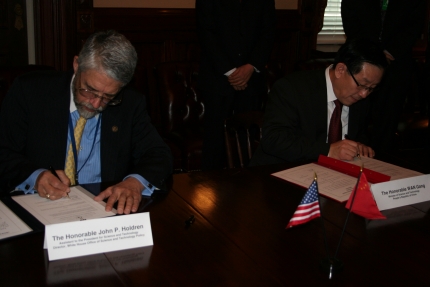
OSTP Director John P. Holdren and the Minister of Science and Technology for the People’s Republic of China Wan Gang sign an historic extension to the U.S.-China Agreement on Cooperation in Science and Technology on January 19, 2011.

OSTP Director John P. Holdren and the Minister of Science and Technology for the People’s Republic of China Wan Gang hold a photograph of U.S. President Jimmy Carter and Chinese Premier Deng Xiaoping signing the original U.S.-China Agreement on Cooperation in Science and Technology in 1979.
Learn more about Civil Rights, , Foreign PolicyStudent Volunteer Application Deadline Extended
Posted by on January 7, 2011 at 2:35 PM EDTWant to assist OSTP staff on exciting policy issues in the many domains that involve science and technology? If so, take note: You now have a few additional weeks because we are extending the application deadline for this summer from January 14 to January 31. Click here to read about the program or here for details on applying. Use these extra few weeks to sharpen your writing sample or resume, or if you are confident with your application, send it in early!
Learn more about TechnologySetting Standards: We Want to Hear From You
Posted by on January 7, 2011 at 11:29 AM EDTThis week President Obama signed the America COMPETES Act, which supports an array of strategies for maintaining America’s leadership in science and technology. Among the Act’s important provisions is one encouraging the National Institute of Standards and Technology (NIST) to expand upon its work with the private sector to develop new standards for a range of vital industries such as emergency communications and tracking, green manufacturing, high performance green building construction, and cloud computing.
Technical standards are not the stuff of everyday conversation, but they are crucial to smart development and economic growth. Whether the goal is reducing health care costs, building a clean energy economy, or defending our Nation, standards are essential to ensuring efficiency, economy, and interoperability. And historically, no one has done it better than the United States.
Since World War II, the United States has played a key role in international standardization—a role made possible by the unique public-private sector cooperation that has been a hallmark of the U.S. standardization system. Through this system, the private sector has largely led the way, with the Federal government engaging as both producer and consumer and with representatives from science and technology agencies often contributing to the standards development process through memberships on technical committees.
The fresh focus on standards in COMPETES—highlighted in part by the creation of the new position of Under Secretary of Commerce for Standards and Technology—follows a series of important steps already taken by this Administration. Last year, for example, the National Science and Technology Council—a Cabinet-level interagency council—established a Subcommittee on Standards. This Subcommittee brings together senior government officials to raise the profile of standards among Federal government leaders and improve Federal agency coordination on standards issues.
Last November we followed up by blogging about the importance of voluntary consensus standards, especially in key growth sectors of the economy such as the smart grid and healthcare IT. Increasingly, Federal agencies such as the Department of Energy, NIST, and the Department of Health and Human Services are collaborating with entrepreneurs and others in the private sector to develop interoperability standards that will drive economic growth, innovation, and jobs.
Most recently, the NSTC Subcommittee on Standards issued a Federal Register Notice seeking input from the public on the effectiveness of Federal agencies in the development and implementation of standards. The subcommittee is seeking answers to such questions as: How is the Federal government doing with respect to standards activities? What works well? What can be improved? We want to hear from you. We encourage you to look at the Notice and send responses to SOS_RFI@nist.gov.
The challenges of the 21st century, including the need to build a clean energy economy, reduce the high cost of health care, and secure our information technology systems, require that we actively consider ways to enhance the efficiency and responsiveness of the standards development process. Working together with our private-sector partners on a foundation of smart standards, we will build the industries and jobs of the future.
Aneesh Chopra is the U.S. Chief Technology Officer
Patrick Gallagher is the Under Secretary of Commerce for Standards and Technology
Learn more about Civil Rights, TechnologyCOMPETES Passage Keeps America's Leadership on Target
Posted by on January 5, 2011 at 12:27 PM EDT[Ed. Note: President Obama signed America COMPETES yesterday, signifying his commitment to maintaining America’s place as a leader in innovation and ingenuity. Also, in December, the President signed a two-year retroactive extension of the Research and Development tax credit through 2011, providing important incentives for companies to invest in America’s future. The blog below—originally posted December 21, 2010—from John Holdren, the President’s science and technology advisor, lays out the significance of America COMPETES to the future of our Nation’s competitiveness.]
The bipartisan passage of the America COMPETES Act represents a major milestone on this Nation’s path to building an innovation economy for the 21st century—an economy that harnesses the scientific and technological ingenuity that has long been at the core of America’s prosperity and applies that creative force to some of the biggest challenges we face today. Whether it’s developing new products that will be manufactured in America, or getting and using energy more sustainably, or improving health care with better therapies and better use of information technology, or providing better protection for our troops abroad and our citizens at home, innovation will be key to our success. And that is exactly what the COMPETES Act is all about.
Passage of the Act comes at a crucial time in our Nation’s economic and technological trajectory—a time that President Obama characterized last month as a “Sputnik moment.” Just as Americans in 1957 quickly grasped the significance of the Soviet Union’s historic launch of the world’s first artificial satellite—responding aggressively with new investments in research and development (R&D) and science, technology, engineering, and mathematics (STEM) education—Americans today are recognizing that we are once again on the brink of a new world. The decisions we make today about how we invest in R&D, education, innovation, and competitiveness will profoundly influence our Nation’s economic vitality, global stature, and national security tomorrow.
COMPETES keeps America on a path of leadership in an ever more competitive world. It authorizes the continued growth of the budgets of three key agencies that are incubating and generating the breakthroughs of tomorrow—the Department of Energy’s Office of Science, the laboratories of the National Institute of Standards and Technology, and the National Science Foundation. COMPETES also bolsters this Administration’s already groundbreaking activities to enhance STEM education—to raise American students from the middle to the top of the pack and to make sure we are training the next generation of innovative thinkers and doers.
COMPETES authorizes ongoing support for ARPA-E, the novel energy-research program modeled after the Defense Advanced Research Projects Agency which promises to give rise to “leapfrog” technologies that will reduce our dependence on foreign energy sources and stimulate a green economy while producing steady, high-quality jobs of the future.
And in a great boost for the cause of generating novel solutions to tough national problems, COMPETES gives every department and agency the authority to conduct prize competitions. Prizes and challenges have an excellent track record of accelerating problem-solving by tapping America’s top talent and best expertise wherever it may lie. The Administration has supported this approach as part of its all-hands-on-deck approach to stimulating innovation, and under COMPETES we can expect a further blossoming of new ideas from citizen solvers across the land.
It is heartening that Congress today recognized that the maintenance of America’s global leadership in science, technology, and innovation transcends politics and partisanship. Full funding of the COMPETES Act is among the most important things that Congress can do to ensure America’s continued leadership in the decades ahead.
As President Obama said in North Carolina last month, “This is our moment. … We’ve got to rebuild on a new and stronger foundation for economic growth. We need to do what America has always been known for: building, innovating, educating, making things.”
John P. Holdren is Assistant to the President for Science and Technology and Director of the Office of Science and Technology Policy
Learn more about TechnologyGet Involved in the National STEM Video Game Challenge Today!
Posted by on December 20, 2010 at 1:49 PM EDTIn September the President unveiled Change the Equation, an expansion of the Administration’s Educate to Innovate campaign. As part of this, the White House announced the National STEM Video Game Challenge, a competition aimed at motivating youth interest in science, technology, engineering, and math (STEM) learning by tapping into students’ natural passions for playing and making video games.
The first year of the Challenge features two separate, but complementary competitions:
- The Youth Challenge engages middle-school students in STEM learning, 21st Century Literacy Skills, and Systems Thinking by challenging them to design original video games. A Best in Class Prize will be awarded in each of 14 different categories. Prize packages include a laptop, gaming subscriptions, and funds for the winner’s school.
- The Developer Challenge challenges emerging and experienced game developers to design mobile-based video games for young children (grades pre-K through 4th) that teach key STEM concepts and foster an interest in STEM subject areas.
Developers will compete for a Grand Prize of $50,000 for best developer submission, a Collegiate Prize of $25,000 for the best undergraduate or graduate student submission, and an Impact Prize of $25,000 for the best submission that has the greatest potential to reach underserved populations. Additionally, a People’s Choice Award will recognize the submission that garners the most votes through an online public poll. The People's Choice Award winner will be invited to the Cooney Center Leadership forum in March 2011, all expenses paid.
If you haven’t submitted your entry already, take note: The Challenge is accepting entries through January 5, 2011. Complete guidelines and rules are available at www.stemchallenge.org/youthprize and www.cooneycenterprizes.org. Also there will be Developer Challenge webinar today, December 20th, at 2 pm EST to provide additional details. Go to: www.cooneycenterprizes.org.
Various partners have already reached out to tens of thousands of teachers, parents, and students through workshops, newsletters, and webinars to provide more information on the Challenge and the potential of game-based learning. For example, BrainPOP introduced the Challenge to its educator network of more than 125,000 teachers through the creation of a custom lesson plan, a web spotlight, and webinars and blog posts. And just last week, more than 100 winners of the President’s Award for Excellence in Math and Science Teaching attended a workshop about getting their students engaged in the challenge.
Get involved in the National STEM Video Game Challenge.You, your student, or your child could create the next STEM gaming sensation!
Learn more about Education, TechnologyPresident Honors Top Teachers and Mentors in Science and Math
Posted by on December 20, 2010 at 12:09 PM EDTLast week was an extraordinarily busy week for President Obama, but that didn’t stop him from taking time on two separate occasions to salute some of our Nation’s most outstanding teachers and early-career researchers in science, technology, engineering, and math (STEM) fields. On Monday, the President welcomed to the White House the 85 newest recipients of the Presidential Early Career Award for Scientists and Engineers (PECASE), the highest honor bestowed upon scientists and engineers in the early stages of their independent research careers. And on Thursday the newest recipients of the Presidential Award for Excellence in Mathematics and Science Teaching (PAEMST)—103 of the Nation’s best middle- and high-school teachers in math and science—met with the President, who showered them with praise for giving students the preparation they will need in order to devise innovative solutions to the challenges facing our Nation.
Both awards recognize individuals who are working to ensure that the United States remains a global leader in science and technology for generations to come. By shining a spotlight on teachers who are getting kids excited about science and math in novel and effective ways—and on scientists and engineers who, early in their careers, have already distinguished themselves as cutting-edge researchers and community leaders—the awards help keep the pipeline of American ingenuity flowing.
PECASE awardees are selected on the basis of two criteria: pursuit of innovative research at the frontiers of science and technology and a commitment to community service, as demonstrated through scientific leadership, public education, or community outreach. Nominations are submitted by 10 participating Federal agencies and departments whose missions have strong science and technology components. Winners are chosen from a larger pool of researchers who have received a grant of up to five years to further their research in support of critical government missions.
The PAEMST award recognizes outstanding primary-school math and science teachers and is administered by the National Science Foundation on behalf of the Office of Science and Technology Policy. The award alternates each year between teachers of grades K-6 and grades 7-12. Recipients are given a $10,000 award and an expense-paid trip to Washington, D.C., for an awards ceremony and several days of educational and celebratory events. Those events this year included visits with OSTP Associate Director for Science Carl Wieman—a noted STEM education researcher and Nobel laureate, Secretary of Education Arne Duncan, National Science Foundation Director Subra Suresh, and Members of Congress.
In a speech he delivered at the award ceremony for the PAEMST awardees, OSTP Director John Holdren underscored just how important top-notch math and science teaching is to the Nation’s future:
“What I see in this room is some of our country’s best kindling,” Dr. Holdren said, referring to the teachers. “You are here this evening because you know how to spread the spark of curiosity, feed the flame of enthusiasm, and help bring fully to life within your students the burning desire to learn more, to consume the knowledge and the experience you bring to the classroom…. Remember you are fanning embers—generating sparks—that in the years ahead will catalyze enormous change and will surely make our world a better and brighter place. For that I am truly grateful, and I thank you for your work.”
Congratulations to the recipients of these prestigious awards!
Learn more about Education
- &lsaquo previous
- …
- 125
- 126
- 127
- 128
- 129
- 130
- 131
- 132
- 133
- …
- next &rsaquo


White House Blogs
- The White House Blog
- Middle Class Task Force
- Council of Economic Advisers
- Council on Environmental Quality
- Council on Women and Girls
- Office of Intergovernmental Affairs
- Office of Management and Budget
- Office of Public Engagement
- Office of Science & Tech Policy
- Office of Urban Affairs
- Open Government
- Faith and Neighborhood Partnerships
- Social Innovation and Civic Participation
- US Trade Representative
- Office National Drug Control Policy
categories
- AIDS Policy
- Alaska
- Blueprint for an America Built to Last
- Budget
- Civil Rights
- Defense
- Disabilities
- Economy
- Education
- Energy and Environment
- Equal Pay
- Ethics
- Faith Based
- Fiscal Responsibility
- Foreign Policy
- Grab Bag
- Health Care
- Homeland Security
- Immigration
- Innovation Fellows
- Inside the White House
- Middle Class Security
- Open Government
- Poverty
- Rural
- Seniors and Social Security
- Service
- Social Innovation
- State of the Union
- Taxes
- Technology
- Urban Policy
- Veterans
- Violence Prevention
- White House Internships
- Women
- Working Families
- Additional Issues