Energy and Environment Latest News
Happening Today: YouTube Creators Interview President Obama Live from the White House
Posted by on January 22, 2015 at 12:02 PM EDTThis is a pretty big deal:
Each year, the President typically spends the days following a State of the Union address answering questions and elaborating on the plans he's laid out for the year. That can mean interviews with reporters, speeches across the country, or even chatting with folks from their homes.
But because we're constantly looking for ways to reach folks we don't usually get to talk to, today we're doing something different:
We've invited three of YouTube's top content creators to the White House to interview the President about the issues they -- and their audiences -- care most about.
You can watch it all live at 5 p.m. Eastern at WhiteHouse.gov/Live. And in the meantime, you can join the conversation online using #YouTubeAsksObama.
Promoting Science-Based Stewardship, Security, and Opportunity in the Arctic Region
Posted by on January 21, 2015 at 4:05 PM EDTToday, President Obama issued an Executive Order to help coordinate Arctic-related activities across the Federal Government and enhance collaboration with State, local, and Alaska Native tribal governments and similar Alaska Native organizations, academic and research institutions, and the private and nonprofit sectors.
The Arctic region provides critical ecological, cultural, and economic services to our Nation. Arctic-based activities that advance the national interest range from defense and security, to maritime safety; to environmental stewardship; the promotion of science and research, and more.
But we know based on decades of rigorous scientific research that climate change is causing the Alaskan Arctic to warm twice as rapidly as the rest of the United States – and that climate change will continue to transform the Arctic in the future as its consequences grow more severe. Dramatic seasonal reduction in Arctic sea ice, widespread glacier retreat, acidifying oceans, earlier spring snowmelt, and thawing permafrost are changing the ways people can access, live, and work in this remote region.
At the same time, there are significant changes in the social, economic, and political landscapes across the Arctic. Many Northern communities are keen to protect and sustain their unique cultures and relationship with the land and ocean, but they also recognize the need to embrace economic opportunities to support improvements in their wellbeing. We are interested in working with these communities to explore new opportunities for economic development while protecting the region that is their home and the core of their cultural heritage.
The United States has a responsibility to strengthen international cooperation in the Arctic, mitigate the greenhouse gas emissions driving climate change, better understand and manage the impacts of climate change in this region, develop and manage resources responsibly, and serve as stewards for valuable and vulnerable ecosystems.
Learn more about Energy and EnvironmentNew Approach to Conservation Creates New Partnerships, New Jobs
Posted by on January 14, 2015 at 5:40 PM EDT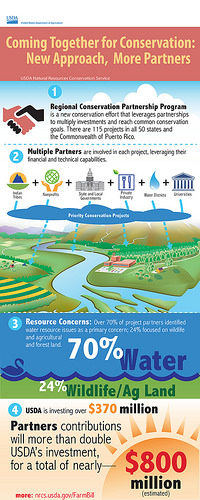
Ed. note: This is cross-posted on the U.S. Department of Agriculture's blog. See the original post here.
When USDA unveiled the new Regional Conservation Partnership Program last year, I said that this effort would pioneer a new era of conservation. As of today, the program is doing just that — leveraging an unprecedented three-quarters-of-a-billion-dollar investment in projects to preserve clean land and water and create new jobs across the country.
One of the innovative programs in the 2014 Farm Bill, the Regional Conservation Partnership Program brings a wide variety of new partners together — from private businesses, to universities, to local and tribal governments, to non-profit organizations and more — to develop their own action plans and to pledge their own resources to the project. Local organizations are in the driver’s seat, setting priorities and developing conservation projects that make sense for their communities.
The response to this new approach to conservation projects was overwhelming. Earlier this year, when local partnerships submitted their plans to USDA, they requested more than six times the amount of available funding in the first round. This incredible response is a call to action and it shows how much need there is for a program like RCPP.
Learn more about Energy and Environment, RuralNew Actions to Reduce Methane Emissions Will Curb Climate Change, Cut Down on Wasted Energy
Posted by on January 14, 2015 at 11:45 AM EDTThe United States is now the largest oil and natural gas producer in the world, and developing these cleaner-burning fuel sources to light and heat American homes and businesses is crucial to the President’s energy strategy. But while these important energy sources produce less carbon pollution overall, methane leaks throughout the oil and gas system are fueling climate change — and wasting valuable fuel that should be captured and used.
Methane — the primary component of natural gas and the third-largest source of U.S. greenhouse gas emissions — is a potent climate pollutant, trapping 25 times as much heat as carbon pollution over the course of a century. The good news is emissions from the oil and gas sector are down 16 percent since 1990. However, without additional action, emissions from this sector are projected to rise more than 25 percent by 2025.
That’s why, today, the Obama administration is announcing an ambitious new goal to cut methane emissions from the oil and gas sector by 40-45 percent from 2012 levels by 2025. Achieving this goal would save up to 180 billion cubic feet of wasted natural gas in 2025 — enough to heat more than 2 million homes for an entire year.
Learn more about Energy and EnvironmentThe Road to State of the Union: Can You Answer This One Question?
Posted by on January 9, 2015 at 7:07 PM EDT
In less than two weeks, the President will deliver the State of the Union address before a joint session of Congress.
The State of the Union is a tradition that's as old as the presidency itself — but here's something we haven't always been able to do:
Ask you, the American people, what you'd like to see come out of it.
So tell us: What would you like to see get done in the next two years?
We're putting together a special memo ahead of the speech — one comprised of the voices of Americans from across the country, sharing that one simple but powerful thought.
Change will take work from every single one of us. So after you respond, share what you're willing to do to help see it through.
Thanks for adding your voice — we'll be in touch as we get closer to January 20.
The Year in Review: A Look Back at the Most Memorable Moments of 2014
Posted by on December 29, 2014 at 1:31 PM EDTA responsible end to the war in Afghanistan. A historic agreement to combat climate change. A strong pace of job growth that we haven't seen since the 1990s.
Overall, 2014 has offered some great achievements for President Obama and the American people. Join the President's Chief of Staff Denis McDonough in taking a look back at this year's most memorable moments -- then share the memories with your friends and family.
 Learn more about , , , , , Economy, Startup America, Education, Energy and Environment, , Foreign Policy, Health Care, Immigration, , Technology, Women

- &lsaquo previous
- …
- 16
- 17
- 18
- 19
- 20
- 21
- 22
- 23
- 24
- …
- next &rsaquo
Related Videos
-
 May 09, 2014 9:21 AM
Inside the White House: Solar Panels
-
 September 01, 2016 9:25 PM
President Obama Delivers a Statement to the Press
White House Blogs
- The White House Blog
- Middle Class Task Force
- Council of Economic Advisers
- Council on Environmental Quality
- Council on Women and Girls
- Office of Intergovernmental Affairs
- Office of Management and Budget
- Office of Public Engagement
- Office of Science & Tech Policy
- Office of Urban Affairs
- Open Government
- Faith and Neighborhood Partnerships
- Social Innovation and Civic Participation
- US Trade Representative
- Office National Drug Control Policy