


Energy and Environment Latest News
Electric Vehicles Help Drive Climate Action
Posted by on November 19, 2014 at 12:41 PM EDTYesterday at the White House, Energy Secretary Ernie Moniz and I got to see American innovation in action, as Pacific Gas & Electric demonstrated their new plug-in hybrid bucket truck — a utility vehicle with emissions nearly 80% lower than a conventional truck.
Not only does PG&E’s plug-in hybrid utility vehicle run cleaner, it provides up to 120 kW of exportable power — meaning that the trucks can actually be used to shorten or end power outages by plugging their reserves into the grid.
This is the kind of innovation we need to take action on climate change — reducing emissions on the one hand and finding creative ways to boost community resilience on the other.
Learn more about Energy and EnvironmentA Toolkit to Help Communities Respond to a Changing Climate
Posted by on November 17, 2014 at 1:45 PM EDTIt’s been a big week for the United States’ efforts on climate change. On November 12, President Obama and Chinese President Xi Jinping announced historic actions to reduce greenhouse gas emissions. Today, we’re announcing important steps that the Administration is taking here at home to help communities respond to and prepare for a changing climate.
Today, the State, Local, and Tribal Leaders Task Force on Climate Preparedness and Resilience – a group of leaders from across the country who are working to boost resilience efforts in their communities – released recommendations on ways in which the federal government can support actions to address the impacts of climate change.
In response to early input from the Task Force, the Administration has developed the Climate Resilience Toolkit, a website that provides centralized, authoritative, easy-to-use information, tools, and best practices to help communities prepare for and boost their resilience to the impacts of climate change.
You can access the toolkit here: toolkit.climate.gov
 Learn more about Energy and Environment
Earth Observations Benefit Nations
Posted by on November 17, 2014 at 12:46 PM EDTLast week, representatives from countries around the world met in Geneva, Switzerland, for the Eleventh Plenary Session of the Group on Earth Observations (GEO-XI). The intergovernmental Group on Earth Observations (GEO) is a collaborative, multi-national organization created to help connect the thousands of technological tools around the world that measure, monitor, and predict the state of Earth’s land, waters, and atmosphere.
Established in 2005, GEO comprises 95 governments and 77 organizations working together around a guiding principle of open data — a principle that President Obama committed the United States to upholding in a May 2013 Executive Order. This Executive Order calls on all Federal agencies to ensure that new data sets are released in open and machine-readable formats.
Open, machine-readable, and interoperable Earth observation data collected and shared by GEO member nations and organizations is a valuable resource for governments, organizations, researchers, firms, and individuals around the world. Farmers benefit from improved weather systems and crop data, flood managers benefit from improved elevation data, and disaster relief managers benefit from improved mapping of rural landscapes and infrastructure.
Since 2005, the U.S. has had an active leadership role as one of four permanent members of GEO’s Executive Committee. The White House Office of Science and Technology Policy (OSTP) supports this leadership by working to maximize the public benefits of the Federal government’s investment in civil Earth observation activities. This work is carried out by the National Science and Technology Council’s U.S. Group on Earth Observations (USGEO), an interagency body chaired by OSTP.
USGEO assesses the impact of Earth observation systems, facilitates expanded data sharing, and supports the United States’ international engagement in GEO. USGEO also helps the Federal government maintain and improve its Earth observing systems in ways that help protect life and property, stimulate economic growth, maintain homeland security, and advance scientific research and public understanding. These activities are outlined in the National Plan for Civil Earth Observations, which establishes priorities and supporting actions for advancing the Nation’s civil Earth observations capabilities.
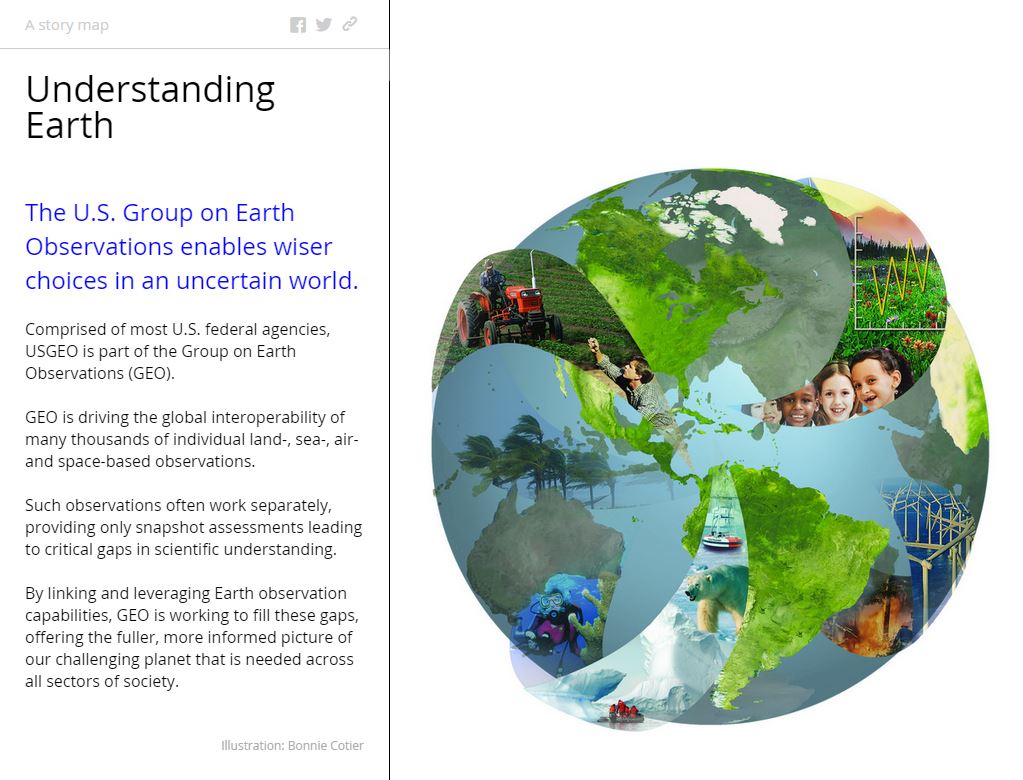
For more information on activities supported by USGEO, click the image above or click here.
Maximizing the value of the Earth observations collected by Federal agencies involves making observation data accessible to users worldwide. In this spirit, President Obama announced at the recent United Nations Climate Summit that the United States would release elevation data for most of the Earth’s land surfaces. These data will improve understanding of environmental change and societal ecosystem and vulnerability in countries worldwide, and their release underscores the U.S. commitment to address the environmental impacts of extreme weather and climate change.
The U.S. elevation data for most of the African continent were released in September 2014, a move that was welcomed by the international development community then and by GEO-XI delegates this month. Additional regional data sets will be released periodically over the next year, and the entire global data set will be publicly available by September 2015.
Through U.S. and international GEO, the United States will work with its domestic and international partners to advance the practical, beneficial use of Earth observations.
Timothy Stryker is Director of the U.S. Group on Earth Observations Program.
Learn more about Energy and Environment, , Taxes#AskDrH: The President's Science Advisor Is Answering Your Questions on Climate Change
Posted by on November 13, 2014 at 3:15 PM EDTGot questions about climate change? Ask the President's science advisor.
Dr. John P. Holdren, Director of the White House Office of Science and Technology Policy, wants to answer any questions that you have about climate change -- what it means, how bad it actually is, and what we can do to fight it.
Starting today, ask Dr. Holdren your questions on Facebook, Twitter, Instagram, or Vine using the hashtag #AskDrH -- and he'll answer some of them on camera.
Learn more about Energy and EnvironmentThe U.S. and China Just Announced Important New Actions to Reduce Carbon Pollution
Posted by on November 12, 2014 at 10:30 AM EDT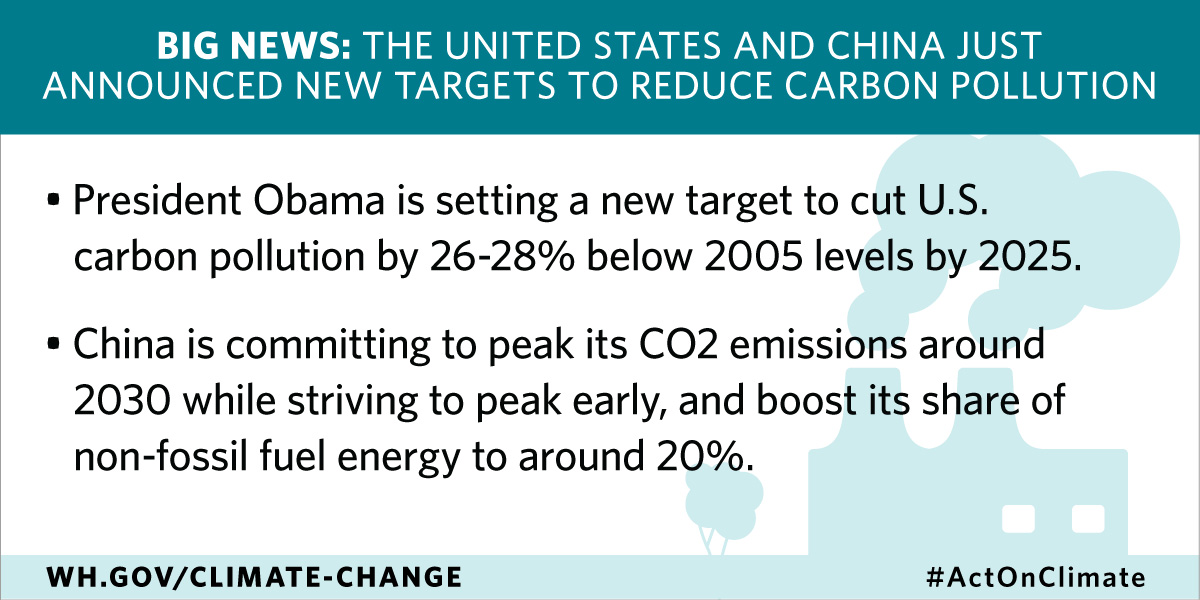
Today in Beijing, President Obama and Chinese President Xi Jinping made history by jointly announcing the United States’ and China’s respective targets for reducing the greenhouse gas emissions driving climate change in the post-2020 period.
This announcement is a unique development in the U.S.-China relationship. The world’s two largest economies, energy consumers, and carbon emitters are reaching across traditional divides and working together to demonstrate leadership on an issue that affects the entire world.
By making this announcement well in advance of the deadline set out in the UNFCCC negotiations, the two leaders demonstrated their commitment to reducing the harmful emissions warming our planet, and urged other world leaders to follow suit in offering strong national targets ahead of next year’s final negotiations in Paris.
Learn more about , Energy and EnvironmentNASA is Working off Earth, for Earth
Posted by on November 3, 2014 at 5:14 PM EDTEd. Note: This blog is cross-posted from the NASA Blog.
At NASA, we have a unique perspective on Earth. Every day, we observe its grandeur from our International Space Station orbiting 250 miles above the planet and capture a wealth of scientific data about how our planet is changing from our fleet of Earth observing satellites. This year, with the launch of five Earth-observing missions -- more Earth-focused launches in a single 12-month period than we’ve had in more than a decade -- NASA will be able to deliver even more crucial data to scientists trying to understand our changing planet.
Back on Earth, we can't escape the impact of climate change on our facilities and operations. Today, we are releasing our annual Sustainability Report and our Climate Change Adaption Plan that detail the steps NASA is taking to reduce carbon emissions, save energy and cut costs for the American taxpayer; as well as a review of the key challenges we face as a result of climate change.
The reports confirm that NASA's critical launch pads and other facilities are vulnerable to beach erosion; currently, 66 percent of our assets are within 16 feet of sea level located along America's coasts. This threat will only increase as sea levels rise and storm intensity increases.
Electrical black-outs and brown-outs associated with heat waves threaten energy utilities that provide power NASA uses to receive and process data from space.
Rocket engine testing at Stennis Space Center depends on surrounding forests to buffer the noise and vibrations from testing, which requires a constant evaluation of our climate resilience.
That's why we believe it is so important to steward our agency's use of natural resources and to plan for future mitigation of the impacts of a changing climate. Our 2014 Strategic Sustainability Performance Plan examines eleven goals including fleet management, greenhouse gas reduction, and climate change resilience and pollution prevention. It shows that in 2013, NASA made significant progress on sustainability measures. For example, we surpassed our petroleum reduction and alternative fuel usage goals, reducing use of petroleum by nearly 37 percent last year, while increasing use of alternative fuels 297 percent over 2005 benchmarks.
NASA is also focusing on the security of our energy and water supplies. Since 2010, we've reduced the amount of water we've used for industrial, landscaping and agricultural purposes by 70 percent. NASA developed an Energy Security Plan (ESP) template to provide Centers with a guideline to generate their energy/water security plans based on their local conditions.
Stewards at NASA Centers are evaluating risks, proposing adaptation strategies, and integrating strategies into existing management plans.
NASA's work in this area has captured national attention. Today, NASA’s Director of Center Operations for the Johnson Space Center in Houston, Joel B. Walker, received a 2014 GreenGov Presidential Award, recognizing his commitment to leading by example on sustainability issues. Joel developed and implemented a multifaceted sustainability management approach that has focused on areas of energy and water reduction, green purchasing, reducing the generation of hazardous waste and increased diversion of waste through recycling initiatives. Under his direction, Johnson Space Center has constructed seven certified green buildings, which use 100 percent green power and has reduced potable water use by 15 percent annually and composted over 85,000 pounds of food waste. Clearly Mr. Walker’s leadership has set the standard for sustainability
Through our management of climate risks and incorporation of sustainability principles into operations and planning, NASA is a resilient enterprise in service to the nation. We will continue to provide stellar research that improves our knowledge of earth science, including data and analyses to better understand climate systems.
Charles Bolden is Administrator of NASA.
Learn more about Energy and Environment
- &lsaquo previous
- …
- 20
- 21
- 22
- 23
- 24
- 25
- 26
- 27
- 28
- …
- next &rsaquo
Related Videos
-
 May 09, 2014 9:21 AM
Inside the White House: Solar Panels
-
 September 01, 2016 9:25 PM
President Obama Delivers a Statement to the Press
White House Blogs
- The White House Blog
- Middle Class Task Force
- Council of Economic Advisers
- Council on Environmental Quality
- Council on Women and Girls
- Office of Intergovernmental Affairs
- Office of Management and Budget
- Office of Public Engagement
- Office of Science & Tech Policy
- Office of Urban Affairs
- Open Government
- Faith and Neighborhood Partnerships
- Social Innovation and Civic Participation
- US Trade Representative
- Office National Drug Control Policy