Energy and Environment Latest News
What USDA Did This Week to Help Rural America:
Posted by on October 24, 2014 at 2:09 PM EDTThis post is the first in a new series that will highlight the work happening across the President's cabinet on any given week. Check back each week -- we guarantee you'll learn something that surprises you.

Those of us who call rural America home know that there’s more to the rural economy than just farms and ranches. From bio-based products to rural manufacturing, the potential to grow and make innovative products in rural America is limitless. Most rural businesses are small ones -- and they support one in three jobs in rural America. Our loans and grants are helping those businesses thrive -- supporting reliable services like water, housing and broadband to make these same communities attract and retain a talented workforce. Collectively, these investments support the businesses and families that call America’s rural areas “home.” That's because we know that the better we equip those communities with the resources they need to succeed, the stronger our entire country's economy will be as a result.
I'm proud to report that the Department of Agriculture did several really important things to help rural communities across the country this week. Here's a run down on what we've been up to. Take a look, and if you learned something new -- pass it on.
Want to stay up to date with USDA? Follow along with us on Twitter at @USDA.
A Call to Action to Advance Climate Education and Literacy
Posted by on October 22, 2014 at 12:36 PM EDTAmerica’s students need access to the latest information, knowledge, and skills in order to be prepared for the jobs of the future. This means continually ensuring that citizens of all ages have a solid grounding in science, technology, engineering, and math (STEM) skills that serve as a basis for discovery, invention, and innovation.
Climate education and literacy are a critical part of this STEM skillset and are particularly important for building a 21st-century workforce, where tomorrow’s community leaders, city planners, and entrepreneurs have the information, knowledge, and training to make sound decisions and grow businesses in the context of a changing climate.
Much work is already being done inside and outside of government to increase science-based understanding and awareness of current and future climate change – through efforts like the Climate Literacy and Energy Awareness Network (CLEAN), climate education projects supported by NOAA, NSF, NASA, and other Federal agencies, and community-based programs to make schools, campuses, and businesses more climate-smart. Leaders are enhancing climate literacy in K-12 classrooms, on college and university campuses, and in parks and museums across the country. But still, there is more to do.
That’s why, over the past few months, the White House Office of Science and Technology Policy (OSTP) has been exploring opportunities at the intersection of two key priorities of the Obama Administration: lifting America’s game in STEM education, and combating climate change.
Learn more about Education, Energy and EnvironmentGood News for the Bees: Supporting Pollinators at Federal Facilities
Posted by on October 22, 2014 at 9:37 AM EDTTucked against Washington D.C.’s 9th street expressway, the Smithsonian Butterfly Habitat Garden at the National Museum of Natural History offers an extraordinary space. This enchanting walkway provides people with peaceful, natural refuge from the hustle and bustle of the nation’s capital while also serving as a much needed habitat for the city’s local pollinators. This small but impactful gem mirrors the principles behind President Obama’s June 2014 memorandum, Creating a Federal Strategy to Promote the Health of Honey Bees and Other Pollinators, which directs Federal agencies to take steps to protect and restore domestic populations of pollinators.
It’s clear the pollinators are in need of this kind of protection. Threatened by loss of habitat and quality food sources, as well as the improper use of pesticides and herbicides, populations of honey bees, native bees, birds, bats, and butterflies have been declining over the past few decades. Managed honey bee colonies, for example, have declined steadily over the past 60 years, from 6 million in 1947 to just 2.5 million today. These losses are a huge threat to global food production and the economy. Honey bees enable the production of at least 90 commercially grown crops in North America, and pollinators contribute more than $24 billion to the U.S. economy each year.
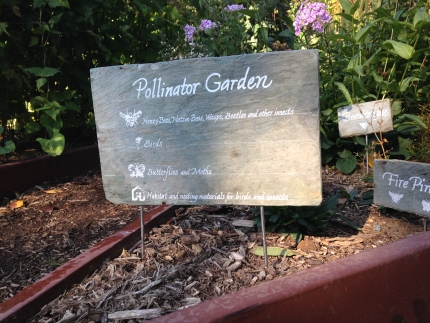
White House Pollinator Garden located on the South Lawn. Photo courtesy of CEQ.
That’s why the President believes the Federal Government should lead by example in expanding the acreage and quality of pollinator habitat. Today, as called for in the Presidential Memorandum, we are releasing revised guidance on Sustainable Designed Landscapes to help Federal agencies incorporate pollinator friendly practices in new construction, building renovations, landscaping improvements, and in facility leasing agreements at Federal facilities and on Federal lands. Facility managers can use the updated guidance to actively examine their current buildings, grounds, and practices for opportunities to transition to a richer diversity of pollinator-friendly plant species.
By integrating pollinator-friendly strategies into everyday design, operations, and maintenance activities, Federal agencies can have a big impact. Every day, agency managers make routine decisions that could affect pollinator populations. The easy-to-use guide will help ensure the best possible decisions are made, supporting pollinator health and habitat on millions of acres of Federal land. Additionally, the guide will serve as a valuable resource for further research on pollinators and the plant species that support them.
The new guidance isn’t the only good news for pollinators today. The General Services Administration announced today its own guidelines for facility design, construction, and management to better protect pollinators. And this week, the U.S. Department of Agriculture is hosting the 14th Annual North American Pollinator Protection Campaign International Conference.
With the new guidance, Federal agencies can start taking the steps necessary to protect and restore pollinator populations now. Places like the Butterfly Habitat Garden - and even the South Lawn of the White House – provide models for implementation across the nation.
View the revised guidance here.
Kate Brandt is the Federal Environmental Executive at the White House Council on Environmental Quality.
Learn more about Energy and EnvironmentHelping the next generation discover the San Gabriels
Posted by on October 16, 2014 at 12:57 PM EDTEditor's Note: This blog introduces readers to Brenda Kyle, a docent at Eaton Canyon.
"We heard from the community that for a lot of urban families this is their only big, outdoor space. And too many children in L.A. County, especially children of color, don't have access to parks where they can run free and breathe fresh air, experience nature, and learn about their own environment. And that was Brenda Kyle's experience...for Brenda, for the entire community, this is an issue of social justice. Because it's not enough to have this awesome natural wonder within your sight -– you have to be able to access it." -President Obama, October 10, 2014
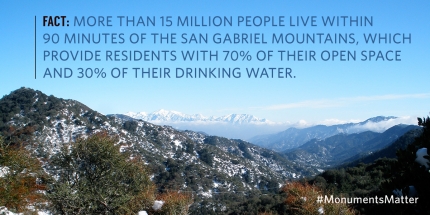
Today, I can assure my nephews that there are no tigers in the San Gabriel Mountains, information that’s helped make me a popular auntie. But I wasn’t always so well-informed. I grew up in the foothills of the San Gabriel Mountains. The main street running through our town paralleled the San Gabriel range, with all northbound streets leading up to the steep mountain sides. As an adult, I noticed the mountains from the stands at a Dodger game and sometimes even used them to navigate. But I had never visited them.
It wasn’t until I was looking for something inexpensive to do with my daughter that I heard about guided nature walks for families in Eaton Canyon in the San Gabriel Mountains. Turns out, these national public lands are teeming with wildlife (but, to my nephews’ relief, no scary tigers!), cultural history, breathtaking scenery, and gifts of clean air and drinking water. I was an instant convert. Soon after, I became a part-time docent, leading regular hikes for families and offering eye-opening experiences to local young people.
The more walks I led the more I realized that, even though the San Gabriel Mountains can be seen from almost any point in Southern California, they are often unknown to residents. Worse yet, that lack of awareness can manifest as neglect. Trash fills the waterways that provide a third of the drinking water for Los Angeles County. Graffiti mars canyon walls. Parking, visitor services, restrooms, educational programs are woefully underfunded and understaffed.
The President’s designation of the San Gabriel Mountains National Monument last week will help change that. After 10 years – a generation – of work by thousands of local residents, the President has not only protected the crown jewel of Los Angeles, but elevated investment in and visibility of this close-to-home yet uncared for recreational resource. Now, more families will access and enjoy these national public lands. More children will be inspired by the wonders of America’s Great Outdoors.
In addition, the President’s leadership has sparked private funding for new trails, tree-plantings and river restoration projects in communities all over the San Gabriel Valley.
These days, as the President mentioned in his speech, I take my two nephews, ages four and five, with me to the mountains every chance I get. They are the second generation to grow up in my tiny foothill town, but, unlike me, these kids go to the San Gabriel Mountains. They can identify two types of sage, as well as buckwheat and sagebrush. They clean up trash to help protect wildlife. They pull invasive mustard weeds to save native plants. They enjoy fresh air and respect the outdoors.
And most important, they ask me to take them into the forest. They are eager stewards and explorers of our Great Outdoors. If you ask them why they like the San Gabriel Mountains, they will very enthusiastically tell you: “We can run and play in the river. We can stand in the waterfall. We can see woodpeckers.” Their list is endless, as it should be. The San Gabriel Mountains National Monument – and all of our national public lands – not only expose our children to nature, but to the world. Thanks to the San Gabriel Mountains, opportunity is now in their vocabulary.
Brenda Kyle is a resident of Duarte, California, and a docent at Eaton Canyon.
Learn more about Energy and EnvironmentThe Department of Defense Must Plan for the National Security Implications of Climate Change
Posted by on October 13, 2014 at 11:30 AM EDTThe responsibility of the Department of Defense is the security of our country. That requires thinking ahead and planning for a wide range of contingencies.
Among the future trends that will impact our national security is climate change. Rising global temperatures, changing precipitation patterns, climbing sea levels, and more extreme weather events will intensify the challenges of global instability, hunger, poverty, and conflict. They will likely lead to food and water shortages, pandemic disease, disputes over refugees and resources, and destruction by natural disasters in regions across the globe.
In our defense strategy, we refer to climate change as a “threat multiplier” because it has the potential to exacerbate many of the challenges we are dealing with today – from infectious disease to terrorism. We are already beginning to see some of these impacts.
A changing climate will have real impacts on our military and the way it executes its missions. The military could be called upon more often to support civil authorities, and provide humanitarian assistance and disaster relief in the face of more frequent and more intense natural disasters. Our coastal installations are vulnerable to rising sea levels and increased flooding, while droughts, wildfires, and more extreme temperatures could threaten many of our training activities. Our supply chains could be impacted, and we will need to ensure our critical equipment works under more extreme weather conditions. Weather has always affected military operations, and as the climate changes, the way we execute operations may be altered or constrained.
While scientists are converging toward consensus on future climate projections, uncertainty remains. But this cannot be an excuse for delaying action. Every day, our military deals with global uncertainty. Our planners know that, as military strategist Carl von Clausewitz wrote, “all action must, to a certain extent, be planned in a mere twilight.”
It is in this context that today I am releasing DoD’s Climate Change Adaptation Roadmap. Climate change is a long-term trend, but with wise planning and risk mitigation now, we can reduce adverse impacts downrange.
Learn more about Defense, Energy and Environment"The Geography of Hope": President Obama Designates the San Gabriel Mountains National Monument
Posted by on October 10, 2014 at 5:37 PM EDT"We are blessed to have the most beautiful landscapes in the world. We have a responsibility to be good stewards of them for future generations."
-- President Obama, October 10, 2014
It is our moral obligation to protect America's most beautiful lands for the next generation. Today, President Obama officially ensured that the San Gabriel Mountains National Monument will join a vast landscape of natural treasures, as part of what writer Wallace Stegner once called "the geography of hope."
Speaking in the Frank G. Bonelli Regional Park in San Dimas, California, the President said:
It’s not just the natural beauty of the San Gabriels that makes it invaluable. Within these hills lies millennia of history, including the ancient rock art of Native peoples -- the first Americans. And just as this region teaches us about our past, it has always offered us a window into the future. It was here at the Mount Wilson Observatory that Edwin P. Hubble showed the universe to be ever-expanding, and it's where astronomers still explore the mysteries of space. I can think of no better way to honor our past and protect our future than by preserving the San Gabriel Mountains.
Learn more about Energy and Environment

- &lsaquo previous
- …
- 22
- 23
- 24
- 25
- 26
- 27
- 28
- 29
- 30
- …
- next &rsaquo
Related Videos
-
 May 09, 2014 9:21 AM
Inside the White House: Solar Panels
-
 September 01, 2016 9:25 PM
President Obama Delivers a Statement to the Press
White House Blogs
- The White House Blog
- Middle Class Task Force
- Council of Economic Advisers
- Council on Environmental Quality
- Council on Women and Girls
- Office of Intergovernmental Affairs
- Office of Management and Budget
- Office of Public Engagement
- Office of Science & Tech Policy
- Office of Urban Affairs
- Open Government
- Faith and Neighborhood Partnerships
- Social Innovation and Civic Participation
- US Trade Representative
- Office National Drug Control Policy