



Energy and Environment Latest News
Celebrating a Milestone in Conservation – and the Law that Made it Possible
Posted by on September 19, 2014 at 4:52 PM EDTJust a few weeks ago, I was at the Smithsonian Museum of Natural History remembering an unfortunately dark moment in conservation history – exactly a century before, on September 1, 1914, the last known passenger pigeon died in a Cincinnati zoo. You can see “Martha,” as they called her, on display at the museum – stuffed, mounted and behind glass.
And now today, we mark an historic milestone of a far different sort on Maryland’s Eastern Shore. At Blackwater National Wildlife Refuge, Secretary of the Interior Sally Jewell and I were privileged to announce that thanks to concerted conservation efforts by area landowners and other partners, the Delmarva Peninsula fox squirrel has recovered from the brink of extinction.
So why did the passenger pigeon become extinct, while the equally common fox squirrel now thrives across much of its historic range?
The answer is simple. Unlike the passenger pigeon, the Delmarva fox squirrel was protected and aided in its recovery by the Endangered Species Act.
In fact, the fox squirrel was one of 67 species listed under the Endangered Species Preservation Act of 1967 and later extended protection by the federal law that succeeded it, the Endangered Species Act of 1973.
The successful recovery of the Delmarva fox squirrel is a testament to the dramatic benefits provided by the ESA. Prior to its protection, the species experienced a dramatic decline as the forests it depended on in the Delmarva Peninsula were cleared for agriculture and development. Its range was reduced by more than 90 percent, and in the mid-1960s there was a very real possibility that it would vanish entirely.
Yet here we are, less than 50 years later, with the Delmarva fox squirrel thriving again. And it wouldn’t have happened without the tools and protections provided by the ESA. Delistings like this one also remind how the Endangered Species Act can catalyze improvmements to natural habitats that promote ecosystem and community resilience in the face of a changing climate, and how it can be an incentive for community investment by improving regulatory predictability and providing certainty for people and businesses.
The ESA has been an unheralded gift to the nation — an expression of our deep desire to conserve biodiversity, the health of the habitat that sustains wildlife and humans alike, and our willingness to work for it. For more than 40 years, the law has been remarkably successful, preventing the extinction of more than 99 percent of the species listed as threatened or endangered since 1973. Its protections have helped the Fish and Wildlife Service and its partners reverse the death spiral of hundreds of species, while recovering dozens more. We can take enormous pride in the recovery of species such as the bald eagle, American alligator, Steller sea lion and other species against astounding odds – just like the Delmarva Fox Squirrel today.
If we want a world with polar bears, condors, and salmon, then we have to make deliberate choices to find a place for them. But as the Delmarva fox squirrel shows, it can be done.
If you could step back in time and prevent the extinction of the passenger pigeon, would you? If you answered yes, you have a historic chance to prevent many other equally senseless tragedies; to change the course of history by taking a stand, here and now in favor of species conservation.
The challenges we face today are daunting, but no more so than those faced by our ancestors a century ago. Like them, we need to have the courage to envision something better and grander than the status quo. Thankfully, we have the Endangered Species Act to help us bring people together across the landscape to make our shared vision of healthy, sustainable ecosystems for both wildlife and people a reality.
Dan Ashe is Director of the U.S. Fish and Wildlife Service.
Learn more about Energy and EnvironmentBiofuels and Our Clean Energy Future
Posted by on September 19, 2014 at 1:44 PM EDTToday at the White House, the Departments of the Navy, Agriculture and Energy announced new contracts to construct and commission biorefineries capable of producing drop-in, military-compatible fuels that can be used in our most advanced warfighting platforms and by commercial industry. Together, the three companies receiving the awards will produce more than 100 million gallons of military grade fuel – at a price that’s competitive with fossil fuel.
The awards, made under Defense Production Act (DPA) authorities, mark important progress on the President’s Climate Action Plan (CAP). The CAP calls upon the Administration to leverage partnerships between the private and public sectors to deploy cleaner fuels. It also specifically tasks the Departments of the Navy, Energy and Agriculture to work with the private sector to accelerate the development of cost-competitive advanced biofuels for use by the military and commercial sectors.

Secretary of the Navy Ray Mabus, Secretary of Agriculture Tom Vilsack, Acting Chair Mike Boots, and Kate Brandt (pictured above) joined Deputy Secretary of Energy Daniel Poneman to announce new contracts to construct and commission biorefineries at an event at the White House. Photo courtesy of the White House Council on Environmental Quality.
The biorefinery projects will be initiated this year, with fuel production expected to begin as early as 2016. That means American jobs that can’t be shipped overseas, and more progress toward replacing imported crude oil with secure, renewable fuels made here in the U.S. Emerald Biofuels will build a refinery on the Gulf coast that uses waste fats and greases; Fulcrum BioEnergy will build a refinery in McCarran, Nevada that utilizes municipal solid waste; and Red Rock Biofuels will build a refinery in Lakeview, Oregon that processes woody biomass.
This success story builds on previous efforts across the government to promote the development and use of advanced biofuels. The Navy has tested and certified their entire fleet to operate on these fuels and in 2012 demonstrated a carrier strike group during the Rim of the Pacific naval exercise in which all the air craft and conventional ships operated for two days on drop-in biofuels. Through its Biomass Crop Assistance Program and Loan Program, USDA has supported farmers and the construction of new advanced biofuel refineries including an algae biofuels project in New Mexico and a first of a kind commercial-scale cellulosic biofuel refinery in Florida. DOE has also been a major champion of advanced biofuel technology through the Bio Energy Technology Office and earlier this month celebrated the grand opening of the POET Project LIBERTY, the nation’s second commercial-scale cellulosic refinery.
Biofuels have an important role to play in fostering rural economic development and reducing greenhouse gas emissions from the transportation sector, all while increasing our energy security. Today’s announcement is an important step forward in accomplishing these goals, and in implementing the President’s Climate Action Plan.
Kate Brandt is Federal Environmental Executive at the White House Council of Environmental Quality.
Learn more about Energy and EnvironmentA New Solar Energy Job-Training Pilot Program for Veterans
Posted by on September 18, 2014 at 4:52 PM EDTSolar energy is shattering records in the United States. Since President Obama took office, installed solar power has increased 13-fold, topping nearly 16 gigawatts today – enough to power the equivalent of 3.2 million average American homes. As solar energy continues to grow, it is becoming a major source of high-paying American jobs – employing nearly 143,000 full-time professionals last year.
During the next decade, the solar industry is slated to grow even more. The next generation of skilled professionals will be key to the industry’s effort to meet the demand for this clean, renewable energy. That’s why the Energy Department is launching a pilot solar installation training program to provide military veterans who are transitioning out of active duty with the skills needed to become the leaders of the nation’s clean energy economy.
The solar industry has long taken a leading role in hiring veterans, employing more service members than any other sector in the U.S. Building on this tradition, the SunShot Initiative’s Solar Instructor Training Network – which aims to train 50,000 new solar installers in total by 2020, some of who will be veterans – is partnering with up to three military bases to create a veterans solar job training pilot project this fall.
Learn more about Energy and Environment, VeteransU.S. Companies Leading to Reduce Emissions of HFC Climate Pollutants
Posted by on September 16, 2014 at 2:18 PM EDTToday, fulfilling a commitment under the President’s Climate Action Plan, the Obama Administration is announcing new private sector commitments and executive actions to reduce emissions of hydroflourocarbons (HFCs), powerful greenhouse gases that exacerbate climate change. Taken together, these commitments will reduce cumulative global consumption of HFCs by the equivalent of 700 million metric tons of carbon dioxide through 2025. That’s an amount equal to 1.5% of the world’s 2010 greenhouse gas emissions—or, in other words, it’s like taking nearly 15 million cars off the road for 10 years.
HFCs, used primarily in air conditioning and refrigeration, are greenhouse gases with up to 10,000 times the global warming potential of carbon dioxide. Unless we act, U.S. emissions of these potent greenhouse gases would nearly double by 2020 and triple by 2030.
Announced today, U.S. industries are leading the way in helping fulfill the President’s pledge by investing billions of dollars to develop and deploy the next generation of safe, cost-effective alternatives to HFCs, and by incorporating these climate-friendly technologies into the cars, air conditioners, refrigerators, foams and other products they manufacture and use.
Learn more about Energy and EnvironmentHow Climate-Resilient Schools Serve Students and Communities
Posted by on September 12, 2014 at 4:39 PM EDTEd. Note: This post introduces you to Commissioner Kristin Jacobs of Broward County, Florida.
Here in Broward County, Florida, we are blessed to enjoy a bounty of natural resources—from the unique Everglades on our western border, to the beaches and coral reefs of the Atlantic Ocean coast to our east. But we also recognize that our young people are a tremendous homegrown natural resource. We were delighted that the U.S. Department of Education came to south Florida on September 4 and 5 to recognize our Broward County Public Schools, a U.S. Department of Education Green Ribbon Schools District Sustainability Awardee, as part of its Green Strides Best Practices Tour celebrating schools that reduce environmental impact and costs, improve health and wellness, and teach environmental education. This celebration also helped to remind us that September is National Preparedness Month, an opportunity for local, state, and federal leaders to bring collective attention to the importance of emergency preparedness and resilience in our communities.
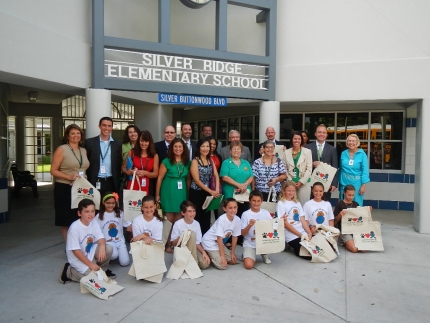
Students and staff at Silver Ridge Elementary in Broward County, Florida, gathering to celebrate Broward County Public Schools' participation in the Green Strides Best Practices Tour as a 2014 U.S. Department of Education Green Ribbon Schools District Sustainability Awardee. Photo courtesy of Broward County.
Broward County government has a long-standing partnership with the Broward County Public Schools, working to integrate environmental conservation and sustainable best practices into student education, educator training, and facilities management. While this collaboration has generated immediate benefits, promoted the sharing of technical resources, and supported a STEM-based curriculum, these joint investments have also furthered our regional efforts to build a climate-resilient community. Our efforts have involved the installation of drought-tolerant landscapes, expansion of native habitat into the urban landscape, establishment of edible school gardens, and promotion of resilient energy systems, along with comprehensive classroom and community discussions of climate, water issues, sea level rise, and the connection between our urban and natural landscapes.
As a member of the President’s State, Local, and Tribal Leaders Task Force on Climate Preparedness and Resilience, I have gained a heightened appreciation of the pressures that climate change poses to diverse communities across the nation. Cities, regions, and states all face community and economic risks from extreme weather and other hazards. As a nation, our ability to withstand these risks depends not only upon successful disaster preparedness planning, but also upon smart investments in community development, infrastructure upgrades, and even in the way we operate our schools.
As we celebrate National Preparedness Month, I would like to celebrate the leadership of President Obama in making climate resilience a focus of federal programs and activities. Working together, we can improve our communities’ security, economic health, and quality of life even in the face of climate impacts and natural disasters. Our natural resources—both our ecosystems and our young people—are counting on us to succeed.
Kristin Jacobs is Broward County Commissioner and a member of the President's State, Local, and Tribal Leaders Task Force on Climate Preparedness and Resilience.
Learn more about Energy and Environment#WomenInSTEM: Making a Cleaner Future
Posted by on September 9, 2014 at 12:08 PM EDTEd. note: This is cross-posted on the U.S. Department of Energy's blog. See the original post here.
Meet Mallory Lindgren, a project manager at a Minnesota-based land and energy development consulting firm, and the latest profile in the Energy Department’s #WomenInSTEM video series. This series celebrates the amazing work of women across the energy sector while providing a new generation of students with a diverse set of role models as they begin their careers in science.
Mallory’s interest in STEM (short for science, technology, engineering, and math) dates back to her childhood and a curiosity about the how the Earth’s natural systems work. Growing up, Mallory’s mother encouraged this inquisitiveness through Star Trek and other science-based TV shows. But it was an environmental science class in college that helped Mallory understand how different fields of science are related and led to a degree in hydrology and, eventually, her career in the energy sector.
Learn more about Energy and Environment
- &lsaquo previous
- …
- 25
- 26
- 27
- 28
- 29
- 30
- 31
- 32
- 33
- …
- next &rsaquo
Related Videos
-
 May 09, 2014 9:21 AM
Inside the White House: Solar Panels
-
 September 01, 2016 9:25 PM
President Obama Delivers a Statement to the Press
White House Blogs
- The White House Blog
- Middle Class Task Force
- Council of Economic Advisers
- Council on Environmental Quality
- Council on Women and Girls
- Office of Intergovernmental Affairs
- Office of Management and Budget
- Office of Public Engagement
- Office of Science & Tech Policy
- Office of Urban Affairs
- Open Government
- Faith and Neighborhood Partnerships
- Social Innovation and Civic Participation
- US Trade Representative
- Office National Drug Control Policy