Energy and Environment Latest News
Sentinel Landscapes: Where Conservation, Working Lands, and National Defense Interests Converge
Posted by on August 1, 2014 at 6:20 PM EDTLast July, the Administration launched the Sentinel Landscapes partnership to accomplish three critical goals: preserve agricultural lands, assist with military readiness, and restore and protect wildlife habitat.
In this unique collaboration, the U.S. Department of Agriculture, Department of Defense, and Department of the Interior work with state, local, and private partners to preserve and restore natural lands important to the nation’s defense mission. The basic premise is to preserve and restore habitat around the military base to ensure at-risk species can survive, while also improving military readiness by ensuring training activities can proceed unimpeded.
Joint Base Lewis McChord (JBLM), located in Washington state’s Puget Sound region, was the first designated Sentinel Landscape. Located about 10 miles southwest of Tacoma, Washington, JBLM is one of the premiere military installations on the West Coast, covering over 91,000 acres to support 43,000 soldiers and airmen for maneuver training and land-warrior system testing.
JBLM also boasts the largest and highest quality prairie habitat in the South Puget Sound region. Once covering more than 150,000 acres, this irreplaceable ecological asset now covers only 23,000 acres, with nearly 90 percent of it found on JBLM. This prairie landscape is a large part of the remaining habitat for several animal and plant species protected under the Endangered Species Act. As development moves closer, these species take refuge on the base, restricting certain military activities like maneuver training for Stryker Brigade Combat Teams. The Sentinel Landscapes partnership ensures that at-risk species can thrive in the habitat surrounding the base without threatening military readiness.
Learn more about Energy and EnvironmentNew Report: The Cost of Delaying Action to Stem Climate Change
Posted by on July 29, 2014 at 11:26 AM EDTThe signs of climate change are all around us. The average temperature in the United States during the past decade was 0.8° Celsius (1.5° Fahrenheit) warmer than the 1901-1960 average, and the last decade was the warmest on record both in the United States and globally. Global sea levels are currently rising at approximately 1.25 inches per decade, and the rate of increase appears to be accelerating.
The scientific consensus is that these changes, and many others, are largely consequences of anthropogenic emissions of greenhouse gases that have led to a warming of the atmosphere and oceans.
The Council of Economic Advisers released a report today that examines the economic consequences of delaying implementing policies to reduce the pace and ultimate magnitude of these changes; the findings emphasize the need for policy action today. The report was written under the leadership of Jim Stock, who recently resigned as a Member of the Council of Economic Advisers to return to his teaching position at Harvard University.
KEY POINTS IN TODAY’S REPORT FROM THE COUNCIL OF ECONOMIC ADVISERS
1. Immediate action substantially reduces the cost of achieving climate targets. Taking meaningful steps now sends a signal to the market that reduces long-run costs of meeting the target. Such action will reduce investments in high-carbon infrastructure that is expensive to replace and will spur development of new low- and zero-emissions technologies. For both reasons, the least-cost mitigation path to achieve a given climate target typically starts with a relatively low price of carbon to send these signals to the market, and subsequently increases as new low-carbon technologies are developed and deployed. An analysis of research on the cost of delay for hitting a specified climate target suggests that net mitigation costs increase, on average, by approximately 40 percent for each decade of delay.
Learn more about Energy and EnvironmentJoin a Twitter Q&A on Climate Change and the Cost of Inaction
Posted by on July 29, 2014 at 10:38 AM EDTClimate change is not a distant threat – we're already experiencing its harmful impacts. That's why President Obama has taken action to cut carbon pollution by moving to cleaner sources of energy and improving the energy efficiency of our cars, trucks, and buildings. But further steps are urgently needed to ensure that we leave our kids a planet that’s not polluted or damaged.
Today, the White House released a new report from the Council of Economic Advisers that breaks down the economic consequences of delaying action to combat climate change. The report finds that delaying policy actions by a decade increases total climate change mitigation costs by about 40%, and failing to take any action would risk substantial economic damage.
So how will this affect you and your community? Jason Furman, Chairman of the Council of Economic Advisers, is taking to Twitter to answer your questions. Today, July 29 at 2:30 p.m. ET, join him for a Twitter Q&A on the economic impacts of climate change on his Twitter handle, @CEAChair.
Here's what you need to know:
- Ask your questions now and during the live event on Twitter with the hashtag #WHClimateChat
- Follow the Q&A live through the @CEAChair Twitter handle
- If you miss the live Q&A, the full session will be posted on WhiteHouse.gov and Storify.com/whitehouse
Learn more about President Obama's plan to combat climate change at WhiteHouse.gov/climate-change, and then join Jason Furman, @CEAChair, for a Twitter chat today, July 29, at 2:30 p.m. ET.
Learn more about Energy and EnvironmentUnleashing Climate Data to Empower America’s Agricultural Sector
Posted by on July 29, 2014 at 8:16 AM EDTToday, in a major step to advance the President’s Climate Data Initiative, the Obama administration is inviting leaders of the technology and agricultural sectors to the White House to discuss new collaborative steps to unleash data that will help ensure our food system is resilient to the effects of climate change.
More intense heat waves, heavier downpours, and severe droughts and wildfires out west are already affecting the nation’s ability to produce and transport safe food. The recently released National Climate Assessment makes clear that these kinds of impacts are projected to become more severe over this century.
Food distributors, agricultural businesses, farmers, and retailers need accessible, useable data, tools, and information to ensure the effectiveness and sustainability of their operations – from water availability, to timing of planting and harvest, to storage practices, and more.
Today’s convening at the White House will include formal commitments by a host of private-sector companies and nongovernmental organizations to support the President’s Climate Data Initiative by harnessing climate data in ways that will increase the resilience of America’s food system and help reduce the contribution of the nation’s agricultural sector to climate change.
Learn more about Energy and EnvironmentFederal Agencies Leading By Example to Reduce Energy Use and Save Money for Taxpayers
Posted by on July 25, 2014 at 12:46 PM EDT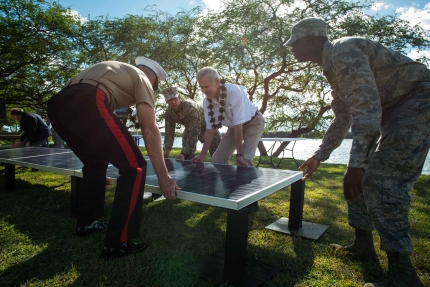
Secretary of the Navy Ray Mabus helps place a solar panel during a ground breaking at the USS Nevada Memorial at Hospital Point. (Photo courtesy of the United States Navy)
In 2009, President Obama set ambitious energy and sustainability goals to reduce energy use, pollution and waste, and save money in Federal operations. Today, Federal agencies released their annual updates highlighting the progress they’ve made thus far. These annual performance scorecards benchmark agencies’ progress and help them to target the best opportunities to improve.
The third National Climate Assessment released earlier this year made clear that climate change is already affecting every region of the country as well as key sectors of the economy. The President firmly believes that the Federal Government should lead by example in improving energy efficiency and cutting harmful carbon pollution. This is the fourth time agencies have publicly released their energy and sustainability scorecards as part of the Administration’s efforts to increase transparency and accountability in Federal operations.
The Federal Government is the largest energy consumer in the U.S. economy, and agencies’ improvements in energy efficiency and reductions in cost and waste are already making a difference.Today, the Federal Government announced:
- Greenhouse gas emissions from Federal facilities have been reduced by 17 percent since 2008, the equivalent of permanently taking 1.8 million cars off the road— roughly the same number of cars registered in the state of Alabama;
- Nine percent of Federal Government electricity is now from renewable sources, surpassing our own benchmark for fiscal year 2013 of 7.5 percent and ensuring that we are well on our way to reaching our new goal of 20 percent renewable energy by 2020; and
- Federal Government potable water use was reduced by 19 percent below 2007 levels.
These are big steps towards meeting our goals, and are saving taxpayers money. And we are working to do more.
For example, the Secretary of the Navy Ray Mabus yesterday announced new renewable energy projects at the Joint Base Pearl Harbor Hickam in Pearl Harbor, Hawaii, the Marine Corps Base Hawaii in Kaneohe, Hawaii, and Camp Smith in Aiea, Hawaii. The projects are expected to generate an estimated average savings of $1.6 million for taxpayers during their first year of operation. These projects will also avoid the burning of 54,000 barrels of imported oil, and reduce CO2 emission by 20,000 tons, the average annual energy use of over 5,000 Oahu homes.
The President has called for action in addressing climate change, and the Federal agencies are answering that call. With Federal Agencies working to lead the way in sustainability, the U.S. can build a healthier economy and a cleaner environment.
Kate Brandt is the Federal Environmental Executive at the Council on Environmental Quality.
Learn more about Energy and EnvironmentWhen Climate Change Hits Home – A Partnership for the Future
Posted by on July 22, 2014 at 2:59 PM EDTLast week, we had the privilege of meeting with President Obama, members of his Cabinet, and 24 other state, local, and tribal leaders for the fourth and final meeting of the President’s Task Force on Climate Preparedness and Resilience. It was an important milestone in a productive and collaborative process.
We discussed the Task Force’s draft recommendations, including many steps that we hope federal agencies will take to help states and communities like ours get ready for climate change, and the Administration announced bold new actions it is taking to support climate preparedness.
Sitting there together, we recalled how the partnership between Vermont and Fort Collins, Colorado, began in far less auspicious circumstances. In September 2013, floods devastated many Colorado communities along the front range. Vermont, having recently rebuilt hundreds of bridges, roads, and homes after the record-setting Tropical Storm Irene, sent a team led by Vermont’s former recovery officer and current transportation Deputy Sue Minter, to provide advice and support to Colorado leaders as they faced the epic challenge of organizing a swift recovery.
The experience of a severe disaster in both our jurisdictions, and our deep concern that the risk of such events is worsening with climate change, has galvanized our determination to strengthen the resilience of our state and city, and to work together with leaders across the country as we “bounce forward," and make our communities safe and prosperous during a time of increased climate-related risks.
Learn more about Energy and Environment
- &lsaquo previous
- …
- 27
- 28
- 29
- 30
- 31
- 32
- 33
- 34
- 35
- …
- next &rsaquo
Related Videos
-
 May 09, 2014 9:21 AM
Inside the White House: Solar Panels
-
 September 01, 2016 9:25 PM
President Obama Delivers a Statement to the Press
White House Blogs
- The White House Blog
- Middle Class Task Force
- Council of Economic Advisers
- Council on Environmental Quality
- Council on Women and Girls
- Office of Intergovernmental Affairs
- Office of Management and Budget
- Office of Public Engagement
- Office of Science & Tech Policy
- Office of Urban Affairs
- Open Government
- Faith and Neighborhood Partnerships
- Social Innovation and Civic Participation
- US Trade Representative
- Office National Drug Control Policy