
Energy and Environment Latest News
"You Can Ignore the Facts; You Can’t Deny the Facts" -- President Obama on Climate Change
Posted by on June 26, 2014 at 7:20 PM EDTLast night, at the Ronald Reagan Building and International Trade Center in Washington, D.C., President Obama addressed the League of Conservation Voters at their annual Capital Dinner. In his remarks, he commended them on their work to protect the planet, and emphasized that the work is "even more urgent and more important" now than when he last spoke to the League in 2006, due to the rapidly growing threat of climate change.
Learn more about Energy and EnvironmentSafe and Responsible Oil and Gas Production as Part of President Obama’s All-of-the-Above Energy Strategy
Posted by on June 25, 2014 at 1:16 PM EDTPresident Obama’s all-of-the-above energy strategy is working – enhancing our energy security, cutting carbon pollution, and spurring economic growth.
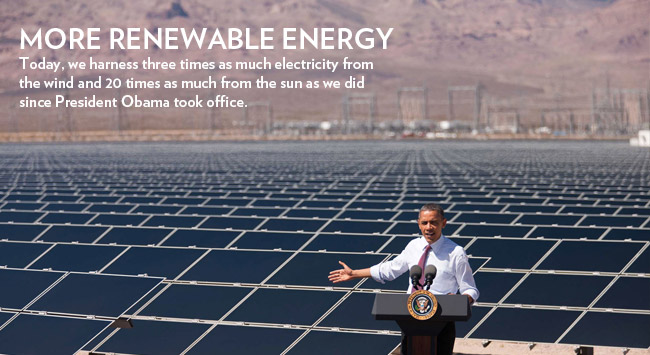
Since the President took office, U.S. production of electricity from wind has more than tripled, production of electricity from solar is up more than ten-fold, and production of oil and gas has grown each year. Today, the U.S. is the world’s leading producer of oil and natural gas.
Let’s drill down on the facts:
- According to Energy Information Agency (EIA) estimates, U.S. crude oil production averaged more than 7.4 million barrels per day (bpd) in 2013, up from 5.0 million bpd in 2008. And that was just last year: EIA expects production to increase to more than 8.4 million bpd in 2014; U.S. crude oil production averaged nearly 8.2 million bpd in March already.
- Domestic natural gas production is on pace to set a new record high in 2014. EIA estimates marketed production averaged more than 72 billion cubic feet per day in March, up more than 5 percent from March of last year and up nearly 25 percent from 2008.
- The number of oil and gas drilling rigs has grown over the last four years. As of April 2014, there were 1,835 operating oil and gas rigs, up over 18 percent from 1,553 when President Obama took office in January 2009.
Learn more about Energy and EnvironmentOur Climate Action Progress: One-Year Report
Posted by on June 25, 2014 at 10:44 AM EDT
President Barack Obama delivers remarks on climate change, at Georgetown University in Washington, D.C., June 25, 2013. (Official White House Photo by Pete Souza)
The effects of climate change are already being felt across the nation. In the past three decades, the percentage of Americans with asthma has more than doubled, and climate change is putting those Americans at greater risk of landing in the hospital. The impacts of extreme weather events – from more severe droughts and wildfires in the West, to more powerful hurricanes and record heat waves – are hitting communities across the country. These changes come with far-reaching consequences and real economic costs.
At the same time, clean energy represents a significant economic opportunity, and we know we can meet this challenge in a way that advances our economy, our environment, and public health at the same time.
That is why, on this day last year, President Obama announced his Climate Action Plan – a comprehensive plan to cut carbon pollution, prepare the United States for the impacts of climate change, and lead international efforts to combat global climate change.
One year later, the Administration has made real progress in advancing the goals in the President’s Climate Action Plan. The policies President Obama has put forward in just one year – when implemented – are expected to cut nearly 3 billion tons of carbon pollution between 2020 and 2025. That’s an amount equivalent to taking more than 600 million cars off the road for a year.
Learn more about Energy and EnvironmentWe the Geeks: SUBMERGED!
Posted by on June 23, 2014 at 1:13 PM EDTWhat better way dive into ocean science than to hear from an expert living 63 feet below the surface? To celebrate the end of National Oceans Month and one year of progress on President Obama’s Climate Action Plan, the White House and the Weather Channel will host “We the Geeks: SUBMERGED!” this Wednesday, June 25, at 2:00 p.m. ET.
Learn more about Energy and Environment, TechnologyLocal Businesses, Leaders, and Non-profits Working in Unison to Prepare for Climate Change Impacts in California
Posted by on June 20, 2014 at 3:04 PM EDT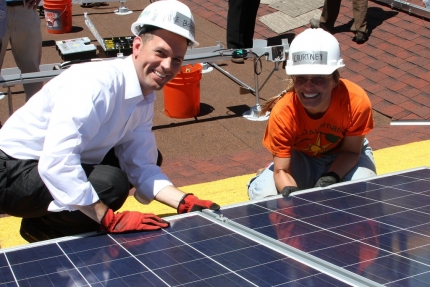
GRID Alternatives Team Leader Courtney helps Acting Chair Boots with his first solar panel installation (Photo from GRID Alternatives)
As the impacts of climate changes become more and more prevalent, the Administration is working hard to create a cleaner, safer and more resilient nation. This week, during a trip to San Jose and San Francisco, Calif., I was able to see firsthand the steps Americans are taking to move towards a clean energy economy and prepare communities for the impacts of climate change.
Yesterday, I joined state and local leaders for a tour of projects focused on building resilience to climate impacts, including sea level rise, at Ocean Beach in San Francisco. Beach erosion has forced the closure of a section of the Great Highway along the City’s Pacific coast and threatens critical wastewater infrastructure. In response, the City of San Francisco has undertaken an unprecedented and expedited collaboration of city, state, and federal agencies—as well as community stakeholders—to implement a sustainable approach to coastal management.
The President knows that the best ideas come from the communities facing the worst of climate change impacts, which is why he established a task force of 26 state, local, and tribal leaders to advise him on what they need from the Federal Government to build resilience in their communities. I’ve had the opportunity to meet with many of these leaders on a regular basis, and the innovation they’ve shown at the community level is truly impressive and already informing the way that we’re developing our policies back in Washington.
Great ideas are also coming from the private sector. Yesterday, at the Silicon Valley Energy Summit at Stanford University I spoke with stakeholders, entrepreneurs, investors, and businesses about new energy innovations and advancements in the United States. It was rewarding to be on stage alongside former Secretary of State, George Shultz, who has been a true leader on the challenging issue of climate change.
Thanks in part to the Obama Administration’s investment in clean energy – the largest in American history – the United States has more than doubled renewable energy generation from wind, solar, and geothermal sources since 2008. Solar jobs have jumped dramatically in recent years, and it has been growing at a rate faster than any other sector in the country. The costs of solar panels are decreasing, too.
Earlier this spring, President Obama called for private and public sector commitments to create jobs by advancing solar deployment and energy efficiency. GRID Alternatives, a non-profit in California, responded to this call along with more than 300 other organizations from the private and public sector. Specifically, GRID Alternatives committed to help install 100 MW of solar power on low-income housing across the country by 2024.
Wednesday, in San Jose, I was able to participate in one of these solar power installations for a local homeowner with GRID Alternatives co-founders Erica Mackie and Tim Sears. On the roof with a group of inspiring volunteers, I installed a solar panel for the first time and the homeowner told me how excited she was about her energy bills decreasing.
It has never been more evident that we’re transitioning to a clean energy economy, and becoming a country that’s resilient to the impacts of climate change. With the right innovation, investment and commitment, America is on the way to achieving both a healthy economy and a healthy environment.
Mike Boots is Acting Chair of the White House Council on Environmental Quality.
Learn more about Energy and EnvironmentThe Overwhelming Consensus of Climate Scientists Worldwide
Posted by on June 20, 2014 at 11:30 AM EDTOverwhelmingly, scientific evidence – including millions of measurements and observations of Earth from land, air, sea, and space – is telling us that:
- the global climate has been changing over the past several decades in a manner that is highly unusual compared to nature climatic variability;
- human emissions of greenhouse gases are the dominant cause of these unusual changes;
- these changes are already having significant adverse impacts on human wellbeing and on ecosystems; and
- that this harm will continue to grow unless and unless the offending emissions are greatly reduced.
The extremely rigorous and thorough 2013 and 2014 working group reports of the Intergovernmental Panel on Climate Change (IPCC), each developed by hundreds of scientists and technical experts from around the world, as well as the massive third U.S. national Climate Assessment, which was developed by more than 300 of the Nation’s top climate scientists and released by the Obama Administration last month, have further strengthened these fundamental scientific understandings.
I encourage anyone who questions whether there is widespread agreement among scientists about the reality and causes of climate change to read the selections provided below from these recent reports and earlier studies and statements by scientific leaders from around the world.
Learn more about Energy and Environment
- &lsaquo previous
- …
- 29
- 30
- 31
- 32
- 33
- 34
- 35
- 36
- 37
- …
- next &rsaquo
Related Videos
-
 May 09, 2014 9:21 AM
Inside the White House: Solar Panels
-
 September 01, 2016 9:25 PM
President Obama Delivers a Statement to the Press
White House Blogs
- The White House Blog
- Middle Class Task Force
- Council of Economic Advisers
- Council on Environmental Quality
- Council on Women and Girls
- Office of Intergovernmental Affairs
- Office of Management and Budget
- Office of Public Engagement
- Office of Science & Tech Policy
- Office of Urban Affairs
- Open Government
- Faith and Neighborhood Partnerships
- Social Innovation and Civic Participation
- US Trade Representative
- Office National Drug Control Policy