Energy and Environment Latest News
New Steps to Protect Pollinators, Critical Contributors to Our Nation’s Economy
Posted by on June 20, 2014 at 11:18 AM EDTToday, President Obama issued a memorandum directing U.S. government agencies to take additional steps to protect and restore domestic populations of pollinators, including honey bees, native bees, birds, bats, and butterflies – critical contributors to our nation’s economy, food system, and environmental health.
Pollinators contribute substantially to the sustainability of our food production systems, the economic vitality of the agricultural sector, and the health of the environment. Honey bee pollination alone adds more than $15 billion in value to agricultural crops in the United States each year, and pollination by other species adds another $9 billion. In addition, pollinators help wild flowering plants grow, making ecosystems stronger and more resilient.
But for decades, pollinator populations in the United States have been falling. The number of managed U.S. honey bee colonies dropped from 6 million colonies in 1947, to 4 million in 1970, 3 million in 1990, and just 2.5 million today. And last winter, the Monarch butterfly migration across North America was smaller than all previous migrations on record, and there is a risk that this iconic migration could end. These numbers highlight the importance of taking immediate steps to address these alarming declines and ensure the sustainability of our nation’s food production systems, economy, and environment.
Learn more about Energy and EnvironmentAccelerating Green Technology Transfer to Impact American Lives
Posted by on June 17, 2014 at 11:04 AM EDTSince the start of the Obama Administration, being a responsible steward of our planet is a role that President Obama has embraced through action and example. Accelerated development and deployment of green technology is a critical part of supporting sustainable growth, and the Administration has gone to great lengths to bring cutting-edge green technology from development stages to real-world application. Whether by cutting pollution, unleashing troves of climate data to empower American communities to prepare for the future, or leading international efforts to combat global climate change, agencies across the Administration are taking bold actions to grow the economy while leaving a green legacy for future generations.
As President Obama said in his State of the Union address earlier this year, “We know that the nation that goes all-in on innovation today will own the global economy tomorrow. This is an edge America cannot surrender. Federally-funded research helped lead to the ideas and inventions behind Google and smartphones.” Some of the most exciting breakthroughs in green technology are likewise getting their start in our federal labs on a daily basis, including:
- A game-changing technology under development by the U.S. Navy that creates fuel from seawater by recovering carbon dioxide and hydrogen and converting them into a liquid hydrocarbon fuel. Earlier this month, an internal combustion powered model aircraft took the first ever flight fueled by seawater as carbon feedstock;
- An ultrafast DC charging system that can charge an electric vehicle in 15 minutes, developed by Argonne National Laboratory. The government-developed charging system can add 60 to 80 miles of range to an electric vehicle on a single, 15-minute charge, and has the potential to be accessed through smartgrid and wireless charging communication;
- A breakthrough geothermal heat pump developed by Oak Ridge National Laboratory in partnership with the company ClimateMaster, which can help save money and energy by increasing efficiency;
- A new technology to remove hazardous heavy metals from water streams, developed through a partnership with the Environmental Protection Agency;
- A prize-winning process from the National Energy Technology Laboratory that improves the capture of carbon dioxide from power plants while reducing the cost.
Learn more about Energy and Environment, TechnologyPresident Obama Speaks on Climate Change at UC Irvine Commencement Ceremony
Posted by on June 16, 2014 at 1:42 PM EDTOn Saturday afternoon, President Obama addressed the University of California, Irvine's 2014 graduating class and challenged them to get involved in one of our planet's most pressing issues: the growing threat of a rapidly changing climate.
Speaking to more than 30,000 people in attendance at Angel Stadium in Anaheim, the President told the UC Irvine community that he was there for one simple reason: because they asked.
"The UC Irvine community sent 10,000 postcards to the White House asking me to come speak today," the President said. Some people tried to guilt him into coming, while others tried bribery. "I'll support the Chicago Bulls," someone wrote. And another student wanted the President to speak because she thought UC Irvine was "super underrated."
Learn more about Energy and EnvironmentVice President Biden on America’s Energy Future: “I Wouldn’t Go Long on Investments that Lead to Carbon Pollution”
Posted by on June 13, 2014 at 9:45 AM EDT
Vice President Biden delivers remarks at the North American Energy Summit in New York City, June 11, 2014. (Official White House Photo by David Lienemann)
On Wednesday, at the North American Energy Summit in New York City, Vice President Biden spoke with an audience of investors, business executives, and senior government officials from the United States, Canada, and Mexico about North America’s emerging status as the global epicenter of energy.
The Vice President described the progress we’ve made toward increased energy security in the past few years. The United States has gone from the world’s largest importer to a soon-to-be exporter of natural gas, from declining to booming oil production, from stagnating to increasing fuel efficiency standards for vehicles, and from projected rising carbon emissions to declining carbon emissions that are at the lowest levels in nearly 20 years.
As an energy superpower, the United States is leading an energy transformation that is changing the world and creating opportunity here at home. Hundreds of thousands of jobs are being created, new companies and industries are spinning off, and manufacturing — in part because of America’s energy advantage — is coming back.
Learn more about Energy and EnvironmentA Step Toward Cleaner Air and Healthier Communities
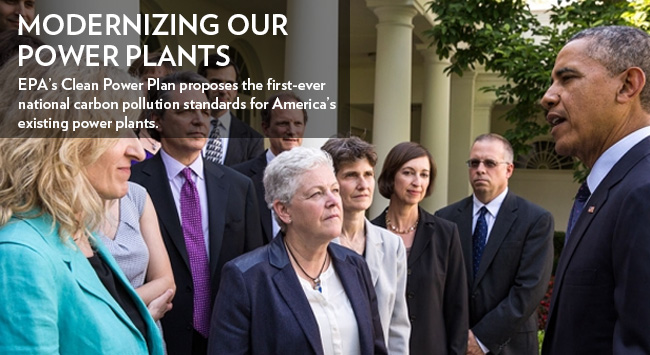
Posted by on June 11, 2014 at 5:14 PM EDTLast week, the Environmental Protection Agency released a vital component of the President’s Climate Action Plan – proposed common-sense carbon pollution standards for existing power plants. Since air pollution from power plants can worsen asthma and other breathing problems, EPA’s guidelines will help protect the health of vulnerable Americans, including children and the elderly.
In a big step forward, yesterday the American Medical Association’s House of Delegates, a body representing more than 500 medical associations and organizations, voted to formally reaffirm their support for carbon pollution standards for power plants and committed to submit comments on the EPA’s proposal underscoring the need to keep strong standards that protect public health. AMA’s vote puts them alongside other public health organizations that have taken leadership on this issue, including the American Thoracic Society and the American Lung Association.
In addition to cutting carbon emissions from the power sector by about 30 percent from 2005 levels by 2030, EPA’s plan will also decrease that sector’s emissions of particulate matter, nitrogen oxides, and sulfur dioxide by about 25 percent. From the soot and smog reductions alone, for every dollar invested through the Clean Power Plan, American families will see up to $7 in health benefits.
In the first year that these standards go into effect, up to 100,000 asthma attacks and up to 2,100 heart attacks will be prevented. These standards will also help more kids to be healthy enough to show up to school – with up to 72,000 fewer absences in the first year. The benefits increase each year from there.
It’s a big step toward cleaner air and better public health.
Learn more about Energy and EnvironmentPresident Obama on Student Loan Debt: “No Hardworking Young Person Should Be Priced Out of a Higher Education”
Posted by on June 11, 2014 at 10:31 AM EDTEd. note: This is cross-posted on The White House Blog. See the original post here.
More students than ever before are relying on student loans to pay for their college education. 71 percent of students earning a bachelor's degree graduate with debt, averaging $29,400. While most students are able to repay their loans, many feel burdened by debt, especially as they seek to start a family, buy a home, launch a business, or save for retirement.
That's why, as part of his year of action to expand opportunity for all Americans, President Obama is taking steps to make student loan debt more affordable and manageable to repay.
The President signed a memorandum directing the Secretary of Education to propose regulations that would allow nearly 5 million federal direct student loan borrowers the opportunity to cap their student loan payments at 10 percent of their income. The memorandum also outlines new executive actions to support federal student loan borrowers, especially vulnerable borrowers who may be at greater risk of defaulting on their loans.
But in his remarks at the signing, the President made clear that Congress needs to take action as well, saying that today's executive action will “make progress, but not enough.” He brought up the bill written by Sen. Elizabeth Warren that would allow students to refinance their student loans at today's lower interest rates, noting that “it pays for itself by closing loopholes that allow some millionaires to pay a lower tax rate than middle-class families.”
The President then detoured briefly from his prepared remarks, explaining why it's a “no-brainer” for Congress to pass the bill:
You would think that if somebody like me has done really well in part because the country has invested in them, that they wouldn’t mind at least paying the same rate as a teacher or a nurse. There’s not a good economic argument for it, that they should pay a lower rate. It’s just clout, that’s all. So it’s bad enough that that’s already happening. It would be scandalous if we allowed those kinds of tax loopholes for the very, very fortunate to survive while students are having trouble just getting started in their lives.
So you’ve got a pretty straightforward bill here. And this week, Congress will vote on that bill. And I want Americans to pay attention to see where their lawmakers’ priorities lie here: lower tax bills for millionaires, or lower student loan bills for the middle class.
“This week, [Congress has] a chance to help millions of young people,” President Obama said. “I hope they do. ... And in the meantime, I’m going to take these actions today on behalf of all these young people here, and every striving young American who shares my belief that this is a place where you can still make it if you try.”
Read the President's full remarks from the signing, and learn more about how the President is working to make college more affordable.
You can watch the video here: http://www.youtube.com/watch?v=Mz5prW9iw14
Learn more about , , Energy and Environment
- &lsaquo previous
- …
- 30
- 31
- 32
- 33
- 34
- 35
- 36
- 37
- 38
- …
- next &rsaquo
Related Videos
-
 May 09, 2014 9:21 AM
Inside the White House: Solar Panels
-
 September 01, 2016 9:25 PM
President Obama Delivers a Statement to the Press
White House Blogs
- The White House Blog
- Middle Class Task Force
- Council of Economic Advisers
- Council on Environmental Quality
- Council on Women and Girls
- Office of Intergovernmental Affairs
- Office of Management and Budget
- Office of Public Engagement
- Office of Science & Tech Policy
- Office of Urban Affairs
- Open Government
- Faith and Neighborhood Partnerships
- Social Innovation and Civic Participation
- US Trade Representative
- Office National Drug Control Policy