Energy and Environment Latest News
GreenGov: Connecting Government and the Private Sector
Posted by on May 20, 2014 at 11:32 AM EDTEarlier this month, the President announced $2 billion in new commitments in energy efficiency by the Federal Government through the use of energy performance contracts, a great example of how the Administration is working with the private sector to improve energy efficiency. All over the country, Federal agencies are leading by example by using less energy, cutting costs, and reducing harmful greenhouse gas emissions. But the Federal Government can’t do it alone. Partnerships between the Federal Government and private sector make commitments to energy efficiency and sustainability a reality.
Last week, the Council on Environmental Quality hosted the GreenGov Workshop on Renewable Energy Purchasing and Development, which brought together Federal agency directors, private sector leaders, and a wide range of other stakeholders committed to clean energy. The workshop encouraged dynamic conversation on the importance of renewable energy for the future of both business and the Federal government.
Presenters, including keynote speaker Secretary of the Navy Ray Mabus, shared lessons learned and innovations in renewable energy deployment for Federal agencies, the use of alternative financing for renewable energy investments, and success stories from both industry and the Federal government. Private sector partners offered their perspective on improving the contracting process while Federal agency presenters provided examples of innovations such as using previously contaminated lands for renewable energy siting and sharing contracting expertise between agencies.
The President firmly believes that the Federal Government should lead by example in improving energy and cutting harmful carbon pollution, which is why he set aggressive targets for Federal agencies for reducing their energy use, greenhouse gas emissions, and water use. Through this initiative, the Federal Government – the largest energy consumer in the U.S. economy – has already reduced its greenhouse gas emissions by 17 percent – the equivalent of permanently taking 1.8 million cars off the road. As we envision a future that is more resilient to climate change, it is imperative to understand the value of partnerships between the Federal government and the private sector. GreenGov helps strengthen those partnerships and build a more energy efficient future.
As two new additions to the Council on Environmental Quality, we’re looking forward to working with Federal agencies and the private sector to keep leading by example.
Kate Brandt is the Federal Environmental Executive and Angela Barranco is the Associate Director for Public Engagement at the White House Council on Environmental Quality.
Learn more about Energy and EnvironmentWest Wing Week 05/16/14 or, “Go Solar!”
Posted by on May 16, 2014 at 6:15 PM EDTThis week, the President praised the power of solar, honored this year's TOP COPS, awarded the Medal of Honor and traveled to New York for the opening of the National September 11 Memorial & Museum.
The State of Our Climate: A Google+ Hangout with Secretary Moniz and Administrator McCarthy
Posted by on May 14, 2014 at 11:19 AM EDTClimate change is not a distant threat – it's affecting us right now. That's why earlier this month, as part of President Obama's plan to act on climate change, the Administration released the third National Climate Assessment, which breaks down the current and projected impacts of climate change on every region of the country and key sectors of our economy.
On Monday, May 19 at 1:00 p.m. ET, join the website Grist.org, Energy Secretary Ernest Moniz, EPA Administrator Gina McCarthy, and the White House for a Google+ Hangout. We'll be chatting about climate change and the steps we're taking to reduce carbon pollution, prepare for the impacts of climate change, and build a clean energy economy – including an upcoming rule that would cut carbon pollution from existing power plants.
Have questions? Secretary Moniz and Administrator McCarthy will answer them during the event. Ask using the hashtag #WHClimateChat on Twitter, Google+, and Facebook.
Watch the Hangout live at 1:00 p.m. ET on Monday, May 19 on the White House Google+ page.
To learn more, check out the latest on President Obama's Climate Action Plan.
Learn more about Energy and EnvironmentChanging the Way We Use Energy to Move America Forward
Posted by on May 9, 2014 at 3:01 PM EDT
President Barack Obama delivers remarks on energy efficiency, at the Walmart in Mountain View, California, May 9, 2014. (Official White House Photo by Pete Souza)
Today in Mountain View, California President Obama stopped by a business that's making big changes to the way it uses energy.
It's a big store in fact, and one that millions of Americans have in their own hometowns: Walmart.
But this isn't your typical Walmart, President Obama said.
"A few years ago, you decided to put solar panels on the roof of the store," he explained. "You replaced some traditional light bulbs with LEDs. You made refrigerator cases more efficient. And you even put in a charging station for electric vehicles."
Those upgrades are helping Mountain View's Walmart save money on its energy bills -- and created dozens of construction jobs in the process.
"More and more companies like Walmart are realizing that wasting less energy isn't just good for the planet. It's good for business," he said. "And it means jobs."
Today President Obama announced several new steps that build on the 20 executive actions he's already taken this year to create jobs and opportunity for more Americans -- new steps that will help generate more clean energy, waste less energy overall, and leave our kids and grandkids a cleaner, safer planet in the process.
Learn more about Energy and EnvironmentLeading by Example to Reduce Carbon Pollution and Waste Less Energy
Posted by on May 9, 2014 at 2:53 PM EDTIn his speech at Georgetown University last summer, President Obama laid out his plan to cut the carbon pollution that drives climate change. One of the ways he said we can do that is through wasting less energy – which will save money for American families, businesses, and the Federal Government.
Following up on that commitment, the President today announced that the Administration is doubling down on energy efficiency in Federal buildings with an additional $2 billion investment in energy upgrades to federal buildings over the next three years. This investment, when combined with the President’s initial 2011 commitment of $2 billion, makes for a total of $4 billion in performance contracts through 2016. This means that the Federal Government will be using long term energy savings to pay for up-front costs, at no net cost to taxpayers.
Energy Performance Contracts drive economic development, utilize private sector innovation, and increase efficiency. They have received broad bipartisan support, along with support from the National Association of Manufacturers and the Chamber of Commerce. The President’s investment in energy upgrades will save billions in energy costs, promote energy independence, and create tens of thousands of jobs in the hard-hit construction sector. We’ve already seen impressive progress here – actual savings through the use of performance contracts has far exceeded the savings guaranteed by the contracts.
The President firmly believes that the Federal Government should lead by example in improving energy efficiency and cutting harmful carbon pollution, which is why he set aggressive targets for Federal agencies for reducing their energy use, greenhouse gas emissions, and water use. Through this initiative, the Federal Government – the largest energy consumer in the U.S. economy – has already reduced its greenhouse gas emissions by 17 percent, the equivalent of permanently taking 1.8 million cars off the road. Today, building on these efforts, the White House announced that it has completed installation of American-made solar panels on the First Family’s residence as a part of an energy retrofit that will improve the overall energy efficiency of the building. The retrofit includes the installation of energy-saving equipment such as updated building controls and variable speed fans, as well as 6.3 kilowatts of solar generation. Watch the behind the scenes installation of solar panels on the roof of the residence here: https://www.youtube.com/watch?v=ORni8uiuslI
Acting on climate is more urgent than ever. The third National Climate Assessment that was released on Tuesday showed that climate change is already affecting every region of the United States as well as key sectors of our economy. The additional investment in energy upgrades for Federal buildings will help improve energy efficiency across the economy and reduce the carbon pollution that drives climate change.
Mike Boots is Acting Chair of the White House Council on Environmental Quality.
Learn more about , Energy and EnvironmentCommitting to a Clean Energy Future
Posted by on May 9, 2014 at 2:44 PM EDTIn his State of the Union address, President Obama pledged to make 2014 a year of action. And today, we announced new ways we’re taking action to advance clean energy and create opportunity for hardworking Americans. The Obama Administration has made historic investments in the research, development, and deployment of clean energy. And these investments are paying off; solar power provides a strong example.
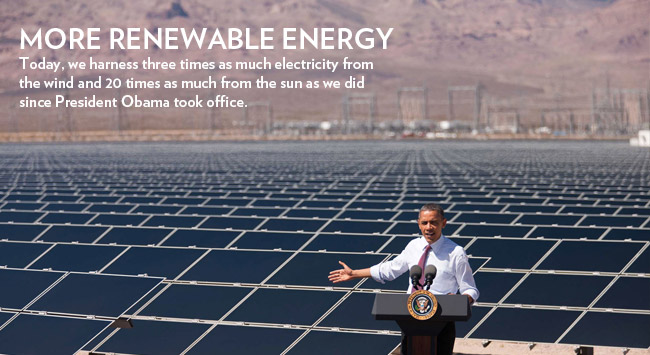
Since President Obama took office, U.S. solar generation has grown more than ten-fold. Since 2011 alone, the cost of a solar energy system has dropped by more than 50 percent. And last year, about one quarter of new power generation capacity came from solar.
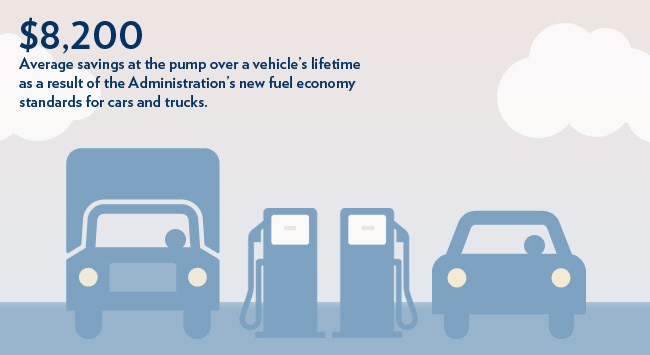
We know that solar is winning in America: It’s good for our environment, our economy, and our energy security. But it’s not alone. Energy efficiency is one of the easiest and cheapest tools we have for combating climate change while expanding opportunity. That’s why the Obama Administration has developed efficiency measures, such as new appliance standards, that will cut carbon pollution and save consumers billions on their utility bills in the next two decades. The Energy Department has partnered with 190 organizations through the Better Buildings Challenge to advance energy efficiency over the next 10 years – and they are making tremendous progress. And fuel economy standards for our cars and trucks mean we are – and will continue to be – less reliant on foreign oil.
But there’s more we can do. That’s why today we announced new executive actions to cut energy waste, create jobs, and reduce carbon pollution. These initiatives will help build a skilled solar workforce, provide innovative financing for deploying solar, improve appliance efficiency, strengthen building codes, and drive investment in energy upgrades to federal buildings. You can read more about our announcements on this fact sheet.
We’re making great progress. But we can’t do it alone. That’s why we asked leaders from every sector to build on the momentum that’s driving solar deployment and efficiency investments throughout the country – and make a commitment to do more.
Learn more about Energy and Environment
- &lsaquo previous
- …
- 34
- 35
- 36
- 37
- 38
- 39
- 40
- 41
- 42
- …
- next &rsaquo
Related Videos
-
 May 09, 2014 9:21 AM
Inside the White House: Solar Panels
-
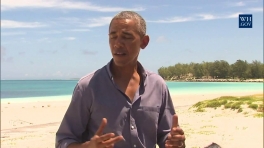 September 01, 2016 9:25 PM
President Obama Delivers a Statement to the Press
White House Blogs
- The White House Blog
- Middle Class Task Force
- Council of Economic Advisers
- Council on Environmental Quality
- Council on Women and Girls
- Office of Intergovernmental Affairs
- Office of Management and Budget
- Office of Public Engagement
- Office of Science & Tech Policy
- Office of Urban Affairs
- Open Government
- Faith and Neighborhood Partnerships
- Social Innovation and Civic Participation
- US Trade Representative
- Office National Drug Control Policy