
Energy and Environment Latest News
West Wing Week 03/14/14 or "What's Up, Captain America?"
Posted by on March 14, 2014 at 12:00 AM EDTThis week, the Vice President and Dr. Biden traveled to Chile to attend the President's inauguration, while the President worked on improving access to college for students, raising the minimum wage, and negotiating a peaceful settlement to the conflict in Ukraine. He also got out the word about this year's March 31st deadline for health insurance applications, congratulated NCAA champs, and designated a new national monument.
Creating New Opportunities For Americans To Buy Green Homes
Posted by on March 13, 2014 at 12:49 PM EDTEd. Note: This is cross-posted from the U.S. Department of Housing and Urban Development
This week, HUD partnered with the White House to host a Green Mortgage Appraisal Roundtable with national leaders from the lending, realtor, homebuilding and appraisal industries.
The roundtable discussion was an initiative of President Obama’s Climate Action Plan and one more step in a series of actions the Administration is taking to accelerate the adoption and use of energy efficient improvements in single-family homes. The event highlighted actions both the Federal government and industry can take to achieve market transformation in this area. We discussed ways that industry leaders can address key challenges when valuing high performance, energy efficient single-family homes and improvements.
For many Americans, this is a key “pocketbook issue.” According to the National Association of Realtors’ Annual Home Buyer/Seller Profile, 87 percent of people surveyed said a home’s heating and cooling costs were “important” or “very important.”
There has been a substantial increase in interest in energy efficient or green homes – as well as solar energy – in America. Energy Star Certified Homes now account for as much as a third of all new homes and the number of homes built to such green standards as LEED for Homes, Enterprise Green Communities Criteria, the National Green Building Standard, and regional or local certifications, continues to grow.
With help from Administration programs at HUD and the Department of Energy, the industry has been working to meet this rapidly growing demand. Between 2009 and 2012, more than 1.25 million existing homes were upgraded to improve their energy efficiency.
We are also expanding the toolkits of consumers and the housing industry to make sure energy information is being shared. The Department of Energy’s Home Energy Score offers a “miles per gallon” type rating that can easily be applied to homes across the country. The Federal Housing Authority (FHA) has made significant progress in updating existing policy for its energy efficient mortgages. These steps include:
- Making it easier to use the FHA PowerSaver program for home energy retrofit loans;
- Updating the FHA energy efficiency policies, including solar and wind technologies, weatherization and the Energy Efficient Mortgage;
And the housing industry has also taken key steps to help homeowners better understand the quality of energy efficient homes. Qualified assessors now score homes on a scale of 1 to 10 and provide recommendations for cost effective efficiency improvements. A growing number of Multiple Listing Services include green data fields and toolkits in their markets. Appraisers are also developing energy efficient appraisal reports, tools, and training that have the potential to catalyze the industry.
Early evidence is showing that these are not only smart investments for long-term cost savings and our environment, but they are also having “contributory value” for homeowners. A recent study by the University of North Carolina with IMT showed that loans on Energy Star Certified Homes are a good bet - foreclosure rates are one third lower than non- Energy Star homes.
The roundtable was also an important forum for assessing the barriers to accurate and reliable valuation of energy efficient or green homes, and identifying actions financial institutions, government agencies, builders, appraisers, and realtors can take to support these efforts. Working together with the housing industry, we can improve the way American’s buy their homes, save middle-class families money, and help preserve our environment.
Carol Galante is the Federal Housing Administration (FHA) Commissioner and Assistant Secretary for Housing and Harriet Tregoning is the Director of the Office of Economic Resilience.
Learn more about , Energy and EnvironmentCEQ Welcomes New General Counsel
Posted by on March 5, 2014 at 10:19 AM EDT
(by EPA)
I am pleased to announce that next month, Brenda Mallory will join the Council on Environmental Quality to serve as our General Counsel. Brenda brings 28 years of experience that will support our work to cut carbon pollution, build a clean energy economy, and protect our air, land and water.
Brenda's service includes substantial work in both the public and private sectors. Since 2010, she has been the Environmental Protection Agency's Principal Deputy General Counsel, where she oversaw management of the Office of General Counsel and served as Acting General Counsel in 2013. Before that, Brenda was the Associate General Counsel for the Pesticides and Toxic Substances Law Office, which advises EPA on both policy and litigation. Her other EPA leadership positions have included Associate Deputy General Counsel for water and waste issues, Special Assistant in the Administrator's Office, and EPA's representative on a White House task force that focused on energy project reviews and permitting.
In 2012, Brenda received the Government Attorney of the Year award from the American Bar Association Section of Environment, Energy, and Resources. Before joining EPA, Brenda spent 17 years in private practice, 15 of which were with the environmental law firm Beveridge and Diamond, where she was a partner and Chair of its Natural Resources Practice Group. Brenda is a 1983 graduate of Columbia Law School and a 1979 graduate of Yale College.
Brenda will be a valuable part of the team working across the Administration to meet President Obama's energy and environmental goals. I look forward to working with her to continue driving progress toward the President's commitment to addressing climate change, protecting the places and natural resources Americans care about, and supporting healthy, prosperous communities.
Mike Boots is Acting Chair of the White House Council on Environmental Quality.
Learn more about Energy and EnvironmentPreparing Now for Our Climate Future
Posted by on March 4, 2014 at 12:39 PM EDTOur climate is changing. We are not just seeing global increases in air and ocean temperatures, we are seeing changes across the United States: extended periods of unusual heat, a greater number of heavier downpours, more severe regional drought and wildfires in parts of the American West, permafrost thawing in Alaska, ocean acidification, and sea-level rise threatening coastal communities. At the same time, much of our Nation’s infrastructure has been designed for the climate that we have had, and not the changing climate we now are experiencing and can expect in the future.
President Obama believes we have a moral obligation to future generations to leave them a planet that is not polluted and damaged. That’s why, last year, he launched a comprehensive Climate Action Plan to reduce the carbon pollution that contributes to climate change, prepare for the impacts of a changing climate on American communities and businesses, and lead international efforts to address this global challenge.
Even as we act to reduce carbon pollution, we know some impacts of climate change are already unavoidable. The Federal Government has an obligation to support American communities by protecting critical infrastructure and natural resources, advancing science that informs planning and investments, establishing policies that promote resilience, and ensuring that Federal operations and facilities continue to protect and serve citizens in a changing climate. The President’s Climate Action Plan prioritizes this work and integrates consideration of climate impacts and risks into Federal programs so that we are making the best possible use of our taxpayer dollars.
In his Budget Request for Fiscal Year 2015 being transmitted to Congress today, President Obama is following through on those commitments and taking a wide range of steps to “up our game” in promoting preparedness for, and resilience against, the impacts of climate change. This includes robust support for State, local, and tribal preparedness efforts, analysis of vulnerabilities of critical infrastructure, creation of incentives to address those vulnerabilities, and development and dissemination of better information and planning tools.
Learn more about Energy and EnvironmentNew Clean Car and Fuel Standards Build the President's Clean Air Legacy
Posted by on March 3, 2014 at 5:30 PM EDTToday, the Environmental Protection Agency (EPA) took action to significantly cut smog, soot and other harmful air pollution from our cars and trucks. The new clean car and fuel standards – which are strongly supported by automakers, public health groups and other stakeholders – require better-performing pollution controls in vehicles, and cleaner gasoline. Cleaner gasoline will reduce pollution from cars and trucks that are currently on the road, and also enable fuel-efficient and low-emissions technologies to work better in new vehicles. That means cleaner air across the country, especially for the more than 50 million people who live, work, or go to school near high-traffic roadways.
These new standards represent a major step in the President’s work to improve air quality and public health in our communities. And they build on an already-strong record that includes:
- first-ever national limits on mercury and other toxic pollution from power plants
- long-overdue limits on toxic air pollution from industrial boilers and incinerators
- rules to cut smog-forming pollutants from oil and gas wells, and
- tighter air quality standards for particulate pollution (or soot), reflecting new science about dangerous health impacts
Together, the Administration’s actions are making our cities and towns healthier places to live, work, and raise a family. They will help prevent tens of thousands of premature deaths, tens of thousands heart attacks and hospital visits, and hundreds of thousands of childhood asthma attacks.
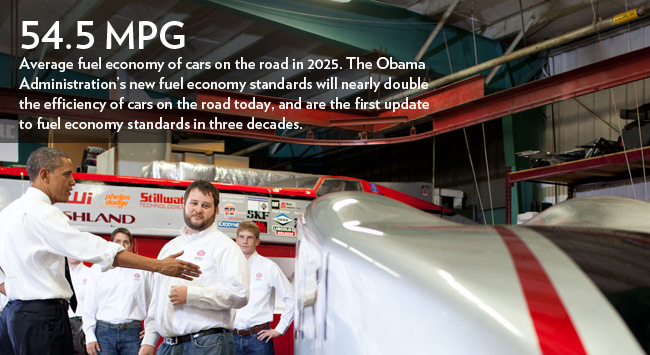
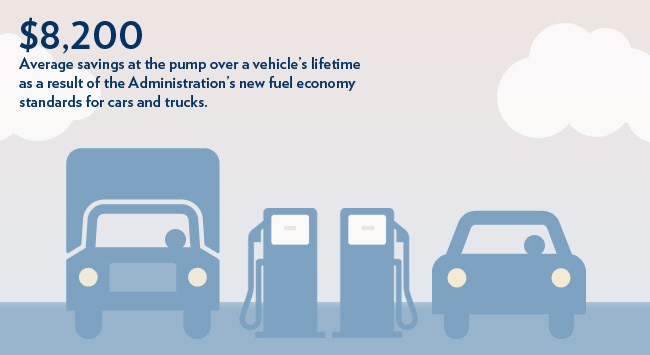
Today’s action also rounds out the Administration’s national clean car program. By cutting the pollution that causes smog and soot, these clean air standards work in tandem with the Administration’s standards that are reducing the carbon pollution that causes climate change and improving fuel efficiency. Those standards, finalized in 2012, will roughly double the miles our cars go on a gallon of gas. For owners of a new car in 2025, that means net savings equivalent to $1 per gallon on every visit to the gas pump.
Because the Administration’s clean car program benefits consumers, workers, businesses, and the environment, it has been met with strong support. The President’s fuel efficiency standards were supported by auto workers, consumer groups, environmental organizations, and auto manufacturers representing over 90% of U.S. auto sales. Similarly, the clean air standards announced today are supported by a broad group of stakeholders, including automakers, auto workers, consumer groups, environmental organizations, states, and cities.
More information on the new clean car and fuel standards can be found here
See what people are saying about the new clean car and fuel standards here
Drew McConville is Senior Advisor to the Chair of the White House Council on Environmental Quality
Learn more about Energy and EnvironmentCleaner Cars, Cleaner Fuels, and a Cleaner Bill of Health
Posted by on March 3, 2014 at 11:55 AM EDTEd. note: This is cross-posted from the EPA Connect blog. See the original post here.
Today I’m thrilled to announce EPA’s new clean fuel and vehicle standards that are a win for public health, a win for our environment, and a win for our wallets. These “Tier 3” emission standards for cars and gasoline will significantly reduce harmful emissions, prevent thousands of premature deaths and illnesses, and encourage innovation and technological improvements in the cars and trucks we drive.
By reducing gasoline sulfur levels by more than 60% (down from 30 to 10 parts per million (ppm) in 2017), vehicle emission control technologies can perform more efficiently, both on existing vehicles and on new ones. The new Tier 3 standards will also slash a range of harmful pollutants that can cause premature death and respiratory illnesses. They will reduce smog-forming volatile organic compounds (VOC) and nitrogen oxides (NOX) by 80%, establish a 70% tighter particulate matter standard (PM2.5), and virtually eliminate fuel vapor emissions.
 Learn more about Energy and Environment
- &lsaquo previous
- …
- 38
- 39
- 40
- 41
- 42
- 43
- 44
- 45
- 46
- …
- next &rsaquo
Related Videos
-
 May 09, 2014 9:21 AM
Inside the White House: Solar Panels
-
 September 01, 2016 9:25 PM
President Obama Delivers a Statement to the Press
White House Blogs
- The White House Blog
- Middle Class Task Force
- Council of Economic Advisers
- Council on Environmental Quality
- Council on Women and Girls
- Office of Intergovernmental Affairs
- Office of Management and Budget
- Office of Public Engagement
- Office of Science & Tech Policy
- Office of Urban Affairs
- Open Government
- Faith and Neighborhood Partnerships
- Social Innovation and Civic Participation
- US Trade Representative
- Office National Drug Control Policy