Energy and Environment Latest News
Recognizing American Communities as Climate Action Champions
Posted by on October 1, 2014 at 9:54 AM EDTFrom more frequent and extreme storms to higher average temperatures and rising seas, Americans today are experiencing first-hand what climate change will mean for their communities and their children. Taking steps today to cut carbon pollution and build resilience is essential to avert far more severe climate impacts in the future. As a recent report from the Council of Economic Advisers warns, postponing action on climate change could increase costs to the American economy by hundreds of billions of dollars per year.
Local communities are on the front lines of the climate challenge — and are among the most ambitious in searching for solutions. From deploying more clean energy and setting energy efficiency goals to building more green infrastructure and revising building codes, many cities, towns, and tribal communities have emerged as leaders in the fight against climate change.
Today, the Obama administration is launching the first round of the Climate Action Champions Competition, to recognize and support the path-breaking steps that local and tribal governments are already taking to reduce carbon pollution and prepare for the impacts of climate change. This new competition, administered by the Department of Energy, will identify 10-15 communities across the country that have proven themselves to be climate leaders by pursuing ambitious climate action on both tracks — reducing greenhouse gas emissions and building climate resilience.
Learn more about Energy and EnvironmentBetter Buildings Challenge Expands to Take on Data Centers
Posted by on September 30, 2014 at 5:00 PM EDTData center energy use has grown rapidly in recent years and is expected to continue to grow. In 2013, U.S. data centers consumed about 100 billion kilowatt-hours (kWh) of electricity, representing more than 2% of all U.S. electricity use. If all U.S. data centers were just 20% more efficient, we could save more than 20 billion kWh by 2020 as a nation. That translates to roughly $2 billion in cost savings.
That’s why the President’s Better Buildings Challenge is expanding to take on data centers with 19 new partners today. The Better Buildings Challenge was launched in 2011 to help American commercial, industrial, and multifamily buildings become at least 20 percent more energy efficient by 2020. Across the country, Better Buildings Challenge partners have completed upgrades to more than 9,000 facilities with 2,100 buildings improving efficiency by least 20 percent, and another 4,500 by at least 10 percent, compared to their baseline years.
The new partners joining the Better Buildings Challenge today include national laboratories; Federal agencies including the Environmental Protection Agency, the Department of Defense, and the Social Security Administration; as well as companies including CoreSite Realty Corporation, ebay inc., and Staples. For example, the Social Security Administration recently announced that its new national data center in Frederick, Maryland, will use about 30 percent less electricity than a typical data center.
These partners are pledging to improve the efficiency of data centers which altogether are currently consuming more than 90 megawatts of power:
- Argonne National Laboratory
- CoreSite Colocation Realty Corporation
- U.S. Department of Defense, Defense Information Systems Agency
- Digital Realty
- U.S. Department of Justice, Drug Enforcement Administration
- ebay, inc.
- Environmental Molecular Sciences Laboratory
- U.S. Environmental Protection Agency
- The Home Depot
- Lawrence Berkeley National Laboratory
- Los Alamos National Laboratory
- Michigan State University
- National Aeronautics and Space Administration
- National Energy Research Scientific Computing Center
- National Renewable Energy Laboratory
- Schneider Electric
- Social Security Administration
- Staples
- U.S. Department of Veteran Affairs
The Department of Energy will work with the data center owners and operators to improve efficiency when Challenge partners install emerging IT systems and technologies. Like all Challenge partners, the new data center partners will work with the Department of Energy to share publically their results and savings, which will be made available on the Better Buildings Challenge website.
Kate Brandt is the Federal Environmental Executive at the White House Council on Environmental Quality.
Learn more about Energy and EnvironmentPresident Obama: "No Nation Is Immune" to Climate Change
Posted by on September 23, 2014 at 4:14 PM EDT"For all the immediate challenges that we gather to address this week -- terrorism, instability, inequality, disease -- there’s one issue that will define the contours of this century more dramatically than any other, and that is the urgent and growing threat of a changing climate."
Those were President Obama's words at today's U.N. Climate Summit -- a meeting of world leaders that showcased climate action commitments from governments, local leaders, and the private sector. In his remarks, the President detailed the ambitious clean energy investments and carbon emission reductions the U.S. has made, but made clear that all of the world's major economies also need to step up in order to protect our planet.
Learn more about Energy and EnvironmentChart of the Week: Why We Can’t Wait to Act on Climate Change
Posted by on September 23, 2014 at 3:30 PM EDTPresident Obama addressed 120 countries at the United Nations General Assembly today on a global challenge that concerns us all: Climate change.
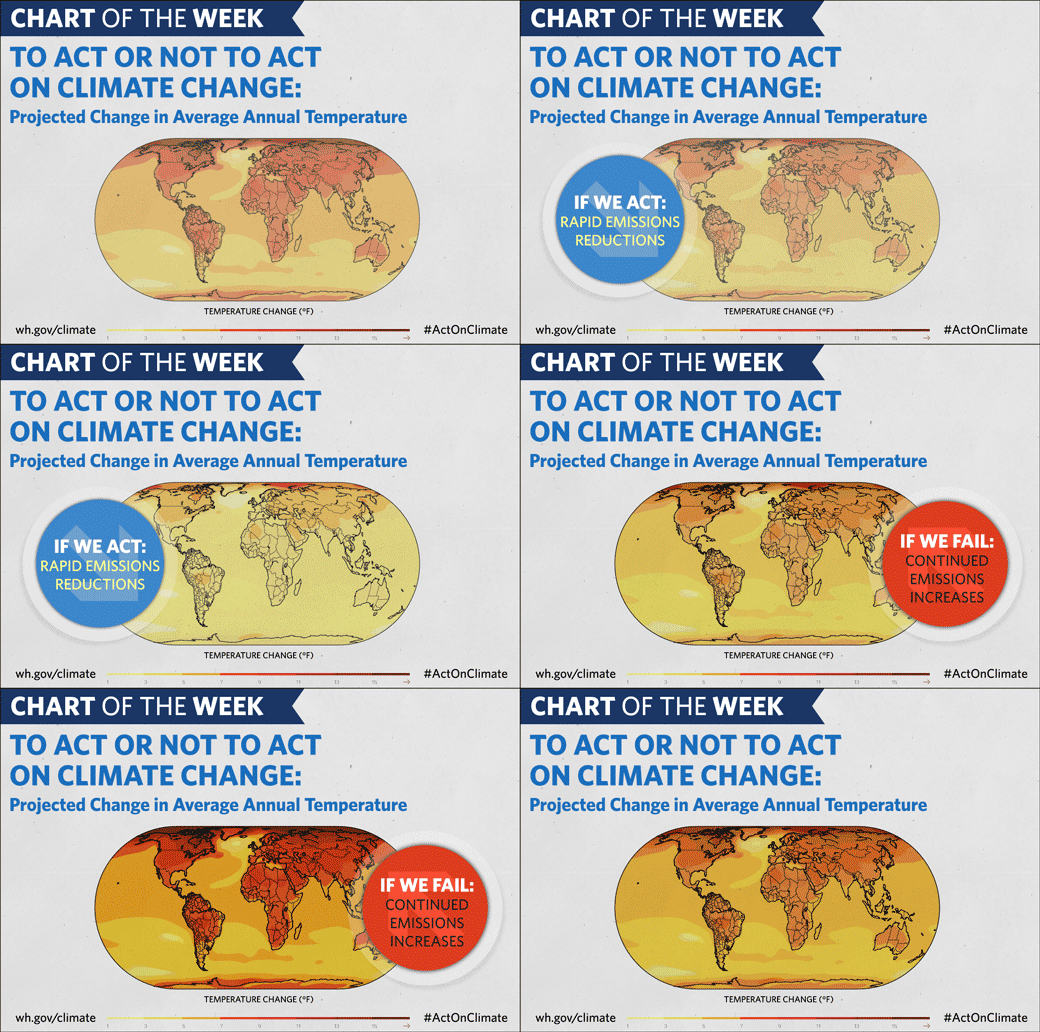
Climate change is a problem that knows no borders, causes devastating destruction in communities, and requires global action. Our climate will continue to change over this century, but the magnitude and significant consequences of that change depends on the amount of heat-trapping gases that countries emit.
It will take all of us working together – governments, communities, businesses, and individuals -- to reduce greenhouse gas emissions and change the future of our climate. In fact, the choices we make right now will determine the extent of future global warming and its impact on the environment, public health, and the economy.
Check out the chart to see the difference we can make if we work together to reduce emissions -- and the disastrous consequences if we fail to act:
 Learn more about Energy and Environment
An Important Step in Our Fight Against Climate Change
Posted by on September 23, 2014 at 2:20 PM EDTEd. Note: This is cross-posted from the Huffington Post. See the original post here.
Today, leaders from more than 120 countries gathered in New York. On the agenda: a challenge that knows no borders, produces devastating local impacts, and requires global action.
President Obama joined the international community at the UN Secretary General's Climate Summit because he believes that we have a moral obligation to our children and to future generations to take decisive action now -- to reduce the carbon pollution and other greenhouse gas emissions warming the planet, and to build resilience to the climate impacts already being felt in communities across the country and around the world.
We are the first generation to experience first-hand the chaos that climate scientists have long warned was coming. In recent years, we have been battered by more frequent and severe storms, become inundated by rising seas and storm surge, parched by deeper drought, and burned by fiercer wildfires. From the world's poorest villages to the tiniest seaside communities, climate change poses a real and dangerous threat.
Learn more about Energy and EnvironmentFond du Lac Band leads climate resilience efforts on Lake Superior Chippewa Indian Reservation
Posted by on September 19, 2014 at 6:20 PM EDT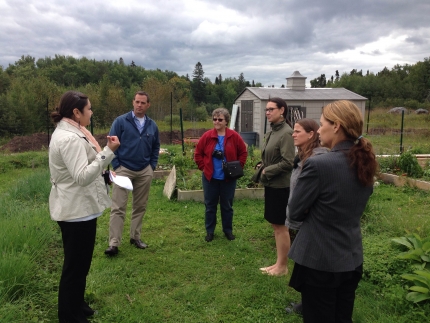
Acting Chair Boots and other Administration officials visit tribal Chairwoman Karen Diver at the Fond du Lac Band of Lake Superior Chippewa Indian Reservation to learn about the Tribe's efforts to prepare for the impacts of climate change. Photo courtesy of CEQ.
Last Friday I had the pleasure of visiting the Fond du Lac Band of Lake Superior Chippewa Indian Reservation. I was joined by Raina Thiele, Associate Director of White House Intergovernmental Affairs, and Ann Marie Bledsoe Downes, Deputy Assistant Secretary at the Department of the Interior. We toured the reservation and facilities with tribal Chairwoman Karen Diver, a member of the President’s State, Local, and Tribal Leaders Task Force on Climate Preparedness and Resilience, and the Tribe’s Resource Management Division.
Over the course of the day, I visited Deadfish Lake, where the Tribe is working to restore wild rice harvests; Simon Creek, where the Tribe monitors hydrology; a newly installed bridge, which replaced a large stretch of road that had been washed out due to a major 2012 flood; and the Fond du Lac Ojibwe School’s community and journey gardens.
As a member of the President’s Task Force on Climate Preparedness and Resilience, Chairwoman Karen Diver is responsible for advising the Administration on how the Federal Government can better support communities across the country that are dealing with the impacts of climate change.
As a result of her efforts, and the efforts of her fellow tribal leader task force member, Mayor Reggie Joule of Alaska’s Northwest Arctic Borough, the Administration announced a new Tribal Climate Resilience Program to help tribes prepare for climate change at the fourth and final task force meeting. We look forward to continuing to work closely with Chairwoman Diver and tribal leaders across the country as they prepare for the impacts of climate change.
Mike Boots is Acting Chair of the White House Council on Environmental Quality.
Learn more about Energy and Environment

- &lsaquo previous
- …
- 24
- 25
- 26
- 27
- 28
- 29
- 30
- 31
- 32
- …
- next &rsaquo
Related Videos
-
 May 09, 2014 9:21 AM
Inside the White House: Solar Panels
-
 September 01, 2016 9:25 PM
President Obama Delivers a Statement to the Press
White House Blogs
- The White House Blog
- Middle Class Task Force
- Council of Economic Advisers
- Council on Environmental Quality
- Council on Women and Girls
- Office of Intergovernmental Affairs
- Office of Management and Budget
- Office of Public Engagement
- Office of Science & Tech Policy
- Office of Urban Affairs
- Open Government
- Faith and Neighborhood Partnerships
- Social Innovation and Civic Participation
- US Trade Representative
- Office National Drug Control Policy