Energy and Environment Latest News
Statement by John P. Holdren on Approval of the IPCC's 5th Assessment Synthesis Report
Posted by on November 2, 2014 at 5:01 AM EDTStatement by Dr. John P. Holdren, Director of the White House Office of Science & Technology Policy, on the release of the Intergovernmental Panel on Climate Change (IPCC) 5th Assessment Synthesis Report:
"The IPCC’s new Synthesis Report is yet another wake-up call to the global community that we must act together swiftly and aggressively in order to stem climate change and avoid its worst impacts.
The report summarizes the contents of five IPCC studies released over the past 12 months and reinforces, in a global context, the conclusions of the Third U.S. National Climate Assessment, released by the Obama Administration in May of this year. These studies—the most comprehensive and detailed ever—confirm that climate change caused by human activities is having impacts on ecosystems and human well-being across the United States and around the world.
The new IPCC report underscores the need to fully implement President Obama’s Climate Action Plan, including continued engagement with other countries on ambitious emissions-reductions targets and the policies and technologies necessary to achieve them."
###
Learn more about Energy and EnvironmentCelebrating Sustainable Aquaculture during National Seafood Month
Posted by on October 31, 2014 at 5:11 PM EDTThe end of October – and of National Seafood Month – is an opportune time to reflect on the importance of America’s seafood industry and the fish, shrimp, and other aquatic-based food sources it provides to our Nation.
Seafood consumption is on the rise, in America and around the globe. In 2012, the United States imported $16.7 billion worth of seafood products for citizens across the country. Here at home, the USDA recommends that people consume a minimum of two servings of seafood per week to increase intake of Omega-3 acids, help decrease the risk of heart disease, and improve physical and cognitive health.
Today, America relies on foreign producers for the large majority of the seafood our citizens consume. And approximately half of the seafood we import is produced through aquaculture, the cultivation of fish in controlled and selected environments. To help satisfy our Nation’s appetite for seafood and our growing population, people and business across the country are finding new ways to secure safe and sustainable sources of seafood right here at home.
The United States aquaculture industry is emerging and both within and outside government – including in the scientific and business communities – experts are looking at ways to support and encourage aquaculture that is safe and sustainable for people, species, and ecosystems. A working group of the interagency National Science & Technology Council, for instance, is exploring ways to make aquaculture more accessible to those seeking to expand or start new businesses.
And just this week, the White House Office of Science and Technology Policy welcomed more than 150 local middle- and high-school students to the White House for a conversation with renowned oceanographer and marine biologist Dr. Sylvia Earle. Throughout the discussion with students, Dr. Earle emphasized the potential benefits of smart, well-managed, aquaculture, noting that sustainably-constructed aquaculture systems can support ecologically-friendly sources of seafood while minimizing harmful impacts on our oceans. She was sure to note that while the oceans are also an important source of fish for consumption, cultivating fish on land is a key, complementary way to help ensure both seafood security and the safety of our marine ecosystems.
Learn more about Energy and EnvironmentMaking Plans and Making Progress: How the Federal Government Can Lead by Example
Posted by on October 31, 2014 at 10:52 AM EDT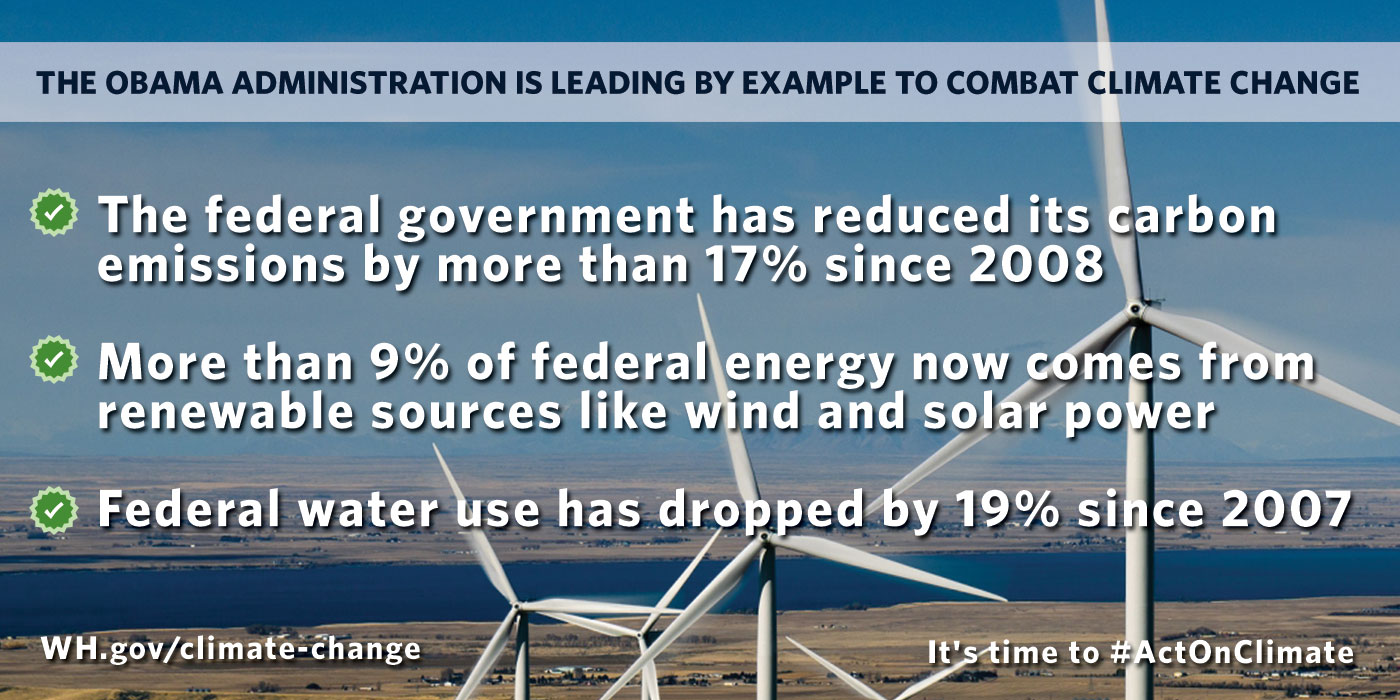
Five years ago this month, President Obama signed his Executive Order on Federal Leadership in Environmental, Energy, and Economic Performance, setting new energy, climate, and environmental targets for federal agencies. The targets are aggressive, but under the President’s leadership, agencies have made significant progress in cutting carbon pollution, improving energy efficiency, and preparing for the impacts of climate change.
Through this initiative, federal agencies have already reduced their greenhouse gas emissions by 17 percent – that’s the equivalent of taking 1.8 million cars off the road. And today, more than 9 percent of our energy comes from renewable sources, on our way to meeting a goal of 20 percent by 2020. We’ve also cut our potable water use by 19 percent, enough water to fill nearly 49,000 Olympic swimming pools.
This progress means we’re on track to meet the President’s goals. But with more than 360,000 buildings, 650,000 fleet vehicles, and $460 billion in annual purchasing power, the federal government is the largest energy consumer in the U.S. economy, so we can’t rest here.
That’s why, today, to coincide with the fifth anniversary of the Executive Order, federal agencies released new plans for reducing their greenhouse gas emissions and preparing for climate change impacts such as flooding, sea level rise, severe weather, and temperature extremes.
Learn more about Energy and EnvironmentEmpowering Entrepreneurial Labs: New Lab-Corps Program Accelerates Energy Technologies to Market
Posted by on October 29, 2014 at 3:41 PM EDTThe Department of Energy national laboratories are American science and engineering powerhouses. These national treasures are generating innovative solutions to the world’s toughest energy challenges. However, promising solutions discovered at the laboratory bench can’t effectively address energy challenges unless and until they are successfully transferred to the marketplace as commercial products and services.
To help increase the rate at which national laboratory discoveries successfully transition into the private sector, the Energy Department today launched Lab-Corps, a new $2.3 million program that will train top lab researchers across the nation how to move high-impact national laboratory-invented technologies into the market. This pilot program supports the Obama Administration’s larger “Lab-to-Market” efforts, which focus on increasing the commercial impact of Federally-funded research and development and generating a greater return on taxpayer investment.
Lab-Corps, which is modeled on the National Science Foundation’s successful Innovation Corps (I-Corps) program, is a specialized technology accelerator and commercialization training curriculum for researchers in our national laboratories who have developed potentially marketable technology breakthroughs. Lab-Corps will initially focus on clean energy technologies. Through Lab-Corps, select labs will support entrepreneurial teams to identify and pursue market applications for new clean energy technologies through direct engagement with industry, entrepreneurs, and investors.
In addition to accelerating successful technology transfer, Lab-Corps will support a commercialization training model that expands upon the popular Lean LaunchPad entrepreneurship curriculum. The Lab-Corps curriculum will be tailored to the unique features of the national laboratories in order to maximize commercial impact and enable lab technologists to pursue a variety of commercialization pathways that extend beyond startup development to include industry agreements, technology licensing, and other partnerships with the private sector.
Six national laboratories have been selected to participate in the Lab-Corps pilot program. Over the next year, five labs – Argonne National Laboratory, Idaho National Laboratory, Lawrence Berkeley National Laboratory, Lawrence Livermore National Laboratory, and Pacific Northwest National Laboratory – will assemble, train, and support entrepreneurial teams to identify private sector opportunities for commercializing promising sustainable transportation, renewable power, and energy efficiency lab technologies.
A sixth – the National Renewable Energy Laboratory in Golden, Colorado – will leverage its deep expertise in technology commercialization and clean energy sectors to develop, deliver, and manage the Lab-Corps training program across the laboratory sites, with help from Brookhaven National Laboratory, Los Alamos National Laboratory, and Sandia National Laboratory.
If successful, the Lab-Corps pilot could be extended to other national laboratories, helping commercialize even more valuable discoveries across different sectors. Similarly, a recent collaboration between the National Institutes of Health and the National Science Foundation is bringing this entrepreneurship training model to teams of biomedical researchers.
Programs such as Lab-Corps boost the American public’s return on investment in Federally-funded research by ensuring that more clean energy discoveries funded by taxpayer dollars in the national laboratories successfully make the leap to the marketplace. These commercialized discoveries in turn help cut carbon pollution, protect the environment, and drive our country’s clean energy economy forward.
Tom Kalil is Deputy Director for Technology and Innovation at the White House Office of Science and Technology Policy
David Danielson is Assistant Secretary for Energy Efficiency and Renewable Energy at the U.S. Department of Energy
Learn more about Energy and Environment, TechnologyENERGY STAR Day: The Power of the Little Blue Label
Posted by on October 28, 2014 at 12:56 PM EDTEd. note: This is cross-posted on EPA Connect, the official blog of EPA's leadership. See the original post here.
Let’s start with a few numbers:
$300 billion in savings. That’s how much consumers and businesses have saved on utility bills in the last 22 years because of the ENERGY STAR program.
Two billion metric tons of greenhouse gas emissions avoided, or the equivalent to the annual emissions of more than 420 million cars, over the last 22 years. Thanks to our little blue ENERGY STAR label, folks are doing their part to reduce their greenhouse emissions and combat climate change.
Since President Obama took office, ENERGY STAR has helped American consumers and businesses save over one billion metric tons of greenhouse gas emissions and approximately $110 billion on their utility bills.
That’s one powerful little label.
Learn more about Energy and EnvironmentThinking Big: A Landscape-Level Approach to Conservation
Posted by on October 24, 2014 at 3:59 PM EDTThis week, I joined Federal colleagues and other conservation leaders at the National Workshop on Large Landscape Conservation to talk about how the Obama Administration is thinking and planning at a landscape-level when it comes to conservation and natural resource management.
Our Nation’s conservation challenges are numerous, and they’re too big for any agency, government, NGO, or landowner to handle alone. For example, climate change is putting many of our vital natural resources at risk. Droughts are getting longer and dryer in some parts of the country, and wildfires are causing more devastation than ever before. And some of our most important watersheds are impacted by heavy pollution, threatening local economies throughout the country. We’re also seeing a growing list of imperiled wildlife species, and development of all kinds – from housing to energy to commercial – is encroaching on our outdoor spaces.
Responding to these challenges involves working across jurisdictions and with all partners, because Mother Nature pays no attention to political or bureaucratic boundaries. That means Federal agencies, tribes, state and local governments, and other stakeholders all have to come to the table and work together. It is this approach – considering all lands and listening to all voices – that best defines landscape-level conservation.
This is the approach the Obama Administration has been taking from the beginning, whether it’s responding to wildfires, making lands more resilient to climate change, or restoring rivers and lakes. In priority areas like preparing for and responding to climate change, protecting and restoring our water resources, and improving land management for multiple uses, we’ve made important progress over the past five and a half years.
Just last month, we released the Climate and Natural Resources Priority Agenda along with a series of public and private sector commitments to support it. The Priority Agenda represents a commitment to manage natural resources in a way that optimizes carbon storage and sequestration, and enhances community preparedness through smart and safe natural infrastructure solution.
We’ve also dedicated unprecedented attention and resources to restoring places like the Chesapeake Bay, California Bay-Delta, Great Lakes, Gulf of Mexico, and the Everglades – each of them national treasures and the lifeblood of local and regional economies. In the Everglades, for example, landscape-scale partnerships have brought together Federal, state, tribal, and private interests to address issues like habitat fragmentation, wildlife protection, and the continued productivity of America’s farms, ranches, forests, and coasts.
In this Administration, we have made managing for multiple uses a principal tenet of our approach to public lands. Taking an integrated approach to planning and land management is quite simply the only way to meet increasing demands for our natural resources without increasing conflict. The Department of the Interior’s “smart from the start” approach to renewable energy production provides an excellent blueprint for how good planning can prevent conflict. And in our efforts to rebuild and protect populations of endangered wildlife species, enlisting states and private landowners as partners and ensuring consistency and predictability across entire ecosystems is helping build a process that is less contentious and ultimately better for landowners and wildlife.
There are many other ways we can pursue a landscape-level approach to land management. But in order to get Americans truly invested in conservation and landscape-level thinking, we need to do everything we can to ensure they can connect with treasured outdoor spaces in their communities. That’s been a hallmark of this Administration, and that’s why, this month, the President created the San Gabriel National Mountains National Monument in Los Angeles County, his 13th national monument designation. And the President made clear that he wasn’t doing this to lock away those gorgeous mountains; instead, he was protecting such a beautiful landscape to unlock it “to make sure everybody can experience these incredible gifts.”
We still have more work to do, and we are committed to continuing our progress. Landscape conservation may never drive news headlines, but if we think bigger and work collaboratively, Americans and our natural systems will benefit from it for years to come.
Mike Boots leads the White House Council on Environmental Quality.
Learn more about Energy and Environment
- &lsaquo previous
- …
- 21
- 22
- 23
- 24
- 25
- 26
- 27
- 28
- 29
- …
- next &rsaquo
Related Videos
-
 May 09, 2014 9:21 AM
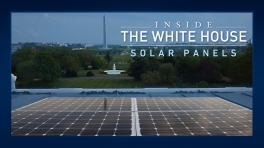
Inside the White House: Solar Panels
-
 September 01, 2016 9:25 PM
President Obama Delivers a Statement to the Press
White House Blogs
- The White House Blog
- Middle Class Task Force
- Council of Economic Advisers
- Council on Environmental Quality
- Council on Women and Girls
- Office of Intergovernmental Affairs
- Office of Management and Budget
- Office of Public Engagement
- Office of Science & Tech Policy
- Office of Urban Affairs
- Open Government
- Faith and Neighborhood Partnerships
- Social Innovation and Civic Participation
- US Trade Representative
- Office National Drug Control Policy