Energy and Environment Latest News
When the Rubber Hits the Road: Teaming Up with NASCAR to Act on Climate
Posted by on December 9, 2014 at 5:48 PM EDT
Transportation Secretary Anthony Foxx and John Podesta, Counselor to the President, announce with NASCAR driver Ryan Blaney the Administration's partnership with NASCAR, tire manufactures and retailers to raise awareness of tire safety and actions to cut carbon pollution and reduce our dependence on foreign oil, in front of the West Wing of the White House, Dec. 9, 2014. (Official White House Photo by Amanda Lucidon)
When NASCAR drivers take a corner at top speed, they — and their tires — experience G-forces that are just about equivalent to what astronauts feel as they’re being launched into space.
So NASCAR knows a thing or two about tire performance and safety. And that’s why NASCAR driver Ryan Blaney joined Secretary of Transportation Anthony Foxx and me at the White House today to talk about proper tire maintenance — and he brought along his #22 Mustang and the #18 “M&Ms” car to really drive the point home.
Learn more about Energy and EnvironmentUnleashing Climate Data and Innovation for more Resilient Ecosystems
Posted by on December 9, 2014 at 10:35 AM EDTEcosystems provide vast services and benefits to humankind: food and water that is needed for survival; nutrients and other natural products that fuel farms and industries; natural controls on many pests and pathogens; storage of carbon safely out of the atmosphere; shared spaces for tourism and recreation; and sanctuaries that preserve biodiversity, natural beauty, and cultural history.
The EcoINFORMA map viewer available on data.gov/ecosystems enables visualizations and mashups of spatial data related to ecosystems, natural resources, and species.
The Third National Climate Assessment confirms that ecosystems and the benefits they provide to society are being affected by climate change. These changes are having impacts on biodiversity and limiting the capacity of ecosystems—including forests, barrier beaches, and wetlands— to continue to play their roles in reducing the impacts of extreme events on infrastructure, human communities, and other valued resources.
Land and water managers, environmental planners, and those who rely on ecosystems to support and run businesses need easy, intuitive access to the most accurate and relevant available information about climate change in order to make informed decisions on the ground.
Today, in an important milestone to help achieve this goal, the Department of Interior and other Executive Branch agencies and offices are releasing, on climate.data.gov, new troves of government data on water and ecosystems, as well as new geospatial tools, as part of the President’s Climate Data Initiative. Earlier installments of that initiative focused on data relating to sea-level rise, flood risk, and agriculture.
The newly released datasets—which include critical information about streamflow, soil, landcover, and biodiversity and are complemented by tools to overlay and visualize them—will be extremely valuable to natural-resource managers faced with day-to-day and long-term strategic decisions about how to operate in the context of climate change.
In a further step to make these data as useful as possible, today a host of public, nonprofit, and private-sector organizations made commitments to devote resources, expertise, and technological capabilities to leverage climate data in ways that make the Nation’s ecosystems and water resources more resilient to the impacts of climate change.
For example, Amazon Web Services (AWS) has committed to make a petabyte of Earth-imagery data from the U.S. Geological Survey widely available as an AWS public dataset; the University of Maryland’s Socio-Environmental Synthesis Center has committed to fund 25 early-career scholars as they conduct research at the nexus of water systems, food systems, and climate change; Esri will stand up a Water Open Data portal to extend accessibility of key water data through interactive services and tools by which selected data can be downloaded in various formats through an intuitive user interface; and HP has announced a partnership with the Camera Trap Data Network to create new data-sharing and analytic tools that allow users to access and analyze millions of camera-trap images and related data about threatened species and biodiversity.
- Read the full set of commitments launched today here.
- Read the Department of Interior's Press Release here.
- Read more about the President’s Climate Data Initiative here.
- Access climate.data.gov here.
Dr. John P. Holdren is Assistant to the President for Science and Technology and Director of the White House Office of Science & Technology Policy
Learn more about Energy and EnvironmentTribal Leaders: It's Time to Bolster Native Community Climate Resilience
Posted by on December 3, 2014 at 3:28 PM EDTEd. Note: This blog introduces you to Chairwoman Karen Diver and Mayor Reggie Joule.
Tribes and Alaska Native Villages feel the brunt of a changing climate in direct and significant ways that undermine their cultures, economies, and the overall general welfare of their citizens. Unfortunately, they are too frequently left out of Federal and state climate preparedness and resilience efforts, both in terms of planning and disaster response. And they generally lack sufficient governmental capacity and financial resources to prepare for and respond to major climate-related events on their own.
These are the overriding messages we heard from tribal leaders across the country while serving on the President’s State, Local and Tribal Leaders Task Force on Climate Preparedness and Resilience. Hundreds of tribal leaders provided their input and recommendations through a number of listening sessions, webinars and questionnaires. These outreach efforts were facilitated by the fine network of Federal agency tribal liaisons.
We are extremely pleased that the Task Force acknowledged a wide range of tribal needs and recommendations in its report submitted to President Obama on November 17. Early on in the process, it became clear that responding to climate change has to be a shared responsibility that shouldn't be constrained by our respective political boundaries, geographical locations or cultures. The report reflects the Task Force’s collegial efforts to find common ground, mutual interests and consensus solutions to the challenges that tribal, state and local governments face in preparing for climate change.
From a tribal perspective, the Task Force’s recommendations affirm that, while Native communities are affected by climate change in ways similar to other communities, Tribes and Native Alaskan Villages feel the effects of a changing climate in ways that are unique to their lifeways, geography, and relationships with the Federal Government. Accordingly, the Task Force offers recommendations that are consistent with government-to-government relationships, Federal treaty obligations and trust responsibilities, and the fact that Native communities are inextricably tied to their places for meeting their subsistence, cultural, spiritual and economic needs.
The Task Force’s recommendations mark the beginning of a process, not the end. President Obama’s commitment to addressing the impacts of climate change is clear, and we are encouraged by the readiness of Federal agencies to digest these recommendations and determine what they can do to implement them. To aid in these implementation efforts, we are pleased to offer a set of supplemental recommendations focused on the specific and unique perspectives of Native communities. They provide greater detail and fully integrate the wide range of input and recommendations that we received from other tribal leaders.
Our hope is that these broader and more detailed recommendations will inform the work of the White House Council on Native American Affairs and its newly formed Climate Change Subgroup. It has been an honor serving on the Task Force. The needs of Native communities in relation to climate change are urgent and significant. The time to act to protect and assist our communities is now.
Karen Diver is Chairwoman of the Fond du Lac Band of Lake Superior Chippewa. Reggie Joule is Mayor of the Northwest Arctic Borough.
Learn more about Energy and EnvironmentAnnouncing the First Class of Climate Action Champions
Posted by on December 3, 2014 at 1:58 PM EDTDeep, persistent drought. Longer, fiercer wildfire seasons. High tides flooding downtowns. Severe storms wreaking havoc. This is the picture from the front lines of climate change — in communities across America.
And as they face these immediate climate crises, cities, towns, counties, and tribes of every size and in every region of the country have stepped up to be part of the solution: identifying their vulnerabilities, cutting carbon pollution, creating jobs by investing in clean energy and energy efficiency, and finding innovative solutions to make their communities and infrastructure more resilient to climate extremes.
Today, in recognition of their strong commitment to the fight against climate change, the Obama administration is naming 16 of these communities as the first class of Climate Action Champions.
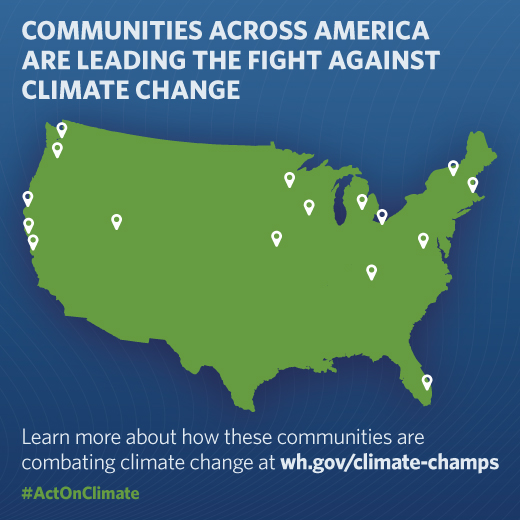
Click here for the full list of Climate Action Champions.
Learn more about Energy and EnvironmentAmerica Is an Arctic Nation
Posted by on December 2, 2014 at 11:14 AM EDT
Climate change is bringing longer, hotter summers to the Arctic, and driving glaciers to retreat. (U.S. Department of State)
There are only eight countries in the world whose territory above the Arctic Circle grants them the honored title of “Arctic Nation.” The United States is one.
The human story in the Arctic is defined by the intense and arduous relationship between people and the environment. Arctic residents know not just how to survive, but how to thrive in some of the harshest conditions on earth. Theirs is a story of adaptation and survival.
Today, however, climate change is transforming this already challenging region at an unprecedented pace. Temperatures in the Arctic are rising at twice the rate of the rest of the world on average. And though the region seems remote to most Americans, other parts of our country are also being impacted by Arctic climate change. The entire country experienced abnormal weather as the result of a storm that passed through the Bering Sea in Alaska earlier this month. Melting glaciers and land-based ice sheets are contributing to rising sea levels. The future of America is inextricably linked to the future of the Arctic.
Learn more about Energy and EnvironmentWelcoming New Ideas: Climate Data and Information for Resilient Development
Posted by on November 19, 2014 at 5:26 PM EDTAt the United Nations Climate Summit in September, President Obama announced a set of new initiatives aimed at strengthening global resilience to climate change, including a Public-Private Partnership on Climate Data and Information for Resilient Development. This partnership’s mission, which is being primarily supported by the United States Agency for International Development (USAID) but with significant contributions from NOAA, NASA, USGS and other U.S. government agencies, is to increase resilience to the impacts of climate change and reduce emissions of greenhouse gases in developing countries by harnessing, creating, and providing timely climate data, information, tools, and services. The partnership will draw on the strengths and resources of public, private, and non-governmental organizations, as well as academic communities from around the world.
To follow on this Presidential announcement, USAID has just released a Request for Information that solicits input from any interested parties on how best to achieve these goals. If you or your organization is interested in providing input or possibly participating in the public-private partnership itself, please respond to this newly-released Request for Information. Submissions from both U.S.-based and international organizations and experts are encouraged.
This new public-private partnership intends to make existing climate data, scientific information, outlooks, tools, and services more actionable and publicly accessible; identify and address targeted climate information and capacity gaps; create a global community of practice that links climate data, climate change adaptation efforts, mitigation, and international development; conduct joint research on how to address specific needs in developing countries, develop new products to support decision-making in climate-vulnerable countries, and advance the aims of the Global Framework for Climate Services.
Learn more about Energy and Environment
- &lsaquo previous
- …
- 19
- 20
- 21
- 22
- 23
- 24
- 25
- 26
- 27
- …
- next &rsaquo
Related Videos
-
 May 09, 2014 9:21 AM
Inside the White House: Solar Panels
-
 September 01, 2016 9:25 PM
President Obama Delivers a Statement to the Press
White House Blogs
- The White House Blog
- Middle Class Task Force
- Council of Economic Advisers
- Council on Environmental Quality
- Council on Women and Girls
- Office of Intergovernmental Affairs
- Office of Management and Budget
- Office of Public Engagement
- Office of Science & Tech Policy
- Office of Urban Affairs
- Open Government
- Faith and Neighborhood Partnerships
- Social Innovation and Civic Participation
- US Trade Representative
- Office National Drug Control Policy