Energy and Environment Latest News
5 Things You Need to Know About Alaska's Bristol Bay
Posted by on December 16, 2014 at 6:12 PM EDTPresident Obama just took action to protect one of Alaska's most powerful economic engines and one of America’s greatest national treasures: Bristol Bay.
Today, he signed a Presidential Memorandum that withdraws these beautiful and pristine waters from all future oil and gas drilling. "These waters are too special and too valuable to auction off to the highest bidder," the President said.
Learn more about , Economy, Energy and EnvironmentNew Recommendations to End Pirate Fishing and Seafood Fraud
Posted by on December 16, 2014 at 2:24 PM EDT
Seafood fraud can happen at any point in the supply chain, undermining law-abiding fishers and misleading consumers. (Photo credit: NOAA)
America’s fisheries drive coastal economies and put food on the tables of families across the country. Unfortunately, the twin global issues of illegal, unreported, and unregulated (IUU) fishing and seafood fraud undermine the economic and environmental sustainability of fisheries and fish stocks.
Global losses attributable to IUU fishing are estimated at $10 billion to $23 billion annually. Pirate fishing vessels take in fish without regard to the sustainability of ocean ecosystems. Not required to file trip plans or carry transponders, the ships roam the oceans in the shadows and become vectors for human, drug, and arms trafficking. Black-market fishing distorts legal markets and displaces law-abiding fishermen, ultimately serving as a drag on the global economy. These challenges can be compounded by seafood fraud — the mislabeling, misbranding, or falsification of product origins — which can occur at any point in the supply chain.
Today, the federal task force on combatting IUU fishing and seafood fraud released its final recommendations to tackle these complex challenges. President Obama announced the creation of the task force at the State Department’s Our Ocean conference in June, and for the last six months, under the leadership of NOAA Administrator Kathy Sullivan and Under Secretary of State Cathy Novelli, representatives from 14 agencies have come together to answer the President’s call to action.
Learn more about Energy and EnvironmentHealth Care Leaders Recognize Climate Risk, Take Action
Posted by on December 15, 2014 at 1:45 PM EDTTwo years ago, as Hurricane Sandy swept over cities in the Northeast, many communities were unprepared to deal with the storm’s devastating consequences. Hospitals and health care workers in New York City were overwhelmed as they struggled to accommodate the influx of patients. As the generators failed at some hospitals, doctors, nurses, and emergency responders evacuated hundreds of patients by flashlight. Months later hospitals were still struggling to readmit patients. In total, health care facilities incurred $3.1 billion in damages from the disaster.
Science tells us that we’re likely to face storms that are more frequent and severe in the future. These storms could cause more damage than ever before, and it will cost more taxpayer dollars to recover and rebuild. And it isn’t only storms; climate change also leads to rising sea levels, increased flood risk, and extreme temperatures, all of which can put our health care facilities - and our public health - at risk. For example, warmer temperatures spurred by carbon pollution can worsen smog, soot, and pollen levels, and trigger more asthma attacks and exacerbate other illnesses. And these kinds of impacts are most dangerous for populations that are already vulnerable, including children and the elderly.
Fortunately, leaders in the health care industry are recognizing this risk. They are leading the way to ensure our health care system is equipped to handle the health challenges presented by climate change, and to ready our hospitals and other health care facilities for the impacts of climate change. And the Administration is committed to support them in this important work.
All over the country, American communities depend on hospitals to provide essential services – at all times and under every possible circumstance. That’s why today, as part of the President’s Climate Action Plan, the Department of Health and Human Services (HHS) is releasing a voluntary climate resilience guide for health care providers, design professionals, policymakers, and others to promote continuity of care before, during, and after extreme weather events. The new guide addresses a wide range of health care facility vulnerabilities and identifies best practices that health care organizations can adopt to improve their climate readiness.
Also today, a group of leaders from the health care industry, professional associations, and other organizations have announced their commitments to using the guide to strengthen the resilience of the health care system in the face of a changing climate. And today at the White House, we are bringing together many of these leaders to share their experiences and discuss the best ways to move forward. The conversation will include Secretary Burwell, Counselor to the President John Podesta, and Dr. Holdren, President Obama’s science advisor.
In addition to the climate resilience guide, HHS is developing a suite of online resilience tools for health care facilities to add to the Administration’s new web-based Climate Resilience Toolkit, which provides easy, intuitive access to dozens of Federal tools that can directly help planners and decision makers across America conduct their work in the context of a changing climate. The Toolkit was released last month in response to feedback from the President’s State, Local, and Tribal Task Force on Climate Preparedness and Resilience. In their recommendations to the President, the governors, mayors, tribal leaders and other officials on the Task Force highlighted efforts to preserve human health and build resilient populations as a major theme.
Leaders in the health care industry understand that climate resilience across all sectors is vital to the safety, security, and prosperity of our nation. In fact, according to an independent study by the National Institute of Building Sciences, every dollar spent on building resilience to hazards saves the nation four dollars in future benefits. The Administration will continue to support health leaders – and leaders in all industries - as they work to build a healthier, safer, more prosperous nation.
Mike Boots leads the White House Council on Environmental Quality.
Learn more about Energy and EnvironmentAction at Home, Leadership Abroad: Our Path to Climate Progress
Posted by on December 12, 2014 at 1:54 PM EDTThis week I traveled to Lima, Peru, for the United Nations climate negotiations (COP 20), an important meeting in the effort to achieve an international climate agreement. Here in Lima, representatives from countries all over the world are gathering to highlight their progress in curbing the greenhouse gas emissions that drive climate change and lay the groundwork for an international climate agreement.
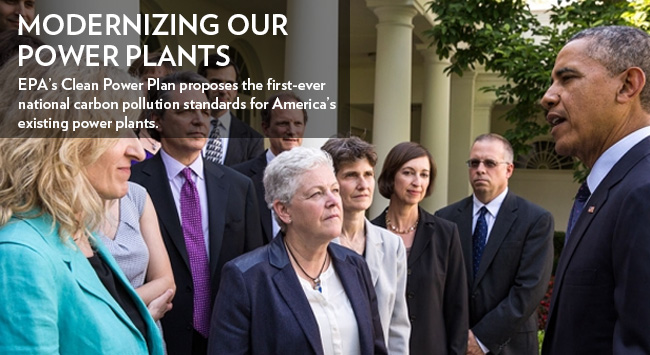
Throughout the week, I shared with our international partners the impressive progress the United States has made since COP 19, held in Warsaw last year. We have worked with states and industry leaders to propose new national limits on harmful carbon pollution from power plants, and we’ve collaborated with governors, mayors, Tribal leaders, and county officials to support communities preparing for the impacts of climate change.
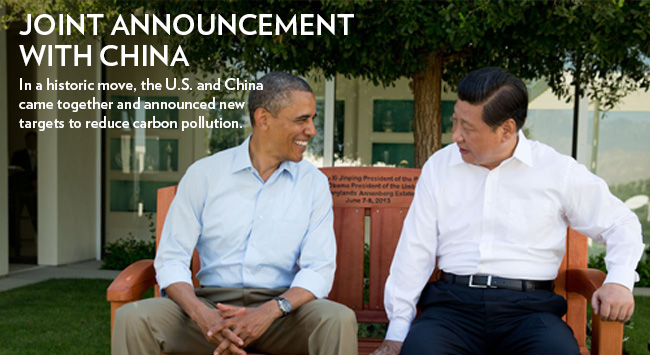
We have also played a leading role in international efforts to combat climate change. Just last month, in an historic joint announcement, President Obama and Chinese President Xi announced our two countries’ respective post-2020 carbon pollution reduction targets. And that same week, President Obama pledged $3 billion to the Green Climate Fund, reflecting the U.S. commitment to reduce carbon pollution and strengthen resilience in developing countries, especially the poorest and most vulnerable.
So it’s clear that the U.S. commitment to leadership on climate change is stronger than ever. Over the past few days, I have been highlighting that leadership in discussions with environmental ministers and government officials from around the world, as well as scientists, state and local leaders, business leaders, and advocates who share the President’s belief that we have a moral obligation not to leave behind a planet that is polluted and damaged.
Some of the sessions throughout the week addressed the already apparent impacts of climate change, including to our most treasured and vulnerable places like the Arctic. Other panels focused on progress in implementing the President’s Climate Action Plan, including EPA’s Clean Power Plan. I also heard about action taken at the subnational level in other countries, and shared how states, cities, and tribes have demonstrated bold leadership in the face of climate change here in the U.S. And one of the discussions explored actions that reduce emissions and build resilience at the same time, such as advancing green stormwater infrastructure and investing in sustainable and resilient transportation.
As part of the week’s events, CEQ hosted two events aimed at getting the word out about President Obama’s Climate Action Plan. The first brought together a group of Administration and White House officials to share how the U.S. is staying on track to meet the President’s bold goal of cutting greenhouse gas emissions in the range of 17 percent by 2020. The other event addressed our efforts to support communities as they prepare for the impacts of climate change and highlighted the work of members of the President’s State, Local, and Tribal Leaders Task Force on Climate Preparedness and Resilience, including Mayor Ralph Becker of Salt Lake City, who participated via video, and Governor Jerry Brown of California.
The steps we’ve taken at home to tackle climate change have made the U.S. a credible voice for climate action on the international stage. And that’s important, because climate change is a global challenge that demands a global response. COP 20 in Lima will help pave the way for an international agreement to be reached at COP 21 in Paris in December of 2015.
As we move towards Paris, the Administration is going to keep pushing forward on all fronts at home to cut carbon pollution, invest in clean energy, boost energy efficiency, and build community resilience. We’ll continue to set ambitious goals, and we’ll remain on track to meet them. Because, as the President said at the UN Climate Summit this year, our children deserve such ambition.
Mike Boots leads the White House Council on Environmental Quality.
Learn more about Energy and EnvironmentNominate a White House Champion of Change for Climate Education and Literacy
Posted by on December 11, 2014 at 5:37 PM EDTCommunities across the United States are working to advance understanding of climate variability and change. Local leaders are helping to increase science-based understanding and awareness of current and future climate change, enhancing climate literacy in K-12 classrooms, on college and university campuses, and in parks and museums across the country.There has been tremendous progress to date, but there is still more work to be done.
A climate-literate workforce will be required for tomorrow’s community leaders, city planners, and entrepreneurs to have the information, knowledge, and training to make sound choices and grow businesses in the context of a changing climate. That’s why on December 3, the White House Office of Science and Technology Policy (OSTP) launched the Climate Education and Literacy Initiative, focused on connecting Americans of all ages with the best-available, science-based information about climate change. This initiative builds upon a Call to Action around climate education and literacy that received nearly 150 submissions from schools, communities, individuals, and organizations across the country. These responses demonstrated the magnitude and diversity of efforts underway and articulated ideas for future action.
Today, we’re asking you to help us identify and honor local leaders who are taking action to enhance understanding of climate change as Champions of Change for Climate Education and Literacy. These extraordinary leaders will be invited to the White House to celebrate their accomplishments and amplify their work to promote climate education and literacy as a critical step toward building an educated, next-generation American workforce that grasps the climate change challenge and is equipped to seek and implement solutions.
Please submit nominations by midnight on Tuesday December 23rd, 2014. Nominees may include the following types of individuals:
- Educators who serve as leaders in promoting and integrating best-available climate science into their classrooms.
- Outstanding students who demonstrate a high proficiency in climate knowledge and skills and leadership both inside and outside of the classroom.
- Young scientists who are advancing understanding of climate impacts and solutions.
- Leaders from, organizations that are developing high-quality, science-based tools, resources, and other learning opportunities for students of all ages.
- Individuals from place-based institutions (zoos, parks, aquaria, museums, etc.) that are effectively engaging visitors around climate change.
- Business leaders taking action to enhance understanding and awareness around climate change.
Click on the link below to submit your nomination (be sure to choose Climate Education and Literacy in the "Theme of Service" field of the nomination form):
Nominate a Climate Education and Literacy Champion of Change
We are looking forward to hosting this event and to highlighting the incredible work that people across the country are doing to advance climate education and literacy.
Laura Petes is Senior Policy Advisor for Climate Adaptation and Ecosystems in the Office of Science and Technology Policy.
Learn more about Energy and EnvironmentHigher Education Institutions Respond to the President’s Call to Support Making on College Campuses
Posted by on December 10, 2014 at 4:10 PM EDTAt the White House Maker Faire last June, more than 150 universities committed to expanding opportunities for Making on their campuses and in their communities. The Maker Faire was one of several OSTP initiatives this year aimed at highlighting the importance of the Maker Movement in creating opportunities for hands-on STEM learning, facilitating entrepreneurship, and expanding advanced manufacturing in the United States. At that event, the President issued a call to action to enable the next generation of innovators to be not just the consumers of things, but the makers of things.
Today, OSTP Director John Holdren visited Spelman College’s innovation lab and Makerspace. Spelman is one example of the many colleges that are creating opportunities for Making in response to the President’s call. Spelman’s innovation lab is home to the Spelbots, an all-female robotics team that has competed in international robotics competitions and is currently building an autonomous Remotely Operated Vehicle (ROV) system.
As part of the visit to Spelman, Director Holdren discussed how a subset of higher education institutions have come together to form the Make Schools Alliance. This new initiative will provide students with spaces, projects and mentors to engage in hands-on Making activities and boost their interest and persistence in science, technology, engineering and math (STEM). The Alliance will capture best practices and support research that examines the impact of Making on learning, student retention, and degree completion in STEM fields. It will also serve as a network, dynamic platform, and one-stop online resource for information on higher education institutions regarding initiatives, programs and collaboration that foster Making. Currently, information on nearly 50 colleges and universities can be found on the Alliance’s online platform.
The Make Schools Alliance builds on a growing momentum in the higher education community to support Making. Earlier this month, members of the Alliance met with Federal agencies, including USAID, CNCS, SBA, NSF and USDA, in Washington, DC to explore potential avenues for broadening accessibility and participation in Making in communities across the country.
K-12 superintendents, teachers, and organizations across the U.S. have joined the higher education community in creating ways for students to design, tinker, invent, and Make in the classroom and after school. One example is the Roanoke County Public School District in Virginia, which has created Makerspaces for its special education students to solve problems by designing and creating their own solutions. A number of programs being offered by Makerspaces, museums, and educational organizations focus on providing professional development for teachers around integrating Making into curriculum and the use of tools and technologies such as programmable microcontrollers, 3D modeling and 3D printing.
Building an educational pipeline that will enable students to make throughout K-12 and continue to develop and pursue their interests in STEM, arts, and design in college will be critical to supporting the America’s next generation of problem solvers and innovators. If your educational institution is doing something to engage students in Making, we want to hear about it! Send an email to maker@ostp.gov.
Stephanie Santoso is the OSTP Senior Advisor for Making.
Learn more about Energy and Environment, Technology
- &lsaquo previous
- …
- 18
- 19
- 20
- 21
- 22
- 23
- 24
- 25
- 26
- …
- next &rsaquo
Related Videos
-
 May 09, 2014 9:21 AM
Inside the White House: Solar Panels
-
 September 01, 2016 9:25 PM
President Obama Delivers a Statement to the Press
White House Blogs
- The White House Blog
- Middle Class Task Force
- Council of Economic Advisers
- Council on Environmental Quality
- Council on Women and Girls
- Office of Intergovernmental Affairs
- Office of Management and Budget
- Office of Public Engagement
- Office of Science & Tech Policy
- Office of Urban Affairs
- Open Government
- Faith and Neighborhood Partnerships
- Social Innovation and Civic Participation
- US Trade Representative
- Office National Drug Control Policy