Health Care Blog
Health Insurance Reform Will Help Small Businesses
Posted by on February 26, 2010 at 2:08 PM ESTAs President Obama made clear at the bipartisan meeting on health insurance reform, and has emphasized all year, small businesses stand to gain substantially from his proposal for comprehensive health insurance reform.
Small businesses are essential to the nation’s economy and its recovery from the recession. They are responsible for a disproportionate share of economy-wide net employment growth, and account for a large majority of jobs in start-ups, a key source of innovation and economic growth.
Nevertheless, both a CEA report released last year and new analysis by the Council of Economic Advisers shows that the status quo of rising costs and declining coverage is unsustainable for small businesses. Over the past decade, average annual family premiums for workers at small firms increased by 123 percent, from $5,700 in 1999 to $12,700 in 2009, while the percentage of small firms offering coverage fell from 65 percent to 59 percent. As shown in the following figure, this insurance offer rate is especially low at small firms with fewer than 10, 25, or 50 employees.

While opponents of reform have raised concerns that some of the provisions in the President’s proposal will harm small businesses and their employees, the facts, figures, and discussion below show that the proposal will mean tax cuts, no new requirements, and numerous other benefits for small firms and their employees:
The President’s proposal makes more than 60 percent of small firms eligible for tax credits to help combat rising costs and declining coverage for their workers.
- CEA estimates indicate that more than 60 percent of small employers would be eligible for the new $40 billion small business tax credit in the President’s proposal. This represents a total of nearly 4 million small firms eligible for the credit. Moreover, millions of workers at small firms and their families would be eligible for their own tax credits to purchase coverage through the Exchange if their firms did not offer coverage.
The President’s proposal exempts virtually all small businesses from any employer responsibility requirements.
- The proposal specifically exempts all firms that have fewer than 50 employees – 96 percent of all firms in the United States or 5.78 million out of 6.02 million total firms – from any employer responsibility requirements. These 5.78 million firms employ 33.8 million workers.
- More than 96 percent of firms with 50 or more employees already offer health insurance to their workers. Thus under the President’s proposal, less than 0.2 percent of all firms in the U.S. (approximately 10,000 out of 6.02 million) would face new employer responsibility requirements. And many of the firms not currently offering coverage are likely to do so because of the lower premiums and greater set of plan choices in the Exchange.
Pooling together with other small firms and individuals through a competitive Exchange will reduce costs, increase plan choice, and provide pressure on insurers to reduce their markups.
- Because individuals and small businesses are not currently pooled together into larger health insurance groups, the administrative costs of marketing and operating health plans are up to 26 percent higher as a percentage of claims compared with larger firms, leading to higher premiums.
- A report by the Congressional Budget Office (pdf) confirms that the Exchange will reduce costs and increase competitive pressure on insurers, driving down premiums for a given amount of coverage for a given group of enrollees by 1 to 4 percent in the small group market.
The President’s proposal will reduce “job lock,” and spur entrepreneurship, job growth, and productivity at small firms.
- As described in a recent CEA report, health insurance reform will reduce “job lock” – the fear of switching jobs or starting a small business due to concerns over losing health coverage – by guaranteeing access to coverage for all Americans. This will encourage more people to launch their own small businesses.
- Moreover, reform will make small firms more competitive by allowing them to offer coverage comparable to that of larger firms, letting them recruit and retain talented workers.
- Finally, improvements in access to coverage will lead to better health status and reduced disability, increasing workplace productivity.
Health insurance reform will benefit workers, firms, and the government budget in many more ways. For a discussion of these impacts, please read the CEA’s report on the Economic Case for Health Care Reform. Chapter 7 of the Economic Report of the President (pdf) also provides a comprehensive discussion of the challenges in the current health care system and the way that reform components work together to address these problems.
Christina Romer is Chair of the Council of Economic Advisers and Mark Duggan is a Senior Economist at the Council of Economic Advisers who focuses on Health
Learn more about Economy, Health CareA Productive Day & Another Step Towards Putting Americans in Charge of Their Health Care
Posted by on February 25, 2010 at 7:32 PM ESTEd. Note: Watch video of the meeting in our section on the President's proposal.
Today’s bipartisan health care meeting offered something you rarely see in Washington: an open, honest, productive discussion between the political parties. Leaders from across the political spectrum gathered at Blair House to exchange thoughts about an issue that touches all of us: rising health costs and unfair insurance company practices.
The President doesn’t view today’s meeting as a campaign debate or piece of theater – and he didn’t approach it as if it were scored like an Olympic event. The President went to Blair House focused on the substance – not the process – and he left the meeting focused on substance: how we put the American people in control of their own health care.
The President remains committed to enacting meaningful health insurance reform that will lower costs for families and small businesses by providing the largest middle class tax cut for health care in American history. He wants to enhance insurance choices and promote competition with a new insurance marketplace where people and small businesses will be able to have the same choices that every member of Congress will have. His proposal will provide common sense rules of the road and basic consumer protections that keep insurance companies honest and he’ll fight to make sure that no American is denied coverage because of a pre-existing medical condition.
Throughout the day, both sides found areas of agreement on important issues like:
- Preventing waste and fraud in Medicare and Medicaid
- Addressing medical malpractice reform
- Reforming the insurance market
- Giving individuals more choices in coverage, and giving small businesses the opportunity to pool coverage for their employees
But there were also important areas of disagreement.
There was a fundamental disagreement about whether we should set some common sense rules of the road to protect American families and small businesses from insurance company abuses. The President doesn’t believe we can afford to leave those decisions about your care to the insurers alone.
The President believes that a problem this big cannot be addressed incrementally. And while insuring 30 million people is going to cost money, it’s important to remember that most of this money is going to tax credits that will reduce premiums and help people get better coverage.
And while the President appreciated the participation and input of everyone today, he doesn’t think we can just scrap a year’s worth of work and start over. The millions of Americans that are suffering can’t afford another year-long debate. There’s too much at stake.
Dan Pfeiffer is White House Communications Director
Learn more about Health CareA Legitimate Philosophical Disagreement
Posted by on February 25, 2010 at 2:28 PM ESTWalking back to the White House to grab lunch after the morning session of the bipartisan meeting at the Blair House, the President stopped in front of the gate on Pennsylvania Avenue to answer a quick question about progress so far:
Q. How is it going, Mr. President?
THE PRESIDENT: It’s interesting. I mean, I don't know if it’s interesting watching it on TV, but it’s interesting being part of it.
Q. Are you making progress?
Q. How is the progress?
THE PRESIDENT: I think we're establishing that there are actually some areas of real agreement and we're starting to focus on what the real disagreements are. If you look at the issue of how much government should be involved -- the argument that Republicans are making really isn’t that this is a government takeover of health care, but rather that we’re insuring the -- or we're regulating the insurance market too much. And that's a legitimate philosophical disagreement. We'll hopefully be able to explore it a little more in the afternoon.
The afternoon session has begun, watch it live with real-time updates.
Learn more about Health CareThe Truth About Health Reform and Premiums
Posted by on February 25, 2010 at 1:48 PM ESTIf you’re watching the bipartisan healthcare meeting today, you’ve seen some people leaning on a talking point that premiums will increase under health care reform. Let’s be clear: our approach will lower costs for American families and businesses, and slow the growth of costs for the country as a whole.
The non-partisan Congressional Budget Office, the Associated Press and the Wall Street Journal all found that our approach will substantially lower the cost of health care premiums for the vast majority of Americans for three reasons: because it lowers administrative costs, it increases competition, and spreads the cost of health care fairly across millions of Americans.
Under our plan, Americans buying comparable health plans to what they have today in the individual market would see premiums fall by 14 to 20 percent. And most Americans buying coverage on their own would qualify for tax credits that would reduce their premiums by an average of nearly 60 percent – even as they get better coverage than what they have today. This is going to encourage people to purchase better coverage.
And like families and individuals, the CBO found that small and large businesses, who are struggling to remain profitable and competitive under the status quo, will benefit from lower administrative costs, increased competition, and better risk pooling. More than 3.5 million small businesses could qualify for tax credits to help them pay their premiums, and small businesses that are eligible for these tax credits would see their premiums 8 to 11 percent lower than they currently are.
Our plan will end insurance company abuses and provide more affordable options. We must act now, because if we don’t, American families and businesses will continue to feel the crushing burdens of skyrocketing premiums.
The meeting is continuing this afternoon and can be watched here. The President’s health care proposal can be found here.
Dan Pfeiffer is White House Communications Director
Learn more about Health CareNow Streaming: Bipartisan Meeting on Health Reform
Posted by on February 25, 2010 at 11:19 AM ESTWe’re closer than ever to making reform a reality, and that’s why the President is hosting an open, bipartisan meeting to discuss Republican and Democratic ideas for making our health care system work better for the American people.
The President has put forth a proposal that incorporates the work the House and the Senate have done and adds additional ideas from Republican members of Congress. The President has long said he is open to any good ideas for reforming our health care system and invites you to watch today’s meeting.
Watch the entire meeting live with a real-time viewer’s guide via Twitter, join the discussion through Facebook and read the President's proposal.
Learn more about Health CareOf Government, Business, and Jobs
Posted by on February 24, 2010 at 5:25 PM ESTToday, President Obama gave a major address to the Business Roundtable to encourage cooperation from business leaders to promote economic recovery. "I want to spend most of my time talking about the specific steps we need to take to build this more competitive America," he told them, "But before I do, I want to talk a little bit about the relationship between business and government in promoting economic growth."
He began spelling out his vision on that score:
I am an ardent believer in the free market. I believe businesses like yours are the engines of economic growth in this country. You create jobs. You develop new products and cutting-edge technologies. And you create the supply chains that make it possible for small businesses to open their doors. So I want everyone in this room to succeed. I want your shareholders to do well, I want your workers to do well, I want you to do well -- because I firmly believe that America’s success in large part depends on your success internationally.
Now, I also believe this: Government has a vital, if limited, role to play in fostering sustained economic growth and creating the foundations for you to succeed.
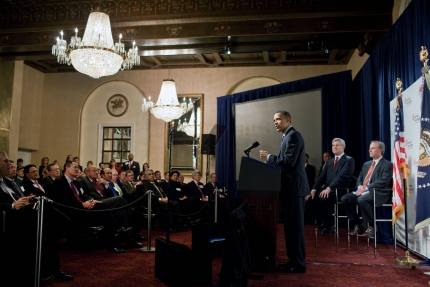
President Barack Obama addresses the Business Roundtable's 2010 First Quarter Meeting in Washington. With the President are John Castellani, President of the Business Roundtable, center, and Ivan Seidenberg, CEO of Verizon Communications, February 24, 2010. (Official White House Photo by Pete Souza)
Saying that the government he leads doesn’t step in “to supplant private enterprise, but to catalyze it,” he reminded the business leaders that it is the government’s responsibility to establish the basic rules of the marketplace to ensure honest competition, make investments that serve general welfare, and to guarantee a level of security for all Americans.
The President discussed a series of initiatives that the administration is taking to assist economic recovery, including the one that the Senate passed today, which provides tax cuts for small businesses that hire new workers. He noted the importance of making it easier for small businesses to get loans, and providing tax incentives for large businesses to invest in new plants and equipment.
He called for support for new financial regulations that can get rid of the system’s current vulnerabilities in order to prevent a future economic crisis by not allowing recklessness to continue. He explained that financial reform means closing loopholes that allow firms to evade rules in order to ensure consumer and investor protections. "This is about putting in place rules that encourage drive and innovation instead of shortcuts and abuse. And those are rules that will benefit everybody."
President Obama highlighted the importance of the administration’s new initiatives to jumpstart clean energy technology, push for stronger education, strengthen trade relations for competition, and establish a stronger health care system. He emphasized the drag on the economy that is caused by the current state of health care, pointing out that health care reform would significantly reduce the deficit while providing more certainty for businesses.On all these issues -– from education to health care to taxes -– my first question can’t be, “Is this good for business?” or “Is this good for labor?” It can’t be, “Is this good politics?” “Are folks going to tag me as a liberal or a conservative?” The only question I have to ask myself is, “Is this good for America? Does it help us compete? Does it grow our economy? Does it create jobs for middle-class and those trying to join the middle class? Is it fostering innovation and creating new business opportunities?” That’s my job as President.

Members of the Business Roundtable listen as President Barack Obama addresses their 2010 First Quarter Meeting in Washington, February 24, 2010. (Official White House Photo by Pete Souza)
- &lsaquo previous
- …
- 168
- 169
- 170
- 171
- 172
- 173
- 174
- 175
- 176
- …
- next &rsaquo
From the Press Office
Related Videos
-
 December 13, 2016 5:04 PM
Signing Ceremony for the 21st Century Cures Act
-
 December 10, 2016 5:00 AM
Weekly Address: It’s Time to Get Covered on the Health Insurance Marketplace