Health Care Blog
Watch, Discuss, Engage at 3:40: HHS Secretary Sebelius & Health Reform Director Nancy-Ann DeParle
Posted by on March 3, 2010 at 8:38 PM ESTThe President has now laid out a path forward for health reform that puts families and businesses in control of their own health care, reduces costs and the deficit, and incorporates new Republican ideas while still instituting fundamental protections again insurance company abuses. He opened his remarks saying, "I want to especially recognize two people who have been working tirelessly on that -- on this effort, my Secretary of Health and Human Services, Kathleen Sebelius -- as well as our quarterback for health reform out of the White House, Nancy-Ann DeParle." We're happy to have both of them in a live video chat at 3:40PM EST to take your questions on the President's proposal. Secretary Sebelius will also be meeting with insurance company leaders in the morning to get answers on the alarming premium hikes being ushered in on families across the country and will be able to discuss what she heard from them.
UPDATE: This event has now concluded.
Learn more about Health CareMoving Forward to Put the American People Ahead of Insurance Companies
Posted by on March 3, 2010 at 3:32 PM ESTEd. Note: At 3:40PM EST, HHS Secretary Kathleen Sebelius and Health Reform Director Nancy-Ann DeParle will take your questions about the President's proposal and remarks in a live video discussion. Watch here at WhiteHouse.gov/live, or join the discussion through Facebook.
Today the President made it exceedingly clear that he intends to move forward on reform to put Americans in control of their health care, and explained once again why:
Democrats and Republicans agree that this is a serious problem for America. And we agree that if we do nothing -– if we throw up our hands and walk away -– it’s a problem that will only grow worse. Nobody disputes that. More Americans will lose their family's health insurance if they switch jobs or lose their job. More small businesses will be forced to choose between health care and hiring. More insurance companies will deny people coverage who have preexisting conditions, or they'll drop people's coverage when they get sick and need it most. And the rising cost of Medicare and Medicaid will sink our government deeper and deeper and deeper into debt. On all of this we agree.
So the question is, what do we do about it?
The answer to that question, of course, has been at least a year in the making – countless hearings, meetings, and conversations have brought the best ideas from both sides to the surface, and the President’s proposal includes a broad array of Republican suggestions in addition to Democratic ones.
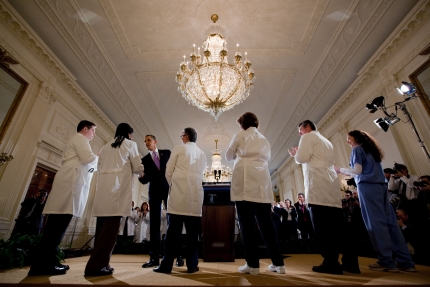
President Barack Obama speaks about health care reform in the East Room of the White House, March 3, 2010. (Official White House Photo by Chuck Kennedy)
However, the President also confronted the fact that there is a fundamental disagreement on how to deal with some core elements of the problem. Explaining that just as he has rejected one extreme of the spectrum that calls for an actual government takeover of health care, so too does he disagree with the other side:
On the other end of the spectrum, there are those, and this includes most Republicans in Congress, who believe the answer is to loosen regulations on the insurance industry -- whether it's state consumer protections or minimum standards for the kind of insurance they can sell. The argument is, is that that will somehow lower costs. I disagree with that approach. I'm concerned that this would only give the insurance industry even freer rein to raise premiums and deny care.
So I don't believe we should give government bureaucrats or insurance company bureaucrats more control over health care in America. I believe it's time to give the American people more control over their health care and their health insurance. I don't believe we can afford to leave life-and-death decisions about health care to the discretion of insurance company executives alone. I believe that doctors and nurses and physician assistants like the ones in this room should be free to decide what's best for their patients. (Applause.)
The President spoke at length about the merits of his proposal, from ending insurance company abuses, to the fact that it is paid for will reduce the deficit (concepts largely abandoned in recent years), to the fact that 30 million people will be covered and millions of middle class families will be able to afford the peace of mind of quality insurance for the first time.
He also called for an up or down vote in the next few weeks just as has been given to many health care bills before and to the Bush tax cuts, pledging that “from now until then, I will do everything in my power to make the case for reform.”
He closed with an explanation of what is motivating him:
So at stake right now is not just our ability to solve this problem, but our ability to solve any problem. The American people want to know if it's still possible for Washington to look out for their interests and their future. They are waiting for us to act. They are waiting for us to lead. And as long as I hold this office, I intend to provide that leadership. I do not know how this plays politically, but I know it's right. (Applause.) And so I ask Congress to finish its work, and I look forward to signing this reform into law.
Learn more about Health CareIncorporating the Best Ideas from Both Parties
Posted by on March 3, 2010 at 11:16 AM ESTYesterday the President sent a letter to Congressional leaders outlining four additional Republican ideas he’d be willing to include. These ideas were identified as priorities by GOP members attending Thursday’s bipartisan meeting:
- Combating waste, fraud, and abuse by engaging medical professionals to conduct random undercover investigations of health care providers who receive taxpayer money.
- More funding for demonstration projects of alternatives for resolving medical malpractice disputes, including health courts.
- Increasing Medicaid reimbursements for doctors.
- Ensuring Health Savings Accounts (HSAs) are in the Exchange.
These four ideas are just the latest to be singled out by the President as promising ways to strengthen our proposal. And they join a long list of good Republican ideas that have been incorporated already. You can learn more here.
Republican ideas in the legislation passed by Congress:
- Advancing medical liability reform through grants to States:
- Extending dependent coverage to age 26.
- Allowing automatic enrollment in health insurance.
- Including mechanisms to improve quality.
- SHOP exchange for small businesses to pool and purchase affordable insurance.
- Allowing the purchase of health coverage across state lines.
- Offering a high-risk pool.
- Supporting proven employer wellness programs
Additional Republican ideas in the President’s proposal:
- Including a comprehensive sanctions database.
- Registration and background checks of billing agencies and individuals.
- Expanded access to the Healthcare Integrity and Protection Data Bank.
- Liability of Medicare administrative contractors for claims submitted by excluded providers.
- Limiting debt discharge in bankruptcies of fraudulent health care providers or suppliers.
- Using technology for real-time data review.
- Illegal distribution of a Medicare or Medicaid beneficiary identification or billing privileges.
- Study of Universal Product Numbers claims forms for selected items and services under the Medicare program.
Dan Pfeiffer is White House Communications Director
Learn more about Health CarePresident Obama Follows Up on Thursday's Bipartisan Meeting on Health Reform
Posted by on March 2, 2010 at 12:55 PM ESTLast Thursday the President hosted a unique, open conversation with leaders from both parties in Congress to hear everyone's ideas about how to finally put American families and small businesses in control of their health care.
The President brought a proposal to the table, which included many Republican ideas that have been incorporated over the past year, and asked Republicans to bring their proposals as well.
The meeting, which lasted most of the day, provided a forum for enlightening discussion and ideas which the President has been considering seriously in the days since. Today the President wrote to Democratic and Republican Leadership to relay his reflections on the meeting along with even more Republican ideas he believes are worth exploring further as part of the final health reform package that he signs:
March 2, 2010
Dear Speaker Pelosi, Senator Reid, Senator McConnell, and Representative Boehner:
Thank you again for the time, energy, and preparation you invested in last Thursday’s bipartisan meeting on health insurance reform. I have always believed that our legislative process works best when both sides can discuss our differences and common goals openly and honestly, and I’m very pleased that our meeting at Blair House offered the American people and their elected representatives a rare opportunity to explore different health reform proposals in extraordinary depth.
The meeting was a good opportunity to move past the usual rhetoric and sound-bites that have come to characterize this debate and identify areas on which we agree and disagree. And one point on which everyone expressed agreement was that the cost of health care is a large and growing problem that, left untended, threatens families, businesses and the solvency of our government itself.
I also left convinced that the Republican and Democratic approaches to health care have more in common than most people think.
For example, we agree on the need to reform our insurance markets. We agree on the idea of allowing small businesses and individuals who lack insurance to join together to increase their purchasing power so they can enjoy greater choices and lower prices. And we agree on the dire need to wring out waste, fraud and abuse and get control of skyrocketing health care costs.
But there were also important areas of disagreement. There was a fundamental disagreement about what role the oversight of the health insurance industry should play in reform. I believe we must insist on some common-sense rules of the road to hold insurance companies accountable for the decisions they make to raise premiums and deny coverage. I don’t believe we can afford to leave life-and-death decisions about health care for America’s families to the discretion of insurance company executives alone.
No matter how we move forward, there are at least four policy priorities identified by Republican Members at the meeting that I am exploring. I said throughout this process that I’d continue to draw on the best ideas from both parties, and I’m open to these proposals in that spirit:
- Although the proposal I released last week included a comprehensive set of initiatives to combat fraud, waste, and abuse, Senator Coburn had an interesting suggestion that we engage medical professionals to conduct random undercover investigations of health care providers that receive reimbursements from Medicare, Medicaid, and other Federal programs.
- My proposal also included a provision from the Senate health reform bill that authorizes funding to states for demonstrations of alternatives to resolving medical malpractice disputes, including health courts. Last Thursday, we discussed the provision in the bills cosponsored by Senators Coburn and Burr and Representatives Ryan and Nunes (S. 1099) that provides a similar program of grants to states for demonstration projects. Senator Enzi offered a similar proposal in a health insurance reform bill he sponsored in the last Congress. As we discussed, my Administration is already moving forward in funding demonstration projects through the Department of Health and Human Services, and Secretary Sebelius will be awarding $23 million for these grants in the near future. However, in order to advance our shared interest in incentivizing states to explore what works in this arena, I am open to including an appropriation of $50 million in my proposal for additional grants. Currently there is only an authorization, which does not guarantee that the grants will be funded.
- At the meeting, Senator Grassley raised a concern, shared by many Democrats, that Medicaid reimbursements to doctors are inadequate in many states, and that if Medicaid is expanded to cover more people, we should consider increasing doctor reimbursement. I’m open to exploring ways to address this issue in a fiscally responsible manner.
- Senator Barrasso raised a suggestion that we expand Health Savings Accounts (HSAs). I know many Republicans believe that HSAs, when used in conjunction with high-deductible health plans, are a good vehicle to encourage more cost-consciousness in consumers’ use of health care services. I believe that high-deductible health plans could be offered in the exchange under my proposal, and I’m open to including language to ensure that is clear. This could help to encourage more people to take advantage of HSAs.
There are provisions that were added to the legislation that shouldn’t have been. That’s why my proposal does not include the Medicare Advantage provision, mentioned by Senator McCain at the meeting, which provided transitional extra benefits for Florida and other states. My proposal eliminates those payments, gradually reducing Medicare Advantage payments across the country relative to fee-for service Medicare in an equitable fashion (page 8). My proposal rewards high-quality and high-performing plans.
In addition, my proposal eliminates the Nebraska FMAP provision, replacing it with additional federal financing to all states for the expansion of Medicaid.
Admittedly, there are areas on which Republicans and Democrats don’t agree. While we all believe that reform must be built around our existing private health insurance system, I believe that we must hold the insurance industry to clear rules, so they can’t arbitrarily raise rates or reduce or eliminate coverage. That must be a part of any serious reform to make it work for the many Americans who have insurance coverage today, as well as those who don’t.
I also believe that piecemeal reform is not the best way to effectively reduce premiums, end the exclusion of people with pre-existing conditions or offer Americans the security of knowing that they will never lose coverage, even if they lose or change jobs.
My ideas have been informed by discussions with Republicans and Democrats, doctors and nurses, health care experts, and everyday Americans – not just last Thursday, but over the course of a yearlong dialogue. Both parties agree that the health care status quo is unsustainable. And both should agree that it’s just not an option to walk away from the millions of American families and business owners counting on reform.
After decades of trying, we’re closer than we’ve ever been to making health insurance reform a reality. I look forward to working with you to complete what would be a truly historic achievement.
Sincerely,
Learn more about Health CareWeekly Address: The Olympic Spirit, the Spirit of Bipartisanship, and Health Reform
Posted by on February 27, 2010 at 6:00 AM ESTThe President takes a moment to congratulate our Olympic athletes. Discussing the unity and pride Americans feel in cheering them on, the President relates that sentiment to his own desire for bipartisanship in Washington. He praises the recent bipartisan meeting and talks about moving forward on health reform.
Learn more about Health CareProtecting Kids from Tobacco and Improving Public Health at Home and Abroad
Posted by on February 26, 2010 at 4:45 PM ESTOne billion people are projected to die this century from tobacco-related causes, including more than 400,000 Americans each year. These deaths are preventable.
In June, President Obama signed into law the bipartisan Family Smoking Prevention and Tobacco Control Act to curb the ability of tobacco companies to market products to children, and to reduce tobacco consumption in the United States. The Act adopts many of the evidence-based policies recommended by the World Health Organization and embodied in the Framework Convention on Tobacco Control. The Act stops tobacco companies from using appealing flavors such as strawberry and chocolate to market cigarettes to children; it implements new warning labels on cigarettes and smokeless tobacco products; it forces companies to more clearly and publicly acknowledge the harmful and deadly effects of products they sell; and it allows scientists at the FDA to take steps to reduce the harmful effects of smoking. With this law, the U.S. government has taken strong steps to reduce the single most preventable cause of death in America.
Protecting kids and the public from tobacco is also important around the world. There are 1.2 billion smokers already worldwide, and tobacco use in developing countries is on the rise. Reversing this trend—through proven interventions such as monitoring tobacco data, protecting people from tobacco smoke, offering help to people who want to quit tobacco use, applying sensible limits on tobacco advertising, raising the price of tobacco, and warning the public about the dangers of tobacco—will save millions of lives.
In his remarks at the signing of the Family Smoking Prevention and Tobacco Control Act, President Obama committed to work with the U.S. partners at the World Health Organization and other nations to fight the tobacco epidemic. Many U.S. agencies are already active in this area—for example, the Centers for Disease Control and Prevention helps conduct surveys on tobacco use around the world, and the Fogarty International Center sponsors cutting-edge research relevant to global tobacco issues. The Obama Administration considers these efforts important and is exploring ways to better support countries in implementing commonsense public health measures to reduce the harms of tobacco.
This week marks the fifth anniversary of the entry into force of the Framework Convention for Tobacco Control, a treaty to reduce tobacco's devastating health consequences around the world. We join with others across the world who are concerned about public health in their own countries and recognize the urgency of curbing the tobacco epidemic. All nations, including our own, should work to save lives by helping communities take on this most preventable cause of death.
Bob Kocher is Special Assistant to the President for Healthcare & Economic Policy
Tino Cuellar is Special Assistant to the President for Justice & Regulatory Policy
Tom Kalil is Deputy Director for Policy at the Office of Science and Technology PolicyLearn more about , Foreign Policy, Health Care
- &lsaquo previous
- …
- 167
- 168
- 169
- 170
- 171
- 172
- 173
- 174
- 175
- …
- next &rsaquo
From the Press Office
Related Videos
-
 December 13, 2016 5:04 PM
Signing Ceremony for the 21st Century Cures Act
-
 December 10, 2016 5:00 AM
Weekly Address: It’s Time to Get Covered on the Health Insurance Marketplace