Health Care Blog
Improving Data Collection on Native Hawaiian and Pacific Islander Health
Posted by on December 18, 2013 at 10:49 AM ESTOver the last four years at the White House Initiative on Asian Americans and Pacific Islanders (WHIAAPI), we have been working with federal agencies across the board to improve data collection, analysis, and dissemination of findings and reports on Asian Americans and Native Hawaiians and Pacific Islanders (NHPIs). We have been particularly focused on NHPIs, who, according to the 2010 U.S. Census, comprise just 0.4 percent of the total U.S. population, making it difficult to include them in sufficient numbers in most national population-based health surveys. The lack of reliable health data for this population has made it difficult to assess their health status and health care utilization. However, the available data for this population indicates that Native Hawaiians and Pacific Islanders experience significant health disparities when compared to other groups, such as lower utilization of health care services and higher rates of chronic diseases, such as diabetes and obesity.
That’s why we welcome the announcement made today that the U.S. Department of Health and Human Services (HHS) will launch the first-ever, large-scale national health survey to collect detailed health information on NHPI households – the Native Hawaiian/Pacific Islander National Health Interview Survey. This information will be collected through HHS’ National Health Interview Survey, the nation’s largest in-person, household health survey. Never before has there been a study of this scale to assess the health needs of NHPIs, and this type of survey has long been called for by the NHPI community. This important effort will help improve our understanding of the health concerns – from access to health care to health insurance coverage to rates of chronic diseases like diabetes or heart disease – faced by this community and to identify areas of opportunity for federal government to better address these concerns.
WHIAAPI encourages advocates and organizations across the country to join us in spreading the word about this landmark survey. We hope you can continue the conversation with us on Twitter using #NHPI.
Our hope is that the results of this study will provide researchers, policymakers, and community leaders with the data they need to understand and address disparities in health and health care, and provide lessons for data collection and analysis focused on small populations.
The Native Hawaiian/Pacific Islander National Health Interview Survey will begin early next year, and the results will become available summer 2015.
Kiran Ahuja is the Executive Director of the White House Initiative on Asian Americans and Pacific Islanders.
Learn more about Health CareHow Obamacare Helps the LGBT Community
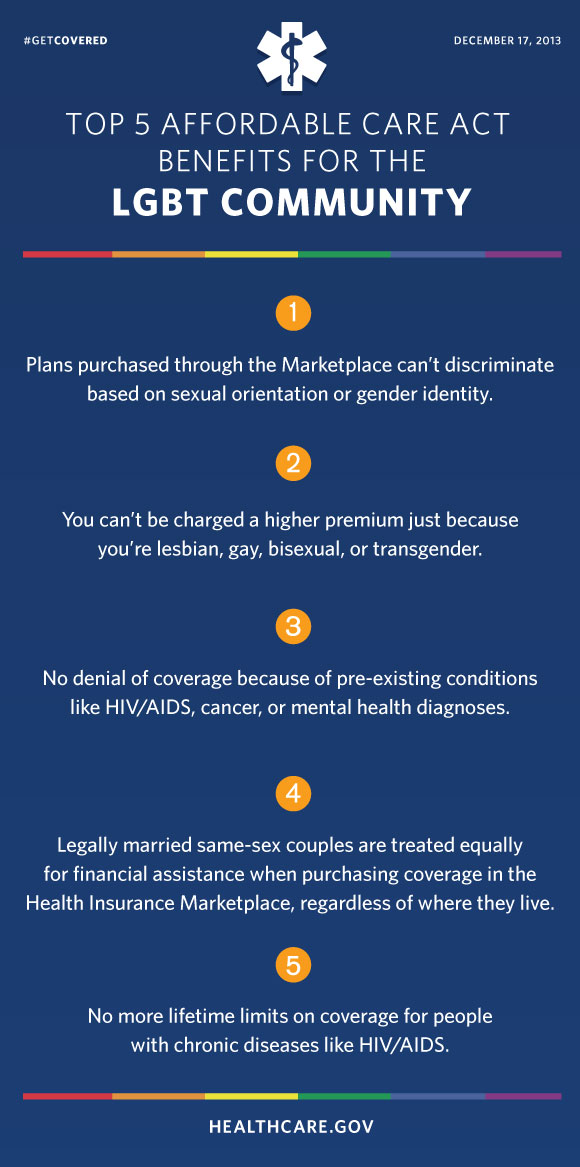
Posted by on December 17, 2013 at 1:00 PM ESTSince taking office, President Obama and his Administration have taken significant steps to advance equality for the lesbian, gay, bisexual, and transgender (LGBT) community. You’ve probably heard of many of these accomplishments: repealing “Don’t Ask, Don’t Tell,” prohibiting anti-LGBT discrimination in hospitals and in housing, promoting international LGBT human rights, standing up against DOMA and then implementing the Supreme Court’s decision in United States v. Windsor.
That’s an important, and exciting, list of accomplishments over the last few years – but it’s missing one very important accomplishment: the Affordable Care Act, otherwise known as Obamacare.
The Affordable Care Act has the potential to transform the lives of countless LGBT people and improve the health and well-being of our community – for generations to come.
Here’s why:
 Learn more about Civil Rights, Health Care
Benefits of Medicaid Expansion for All States
Posted by on December 12, 2013 at 12:28 PM ESTUnder the Affordable Care Act, states have the opportunity to expand Medicaid coverage to provide millions of Americans access to affordable healthcare. In return, states receive 100 percent of federal funding to cover those costs for the first three years and no less than 90 percent federal support for those costs in the years following. Taken together, if all 24 states that haven’t expanded coverage did so, about 5.4 million uninsured Americans would gain access to health insurance coverage by 2016.
This leaves state officials facing a critical decision: play political games and continue to block Medicaid expansion under the Affordable Care Act or put partisanship aside and bring in much needed funds to allow millions of citizens access to healthcare. It should not be a difficult choice. Now is the time for elected officials to follow the example of Governor John Kasich in Ohio and Governor Jan Brewer in Arizona to put politics aside and expand Medicaid.
As Nebraska State Senator Jeremy Nordquist said:
“It’s often overlooked that Nebraska has a high number of uninsured in rural counties. Without expansion, rural hospitals will face growing financial challenges, which will undoubtedly lead to a reduction in the services they provide and – we are hearing – a real risk of these critical hospital closing their doors. The good news is that the Nebraska Legislature is unique. We are nonpartisan, unicameral and constantly find ways to work together to move our state forward. On this issue, there is a strong bipartisan majority that supports expanding Medicaid. Providing access to quality, affordable health care should be a priority for all of us who represent the ‘good life’ in Nebraska. If all legislators and our Governor truly care about growing our economy and strengthening our health care system, we will pass Medicaid expansion in 2014.”
Here’s a sample of some coverage from the last week about local leaders and organizations across the country encouraging leaders to put politics aside, and improve access to quality healthcare by expanding Medicaid:
Washington Times: White House PR blitz hits states that rejected Medicaid expansion The Obama administration’s all-out public relations push to sell its health care reform law increasingly is targeting individual governors, who will bear much of the blame, the White House says, if millions of poor Americans remain uninsured. Administration officials Monday joined with state and local Democratic leaders in North Carolina to put pressure on Gov. Pat McCrory, a Republican, to expand Medicaid eligibility under Obamacare. Under Mr. McCrory, North Carolina is one of two dozen states that so far have opted out of that expansion, a crucial building block of the Affordable Care Act but one that became voluntary as a result of a Supreme Court decision last year. LINK
McClatchy: White House, N.C. Democrats press state to expand Medicaid The White House enlisted two top North Carolina Democrats on Monday to urge Gov. Pat McCrory and the legislature to reconsider their opposition to Medicaid expansion under Obamacare. “Medicaid expansion is a smart choice for states,” White House Spokesman Josh Earnest said during a telephone news conference along with Durham Democrats, Mayor Bill Bell and state Sen. Floyd McKissick. Earnest said that states would save money “over and above the expense of expanding Medicaid.” Bell said that in Durham, the state’s fourth largest city, 61,000 people would get insurance if the expansion went through. LINK
Learn more about Health CareThanks to the Affordable Care Act, Lisa No Longer Has to Worry About Her Daughter's Pre-Existing Condition
Posted by on December 12, 2013 at 11:15 AM ESTLisa's daughter Zoie was diagnosed with childhood kidney cancer at age 3. Thanks to the Affordable Care Act, insurance companies are now prohibited from denying health coverage to children like Zoie who have pre-existing conditions. Below, see what Lisa has to say about how the health care law is helping her familiy.
For more information:
- Get Covered at HealthCare.gov
- Adele's Story: I Don't Have to Worry About Lifetime Limits on My Daughter's Health Care
- Karmel's Story: I No Longer Fear My 'Pre-Existing Condition'
Learn more about Health CareIt Shouldn’t Have Happened to Me, But It Did
Posted by on December 4, 2013 at 10:40 PM ESTEd. note: This post was updated March 21, 2014.
“You have stage IV cancer.”
“Well, how many stages are there? Five, six, ten?”
“There's only four.”
Two months after proposing to my wife and just three months before my 36th birthday, those were the first words spoken to me by my oncologist.
A check-up with my family doctor only days before spawned a whirlwind of appointments, scans, and tests. I sat, listening in awe, trying to wrap my head around the reality of balancing fear and uncertainty with wanting to fight, but not really knowing how. I learned that I was now a stage IV, metastatic colorectal cancer patient. A cancer that usually afflicts those 65 and older wasn’t just inside my body, it was growing and making its way through my body, spreading from my colon to a tumor in my liver and another one in my lungs.
I was otherwise healthy my whole life – 35 years old, an athlete into college, professionally doing important work I’d only dreamed of, and finally about to be married and start my own family. Fighting to survive a catastrophic disease was NOT part of my plans.
Thankfully, I was fortunate enough to have insurance through my employer and my cancer was treatable and curable, they said. Thankfully, because I had insurance, they said, if I gave them the next year for treatment, they’d give me back the rest of my life.
But imagine if I didn’t have access to health insurance through my job. Until that week, just 20 months ago, I could have made the case that I almost didn’t “need” to spend money on health insurance. Technically, with only yearly check-ups and mostly needing only over-the-counter medicines, I could have afforded to pay for my health care needs myself.
Learn more about Health CareWhite House Youth Summit: Making Sure People Have the Information They Need to #GetCovered
Posted by on December 4, 2013 at 7:50 PM ESTThis afternoon, youth leaders from across the country gathered here for our White House Youth Summit. The Summit was made of up 160 of this country's finest national and local leaders aged 18-35. Joined by White House and Administration staff, these millennial participants discussed issues important to their generation -- especially spreading the word about the Affordable Care Act and organizing to get people enrolled in their respective communities. They also participated in a series of panels and breakout workshops with administration officials, stakeholder groups, and advocates.
To kick off the event, a very special guest dropped by to speak to the Youth Summit: President Obama -- who let young Americans know he needed their help.
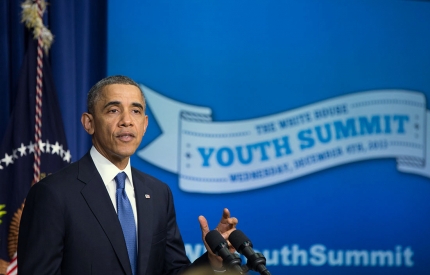
President Barack Obama delivers remarks at the White House Youth Summit on the Affordable Care Act (ACA) in the Eisenhower Executive Office Building South Court Auditorium, Dec. 4, 2013. (Official White House Photo by Pete Souza)
So I'm going to need you all to spread the word about how the Affordable Care Act really works, what its benefits are, what its protections are and, most importantly, how people can sign up. I know people call this law Obamacare. And that's okay -- because I do care. I care about you. I care about families. I care about Americans.
But no matter how much I care, the truth is, is that for your friends and your family, the most important source of information is not going to be me, it's going to be you. They are going to trust you. If you're taking them on a website, walking them through it saying, look at the price you're able to get, look at the benefits you're able to get. That's what's going to be making a difference.
Learn more about Health Care
- &lsaquo previous
- …
- 41
- 42
- 43
- 44
- 45
- 46
- 47
- 48
- 49
- …
- next &rsaquo
From the Press Office
Related Videos
-
 December 13, 2016 5:04 PM
Signing Ceremony for the 21st Century Cures Act
-
 December 10, 2016 5:00 AM
Weekly Address: It’s Time to Get Covered on the Health Insurance Marketplace