Health Care Blog
Improving Consumer Information - New Letters Make Health Insurance Choices Clear
Posted by on November 21, 2013 at 2:13 PM ESTToday, the Centers for Medicare & Medicaid Services (CMS) took a major step to give consumers across the country new, standardized information about their options and rights when it comes to health insurance. This effort is a direct response to the President’s concerns that the small percentage of Americans receiving confusing letters from their insurance companies need clearer information about how to keep an existing plan, or how to choose a new plan with new protections available in the health insurance marketplace.
Because of the Affordable Care Act, people with health insurance have stronger protections than ever before. This means that consumers in new health insurance plans will no longer be charged more because of gender or a pre-existing condition, there will be caps on out-of-pocket costs, and plans will have to offer a basic package of 10 categories of essential health benefits.
These new market rules do not apply if you are in the same health plan you were in when the law passed, a so-called grandfathered plan. Your plan does not need to meet these new requirements – and your plan is required to let you know that. Additionally, these protections may not apply if your insurer takes the new option announced by the President last week. This transitional policy allows issuers in states that permit it to renew health plans that were in effect on October 1, 2013, without adopting all of the 2014 market rule changes. This helps give consumers in the individual and small group markets the choice of staying in their plan or joining a new Marketplace plan next year.
Learn more about Health CareNew Report from the Council of Economic Advisers: The Recent Slowdown in Health Care Cost Growth and the Role of the Affordable Care Act
Posted by on November 20, 2013 at 12:34 PM ESTThe Affordable Care Act (ACA) was passed against a backdrop of decades of rapid growth in health care spending, and one of the ACA’s key goals was to root out serious inefficiencies in the United States health care system that increase costs and compromise patients’ quality of care. Recent data show that health care spending and prices are growing at their slowest rates in decades; it appears that something has changed for the better. While this marked slowdown likely has many causes, and these causes are not yet fully understood, the available evidence suggests that the ACA is contributing to these trends, and, moreover, is helping to improve quality of care for patients. Today the White House Council of Economic Advisers released a new report analyzing recent trends in health costs, the forces driving those trends, and their likely economic benefits. Read the full report here.
Key points in today's report from the Council of Economic Advisers:
1. Health care spending is growing at the slowest rate on record: According to the most recent projections, real per capita health care spending has grown at an estimated average annual rate of just 1.3 percent over the three years since 2010. This is the lowest rate on record for any three-year period and less than one-third the long-term historical average stretching back to 1965. This slower growth in spending is reflected in Medicare, Medicaid, and private insurance.
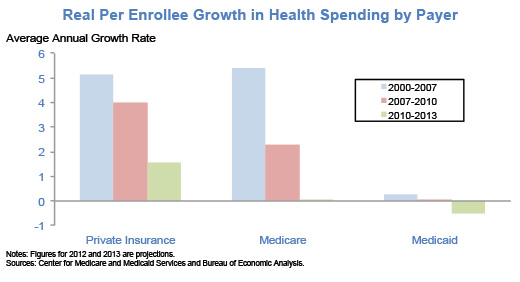
2. Health care price inflation is at its lowest rate in 50 years: Measured using personal consumption expenditure price indices, inflation for health care goods and services is currently running at just 1 percent on a year-over-year basis, the lowest level since January 1962. (Health care inflation measured using the medical CPI is lower than at any time since September 1972.)
Learn more about Economy, Health CareThe Burden of Diabetes on the Native Hawaiian and Pacific Islander Community
Posted by on November 20, 2013 at 8:24 AM ESTAs a physician for more than 30 years, I have seen the tremendous burden that diabetes places on patients and their loved ones. As November marks National Diabetes Month, let us recommit to educating ourselves and our communities about how to prevent, manage, and treat diabetes.
Diabetes affects nearly 26 million Americans, but the Native Hawaiian and Pacific Islander community is at particular risk. In fact, Native Hawaiians and Pacific Islanders are more than three times more likely to be diagnosed with diabetes, compared to non-Hispanic whites. This is due to higher rates of risk factors such as being overweight and obesity, high blood pressure, high cholesterol, and smoking. Within the U.S. Pacific Islands themselves, the prevalence of overweight and obesity exceeds 90 percent and diabetes approaches 50 percent in some areas.
I encourage all Americans, including Native Hawaiians and Pacific Islanders, to take advantage of preventive care, which is critical to improving health and outcomes and identifying early signs of disease or risk factors. The Affordable Care Act offers quality health insurance to uninsured Americans, including nearly 240,000 uninsured Native Hawaiians and Pacific Islanders.
The law ensures that Americans at higher risk for developing type-2 diabetes can receive diabetes screenings, diet counseling, and obesity screenings with no out-of-pocket costs. Additionally, screening for gestational diabetes is available with no co-payment for women 24 to 28 weeks pregnant. Beginning in 2014, Americans cannot be denied health coverage because they have diabetes or any other pre-existing health condition.
Additional initiatives, such as First Lady Michelle Obama’s Let’s Move program, the Centers for Disease Control and Prevention (CDC)’s National Diabetes Prevention Program, and the National Diabetes Education Program (a partnership of the National Institutes of Health and the CDC) are helping Americans of all ages take action to improve their health and that of the nation. Help spread the word on the importance of preventing and managing diabetes, so that all Americans can live their full potential for health.
Howard K. Koh, MD, MPH, is the Assistant Secretary for Health at the U.S. Department of Health and Human Services.
Learn more about Health CareAmericans Are Getting Covered Thanks to the Affordable Care Act
Posted by on November 19, 2013 at 4:37 PM ESTThanks to the Affordable Care Act, Americans all over the country are enrolling in affordable health coverage. Many were unable to get insurance before and many others are signing up for new plans that offer better coverage than what they had before, often at lower costs.
Here are some of the stories being reported around the country.
Butch Matthews, a 61-year-old former small business owner from Little Rock, Arkansas, learned he will be able to buy a better plan that saves him nearly $13,000 ayear. [ThinkProgress, 10/2/13]
Rakesh Rikhi of San Jose, California, pays $950 a month to insure himself, his wife and two children with Kaiser. Through CoveredCalifornia, his state’s marketplace, he’ll be able to get a similar Kaiser plan that saves his family $400 a month. [NBC Bay Area, 10/12/13].
Learn more about Health Care, Urban PolicyWebinar on December 19th: Hepatitis B and Reducing Perinatal Transmission -An Overview and Discussion of New Tools
Posted by on November 18, 2013 at 8:04 PM ESTPlease join the White House Initiative on Asian Americans and Pacific Islanders (WHIAAPI) and Hep B United on Thursday, December 19th, from 2:30-4:00 PM EDT for a webinar on Hepatitis B and Reducing Perinatal Transmission featuring speakers from the U.S. Department of Health and Human Services (HHS) and Hep B United.
Mother to child transmission, also known as perinatal transmission, of hepatitis B is still a public health issue in the U.S. Approximately 800 newborns in the U.S. are chronically infected each year through perinatal exposure. Half of all hepatitis B-infected individuals—or 1 in 12—are from Asian American and Pacific Islander (AAPI) populations, and the most common form of transmission is from mother to child.
Join us for this interactive session to discuss new tools and best practices toward reducing hepatitis B health disparities in AAPI communities, including potential interventions in prenatal care, information about gaps in reporting and a new resource from the Immunization Action Coalition entitled, Give Birth to the End of Hep B.
Title:
Hepatitis B and Reducing Perinatal Transmission: An Overview and Discussion of New ToolsDate:
Thursday, December 19th, 2013Time:
2:30-4:00 pm EDTRegister at: http://bit.ly/17E5MsJ
A confirmation email with information on how to join the webinar will be sent to you after you register.Moderator:
Chari Cohen, MPH, DrPH(c), Director of Public Health, Hepatitis B FoundationSpeakers:
- A. Seiji Hayashi, MD, MPH, Chief Medical Officer, Bureau of Primary Health Care, Health Resources and Services Administration, HHS
- Trudy Murphy, MD, Division of Viral Hepatitis, National Center for HIV/AIDS, Viral Hepatitis, STD, and TB Prevention, CDC
- Su Wang, MD, MPH, former Assistant Director of Medical Affairs, Charles B. Wang Community Health Center; Medical Director, Center for Asian Health Chinese Health Initiative: Medical Care for the Chinese Community, Saint Barnabas Medical Center
- Deborah Wexler, MD, Executive Director, Immunization Action Coalition
Note: This call is off the record and not for press purposes.
Juliet Bui is a Policy Advisor on Health with the White House Initiative on AAPIs.
Learn more about Health CareLearning about the Health Insurance Marketplace in Vietnamese
Posted by on November 18, 2013 at 10:31 AM EST
Department of Education’s Kim Oanh Nguyen and Department of Health and Human Services’ Kimquy Kieu, and Minh Wendt hosted a Google+ Hangout in Vietnamese on the Health Insurance Marketplace on November 6, 2013 (Photo courtesy of Jason Tengco)
On November 6, 2013, the White House Initiative on Asian Americans and Pacific Islanders (WHIAAPI) held a Google+ Hangout in Vietnamese to discuss the Health Insurance Marketplace, a whole new way to shop for affordable, quality health coverage. Vietnamese American communities from around the country tuned in. In addition, Vietnamese American community groups gathered at local community centers in California, Louisiana, New Jersey, New York, Pennsylvania, and Texas to participate in the discussion.
The Department of Health and Human Services’ Kimquy Kieu, MD, MPH and Minh Wendt, Ph.D., responded to a broad array of questions about the Health Insurance Marketplace, Topics included eligibility requirements, financial assistance, enrollment dates, consumer assistance programs in local communities, and resources for in-language assistance.
Open enrollment in the Marketplace runs through the end of March 2014. Individuals have until December 15, 2013 to sign up for coverage starting on January 1, 2014. There are a number of ways to shop for coverage in the Marketplace. Individuals can visit HealthCare.gov, call the call center at 1-800-318-2596 (TTY 1-855-889-4325), or use the Find Local Help feature on the website to find people in local communities who are trained to help them understand their coverage options and enroll in a plan.
Two million Asian Americans and Pacific Islanders are projected to become insured thanks to the Affordable Care Act. For Asian Americans and Pacific Islanders, the Affordable Care Act will help reduce disparities in both health care and health outcomes through expanded insurance coverage and better access to quality health care services. Two million uninsured Asian Americans and Pacific Islanders have new opportunities for coverage through the Marketplace.
The turnout at the Vietnamese-language Hangout and the enthusiasm of the participants highlight the need to engage the Asian American and Pacific Islanders’ limited English proficient community on the Affordable Care Act in the languages they speak. In addition to the Hangout that we held in Korean in August, WHIAAPI plans to hold another Google+ Hangout on the Marketplace in Chinese.
Tuyet Duong is a Senior Advisor at the White House Initiative on Asian Americans and Pacific Islanders.
Tìm Hiểu Về Thị Trường Bảo Hiểm Sức Khoẻ bằng Tiếng Việt
Tác giả Tuyet Duong
Department of Education’s Kim Oanh Nguyen and Department of Health and Human Services’ Kimquy Kieu, and Minh Wendt hosted a Google+ Hangout in Vietnamese on the Health Insurance Marketplace on November 6, 2013 (Photo courtesy of Jason Tengco)
Nguyễn Kim Oanh thuộc Bộ Giáo Dục và Kiều Kim Quy thuộc Bộ Y Tế và Nhân Sinh, và Minh Wendt đã chủ trì một buổi Google+ Hangout bằng tiếng Việt về Thị Trường Bảo Hiểm Sức Khỏe vào ngày 6 Tháng Mười Một, 2013 (Hình Ảnh Jason Tengco)
Vào Ngày 6 Tháng Mười Một, 2013, White House Initiative on Asian Americans and Pacific Islanders (Sáng Kiến của Toà Bạch Ốc về Người Mỹ gốc Á Châu và Đảo Thái Bình Dương - WHIAAPI) đã tổ chức một buổi Google+ Hangout bằng tiếng Việt để bàn về Health Insurance Marketplace (Thị Trường Bảo Hiểm Sức Khỏe), một phương cách hoàn toàn mới để mua bảo hiểm sức khỏe có phẩm chất, hợp túi tiền. Các cộng đồng người Mỹ gốc Việt từ khắp nơi trên toàn quốc đã lắng nghe cuộc thảo luận này. Ngoài ra, các nhóm cộng đồng người Mỹ gốc Việt đã quy tụ tại các trung tâm cộng đồng địa phương ở California, Louisiana, New Jersey, New York, Pennsylvania, và Texas để tham gia trong cuộc bàn luận.
Kiều Kim Quy, MD, MPH thuộc Ban Dịch Vụ Y Tế và Nhân Sinh và Minh Wendt, Ph.D., đã trả lời nhiều câu hỏi về Thị Trường Bảo Hiểm Sức Khỏe, các đề tài bao gồm quy định để hội đủ điều kiện, trợ giúp tài chánh, các ngày ghi danh, các chương trình trợ giúp khách hàng tại các cộng đồng địa phương, và các nguồn trợ giúp ngôn ngữ .
Thời gian ghi danh với Thị Trường diễn ra cho tới cuối tháng Ba 2014. Các cá nhân có đến ngày 15 Tháng Mười Hai, 2013 để ghi danh mua bảo hiểm có hiệu lựcvào ngày 1 Tháng Giêng, 2014. Có một số cách để mua bảo hiểm trên Thị Trường. Các cá nhân có thể vào trang mạng HealthCare.gov, gọi trung tâm trợ giúp ở số 1-800-318-2596 (TTY 1-855-889-4325), hoặc dùng tính năng Find Local Help (Tìm Sự Giúp Đỡ Tại Địa Phương) trên trang mạng để tìm những người ở các cộng đồng địa phương được huấn luyện để giúp họ hiểu các lựa chọn bảo hiểm và ghi danh vào một chương trình.
Hai triệu người Mỹ gốc Á Châu và Đảo Thái Bình Dương theo dự kiến sẽ được bảo hiểm nhờ Đạo Luật Chăm Sóc Phù Hợp Túi Tiền. Đối với Người Mỹ gốc Á Châu và người Đảo Thái Bình Dương, Đạo Luật Chăm Sóc Phù Hợp Túi Tiền sẽ giúp giảm thiểu sự chênh lệch luôn cả về chăm sóc sức khỏe và các kết quả sức khỏe qua bảo hiểm được mở rộng và sự tiếp cận tốt hơn với các dịch vụ chăm sóc sức khỏe phẩm chất. Hai triệu người Mỹ gốc Á Châu và người Đảo Thái Bình Dương không có bảo hiểm sẽ có các cơ hội mới để có bảo hiểm qua Thị Trường.
Thành phần tham gia và sự nhiệt thành của những người tham gia buổi Hangout bằng tiếng Việt đã nhấn mạnh nhu cầu tham gia cần thiết của cộng đồng người Mỹ gốc Á Châu và người Đảo Thái Bình Dương kém tiếng Anh vào Đạo Luật Chăm Sóc Phù Hợp Túi Tiền bằng ngôn ngữ bản xứ . Ngoài Hangout mà chúng tôi tổ chức bằng tiếng Hàn vào tháng Tám, WHIAAPI dự định tổ chức một buổi Google+ Hangout nữa trên Thị Trường bằng tiếng Trung Hoa.
Tuyết Dương là một Cố Vấn Cấp Cao thuộc Sáng Kiến của Toà Bạch Ốc về người Mỹ gốc Á Châu và người Đảo Thái Bình Dương.
Learn more about Health Care
- &lsaquo previous
- …
- 43
- 44
- 45
- 46
- 47
- 48
- 49
- 50
- 51
- …
- next &rsaquo
From the Press Office
Related Videos
-
 December 13, 2016 5:04 PM
Signing Ceremony for the 21st Century Cures Act
-
 December 10, 2016 5:00 AM
Weekly Address: It’s Time to Get Covered on the Health Insurance Marketplace