Health Care Blog
Weekly Wrap Up: Honoring Those Who Have Served
Posted by on November 15, 2013 at 6:45 PM ESTHonoring our Military: On Veterans Day, the President honored those who have served, or are currently serving, our country. The President hosted a breakfast that morning for veterans and their families before heading off to Arlington Cemetery with the Vice President, the First Lady, and Dr. Biden. The President participated in a wreath-laying ceremony and spoke to the crowd about the devotion and commitment of those who don our nation’s uniform.
In the life of our nation, across every generation, there are those who stand apart. They step up, they raise their hands, they take that oath. They put on the uniform and they put their lives on the line. They do this so that the rest of us might live in a country and a world that is safer, freer, and more just.
The President also reminded Americans that we need to support troops after they have come home. “This is how we’ll be judged. Not just by how well we care for our troops in battle, but how we treat them when they come home,” the President said. Check out the President’s remarks here.
In honor of Veteran’s Day, First Lady Michelle Obama and Dr. Jill Biden wrote an op-ed about Joining Forces that appeared in military news websites, highlighting their commitment to employment, wellness, and education for veterans, service members, and their families.
Continuing his work with members of the military later that week, the President welcomed senior civilian defense and military leaders to an annual meeting and dinner, where those present discussed a wide range of issues.
President Obama Announces New Steps to Help Americans Receiving Insurance Cancellation Notices
Posted by on November 14, 2013 at 2:25 PM EST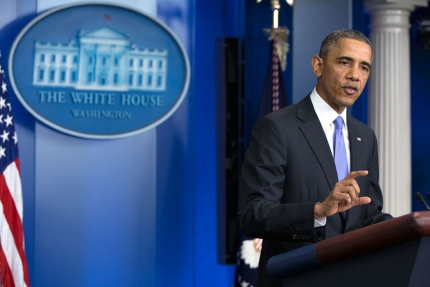
President Barack Obama answers questions at a news conference in the James S. Brady Press Briefing Room of the White House, Nov. 14, 2013. (Official White House Photo by Pete Souza)
In the past few weeks, some Americans have been notified by their health insurance companies that plans they bought on the old individual insurance market are being cancelled – often because these plans no longer meet the Affordable Care Act’s requirement to cover basic benefits like prescription drugs or doctors’ visits.
Today, President Obama announced that insurers can offer these customers the option to renew their 2013 health plans in 2014, without change, allowing them to keep their plans.
Already, people who have plans that predate the Affordable Care Act can keep those plans if they haven’t changed. That was already in the law. That's what's called a grandfather clause. It was included in the law. Today, we're going to extend that principle both to people whose plans have changed since the law took effect, and to people who bought plans since the law took effect.
"The bottom line, President Obama said, is that "insurers can extend current plans that would otherwise be canceled into 2014, and Americans whose plans have been canceled can choose to re-enroll in the same kind of plan."
President Obama pointed out that the individual insurance market had serious problems before the Affordable Care Act. "And it’s important that we don’t pretend that somehow that’s a place worth going back to. Too often, it works fine as long as you stay healthy; it doesn’t work well when you’re sick," he said. "So year after year, Americans were routinely exposed to financial ruin, or denied coverage due to minor preexisting conditions, or dropped from coverage altogether – even if they paid their premiums on time."
Creating new protections for people in the individual market – preventing them from being charged more because of a pre-existing condition or getting fewer benefits like mental health services or prescription drugs – “is one of the reasons we pursued this reform in the first place,” President Obama said.
Learn more about Health CareWorking Together to Strengthen our Community Health Centers
Posted by on November 12, 2013 at 9:50 AM ESTOn a recent trip to California, as part of U.S. Secretary of Education Arne Duncan’s Strong Start, Bright Future back-to-school bus tour, I had the opportunity to visit Operation Samahan (Tagalog for “working together”), a community health center located in National City, CA that predominantly serves the Filipino American community and low-income, uninsured families and individuals.
During my visit, I learned about the organization’s humble beginnings forty years ago, when a group of volunteer doctors and nurses met in a barber shop in downtown San Diego. Frustrated by the lack of culturally and linguistically competent health care services available to their own families and communities, they began seeing Filipino American and Latino patients, focused on providing primary and preventive care. The demand for their services rapidly grew, and Operation Samahan was born. The health clinic has since grown to six sites throughout the County of San Diego and provides a comprehensive spectrum of health care and preventive services.
Community health centers such as Operation Samahan play a vital role in delivering health care services in communities with historically high rates of uninsured Americans – and are equipped to do so in a culturally and linguistically competent manner. These health centers are also on the front lines of helping uninsured residents enroll in new health insurance options available in the Health Insurance Marketplaces under the Affordable Care Act. And because of the Affordable Care Act, many uninsured Americans are gaining coverage through Medicaid and the Marketplaces. A number of these newly insured individuals will be turning to community health centers for health care – especially culturally and linguistically competent services. Increasing the capacity of community health centers across the country to meet these new demands is critical.
Just last week, the U.S. Department of Health and Human Services announced a new $150 million investment under the Affordable Care Act to help health centers provide more individuals and families across the country with access to quality health care services. This investment will help support a total of 236 new community health center sites nationwide that provide essential health care services, such as primary and dental care, to approximately 1.25 million additional patients.
Several health centers that are focused on Asian American, Native Hawaiian, and Pacific Islander communities, including Operation Samahan, will receive these new investments:
- Korean Health Education, Information and Research Center, Los Angeles, CA
- Asian Americans for Community Involvement of Santa Clara, San Jose, CA
- Operation Samahan, National City, CA
- Nhan Hoa Comprehensive Health Care Clinic, Garden Grove, CA
- Hamdard Center for Health & Human Services, Addison, IL
- Asian Human Service Family Health Center, Chicago, IL
- MQVN Community Development Corp., New Orleans, LA
- Asian Service Action, Akron, OH
- Center for Pan Asian Community Services, Atlanta, GA
- American Samoa Government Department of Health, Pago Pago, AS
These funds will be important to help improve access to quality health care services for all Americans.
Maria Pastrana Lujan is an Advisor on Community Engagement at the White House Initiative on Asian Americans and Pacific Islanders.
Learn more about Health CareHere's Why Every State Should Expand Medicaid Through Obamacare
Posted by on November 9, 2013 at 6:40 PM EST"Because of this document--and the long years of struggle which so many have put into creating it--in this town, and a thousand other towns like it, there are men and women in pain who will now find ease. There are those, alone in suffering who will now hear the sound of some approaching footsteps coming to help. There are those fearing the terrible darkness of despairing poverty--despite their long years of labor and expectation--who will now look up to see the light of hope and realization.
There just can be no satisfaction, nor any act of leadership, that gives greater satisfaction than this.”
Those are the words of Lyndon B. Johnson speaking in Independence, Missouri at the signing of the Social Security Amendments of 1965 that created Medicare and Medicaid.
More than 50 years later, the state of Missouri, home to more than 253,000 uninsured Americans who could gain access to care, is one of the twenty four states that refuse to expand Medicaid. Over 5.4 million Americans could gain access to care in 2014, but won’t because of choices made by their elected state officials. There are few clearer examples of how political gamesmanship has real life consequences for people.
The administration is ramping up efforts to raise awareness about the how people can gain access to affordable health care if their leaders act. Earlier this week, President Obama visited three states where over 1.5 million Americans could be helped but have been left behind by their governors. At an event in Texas, President Obama expressed concern for those Americans:
“Across this state, you've got a million people -- because this is a big state -- a million people, citizens, who don’t have health insurance that could get health insurance right away if the state of Texas decided to take advantage of it.
So one of the things that sometimes gets me a little frustrated, although I understand it because I’m in politics, is folks who are complaining about how the website is not working, and why isn’t Obama fixing this, and all these people are uninsured, and yet they're leaving a million people right now without health insurance that they could immediately fix. There’s not a lot of logic to that.”
Yesterday, the President called on Louisiana’s leaders to work together to expand Medicaid – a move that would provide health insurance coverage to 265,000 uninsured residents in Louisiana by 2016:
“Republican governors in states like Ohio and Nevada, Arizona, they're doing it, too. Oregon has already reduced the number of uninsured by about 10 percent. And some of these folks opposed Obamacare, but they did support helping their citizens who can’t get coverage.
“So we want to work with everybody -- mayor, governor, insurance -- whoever it is that wants to work with us here in Louisiana to make sure that even if you don't support the overall plan, let’s at least go ahead and make sure that the folks who don't have health insurance right now can get it through an expanded Medicaid. Let’s make sure we do that. It’s the right thing to do.
Learn more about Health Care, Urban PolicyWeekly Wrap Up: “You Can Make it Here if You Try”
Posted by on November 8, 2013 at 6:30 PM ESTRemarks on the Economy: President Obama made a visit to the Port of New Orleans in Louisiana to talk about the economy. In his speech, he discussed the importance of investing in our nation’s infrastructure so that more products stamped “Made in America” can be sold around the world.
“So let's make it easier for more businesses to expand and grow and sell more goods made in America to the rest of the world,” he said. “Let’s make sure we’ve got the best ports and roads and bridges and schools.”
He also called on members of Congress to work together to pass a farm bill, fix our broken immigration system, set a responsible budget, and work on growing the economy.
Growing our economy, creating new jobs, helping middle-class families regain a sense of stability and security so they can find good jobs and make sure that their kids are doing even better than they did -- that’s always been what America is about, but for too many people, that sense that you can make it here if you try, that sense has been slipping away. And my driving focus has been to restore that sense of security, and it should be Washington's focus, regardless of party. That’s what everybody in Washington should be thinking about every day.
The Affordable Care Act: Making a Difference in our Neighborhoods
Posted by on November 8, 2013 at 3:35 PM ESTCommunity Health Centers enable people to receive health care in the neighborhoods where they live so they can get high-quality care close to home. That’s why the Affordable Care Act builds on this model of care, by making critical investments in new facilities, doctors, nurses, and staff. This week, HHS announced new primary care sites in 236 communities for 1.25 million additional patients, made possible by the Affordable Care Act. These investments will make an enormous difference in people’s lives by increasing access to the care they need, where they need it.
As you can see from the media coverage in states around the country, these types of primary care investments are critical for families who need care. Here’s just a sample of the coverage:
AZ – Arizona Daily Star: New U.S. grant to pay for Sierra Vista community health care A new community health clinic will be operating in Sierra Vista by February, due to an unexpected federal grant of nearly $1 million. U.S. Department of Health and Human Services Director Kathleen Sebelius announced Thursday that $150 million in Affordable Care Act funds will be going to 236 health programs in 43 states. LINK
CA – Recordnet.com: Grants awarded for health center The U.S. Department of Health and Human Services on Thursday awarded a $691,667 grant to Community Medical Centers Inc. to help it establish a new health center service delivery site. LINK
- &lsaquo previous
- …
- 44
- 45
- 46
- 47
- 48
- 49
- 50
- 51
- 52
- …
- next &rsaquo
From the Press Office
Related Videos
-
 December 13, 2016 5:04 PM
Signing Ceremony for the 21st Century Cures Act
-
 December 10, 2016 5:00 AM
Weekly Address: It’s Time to Get Covered on the Health Insurance Marketplace