Health Care Blog
The Dramatic Slowdown in Health Costs and What It Means for the Economy, Families and the Budget
Posted by on September 19, 2013 at 10:30 AM ESTNew data out yesterday from the Centers for Medicare and Medicaid Services (CMS) and discussed in a piece in Health Affairs show that economy-wide health spending continues to grow at a historically slow rate. After adjusting for inflation, health spending growth was 1.7 percent (3.9 percent nominal) in 2011, is estimated at 2.1 percent in 2012 (3.9 percent nominal), and is projected at 2.3 percent (3.8 percent nominal) for 2013. Assuming the projections hold, these rates of spending growth are the three lowest on record, well below the 4.2 percent average inflation-adjusted rate observed over the decade ending in 2010 and the 5.5 percent average inflation-adjusted rate from 1965 to 2010. As the President said earlier today, these reductions in health cost growth are good for American companies’ bottom lines, good for our economy, and good for jobs.
 Learn more about Economy, Health Care
More Affordable Healthcare through a Healthier America
Posted by on September 17, 2013 at 3:19 PM ESTLast week, the White House honored eight Champions of Change, who are leading extraordinary initiatives in their communities to promote healthier lifestyles through Prevention and Public Health. These leaders are helping communities focus on healthy living by expanding preventative screenings, reducing health disparities, and promoting valuable ideas like healthy eating and exercise. They are reducing the cost of healthcare for Americans by helping them live healthier and happier lives.
These public health leaders have made healthcare a priority. Elmer Huerta realized he needed to do more on health education after treating patients for preventable diseases that could be detected early on. Janine Janosky and her colleagues focused their efforts on tackling chronic diseases like diabetes through an integrated health and wellness model. (Read more about the Champions and their work in their blogs)
Providing Americans with access to quality and affordable health coverage has been a priority for the President. The implementation of the Affordable Care Act, called for the creation of the National Prevention Strategy to fund public health initiatives, including ones led by some of these Champions, moving our nation’s focus from sickness and disease to wellness and prevention. Secretary Sebelius points out in her blog that the Affordable Care Act ensures that every American has the opportunity to be healthy by investing in public health – something that affects and connects us all.
However, those who work in public health know that making healthcare available is not enough – just as setting up screening facilities, accessible clinics, bike racks and surveillance programs is not enough. What makes these effective, is health education. A community must understand the options available to them and how these options relate to their personal health and what they can afford.
On October 1st, Americans will want to know more about the new Marketplace, how to enroll and what their options are. Spread the word on getting enrolled in your communities by:
Join the conversation:
- Learn more at marketplace.cms.gov
- Get email updates at Healthcare.gov/subscribe
- Follow us on Twitter @HealthCareGov
Share informational graphics on the Affordable Care Act with your members, networks and communities
Direct people to the official consumer resources to learn about the Marketplace and get coverage and post it on your website:
- HealthCare.gov
- CuidadoDeSalud.gov
- The 24/7 Consumer Call Center: 1-800-318-2596
Learn more about Health CareAmerica’s Uninsured: Progress and Prospects for 2014
Posted by on September 17, 2013 at 12:30 PM ESTEarlier today, the Census Bureau released estimates of the number of Americans who lacked health insurance in 2012, and the Department of Health and Human Services (HHS) estimated that nearly 6 out of 10 uninsured Americans could be able to access low-cost, high value health insurance for under $100 per person per month starting in 2014. The numbers indicate that the President’s policies are making progress in expanding access to affordable health care – progress that will accelerate in the months ahead, as the Affordable Care Act creates simple new ways for every American to get the secure health care coverage they deserve.
Overall, Census found that the share of Americans without health insurance declined by 0.3 percentage points, from 15.7 percent in 2011 to 15.4 percent in 2012. Adding this to last year’s decline, the share of Americans without health insurance has declined by 0.9 percentage points since the enactment of the Affordable Care Act in 2010.
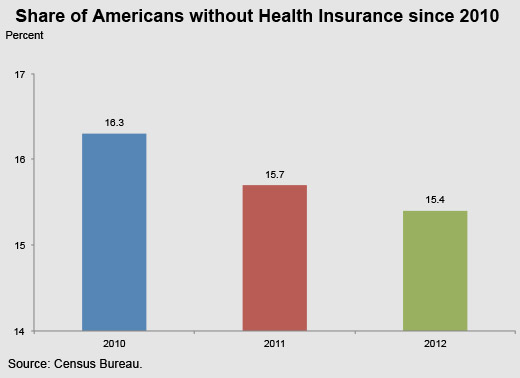
The declines in uninsurance were especially large for young adults ages 19-25. From 2011 to 2012, the share of young adults in this age group without insurance declined by 0.5 percentage points to 27.2 percent, which tied the largest drop for any age group in 2012 and which comes on the heels of a sharp 3.7 percent decline from 2009 to 2011. Research has found that most of the recent coverage gains in this age group can be attributed to the ACA’s provision allowing young adults to remain on their parents’ health insurance plans through age 25.
Learn more about Health CareObamacare and LGBT Health
Posted by on September 17, 2013 at 12:14 PM ESTEd. Note: This is cross-posted from the U.S. Department of Health & Human Services Blog
Throughout the Administration, we operate on the fundamental belief that every American deserves equal opportunity, equal protection, and equal rights under the law. That’s why the Affordable Care Act is so important for lesbian, gay, bisexual, and transgender (LGBT) Americans.
The health care law prevents health insurance companies from charging anyone a higher premium just because they happen to be lesbian, gay, bisexual or transgender. It also prevents insurers from raising rates or denying coverage because of a pre-existing condition like HIV/AIDS, cancer, or mental health concerns.
Thanks to the law, insurance companies can no longer impose a lifetime limit on your coverage. This is particularly important to HIV/AIDS patients, and anyone who has a chronic condition.
The Affordable Care Act also includes critically important, non-discrimination provisions. For example, starting in January 2014, it will be illegal for any of the insurance companies who offer coverage through the Marketplace to discriminate on the basis of sexual orientation or gender identity. We’ve also taken action to strengthen the civil rights provision in the law, by clarifying that the new law’s prohibition on sex discrimination includes discrimination based on sex stereotyping, and on gender identity.
All of this is good news for the LGBT community, particularly when we consider that one in three lower income LGBT adults in our country do not have health insurance. Starting October 1, they are going to have the opportunity to sign-up for quality, affordable coverage through the new Health Insurance Marketplace for coverage beginning as early as January 1, 2014.
But here’s the thing: most of these Americans are not yet aware of their new options.
You don’t have to be an expert to figure out what we need to do to get the word out. It’s outreach. It’s education. It’s communication.
That’s why, last week at the White House, I joined Valerie Jarrett, Senior Advisor to President Obama, and nearly 200 LGBT community leaders and allies from across the country for a briefing on Obamacare and the LGBT community. The purpose of this briefing was to equip community leaders with the tools, information, and resources they need to get involved and help local LGBT communities get access to quality, affordable health care.
And that’s why we are excited to work with organizations like Out2Enroll, a new initiative to educate the LGBT community about the Affordable Care Act. Rooting for more of our neighbors to sign up for health care is not enough. It’s going to take work at the grassroots. And so Out2Enroll has a very important mission.
Dr. King taught us, “Human progress never rolls in on the wheels of inevitability. It comes through the tireless effort and the persistent work of dedicated individuals.”
So in the weeks and months ahead, we look forward to working with a diverse range of partners – national advocates, LGBT community centers, HIV/AIDS service providers, Pride organizations, PFLAG chapters – to ensure that members of the LGBT community have the information, resources, and tools they need to sign up for quality, affordable health care.
I hope you will join us in this important work.
In case you missed it:
Kathleen Sebelius is the Secretary of Health and Human Services.
Learn more about Health CareImproving the Public’s Health through the Affordable Care Act
Posted by on September 13, 2013 at 11:05 AM ESTEd. Note: This blog post was originally published by HHS.
With the leadership of our partners in prevention and public health and with implementation of the Affordable Care Act, the Obama Administration is helping to ensure every American has the opportunity to be healthy because we know that the nation’s public health affects and connects us all.
Yesterday, the White House highlighted the importance of prevention and public health, recognizing local leaders, also known as Champions of Change, from across the country. Eight Champions of Change shared their incredible work, which in many cases are supported through the Prevention and Public Health (PPHF), an important component of the Affordable Care Act. These eight Champions were selected from over 900 nominations, higher than any other Champions event and a testament to the important work in prevention and public health happening across the country. They talked about how, through encouraging preventive screenings, reducing health disparities, promoting physical activity and healthy eating, and fighting health care acquired infections, public health and prevention efforts are building healthier communities for all Americans.
I congratulate these eight Champions and celebrate the work of all our partners in prevention and public health across the country:
-
Janine E. Janosky, Vice President for the Center for Community Health Improvement
Akron, OH -
Erica Washington, Healthcare-Associated Infections Coordinator
New Orleans, LA -
Andrea Hays, Director of the move∙ment Initiative & Upgrade Campaign
Evansville, IN -
Marion Kainer, MD MPH, Physician and Epidemiologist
Nashville, TN -
Natalie Pawlenko, Director, Office of Local Public Health, NJ Department of Health
Trenton, NJ -
Myriam Escobar, Community Outreach Worker at Moffitt Cancer Center
Tampa, FL -
Ira Combs, Community Liaison Nurse Coordinator at University of Nebraska Medical Center
Omaha, NE -
Elmer Huerta, Director of the Cancer Preventorium at MedStar Washington Hospital Center
Washington, DC
President Obama and the entire Obama Administration have made prevention and public health a top priority because of the lasting effects they have on the health of Americans.
That is why the Affordable Care Act provides unprecedented resources through the Prevention and Public Health Fund to support community-based strategies to prevent chronic diseases, and to improve public health. The Affordable Care Act also created the National Prevention, Health Promotion, and Public Health Council, which provides federal leadership to engage states, communities, and private partners in creating a healthier America through the recommendations of the National Prevention Strategy – a blueprint for ensuring Americans are healthy at every stage of life. The Prevention and Public Health Fund is supporting projects that help our health care system shift from a focus on sickness and disease to one based on wellness and prevention.
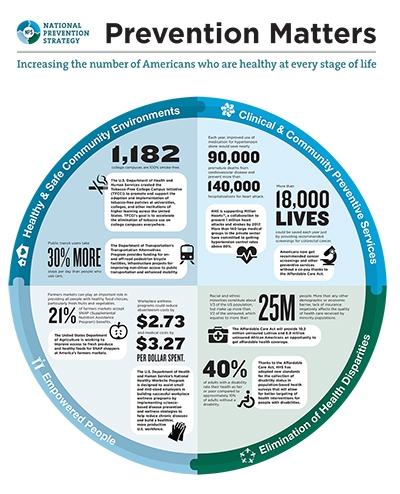
Also at the event, some important news about the 2012 TIPS from Former Smokers campaign, work made possible by the Prevention and Public Health Fund, was announced. As a result of our first federally supported national tobacco education campaign, more than 100,000 people have quit smoking long-term. This doubled even our most ambitious goals for the campaign—a three-month ad campaign that will make a lifetime of difference for these families.
And our efforts in public health to support healthy communities are only strengthened by better opportunities for coverage for more Americans. For example, we now have the opportunity to connect our public health messaging on tobacco use prevention with the coverage of tobacco screening and cessation services through the new preventive benefits in the Affordable Care Act. Now, we can not only drive traffic to quitlines, but also know that those ready to quit have access to free cessation services in new health plans. The same is true for many of our diabetes, cancer and other key prevention and public health education initiatives.
In addition to the celebration, on Monday, we hosted national, state and local individuals to engage in a conversation about the role of public health in the future as the implementation of the Affordable Care Act continues and the Health Insurance Marketplaces go live on October 1, more states decide to expand Medicaid and the health care landscape continues to evolve. In both discussions, it was clear that in order to achieve our goals of improving the nation’s health, our greatest resources are our public health and prevention leaders. Improving the health of Americans requires thousands of dedicated workers who work selflessly and tirelessly in small and large communities across our nation. With a collective spirit, these local agents of change take innovative approaches and solutions to address local health issues—work that we know makes a difference.
Together, public health efforts and greater insurance coverage will help us accelerate efforts to improve nation’s health.
And the opportunities to improve the nation’s health will only get better with the new Health Insurance Marketplace. Starting October 1, new Marketplaces are opening in every state which will offer quality health insurance at an affordable price. You can learn more about your new options at HealthCare.gov.
Learn more about Health Care-
Janine E. Janosky, Vice President for the Center for Community Health Improvement
Watch Live on Thursday: The impact of “Obamacare” on the LGBT community
Posted by on September 10, 2013 at 8:32 AM ESTDespite the tremendous progress we’ve made in achieving equality for the lesbian, gay, bisexual, and transgender (LGBT) community, many LGBT individuals still face limited access to health care and insurance, and are less likely to get the preventive care they need to stay healthy.
Thankfully, the Affordable Care Act, or Obamacare as it’s also known, directly addresses some of these needs, by:
- Protecting the right to access quality, affordable health insurance. Starting in 2014, the health care law prevents insurers from denying us coverage or charging us a higher premium because of a pre-existing condition or because we are LGBT.
- Removing lifetime dollar limits on coverage. That means that people with chronic diseases, like HIV/AIDS, cancer and mental health concerns, can get the care we need. And starting in 2014, all annual limits will be illegal, too.
- Promoting wellness by requiring insurers to cover preventive care at no additional cost. LGBT adults and teens can get screened by a health professional for HIV and depression without paying co-pays or deductibles. Other preventive services, like cervical cancer screening for sexually active women, obesity counseling for people at risk, and well-woman visits are also covered at no extra cost.
- Helping more LGBT Americans find affordable health insurance. Starting October 1, 2013, all Americans without insurance and those looking for better options will have a new place to shop for plans, the Health Insurance Marketplace, and may qualify for lower costs on monthly premiums.
The Affordable Care Act could truly transform the health and well-being of the LGBT community for generations to come, and the upcoming open enrollment period in the Health Insurance Marketplace, – from October 2013 to March 2014 – provides an important opportunity to get folks enrolled.
That’s why the White House Office of Public Engagement and the U.S. Department of Health and Human Services are teaming up to host a Briefing on Obamacare and the LGBT Community, this Thursday, September 12th. The event will include remarks by Senior Advisor Valerie Jarrett and HHS Secretary Kathleen Sebelius, as well as an exciting presentation of important new research on how LGBT communities perceive and access health care, and suggested messaging strategies for reaching key sub-communities.
And you can watch it live from home or work! Visit http://obamawhitehouse.archives.gov/live this Thursday, September 12th, starting at 1:15 p.m. EDT to tune in.
Gautam Raghavan is an Advisor in the White House Office of Public Engagement. Matthew Heinz, MD, is Director of Provider Outreach and Director of LGBT Outreach at the U.S. Department of Health and Human Services.
Learn more about Health Care
- &lsaquo previous
- …
- 52
- 53
- 54
- 55
- 56
- 57
- 58
- 59
- 60
- …
- next &rsaquo
From the Press Office
Related Videos
-
 December 13, 2016 5:04 PM
Signing Ceremony for the 21st Century Cures Act
-
 December 10, 2016 5:00 AM
Weekly Address: It’s Time to Get Covered on the Health Insurance Marketplace