The White House

Office of the Press Secretary

White House Announces Forum on Workplace Flexibility

WASHINGTON, DC – The Obama Administration announced plans today to hold a Forum on Workplace Flexibility on March 31st at the White House. The President and First Lady will discuss the importance of creating workplace practices that allow America’s working men and women to meet the demands of their jobs without sacrificing the needs of their families. The forum will be an opportunity for labor leaders, CEOs, small business owners, and policy experts to share their ideas and strategies for making the workplace more flexible for American workers and families.

“Millions of women and men across the country struggle to balance the demands of their jobs and the needs of their families. Too often, caring for a child or an aging parent can strain a career-- sometimes to the point of job loss,” said President Obama. “As the parents of two young girls, Michelle and I understand the challenges America’s working families face and we are looking forward to hearing from moms, dads, business leaders, advocates and experts about their ideas for creating and encouraging flexible workplaces, so that working Americans do not have to choose between their careers and meeting the needs of their families.”

Press coverage and additional details for the Forum on Workplace Flexibility will be announced in the coming days.

The White House

Office of the Press Secretary

Casa Blanca anuncia foro sobre flexibilidad en el entorno laboral

WASHINGTON, DC – El gobierno del Presidente Obama anunció esta semana planes para realizar un Foro sobre la Flexibilidad en el Entorno Laboral (Forum on Workplace Flexibility) el 31 de marzo en la Casa Blanca. El Presidente y la Primera Dama hablarán de la importancia de crear prácticas laborales que permitan que los trabajadores de ambos sexos en Estados Unidos cumplan con lo que les exigen sus empleos sin sacrificar las necesidades de sus familias. El foro será una oportunidad para que líderes sindicales, altos ejecutivos, dueños de pequeñas empresas y expertos en política intercambien ideas y estrategias a fin de hacer el entorno laboral más flexible para los trabajadores y familias estadounidenses.

“Millones de mujeres y hombres en todo el país tienen dificultad para mantener el equilibrio entre las exigencias de sus empleos y las necesidades de sus familias. Con demasiada frecuencia, cuidar a un hijo o un padre mayor de edad puede afectar una carrera, a veces hasta el punto de causar la pérdida del empleo”, afirmó el Presidente Obama. “Como padres de dos niñas, Michelle y yo comprendemos los desafíos que las familias trabajadoras de Estados Unidos enfrentan y estamos deseosos de escuchar las ideas de mamás, papás, líderes empresariales, grupos de apoyo y expertos para crear y fomentar centros laborales flexibles, de manera que los trabajadores estadounidenses no tengan que escoger entre sus carreras y atender las necesidades de sus familias”.

Se anunciará en días próximos información sobre la cobertura por la prensa y detalles adicionales acerca del Foro sobre la Flexibilidad en el Entorno Laboral.

###


Spurring Job Growth in the Private Sector

March 18, 2010 | 9:24 | Public Domain

President Obama signs the HIRE Act, a jobs bill that offers incentives for businesses to hire new workers, in a ceremony in the Rose Garden.

Download mp4 (270MB) | mp3 (9MB)

Read the Transcript

Remarks by the President before Signing the HIRE Act

11:20 A.M. EDT

THE PRESIDENT:  Good morning, everybody.  Please have a seat.

Well, on this beautiful morning, we are here to mark the passage of a welcome piece of legislation for our fellow Americans who are seeking work in this difficult economy.  But first, let me say a few words about the latest development in the debate over health insurance reform.  I don’t know if you guys have been hearing, but there’s been a big debate going on here. 

This morning, a new analysis from the Congressional Budget Office concludes that the reform we seek would bring $1.3 trillion in deficit reduction over the next two decades.  (Applause.)  That makes this legislation the most significant effort to reduce deficits since the Balanced Budget Act in the 1990s.  (Applause.)  And this is -- this is but one virtue of a reform that will bring new accountability to the insurance industry and greater economic security to all Americans.  So I urge every member of Congress to consider this as they prepare for their important vote this weekend. 

And I want to welcome all the members of Congress who are here, those who are on stage -- Madam Speaker, Majority Leader Reid -- as well as some of my Cabinet members who are here.

In a few moments, I’ll sign what’s called the HIRE Act -- a jobs bill that will encourage businesses to hire and help put Americans back to work.  And I’d like to say a few words about what this jobs bill will mean for workers, for businesses, and for America’s economic recovery.

There are a number of ways to look at an economic recovery.  Through the eyes of an economist, you look at the different stages of recovery.  You look at whether an economy has begun to grow; at whether businesses have begun to hire temporary workers or increase the hours of existing workers.  You look at whether businesses, small and large, have begun to hire full-time employees again.

That’s how economists measure a recovery -- and by those measures, we are beginning to move in the right direction.  But through the eyes of most Americans, recovery is about something more fundamental:  Do I have a decent job?  Can I provide for my family?  Do I feel a sense of financial security?

The great recession that we’ve just gone through took a terrible toll on the middle class and on our economy as a whole.  For every one of the over 8 million people who lost their jobs in recent years, there’s a story of struggle -- of a family that’s forced to choose between paying their electricity bill or the car insurance or the daughter’s college tuition; of weddings and vacations and retirements that have been postponed.

So here’s the good news:  A consensus is forming that, partly because of the necessary -- and often unpopular -- measures we took over the past year, our economy is now growing again and we may soon be adding jobs instead of losing them.  The jobs bill I’m signing today is intended to help accelerate that process.

I’m signing it mindful that, as I’ve said before, the solution to our economic problems will not come from government alone.  Government can’t create all the jobs we need or can it repair all the damage that’s been done by this recession.

But what we can do is promote a strong, dynamic private sector -- the true engine of job creation in our economy.  We can help to provide an impetus for America’s businesses to start hiring again.  We can nurture the conditions that allow companies to succeed and to grow.

And that’s exactly what this jobs bill will help us do.  Now, make no mistake:  While this jobs bill is absolutely necessary, it’s by no means enough.  There’s a lot more that we’re going to need to do to spur hiring in the private sector and bring about full economic recovery -- from helping creditworthy small businesses to get loans that they need to expand, to offering incentives to make homes and businesses more energy efficient, to investing in infrastructure so we can put Americans to work doing the work that America needs done.

Nevertheless, this jobs bill will make a difference in several important ways.  First, we will forgive payroll taxes for businesses that hire someone who’s been out of work at least two months.  That’s a tax benefit that will apply to unemployed workers hired between last month and the end of this year.  So this tax cut says to employers:  If you hire a worker who’s unemployed, you won’t have to pay payroll taxes on that worker for the rest of the year.  And businesses that move quickly to hire today will get a bigger tax credit than businesses that wait until later this year.

This tax cut will be particularly helpful to small business owners.  Many of them are on the fence right now about whether to bring in that extra worker or two, or whether they should hire anyone at all.  And this jobs bill should help make their decision that much easier.  And by the way, I’d like to note that part of what health insurance reform would do is to provide tax credits for over 4 million small businesses so they don’t have to choose between hiring workers and offering coverage.

The second thing this bill does is to encourage small businesses to grow and to hire by permitting them to write off investments they make in equipment this year.  These kinds of expenses typically take years to depreciate, but under this law, businesses will be able to invest up to $250,000, let’s say, in a piece of factory equipment, and write it off right away.  Put simply, we’ll give businesses an incentive to invest in their own future -- and to do it today.

Third, we’ll reform municipal bonds to encourage job creation by expanding investment in schools and clean energy projects.  Say a town wants to put people to work rebuilding a crumbling elementary school or putting up wind turbines.  With this law, we’ll make it easier for them to raise the money they need to do what they want to do by using a model that we've called Build America Bonds -- one of the most successful programs in the Recovery Act.  We’ll give Americans a better chance to invest in the future of their communities and of the country. 

And finally, this jobs bill will maintain crucial investments in our roads and our bridges as we head into the spring and summer months, when construction jobs are picking up.

I want to commend all the members of Congress, and their leadership is what made this bill possible.  Many of them are here today.  I’m also gratified that over a dozen Republicans agreed that the need for this jobs bill was urgent, and that they were willing to break out of the partisan morass to help us take this forward step for the American people.  I hope this is a prelude to further cooperation in the days and months to come, as we continue to work on digging our way out of the recession and rebuilding our economy in a way that works for all Americans and not just some Americans.

After all, the jobs bill I’m signing today -- and our broader efforts to achieve a recovery -- aren’t about politics.  They’re not about Democrat versus Republican.  This isn’t a game that we’re playing here.  They’re about the people in this country who are out of work and looking for a job; they’re about all the Americans -- of every race and region and age -- who’ve shared their stories with me over the last year.

The single mother who’s told me she’s filled out hundreds of job applications and been on dozens of interviews, but still hasn’t found a job.  The father whose son told me he started working when he was a teenager, and recently found himself out of a job for the very first time in his life.  The children who write to me -- they’re worried about their moms and their dads, worried about what the future holds for their families.

That’s who I’m thinking about every morning when I enter into the Oval Office.  That’s who I’m signing this bill for.  And that’s who I’m going to continue to fight for so long as I am President of the United States.

So with that, let me sign this bill and let’s get to work.  (Applause.)

(The bill is signed.)

END
11:27 A.M. EDT

Close Transcript

The White House

Office of the Press Secretary

President Obama Details Administration Efforts to Support Two Million New Jobs by Promoting New Exports

In his State of the Union address, President Obama called for a new National Export Initiative (NEI) to double U.S. exports and support two million new jobs. Today, President Obama announced five steps the Administration is taking under the NEI to help U.S. firms expand sales of their goods and services abroad: creating a new Cabinet-level focus on U.S. exports, expanding export financing, prioritizing government advocacy on behalf of U.S. exporters, providing new resources to U.S. businesses seeking to export, and ensuring a level playing field for U.S. exporters in global markets.

A New, Focused High-Level Effort to Promote U.S. Exports

The President signed today an Executive Order instructing the federal government to enhance and coordinate Federal efforts to promote exports. The President ordered the following measures to ensure high-level coordination of U.S. export promotion activities:

  • Creating the Export Promotion Cabinet: The President has created the Export Promotion Cabinet to ensure that export promotion is a top-level priority of all relevant cabinet agencies, and that export promotion activities are incorporated in a wide array of government programs, not just existing dedicated export promotion offices. The Export Promotion Cabinet will coordinate with the Trade Promotion Coordinating Committee, an existing staff-level interagency body that supports U.S. trade and export efforts, to execute a new National Export Strategy. The Export Promotion Cabinet will hold its first meeting in April, and will meet regularly thereafter. Members of the Cabinet include the Secretaries of State, Treasury and Commerce, senior White House advisors, and the heads of key U.S. economic and trade agencies.
  • Relaunching the President’s Export Council (PEC): The PEC has served as the principal private sector advisory committee on international trade. It advises the President of government policies and programs that affect U.S. trade performance; promotes export expansion; and provides a forum for discussing and resolving trade-related challenges among the business, industrial, agricultural, labor, and government sectors. Today, the President announced the relaunch of the PEC to be chaired by Jim McNerney, CEO of the Boeing Corporation, and Ursula Burns, CEO of the Xerox Corporation, who will serve as the vice-chair.

More Financial Support for U.S. Exporters

In fiscal year 2009, Export-Import Bank (Ex-Im) authorized $21 billion in support of U.S. exports, 50% more than the previous year. Under the Obama Administration, Ex-Im has further increased its authorizations to $10 billion in the first quarter of this fiscal year alone, three times the amount it did in the first quarter last year. Ex-Im projects that this pace of expansion will continue and ultimately double Ex-Im’s trade finance capacity within five years. Additionally, as part of the National Export Initiative, Ex-Im is expanding its efforts to work with small business by creating a new facility to provide up to $2 billion a year in trade finance to small and medium-sized enterprises.

Major Government-wide Export Advocacy Effort

Today, Secretary Locke issued Government-wide advocacy instructions for all senior level officials who work with foreign counterparts in the U.S. and abroad. This instruction ensures that our export promotion efforts will be conducted by U.S. officials who regularly communicate with other governments. This guidance is also instrumental to help ensure that our officials abroad are proactively looking for new export opportunities for U.S. businesses in their daily work routines. As part of our new advocacy efforts, the U.S. government is also:

  • Sponsoring an Unprecedented Number of Trade Missions this Year: U.S. trade missions bring senior U.S. officials and U.S. businesses in direct contact with export opportunities. Over 40 trade and reverse trade missions are scheduled in 2010 to promote U.S. goods, agriculture products and services.
  • Creating a New Market Exporter Initiative: The Department of Commerce is launching a new public-private partnership that engages U.S. global shipping companies like FedEx, UPS and USPS as strategic partners to expand U.S. export opportunities. This effort will build on the knowledge and market reach of its private sector partners to focus on U.S. businesses that currently only export to one or two countries, and provide support to these businesses on how to proactively expand their customer bases to additional markets.
  • Launching an International Business Partnership Program: The U.S. Trade and Development Agency (USTDA) is launching a new program to bring 250 – 300 senior procurement officials from over 20 countries to the U.S. this year to meet with U.S. businesses seeking to gain access to emerging economies.
  • Engaging our Ambassadors in a New Commercial Diplomacy Strategy: Secretary Clinton has directed U.S. ambassadors to emphasize commercial diplomacy in their work. The State Department will also require: Embassies to create Senior Visitor Business Liaisons to manage country advocacy efforts; and launch a program that sends U.S. Ambassadors around the U.S. to discuss export opportunities in their countries of assignment.

Expanded Support and Resources for Potential U.S. Exporters

Many businesses want to export their products, but just don’t have the knowledge, experience and resources required to identify and enter new markets. As part of the National Export Initiative, President Obama has proposed increasing funding for export promotion programs by $134 million for FY2011. This funding will provide for the hiring of over 325 trade experts to provide advice to potential U.S. exporters, and expand agriculture export initiatives to provide producers with technical assistance for exporting specialty crops. The Administration is also working to streamline existing U.S. exporter resources by:

  • Creating One-Stop Export Promotion Shops: Ex-Im, Small Business Administration (SBA), the Departments of Commerce and Agriculture, and USTDA will partner to provide potential exporters a comprehensive tool kit of services ranging from financing options to export counseling to market access intelligence through 109 Commerce Export Assistance Centers, 900 SBA Small Business Development Centers, 8 Ex-Im regional offices, 2,000 USDA Farm Service county offices, and more than 250 U.S. Embassies and Consulates abroad. This effort will support U.S. exporters in every state and 168 countries around the world.

Free and Fair Access to Markets around the World

  • Enforcing Trade Rights: USTR Ambassador Ron Kirk will continue to vigorously enforce the rights of American businesses under our trade agreements. His efforts have included filing suit over Chinese export quotas and duties on raw materials that harmed core U.S. industrial sectors from steel and aluminum to chemicals. Over the past year, our trade enforcement efforts have led to resolving the long-standing American claim against policies that restricted exports of American beef to the EU, ending more than 70 different measures in China that gave illegal subsides for exports and harmed U.S. companies, and working to end barriers to our poultry and meat exports during the H1N1 outbreak.
  • Opening New Markets: Ambassador Kirk will continue to work towards an ambitious and balanced Doha agreement that creates meaningful new market access for U.S. exports and ensures fair access to agriculture, goods, and services markets for American businesses. USTR will pursue negotiations in the Trans-Pacific Partnership to develop a broad-based, high-standard 21st century trade agreement in the fastest growing region in the world. USTR will also work to resolve outstanding issues with Panama, Colombia and Korea with the objective of moving forward with the pending Free Trade Agreements at an appropriate time.
  • Laying the Groundwork for Strong, Sustainable and Balanced Growth: Building on the historic results of the Pittsburgh Summit, Secretary Geithner will continue to work within the G-20 and other international fora to pursue policies that will lead to stronger and better balanced global growth, fostering increased trade and job expansion.

Export Control System Reform to Enhance National Security and the Competitiveness of Key U.S. Industries

Separately, the President announced the initial results of the Administration’s export efforts to reform the U.S. export control system – the set of policies and procedures that have developed over the past 50 years to restrict the export of sensitive technologies for national security purposes. The Administration’s reform program will enhance national security by focusing on the enforcement of strict controls around the export of the most critical technologies and products, while strengthening the competitiveness of key manufacturing industries in the U.S. by streamlining the regulations that apply to their exports. Secretary Gates will lay out the outline of these reform proposals in the coming weeks, and the President looks forward to continuing to consult with Congress on this important reform effort. In the meantime, the President announced two specific steps that the Administration is prepared to take to reform the export control system:

  • Reducing the Delay of U.S. Exports of Encryption Products from 30-60 Days to 30 Minutes: Currently, a U.S. exporter of a product with encryption capabilities (e.g., a cell phone or a network storage system) needs to file with the Department of Commerce for a technical review of the product before they can export. The review can take between 30-60 days. There are over 3,300 such filings each year. This proposed rule is intended to replace the current review-and-wait process with a more efficient one-time notification notification-and-ship process which may eliminate up to 85 percent of all the technical reviews of these products (about 2,800). The new process will continue ensure that the U.S. government still receives information it needs for its national security requirements while facilitating U.S. exports and innovation for new products and new technologies.
  • Reducing the Delay of U.S. Exports of Encryption Products from 30-60 Days to 30 Minutes: Currently, a U.S. exporter of a product with encryption capabilities (e.g., a cell phone or a network storage system) needs to file with the Department of Commerce for a technical review of the product before they can export. The review can take between 30-60 days. There are over 3,300 such filings each year. This proposed rule is intended to replace the current review-and-wait process with a more efficient one-time notification notification-and-ship process which may eliminate up to 85 percent of all the technical reviews of these products (about 2,800). The new process will continue ensure that the U.S. government still receives information it needs for its national security requirements while facilitating U.S. exports and innovation for new products and new technologies.


The White House

Office of the Press Secretary

Declaraciones del Secretario de Prensa Robert Gibbs acerca del voto para concluir el debate sobre prórrogas tributarias y asistencia a desempleados

Las medidas tomadas hoy en el Senado nos acercan más a la implementación de un conjunto de incentivos tributarios, respaldo para préstamos a pequeñas empresas y ayuda a familias estadounidenses, lo cual es un componente crucial de nuestra recuperación económica. Éste es un paso más en nuestra lucha por hacer que el pueblo estadounidense vuelva a trabajar y apoyar a las familias que han sido más afectadas por la crisis económica. El conjunto de medidas prorrogará un grupo de cláusulas tributarias que ya fueron aprobadas por la Cámara y que proporcionarán apoyo inmediato a personas y empresas, lo que incluye la prórroga del Crédito Tributario por Investigación y Experimentación para apoyar la inversión en empleos de investigación y desarrollo en Estados Unidos. Prorrogaría hasta fin de año los beneficios por desempleo y la ayuda con el seguro COBRA para trabajadores que han perdido su empleo. Y permitiría que la Administración de Pequeñas Empresas pueda continuar otorgando decenas de miles de millones de dólares en préstamos a dueños de pequeñas empresas hasta fin de año. El Presidente les agradece a los miembros de ambos partidos que ayudaron a que este proyecto de ley siga avanzando.

Creating New Jobs in a Clean Energy Economy

March 05, 2010 | 7:57 | Public Domain

President Obama speaks on how encouraging a clean energy economy can create new jobs as he visits OPower, an Arlington, VA company that developers energy efficiency software.

Download mp4 (160MB) | mp3 (7MB)

Read the Transcript

Remarks by the President on Clean Energy Jobs

11:43 A.M. EST

THE PRESIDENT:  Good morning, everybody.  It is great to be here at OPOWER.  And just looking around, this looks like a fun place to work.  (Laughter.)  The work you do here, as we just heard, is making homes more energy efficient, it's saving people money, it's generating jobs and it's putting America on the path to a clean energy future.  And I understand last year that you doubled your workforce thanks to Bonnie -- (applause) -- you’re hoping to hire another hundred workers this year.  And so this is a model of what we want to be seeing all across the country.  Our goal for the economy is to show similar job growth in the months ahead.

This morning we learned that in February our economy lost an additional 36,000 jobs.  Now, this is actually better than expected, considering the severe storms all along the East Coast are estimated to have had a depressing effect on the numbers.  And it shows that the measures that we’re taking to turn our economy around are having some impact.  But even though it's better than expected, it's more than we should tolerate.

Far too many Americans remain out of work.  Far too many families are still struggling in these difficult economic times.  And that's why I'm not going to rest, and my administration is not going to rest, in our efforts to help people who are looking to find a job; to help business owners who want to expand feel comfortable hiring again.  And we're not going to rest until our economy is working again for the middle class, and for all Americans.

And that's why my immediate priority is not only providing relief to people who are out of work, but also to help the private sector create jobs and put America back to work.  Earlier this week, after breaking through a political logjam that some of you probably saw if you were watching TV, Congress passed and I signed into law a bill that extends unemployment insurance to help people who've been laid off get through these hard times.  It also extended COBRA so that folks who've lost their jobs don't lose their health insurance, and it extended financing for small businesses, and makes it possible for 2,000 furloughed transportation workers to go back to work.

So signing this bill and getting relief out the door swiftly is absolutely essential.  But it's only a temporary step.  The relief I signed into law will last about a month.  And that's why I'm calling [on] Congress to extend this relief through the end of the year.  And because the best form of economic relief is a quality job, I'm also calling on Congress to pass jobs measures that cut taxes, increase lending, incentivize expansion for businesses both large and small.

Now, both the House and the Senate have passed a bill that would give businesses a payroll tax refund for every person hired this year.  And for companies that are considering expanding, this credit could help them decide to bring an extra employee or two this year.  So for companies like OPOWER that are doing pretty well and already expanding, the tax credit may help them decide to hire even more workers more quickly.  So instead of a hundred, maybe we get 110, 115.  We'll see.  (Applause.)

This bill would also encourage small companies to expand by permitting them to write off expenses for new equipment.  And while it's by no means enough, this legislation is an important step on the road to recovery, and I look forward to signing it into law.

Now, even as we fight to help the private sector create more jobs, and even as we fight to bring about a full economic recovery, we know that there have been success stories all across America.  OPOWER is one of those success stories.  This is a company that works with utilities to help folks understand their energy costs and how they can save money on their energy bills.  And for the press, if you weren't able to hear, this board testifies to the number of kilowatt hours that have been saved, the amount of money that's gone back into consumers' pockets, and the amount of carbon that has been taken out of the atmosphere as a consequence of the great work that these people at OPOWER are doing.

Now, part of the reason I suspect you're growing is that you're doing your jobs well.  But I also know that a big part of the reason is that you're seizing the opportunities of the future.  The jobs of tomorrow will be jobs in the clean energy sector, and this company is a great emblem for that.  That's why my administration is taking steps to support a thriving clean energy industry across this country -- an industry that's making solar panels, and building wind turbines, producing cutting-edge batteries for fuel-efficient cars and trucks, and helping consumers get more control over their energy bills.

And that's also why earlier this week I urged Congress to enact a new initiative we're calling Homestar that would offer homeowners rebates for making their homes more energy-efficient -- rebates worth up to $1,500 for individual home upgrades and up to $3,000 for retrofitting their entire home.  So if they're getting this good information from OPOWER and they see that, boy, that drafty window is costing me a couple of hundred bucks a year, they're now going to have an incentive to go to Home Depots or go to Lowes to hire a certified contractor and make the changes that will ultimately pay for themselves, improve our environment, and improve our economy.

I want to thank, by the way, your home state senator, Mark Warner, for his great work on Homestar in the Senate.

Think about the way that the rebates we're talking about could help spur private sector job growth.  It could not only help businesses like OPOWER to help consumers make their homes more energy efficient, it's also going to create business for the local contractors and the companies hired to upgrade homes.  These companies then, in turn, have to purchase supplies and that creates business for retailers.  These retailers would need to restock their shelves, and that creates business for manufacturers.  And almost all the goods that are required to make homes more energy efficient are actually produced right here in the United States of America.  It's very hard to ship an energy-efficient window across an ocean.

So, yes, people who are out of work right now need some immediate relief.  Yes, we need to extend unemployment insurance and COBRA to help Americans weather these tough times.  And, yes, we've got to do everything we can to help the private sector create jobs right now.

But even as we do, we also need to replicate the success of clean energy companies like OPOWER.  We need to invest in the jobs of the future and in the industries of the future, because the country that leads in clean energy and energy efficiency today, I'm absolutely convinced, is going to lead the global economy tomorrow.  I want that country to be the United States of America.  I want companies like OPOWER to be expanding and thriving all across America.  It's good for consumers.  It's good for our economy.  It's good for our environment.

It's wonderfully exciting to be here.  And I think when you look at this group that's gathered here, you can see the future in this company.  So thanks for the great work you guys are doing.  Let's see if we can replicate your success all across the country.

Thank you very much, everybody.  (Applause.)

END
11:52 A.M. EST

Close Transcript

The White House

Office of the Press Secretary

Remarks by the President on Clean Energy Jobs

OPOWER, Arlington, Virginia

11:43 A.M. EST

THE PRESIDENT:  Good morning, everybody.  It is great to be here at OPOWER.  And just looking around, this looks like a fun place to work.  (Laughter.)  The work you do here, as we just heard, is making homes more energy efficient, it's saving people money, it's generating jobs and it's putting America on the path to a clean energy future.  And I understand last year that you doubled your workforce thanks to Bonnie -- (applause) -- you’re hoping to hire another hundred workers this year.  And so this is a model of what we want to be seeing all across the country.  Our goal for the economy is to show similar job growth in the months ahead.

This morning we learned that in February our economy lost an additional 36,000 jobs.  Now, this is actually better than expected, considering the severe storms all along the East Coast are estimated to have had a depressing effect on the numbers.  And it shows that the measures that we’re taking to turn our economy around are having some impact.  But even though it's better than expected, it's more than we should tolerate.

Far too many Americans remain out of work.  Far too many families are still struggling in these difficult economic times.  And that's why I'm not going to rest, and my administration is not going to rest, in our efforts to help people who are looking to find a job; to help business owners who want to expand feel comfortable hiring again.  And we're not going to rest until our economy is working again for the middle class, and for all Americans.

And that's why my immediate priority is not only providing relief to people who are out of work, but also to help the private sector create jobs and put America back to work.  Earlier this week, after breaking through a political logjam that some of you probably saw if you were watching TV, Congress passed and I signed into law a bill that extends unemployment insurance to help people who've been laid off get through these hard times.  It also extended COBRA so that folks who've lost their jobs don't lose their health insurance, and it extended financing for small businesses, and makes it possible for 2,000 furloughed transportation workers to go back to work.

So signing this bill and getting relief out the door swiftly is absolutely essential.  But it's only a temporary step.  The relief I signed into law will last about a month.  And that's why I'm calling [on] Congress to extend this relief through the end of the year.  And because the best form of economic relief is a quality job, I'm also calling on Congress to pass jobs measures that cut taxes, increase lending, incentivize expansion for businesses both large and small.

Now, both the House and the Senate have passed a bill that would give businesses a payroll tax refund for every person hired this year.  And for companies that are considering expanding, this credit could help them decide to bring an extra employee or two this year.  So for companies like OPOWER that are doing pretty well and already expanding, the tax credit may help them decide to hire even more workers more quickly.  So instead of a hundred, maybe we get 110, 115.  We'll see.  (Applause.)

This bill would also encourage small companies to expand by permitting them to write off expenses for new equipment.  And while it's by no means enough, this legislation is an important step on the road to recovery, and I look forward to signing it into law.

Now, even as we fight to help the private sector create more jobs, and even as we fight to bring about a full economic recovery, we know that there have been success stories all across America.  OPOWER is one of those success stories.  This is a company that works with utilities to help folks understand their energy costs and how they can save money on their energy bills.  And for the press, if you weren't able to hear, this board testifies to the number of kilowatt hours that have been saved, the amount of money that's gone back into consumers' pockets, and the amount of carbon that has been taken out of the atmosphere as a consequence of the great work that these people at OPOWER are doing.

Now, part of the reason I suspect you're growing is that you're doing your jobs well.  But I also know that a big part of the reason is that you're seizing the opportunities of the future.  The jobs of tomorrow will be jobs in the clean energy sector, and this company is a great emblem for that.  That's why my administration is taking steps to support a thriving clean energy industry across this country -- an industry that's making solar panels, and building wind turbines, producing cutting-edge batteries for fuel-efficient cars and trucks, and helping consumers get more control over their energy bills.

And that's also why earlier this week I urged Congress to enact a new initiative we're calling Homestar that would offer homeowners rebates for making their homes more energy-efficient -- rebates worth up to $1,500 for individual home upgrades and up to $3,000 for retrofitting their entire home.  So if they're getting this good information from OPOWER and they see that, boy, that drafty window is costing me a couple of hundred bucks a year, they're now going to have an incentive to go to Home Depots or go to Lowes to hire a certified contractor and make the changes that will ultimately pay for themselves, improve our environment, and improve our economy.

I want to thank, by the way, your home state senator, Mark Warner, for his great work on Homestar in the Senate.

Think about the way that the rebates we're talking about could help spur private sector job growth.  It could not only help businesses like OPOWER to help consumers make their homes more energy efficient, it's also going to create business for the local contractors and the companies hired to upgrade homes.  These companies then, in turn, have to purchase supplies and that creates business for retailers.  These retailers would need to restock their shelves, and that creates business for manufacturers.  And almost all the goods that are required to make homes more energy efficient are actually produced right here in the United States of America.  It's very hard to ship an energy-efficient window across an ocean.

So, yes, people who are out of work right now need some immediate relief.  Yes, we need to extend unemployment insurance and COBRA to help Americans weather these tough times.  And, yes, we've got to do everything we can to help the private sector create jobs right now.

But even as we do, we also need to replicate the success of clean energy companies like OPOWER.  We need to invest in the jobs of the future and in the industries of the future, because the country that leads in clean energy and energy efficiency today, I'm absolutely convinced, is going to lead the global economy tomorrow.  I want that country to be the United States of America.  I want companies like OPOWER to be expanding and thriving all across America.  It's good for consumers.  It's good for our economy.  It's good for our environment.

It's wonderfully exciting to be here.  And I think when you look at this group that's gathered here, you can see the future in this company.  So thanks for the great work you guys are doing.  Let's see if we can replicate your success all across the country.

Thank you very much, everybody.  (Applause.)

END
11:52 A.M. EST

The statement below was posted on www.WhiteHouse.gov by the Chair of the Council of Economic Advisers Christina Romer. The statement can also be accessed HERE.

Romer Blog Post: Statement On The Employment Situation In February

Posted by Christina Romer on March 05, 2010 at 09:36 AM EST

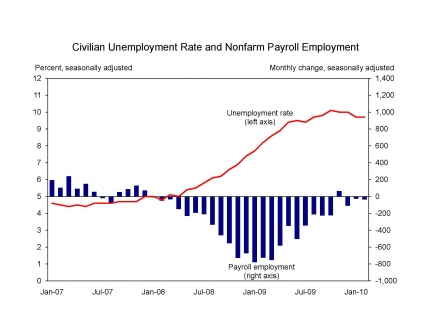
Although the labor market remains severely distressed, today’s report on the employment situation is consistent with the pattern of stabilization and gradual labor market healing we have been seeing in recent months.

The unemployment rate remained constant at 9.7 percent.  Many had expected that some of January’s 0.3 percentage point decline would prove to be a transitory drop.  That it was maintained for a second month makes it more likely that it was a genuine decline, not statistical noise.  The number of workers unemployed for more than 26 weeks fell by 180,000, the first decline in over a year.

Payroll employment declined by 36,000, slightly more than last month.  However, as many analysts have discussed in recent weeks, the large snowstorms in the Mid-Atlantic region in mid-February likely had a substantial negative impact on this number.  Someone who has a job but missed the entire pay period that included the 12th of the month because of the weather, and so did not receive a paycheck, is not counted as being on the payroll.  The Council of Economic Advisers estimates  that the impact of bad weather on the February employment number was likely substantially negative.  Importantly, negative weather effects this month would be expected to be counteracted next month, as workers who temporarily disappeared from payrolls because of the snow are once again counted.  In addition, according to the Bureau of Labor Statistics, temporary Census employment was an unusual factor adding about 15,000 to the payroll employment total in February.  Census employment is expected to rise substantially over the next few months, before declining again over the summer as the Census is completed.

Of course, an unemployment rate of 9.7 percent is unacceptably high and we need to achieve robust employment growth in order to recover from the terrible job losses that began over two years ago.  That is why it is essential that Congress pass additional responsible measures to promote job creation.  It is also vital that we continue to support those struggling with unemployment.

As always, it is important not to read too much into any individual data release, positive or negative.  Because of the disruptions from the weather, this is especially true of today’s employment data.  Although the overall trajectory of the economy has improved dramatically over the past year and appears to be continuing to improve, there will surely continue to be bumps in the road ahead.

Civilian Unemployment Rate

March 5, 2010.

Christina Romer is Chair of the Council of Economic Advisers

President Obama on Jobs, Energy & Strengthening the Economy

March 02, 2010 | 15:58 | Public Domain

The next stop on the Whte House to Main Street tour was to Savannah, GA where the President spoke on creating jobs and strengthening the economy through energy efficiency initiatives.

Download mp4 (319MB) | mp3 (15MB)

Read the Transcript

Remarks by the President on Energy Efficiency in Savannah, Georgia

12:31 P.M. EST

THE PRESIDENT:  Hello, everybody.  (Applause.)  Well, thank you so much.  Everybody please have a seat, have a seat.  Thank you.  (Applause.)  It is good to be back in Georgia.  It is good to be back in Georgia -- although where’s the sun, guys?  (Laughter.)  I was looking forward to --

AUDIENCE MEMBER:  Fired up!

THE PRESIDENT:  I'm still fired up, but we've been getting a lot of snow in Washington, D.C., so I was looking forward to maybe 60, 70 degrees.  (Laughter.)  But I guess I'll take 50.

I want to, first of all, just make some acknowledgments of some wonderful leaders who are here.  First of all, I want to thank President Kathy Love and the entire Savannah Tech community for their hospitality.  (Applause.)  I want to thank your governor, who I just had a chance to see recently, host him in the White House with the other governors -- Mr. Sonny Perdue.  (Applause.)  Your mayor, Otis Johnson, is in the house.  (Applause.)  Congressman John Barrow -- you're in his district.  (Applause.)  That's right.  Congressman Jack Kingston -- (applause) -- Congressman Sanford Bishop -- (applause) -- and Congressman Hank Johnson are all in the house.  (Applause.)     

Well, thank you so much for taking the time to be here today.  I really appreciate the opportunity to visit here at Savannah Tech.  And I just took a brief tour of some of the classrooms where students are learning about clean energy.  They’re learning about solar cells; they’re learning about efficient heating and cooling systems.  You’ve got young people here who, through the YouthBuild program, are gaining job skills that will help them the rest of their lives.  And by the way, they’re building a house right now while they’re at it.  (Applause.) 

From the instructors to the students, you saw just an incredible enthusiasm for America’s future.  And I was just talking to President Love about the focus of Savannah Tech on clean energy, the idea that this can be a real model for green energy as a way of linking students to the enormous job opportunities and business opportunities that exist in the future.  These are the skills that will help our country transform the way we produce and use energy. 

And that's so important –- especially as families in Georgia and across America continue to experience the painful consequences of the worst economic crisis that we've had in generations. 

I had also had a chance to meet with some business owners who told me what I've heard time and again, that it's tough out there.  Unemployment in Georgia is still above 10 percent.  That doesn't include folks who have had to accept part-time jobs or, in some cases, have given up finding a job altogether.  And when it comes to domestic policy, I have no more important a job as President than seeing to it that every American who wants to work and is able to work can find a job -- and a job that pays a living wage.  (Applause.)  That was my focus last year and that is my focus this year:  to lay a foundation for economic growth that will create jobs, that raises incomes, that will foster a secure economic future for middle class families.

This depends on not just spurring hiring, but doing so in the areas that will create lasting opportunities and prosperity. That's why we've invested in roads and railways so that our economy has room to grow and we're laying the infrastructure for the future.  In fact, because of the Recovery Act, there are more than 300 transportation projects underway in Georgia right now.  (Applause.)

That's why we invested in schools and prevented layoffs of hundreds of thousands of teachers and public school workers, including thousands of educators in this state -- because we know we will not be able to compete in new industries unless we've got workers ready to fill jobs in those industries.  And I'd also point out that I've proposed the largest-ever investment in community colleges and technical schools like this one, to produce millions more graduates who are ready to meet the demands of a 21st century economy.  (Applause.)

And to spur hiring and sustain growth we've placed a big emphasis on energy.  Just a few weeks ago, I announced a loan guarantee to break ground on the first new nuclear power plant in our country in nearly three decades -– a project right here in Georgia -- (applause) -- right here in Georgia -- a project that's going to create more than 3,000 construction jobs in the next few years and ultimately 800 permanent jobs operating the plant.  We're on track to create 700,000 jobs across America building advanced batteries for hybrid cars, and modernizing our electric grid, and doubling our capacity to generate clean energy.

And, in fact, here at Savannah Tech, the Recovery Act provided a grant to YouthBuild to help provide training in these very fields.  (Applause.)  Because I'm convinced that the country that leads in clean energy is also going to be the country that leads in the global economy.  And I want America to be that nation.  I don't want us to be second place or third place or fourth place when it comes to the new energy technologies; I want us to be in first.  (Applause.)

So we have the potential to create millions of jobs in this sector.  These are jobs building more fuel-efficient cars and trucks to make us energy independent.  These are jobs producing solar panels and erecting wind turbines.  These are jobs designing and manufacturing and selling and installing more efficient building materials -– because 40 percent of the energy we use is used by our homes and buildings.  Think about that.  All of us know that we use a lot of gas in our cars.  But in terms of energy usage, 40 percent of it goes to our homes and our buildings.

So as we're looking for additional initiatives to spur hiring, I think we ought to embrace what's happening on this campus.  I think we ought to continue to embrace the incredible potential that awaits us across America in clean energy.  So in my State of the Union address, I called on Congress to pass a set of initiatives for homeowners who make their homes more energy-efficient -– to continue the energy transformation that's already begun.  So today I want to explain the details of this program.  And I also want to thank the members of the House and the Senate who are helping to usher this proposal through Congress.

Now, many of you have heard of “Energy Star” -- how many people have heard of “Energy Star”?  You've seen that “Energy Star” sticker on a computer or on a microwave?  The Energy Star program was created to promote energy efficiency by letting consumers know which appliances, which electronics would save electricity and, therefore, would save them money over time.  The program I’m describing today applies this concept not to the appliances, but to the home itself –- and it takes it further.  So we're going to call it “Homestar,” just to make it easy to remember.  (Applause.)

Here’s how it would work.  We’d identify the kinds of building supplies and systems that would save folks energy over time.  And here's one of the best things about energy efficiency -- it turns out that energy-efficient windows or insulation, those things are products that are almost exclusively manufactured right here in the United States of America.  (Applause.)  It's very hard to ship windows from China.  (Laughter.)  So a lot of these materials are made right here in America. 

So we take these materials, and if a homeowner decides to do work on his or her house -- to put in new windows, to replace a heating unit, to insulate an attic, to redo a roof -– the homeowner would be eligible for a rebate from the store or the contractor for 50 percent of the cost of each upgrade up to $1,500.  Now, if you decided to retrofit your whole house to greatly reduce your energy use, you'd be eligible for a rebate of up to $3,000. 

Now, these are big incentives.  And you'd get these rebates instantly from the hardware store or the contractor.  So if you went to Lowe's or Home Depot or wherever you went, right there when you paid at the cash register you'd get that money.  You wouldn't have to mail in a long form, wait for a check to arrive months later.  (Applause.)

Now, we know this will save families as much as several hundred dollars on their utilities.  We know it will make our economy less dependent on fossil fuels, helping to protect the planet for future generations.  But I want to emphasize that Homestar will also create business and spur hiring up and down the economy. 

I was just meeting with a number of business leaders in different segments of this industry.  We've got some manufacturers making insulation and windows and other products; we've got folks who are contractors.  So -- stand up, guys -- the guys I just met with.  See, they're already -- they're ready to work.  They're ready to go.  (Applause.)  So we were just talking about how they are geared up and they've got the capacity to guarantee a homeowner that if they're willing to do this work on their house, they will get their money back -- not just through the rebate but in the energy savings that you're seeing each year.

Let's say you decide to use this rebate to seal up and insulate your attic -- because you want to save electricity, but also because you're tired of a drafty house.  Think about all the ways in which that will stimulate jobs and growth.  If you really knew what you were doing, you might do it yourself, but you're probably going to have somebody come to the house to carry out the installation work -– (laughter) -- because you did the smart thing and you refused to let your husband do it himself.  (Laughter.)  That's the smart thing.  (Applause.)  He'll be stubborn.  He'll tell you he can do it -- (laughter) -- but don't listen to him. 

So that creates work for small businesses and contractors like some of the folks who are here today.  And obviously construction work is -- that's been as hard hit as anything during this recession, so you’ve got a lot of skilled contractors ready to go.  And that, in turn, means that the contractors start hiring some of these folks who may have been laid off -- some of them may have been trained right here at Savannah Tech.  Now, you also have to buy the insulation and the other materials, and that means you're producing business for your local retailer.  And that retailer has to purchase those supplies from manufacturers  –- as I said, most of them located right here in the United States of America.  And I mentioned these domestic manufacturers who are in the crowd, they would benefit -- they would benefit from this program.  And then there’s this huge amount of capacity -- excess capacity -- in construction and related industries to meet any surge in demand that was out there. 

So the fact is that there’s nearly 25 percent unemployment in the construction industry so far, so construction companies, hardware stores, contractors, manufacturers -- they faced a rapid decline in demand in the wake of the mortgage crisis.  And to make matters worse, these businesses have seen the same decline in credit that has hurt every sector of our economy.

So these are companies ready to take on new customers; they’re workers eager to do new installations and renovations; factories ready to produce new building supplies.  All we’ve got to do is create the incentives to make it happen.  And this is not a Democratic idea or a Republican idea; this is a common-sense approach that will help jumpstart job creation while making our economy stronger.  (Applause.)  

Ultimately, that’s what we’re called to do.  Just like a responsible homeowner will invest in their homes in the near term to fortify their economic security in the long term, we’ve got to do the same as a country.  It will have some costs on the front end -- you buy a new boiler, or you get some insulation, or you get some new windows, that's going to have an initial cost, and the same is true from a government perspective.  And it’s going to be politically difficult to do some of this, but it’s what’s right to plan for our future. 

The same is true when it comes to reforming our education system.  The same is true when it comes to trying to make our health care system more affordable.  The same is true when it comes to energy.  Each of these things are hard; some of them have some costs on the front end, and working stuff through Congress is more than a notion.  (Laughter and applause.)  But by taking these steps we’ll help foster the kind of broadly shared growth that will serve us in the years and the decades to come. 

That’s how we’ll create the conditions for businesses to expand and hire.  That’s how we’ll truly grow our middle class again.  That’s how we’ll not only rebuild our economy but we'll  rebuild it stronger than it was before this crisis.

I am confident that we can do it.  Savannah Tech is leading the way; a whole bunch of folks in this room are leading the way; and I just hope that Washington stands alongside you in making sure that we've got the kind of energy future that we need.

Thank you very much, everybody.  God bless you.  God bless the United States of America.  (Applause.) 

END
12:48 P.M. EST

Close Transcript
The White House

Office of the Press Secretary

President Obama Announces Members of the National Council on Federal Labor-Management Relations

Council to advise on labor-management relations in the executive branch

WASHINGTON – Today, President Barack Obama announced his intent to appoint the following individuals to the National Council on Federal Labor-Management Relations.

  • Carol A. Bonosaro, Member, National Council on Federal Labor-Management Relations
  • William Dougan, Member, National Council on Federal Labor-Management Relations
  • Michael B. Filler, Member, National Council on Federal Labor-Management Relations
  • John Gage, Member, National Council on Federal Labor-Management Relations
  • David Holway, Member, National Council on Federal Labor-Management Relations
  • Gregory Junemann, Member, National Council on Federal Labor-Management Relations
  • Colleen M. Kelley, Member, National Council on Federal Labor-Management Relations
  • H.T. Nguyen, Member, National Council on Federal Labor-Management Relations
  • Darryl Perkinson, Member, National Council on Federal Labor-Management Relations

The Council, created in 2009 by Executive Order, is tasked with advising the President on matters involving labor-management relations in the executive branch.  The Council is co-chaired by the Director of the Office of Personnel Management, John Berry, and the Deputy Director for Management of the Office of Management and Budget, Jeffrey Zients.  The Chair of the Federal Labor Relations Authority, Carol Pope, was designated as an ex-officio member.  In addition, the President designated to the Council the following individuals: W. Scott Gould, Deputy Secretary of the Department of Veterans Affairs; Seth Harris, Deputy Secretary of the Department of Labor; Jane Holl Lute, Deputy Secretary of the Department of Homeland Security; William J. Lynn, III, Deputy Secretary of the Department of Defense; and Neal Wolin, Deputy Secretary of the Department of Treasury.

President Obama said, “I am grateful that these distinguished men and women have offered their wise counsel to help foster successful labor-management relations within the executive branch. I look forward to continuing this important dialogue with them for years to come.”

President Obama announced today his intent to appoint the following individuals:

Carol A. Bonosaro, Nominee for Member, National Council on Federal Labor-Management Relations
Carol Bonosaro has been President of the Senior Executives Association, the professional association representing the top career executives in the Federal government, since 1986. She served on the Association’s Board of Directors from 1981 to 1986, including as Chair from 1983-1986.  Ms. Bonosaro began her government career in 1961 at the then Bureau of the Budget (now Office of Management and Budget) as a management intern. At 33, she reached the executive ranks at the U.S. Commission on Civil Rights, where she held various positions including Director of the Women’s Rights Unit where she developed the Commission's program implementing its new jurisdiction over sex discrimination. Ms. Bonosaro directed the Commission’s Congressional and Public Affairs Program from 1980 to 1986 when she retired from the Senior Executive Service. She is Chair of the William A. Jump Memorial Foundation, a member of the Advisory Board of the Asian American Government Executives Network, and a former member of the National Partnership Council. She received the 2005 Stan Suyat Award from the Asian American Government Executives Network.  A graduate of Cornell University, Ms. Bonosaro attended George Washington University for graduate study in economics and Harvard University's Program for Senior Managers in Government.

William Dougan, Nominee for Member, National Council on Federal Labor-Management Relations
William Dougan has been the President of the National Federation of Federal Employees (NFFE) since 2009.  A 30-year member of the National Federation of Federal Employees, he has served in a number of union positions at the Local, Council, and National levels.  Previously, Mr. Dougan served as National Secretary-Treasurer in 2007 and also served over 4 years as President of NFFE's Forest Service Council.  He began his federal career in 1976 as a temporary employee with the National Park Service.  He then worked for the Forest Service as a firefighter and tree planter, and became a permanent employee (and NFFE member) in 1979.  He worked as a forester on National Forests in Washington, Oregon, and Alaska.  He retired from the Forest Service in 2007 after a 30-year career.  Mr. Dougan received his B.S. in Forest Management from Humboldt State University and has completed graduate studies at Oregon State University, Washington State University, and the University of Washington.

Michael B. Filler, Nominee for Member, National Council on Federal Labor-Management Relations
Michael B. Filler is the Director of the Public Services Division of the International Brotherhood of Teamsters and has 30 years of public sector labor experience. Prior to joining the Teamsters in 2003, he served as Director of Negotiations for the National Treasury Employees Union (NTEU).  He also served for 12 years as the Northeast Regional Director.

John Gage, Nominee for Member, National Council on Federal Labor-Management Relations
John Gage has been the National President of the American Federation of Government Employees since 2003 and is a member of the AFL-CIO Executive Council.  He has been involved in AFGE and the labor movement for more than 25 years.  Mr. Gage has committed years of service as president of AFGE Local 1923 and as national vice president of AFGE’s 4th District. Mr. Gage also serves as a trustee of the National Labor College, an accredited four year college for union members and their families.  He received his B.A. from Wheeling Jesuit University.

David Holway, Nominee for Member, National Council on Federal Labor-Management Relations
David Holway has been the President of the National Association of Government Employees since October of 2002. Prior to his election in 2002, Mr. Holway served in many capacities at NAGE. He also previously held several government positions including Deputy Commissioner in the Massachusetts Department of Correction, Chief Financial Officer at the Norfolk County Hospital, and as budget and staff director at the Massachusetts Legislative Committee on Counties.  Mr. Holway served on the Cambridge Massachusetts School Committee 1978-1979. He received his B.S. from Boston State College.

Gregory Junemann, Nominee for Member, National Council on Federal Labor-Management Relations
Gregory Junemann has been President of the International Federation of Professional and Technical Engineers (IFPTE) AFL-CIO & CLC since 2001. Before assuming his presidential post, Mr. Junemann was serving his third term as Secretary-Treasurer/Director of Organizing for IFPTE, a position he was first elected to in 1994. As Secretary-Treasurer, he was IFPTE's Chief Financial Officer, responsible for all aspects of the Federation's finances. Prior to his election as Secretary-Treasurer, Mr. Junemann served IFPTE as the Midwest Area Vice President (1986-1994) and was the Finance Committee Chairman (1988-1994). On the local union level, Mr. Junemann served IFPTE Local 92 in Milwaukee in many capacities including President, Vice President, and Bargaining Committee Chairperson.  He was also employed for 17 years at the Ladish Company in Wisconsin where he worked as a Senior Cost Estimator and Project Planner.

Colleen M. Kelley, Nominee for Member, National Council on Federal Labor-Management Relations
Colleen M. Kelley has been the President of the National Treasury Employees Union since 1999 and was re-elected to a third four-year term in 2007.  A Pittsburgh native, certified public accountant (CPA), and an NTEU member since 1974, Ms. Kelley was an IRS Revenue Agent for 14 years and served in various NTEU chapter leadership positions, including chapter president of NTEU Chapter 34 in Pittsburgh. Ms. Kelley serves on the Federal Salary Council, the Employee Thrift Advisory Council of the Federal Retirement Thrift Investment Board, and the Federal Employee Education and Assistance Fund (FEEA) Board of Directors. She is also a member of the Board of Governors of the Partnership for Public Service, which is committed to enhancing perceptions of public service and encouraging participation in the public sector. Ms. Kelley first joined the IRS upon graduation from Drexel University, where she earned a bachelor’s degree in accounting. She also earned an MBA from the University of Pittsburgh.

H.T. Nguyen, Nominee for Member, National Council on Federal Labor-Management Relations
H.T. Nguyen is currently the Executive Director/General Counsel for the Federal Education Association (FEA), a state affiliate of the National Education Association representing federally-employed educators.  Previously, Mr. Nguyen served as the Deputy General Counsel for FEA (1988-1998), where he was the Association's lead attorney in all major cases involving FEA.  Prior to that, Mr. Nguyen was a Staff Attorney with FEA (1984-1988).  He holds a B.A. (American Government), an M.A. (International Relations), and a J.D from the Catholic University of America.

Darryl Perkinson, Nominee for Member, National Council on Federal Labor-Management Relations
Darryl Perkinson currently serves as the National President of the Federal Managers Association (FMA), which represents the interests of the over 200,000 managers, supervisors and executives serving in the federal government. Within FMA, Mr. Perkinson held many leadership positions both at the local and national levels before ascending to National President in 2006. He is also presently the Nuclear Training Manager at the Norfolk Naval Shipyard (NNSY), serving in the Consolidated Training Division.  He has also been assigned to serve as the chairman of the Shipyard’s Training Council and as a member of the Shipyard Training Workforce and Development Board of Directors.  Mr. Perkinson began his career at NNSY as a pre-apprentice in 1970 as part of the school-to-work program with the City of Portsmouth, Virginia, and Wilson High School. He attended Virginia Wesleyan College and obtained a B.A. in Social Sciences in 1975. In 2006, Mr. Perkinson received his Master in Business Administration with a Concentration in Human Resources from Strayer University with honors.