Forum on Jobs and Economic Growth: Encouraging Business Investment, Competitiveness and Job Creation

December 4, 2009 | 1:11:26

Commerce Secretary Gary Locke and CEA Chair Christy Romer moderate a discussion on Encouraging Business Investment, Competitiveness and Job Creation at the Forum on Jobs and Economic Growth. December 3, 2009. (Public Domain)

Download mp4 (513MB) | mp3 (65MB)

The White House

Office of the Press Secretary

Statement from Chair of the Council of Economic Advisers, Christina Romer, on the Employment Situation in November

The statement below was posted on Whitehouse.gov by the Chair of the Council of Economic Advisors, Christina Romer, in response to the November employment report. The statement can also be accessed at the following link: http://obamawhitehouse.archives.gov/blog/2009/12/04/employment-situation-november.

On the Employment Situation in November
Posted by Christina Romer on December 04, 2009 at 09:30 AM EST

Today's employment report was the most hopeful sign yet that the stabilization of financial markets and the recovery in economic growth may be leading to improvements in the labor market.

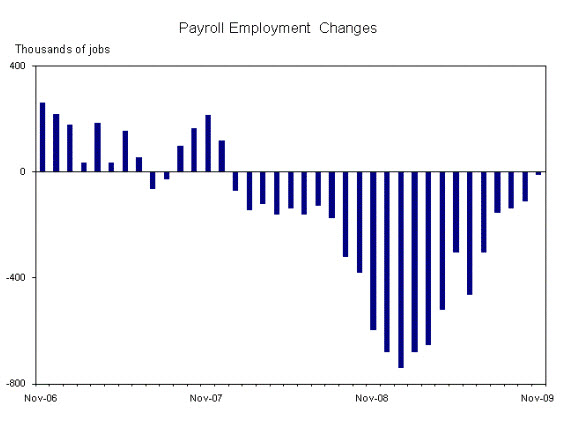
Payroll employment declined 11,000 in November.  This is a dramatic improvement from the decline of 597,000 in November 2008 and 741,000 in January 2009.  It is by far the closest we have been to stable employment since the recession began almost two years ago.  Furthermore, the employment loss in both September and October was revised down substantially, with the result that employment as of October is nearly 160,000 higher than was reported last month.  As was true in October, the largest employment gains in November were in temporary help services, which is often a leading indicator of labor demand.  21,000 jobs were also added in state and local public education.  Both the work week and aggregate hours increased, another early sign of labor market healing.
 
The unemployment rate, which had risen to 10.2% in October, declined to 10.0% in November.  This decline primarily reflects an increase in the number employed, as measured by the household survey.  Despite the welcome decline, the unemployment rate remains unacceptably high.  This underscores the need for the responsible actions to jumpstart private-sector job creation that the President highlighted at yesterday’s Forum on Jobs and Economic Growth at the White House.

There are many bumps in the road ahead.  The monthly employment and unemployment numbers are volatile and subject to substantial revision.  Therefore, it is important not to read too much into any one monthly report, positive or negative.  But, it is clear we are moving in the right direction.
 Payroll Employment Changes
 
Christina Romer is Chair of the Council of Economic Advisers


President Obama Opens Forum on Jobs and Economic Growth

December 4, 2009 | 31:01

The President, along with Vice President Biden and Secretary of Labor Hilda Solis, opens the Forum on Jobs and Economic Growth. December 3, 2009. (Public Domain)

Download mp4 (198MB) | mp3 (28MB)

Forum on Jobs and Economic Growth: The Innovation Agenda and Green Jobs of the Future Discussion

December 4, 2009 | 1:21:13

Energy Secretary Steven Chu and Assistant to the President Carol Browner moderate a discussion on The Innovation Agenda and Green Jobs of the Future at the Forum on Jobs and Economic Growth. December 3, 2009. (Public Domain)

Download mp4 (520MB) | mp3 (74MB)

Forum on Jobs and Economic Growth: Expanding Job Opportunities for America’s Workers Through Exports Discussion

December 4, 2009 | 1:26:25

NEC Director Lawrence Summers and Chairman of the U.S. Export-Import Bank Fred Hochberg moderate a discussion on Expanding Job Opportunities for America’s Workers Through Exports at the Forum on Jobs and Economic Growth. December 3, 2009. (Public Domain)

Download mp4 (555MB) | mp3 (79MB)

Forum on Jobs and Economic Growth: Small Businesses and Entrepreneurs and the Engine of Job Growth Discussion

December 4, 2009 | 1:22:30

Treasury Secretary Timothy Geithner and SBA Administrator Karen Mills moderate a discussion on Small Businesses and Entrepreneurs and the Engine of Job Growth at the Forum on Jobs and Economic Growth. December 3, 2009. (Public Domain)

Download mp4 (530MB) | mp3 (75MB)

Forum on Jobs and Economic Growth: Creating Jobs Through the Rebuilding of America’s Infrastructure Discussion

December 4, 2009 | 1:21:37

Transportation Secretary Ray LaHood and OMB Director Peter Orszag moderate a discussion on Creating Jobs Through the Rebuilding of America’s Infrastructure at the Forum on Jobs and Economic Growth. December 3, 2009. (Public Domain)

Download mp4 (525MB) | mp3 (74MB)

President Obama Closes Forum on Jobs and Economic Growth

December 4, 2009 | 55:49

The President holds a discussion with participants to close the Forum on Jobs and Economic Growth. December 3, 2009. (Public Domain)

Download mp4 (356MB) | mp3 (51MB)

Read the Transcript

Remarks by the President and Q&A at the Closing Session of the Forum on Jobs and Economic Growth

3:57 P.M. EST

THE PRESIDENT:  Thank you, everybody.  Thank you.  Please be seated.  We want to make sure we get in as much discussion as possible in the remaining time that we have.

I hope everybody enjoyed the breakout sessions.  I had the opportunity to attend two of them for quite some time and enjoyed some terrific conversation and some great ideas.

I heard a great deal of challenges this afternoon about -- or a great deal this afternoon about the challenges that we're all facing, for businesses large and small, when it comes to trying to create jobs.  There's no question that it is difficult out there right now.  But we also heard some exciting ideas and proposals for how we can spur hiring today and lay the groundwork for sustainable economic growth in the future.  In other words, ideas that help us in the short term but also point us in the direction of rebuilding the country.

I attended two of the sessions -- one on infrastructure, where there was broad agreement that the infrastructure in America is not where it needs to be and we've got enormous investments to make.  We got some good, hardheaded feedback from people like Doug Holtz-Eakin and others about how we have to do this more effectively -- how can we measure the costs and benefits of infrastructure investment; how can we make sure that shovel ready actually means shovel ready; how can there be more effective coordination between federal, state, and local governments in order to maximize the benefits of our infrastructure spending.  And there was considerable amount of discussion about how we can leverage the private sector to boost our infrastructure spending.

We also heard, in the clean energy session that I just left, some terrific ideas about how weatherization and energy efficiency promises immediate impacts on the ground, we can create new jobs, spur enormous amounts of business opportunities for the clean tech sector, but we're also laying the groundwork for energy independence, and we would also, as a consequence of having made those investments, set up the prospect that it would pay for itself from ultimate energy savings.

Now, I will tell you that in the green energy discussion, the clean energy discussion, there was also an acknowledgment that we're not going to be able to maximize the benefits of clean energy investment unless we get settled how we're dealing with carbon and the price of carbon.  And we don't want to turn this into a discussion about Congress and legislation, but I think there was some consensus around the table that if we can focus on the enormous business opportunities there, that in fact America will benefit and will be able to compete in the next great round of economic growth around the world.

I was not in some of the other meetings, but I've gotten a quick summary.  My understanding that in the business investment and tax session, there were some important ideas put forward about how we can provide additional tax incentives for job growth.  For example, Bill McComb, CEO of Liz Claiborne, explained the impact of the expanded business tax breaks that I signed into law a few weeks ago.  Before the provisions went into effect, he was planning to close 10 stores.  Now he's going to save those 10 and open an additional 25.  So that's a good news story, but it's also indicative of how our tax policies can make a difference.

Several participants, including Larry Mishel and Alan Blinder, proposed offering additional tax incentives for job creation.  And this concept was raised in a number of the other sessions as well, so it's an idea that we think is worthy of further consideration.

In the small business discussion, Joe Stiglitz I think presented an economic case for how credit markets can fail and deny even good borrowers credit, and put forward some specific ideas about how we can get credit moving again.  All the reports that we're getting is that if you are a big corporation right now, the credit markets are working for you.  If you are a small business, and in some cases a medium-sized business, even if you are profitable, that you're still seeing credit frozen.  And we are going to have to unlock that, and that's going to require an interface between what we're doing on the recovery side and what we're doing on financial regulation and our banking policies.

Angie Selden, who runs a company called Arise Virtual Solutions, explained -- where are you, Angie?  There you are.  She explained how she's creating thousands of call-in sales jobs, bringing jobs back to the United States that have gone overseas in the last several years.  And she had some very specific ideas about how we could foster more of this reverse job migration, which we're going to take a look at.

Which brings us to the exports session.  One of the things that obviously in a time of fiscal constraint that we're constantly looking for is how we can spur job growth here in the United States without spending a whole lot of government money.  We're going to need to put public dollars in, but where can we find leverage?

I think everybody agrees that expanding our exports has to be a priority.  And this was the major topic when I traveled to Asia several weeks ago.  During the session, as I understand it, we heard from Jim Hoffa about the importance of trade strategies that open markets.  We heard from Boeing CEO Jim McNerney about the 22,000 small business suppliers that he relies on to make products -- and underscoring the fact that if these suppliers, these smaller suppliers aren't getting credit it's very hard for him to build products for export.

Bob Iger, from Disney, and other business leaders talked about how we can make our businesses more competitive and some specific ideas were protecting intellectual property and tax policies to promote innovation here at home.

Finally we heard from a broad cross-section of thinkers about the urgent need for more effective worker training.  And Randall Stephenson from AT&T talked about a successful partnership with San Antonio community colleges to train workers for jobs that the company is committed to bringing back from India.  And I think we all agreed that we should look to build on these kinds of partnerships to leverage the community college system.  We heard from -- in our infrastructure session we heard that same refrain about the need to train workers effectively.

Randy Weingarten of the AFT suggested a specific idea:  community schools, especially in rural areas, where parents can get training after hours in the same place where their kids are learning during the day, and I think that's a terrific idea worth exploring.

Let me just close by saying this.  What was striking is the overlap that existed in a lot of these sessions.  When we were in the clean energy session, there was an emphasis on how do we get small businesses and small contractors to get certified and get the financing needed to move forward and take advantage of these clean energy sector opportunities.

When we were in the infrastructure section, there was a strong emphasis on needing to plan not just for existing road projects, but also how do we think about the fact that in the future we need a cleaner transportation industry.  So there's a lot of overlap between all these different breakout sessions that we engaged in.  And it underscores how despite the fact that we had some breakout sessions, we're going to have to figure out how to break out of these silos and integrate these strategies if we're going to be able to get the most bang for the buck.

So, overall, we generated a lot of important ideas.  Some of them I think we can translate immediately into administration plans and potentially legislation.  What I want to do, though, is for the remaining part of this jobs forum, just to call on all of you and to see what kinds of ideas maybe I have not highlighted, things that really stood in the sessions.  Or if you didn't have an opportunity to speak, but you've got this burning idea that is really going to set the world on fire, I want to make sure that you've got the opportunity to -- (laughter) -- that you've got the opportunity to lay it out right now.

So, yes, and please do me a favor and introduce yourself.  Some of you -- a lot of you I know, but not everybody in the room knows you.

Q    My name is David Barber, from Barber Foods in Portland, Maine.  One of the things that we spent a lot of time on was the regulation, from our standpoint, and to your point about not creating regulations and realize the unintended consequences of those.  So that's very important to us as a small manufacturer of food in Portland, Maine.

One of the things that I wanted to make sure -- that we didn't get out in my session -- was we employ 750 people.  We're self-insured.  We spend $4 million every year in health care, self-insured.  And we develop programs to have our associates be healthier.  We've avoided an extra cost this year of 10 percent in our rise; normally, it's 20 percent.  We kept that down to below 10 percent by creating programs to keep our associates more healthy.  And we are sharing those with anybody that will listen.  So we want to make sure that gets out.

THE PRESIDENT:  Well, this is not a plant -- (laughter) -- but let me just point out, obviously the inefficiencies of our current health system are a drag on the economy and a drag on job growth.  And if you -- as a small business or a large business -- are seeing premiums for your employees going up 15, 20 percent a year -- I've had letters from small businesses who said that their policy was jacking up their costs by as much as 48 percent.  In those kinds of situations, you're not going to be able to invest in hiring that new worker, because you're trying to keep the worker you've got and provide them coverage.

So it is very important, I think, for us to take steps both legislatively but also in the private sector to improve prevention, improve wellness, bend the cost curve.  I actually think that the legislation that we are working -- that as we speak I hope members of Congress are working on right now, will have that salutary impact.

But you're absolutely right that companies like yours, companies like Safeway, have done some very important, creative work on your own.  And the question is, are there ways that we can further incentivize those practices and spread the word to companies all across the economy, that you can save money that in turn can be used to reinvest in your businesses.

Yes, sir.

Q    I don't bring an idea, but in reference to silos, is there going to be a document that boils down to different groups so that the people in my group understood what happened in the next group because they might use ideas from the next group.

THE PRESIDENT:  Yes.  We had extensive note-taking in every one of the sessions and that will be distributed to all of you.  And I want to assure you that this is just the start of this interaction that we're having with you, so you will then have the opportunity to continue to refine a lot of these ideas.  We'll probably set up some working groups coming out of this.  And the input that we're soliciting from you is going to be continuous.

All right.  Frank.

Q    Mr. President, I just --

THE PRESIDENT:  Introduce yourself.

Q    Frank Cownie, the mayor of Des Moines, Iowa.  I would emphasize that we feel that it's important that we get targeted fiscal assistance to local government, whether it's through infrastructure projects that we talked about in our group or whether it's energy efficiency block grants or whether it's TIGER grants or whether it's CDBG -- those are all formulas that work and have worked in the past.  And I think to get money to where people live, where people work, where the GDP is produced in this country, that we have to target those kinds of opportunities.

THE PRESIDENT:  Okay.  Let me just pick up on this point, and this may have been discussed in some of the groups but it might not have.  As tough as this financial crisis and recession has been on the federal budget, it has in some cases been worse on state and local government budgets.  About a third of the Recovery Act were essentially stabilization funds either for individuals in the form of unemployment insurance or assistance to states so that they didn't have to lay off teachers and firefighters and police officers.  We don't get a lot of credit for that.  I would point out that some mayors and governors who were very critical of the Recovery Act nevertheless were very happy to get this money.

But I think that it does raise the point that what we've been able to do this year is to stabilize aggregate demand.  And that's been very important to preventing a much more difficult economic environment and a tougher job environment.  Next year we're going to still have some of those challenges because usually state and local government revenues lag the recovery as a whole.  They may need some more help from the federal government.  And I think it's important, particularly for business leaders here, to understand that fact, that if you see a complete collapse in state and local government spending on basic needs, that that could create a very bad business climate for all of you.  And that's something that we're going to have to consider working on very carefully.

All right, the gentleman right there.

Q    Thank you, Mr. President.  My name is Noel Cuellar from Michigan -- tough out there.  One of the things that we're looking at is -- medium-size small businesses -- is the ability for financing.  You know, every month is looking better, it looks like we're bouncing back.  But the ability to get the financing for the upswing -- to buy the raw materials -- so we're kind of struggling buying raw materials or hiring people.  It's a tough decision.

THE PRESIDENT:  Well, look, as I said earlier, the credit markets were completely frozen for everybody.  Because of extraordinary intervention on our part, the financial panic abated and some of the credit markets out there thawed.  So for a Fortune 100 company right now you can probably get credit.  If you are a small business out there right now, though, it is still very tough.

Now, we have increased SBA loans by about 73 percent.  And we are constantly looking for more ways that we can push the banks and the credit markets to get money into the hands of small and medium-sized businesses who create the majority of jobs.

One of the things that -- I'm not sure if Secretary Geithner is here, but -- there he is, he's in the back.  One of the things that I think Tim will testify is that basically at least every other day I ask him, what are we doing to help credit flow to small and medium-sized businesses?  And there is going to be an overlap between what we're doing on the Recovery Act and what we need to do in terms of bank policy, what we're doing -- what the Fed is doing in terms of the credit markets.

And one of the things that we're really exploring is how can we help the community banks and smaller banks to loosen up credit.  In fairness to them, they're a little bit caught in between, because bank regulators are looking at their books and saying, boy, that was a real mess.  So they're asking them to increase their capital requirements and tighten up their lending criteria.  On the other hand, they've got the President of the United States saying, why aren't you lending more.  So they're a little bit in a fix.

Now, some of that is unavoidable because they really do need to strengthen -- you know, the banking sector was in bad shape and it was over-leveraged and we really did need to take some steps to shore up the banking system.  But we have to make sure that we don't overcorrect, and that's something that we're concerned about.

Some of the smaller banks also -- although they weren't involved in some of the crazy stuff that was going on on Wall Street -- frankly were just way overextended when it came to the commercial real estate market, built a lot of malls out there, a lot of strip malls out there.  And now they're finding that with the commercial real estate market actually not having bottomed out, it's sort of trailing the housing market in terms of problems that it's having, that's having a lot of effect on small banks as well.

The bottom line is this:  We know this is a priority.  We are pushing as hard as we can to do it in a responsible way.  We actually think that by getting financial regulatory reform done -- which is currently pending in Congress -- that will provide the certainty and the framework available to us so that we can then help these banks more effectively do the right thing than we're doing right now.

I want to -- behind the gentleman that I just called.  I want to make sure that we're getting a little gender equity here in -- no, no, not you.  (Laughter.)  Yes, right here.  Go ahead.

Q    Thank you, Mr. President.  I'm a farmer from Missouri, my name is Rhonda Perry, and I'm representing the National Family Farm Coalition today.  And I just wanted to bring your attention -- which I know that you understand fully -- that there's been a lot of conversation about we need to get the biggest bang for our buck.  And many times, in many places around this country, in rural communities, independent family farmers are the biggest bang for our buck in terms of creating jobs with independent businesses that depend on farmers.  From the people we buy our seed from to the people we use to process our meat to the transportation system to haul our grain, we create a lot of jobs in rural Missouri, so we want to make sure that's not overlooked.

And one of the things that you and the First Lady have highlighted is this incredible move that's underfoot, where thousands of farmers are producing food for local markets.  So we need to make sure that we have the infrastructure in place, from the meat processing to the transportation and storage to make that a reality, because that really is and could be a reality for us.

And whereas we have tended in the past to put a lot of money into the hands of corporate agribusiness out here in our rural communities, they have not proven to be the bang for the buck that independent family farmers have in terms of job creation that are good-paying and fair jobs in our communities.  So thank you for all you're doing on competition and on local food.  And we just want to remember that we are a job creator out here, so thank you.

THE PRESIDENT:  Robert, you had your hand up.  Wait for the mic, so everybody can hear you.

Q    You know, most of the things that have been proposed today cost money.  And there is this concern about the federal deficit.  I hope that your administration will recognize, as I know you will, that it's possible, first of all, to reduce the deficit over time and sometimes in the short run realize that you need to increase the deficit.  I hope the concern about the deficit in the long run doesn't crowd out the need for additional spending in the short run.

And I also think that some of these programs that increase jobs and increase GDP are probably the fastest way to get the economy back on a track that will reduce the deficit over time.  It's certainly a better way to reduce the deficit than putting ourselves into a debtor's prison, and assume we can deflate our way to recovery.

THE PRESIDENT:  Well, I think this is an important point.  We have been talking a lot about specific initiatives.  There is a macroeconomic element to this whole thing, and so let me just amplify what was just said.  We have a structural deficit that is real and growing, apart from the financial crisis.  We inherited it.  We're spending about 23 percent of GDP and we take in 18 percent of GDP, and that gap is growing, because health care costs -- Medicare and Medicaid in particular -- are growing, and we've got to do something about that.

You then layer on top of that the huge loss of tax revenue as a consequence of the financial crisis, and the greater demands for unemployment insurance and so forth.  That's another layer.  Probably the smallest layer is actually what we did in terms of the Recovery Act.  I think there is a misperception out there that somehow the Recovery Act caused these deficits.  No.  I mean, we had -- we've got a 9-point-something trillion-dollar deficit.  Maybe a trillion dollars of it can be attributed to both the Recovery Act as well as the cleanup work that we had to do in terms of the banks.

It turns out, actually, TARP, as wildly unpopular as it has been, has been much cheaper than any of us anticipated.  So that's not what's contributing to the deficit.  We've got a long-term structural deficit that is primarily being driven by health care costs and our long-term entitlement programs.  All right, so that's the base line.

Now, if we can't grow our economy, then it is going to be that much harder for us to reduce the deficit.  The single most important thing we could do right now for deficit reduction is to spark strong economic growth, which means that people who've got jobs are paying taxes, and businesses that are making profits have taxes, are paying taxes.  That's the most important thing we can do.  We understand that in this administration.  That's not always the dialogue that's going on out there in public, and we're going to have to do a better job of educating the public on that.

The last thing we would want to do in the midst of a -- what is a weak recovery, is us to essentially take more money out of the system either by raising taxes or by drastically slashing spending.  And frankly, because state and local governments generally don't have the capacity to engage in deficit spending, some of that obligation falls on the federal government.

Having said that, what is also true is that unless businesses and global capital markets have some sense that we've got a plan, medium and long term, to get the deficit down, it's hard for us to be credible, and that also could be counterproductive.

So we've got about as difficult a economic play as is possible, which is to press the accelerator, in terms of job growth, but then know when to apply the brakes in the out-years, and do that credibly.  And we are trying to strike that balance, but we're going to need help from all of you who oftentimes are more credible than politicians in delivering that message, because we want to leverage whatever public dollars are spent, and we are under no illusion that somehow the federal government can spend its way out of this recession.  But it is absolutely true that any of the ideas that have been mentioned here are still going to require some public dollars, and those are actually good investments to make right now.

How much time do we have?  Just want to make sure I'm not -- we're doing good, okay, good.

We actually have an Internet question because we're trying to make sure that this goes out to other locations.  What do you got?

Q    Mr. President, as you know, in addition to all these people, a lot of people have been watching through the Web site, all the breakout sessions, which will be available for anyone to watch afterward for those of you who want to check out other ones, but they've also been talking on Facebook, on Twitter about what they're seeing.

And we had one question from Don Arrington (ph), who says, "What confuses me is I have an MBA, and that has educated me right out of the market.  I thought furthering my education was supposed to help me in a tough job market."

THE PRESIDENT:  Well, look, first of all, I got a law degree, so it was more expensive, it took longer, and I don't know how much more useful it was.  (Laughter.)  But that e-mail, I think, is indicative of what a lot of people are feeling out there.  This is not the normal recession that we've just gone through.  This is one that is going deep into the economy, it is not hitting blue-collar workers alone.  It is hitting white-collar workers just as hard, and in some cases, when it comes to middle management it's actually hitting them harder.  A lot of people who expected to always be able to find a job are finding the job market really tight.

I guess what I'd say is, number one, we know long term that more education means more opportunity for the individual, greater income for the individual.  That is not decreasing, that is actually increasing -- the gap between higher education and somebody with a high school education.  And in a knowledge-based economy, that's not going away.

So as frustrating as it may be for the college grad or the MBA, the fact of the matter is you are still going to be much better off than if you didn't have that education short term as well as long term.  It is not only good for the individual, it is also critical for our economy.

I told this story I think in this room just a while back, but I just want to repeat it, because we were doing a session on science, technology, and math education.  And one of the things that I'm very proud of in this administration that nobody, except maybe Friedman and a couple others, have paid attention to is, we are actually initiating more education reform, tougher education reform, than just about any administration over the last several years, and people like Randy and others are helping us in this process.

But I told the story of my lunch with the President -- President Lee of South Korea.  And, Gary, you were in that lunch -- remember I asked him, what's happening in terms of education policy in Korea?  And he said, well, you know, my biggest problem is, Korean parents are too demanding and they are insisting, for example, that I import, and I've had to import, thousands of foreign English teachers because they all feel that first graders should be learning English already.

Now, you think about that mentality, which is pervasive throughout Asia -- you saw the same thing in China -- and it gives you a sense of what we're up against in terms of global competition.

So as tough as this recession is, as tough as the job market may be, we need to double down on our education investment.  We have to be more demanding of our schools, of ourselves as parents.  Young people are going to have to be more demanding in terms of our ability to compete.  And I don't want -- the last thing I want, and this actually relates to the previous question, the last thing I want is us to essentially use up our seed corn here, to not make investments in education, to not make our investments in clean energy, to essentially say the only way we can handle this is to constrict our dreams and to go small -- because these other countries out there, they're making these investments in infrastructure, in education, in clean energy.  And we can't lose the race just because we're going through a tough time right now.  Now is the time actually to make sure that we're prioritizing properly and pushing even harder on that front.

Okay.  Yes, sir.

Q    Mr. President, Fred Lampropoulos of Merit Medical Systems.  One of the overriding thoughts in our forum was that there's uncertainty that there's such an aggressive legislative agenda that businesspeople don't really know what they ought to do.  In fact, one CEO said that he thought he has to kind of wait and may have to restructure his business -- this is a large multinational pharma company -- and that uncertainty is really what's holding back the jobs.  And I hear that a lot in the press.  There's so much going on, no one really knows what to do.  How are you going to give us that confidence and make sure that we're certain about both the near-term and long-term growth prospects?

THE PRESIDENT:  You know, I actually think this is a legitimate concern.  This has been a tough year, with a lot of uncertainty.  Now, at the beginning of this crisis, when we were in transition, we could have made a decision.  And there were legitimate arguments for that decision -- there are legitimate arguments for the course that could have been taken, which is to say things are so bad -- we got two wars, we've got a crisis in the financial markets, we've just found out we lost 700,000 jobs per month in the first quarter -- that we should not try any big initiatives legislatively, just shouldn't do it, until everything has stabilized and settled down.

And I strongly considered that argument.  But I think the response is the point that was just made earlier, that if we keep on putting off tough decisions about health care, about energy, about education, we'll never get to the point where there's a lot of appetite for that.  I mean, keep in mind we just went through 10, 15 years where everything looked pretty good.  Except what happened was, is that that growth was built on a house of cards.  The fundamentals of the economy were weakening.  And they were papered over by massive leverage, credit card debt, a housing market bubble.

Our health care system we had to keep on putting off, but the fact of the matter is there is no way that businesses can sustain their current spending levels on health care.  They can't do it.  And families can't, either.  And this CEO of a pharmaceutical company I think would know that, because I'm sure that companies and health care providers are sending that message.  So my belief was that we had to start tackling some of those fundamental problems if we were going to emerge stronger than we were before.

Having said that, my strong hope is, is that we get health care done by the end of this year.  That eliminates some uncertainty because people will have a sense of what's going to be happening in the health care field; that we get financial regulatory reform done, if not by the end of this year then early next year so that banks have certainty; and that, to the extent that the uncertainty is derived from these major legislative initiatives, I think will be solved in the next few months.

I think that the best way for us to deal with long-term uncertainty is to tackle the things that we've been putting off and sweeping under the rug.  There's no point in us pretending that these aren't problems, and thinking that somehow we can go back to business as usual, because I think if we take that approach, then we might be able to manage for the next three or four or five years, but sooner or later we are going to get back into the same problems that we've already been in.  And I think it's very important to start doing the hard business now.

Okay, yes, back there.

Q    Thank you, Mr. President.  My name is Chandra Brown and I'm the president of United Streetcar, which is a subsidiary of Oregon Iron Works, and we are hiring, and we are building the first modern streetcar in 58 years back in this country.  So we're bringing jobs from Europe to here.

And I just wanted to emphasize the importance of having the federal government as a partner in some of these infrastructures, because we're a traditional manufacturing union house, and we want to be the next generation in clean energy, whether that's building streetcar vehicles for the 85 cities looking for it, whether it's building the first wave energy device that we're going to be building off the coast of Oregon.

I think it's critical that our traditional manufacturing base, that those jobs stay here in the United States, and that we continue to advance on those where it's going to be a benefit for all things -- climate change, job creation, and economic development, especially for streetcars and the 85 cities that are looking at them.

THE PRESIDENT:  I'm looking forward to riding on one of them.

Q    All right.  Anytime.

THE PRESIDENT:  Good.  This gentleman right here has been waiting.  Go ahead.

Q    Mr. President, thank you for the invitation.  My name is Bill Aossey from Cedar Rapids, Iowa.  I have a request that won't cost us anything.  It'll bring money home.  Can you please help ease the visa regulations so we can have students coming back, and international business visitors that will bring money and cultivate long-term resources of culture and academic relationships?  So please help ease this visa -- it'll bring money in and it won't cost us anything.  Thank you.

THE PRESIDENT:  Well, I think you make an important suggestion.  We live in a interconnected world and an interdependent world, and I think that, properly, we had to respond to 9/11 by reviewing our policies on visas, on immigration, on a whole host of issues.

But I think it is important for us not to get into a bunker mentality.  That's not America's strength.  Our strength has always been saying yes to the rest of the world, inviting ideas and different cultures and commerce.  And we have not seen the same kinds of openness, I think, over the last several years that I'd like to see.

Now, we've got to do it in a prudent way, but, you know, let's just take the example of foreign students.  One of the great things about this country is we get the best and the brightest talent to study here, and once they study here they start enjoying the intellectual freedom and the entrepreneurship, and they decide to stay, and they start new businesses.  And suddenly you've got a whole new generation of folks who are creating intel or other extraordinary businesses.

If those students start seeing a closed door, then we are losing what is one of our greatest competitive advantages, and that's something that I think we're committed to doing.

Let me broaden the point.  There are a lot of things that don't cost money that could make a difference.  So this goes back to the issue of certainty.  I mean, I do think that providing some regulatory certainty and reducing red tape on a whole bunch of areas like infrastructure investment is very important.  And what I've instructed our team to do is any good idea that will make the systems and processes of the private sector interacting with government smoother, quicker, crisper, more tech-savvy -- I'm for.

And I think on the export front is another example of where a lot of times just showing up, making sure that Gary Locke or our trade representative -- what's that guy's name, Ron Kirk -- (laughter) -- I'm messing with you, Ron.  Is he here?  You can tell him I said that.  But making sure that they are actively pursuing business opportunities overseas and we are not making it tougher.  Let me give you one specific example that could have some significant job implications.

We still have a lot of trade restrictions on high-tech exports that are actually carryovers from the Cold War.  Now, part of the problem is we haven't gotten the kind of intellectual property enforcement in other countries that we need -- and so understandably businesses are wary about sending their products overseas just to be duplicated and then shipped back to us using lower-wage labor.  But in some cases it really has to do with a failure to update and review what restrictions still make sense and what restrictions don't.

Now, China, Korea, a whole bunch of Asian nations would love to import some high-value-added, high-tech stuff that could create huge numbers of jobs here in the United States.  If we just increased our share of exports to Asia by 1 percent, that's about a quarter million jobs right there.  If we increased it by 5 [percent], that's a million jobs.  That fills a big hole; it doesn't cost us money.

So we are going to be scouring federal regulations, restrictions, et cetera that are inhibiting export growth.  We're going to be trying to see if we can use the federal government to link up small business and medium-sized businesses to exports more effectively.  I know a lot of this stuff was talked about in the exports section.  This is going to be a top priority.

Even though I was only supposed to take one more question, I'm going to take two because I had actually called on this gentleman right here and I felt bad that -- go ahead.

Q    I am Farooq Kathwari, chairman and CEO of Ethan Allen.  Just to follow up on this question, immigration, although my comment is on a separate subject, I came to the United States at age 21 with just a few hundred dollars.  I went to work during the day printing envelopes, went to school.  And this country afforded me the opportunity to be where I am today.  I think we should make sure that that kind of an opportunity is not taken away.

Now, my comment is that Ethan Allen is a 77-year-old company.  We have -- to survive, we have to reinvent, either by chance or by plan.  Otherwise, anybody 77 years old, an enterprise, cannot survive.  Well, this last year -- I refer it to like a tsunami hitting the economy -- has given us more opportunity to reinvent in the last seven or eight months than I've seen in the last 25 years that I've been president of Ethan Allen.

We have -- in the first seven or eight months, we had to consolidate.  We had to let people go.  We are a vertically integrated company, from manufacturing to retailing to logistics.  We have taken the brunt of this recession in communities that are very, very far away from Washington -- in Vermont, in Maine, North Carolina, Pennsylvania.  And we have had people with us for 30 to 40 years we had to let go, but we had to.

In the last seven months, as I said, after all this major reinvention, major consolidation -- but we are inventing.  In the last few months, we have been adding people.  We make furniture, and we have 30 stores in China and we're shipping them from the United States.  It's possible.  I would say, Mr. President, that we should not miss this opportunity; crisis creates an opportunity.

We as business leaders are ready for reinvention.  And I think the government should help us -- should help us in fiscal policy, should help us in tax policy, because a reinvention like you talk of the infrastructure of building bridges -- but we got to build up banks, we've got to build our technology.  And I think the government can play a very, very important role, because this opportunity is going to be shot and I think we should not miss it.

THE PRESIDENT:  Well, this is actually a good place to close.  What people are going through every day is heartbreaking, all across the country.  And the decisions that you just made as a CEO obviously have enormous ripple effects.  You had to do it in order to keep your company profitable.  On the other hand, the consequences of those layoffs obviously are felt deeply not just by the individuals involved but by the places -- the restaurant that that person who's been laid off used to frequent -- and it just keeps on rippling throughout the economy.

Digging ourselves out of the hole that we've dug ourselves into is not going to be easy.  The loss of -- the job loss this past year and the months preceding it were as severe as anything we've seen for a very long time, as rapid as we've seen in a very long time.  And generating the kind of economic growth that leads to the kind of hiring that gets our employment base back up to where it was is going to be hard and it's going to take a lot of work.

But I just want to echo what I said at the beginning of this session.  We still have the best universities in the world.  We still have the most open, entrepreneurial economy and market of any advanced nation.  We still have the most productive workers in the world.  Despite the issues of unsettledness around some of -- things like the banking industry and the financial sector, the truth of the matter is, is that we are still the most stable country in the world, which is why, during the midst of this crisis, everybody was buying into the U.S. and the dollar was shooting up and people were snatching up treasuries because they still have confidence in what America has to offer.

And so the most important message that all of us I think have to take away from this session is that if we combine traditional American optimism with an acknowledgment that we can't go back to business as usual, and that we have to rediscover a sense of seriousness of purpose when it comes to educating our kids or when it comes to government managing money properly or it comes to CEOs feeling some obligations to their workers and their communities -- if we can recapture that sense that we're in this thing together and that we are willing to work hard, that America is not great because it's owed to us, but we've been great because previous generations have put in the hard work to get us there, then I'm confident that we're going to get through this tough time and the 21st century is going to be as good for us as the 20th was.

But it's not going to come easily and it is going to require a level of cooperation and a willingness to work strategically together that we have not seen over the last several years.  And frankly, this town and the way the political dialogue is structured right now is not conducive to what we need to do to be globally competitive.  And all of you are leaders in your communities -- in the business sector and the labor sector, in academia, we even have a few pundits here -- it is important to understand what's at stake and that we can't keep on playing games.

I mentioned that I was in Asia on this trip thinking about the economy, when I sat down for a round of interviews.  Not one of them asked me about Asia.  Not one of them asked me about the economy.  I was asked several times about had I read Sarah Palin's book.  (Laughter.)  True.  But it's an indication of how our political debate doesn't match up with what we need to do and where we need to go.

But this kind of dialogue helps and I appreciate all of you participating.  Thank you, everybody.  (Applause.)

Because I'm traveling to Allentown, Pennsylvania --

AUDIENCE MEMBER:  Yay!  (Laughter.)

THE PRESIDENT:  -- I want to make sure that this room of business leaders and labor leaders and others just have a chance real quickly to hear directly from the mayor of Allentown, who's here right now.  Come on up, Mr. Mayor -- (applause) -- because I want to make sure that -- this is the kind of town where the rubber hits the road and I'm going to be having conversations with workers, small businesses, community colleges, and I want the mayor just to give a sense of what's going on and what you think would make the biggest difference in your town.

MAYOR PAWLOWSKI:  Thank you so much, Mr. President, and I want to say we're really honored to have you in Allentown, coming to Allentown tomorrow.  I, for one, am very thankful that you're taking on these challenges.  I know you were handed with a mess when you came in -- probably the worst economy in 70 years -- and I want to say thank you personally for all that you've done.  I think you're doing a great job.

On behalf of the city of Allentown, we have had some difficult challenges, like most mid-sized cities in the Northeast.  Our unemployment rate last month has gone up -- it went up to 9.8 percent.  We have about 41,000 people in that region that are unemployed.

But there's great things that are happening.  We hopefully -- and hopefully you're going to see some of those great things.  We've got some great companies that are actually growing, that are expanding.  We have a company that I know you're going to be at tomorrow that is actually manufacturing steel still in the United States, and doing a great job at it, growing their business and growing the workforce.

We have a number of unique small businesses.  In that particular region, we're very diversified.  We have a lot of Fortune 500 companies.  We have Air Products and Chemicals that's headquartered there; Pennsylvania Power & Light; Olympus has their North American headquarters around the city of Allentown.  But we have over 1,400 employers.  Only 1,100 of them are large employers.  The majority are small businesses.

And there's a number of small businesses in the area that are actually growing the economy.  One of them is the Terra Group, and I want to say thank you on behalf of them.  They started a product that was a small water filtration -- portable water filtration system, and the Marines have just bought that for our troops in Afghanistan.  And they're expanding -- you could clap on that, that was -- (laughter.)  They're actually expanding to hire another 40 jobs because of that.

And so I want to thank you.  We look forward to having you tomorrow, and we look forward to having you around the city of Allentown and talking to many of the businesses that are doing some great things in rebuilding this economy.  (Applause.)

THE PRESIDENT:  And if there are any CEOs here who are looking to locate, I'm sure Mayor Bing, Mayor Pawlowski, Mayor Cownie of Des Moines, they're all interested in talking to you.  (Laughter.)  And they have literature, I'm sure.  (Laughter.)  So thank you very much, everybody.  (Applause.)

END
4:51 P.M. EST
Close Transcript

The White House

Office of the Press Secretary

Remarks by the President and Q&A at the Closing Session of the Forum on Jobs and Economic Growth

Dwight D. Eisenhower Executive Office Building, Washington, D.C.

3:57 P.M. EST

THE PRESIDENT:  Thank you, everybody.  Thank you.  Please be seated.  We want to make sure we get in as much discussion as possible in the remaining time that we have.

I hope everybody enjoyed the breakout sessions.  I had the opportunity to attend two of them for quite some time and enjoyed some terrific conversation and some great ideas.

I heard a great deal of challenges this afternoon about -- or a great deal this afternoon about the challenges that we're all facing, for businesses large and small, when it comes to trying to create jobs.  There's no question that it is difficult out there right now.  But we also heard some exciting ideas and proposals for how we can spur hiring today and lay the groundwork for sustainable economic growth in the future.  In other words, ideas that help us in the short term but also point us in the direction of rebuilding the country.

I attended two of the sessions -- one on infrastructure, where there was broad agreement that the infrastructure in America is not where it needs to be and we've got enormous investments to make.  We got some good, hardheaded feedback from people like Doug Holtz-Eakin and others about how we have to do this more effectively -- how can we measure the costs and benefits of infrastructure investment; how can we make sure that shovel ready actually means shovel ready; how can there be more effective coordination between federal, state, and local governments in order to maximize the benefits of our infrastructure spending.  And there was considerable amount of discussion about how we can leverage the private sector to boost our infrastructure spending.

We also heard, in the clean energy session that I just left, some terrific ideas about how weatherization and energy efficiency promises immediate impacts on the ground, we can create new jobs, spur enormous amounts of business opportunities for the clean tech sector, but we're also laying the groundwork for energy independence, and we would also, as a consequence of having made those investments, set up the prospect that it would pay for itself from ultimate energy savings.

Now, I will tell you that in the green energy discussion, the clean energy discussion, there was also an acknowledgment that we're not going to be able to maximize the benefits of clean energy investment unless we get settled how we're dealing with carbon and the price of carbon.  And we don't want to turn this into a discussion about Congress and legislation, but I think there was some consensus around the table that if we can focus on the enormous business opportunities there, that in fact America will benefit and will be able to compete in the next great round of economic growth around the world.

I was not in some of the other meetings, but I've gotten a quick summary.  My understanding that in the business investment and tax session, there were some important ideas put forward about how we can provide additional tax incentives for job growth.  For example, Bill McComb, CEO of Liz Claiborne, explained the impact of the expanded business tax breaks that I signed into law a few weeks ago.  Before the provisions went into effect, he was planning to close 10 stores.  Now he's going to save those 10 and open an additional 25.  So that's a good news story, but it's also indicative of how our tax policies can make a difference.

Several participants, including Larry Mishel and Alan Blinder, proposed offering additional tax incentives for job creation.  And this concept was raised in a number of the other sessions as well, so it's an idea that we think is worthy of further consideration.

In the small business discussion, Joe Stiglitz I think presented an economic case for how credit markets can fail and deny even good borrowers credit, and put forward some specific ideas about how we can get credit moving again.  All the reports that we're getting is that if you are a big corporation right now, the credit markets are working for you.  If you are a small business, and in some cases a medium-sized business, even if you are profitable, that you're still seeing credit frozen.  And we are going to have to unlock that, and that's going to require an interface between what we're doing on the recovery side and what we're doing on financial regulation and our banking policies.

Angie Selden, who runs a company called Arise Virtual Solutions, explained -- where are you, Angie?  There you are.  She explained how she's creating thousands of call-in sales jobs, bringing jobs back to the United States that have gone overseas in the last several years.  And she had some very specific ideas about how we could foster more of this reverse job migration, which we're going to take a look at.

Which brings us to the exports session.  One of the things that obviously in a time of fiscal constraint that we're constantly looking for is how we can spur job growth here in the United States without spending a whole lot of government money.  We're going to need to put public dollars in, but where can we find leverage?

I think everybody agrees that expanding our exports has to be a priority.  And this was the major topic when I traveled to Asia several weeks ago.  During the session, as I understand it, we heard from Jim Hoffa about the importance of trade strategies that open markets.  We heard from Boeing CEO Jim McNerney about the 22,000 small business suppliers that he relies on to make products -- and underscoring the fact that if these suppliers, these smaller suppliers aren't getting credit it's very hard for him to build products for export.

Bob Iger, from Disney, and other business leaders talked about how we can make our businesses more competitive and some specific ideas were protecting intellectual property and tax policies to promote innovation here at home.

Finally we heard from a broad cross-section of thinkers about the urgent need for more effective worker training.  And Randall Stephenson from AT&T talked about a successful partnership with San Antonio community colleges to train workers for jobs that the company is committed to bringing back from India.  And I think we all agreed that we should look to build on these kinds of partnerships to leverage the community college system.  We heard from -- in our infrastructure session we heard that same refrain about the need to train workers effectively.

Randy Weingarten of the AFT suggested a specific idea:  community schools, especially in rural areas, where parents can get training after hours in the same place where their kids are learning during the day, and I think that's a terrific idea worth exploring.

Let me just close by saying this.  What was striking is the overlap that existed in a lot of these sessions.  When we were in the clean energy session, there was an emphasis on how do we get small businesses and small contractors to get certified and get the financing needed to move forward and take advantage of these clean energy sector opportunities.

When we were in the infrastructure section, there was a strong emphasis on needing to plan not just for existing road projects, but also how do we think about the fact that in the future we need a cleaner transportation industry.  So there's a lot of overlap between all these different breakout sessions that we engaged in.  And it underscores how despite the fact that we had some breakout sessions, we're going to have to figure out how to break out of these silos and integrate these strategies if we're going to be able to get the most bang for the buck.

So, overall, we generated a lot of important ideas.  Some of them I think we can translate immediately into administration plans and potentially legislation.  What I want to do, though, is for the remaining part of this jobs forum, just to call on all of you and to see what kinds of ideas maybe I have not highlighted, things that really stood in the sessions.  Or if you didn't have an opportunity to speak, but you've got this burning idea that is really going to set the world on fire, I want to make sure that you've got the opportunity to -- (laughter) -- that you've got the opportunity to lay it out right now.

So, yes, and please do me a favor and introduce yourself.  Some of you -- a lot of you I know, but not everybody in the room knows you.

Q    My name is David Barber, from Barber Foods in Portland, Maine.  One of the things that we spent a lot of time on was the regulation, from our standpoint, and to your point about not creating regulations and realize the unintended consequences of those.  So that's very important to us as a small manufacturer of food in Portland, Maine.

One of the things that I wanted to make sure -- that we didn't get out in my session -- was we employ 750 people.  We're self-insured.  We spend $4 million every year in health care, self-insured.  And we develop programs to have our associates be healthier.  We've avoided an extra cost this year of 10 percent in our rise; normally, it's 20 percent.  We kept that down to below 10 percent by creating programs to keep our associates more healthy.  And we are sharing those with anybody that will listen.  So we want to make sure that gets out.

THE PRESIDENT:  Well, this is not a plant -- (laughter) -- but let me just point out, obviously the inefficiencies of our current health system are a drag on the economy and a drag on job growth.  And if you -- as a small business or a large business -- are seeing premiums for your employees going up 15, 20 percent a year -- I've had letters from small businesses who said that their policy was jacking up their costs by as much as 48 percent.  In those kinds of situations, you're not going to be able to invest in hiring that new worker, because you're trying to keep the worker you've got and provide them coverage.

So it is very important, I think, for us to take steps both legislatively but also in the private sector to improve prevention, improve wellness, bend the cost curve.  I actually think that the legislation that we are working -- that as we speak I hope members of Congress are working on right now, will have that salutary impact.

But you're absolutely right that companies like yours, companies like Safeway, have done some very important, creative work on your own.  And the question is, are there ways that we can further incentivize those practices and spread the word to companies all across the economy, that you can save money that in turn can be used to reinvest in your businesses.

Yes, sir.

Q    I don't bring an idea, but in reference to silos, is there going to be a document that boils down to different groups so that the people in my group understood what happened in the next group because they might use ideas from the next group.

THE PRESIDENT:  Yes.  We had extensive note-taking in every one of the sessions and that will be distributed to all of you.  And I want to assure you that this is just the start of this interaction that we're having with you, so you will then have the opportunity to continue to refine a lot of these ideas.  We'll probably set up some working groups coming out of this.  And the input that we're soliciting from you is going to be continuous.

All right.  Frank.

Q    Mr. President, I just --

THE PRESIDENT:  Introduce yourself.

Q    Frank Cownie, the mayor of Des Moines, Iowa.  I would emphasize that we feel that it's important that we get targeted fiscal assistance to local government, whether it's through infrastructure projects that we talked about in our group or whether it's energy efficiency block grants or whether it's TIGER grants or whether it's CDBG -- those are all formulas that work and have worked in the past.  And I think to get money to where people live, where people work, where the GDP is produced in this country, that we have to target those kinds of opportunities.

THE PRESIDENT:  Okay.  Let me just pick up on this point, and this may have been discussed in some of the groups but it might not have.  As tough as this financial crisis and recession has been on the federal budget, it has in some cases been worse on state and local government budgets.  About a third of the Recovery Act were essentially stabilization funds either for individuals in the form of unemployment insurance or assistance to states so that they didn't have to lay off teachers and firefighters and police officers.  We don't get a lot of credit for that.  I would point out that some mayors and governors who were very critical of the Recovery Act nevertheless were very happy to get this money.

But I think that it does raise the point that what we've been able to do this year is to stabilize aggregate demand.  And that's been very important to preventing a much more difficult economic environment and a tougher job environment.  Next year we're going to still have some of those challenges because usually state and local government revenues lag the recovery as a whole.  They may need some more help from the federal government.  And I think it's important, particularly for business leaders here, to understand that fact, that if you see a complete collapse in state and local government spending on basic needs, that that could create a very bad business climate for all of you.  And that's something that we're going to have to consider working on very carefully.

All right, the gentleman right there.

Q    Thank you, Mr. President.  My name is Noel Cuellar from Michigan -- tough out there.  One of the things that we're looking at is -- medium-size small businesses -- is the ability for financing.  You know, every month is looking better, it looks like we're bouncing back.  But the ability to get the financing for the upswing -- to buy the raw materials -- so we're kind of struggling buying raw materials or hiring people.  It's a tough decision.

THE PRESIDENT:  Well, look, as I said earlier, the credit markets were completely frozen for everybody.  Because of extraordinary intervention on our part, the financial panic abated and some of the credit markets out there thawed.  So for a Fortune 100 company right now you can probably get credit.  If you are a small business out there right now, though, it is still very tough.

Now, we have increased SBA loans by about 73 percent.  And we are constantly looking for more ways that we can push the banks and the credit markets to get money into the hands of small and medium-sized businesses who create the majority of jobs.

One of the things that -- I'm not sure if Secretary Geithner is here, but -- there he is, he's in the back.  One of the things that I think Tim will testify is that basically at least every other day I ask him, what are we doing to help credit flow to small and medium-sized businesses?  And there is going to be an overlap between what we're doing on the Recovery Act and what we need to do in terms of bank policy, what we're doing -- what the Fed is doing in terms of the credit markets.

And one of the things that we're really exploring is how can we help the community banks and smaller banks to loosen up credit.  In fairness to them, they're a little bit caught in between, because bank regulators are looking at their books and saying, boy, that was a real mess.  So they're asking them to increase their capital requirements and tighten up their lending criteria.  On the other hand, they've got the President of the United States saying, why aren't you lending more.  So they're a little bit in a fix.

Now, some of that is unavoidable because they really do need to strengthen -- you know, the banking sector was in bad shape and it was over-leveraged and we really did need to take some steps to shore up the banking system.  But we have to make sure that we don't overcorrect, and that's something that we're concerned about.

Some of the smaller banks also -- although they weren't involved in some of the crazy stuff that was going on on Wall Street -- frankly were just way overextended when it came to the commercial real estate market, built a lot of malls out there, a lot of strip malls out there.  And now they're finding that with the commercial real estate market actually not having bottomed out, it's sort of trailing the housing market in terms of problems that it's having, that's having a lot of effect on small banks as well.

The bottom line is this:  We know this is a priority.  We are pushing as hard as we can to do it in a responsible way.  We actually think that by getting financial regulatory reform done -- which is currently pending in Congress -- that will provide the certainty and the framework available to us so that we can then help these banks more effectively do the right thing than we're doing right now.

I want to -- behind the gentleman that I just called.  I want to make sure that we're getting a little gender equity here in -- no, no, not you.  (Laughter.)  Yes, right here.  Go ahead.

Q    Thank you, Mr. President.  I'm a farmer from Missouri, my name is Rhonda Perry, and I'm representing the National Family Farm Coalition today.  And I just wanted to bring your attention -- which I know that you understand fully -- that there's been a lot of conversation about we need to get the biggest bang for our buck.  And many times, in many places around this country, in rural communities, independent family farmers are the biggest bang for our buck in terms of creating jobs with independent businesses that depend on farmers.  From the people we buy our seed from to the people we use to process our meat to the transportation system to haul our grain, we create a lot of jobs in rural Missouri, so we want to make sure that's not overlooked.

And one of the things that you and the First Lady have highlighted is this incredible move that's underfoot, where thousands of farmers are producing food for local markets.  So we need to make sure that we have the infrastructure in place, from the meat processing to the transportation and storage to make that a reality, because that really is and could be a reality for us.

And whereas we have tended in the past to put a lot of money into the hands of corporate agribusiness out here in our rural communities, they have not proven to be the bang for the buck that independent family farmers have in terms of job creation that are good-paying and fair jobs in our communities.  So thank you for all you're doing on competition and on local food.  And we just want to remember that we are a job creator out here, so thank you.

THE PRESIDENT:  Robert, you had your hand up.  Wait for the mic, so everybody can hear you.

Q    You know, most of the things that have been proposed today cost money.  And there is this concern about the federal deficit.  I hope that your administration will recognize, as I know you will, that it's possible, first of all, to reduce the deficit over time and sometimes in the short run realize that you need to increase the deficit.  I hope the concern about the deficit in the long run doesn't crowd out the need for additional spending in the short run.

And I also think that some of these programs that increase jobs and increase GDP are probably the fastest way to get the economy back on a track that will reduce the deficit over time.  It's certainly a better way to reduce the deficit than putting ourselves into a debtor's prison, and assume we can deflate our way to recovery.

THE PRESIDENT:  Well, I think this is an important point.  We have been talking a lot about specific initiatives.  There is a macroeconomic element to this whole thing, and so let me just amplify what was just said.  We have a structural deficit that is real and growing, apart from the financial crisis.  We inherited it.  We're spending about 23 percent of GDP and we take in 18 percent of GDP, and that gap is growing, because health care costs -- Medicare and Medicaid in particular -- are growing, and we've got to do something about that.

You then layer on top of that the huge loss of tax revenue as a consequence of the financial crisis, and the greater demands for unemployment insurance and so forth.  That's another layer.  Probably the smallest layer is actually what we did in terms of the Recovery Act.  I think there is a misperception out there that somehow the Recovery Act caused these deficits.  No.  I mean, we had -- we've got a 9-point-something trillion-dollar deficit.  Maybe a trillion dollars of it can be attributed to both the Recovery Act as well as the cleanup work that we had to do in terms of the banks.

It turns out, actually, TARP, as wildly unpopular as it has been, has been much cheaper than any of us anticipated.  So that's not what's contributing to the deficit.  We've got a long-term structural deficit that is primarily being driven by health care costs and our long-term entitlement programs.  All right, so that's the base line.

Now, if we can't grow our economy, then it is going to be that much harder for us to reduce the deficit.  The single most important thing we could do right now for deficit reduction is to spark strong economic growth, which means that people who've got jobs are paying taxes, and businesses that are making profits have taxes, are paying taxes.  That's the most important thing we can do.  We understand that in this administration.  That's not always the dialogue that's going on out there in public, and we're going to have to do a better job of educating the public on that.

The last thing we would want to do in the midst of a -- what is a weak recovery, is us to essentially take more money out of the system either by raising taxes or by drastically slashing spending.  And frankly, because state and local governments generally don't have the capacity to engage in deficit spending, some of that obligation falls on the federal government.

Having said that, what is also true is that unless businesses and global capital markets have some sense that we've got a plan, medium and long term, to get the deficit down, it's hard for us to be credible, and that also could be counterproductive.

So we've got about as difficult a economic play as is possible, which is to press the accelerator, in terms of job growth, but then know when to apply the brakes in the out-years, and do that credibly.  And we are trying to strike that balance, but we're going to need help from all of you who oftentimes are more credible than politicians in delivering that message, because we want to leverage whatever public dollars are spent, and we are under no illusion that somehow the federal government can spend its way out of this recession.  But it is absolutely true that any of the ideas that have been mentioned here are still going to require some public dollars, and those are actually good investments to make right now.

How much time do we have?  Just want to make sure I'm not -- we're doing good, okay, good.

We actually have an Internet question because we're trying to make sure that this goes out to other locations.  What do you got?

Q    Mr. President, as you know, in addition to all these people, a lot of people have been watching through the Web site, all the breakout sessions, which will be available for anyone to watch afterward for those of you who want to check out other ones, but they've also been talking on Facebook, on Twitter about what they're seeing.

And we had one question from Don Arrington (ph), who says, "What confuses me is I have an MBA, and that has educated me right out of the market.  I thought furthering my education was supposed to help me in a tough job market."

THE PRESIDENT:  Well, look, first of all, I got a law degree, so it was more expensive, it took longer, and I don't know how much more useful it was.  (Laughter.)  But that e-mail, I think, is indicative of what a lot of people are feeling out there.  This is not the normal recession that we've just gone through.  This is one that is going deep into the economy, it is not hitting blue-collar workers alone.  It is hitting white-collar workers just as hard, and in some cases, when it comes to middle management it's actually hitting them harder.  A lot of people who expected to always be able to find a job are finding the job market really tight.

I guess what I'd say is, number one, we know long term that more education means more opportunity for the individual, greater income for the individual.  That is not decreasing, that is actually increasing -- the gap between higher education and somebody with a high school education.  And in a knowledge-based economy, that's not going away.

So as frustrating as it may be for the college grad or the MBA, the fact of the matter is you are still going to be much better off than if you didn't have that education short term as well as long term.  It is not only good for the individual, it is also critical for our economy.

I told this story I think in this room just a while back, but I just want to repeat it, because we were doing a session on science, technology, and math education.  And one of the things that I'm very proud of in this administration that nobody, except maybe Friedman and a couple others, have paid attention to is, we are actually initiating more education reform, tougher education reform, than just about any administration over the last several years, and people like Randy and others are helping us in this process.

But I told the story of my lunch with the President -- President Lee of South Korea.  And, Gary, you were in that lunch -- remember I asked him, what's happening in terms of education policy in Korea?  And he said, well, you know, my biggest problem is, Korean parents are too demanding and they are insisting, for example, that I import, and I've had to import, thousands of foreign English teachers because they all feel that first graders should be learning English already.

Now, you think about that mentality, which is pervasive throughout Asia -- you saw the same thing in China -- and it gives you a sense of what we're up against in terms of global competition.

So as tough as this recession is, as tough as the job market may be, we need to double down on our education investment.  We have to be more demanding of our schools, of ourselves as parents.  Young people are going to have to be more demanding in terms of our ability to compete.  And I don't want -- the last thing I want, and this actually relates to the previous question, the last thing I want is us to essentially use up our seed corn here, to not make investments in education, to not make our investments in clean energy, to essentially say the only way we can handle this is to constrict our dreams and to go small -- because these other countries out there, they're making these investments in infrastructure, in education, in clean energy.  And we can't lose the race just because we're going through a tough time right now.  Now is the time actually to make sure that we're prioritizing properly and pushing even harder on that front.

Okay.  Yes, sir.

Q    Mr. President, Fred Lampropoulos of Merit Medical Systems.  One of the overriding thoughts in our forum was that there's uncertainty that there's such an aggressive legislative agenda that businesspeople don't really know what they ought to do.  In fact, one CEO said that he thought he has to kind of wait and may have to restructure his business -- this is a large multinational pharma company -- and that uncertainty is really what's holding back the jobs.  And I hear that a lot in the press.  There's so much going on, no one really knows what to do.  How are you going to give us that confidence and make sure that we're certain about both the near-term and long-term growth prospects?

THE PRESIDENT:  You know, I actually think this is a legitimate concern.  This has been a tough year, with a lot of uncertainty.  Now, at the beginning of this crisis, when we were in transition, we could have made a decision.  And there were legitimate arguments for that decision -- there are legitimate arguments for the course that could have been taken, which is to say things are so bad -- we got two wars, we've got a crisis in the financial markets, we've just found out we lost 700,000 jobs per month in the first quarter -- that we should not try any big initiatives legislatively, just shouldn't do it, until everything has stabilized and settled down.

And I strongly considered that argument.  But I think the response is the point that was just made earlier, that if we keep on putting off tough decisions about health care, about energy, about education, we'll never get to the point where there's a lot of appetite for that.  I mean, keep in mind we just went through 10, 15 years where everything looked pretty good.  Except what happened was, is that that growth was built on a house of cards.  The fundamentals of the economy were weakening.  And they were papered over by massive leverage, credit card debt, a housing market bubble.

Our health care system we had to keep on putting off, but the fact of the matter is there is no way that businesses can sustain their current spending levels on health care.  They can't do it.  And families can't, either.  And this CEO of a pharmaceutical company I think would know that, because I'm sure that companies and health care providers are sending that message.  So my belief was that we had to start tackling some of those fundamental problems if we were going to emerge stronger than we were before.

Having said that, my strong hope is, is that we get health care done by the end of this year.  That eliminates some uncertainty because people will have a sense of what's going to be happening in the health care field; that we get financial regulatory reform done, if not by the end of this year then early next year so that banks have certainty; and that, to the extent that the uncertainty is derived from these major legislative initiatives, I think will be solved in the next few months.

I think that the best way for us to deal with long-term uncertainty is to tackle the things that we've been putting off and sweeping under the rug.  There's no point in us pretending that these aren't problems, and thinking that somehow we can go back to business as usual, because I think if we take that approach, then we might be able to manage for the next three or four or five years, but sooner or later we are going to get back into the same problems that we've already been in.  And I think it's very important to start doing the hard business now.

Okay, yes, back there.

Q    Thank you, Mr. President.  My name is Chandra Brown and I'm the president of United Streetcar, which is a subsidiary of Oregon Iron Works, and we are hiring, and we are building the first modern streetcar in 58 years back in this country.  So we're bringing jobs from Europe to here.

And I just wanted to emphasize the importance of having the federal government as a partner in some of these infrastructures, because we're a traditional manufacturing union house, and we want to be the next generation in clean energy, whether that's building streetcar vehicles for the 85 cities looking for it, whether it's building the first wave energy device that we're going to be building off the coast of Oregon.

I think it's critical that our traditional manufacturing base, that those jobs stay here in the United States, and that we continue to advance on those where it's going to be a benefit for all things -- climate change, job creation, and economic development, especially for streetcars and the 85 cities that are looking at them.

THE PRESIDENT:  I'm looking forward to riding on one of them.

Q    All right.  Anytime.

THE PRESIDENT:  Good.  This gentleman right here has been waiting.  Go ahead.

Q    Mr. President, thank you for the invitation.  My name is Bill Aossey from Cedar Rapids, Iowa.  I have a request that won't cost us anything.  It'll bring money home.  Can you please help ease the visa regulations so we can have students coming back, and international business visitors that will bring money and cultivate long-term resources of culture and academic relationships?  So please help ease this visa -- it'll bring money in and it won't cost us anything.  Thank you.

THE PRESIDENT:  Well, I think you make an important suggestion.  We live in a interconnected world and an interdependent world, and I think that, properly, we had to respond to 9/11 by reviewing our policies on visas, on immigration, on a whole host of issues.

But I think it is important for us not to get into a bunker mentality.  That's not America's strength.  Our strength has always been saying yes to the rest of the world, inviting ideas and different cultures and commerce.  And we have not seen the same kinds of openness, I think, over the last several years that I'd like to see.

Now, we've got to do it in a prudent way, but, you know, let's just take the example of foreign students.  One of the great things about this country is we get the best and the brightest talent to study here, and once they study here they start enjoying the intellectual freedom and the entrepreneurship, and they decide to stay, and they start new businesses.  And suddenly you've got a whole new generation of folks who are creating intel or other extraordinary businesses.

If those students start seeing a closed door, then we are losing what is one of our greatest competitive advantages, and that's something that I think we're committed to doing.

Let me broaden the point.  There are a lot of things that don't cost money that could make a difference.  So this goes back to the issue of certainty.  I mean, I do think that providing some regulatory certainty and reducing red tape on a whole bunch of areas like infrastructure investment is very important.  And what I've instructed our team to do is any good idea that will make the systems and processes of the private sector interacting with government smoother, quicker, crisper, more tech-savvy -- I'm for.

And I think on the export front is another example of where a lot of times just showing up, making sure that Gary Locke or our trade representative -- what's that guy's name, Ron Kirk -- (laughter) -- I'm messing with you, Ron.  Is he here?  You can tell him I said that.  But making sure that they are actively pursuing business opportunities overseas and we are not making it tougher.  Let me give you one specific example that could have some significant job implications.

We still have a lot of trade restrictions on high-tech exports that are actually carryovers from the Cold War.  Now, part of the problem is we haven't gotten the kind of intellectual property enforcement in other countries that we need -- and so understandably businesses are wary about sending their products overseas just to be duplicated and then shipped back to us using lower-wage labor.  But in some cases it really has to do with a failure to update and review what restrictions still make sense and what restrictions don't.

Now, China, Korea, a whole bunch of Asian nations would love to import some high-value-added, high-tech stuff that could create huge numbers of jobs here in the United States.  If we just increased our share of exports to Asia by 1 percent, that's about a quarter million jobs right there.  If we increased it by 5 [percent], that's a million jobs.  That fills a big hole; it doesn't cost us money.

So we are going to be scouring federal regulations, restrictions, et cetera that are inhibiting export growth.  We're going to be trying to see if we can use the federal government to link up small business and medium-sized businesses to exports more effectively.  I know a lot of this stuff was talked about in the exports section.  This is going to be a top priority.

Even though I was only supposed to take one more question, I'm going to take two because I had actually called on this gentleman right here and I felt bad that -- go ahead.

Q    I am Farooq Kathwari, chairman and CEO of Ethan Allen.  Just to follow up on this question, immigration, although my comment is on a separate subject, I came to the United States at age 21 with just a few hundred dollars.  I went to work during the day printing envelopes, went to school.  And this country afforded me the opportunity to be where I am today.  I think we should make sure that that kind of an opportunity is not taken away.

Now, my comment is that Ethan Allen is a 77-year-old company.  We have -- to survive, we have to reinvent, either by chance or by plan.  Otherwise, anybody 77 years old, an enterprise, cannot survive.  Well, this last year -- I refer it to like a tsunami hitting the economy -- has given us more opportunity to reinvent in the last seven or eight months than I've seen in the last 25 years that I've been president of Ethan Allen.

We have -- in the first seven or eight months, we had to consolidate.  We had to let people go.  We are a vertically integrated company, from manufacturing to retailing to logistics.  We have taken the brunt of this recession in communities that are very, very far away from Washington -- in Vermont, in Maine, North Carolina, Pennsylvania.  And we have had people with us for 30 to 40 years we had to let go, but we had to.

In the last seven months, as I said, after all this major reinvention, major consolidation -- but we are inventing.  In the last few months, we have been adding people.  We make furniture, and we have 30 stores in China and we're shipping them from the United States.  It's possible.  I would say, Mr. President, that we should not miss this opportunity; crisis creates an opportunity.

We as business leaders are ready for reinvention.  And I think the government should help us -- should help us in fiscal policy, should help us in tax policy, because a reinvention like you talk of the infrastructure of building bridges -- but we got to build up banks, we've got to build our technology.  And I think the government can play a very, very important role, because this opportunity is going to be shot and I think we should not miss it.

THE PRESIDENT:  Well, this is actually a good place to close.  What people are going through every day is heartbreaking, all across the country.  And the decisions that you just made as a CEO obviously have enormous ripple effects.  You had to do it in order to keep your company profitable.  On the other hand, the consequences of those layoffs obviously are felt deeply not just by the individuals involved but by the places -- the restaurant that that person who's been laid off used to frequent -- and it just keeps on rippling throughout the economy.

Digging ourselves out of the hole that we've dug ourselves into is not going to be easy.  The loss of -- the job loss this past year and the months preceding it were as severe as anything we've seen for a very long time, as rapid as we've seen in a very long time.  And generating the kind of economic growth that leads to the kind of hiring that gets our employment base back up to where it was is going to be hard and it's going to take a lot of work.

But I just want to echo what I said at the beginning of this session.  We still have the best universities in the world.  We still have the most open, entrepreneurial economy and market of any advanced nation.  We still have the most productive workers in the world.  Despite the issues of unsettledness around some of -- things like the banking industry and the financial sector, the truth of the matter is, is that we are still the most stable country in the world, which is why, during the midst of this crisis, everybody was buying into the U.S. and the dollar was shooting up and people were snatching up treasuries because they still have confidence in what America has to offer.

And so the most important message that all of us I think have to take away from this session is that if we combine traditional American optimism with an acknowledgment that we can't go back to business as usual, and that we have to rediscover a sense of seriousness of purpose when it comes to educating our kids or when it comes to government managing money properly or it comes to CEOs feeling some obligations to their workers and their communities -- if we can recapture that sense that we're in this thing together and that we are willing to work hard, that America is not great because it's owed to us, but we've been great because previous generations have put in the hard work to get us there, then I'm confident that we're going to get through this tough time and the 21st century is going to be as good for us as the 20th was.

But it's not going to come easily and it is going to require a level of cooperation and a willingness to work strategically together that we have not seen over the last several years.  And frankly, this town and the way the political dialogue is structured right now is not conducive to what we need to do to be globally competitive.  And all of you are leaders in your communities -- in the business sector and the labor sector, in academia, we even have a few pundits here -- it is important to understand what's at stake and that we can't keep on playing games.

I mentioned that I was in Asia on this trip thinking about the economy, when I sat down for a round of interviews.  Not one of them asked me about Asia.  Not one of them asked me about the economy.  I was asked several times about had I read Sarah Palin's book.  (Laughter.)  True.  But it's an indication of how our political debate doesn't match up with what we need to do and where we need to go.

But this kind of dialogue helps and I appreciate all of you participating.  Thank you, everybody.  (Applause.)

Because I'm traveling to Allentown, Pennsylvania --

AUDIENCE MEMBER:  Yay!  (Laughter.)

THE PRESIDENT:  -- I want to make sure that this room of business leaders and labor leaders and others just have a chance real quickly to hear directly from the mayor of Allentown, who's here right now.  Come on up, Mr. Mayor -- (applause) -- because I want to make sure that -- this is the kind of town where the rubber hits the road and I'm going to be having conversations with workers, small businesses, community colleges, and I want the mayor just to give a sense of what's going on and what you think would make the biggest difference in your town.

MAYOR PAWLOWSKI:  Thank you so much, Mr. President, and I want to say we're really honored to have you in Allentown, coming to Allentown tomorrow.  I, for one, am very thankful that you're taking on these challenges.  I know you were handed with a mess when you came in -- probably the worst economy in 70 years -- and I want to say thank you personally for all that you've done.  I think you're doing a great job.

On behalf of the city of Allentown, we have had some difficult challenges, like most mid-sized cities in the Northeast.  Our unemployment rate last month has gone up -- it went up to 9.8 percent.  We have about 41,000 people in that region that are unemployed.

But there's great things that are happening.  We hopefully -- and hopefully you're going to see some of those great things.  We've got some great companies that are actually growing, that are expanding.  We have a company that I know you're going to be at tomorrow that is actually manufacturing steel still in the United States, and doing a great job at it, growing their business and growing the workforce.

We have a number of unique small businesses.  In that particular region, we're very diversified.  We have a lot of Fortune 500 companies.  We have Air Products and Chemicals that's headquartered there; Pennsylvania Power & Light; Olympus has their North American headquarters around the city of Allentown.  But we have over 1,400 employers.  Only 1,100 of them are large employers.  The majority are small businesses.

And there's a number of small businesses in the area that are actually growing the economy.  One of them is the Terra Group, and I want to say thank you on behalf of them.  They started a product that was a small water filtration -- portable water filtration system, and the Marines have just bought that for our troops in Afghanistan.  And they're expanding -- you could clap on that, that was -- (laughter.)  They're actually expanding to hire another 40 jobs because of that.

And so I want to thank you.  We look forward to having you tomorrow, and we look forward to having you around the city of Allentown and talking to many of the businesses that are doing some great things in rebuilding this economy.  (Applause.)

THE PRESIDENT:  And if there are any CEOs here who are looking to locate, I'm sure Mayor Bing, Mayor Pawlowski, Mayor Cownie of Des Moines, they're all interested in talking to you.  (Laughter.)  And they have literature, I'm sure.  (Laughter.)  So thank you very much, everybody.  (Applause.)

END
4:51 P.M. EST

The White House

Office of the Press Secretary

Remarks by the President and Vice President at the Opening Session of the Jobs and Economic Growth Forum

Dwight D. Eisenhower Executive Office Building, South Court Auditorium, Washington, D.C.

1:42 P.M. EST

THE VICE PRESIDENT:  Thank you.  Secretaries, members of the Cabinet, distinguished guests, I welcome you all here today.  Your presence is welcomed, but quite frankly, it's not nearly as important as your input.  We're looking to you.  We're counting on you.  We need help, for we realize that even after all we have done in these last 10 months that -- to revitalize American communities, our capacity, the government's capacity, is still somewhat limited.  We can help -- we can help create the conditions that make for a stronger economy, make a stronger economy possible.  But it's you, all of you in this audience here, who are in the position to make it a reality.  To put it another way, without you it will not become a reality.

So our task together is obviously not an easy one.  We've not faced this kind of economic dilemma in the lifetime of anyone in this room.  And so building a new and invigorated platform upon which we can enter this century in a way that we can lead in the 21st century, the way we did in the 20th century, is at rock bottom what this is all about.  No more bubbles.  No more bubbles.  You cannot sustain your world leadership based upon a housing bubble or a dot-com bubble; it's got to be based on a really firm foundation.  I don't have to tell you.  That's preaching to the choir, as they say where I'm from.  I know you all understand that.

Look, the Recovery Act -- much maligned, but worked -- has worked very well -- the Recovery Act has played a vital role in kick starting this process.  It has not only pulled us back from that abyss that we were looking at -- remember the -- remember your college days, having to study the essayist, Samuel Johnson?  And one of the favorite quotes I remember, Mr. Secretary, was "There is nothing like a hanging to focus one's attention."  (Laughter.)  Well, let me tell you, your attention has been focused, our attention has been focused.  And we've been able to pull back from that dark abyss.

My deceased wife used to have an expression.  She'd say, "The greatest gift God gave mankind, Joey, is the ability to forget."  And my mother would quickly add, "Yes, if it weren't for that, all women would only have one child."  (Laughter.)  But all kidding aside, it's amazing -- amazing what we've forgotten already in 10 months just how dire and bleak things looked 10 months ago.

And so the Recovery Act has put us on the path to recovery, it pulled us back from the brink.  Before the President and I dropped our right hand on January the 20th of this year, already that month 700,000 people had lost their jobs; 740,000 by the end of that month lost their job; another 640,000 in the short month of February.  So the fact of the matter is the last job report was not good, but a lot better -- 190,000 jobs lost.  Our economy was shrinking when we took office at a rate of 6 percent, actually above 6 percent.  And now it's growing at a rate at about 3 percent the last quarter.  And leading economists attribute a large portion of that GDP growth in the last quarter to the Recovery Act.

And according to the most CBO report -- and if you've noticed, the one thing those of you who aren't -- do not work here every day notice the only thing Democrats and Republicans agree on is the objectivity of CBO.  We all quote their numbers, and we quote them even when they don't agree with what we wanted to do, because they are bipartisan; they are responsible.  And the CBO report, the most recent report of several days ago, said the act is responsible for creating as many as 1.6 million jobs.  A couple of my friends on the Hill wrote me a note saying, "Joe, stop quoting that the act created over 600,000 jobs."  I wrote back and said, "I promise I'll do that if you start saying it created 1.6 million jobs."  But the point is it has created jobs. 

So there's been progress.  But you know it's not enough.  That laid-off teacher -- that laid off teacher, they don't want to hear about the GDP.  That out of work autoworker or that Teamster, they don't want to hear about a CBO report.  There used to be an expression, and I'm not joking, my grandfather always used it.  He was from Scranton, Pennsylvania.  He said, "When the guy from Throop is out of work, it's an economic slowdown.  When your brother-in-law is out of work, it's a recession.  When you're out of work, it's a depression."  And it is a depression for over 10 million Americans, which is why I'm pleased that the next phase of this Recovery Act -- we are only about halfway through it -- we're entering even at a more rapid rate, we're distributing these dollars even quicker, projects are getting in the ground faster, and we're spending -- and a particular focus on those aspects that have proven successful in creating jobs, putting real paychecks in the pockets of hardworking Americans. 

And by design, the items in the act which have the biggest impact are yet to come.  Within the next two weeks to a month, another roughly $13 billion is going to be announced rolling out in terms of both investments in broadband and high-speed rail, and competitive education and infrastructure.  In fact, the money spent on clean water, renewable energy, superfund sites, and much more, is going to more than double -- it's going to more than double in this quarter and will maintain a similar pace for the next two quarters.

So tomorrow, for example, Secretary LaHood -- who is here -- is going to be making an important announcement about the number of high-speed rail manufacturers who are looking to come to the United States, build facilities here, manufacture components here, manufacture train sets here based on our willingness to provide the seed money to invest in high-speed rail.  And many more announcements like that are coming in the months ahead.  But we're not just looking to bold new programs.  Many of the upcoming investments are expansions of our most successful programs to date.  And that's where you all come in. 

At today's job summit, we're all hearing -- we'll be hearing about ideas -- ideas that can do even more than we've done so far.  Some of you will urge us to invest more in infrastructure -- roads, bridges, water projects.  We've seen this investment succeed in creating jobs in the Recovery Act.  And today, we'll hear the case for doing more along those lines.

Others of you today are going to argue that we should invest in green jobs, retrofitting, weatherizing, making homes and offices more energy efficient.  Again, we've seen that these investments can be successful in creating jobs.  And today we'll hear the case for doing more along those lines, I suspect as well. 

And still others of you will talk about the need for more incentives for small businesses and our other ideas to help business through tax incentives.  And again, similar investments in the Recovery Act are showing some real promise.  So we should see if there's more we can do in those areas.

Many different participants are going to -- are here, and many different offerings are going to be put forward, many different ideas.  But in the end, the grist is the same:  take the things that we know work, and make them work better and make them work faster.  And all of this can't be done -- I should put it another way:  None of it can be done without your full buy-in and your leadership in the private sector.

President Obama has focused on this issue with an intensity that it demands, and with an intensity it deserves.  With everything else he has on his plate -- and I've been here for eight Presidents -- I think I can say without fear of contradiction, no President has ever entered office with as many crises sitting on his desk the day he walked into office.  And I've been here for eight Presidents as a United States senator.

But notwithstanding that, his laser focus has been -- and the economic team can tell you, every morning we have the meeting relating to the principles on the economy, the principals in the economic team coming in, it's what we call the Presidential Daily Briefing, is jobs, jobs, jobs, jobs. 

And so, folks, we not only want to create jobs, but good jobs, jobs you can raise a family on, jobs that will service a foundation for a new economic future in this country.  And no man is more committed to making that happen than President Barack Obama. 

So, ladies and gentlemen, please welcome the President of the United States of America, Barack Obama.  (Applause.)

THE PRESIDENT:  Thank you.  Thank you, everybody.  Thank you very much.  Please, have a seat.  Good afternoon, everybody.  I'm glad you all could join us today for this job forum here at the White House.  We've got leaders from just about every sector of the economy -- government, labor, academia, non-profits, and businesses of all sizes.  And I know that your unions or universities or cities or companies don't run themselves, so I appreciate that you've taken the time to be here today.  And I appreciate the unique perspective each of you brings to the great economic challenge before us:  the continuing plight of millions of Americans who are still out of work.

Sometimes in this town, we talk about these things in clinical and academic ways.  But this is not an academic debate.  With one in 10 Americans out of work, and millions more underemployed, not having enough hours to support themselves, this is a struggle that cuts deep, and it touches people across this nation.  Every day I meet people or I hear from people who talk about sending out resume after resume, and they've been on the job hunt for a year or year and a half and still can't find anything and are desperate.  They haven't just lost the paycheck they need to live; they're losing the sense of dignity and identity that comes from having a job.  I hear from business owners who face the heartbreak of having to lay off longtime employees, or shutting their doors altogether -- in some cases businesses that they've taken years to build; in some cases businesses that they inherited from their parents or their grandparents.  And I see communities devastated by lost jobs and devastated by the fear that those jobs are never coming back.

Now, as Joe mentioned, it's true that we've seen a significant turnaround in the economy overall since the beginning of the year.  Our economy was in a freefall; our financial system was on the verge of collapse; we were losing 700,000 jobs per month.  And it was clear then that our first order of business was to keep a recession from slipping into a depression; from preventing financial meltdown and getting the economy growing again -- because we knew that without economic growth, there would be little to nothing we could do to stem job losses.  And we knew that trying to create jobs in an economy based on inflated home prices and maxed-out credit cards and overleveraged banks was akin to building a house on sand.

So we implemented plans to stabilize the financial system and revive lending to families and businesses.  We passed the Recovery Act, which stopped our freefall and help spur the growth that we've seen.  Today, our economy is growing again for the first time in a year and at the fastest pace that we've seen in two years.  And productivity is surging.  Companies are reporting profits.  The stock market is up.

But despite the progress we've made, many businesses are still skittish about hiring.  Some are still digging themselves out of the losses they incurred over the past year.  Many have figured out how to squeeze more productivity out of fewer workers, and that cost-cutting has become embedded in their operations and in their culture.  That may result in good profits, but it's not translating into hiring.  And so that's the question that we have to ask ourselves today:  How do we get businesses to start hiring again?  How do we get ourselves to the point where more people are working, and more people are spending, and you start seeing a virtuous cycle and the recovery starts to feed on itself?

We knew from the outset of this recession, particularly a recession of this severity and a recession that is spurred on by financial crisis rather than as a consequence of the business cycle, that it would take time for job growth to catch up with economic growth.  We all understood that.  That's always been the case with recessions.  But we cannot hang back and hope for the best when we've seen the kinds of job losses that we've seen over the last year.  I am not interested in taking a wait-and-see approach when it comes to creating jobs.

What I'm interested in is taking action right now to help businesses create jobs right now, in the near term.  That's why we made more credit available to small banks that provide loans to small businesses.  That's why we provided tax relief to help small businesses stay afloat and proposed raising SBA loan limits to help them expand.  That's why we created the Cash for Clunkers program, and made sure the Recovery Act included investments that would start saving and creating jobs this year -- as Joe mentioned, as many as 1.6 [million] so far is estimated, according to the most recent analysis.  And that's why I've been working continuously with my economic advisors, as well as congressional leaders and others, on new job creation ideas.  And I'll be speaking in greater detail about several ideas that have already surfaced early next week.

But I want to be clear -- while I believe that government has a critical role in creating the conditions for economic growth, ultimately true economic recovery is only going to come from the private sector.  We don't have enough public dollars to fill the hole of private dollars that was created as a consequence of the crisis.  It is only when the private sector starts to reinvest again, only when our businesses start hiring again and people start spending again and families start seeing improvement in their own lives again that we're going to have the kind of economy that we want.  That's the measure of a real economic recovery.

So that's why I've invited all of you here today.  Many of you run businesses yourselves.  Each of you is an expert on some aspect of job creation.  Collectively, your views span the spectrum.  That was deliberate.  We've looking for fresh perspectives and new ideas.

I want to hear about what unions and universities can do to better support and prepare our workers -- not just for the jobs of today, but for the jobs five years from now and 10 years from now and 50 years from now.  I want to hear about what mayors and community leaders can do to bring new investment to our cities and towns and help recovery dollars get to where they need to go as quickly as possible.  I want to hear from CEOs about what's holding back our business investment and how we can increase confidence and spur hiring.  And if there are things that we're doing here in Washington that are inhibiting you, then we want to know about it. 

And I want to continue this conversation outside of Washington, which is why I'll be meeting with some of the small business owners that you saw in the video in Allentown, Pennsylvania, tomorrow, to get their ideas.  It's also why we've asked state and local officials and community organizations to hold their own jobs forums over the next week or so and to report back with the ideas and recommendations that result.

Now, let me be clear.  I am open to every demonstrably good idea, and I want to take every responsible step to accelerate job creation.  We also, though, have to face the fact that our resources are limited.  When we walked in, there was an enormous fiscal gap between the money that is going out and the money coming in.  The recession has made that worse because of fewer tax receipts and more demands made on government for things like unemployment insurance. 

So we can't make any ill-considered decisions right now, even with the best of intentions.  We're going to have to be surgical and we're going to have to be creative.  We're going to have to be smart and strategic.  We'll need to look beyond the old standbys and fallbacks and come up with the best ideas that give us the biggest bang for the buck. 

So I need everybody here to bring their A-game here today.  I'm going to be asking some tough questions.  I will be listening for some good answers.  And I don't want to just brainstorm up at 30,000 feet.  I want details in our discussion today.  I'm looking for specific recommendations that can be implemented that will spur on job growth as quickly as possible.

I want to be clear:  We won't overcome our unemployment challenge in just a few hours this afternoon.  I assure you there is extraordinary skepticism that any discussions like this can actually produce results.  I'm well aware of that.  I don't mind skepticism.  If I listened to the skeptics, I wouldn't be here.  (Laughter.) 

But I am confident that we'll make progress.  I'm confident that people like you, who've built thriving businesses or revolutionized industries or brought cities and communities together and changed the way we look at the world and innovated and created new products, that you can come up with some additional good ideas on how to create jobs.  And I'm confident that the spirit of "bold, persistent experimentation" that FDR talked about and that's gotten this country through some of our darkest hours remains alive and well -- not just in this room, but all across the country. 

We still have the best universities in the world.  We've got some of the finest science and technology in the world, we've got the most entrepreneurial spirit in the world, and we've got some of the most productive workers in the world.  And if we get serious, then the 21st century is going to be the American century, just like the 20th century was.  But we're going to have to approach this with a sense of seriousness and try to set the politics and the chatter aside for a while and actually get to work.

So, welcome.  Thank you for participating.  We are going to maximize the productivity of this effort over the next several hours.  And I will be returning back with you so that I can get a report on what kinds of ideas seem to make the most sense.  Thank you very much, everybody.  (Applause.)

END
2:03 P.M. EST