The White House

Office of the Press Secretary

President Obama Announces More Key Administration Posts, 7/1/10

WASHINGTON – Today, President Barack Obama announced his intent to nominate the following individuals to key administration posts:

  • Alexander A. Arvizu, Ambassador to the Republic of Albania, Department of State
  • Nisha Desai Biswal, Assistant Administrator for Asia, United States Agency for International Development
  • Michele T. Bond, Ambassador to the Kingdom of Lesotho, Department of State
  • Paul W. Jones, Ambassador to Malaysia, Department of State
  • George A. Krol, Ambassador to the Republic of Uzbekistan, Department of State
  • Francis J. Ricciardone, Ambassador to the Republic of Turkey, Department of State
  • Timothy Charles Scheve, Member, Internal Revenue Service Oversight Board
  • Duane E. Woerth, for the rank of Ambassador during his tenure of service as U.S. Representative on the Council of the International Civil Aviation Organization, Department of State

President Obama also announced his intent to appoint several individuals to key administration posts. Their biographies are below.

President Obama said, “I am grateful that these impressive individuals have agreed to join my administration. I am confident they will serve ably in their new roles, and look forward to working with them in the coming months and years.” 

President Obama announced his intent to nominate the following individuals to key administration posts:

Alexander A. Arvizu, Nominee for Ambassador to the Republic of Albania, Department of State
Alexander Arvizu is a career member of the Senior Foreign Service, rank of Minister-Counselor.  He is currently the Director of Entry-Level Career Development and Assignments in the Department of State.  Previously, he was a Deputy Assistant Secretary in the Bureau of East Asian and Pacific Affairs.  He served as Deputy Chief of Mission in Bangkok, Thailand, and Phnom Penh, Cambodia.  His other overseas postings were Seoul, Korea and Osaka-Kobe, Japan.  His Washington service includes a detail assignment to the National Security Council, where he was Director for Asian Affairs, and as a Member of the 46th Senior Seminar.  A native of Colorado, Mr. Arvizu received a B.S. degree from Georgetown University.

Nisha Desai Biswal, Nominee for Assistant Administrator for Asia, United States Agency for International Development
Nisha Desai Biswal is the Majority Clerk for the State Department and Foreign Operations Subcommittee on the Committee on Appropriations in the U.S. House of Representatives which has jurisdiction over the State Department, United States Agency for International Development (USAID) and other aspects of the international affairs budget.  Ms. Biswal provides staff support to Appropriations Committee Chairman David Obey and Subcommittee Chairwoman Nita Lowey in managing the appropriations and oversight of the U.S. international affairs budget. Ms. Biswal was the Director of Policy and Advocacy at InterAction, the largest alliance of U.S. based international humanitarian and development non-governmental organizations.  She previously served on the professional staff of the House International Relations Committee where she was responsible for South and Central Asia policy as well as oversight of the State Department and USAID.  Ms. Biswal worked at the U.S. Agency for International Development where she served as Special Assistant to the Administrator.  During her four years at USAID, Ms. Biswal also worked in the Office of U.S. Foreign Disaster Assistance, the Office of Transition Initiatives, and served as chief of staff in the Management Bureau. Ms. Biswal has also worked with the American Red Cross both in their Washington headquarters and overseas as an international delegate in Armenia, Georgia and Azerbaijan.  Ms. Biswal holds a B.A. from the University of Virginia.

Michele T. Bond, Nominee for Ambassador to the Kingdom of Lesotho, Department of State
Michele T. Bond is a career member of the Senior Foreign Service, with the rank of Minister-Counselor.  She currently serves as Deputy Assistant Secretary for Overseas Citizens Services in the Bureau of Consular Affairs.  She previously served as Director of Consular Affairs' Office of Policy Coordination and Public Affairs, Managing Director for Overseas Citizens Services, and Director of Consular Training at the Foreign Service Institute.  Overseas postings include Guatemala City, Belgrade, Prague, Moscow and Amsterdam, where she was Consul General.  Mrs. Bond received a B.A. with honors from Wellesley College and Master’s degrees from the National War College and Georgetown University's School of Foreign Service.

Paul W. Jones, Nominee for Ambassador to Malaysia, Department of State
Paul W. Jones is a career member of the Senior Foreign Service. He is currently the Deputy to the Special Representative and Deputy Assistant Secretary of State for Afghanistan and Pakistan. Mr. Jones previously served as the Deputy Chief of Mission and Charge d'Affaires in the Philippines. Prior assignments include Deputy Chief of the U.S. Mission to the Organization for Security and Cooperation in Europe and Deputy Chief of Mission in Macedonia. Other overseas posts include Colombia and Russia. In Washington, he has served as Director of the Executive Secretariat Staff and Director of the European Bureau's Balkans office. Mr. Jones graduated from Cornell University and received Master's degrees from the University of Virginia and the Naval War College.

George A. Krol, Nominee for Ambassador to the Republic of Uzbekistan, Department of State
George A. Krol is a career member of the Senior Foreign Service, with the rank of Minister-Counselor.  He currently serves as Deputy Assistant Secretary of State for Central Asia in the Bureau of South and Central Asian Affairs.  He previously served as United States Ambassador to the Republic of Belarus, Minister Counselor at the United States Embassy in Moscow and has had other overseas postings in Ukraine, Belarus, Russia, India and Poland.  In Washington, he has held several assignments, including Director of the State Department Office of Russian Affairs, Special Assistant to the Ambassador–at-Large for the Newly Independent States and served on the faculty of the National War College. Born in Pittsburgh, Pennsylvania but raised in New Jersey, Mr. Krol is a graduate of Harvard College and Oxford University, England.

Francis J. Ricciardone, Nominee for Ambassador to the Republic of Turkey, Department of State
Francis Joseph Ricciardone, Jr., of Massachusetts, is a Career Minister in the Foreign Service. He has served since 2009 as Deputy Ambassador and Charge’ d’Affaires at the US Embassy in Kabul, Afghanistan. He also served as Ambassador to Egypt until 2008, and Ambassador to the Philippines and concurrently to Palau. Ambassador Ricciardone began his career in Ankara and Adana, Turkey. He served twice again in Turkey: as political advisor to the US and Turkish commanders of Operation Provide Comfort at Incirlik Air Force Base, and as Deputy Chief of Mission and Charge’ d’Affaires. He led the transition to an organization of the US Embassy in Baghdad in 2004, and the Department of State’s Task Force in response to the attacks of September 11, 2001. He served as former Secretary Albright’s Special Representative for the Transition of Iraq from 1999-2001. Ricciardone graduated summa cum laude from Dartmouth College in 1973.

Timothy Charles Scheve, Nominee for Member, Internal Revenue Service Oversight Board
Timothy C. Scheve is President and Chief Executive Officer of Janney Montgomery Scott LLC. Mr. Scheve became the President and CEO in August 2007 and has over 25 years of experience in the securities industry. Before becoming the President and CEO of Janney, Mr. Scheve served in a variety of leadership roles at Legg Mason. He was appointed Executive Vice President of Legg Mason in 1998 and Senior Executive Vice President in 2000. In 2003, he was named President and CEO of Legg Mason’s broker-dealer, the former Legg Mason Wood Walker, Inc. (LMWW). After Legg Mason sold LMWW, Mr. Scheve was responsible for the integration of Citigroup’s Asset Management division into Legg Mason’s Asset Management business serving as Chief Administrative Officer. He was also responsible for Legg Mason’s International Asset Management business. Prior to joining Legg Mason, Mr. Scheve served as a Senior Consultant for the Management Information Consulting Group of Price Waterhouse & Company. His professional affiliations include roles on the Board of Trustees of the American Red Cross of Southeastern Pennsylvania, the Board of Directors of The Pennsylvania Trust Company, the Board of Directors of the Securities Industry and Financial Markets Association, where he serves on the Private Client Group Steering Committee. He is also a trustee for The Catholic University of America. Mr. Scheve earned a B.A., summa cum laude, from Catholic University and a M.A. in economics from Brown University. He was elected to Phi Beta Kappa in 1980.

Duane E. Woerth, Nominee for the rank of Ambassador during his tenure of service as U.S. Representative on the Council of the International Civil Aviation Organization, Department of State
Duane E. Woerth is currently Senior Vice President at an internet advertising firm in Omaha, Nebraska that he co-founded. From 1999-2006, he served as president of the Air Line Pilots Association. Immediately following the attacks of 9/11, he was appointed by United States Department of Transportation Secretary Norman Mineta to serve on the Rapid Response Team for Aircraft Security. Additionally, he was Co-Chairman of the Next Generation Air Transportation System Executive Council, a private sector organization developed to work with the Department of Transportation and Federal Aviation Administration to modernize the National Airspace System through 2025. He has served on several airline boards of directors, including Northwest Airlines, and he is currently a director of Hawaiian Airlines. Woerth earned a B.S. in business from the University of Nebraska and a Master’s from the University of Oklahoma. He served in the United States Air Force and the Kansas Air National Guard and retired with the rank of Lieutenant Colonel.

President Obama announced his intent to appoint the following individuals to key administration posts:

James M. Kesteloot, Appointee for Member, Committee for Purchase from People Who are Blind or Severely Disabled
James M. Kesteloot is the former President and Executive Director of The Chicago Lighthouse for People Who Are Blind or Visually Impaired. He joined the organization in 1969 as a Job Placement Counselor and served in many capacities throughout his 40 plus years with the organization. Mr. Kesteloot, who has been legally blind his entire life, has extensive practical experience with issues relating to the hiring of those who are blind or visually impaired.  He has consulted for many organizations and has served on numerous councils, including appointments by Governors Thompson and Edgar to the state Blind Services planning Council, and an appointment by Mayor Richard M. Daley to his Task Force for the Employment of People with Disabilities. Mr. Kesteloot has served on the Executive Committee of the Board of National Industries for the Blind; as President of the Central Lions Club; and as a member of the United Way of Chicago Council. He has received the American Optometric Association’s Apollo Award for his contributions to the visual welfare of the public; the National Industries for the Blind’s Robert B. Irwin Award for service to people who are blind; and the Illinois Association for Education and Rehabilitation’s Distinguished Service Award. He earned his Master’s of Science in Management of Rehabilitation Services from DePaul University and his Bachelor’s of Science from Loyola University.

Wayne Newell, Appointee for Member, National Advisory Council on Indian Education
Wayne Newell is a member of the Passamaquoddy Tribe located in eastern Maine and currently resides in Indian Township. Mr. Newell’s career spans over 40 years in Native education. He has participated in various projects which include the publication of a tribal dictionary, creation of a tribal language writing system and training of Native people to participate in the education of their children. Mr. Newell is also a singer of Native music and a story teller for his community.  He currently serves as Trustee for the University of Maine system and is a former member of NACIE under the Carter Administration.  Mr. Newell holds a master’s degree in Education from Harvard University and is working toward a doctoral degree from Boston College.

Stacy Phelps, Appointee for Member, National Advisory Council on Indian Education
Stacy Phelps is an enrolled member of the Sisseton Wahpeton Oyate Tribe in South Dakota. He currently coordinates the South Dakota GEAR UP and is the Chief Executive Officer of the American Indian Institute for Innovation. In 2008, South Dakota Governor Mike Rounds appointed Mr. Phelps to the South Dakota State Board of Education.  Due to his efforts working with American Indian students in early college readiness programs and developing STEM programs at tribal colleges and universities, Mr. Phelps was presented with a Presidential Award for Excellence in Science, Mathematics, and Engineering Mentoring in a White House ceremony in January 2010. Mr. Phelps earned his B.S. degree in Mechanical Engineering from South Dakota School of Mines and Technology and his M.S. degree in Educational Technology from Dakota State University.  He is completing his doctoral degree in Adult Higher Education at the University of South Dakota.

Patricia Whitefoot, Appointee for Member, National Advisory Council on Indian Education
Patricia Whitefoot is a member of the Yakama Nation.  Ms. Whitefoot has almost 40 years of education experience and has managed various Indian Education programs ranging from early childhood to higher education.  As the Indian Education Director of Toppenish School District, she serves as President of the National Indian Education Association.  She also served on the Yakama Tribal Council.  Ms. Whitefoot earned her B.A. in Elementary Education at Central Washington University of Ellensburg, WA and her M.A. in Education at Ft. Wright College of Spokane, WA.
 

The White House

Office of the Press Secretary

Advancing Our Interests: Actions in Support of the President's National Security Strategy

Read the National Security Strategy on WhiteHouse.gov.

SECURITY

Disrupt, Dismantle, and Defeat Al-Qa’ida and its Violent Extremist Affiliates in Afghanistan, Pakistan, and Around the World: Since this Administration took office, it has been working with key partners around the world – including in the Gulf, Africa, Asia, and Europe – against al-Qa’ida and its extremist affiliates who remain intent on conducting further attacks against the Homeland and against U.S. interests around the globe. In part as a result of this global effort, al-Qa’ida and its affiliates have sustained a dozen leadership losses.  In addition, cooperation between our intelligence, homeland security and law enforcement professionals continued to be strengthened, allowing us to identify and disrupt plots here at home; as a result, in 2009, more defendants were charged with terrorism violations in federal court than in any year since 9/11.

Afghanistan: The President and the international community are providing the resources necessary to implement our strategy.  In Afghanistan, close to half of the 50,000 U.S. troops pledged for 2010 are now on the ground.  Increasingly, our collective efforts have focused intensely on providing trainers and funding for Afghan National Security Forces to support their assuming lead security responsibility.   On the civilian front, assistance has increased from $2.2 to $2.8 billion, and those funds have been reallocated to priority regions in the South and the East.  We have more than tripled the overall number of U.S. Direct Hire civilians in Afghanistan from 320 in January 2009 to more than 1,000 today and have roughly quadrupled our field presence through the staffing of 26 PRTs, and more than 30 District Support Teams (DST) located in key districts.  More than a dozen additional DSTs will come online in 2010, focused on districts where ISAF is working to reverse Taliban momentum and improve security. 

Pakistan: In Pakistan, the Pakistani government has undertaken its biggest offensive against the violent extremists within its borders in years.  The President signed the bipartisan Kerry-Lugar-Berman bill that authorizes $1.5 billion in non-military assistance to the Pakistani people every year over the next five years .  FY 2010 and FY 2011 funds will continue the effort we started with the FY 2009 Supplemental to focus on high impact, high visibility projects that meet the urgent demands of the Pakistani people, with an initial focus on energy and water.  The U.S. Mission in Pakistan now has 584 Americans – a seventy percent increase since 2008.  We expect to grow by another 120 Americans in the next two years.  On the military side, we have fully resourced our security assistance to Pakistan including the provision of $238M in Foreign Military Financing for FY 2010 and last year we initiated a special counterinsurgency assistance fund for $1.1 billion.  We have also reimbursed Pakistan $1.3B in 2010 for military expenses they incurred in 2008 and 2009 under our Coalition Support Funds program.

International Support in Afghanistan and Pakistan: The Administration’s strategy views the Afghan conflict in a regional context.  Since January 2009, we have engaged Afghanistan, Pakistan, their neighbors, and key international partners to coordinate assistance and encourage additional political and economic support for Afghanistan and Pakistan.  These partners – including several Muslim countries – are offering crucial military, economic, humanitarian, and technical assistance to Afghanistan and Pakistan. Also, over half of the 7,000 Allied troops promised in support of the President’s new strategy have arrived in Afghanistan.

Responsible drawdown of forces in Iraq: In June 2009, U.S. forces re-positioned outside Iraq’s cities, at which point Iraqi Security Forces successfully took the lead in defending Iraq from internal threats.  The number of civilian deaths has dropped to the lowest level recorded since 2003, and Iraqi Security Forces have dealt strong blows against terrorists, including the recent death of the top two leaders of al-Qa’ida in Iraq and the arrest of the leader of Ansar al-Sunna.  Iraqi Security Forces also successfully provided security for Iraq’s Parliamentary election in March 2010.  In February 2010, we drew down to under 100,000 troops for the first time since 2003.  Given the significantly improved performance and capability of the Iraqi Security Forces and the sustained drop in Iraqi civilian casualties, we are on track to meet the President's plan to end the combat mission by August 31, 2010, and to drawdown to 50,000 troops.  The troop drawdown does not mean disengagement but transformation of our bilateral relationship towards greater civilian cooperation and a focus on capacity building.

Commitment to Closing the Guantanamo Bay Naval Facility: Our nation’s senior defense officials and military commanders all support the closure of the detention facility at Guantanamo to help advance our security.  The Administration has instituted the most comprehensive review process ever applied to detainees at Guantanamo, with significant improvements including halting the “stove-piping” of classified intelligence and for the first time compiling in a single repository the best information available relating to Guantanamo detainees.  Every decision to transfer a detainee to a foreign country in 2009 and 2010 has been made unanimously by all agencies involved in the review process after a full assessment of intelligence and threat information.  The Administration has made remarkable progress working with our friends and allies to resettle many detainees in third countries.  Since 2008, the State Department has successfully resettled 33 detainees to 13 different destinations.

UNSC Resolution on Prague Agenda: Shortly after taking office, President Obama put forward a comprehensive agenda to stop the spread of nuclear weapons, and to pursue the peace and security of a world without them. In September 2009, President Obama chaired the first ever Summit-level meeting of the UN Security Council focused on Nuclear Nonproliferation and Nuclear Disarmament, underscoring the role the world’s principal multilateral instrument for global security cooperation can play to deal with nations that violate the Non-Proliferation Treaty and encourage progress towards nuclear disarmament.  It resulted in unanimous adoption of UNSC Resolution 1887.

New START: The United States concluded a New START Treaty with Russia, which was signed by Presidents Obama and Medvedev on April 8, reducing the limits on strategic offensive warheads by approximately 30 percent and the limits on strategic delivery vehicles by over 50 percent compared with previous treaties.  New START reestablished U.S. and Russian cooperation and leadership on arms control and non-proliferation, advanced U.S.-Russia relations, and preserved the flexibility that the United States needs to protect its security and its allies. The New START Treaty has been submitted to the Senate for advice and consent to ratification and we hope to have the treaty into force by the end of this year.

Strengthen the Nuclear Non-Proliferation Treaty: Our Nuclear Posture Review reaffirms the importance of the NPT, providing security incentives for non-nuclear states to forsake nuclear weapons and comply with their NPT and non-proliferation obligations. We have taken steps to strengthen the NPT in our diplomacy, achieved an increase in the IAEA safeguards budget, and reached international agreement on an arrangement to enable states to obtain nuclear energy without additional enrichment or reprocessing facilities.

Secure Vulnerable Nuclear Weapons and Material: The President has underscored that nuclear terrorism is the most immediate and extreme threat we and other nations face, and called for a four-year effort to secure all vulnerable nuclear material worldwide to prevent nuclear terrorism at its source.  In April 2010, he hosted in Washington a historic Summit of leaders from 47 nations and three international organizations to advance that goal.   Over 30 nations announced specific steps to better secure nuclear materials and prevent smuggling ,and endorsed the President’s four-year lockdown effort and an agreed upon work-plan to pursue it.  U.S. threat reduction programs this year have reduced the nuclear threat in many ways through securing and/or destroying nuclear materials and delivery systems, reducing civilian use of weapons-usable materials, and improving our own and other countries’ abilities to detect and interdict nuclear smuggling.  The President’s FY11 budget proposes a 30%+ increase in funding for nuclear security programs.

Iranian Nuclear Program: For the first time in almost a decade, the United States is fully contributing to and leading international efforts to prevent Iran from obtaining a nuclear weapon through a combination of tough, principled diplomacy and pressure on Iran.  The focus is now where it should be: on the Iranian government and the decisions they face.  This month, Secretary Clinton announced that the P5+1 had reached consensus on a new and wide-ranging U.N. Security Council sanctions resolution that will urgently bring together the international community around measures to sharpen the choice that Iran faces.  Even Iran’s friends and close trade partners are lending their support.  This newfound multilateral effort strengthens our diplomatic hand as we seek to resolve the challenges posed by Iran’s nuclear program.

North Korean Nuclear Program: Beyond improved bilateral relationships around the world, President Obama’s outreach facilitated a united regional and global response to the DPRK’s missile and nuclear tests resulting in unprecedented and globally enforced sanctions through UNSC Resolution 1874.  The United States has made consistently clear the path that will lead North Korea to security and prosperity is to stop its provocative behavior, improve relations with its neighbors, comply with its commitments and international obligations, and begin taking irreversible steps to eliminate its nuclear weapons program.

Improved and Strengthened Missile Defense: In September 2009, the President announced a new approach to missile defense in Europe – the Phased Adaptive Approach – which enhances the collective defense of the United States, our deployed forces, and our allies and partners against existing and emerging ballistic missile threats from the Middle East. The Phased Adaptive Approach will deploy proven technologies and capabilities resulting in more comprehensive coverage for Europe sooner, and will be flexible, adaptive, and scalable to the evolving threat.  Furthermore, as described in the February 2010 Ballistic Missile Defense Review Report, the U.S. will sustain and enhance our ability to defend the U.S. homeland against the threat of limited ballistic missile attack and enhance missile defense cooperation with allies and partners around the world, including Russia.

Counter Biological Threats: The Administration released a National Strategy for Countering Biological Threats to address the challenges from proliferation of biological weapons or their use by terrorists.  The strategy recognizes the beneficial nature of advances in the life sciences while addressing the risks associated with misuse and potential consequences of a biological attack. 

Efforts to bring about Middle East Peace: Against a difficult backdrop – recent war, no prospect of negotiations, and facing Israeli elections – the President began his term by immediately appointing Senator George Mitchell as full time Special Envoy to the Middle East.  As the result of the concerted efforts of Special Envoy Mitchell and our diplomatic team, we have successfully completed two rounds of proximity talks, where Senator Mitchell conducted meetings with both Israeli Prime Minister Netanyahu and Palestinian Authority President Abbas and discussed serious and substantive core issues.  We have also convinced both parties about the importance of a return to direct negotiations.  The Administration continues to support the improvement of Palestinian security efforts and institutional reforms under President Abbas and Prime Minister Fayyad, and continues to secure increased Arab financial support for the Palestinian Authority. 

Continued Commitment to Israel’s Security: Our commitment to Israel's security is unshakable and our defense relationship is stronger than ever, to the mutual benefit of both nations.  In a signal of just how strong our commitment is to Israeli security, the President has asked Congress to authorize $205 million to support the production of an Israeli-developed short range rocket defense system called Iron Dome.  This funding will allow Israel to expand and accelerate Iron Dome production and deployment to provide timely improvements to their multi-tiered defense, to protect against the rockets used by Hamas and Hizballah. This step is one in a series – which includes our annual $3 billion military assistance package, extensive consultations with Israel to ensure its qualitative military edge, and joint exercise on missile defense, that demonstrates the strength of our mutual defense relationship.

Sudan: Since January, we have completed a comprehensive review of our policies in Sudan, developed a strategy that focuses on addressing the crisis in Darfur and implementing the Comprehensive Peace Agreement, which is seeing the first serious multilateral effort to address outstanding issues since 2005 We have named a full time Special Envoy with access at the highest levels of the Administration, who has re-energized and broadened the multilateral coalition focused on addressing Sudan's challenges. 

Somalia: Following a comprehensive review of our policies on Somalia, this year the President issued Executive Order 13536, the first EO focused on addressing the underlying factors contributing to instability in Somalia.  The Administration’s policy on Somalia is the first comprehensive approach to addressing the counterterrorism, counterpiracy, humanitarian, and security and political concerns facing the beleaguered state.

Secure Cyberspace: Since the President’s landmark speech on cybersecurity in May 2009, the White House has appointed Howard Schmidt as Cybersecurity Coordinator in the National Security Staff.  Mr. Schmidt and his team have launched the National Initiative for Cybersecurity Education (NICE), released an unclassified summary of the Comprehensive National Cybersecurity Initiative (CNCI), engaged with international partners and the United Nations, and worked with the Office of Management and Budget (OMB) to release a significant revision of the Federal Information Systems Management Act (FISMA) implementation requirements.  Cybersecurity initiatives have been undertaken with careful attention to privacy and civil liberties.

PROSPERITY

Commitment to World-Class Education: The long-term economic and national security of our nation depends on providing every student with an education that will enable them to succeed in a global economy.  To this end, the American Recovery and Reinvestment Act of 2009 (ARRA) provided approximately $100 billion to deliver emergency education funding to states while driving key reforms in elementary and secondary education.  Building on that effort, President Obama has launched a larger framework of education reform to strengthen and improve America’s public education system by raising standards and improving assessments; promoting teacher development and excellence; building the capacity to use data to drive instructional improvement in our schools; and driving change in America’s most underperforming schools.  In order to better prepare America’s students to graduate ready for college and career, the Obama Administration has challenged states to compete under the Race to the Top to spur systemic change in education policies and practices across each of these reforms.  The Obama Administration has also supported the development and expansion of new, promising models for closing the achievement gap through the Investing in Innovation Fund, while pursuing focused and strategic change in America’s lowest-performing schools through the School Improvement Fund. 

Strengthening Higher Education: The President has embarked on a historic reform of our nation’s higher education system, more than doubling the total amount of Pell Grant funding available to assist low-income students in pursuing higher education, strengthening America’s community colleges, and re-organizing our federal student loan programs to put students first.  Together, these reforms will better enable America to reach the President’s goal to again lead the world with the higher percentage of college graduates than any other nation by 2020. 

Clean Energy Investments: The United States is investing $80+ billion in clean energy through its Recovery Act – including the largest-ever investment in renewable energy, which will double our generating capacity in three years. This demonstrates our commitment to lead in the production of new sources of energy that can create new jobs and enhance our energy security in the 21st century.

Efficiency: President Obama announced the first ever joint fuel economy/carbon dioxide tailpipe standards for cars and trucks last May and built on that announcement this month by adding similar standards for heavy trucks. We’ve forged more stringent efficiency standards for appliances like refrigerators and microwaves, and have a dozen more appliance standards under development.

Emissions Inventory Rule: We have issued a rule that requires large emission sources and suppliers of fossil fuels to monitor and report their greenhouse gas emissions.  This will serve as an important foundation for future cap-and-trade policy and enable private firms to better manage what they measure.

National Export Strategy: President Obama put forward the National Export Initiative (NEI) with the goal of doubling exports over the next 5 years as part of a broad effort to increase economic growth and support several million jobs.   The Initiative, lead by the newly created Export Promotion Cabinet, is focused on promoting exports by increasing advocacy and advice for exporters, particularly small and medium sized enterprises, improving access to export financing, reducing barriers to U.S. exports and services abroad, enforcing trade rules and agreements, and working through international institutions to foster sustained and balanced growth.

Export Control Reform: The Administration launched a major effort to reform our export control system so as to strengthen our national security by focusing our efforts on controlling the export of the most critical items while maintaining the competitiveness of key sectors of our economy.

G-20: The Administration has shifted the focus of our efforts at international economic cooperation to the G-20, a body that represents the reality of our times and that brings to the table the countries needed to build a stronger global economy, reform the financial system and lift the lives of the poorest. The G-20 worked together to coordinate policy actions of unprecedented scale and in effect to pull the world economy back to the brink of depression through concerted efforts to stimulate demand, reform financial regulations and modernize and mobilize resources for the international financial institutions.  We have committed to put the G-20 at the center of efforts to build a durable recovery that avoids the financial fragilities that led to this crisis. 

Balanced and Sustainable Growth: Together with our G-20 partners, we have embraced an agenda of balanced and sustainable growth - and created a process of cooperation and coordination to try to ensure that the recovery from the global economic crisis avoids a return to the dangerous imbalances and financial excesses that risk undermining long-run growth.  This is the first time that such a large group of countries have agreed to work together to assess each other’s economic plans, seek consensus on needed reforms and ultimately adopt policies that support the rebalancing needed to assure strong growth for all.

Presidential Summit on Entrepreneurship: The Presidential Summit on Entrepreneurship (April 26-27, 2010) highlighted the important role that entrepreneurship can play in expanding opportunity at home and abroad, while deepening engagement among the United States and Muslim communities around the world.  The Summit included approximately 250 successful entrepreneurs from more than fifty countries; identified ways to advance economic and social entrepreneurship; built networks among stakeholders in entrepreneurship; and, provided an opportunity to establish partnerships that advance entrepreneurship. 

Global Technology and Innovation Fund: In response to President Obama’s Cairo speech last June, the Overseas Private Investment Corporation (OPIC) launched the global technology and innovation call for privately managed investment funds in October 2009.  With the private sector capital catalyzed by OPIC, these Funds will have the potential to mobilize over $2 billion in private equity capital for Muslim-majority countries. All Funds remain subject to review and approval of OPIC’s Board of Directors.

Science Envoys: This program sends prominent U.S. scientists overseas to identify opportunities for new partnerships in science and technology.  The first three envoys, Dr. Ahmed Zewail, Dr. Elias Zerhouni, and Dr. Bruce Alberts, have traveled across the world, from Saudi Arabia, Kuwait, Qatar, Algeria, Tunisia, and Indonesia.  Secretary Clinton has also committed to expanding the number of Environment, Science, Technology, and Health (ESTH) officers at U.S. embassies. 

Development Policy: We launched a Presidential Study which will produce guidance for the first-ever U.S. Global Development Policy, the instruments needed to achieve U.S. development objectives, and the institutional architecture required for success.

VALUES

Prohibited Torture Without Exception or Equivocation: Shortly after taking office, the President issued Executive Order 13491, which unequivocally prohibits torture of individuals detained in any armed conflict.  The Executive Order requires that all such persons in U.S. custody or control must be treated humanely and may not be subjected to violence to life and person (including murder of all kinds, mutilation, cruel treatment, and torture), nor to outrages upon personal dignity, including humiliating and degrading treatment.

Legal Aspects of Countering Terrorism: In some of his first official acts, President Obama took a series of steps to prohibit torture, begin a process to close Guantanamo Bay prison, and enhance oversight of interrogation and transfers of individuals to other nations.  We have also incorporated internationally-recognized law of war principles into decisions regarding who may be detained in an armed conflict.

Reform of State Secrets Privilege: When we invoke the state secrets privilege, we will follow clear procedures to provide greater accountability and to ensure the privilege is invoked only when necessary and in the narrowest way possible.  We will never invoke the privilege to hide a violation of law or to avoid embarrassment to the government.  The Attorney General must approve any invocation of the privilege after review by the DOJ’s newly established State Secrets Review Committee, composed of senior Department officials.

Promoting Greater Openness and Transparency: The Administration has  launched efforts to make American government more transparent and to engage citizens through an opening up of government. Responding to the President’s Open Government Directive, federal departments and agencies are making more information available and faster than ever before. For example, Data.gov brings together hundreds of thousands of government-produced datasets; Recovery.gov enables citizens to track the progress of our efforts to promote economic recovery; and now Americans can view records of all individuals who visit the White House.

Cuba: Fulfilled the President’s promise to reach out in support of the Cuban people’s desire to freely determine their future, to expand the free flow of information to, from, and among the Cuban people, and to pragmatically engage with Cuban authorities to advance U.S. national interests.   Gained hemispheric consensus on resolution highlighting need for Cuba to abide by core democratic and human rights principles as part of any return to participation in the Organization of American States.

Ensuring that New and Fragile Democracies Deliver Tangible Improvements for Their Citizens: President Obama laid out a comprehensive vision for U.S.-African engagement in Accra that emphasized the importance of good governance and opportunity for the African people. President Obama has underscored his emphasis on African governance by hosting visits from African leaders with strong governance records – President Kikwete of Tanzania, Morgan Tsvangirai of Zimbabwe, President Khama of Botswana, while making his first African visit to Ghana.

Promoting Internet Freedom: The administration has made clear its commitment to global internet freedom, including through the agenda put forward by the Secretary of State on January 21, and established an Internet Freedom Task Force that is working with the private sector on these issues. We have modified our sanctions policy to allow citizens in countries like Iran, Sudan and Cuba to have greater access to relevant technologies.

Multilateral Human Rights Instruments: We have demonstrated our enhanced commitment to international human rights norms by signing the Convention on the Rights of Disabled Persons and initiating a review of our positions on the Declaration of the Rights of Indigenous Persons and the Ottawa Convention on the Prohibition of the Use, Stockpiling, Production and Transfer of Anti-Personnel Mines.

UN Human Rights Council: President Obama made the decision to seek a seat on the UN Human Rights Council, well aware of its flaws. Through our engagement there, we have succeeded in sponsoring a ground-breaking resolution on freedom of expression, blunted the momentum toward a binding treaty that would impose restrictions on speech, defeated an attempt to abolish the independent expert on human rights in Sudan, helped to ensure passage of key country-specific mandates on Burma, Guinea, North Korea and the Democratic Republic of Congo, and succeeded in getting Iran to withdraw its candidacy for Council membership.

Pursuing a Comprehensive Global Health Strategy: We launched a six-year, $63 billion Global Health Initiative (GHI) focused on sustainable service delivery where the needs are greatest and the conditions are right to build effective health service delivery systems. The GHI approach, which will be implemented in all countries in which the United States provides health assistance, but fast tracked in nine countries, focuses on HIV-AIDS, TB, malaria and neglected tropical diseases and improving the health of women and children.  It advances a new business model that integrates programming to ensure sustainability; uses proven, evidence-based interventions, and phases out strategies that have not improved health outcomes; measures the outcomes and impact of our health assistance; innovates for results by identifying, implementing, and rigorously evaluating new approaches that reward efficiency, effectiveness, and sustainability; and collaborates with developing country governments for impact, emphasizing effective and accountable developing country government leadership in addressing development challenges.

Food Security: We have doubled financial resources for food security in FY2010 to combat global hunger and stimulate agricultural productivity.  At the L’Aquila G8 Summit, we championed a new business model for agriculture development that emphasizes country-ownership, multilateral partnership, and a sustained and coordinated donor commitment which was adopted by leaders.  We have rallied support at the G-8, G-20, UNGA, and World Food Summit for this initiative, leveraging a $3.5 billion commitment over three years from the U.S. cultural development fund into a $22 billion global commitment.

Polio Eradication: The United States and the Organization of Islamic Conference are working closely to eradicate polio.  Additionally, since the President's Cairo speech, the OIC is working with the World Health Organization to develop national campaigns among the 57 OIC members to combat the disease.  The Islamic Fiqh Academy issued a fatwa urging the ministries of health in Muslim countries to promote campaigns for vaccination against the disease while calling on parents to have their children vaccinated.  During their consultations on polio, Center for Disease Control is finding an enormous appetite for partnerships with Muslim-Majority Country governments, especially on knowledge transfer and technical assistance.  Health and Human Services Office of Global Health Affairs (OGHA) is pursuing ways to shape the polio effort into a broader global engagement.

Haiti: The United States is committed to leading in response to humanitarian disasters. We demonstrated the effective use of U.S. power in coming to the assistance of the people of Haiti in the wake of an earthquake that claimed more than 230,000 lives by deploying the United States Armed Forces and resources from across the government to facilitate a massive humanitarian relief operation, doing so in partnership with more than 140 countries and the United Nations.

Assisting IDPs in Pakistan: In Pakistan, our support to UNHCR and the ICRC provided protection and life-sustaining assistance, including camp management, emergency shelter and non-food items for persons displaced by the military offensive in the Swat valley, and supported early recovery and voluntary returns, while our humanitarian diplomacy helped to discourage forced returns of IDPs that would have complicated our broader policy objectives.

Facilitating the Return, Reintegration and Resettlement of Iraqi Refugees and IDPs:
The United States led efforts to encourage return to Iraq and reintegration of Iraqis, provide assistance to Iraqi refugees in the region, and resettle vulnerable Iraqis in the United States – each of which is critical for long-term stability in the region.  Even amid the drawdown of forces, we elevated the issue by announcing a White House coordinator for Iraqi refugees and displaced persons and securing in parallel the agreement of the Iraqi government to appoint a senior adviser on the issue. Our diplomatic efforts were also successful in convincing the Iraqi government to more than double its refugee budget.

INTERNATIONAL ORDER

Asia:  In his first year, the President re-established U.S. leadership in the Asia-Pacific region through enhanced bilateral and multilateral engagement that strengthened longstanding alliances – including Japan, Korea and Australia, created a stable and productive relationship with China, breathed new life into relations with Southeast Asia such as Indonesia, Vietnam, and Malaysia, and demonstrated renewed U.S. commitment to the region’s multilateral institutions, including through institutions like APEC and ASEAN.  This is especially true with ASEAN, where accession to ASEAN’s Treaty of Amity and Cooperation and holding the first ever meeting between a U.S. President and the leaders of all 10 ASEAN states clearly signaled revitalized interest in the region.  Through strategic-level dialogues, we also helped expand Southeast Asia’s worldview beyond the region, resulting in contributions to Afghanistan, Middle East peacekeeping,  and counter-piracy efforts in the Gulf of Aden by Singapore, Malaysia, and Indonesia.

Europe: Over the past year and a half, the President has built strong relationships with his European counterparts to further strengthen our joint efforts to respond to the threats and challenges of the 21st century.  Through numerous bilateral meetings, in multilateral fora such as the April 2009 NATO and U.S.-EU Summits as well as an additional U.S.-EU Summit in November 2009, and regional gatherings such as the working dinner the President hosted by the President in Prague in April 2010 for Central and Eastern European leaders, the President has revitalized and strengthened our ties with allies and partners across Europe.  He is committed to ensuring that NATO remains the most successful security alliance in history, and is therefore pursuing steps to ensure that it has 21st century capabilities that make Article 5 real and meaningful to all members.  Allies and partners have provided 10,000 new forces to Afghanistan since last fall to complement the President’s troop commitment, working through a multi-national command structure that delivers both urgent battlefield needs and enhanced civilian support.  He has emphasized that a strong Europe will be a stronger partner for the United States, working closely with the EU to enhance our counterterrorism cooperation to make all of our citizens safer.  He has pursued a deliberate multilateral approach to respond to Iran’s failure to comply with its international obligations related to its nuclear program.  He has supported democratic development and territorial integrity in the Caucasus, which in turn has produced contributions toward our global security agenda.  He has pursued the modernization of ties with Turkey to address joint strategic challenges.  He has supported Ukraine’s democratic achievements and struggle to build a viable economy.  In the economic realm, through the G-20 and extensive bilateral and multilateral consultations, he has worked with our European allies and partners to further a durable recovery; today, he is coordinating with his counterparts closely to support Europe’s efforts to respond to the urgent Eurozone crisis.

China: In the past, U.S.-China relations have been marked by increased tension and volatility in the first year of a new U.S. administration.  During President Obama’s first year, the United States and China succeeded in establishing a stable and productive relationship marked by tangible cooperation in tackling global challenges such as economic recovery, climate change and clean energy, nonproliferation and regional security.  The United States and China held the first and second meeting of the Strategic and Economic Dialogue and President Obama made a state visit to China where both sides released a wide ranging joint statement outlining the comprehensive scope of the relationship.  

Russia: The “reset” with Russia was a substantial strategy shift from previous Russia policy.  It was designed to reverse what the administration termed a “dangerous drift” in the bilateral relationship and to pursue a policy of engagement with Russian President Medvedev, the Russian government, and Russian society that focused on achieving concrete results in areas of mutual interest.  President Obama also committed to a “dual track” approach, in which the U.S. would broaden its contacts and engagement not only with the Russian government, but Russian business, people, and civil society organizations.  From this reset has developed a series of accomplishments critical to our national security and national interests including the new START Treaty, agreement on an Iran Tehran Research Reactor proposal, agreement on a robust UN Security Council sanctions resolution, halting of the delivery of the S-300 anti-missile system to Iran, agreement to allow transit of non-lethal and lethal equipment through Russia to Afghanistan for ISAF and U.S forces., and Russian support for UN Security Council resolution 1874 in response to North Korea’s nuclear test.

India: The U.S. and India launched a Strategic Dialogue to build a broad-based and multi-layered Strategic Partnership that will strengthen bilateral ties.  We also completed negotiations last year on an agreement to govern the reprocessing of U.S.-origin spent nuclear fuel.  Efforts have intensified and been formalized regarding counter-terrorism cooperation to enhance the security of both our countries, especially after the tragic Mumbai attack.  The U.S.-India CEOs Forum was revived and expanded to bolster business investment and ties in both countries and together we launched a Green Partnership to strengthen U.S.-India cooperation on clean energy, climate change, and food security.

Latin America: The Administration has launched a new way of engaging countries of the Americas through the Energy and Climate Partnership of the Americas and a re-cast Pathways to Prosperity Initiative which each seek to bring countries together based on mutual respect and mutual responsibility to confront the challenges of energy security and climate change and to enhance greater economic and social inclusion in the Americas.

Mexico: Deepened our partnership with Mexico on security by taking action to fulfill our responsibility to cutoff illegal flows in both directions across our borders and by supporting Mexico’s efforts to dismantle and defeat transnational criminal organizations while also advancing on cooperation to enhance economic competitiveness, develop clean energy development, and respond to the global economic crisis.

African Union: On April 23, 2010, National Security Advisor General Jim Jones welcomed a delegation from the African Union to the White House.  The meeting between General Jones, joined by members of the President’s National Security Staff, and the African Union delegation led by African Union Commission Chairperson Jean Ping concluded the first high level bilateral discussions between the United States and the AU, the meeting was also an important opportunity for the United States to reiterate the importance it places on the role of the African Union regional security, promoting good governance, and supporting economic opportunity.

Bilateral Energy and Climate Partnerships: The United States is accelerating its collaboration with China, India, Mexico, Canada and other key international partners to combat climate change, coordinate clean energy research and development, and support the international climate talks.

Arctic and Black Carbon: The nations participating in the Arctic Council agreed to a U.S.-led initiative to focus on short-lived pollutants that contribute to climate change, such as black carbon (soot) and to identify existing and new measures to reduce emissions of these pollutants.

Phasing Down HFCs (Hydrofluorocarbons): The United States joined Canada and Mexico in proposing to phase-down HFC emissions, a very potent greenhouse gas, in developed and developing countries under the Montreal Protocol.  This represents a down payment of about 10% of the emission reductions necessary to cut global greenhouse gas emissions to half their current levels by 2050.

Fossil Fuel Subsidies: The Administration won commitment from the G-20 counties to phase out over the medium term inefficient fossil fuel subsidies  - a critical down payment on our commitment to reduce greenhouse gas emissions.  These subsidies that encourage wasteful consumption, reduce our energy security, impede investments in clean energy and undermine efforts to address climate change. 

MEF/Copenhagen Accord: The Administration has pursued a broad international effort to combat climate change, including through an array of bilateral and regional partnerships which forged cooperation in pursuing policies and developing clean technologies.  We Launched the Major Economies Forum in support of the UN negotiations, and helped forge the Copenhagen Accord through which, for the first time, all major economies – including the United States, China, and India – have committed to take meaningful actions to reduce emissions and agreed to establish mechanisms of transparency and international consultations with regard to those actions.  Now, more than 120 countries representing over 85% of all global emissions have agreed to the provisions of the Accord.

Peacekeeping and Armed Conflict: President Obama is the first U.S. President to meet with the leading troop contributors to UN peacekeeping in order to get their inputs on policies that will strengthen the performance of peacekeepers world-wide. The President’s peacekeeping initiative has already enhanced attention to civilian protection on the UN Security Council, strengthened international efforts to prevent violence against women and girls, and begun to mobilize international resources to close the global “policing gap” that has undermined peacekeeping effectiveness.

H1N1 Crisis response: Developed a National Framework for 2009-H1N1 Influenza Preparedness and Response to galvanize action and provide a common lexicon and approach to organize activities and track progress of Nation-wide efforts to protect the health and safety of the American people.  Built a multi-national coalition and facilitated the President’s pledge to donate H1N1 vaccine to the World Health Organization for developing countries, thereby promoting collaboration globally to address pandemic threats.  H1N1 will be included in this year’s flu vaccine.  We are actively leveraging lessons learned to inform preparedness efforts going forward, at home and abroad. This includes building on collaborative partnerships with State and local public health officials made stronger in the face of adversity, and actively engaging with international partners and organizations to institutionalize processes and procedures to address shared responsibilities regarding emerging pandemic threats and other global health issues.

Reestablishing America’s standing in the World: A number of polls (below) have shown increases in support for U.S. leadership, increases in perceptions about the U.S., and confidence in President Obama.

  • “For the first time since the BBC started tracking in 2005, views of the United States‘ influence in the world are now more positive than negative on average.”
  • The 2009 Pew poll reflected a markedly improved image of the United States globally.  According to the poll, “Improvements in the U.S. image have been most pronounced in Western Europe, where favorable ratings for both the nation and the American people have soared. But opinions of America have also become more positive in key countries in Latin America, Africa and Asia, as well.”
  • The United States moved six spots to become the most admired country globally in the 2009 Anholt-GfK Roper Nation Brands Index. 
  • According to the 2009 Transatlantic Trends poll, “U.S.-European relations have rebounded from their historic low point early this decade,” marking a “reversal that is unprecedented in the eight years” of the poll.

BBC: Global views of United States improve while other countries decline
http://www.bbc.co.uk/pressoffice/pressreleases/stories/2010/04_april/19/poll.shtml

Pew: Confidence in Obama Lifts U.S. Image Around the World:
http://pewresearch.org/pubs/1289/global-attitudes-survey-2009-obama-lifts-america-image

Gallup: Global Perceptions of U.S. Leadership Improve in 2009
http://www.gallup.com/poll/125720/Global-Perceptions-Leadership-Improve-2009.aspx
http://www.gallup.com/poll/121991/World-Citizens-Views-Leadership-Pre-Post-Obama.aspx

Anholt-GfK Roper: America is Now the Most Admired Country Globally
http://www.gfk.com/group/press_information/press_releases/004734/index.en.html

Transatlantic Trends: Support for U.S. Leadership Skyrockets in Europe
http://www.gmfus.org/trends/2009/docs/2009_English_Key.pdf

The White House

Office of the Press Secretary

A New Beginning: Presidential Summit on Entrepreneurship

In his June 2009 “A New Beginning” speech in Cairo, President Obama announced that the U.S. would host a Summit on Entrepreneurship to identify how we can deepen ties between business leaders, foundations, and entrepreneurs in the United States and Muslim communities around the world.  The Presidential Summit on Entrepreneurship, held in Washington, D.C., today and Tuesday, April 27, at the Ronald Reagan Building, follows through on President Obama’s commitment.  It represents an opportunity to highlight the importance of social and economic entrepreneurship, and strengthen mutually-beneficial relationships with entrepreneurs in Muslim-majority countries and Muslim communities around the world.  The Summit emphasizes the President’s broader aims of supporting entrepreneurship, innovation, and opportunity at home and abroad.

SUMMIT PARTICIPANTS

Participants have been selected from around the world to represent their home countries, regions, and sectors at the Summit.  They hail from over fifty countries on five continents and include successful entrepreneurs, investors, academics, and leaders of entrepreneurship networks, non-profit organizations, foundations, and businesses who are invested in promoting entrepreneurship.  (Submitted biographies attached.)

Participants hail from: Afghanistan, Albania, Algeria, Australia, Austria, Bahrain, Bangladesh, Brazil, Brunei, Cameroon, Canada, China, Denmark, Djibouti, Egypt, Finland, France, Gambia, Germany, India, Indonesia, Iraq, Israel Jordan, Kazakhstan, Kenya, Kosovo, Kuwait, Kyrgyz, Lebanon, Libya, Madagascar, Malaysia, Mauritania, Morocco, Netherlands, Niger, Nigeria, Norway, Oman, Pakistan, the Palestinian Territories, Paraguay, the Philippines, Qatar, Russia, Saudi Arabia, Somalia, Spain, Sweden, Syria, Tajikistan, Tunisia, Turkey, UAE, Uganda, United Kingdom, the United States, and Yemen.

SUMMIT COVERAGE

A complete agenda can be found at http://www.state.gov/entrepreneurshipsummit/

The plenary sessions will be OPEN press, and the State Department will provide live coverage at http://www.state.gov/entrepreneurshipsummit/.  The President’s remarks will also be livestreamed at www.whitehouse.gov/live.

ATTACHED are 1) a fact sheet on the Summit, 2) biographies of Summit participants, and 3) select press clips.
 

The White House

Office of the Press Secretary

Press Briefing by Ben Rhodes, Deputy National Security Advisor for Strategic Communications; Gary Samore, Senior White House Coordinator for WMD Counterterorrism and Arms Control; and Laura Holgate, Senior Director for WMD Terrorism and Threat Reduction

Washington Convention Center, Washington, D.C.

5:54 P.M. EDT

MR. RHODES:  Good evening, everybody.  Thanks for sticking around after a long couple days.  I'll just say a few words by way of introduction, and then I'll pass it on to my colleagues, Gary Samore, who is the weapons of mass destruction coordinator on the National Security Council, and Laura Holgate, who is the senior director for WMD terrorism and threat reduction.

We just completed I think what we believe is to be a very important and positive nuclear security summit.  You heard the President speak to the outcome.  We’d like to take this opportunity to really walk you through what’s in the communiqué, what’s in the work plan, and what’s in some of the national commitments that came out of the summit.  Gary and Laura can do that, because I know there are a lot of questions. 

I'd just say, by way of introduction, that -- two things.  Number one, the President obviously has a comprehensive agenda as it relates to nuclear weapons, and we’ve had a very busy week on that front.  We had the introduction of our new Nuclear Posture Review, which reduces the role of nuclear weapons in our national security strategy, reinforces the Non-Proliferation Treaty, invests in a reliable stockpile and modernizing stockpile without the production of new nuclear weapons. 

We saw the President sign the START treaty, the New START treaty in Prague with President Medvedev, keeping one of the core commitments coming out of the Prague speech within a year, to reduce the deployed warheads and launchers that the United States and Russia have; to reinvigorate U.S. and Russian leadership on the non-proliferation regime.  And we’re very pleased with that, of course. 

But what this summit was focused on in a very specific way was nuclear security, securing nuclear materials and the threat of nuclear terrorism.  You’ve heard us say that we believe that this issue demanded this level of focus because it’s the highest-consequence threat that the American people face.  And we also know that there are tangible steps that could be taken to secure nuclear materials around the world.

We know where we want to get.  We want to get to a place where the high-enriched uranium, plutonium, the materials for a nuclear bomb are at an adequate level of security that we are confident that they’re not going to fall into the hands of terrorists or those who would use them to do harm.

So the President has set an ambitious goal of securing those materials within four years.  He called this unprecedented gathering of world leaders to galvanize action at the highest levels of government behind that goal. 

And I think what we’ve seen today is several layers of action.  We have the communiqué, which is the statement and the commitment by all these leaders to take actions in support of the goal of securing all of these nuclear materials.  We have a work plan that essentially lays out a series of steps that nations will take in pursuit of the goal. 

And I think that part of what’s important about the summit is we saw a series of national commitments that illustrated precisely the kind of actions that we’d like to see that are embedded in the work plan, which ranged from nations giving up, literally, their high-enriched uranium, eliminating high-enriched uranium and plutonium from within their borders; to nations supporting international organizations and efforts, such as the IAEA, which are fundamental to the nuclear security; to nations investing in regional centers of excellence that can enhance nuclear security standards, an exchange of best practices.

So with that, I think I'll call Gary up here, and what he can really do is walk you through the communiqué, what we believe is important -- and Laura can walk you through that as well -- and also what these specific national commitments are and how they are indicative of the kind of action that we expect to see going forward.

And the only other thing I’d say is that we believe that this is of course the beginning of a very robust effort.  We feel like we have a lot of momentum coming out of this summit.  We’re going to continue to work at this at the working level, with Gary and his colleagues carrying out on these -- carrying through these commitments that have been made and pursuing new ones, and implementing this work plan.  And we’re very confident that we’ll make substantial progress between now and the next Nuclear Security Summit, which is slated to be in the Republic of Korea in 2012.

So with that I’ll turn it over to Gary.

MR. SAMORE:  Thanks, Ben. 

What I’d like to do is focus on the broad atmospherics in the room, as well as the overall outcome.  And then Laura is going to go through with you in much more detail the elements of the summit communiqué, the work plan, and the specific actions that countries have taken. 

There are really four points I want to make -- first, what I’m calling the spirit of Washington.  This was a really remarkable show of unity of purpose of commitment to deal with the nuclear terrorism threat.  I’ve been working in this field since 1984, and I’ve never seen anything like this, where so many countries represented by their leaders reached an agreement that nuclear terrorism is a serious threat, the consequences of which would be catastrophic, and, therefore, in order to deal with that threat, the steps necessary and the resources necessary are something that governments are prepared to commit.

In the past in this area there’s been a lot of skepticism whether nuclear terrorism is really serious.  Could terrorists really build nuclear weapons?  Could they really get their hands on fissile material?  I think this summit really removed that doubt. 

And keep in mind, this is from countries and all regions of the world representing Europe, Asia, Latin America, Africa, the Middle East.  When Laura and I started this process after the President’s speech in Prague, I think we encountered some of that skepticism.  But after a series of meetings at the expert level and now this summit, I really do think that we’ve achieved very strong international agreement that the threat is serious enough to justify the kind of resources needed to solve the problem.

The second big consensus that came out of this summit is that the solution to the threat is actually pretty simple.  In concept, it’s just making sure that terrorists don’t acquire separated plutonium or highly enriched uranium.  Now, there’s a lot of that material in the world, more than 2,000 tons of it.  But physical protection is something that governments know how to do, something that private companies know how to do -- if they invest the resources.  Just like we guard gold in banks, we can guard plutonium in storage facilities.

And I think from that standpoint -- now, the exact solution may differ from country to country.  In some cases, countries may choose to eliminate the fissile material that they have, or to transform it into a form that can’t be directly used in nuclear weapons.  But to the extent that countries maintain nuclear materials -- whether in their civil or military sector  -- the solution to making sure that terrorists don’t get it is straightforward.  It’s just a question of putting the resources in place -- the programs in place in order to ensure that it’s well protected and accounted for.

The third big outcome is that the President told us he doesn’t want a gauzy set of communiqués.  So we got him a geeky set of communiqués and work plans.  And as Laura will describe to you, the work plan and the communiqué get into the real nuts and bolts of the nuclear security system both domestically and internationally.  And I think we -- I hope you got -- we did sort of a little primer, a glossary, so you could understand when we talk about U.N. Security Council Resolution 1540, or the G8 Partnership, or the Convention on the Suppression of Acts of Nuclear Terrorism -- these are not things that people normally deal with and we wanted to try to explain to you that at the expert level, endorsed by the leaders, we’re dealing with the real nuts and bolts in terms of both firm commitments and concrete actions.

And I want to just amplify what Ben said.  Whenever you bring leaders together, there’s a lot of pressure for countries to come to meeting with not just something positive to say but some demonstration of their commitment.  And we used the summit shamelessly as a forcing event to ask countries to bring house gifts.  And as Laura will go over with you, almost every country came to this meeting with something new -- something new that they were going to do.  And I think we want to try to keep up that spirit and momentum as we proceed in the future.  And that’s the fourth and last point I want to make. 

Coming out of this summit, there’s a tremendous sense of keeping this process alive.  I really do think the 50 countries -- or 47 countries and three international organizations -- I think we really developed a good working relationship.  I think everybody felt -- at my level -- felt really positive about the outcome and felt that it was a solid piece of work.  I hope you’ll have a chance to ask some of the foreign government officials their view.  I was really struck at how pleased people were with the outcome, and of course that was then endorsed by the leaders. 

And bringing leaders together forces governments to explain to their leaders what these issues are involved and it naturally elevates it within every government, and therefore I think brings it to a higher level attention and makes it more likely that you’ll get action on some projects that have been frankly  -- frankly, had been lingering for years.  And this summit forced action and forced decisions to be made.

As Ben mentioned, we’re going -- this is just a kickoff of what we think will be an intense process.  We expect to have the next round of experts meetings by the end of the year in Buenos Aires.  And I would expect to have two or three more before the summit in Korea in 2012.  And my prediction is that we are likely to have even more concrete results in 2012; we’ll be able to do better than we did this time because I think we’ve set a pattern -- countries will want to come to the next meeting with even bigger and better house gifts.

So I’m going to stop there and ask Laura to go through with you in more detail some of the things that we’ve achieved.

MS. HOLGATE:  Good evening.  I wanted to say just a few words about the documents and then some of the national actions that we’ve been talking about in terms of concrete outcomes.

The communiqué is a high-level political statement by all of the 47 countries who are participating that pledges to strengthen nuclear security and reduce the threat of nuclear terrorism.  It endorses the President’s call to secure all vulnerable nuclear materials in four years.  And it pledges to work together towards that end.

The implementation of the communiqué will result in focused national efforts to improve security and accounting of nuclear materials and strengthen regulations at the national level.  And it’s important to say that this is with a special focus on highly enriched uranium and plutonium, which is the raw ingredients of nuclear weapons.

We would expect to see consolidation of stocks of highly enriched uranium and plutonium, and reduction in the use of highly enriched uranium.  Action on the communiqué would increase the number of countries signing up to some of the key international treaties that you’ve been hearing about on nuclear security/nuclear terrorism, as well as add to those countries who are cooperating under mechanisms like the global initiatives to combat nuclear terrorism, building capacity for nuclear security among law enforcement, industry and technical personnel.

The communiqué also calls for the International Atomic Energy Agency to receive the financial and expert support that it needs to develop nuclear security guidelines and to provide advice for its member states on how to implement them. 

Under the communiqué, bilateral and multilateral security assistance will also be applied where it can do the most good.  And international cooperation would increase, including new opportunities for U.S. bilateral security programs.  We’d see that nuclear industry sharing best practices for nuclear security, at the same time making sure that the security measures do not prevent countries from enjoying the benefits of peaceful nuclear energy.

So that’s kind of what the communiqué covers in a nutshell.  It launches a summit work plan, which is issued as guidance for national and international actions to carry out the communiqué.  This detailed document lays out the specific steps that it will take to bring the vision of the communiqué into effect.

These steps include ratifying and implementing treaties; cooperating through the United Nations to implement and assist others in meeting Security Council resolutions, in particular, U.N. Security Council Resolution 1540; working with the International Atomic Energy Agency to update and implement security guidance and carry out advisory services; reviewing national regulatory and legal requirements that relate to nuclear security and nuclear trafficking; converting civilian facilities that use highly enriched uranium to non-weapons-useable materials; research on new nuclear fuels, detection methods and forensic technologies; development of corporate and institutional cultures that prioritize nuclear security; education and training to ensure that countries and facilities have the people they need to protect their materials; and joint exercises among law enforcement and Customs officials to enhance nuclear detection opportunities.

So many of these activities are already underway, but this summit is elevating, expanding and energizing a number of these very effective mechanisms and institutions that have been created over the last decade. 

This isn’t a pledging conference and it’s not a context in which we’re inventing big, new international institutions.  It’s really a way to try to elevate and implement all of the good words that have been said over the last two years.

And so building on those general commitments and, in the sense of the rising tide lifting all boats, we also have a number of boats that are moving out fast.  And, Jeff, if you could put up the slide -- this is just kind of a summary of the clusters of types of activities that we’ve seen national -- participating countries present.  I counted on my list of countries about 30 countries out of the 50 participants here who have committed to take various actions, and these can be clustered in the following ways.

One of the most important things in the context of dealing with the threats of nuclear terrorism is actually removing and eliminating material.  And we have had a number of countries who’ve committed to take those activities:  Canada, Chile, Kazakhstan, Mexico, Russia, Ukraine, and the United States.

Related to that, in many cases, is a determination to convert research reactors that often are the sources of these highly enriched uranium or weapons-usable materials.  So we’ve seen those commitments be created or reiterated in Chile, Kazakhstan, Mexico, and Vietnam.

We’ve seen Russia celebrate the end of their plutonium production reactor this week, which is a longtime project but it’s finally at the endpoint.  We’ve also seen in other countries -- a number of countries commit to accelerate their treaty ratification process, and so there’s a few countries here that have either just completed them or in the process of completing them.  And the U.S. is among those that’s in the process.  We just introduced legislation -- we just provided legislation to the Congress in the last couple of weeks that will complete our ratification requirements for these key treaties that you’ve been hearing so much about.

We’ve had new pledges to support the International Atomic Energy Agency in its activities.  And we’ve seen three -- four countries talk about a review service that the IAEA provides in terms of bringing in peer review of the nuclear security at certain facilities.  And Finland mentioned the success that they have with their facility, and at this summit we’ve seen France, the U.K., and the U.S. commit to those kinds of reviews.

This is significant because often these reviews are seen as part of an assistance process, and they’re requested by countries who are not necessarily thought of as the most capable in nuclear security.  What we’re seeing here is countries beginning to look at this possibility as a peer review process, as a way to enhance and improve their own security.  

We’ve seen several countries committing to support capacity-building activities or centers of excellence.  We’ve seen -- and in that case we see China, France, Italy, India, Japan, Kazakhstan, the U.S., and the U.K. 

A number of countries have signed up anew to the global initiative to combat nuclear terrorism, or are working hard to extend and expand the G8 global partnership against weapons and materials of mass destruction. And in terms of the global initiative, we have brand-new commitments from Argentina, the Philippines, Thailand, and Vietnam to join and be part of that effort.

Several countries have chosen this opportunity to talk about their new national regulations around nuclear security and export control, and we’ve seen progress in Armenia, Egypt, and Malaysia in that context.  And we’ve also seen some movement in the context of nuclear detection.  And here I have a late add -- just this afternoon, Argentina signed a megaports agreement with the United States.  That was after I did this slide, so it’s not on here.  But Italy, the UAE, have also just recently announced megaports cooperation with the U.S. to install radiation detectors at major ports to ensure against nuclear trafficking.  And the U.S. is working very hard on dealing with -- on developing new detection technologies.

We’ve seen an increase in bilateral contributions and cooperation from Canada, New Zealand, Norway, and the United States.  And we’ve also seen a number of countries announcing their intent to hold regional or national conferences or meetings in support of nuclear security, and that’s Canada, Japan, Kazakhstan, Korea, and Saudi Arabia.

So hopefully this gives you a little bit of texture, and there will be some documents that are released here shortly that have more specifics on what each country has committed.  But I think this gives real life to the commitments that have been made that may sometimes sound dry or technical.  And these are things that will really change the status of security on the planet.

Thank you.

MR. RHODES:  Thanks, Laura.  So we’ll take any questions you guys have about this stuff.

Q    Two questions.  Gary, you said you had seen nothing like this since 1984.  And if you could describe for a moment exactly how this differs -- because certainly through the past 10 years we’ve seen the international conventions Laura just referred to; we’ve seen a Security Council agreement, which was obviously debated thoroughly at the Security Council -- so why we should think that these are more binding. 

And a specific question on the agreement with Russia that Secretary Clinton signed today.  My recollection is this also goes back to the Clinton administration when I think that President Clinton himself may have announced this in 1998.

MR. SAMORE:  I think that the 9/11 terrorist attacks galvanized the United States under the Bush administration to take the threat of nuclear terrorism much more seriously than the U.S. did in the past.  And as a consequence, I think the Bush administration deserves credit for putting in place a number of important -- and working with other countries to put in place -- a number of important instruments that we now have
-- we are now using to pursue our own efforts.  And that includes U.N. Security Council Resolution 1540, the G8 Global Partnership, the revision on the Convention of Physical Protection of Nuclear Material, the Convention on the Suppression of Acts of Nuclear Terrorism.  All of these building blocks are things that began under the Bush administration.

Where I think we have been able to build on is that I think -- and this in part was a reflection of the perception of U.S. policy in that period -- I think we’ve been much more global.  This is not a concern just limited to the United States and its Western allies.  I think we’ve been able to bring in, in this summit, the whole world, including regions of the world which up to now, I think, have not been very invested with the credibility of the threat.  And I mean Asia and the Middle East, Latin America, Africa.  I think this is a much more international, global effort.

So I think that’s an important achievement.  I also think that in terms of the concrete measures that this conference has stimulated countries to take, when you do these kinds of things at the leader level, you’re much more likely to get big decisions made.  And I think a lot of the things the Bush administration did were very good, but there never was a summit of 47 leaders and three big international organizations.  So I think that really is a difference in kind that will I think pay benefits in the future.

On the plutonium disposition agreement, this is something I remember very well, because I helped negotiate it in the Clinton administration.  But it’s been languishing for 10 years because we and the Russians couldn’t reach agreement on some implementing language.

It was in 2000, when President Clinton went to Moscow in 2000, we announced the completion -- and we did complete it, but there was some implementing details.  For 10 years it’s been languishing.  And when President Obama came in, we intensified our negotiations with the Russians and finally reached agreement.  And now I'm very happy to say, after all this time, we’ve signed the implementing legislation so that we can begin the process of disposing of 34 metric tons of weapons-grade plutonium each.

So I think it’s another indication that President Obama’s commitment and passion on this issue has helped to produce results.

MR. RHODES:  David, I'd just add one thing.  Across this agenda, there has been a sense the President had when he came in that some of our efforts in the areas of nuclear weapons, non-proliferation, nuclear security, were fraying; that the NPT was fraying; our nuclear security initiatives were not proceeding with the kind of urgency that the threat demanded and that, in general, there wasn’t a sense of momentum around nuclear security and non-proliferation.

That was precisely the rationale that led him to make his speech in Prague as his first major foreign policy address on foreign soil and to lay out this agenda.  And essentially what he did there is try to reinvigorate the U.S. government and the international community around a very broad set of goals, including nuclear security, and again, as Gary said, taking this issue, which had been of concern and where steps had been taken, and elevating it to the level of leaders and broadening the coalition to include all regions of the world is fundamental to our ability to achieve our objectives. 

You’ve heard the President say many times that this is not the kind of thing that we can do alone, nor is it the kind of thing that we can do with a small group of our allies -- that it’s going to take broad collective action and global action to make progress, and it’s also going to take the intensive efforts of leaders focusing on this and, as Gary has pointed out, holding their own governments accountable to the kinds of actions that you’ve seen announced today.

So, yes, Jonathon.

Q    This is probably for Gary or for Laura.  When you look at the language, they talk about participating state parties to the convention will assist states as appropriate and upon their request to implement the convention.  Participating states will consider where appropriate converting highly enriched uranium fuel to research reactors where it is technically and economically feasible.  You see these “where appropriate” caveats throughout the language.  And I’d like to just get an explanation of why those are in there, who insisted on them, and how much they -- given out to countries that don’t want to participate.

MR. RHODES:  I’d say two things and then I’d turn it over to Gary.  The first thing I’d say is we believe that this is a situation where every nation has an interest in achieving nuclear security.  So the notion that a nation would not want to secure its nuclear materials is not the same obstacle to robust international collaboration that you might have on a separate issue.  So we believe that, as Gary spoke to, galvanizing nations to the threat, again, is fundamental to creating that sense of urgency for moving forward.

The second thing I’d say before turning it over to Gary is that different nations have different things that they need to do in order to achieve the President’s goal of locking down all these materials, right?  So for some nations, it’s going to be the kinds of actions you’ve seen in terms of shipping HEU out of the country, disposition of plutonium.  For some nations it’s going to be the adoption of new security standards. 

So it has to be an approach that is flexible enough to take into account the targeted needs of different nations.  So there’s not going to be one size fits all that you can drop on somebody and say, this is what’s required out of you.  It’s going to be a more focused effort into figuring out, okay, what does X nation need to do in service of this global goal?  And the communiqué enables that kind of focused action so that we’re looking at nations saying, okay, what kind of actions do they need to take, what kind of assistance do they need to achieve those actions, what kind of standards do they need to put in place.

But I’ll turn it to Gary now.

MR. SAMORE:  Jonathon, I think it’s important to realize that the structure of nuclear security is fundamentally a sovereign responsibility of nation states.  And countries guard very jealously their freedom of action and their responsibility for making sure that their nuclear materials, whether in the civil or the military sector, are well secured.

Now, as Ben said, every country has an interest in making sure that those materials are secure.  So we’ve got something to work with.  But in my view, trying to construct an international regime that would require countries to take certain steps and to have an enforcement mechanism to take certain steps on nuclear security is not attainable.  And the effort to try to create such a regime I think would distract our efforts from the near-term need to secure these materials.

So as the President said, it might be nice if there was a world policeman -- but there isn’t.  I think we’ve got to work with the structure we have.  Given the interest that countries have in securing this material, I think we can do it with the fundamentally national-based structure that exists.

Q    Just to follow up, I mean, there isn’t an international policeman, but there is the IAEA, there is the U.N. Security Council -- they exist to enforce international law.  And we have made international law that is enforceable.

MR. SAMORE:  Well, I think the IAEA is a perfect example.  The IAEA role in nuclear security is to provide advice and assistance.  It’s not like safeguards.  In the safeguards area, the IAEA has the authority to conduct inspections, and if they find that a country is violating their safeguards inspections and they’re carrying out nuclear activities inconsistent with peaceful uses, the IAEA has a responsibility to report that to the board of governors and then to the U.N. Security Council. 

There’s no comparable authority in the nuclear security area.  And in my view, it is not attainable.  It is not possible to get an international agreement to give the IAEA the same kind of authority in nuclear security that it has in nuclear safeguards.  I might wish that it were, but we have to deal in a world as it exists.  And given the urgency of the threat, in my view, we would just waste a lot of time and effort trying to create something that I honestly do not believe is possible.  Much better to work with the system we have, build on countries’, A, self-interest in securing nuclear material and avoiding terrorism -- and I think there are mechanisms available, but it requires a cooperative approach as opposed to approach that has an enforcement mechanism.

Q    While you haven’t -- you’re not in favor of an enforcement mechanism or don’t believe it’s practical, you did require that countries, many of them bring a housewarming gift or some sort of commitment in connection with their appearance here.  And a number of those have been announced.  However, with respect to Russia, as David was mentioning earlier, aside from the plutonium issue there’s also the issue of research reactor convergence, which you have up on the list there I believe.  Russia has more of those than any other country.  In fact, I believe they’re about to open another such reactor soon.  Can you say whether there were any discussions about that issue with the Russians in connection with this summit?  And is there any hope of having that issue move in the right direction, as opposed to what the U.S. views as the wrong direction?  Thank you.

MR. RHODES:  The first thing I’d say is we believe that Russia -- the steps announced by Russia as relates to plutonium disposition and the closing of the plutonium reactor are precisely the kinds of actions that this summit was intended to galvanize.  Because here you have tangible steps that in many cases have been languishing for years, steps that we hadn’t created a sense of urgency around implementation, that had been -- the had fallen prey to a drift in the U.S.-Russia relationship.  And the combination of the cooperative relationship that the President and President Medvedev have forged together and the broader international effort around the summit helped to galvanize those very important commitments to the summit.

As it relates to the reactor, I don’t know if you want to take it.

MS. HOLGATE:  As you properly point out, Russia has a number of research reactors that continue to use highly enriched uranium.  But in -- I think this is precisely the kind of area where the political space that Ben referenced is going to help us; where we -- this notion of how do we work with Russia to develop new fuel types to deal with the conversion issues or to help them shut down those reactors has been on the table for a number of years.  It persists, it’s part of the conversations that go on all the time at all levels with our Russian counterparts.

But the context of this kind of a global effort, the renewal and, in some ways, intensification of the commitments around conversion and moving away from HEU, blending down HEU, we think will help move our work with Russia in this particular area along.  We didn’t see any particular advances on that in this meeting, but I firmly intend to take advantage of this moment to reengage and try to push -- continue to try to push that issue with the Russians, because it is a key part of achieving our goals on HEU minimization.

Q    Hi, thank you.  Just a couple quick questions.  One, on the Russia disposition program -- is there any way to ensure that they eventually won’t produce plutonium from those reactors, because they are breeder reactors after all?  And my second question is just on the Times article about China receiving oil, in case they enforce sanctions on Iran.  Is that true?  And if so, is that a policy?  Are we going to do that for other countries as well?

MR. RHODES:  Can you repeat the first question one more time?  I’m sorry, I didn’t quite hear.

Q    Sure.  Just on the Russia disposition program, is there any way to ensure that those reactors eventually won’t be used to produce plutonium?  Because they are, after all, breeder reactors.

MR. RHODES:  I’d take the second question first and Laura can take the first one.

The efforts that we’ve had through the P5-plus-1 with China have been focused upon our common interests in preventing, frankly, what would be very damaging to global security, which is an Iran that continues to fail to live up to its international obligations; that damages, therefore, the NPT, the credibility of the international community; that also sees potential nuclear arms races in the Middle East and a very destabilizing activity over the next several years.

So our fundamental discussions with China have been focused on taking action on sanctions because of the common threat that we both face from Iran.  I wouldn’t get into -- I’m not going to -- so I wouldn’t speculate around the kinds of scenarios you outlined.

The point that the President makes President Hu is that we have a shared interest in preventing nations from violating their international obligations, from causing NPT to fray, is that foundation of preventing the spread of nuclear weapons.  And that’s the basis upon which the President has engaged President Hu.  But I’ll turn it over to Laura.

MS. HOLGATE:  On the plutonium management and disposition agreement, the U.S. and Russia are committed to transparency provisions that allow us to look at each other’s facilities as we proceed with the disposition efforts.  And the Russian reactors that will be burning this plutonium, transforming it to a form that can't be used as weapons, will be looked at and made sure that they are not operating in a mode that breeds new plutonium into the fuel and the Russians’ ability to reprocess that fuel -- I mean, the U.S. ability for that matter as well.  Neither country is allowed to reprocess the fuel until after all of the 34 tons that the agreement covers have been disposed of.

And we fully expect that there will be additional material that will flow into that disposal pipeline as dismantlements proceed under START and New START and other future arms control agreements.  So we expect that the disposition effort will continue for some time before the reprocessing of that fuel is allowed.

MR. RHODES:  We’ll take one or two more here.  Yes.

Q    Thank you.  President Sarkozy, during the dinner last night, suggested that the international community could think about a mechanism to -- for jurisdiction, an international jurisdiction, to prosecute individuals or heads of state responsible that would be involved in some proliferation.  Do you think that’s a good idea?  Do you -- it’s not on your slide, but is it something that --

MR. SAMORE:  Well, President Sarkozy introduced this idea of some kind of tribunal to deal with state officials that provide assistance, nuclear assistance to terrorist groups, at the dinner last night.  And there was a very lively discussion among the world leaders, who had a lot of different views about the proposal.

What President Obama said to summarize the discussion is that this was an interesting idea, a creative idea; certainly merited further discussion.  And the leaders agreed that this is one of the things the experts will be discussing as we continue to meet between now and the 2012 summit.

MR. RHODES:  Separate and apart from that, the only thing I'd add as it relates to the passage of nuclear materials to terrorists, within our own Nuclear Posture Review, recognizing that this is the nature of the threat in the 21st century, we embrace the notion that those nations that do pass nuclear materials to terrorists will be held accountable for that action through our nuclear deterrent.  So this is an issue that the United States has brought into its own nuclear policy, recognizing that the passage of materials from a state to a terrorist group is really a first-order threat that we face.

We’ll take one more in the back here.

Q    The focus of your summit was on weapons-grade fissile materials.  But there are vast amounts in the world of nuclear waste that can be used in dirty bombs.  Now, I'm wondering whether or not that was just a road too far to deal with in this summit.  To what extent does the threat posed by the nuclear waste rival the threat posed by terrorists getting their hands on weapons-grade material?

MR. RHODES:  I'll provide an answer and then see if my colleagues want to join in.

I think that the reason for the focus on the materials that can be used to make a weapon -- plutonium, high-enriched uranium -- are that that is the highest-consequence threat.  When you look at the possible scenarios for a terrorist attack in an American city or any city in the world, that the nuclear yield produced by a weapon is by many, many orders of magnitude the most devastating threat.  That doesn’t diminish the fact that there -- that doesn’t do away with the fact that there are many other threats that we take very seriously and that we’re doing a number of things on, that my colleagues may speak to, including a potential for the release of a dirty bomb or a radiological device.

But given the orders of magnitude by which a nuclear yield threatens our people and people around the world, we wanted to focus on this.

And I think -- the important thing -- as you look at the national actions that come out of the summit, as you look at the communiqué and the work plan, as Gary said, there is a -- there is material -- we know precisely what this material is, and we know that there are measures that can be taken to secure it.  And each step that we take in pursuit of that goal makes the United States more secure and makes the world more secure.

So we believe just the actions that were announced today at this summit enhance our security, because as we’re securing more HEU, as nations are giving up that HEU, as nations are disposing of plutonium, as nations are adopting best practices -- all of those efforts contribute towards lessening the pool that terrorists have to acquire a weapon and securing the materials so that they can be used for peaceful purposes.

So each step that we take down this road makes us safer, because each step that we take, again, diminishes that pool.  And where we want to get to is a point where, through our national actions, through the kind of international conventions that are embedded in this communiqué, through the adoption of best practices and standards that will be funded through some of the kinds of efforts that we’ve already seen announced today, and through the kind of bilateral technical and financial assistance that nations like the United States can provide, we are facilitating the shrinking of that pool of materials that are vulnerable to exploitation by terrorists.

So, again, this is -- the reason for the focus is because it’s the highest-consequence threat that we face, and because we believe that we can take tangible steps down this road of lessening those materials and preventing them from falling into the wrong hands.

I don’t know if you want to speak to the -- as it relates to dirty bombs, we have separate efforts, of course, taking place that my colleagues work on and many other parts of government work on -- biological weapons, chemical weapons, and dirty bombs.  But the yield from, say, a conventional explosion with the release of radiological materials would not, while a weapon of mass effect, would not have the kind of mass destruction from a nuclear yield, which could kill tens if not hundreds of thousands of people.  And so that’s why we have this kind of focus.

And again, on both the nuclear side and the terrorism side, the President has -- this is one piece of a comprehensive puzzle.  So on the nuclear side, this is the nuclear security piece.  We have the non-proliferation piece, which is focused through our efforts to strengthen the NPT, keep our own obligations, reduce our own arsenals. Then on the terrorism side, we have, again, our broader counterterrorism policy of disrupting, dismantling, and defeating terrorist networks.  But what this summit was focused on in a very clear way was securing those materials that could lead to the highest-consequence attack so we’re not dealing with a 9/11 that is by many more orders of magnitude devastating to our people or to global security.

So with that, I think we’ve got to wrap and catch a motorcade.  But thanks, everybody, and be in touch with any more questions.

END
6:37 P.M. EDT

Vice President Biden Discusses the Historic Opportunity to Create a Better, Safer World

Before a lunch meeting with foreign leaders and dignitaries, Vice President Biden delivered remarks about the significance of the Nuclear Security Summit and the “historic task of creating a better and a safer world for all our peoples.” He discussed the goal of reducing the number of nuclear weapons arsenals worldwide and the importance of controlling nuclear materials to prevent extremists groups from gaining access to them. He also talked about the United States’ support for peaceful benefits of nuclear power and technology.

The United States of America stands fully committed to supporting the promotion of peaceful benefits of nuclear power, in the context though -- in the context of the nuclear non-proliferation treaty.  But, again, here we can all agree that those who have developed nuclear technology should do so -- are going to develop a peaceful nuclear technology must do so wisely, with a proper attention to security, good governance, and as safely as it can possibly be done.

As countries seeking to develop your nuclear sectors, we stand ready to support you, to share our experience with you.

And we recognize that it is not a problem for governments alone to control this fissile material, it requires good regulations and public-private partnerships to get it right.

More than half the world’s dangerous nuclear materials are owned not by governments but by industry.  And we will work with them, as we will work with you, to address our common concerns. 

Later this week, the Vice President will host a roundtable discussion with leading nuclear industries to talk about forming partnerships and working to guarantee safety and security. Today, the President is holding several bilateral discussions with world leaders at the Nuclear Security Summit.

President Obama at Bilateral Meeting with Prime Minister of Malaysia

President Barack Obama participates in an expanded bilateral meeting with Prime Minister Mohamed Najib Abdul Razak of Malaysia, during the Nuclear Security Summit at the Walter E. Washington Convention Center in Washington, D.C., April 12, 2010. (Official White House Photo by Pete Souza)

Related Topics: Defense

The White House

Office of the Press Secretary

Readout of the President's Bilateral Meeting with Prime Minister Mohammed Najib Abdul Razak of Malaysia

President Obama met with Prime Minister Najib of Malaysia today to discuss matters of mutual interest including, non-proliferation, trade and investment, human rights, Afghanistan, and Iran.  Malaysia’s economic vibrancy, democracy, and willingness to cooperate on key security and multilateral issues form the basis for a strong bilateral partnership with the United States.  Such a partnership is consistent with, and a critical component of, the Administration’s  intent to strengthen further our long-standing ties with Southeast Asia and the Association of Southeast Asian Nations (ASEAN).  

The President congratulated Prime Minister Najib for recent action on the Strategic Goods Act, which will strengthen the ability of Malaysian authorities to take action against individuals and entities engaged in proliferation.  The Prime Minister shares U.S concern about the destabilizing effects caused by the proliferation of weapons of mass destruction and welcomed U.S. leadership and capacity-building efforts in this area.  The President and Prime Minister also agreed to work together to further strengthen the Nuclear Non-Proliferation Treaty and to achieve a successful NPT Review Conference next month.

The Prime Minister discussed his New Economic Model policy and both leaders noted the shared interest in deepening the bilateral economic relationship and support for broader regional economic integration.    Malaysia is currently the 18th largest trading partner of the United States with approximately $34 billion in two-way goods trade in 2009.  The two leaders also noted the broadening cooperation between the United States and Malaysia in entrepreneurship, technology, and education.

The two leaders have a shared vision for a stable, secure, democratic, and prosperous Afghanistan.  Prime Minister Najib informed President Obama that at the request of the Government of Afghanistan, Malaysia recently deployed a team to assess possible ways to contribute to the reconstruction of Afghanistan.   In addition to the training of Afghan teachers and public officials which Malaysia is currently undertaking, the Prime Minister stated Malaysia’s readiness to consider capacity building in cooperation with Afghanistan through the training of police, military personnel and civilian administrators.

The President and the Prime Minister agreed on the importance of Iran strictly abiding by its obligations under the international nuclear non-proliferation regime.  The two Leaders also agreed on the need for the international community to send a clear signal to Iran that while it has the right to develop peaceful uses of nuclear energy, Iran should not use this right to develop nuclear weapons capability as stated in UNSC and IAEA resolutions.

Prime Minister Najib informed President Obama that Malaysia has made significant efforts to curb human trafficking, and is taking appropriate measures in combating this heinous crime.

Prime Minister Najib conveyed his support of President Obama’s aspiration to start a new beginning between the United States and Muslims around the world, as reflected in his speech in Cairo in June 2009, and offered Malaysia’s assistance to cooperate with the United States to engage the Muslim world.

The two leaders agreed that the positive effects on regional peace and stability and on the prosperity of both nations warrant continued efforts to further strengthen the growing partnership between the United States and Malaysia.

Expanding the Effort to Achieve Nuclear Security

Last week saw marked progress on one of the President's key long-term foreign policy objectives to stop the spread of nuclear weapons, and to secure vulnerable nuclear materials.  On April 8th, President Obama signed the New START Treaty which will require the United States and Russia to reduce -- by 30 percent below the levels in a treaty signed in 2002 -- the number of nuclear warheads they have deployed on intercontinental ballistic missiles, submarine-based ballistic missiles, and bombers.  A year in the making, this treaty marked an important step towards the goal of eliminating the threat of nuclear weapons to humanity, a goal the President recognizes may not be reached in his lifetime but which will never happen if we do not strive for it.  The New Start Treaty was signed two days after the Department of Defense released the new Nuclear Posture Review, which establishes as a goal of America's foreign policy "to reduce the role of nuclear weapons in our national security strategy and focus on reducing the nuclear dangers of the 21st century, while sustaining a safe, secure and effective nuclear deterrent for the United States and our allies and partners as long as nuclear weapons exist," as the President put it in his statement.

This morning the President arrived at the Nuclear Security Summit with leaders from around the world to pursue a comprehensive nuclear security agenda to secure all vulnerable nuclear materials around the world within four years. As Deputy National Security Advisor for Strategic Communications Ben Rhodes explained in previewing the summit, "Obviously no one nation is capable of taking the actions necessary to secure vulnerable nuclear materials that are in many different countries and in many different regions of the world.  Similarly, no one nation is capable of pursuing the kind of nuclear security measures that can prevent the transit, illicit transit, of those types of materials."  The summit will focus on collective action to achieve these goals, and as the largest gathering of countries by an American President dedicated to a specific issue in decades, it represents a recognition by the President and so many other leaders of the seriousness of the threat posed by nuclear terrorism.

The President and King Abdullah II of Jordan at the Nuclear Security Summit

President Barack Obama meets with King Abdullah II of Jordan at the Nuclear Security Summit at the Washington Convention Center April 12, 2010. (Official White House Photo by Lawrence Jackson)

The work of the summit began yesterday with a number of bilateral meetings, with more scheduled today with King Abdullah of Jordan, Prime Minister Mohamed Najib Abdul Razak of Malaysia, President Serzh Sargsian of Armenia, and President Hu Jintao of China.  The President will welcome each head of delegation late this afternoon, and the summit will begin in earnest with a working dinner tonight to be followed with much more tomorrow. 

The White House

Office of the Press Secretary

Press Briefing to Preview The Nuclear Security Summit by Gary Samore, White House Coordinator for WMD Counter-Terrorism and Arms Control, and Ben Rhodes, Deputy National Security Advisor for Strategic Communications

Via Teleconference

11:08 A.M. EDT

MR. HAMMER:  Hello.  Good morning, everyone.  Thanks for joining us.  Today we have with us Deputy National Security Advisor for Strategic Communications Ben Rhodes, who will kick off a brief introduction of what is coming up this exciting week.  And then he will be followed by Gary Samore, who’s actually the sherpa for the Nuclear Security Summit and will walk through the specifics of the schedule and some of the issues that we expect will be coming up.  So with that, let me just turn it over to Ben.  Go ahead, Ben.

MR. RHODES:  Great.  Thanks, everybody, and thanks for joining the call.  We’re actually flying back from Prague where we -- the President signed the new START treaty with President Medvedev.  So if my connection is not good, I apologize for that, and if I fall off, my colleagues are more than capable of going forward.  But I do want to say a few words about the summit before we get into the schedule and then turn it over to Gary Samore, who can walk you through the summit, and then we’ll move to your questions.

The first thing I’d just say is that the summit is dedicated to nuclear security and the threat of nuclear terrorism.  And I think that it is absolutely fundamental to view this summit with the starting point of the grave nature of the threat of nuclear terrorism.  We know that terrorist groups, including al Qaeda, are pursuing the materials to build a nuclear weapon, and we know that they have the intent to use one.  This of course would be a catastrophic danger to American national security and to global security were they able to carry out that kind of attack.

To that end, there is a substantial amount of vulnerable nuclear material around the world and some of my colleagues can speak to the specifics of that threat later in the call.  And that’s why President Obama, frankly, focused on this issue from when he came into the United States Senate; it was a focus of his national security platform in his campaign; and then one year ago in Prague, as a part of his comprehensive nuclear non-proliferation and security agenda, he laid out his aim to secure all vulnerable nuclear materials around the world within four years. 

As a part of that effort, he said he would host a global summit to rally the collective action that is necessary to achieve that goal.  Obviously no one nation is capable of taking the actions necessary to secure vulnerable nuclear materials that are in many different countries and in many different regions of the world.  Similarly, no one nation is capable of pursuing the kind of nuclear security measures that can prevent the transit, illicit transit, of those types of materials.

So this is an unprecedented gathering of nations to address this issue.  It’s unprecedented given the fact that nuclear security has not been addressed by this many nations at this level before.  It’s also the largest gathering of countries hosted by an American President dedicated to a specific issue like this in many decades, since the conference in San Francisco around the United Nations.  And again, I think that underscores the seriousness of the threat posed by nuclear terrorism.

And also we believe that there are specific steps that can be taken to achieve this goal; that it is possible for nations to take actions to secure vulnerable nuclear materials.  So the summit is intended to rally collective action behind the goal of securing all vulnerable nuclear materials within four years.

Underneath that collective action, of course, different countries will need to make specific commitments of their own because this kind of challenge, as Gary can speak to, is different for each country.  But coming out of the summit we expect there to be, again, this collective commitment to pursue this goal, as well as a number of specific actions that will be announced in the -- over the course of the next several days by individual countries.

And the goal here is to, again, achieve agreement behind a plan of action, to initiate specific commitments from countries, and also to provide momentum going forward so that this goal can be achieved.  And we believe this summit is the beginning of what will be a very aggressive and international effort that speaks to President Obama’s focus on nuclear security as a top national security priority and also speaks to his strong commitment to multilateral cooperation to achieve important goals.

And the only other thing I’d say is that this is also of course connected a broader nuclear non-proliferation and security agenda.  Earlier this week we put forward a new Nuclear Posture Review that puts non-proliferation and nuclear terrorism at the center of America's strategy to further strengthen the Non-Proliferation Treaty by isolating those nations, non-nuclear states that are not in compliance with their international obligations.

We signed yesterday in Prague the new START treaty which reduces the deployed nuclear weapons and delivery vehicles of the United States and Russia, and reaffirmed the strong leadership of the United States and Russia, as the two nations with 90 percent of the world’s nuclear weapons, to both keep their commitment under the NPT and to demonstrate responsible leadership on nuclear issues.

All of these we believe -- all of these nuclear actions reinforce one another.  We believe that they strengthen international cooperation in this critical area.  We believe that they, again, incentivize nations to cooperate and to live up to their obligations, while isolating those who don't; and that ultimately they do a great deal to enhance the security not just of the United States but of the world.

With that, I'll start moving into the schedule.  I'll just work through what the President is planning -- his day on Monday, and then turn it over to Gary, who can take you through the schedule of the actual summit and explain the purpose of the different sessions.

I'm going to start by saying that I’ll be -- I'm going to work through the bilateral meetings that the President currently has scheduled.  It’s certainly -- at these kinds of occasions, there will be many opportunities for the President to interact on a bilateral basis with his fellow leaders.  So in addition to the opportunities that will come at meals and sessions, we expect there to be potential for additional bilateral contacts between the President and his colleagues. 

So we will let you know as those take shape and if anything else is scheduled.  So I will just be speaking to those meetings that are currently on the schedule.

On Sunday, the 11th, the President will hold a series of meetings at the Blair House.  It will begin with a meeting with Prime Minister Singh of India.  Obviously the President developed a close working relationship with Prime Minister Singh, who visited the United States for a State Dinner and working visit last year.  And we expect, again, to have a dialogue with the Indians, a continuing dialogue on a range of issues that we’re working with them together on.

The President will then have a meeting with President Nazarbayev of Kazakhstan.  Kazakhstan is an important country as it relates to nuclear security and is a partner with the United States on a range of issues.  And the President looks forward to hosting this bilateral meeting with President Nazarbayev.

The President will then have a bilateral meeting with President Zuma of South Africa.  The President has met with President Zuma in several multilateral forums and we’ve cooperated with South Africa on a range of issues.  Obviously South Africa has been an important nation as it relates to non-proliferation -- forsaking a nuclear weapons program in the past.  And they’re also an important partner for the United States on a range of issues that the two Presidents will be able to discuss.

And then the President will be hosting a bilateral meeting with Prime Minister Gilani of Pakistan.  The United States and Pakistan have a deepening partnership on a range of issues, and the President looks forward to this opportunity to continue strengthening that partnership during discussions with Prime Minister Gilani.

Then the President will then be able to have a courtesy call that we’ve scheduled with President Goodluck Jonathan of Nigeria.  Nigeria, of course, also being a critical leader in Africa and partner for the United States on a range of issues, so they’ll be able to have a courtesy call together to discuss several of those issues.

The next day, on Monday, the President will hold a series of bilateral meetings at the convention center, where the summit will be hosted.  The first of those meetings with be with King Abdullah of Jordan.  The President and King Abdullah have had a close working relationship for a number of years, dating back to even before the President was elected, when he was able to visit with the King in Amman.  The President has been looking forward to an opportunity to host King Abdullah to discuss, again, a range of issues on which we cooperate with -- (connection drops) --

MR. HAMMER:  Well, Ben, you may have dropped off -- Ben?  One second, folks, we’ll see if we can get him right back on -- one moment.

OPERATOR:  This is the operator.  I do still show him connected though.

MR. HAMMER:  Okay.  We can’t hear him; hopefully he can hear us.  One moment -- we’ll wait for just another moment and if Ben is unable to rejoin, then we’ll proceed with Gary Samore to walk you through the schedule of the actual summit.  Just one moment.

OPERATOR:  And his line has officially dropped.  We’ll watch and see if he dials back in.

MR. HAMMER:  Well, I’ll go through -- this is Mike Hammer -- we’ll go through the remaining bilaterals.  So Ben mentioned with King Abdullah of Jordan. 

Following that, there will be a bilateral with Prime Minister Mohamed Najib Abdul Razak and we -- from Malaysia.  And that’s an important meeting -- the President has not had an occasion to meet with him -- will be discussing a number of important issues.  As a majority-Muslim country, we think this will be an important meeting in terms of the overall agenda the President has in terms of engagement with the Muslim communities around the world. 

Following that, we will have -- the President will have a meeting with President Serzh Sargsian of Armenia.  Again, there’s a very important bilateral relationship that the United States has with Armenia and their issues relating to the protocols that we’re trying to encourage in terms of normalization between Armenia and Turkey.

Following that, the President will have an opportunity to have another bilateral meeting with President Hu Jintao of China.  I think we’re all quite familiar with the extensive relationship that the United States enjoys with China.  So we can expect a number of important bilateral issues to come up during that meeting.

And finally, proceeding then to Tuesday -- that would be the final meeting for -- bilateral that we have scheduled.  Actually, I think that one is not quite set as I see it on my schedule.  So I think we’ve covered now the bilateral meetings and then we will now just turn it over to Gary Samore, who will go through the actual schedule of the summit and discuss the substance of the issues that will be presented during those sessions.

MR. SAMORE:  Thanks, Mike.  Well, I’m going to talk about the summit itself and what we hope to achieve.  Now Ben has already given you a good sense of the overall goals of the Nuclear Security Summit and how the summit sits in the President’s broader nuclear agenda, including arms control and non-proliferation, as well as peaceful uses of nuclear energy.

As Ben said, the Nuclear Security Summit is focused on a very specific issue of securing nuclear materials and cooperating to prevent nuclear smuggling in order to reduce as much as possible the threat that terrorist groups or criminal gangs get their hands on nuclear materials that can be used for nuclear weapons.  And that really focuses on separated plutonium and highly enriched uranium.  Those are the two materials that can be used for nuclear explosives.  And if we’re able to lock those down and deny them to non-state actors, then we have essentially solved the risk of nuclear terrorism.

So in terms of the actual agenda and structure of the summit, after the President finishes his bilaterals on Monday, April 12th, there will be a welcoming ceremony at the Washington Convention Center starting at 5:00 p.m.  And the President will individually greet each of the delegations that are coming to the summit. 

As Ben mentioned, this is really unprecedented collection of countries who’ve come together to talk about the nuclear security issue.  There will be a total of 47 countries.  Thirty-eight of those countries will be represented at the head of state or head of government level -- kings, presidents, and prime ministers.  Nine of those 47 countries will be represented by deputy prime ministers, vice presidents, or foreign and defense ministers.  So that’s a total of 47 countries.  This is by far the largest international gathering to talk about nuclear security issues.

We also have three heads from international organizations.  Ban Ki-moon will be there, the Secretary General of the U.N.; Doctor Amano, the head of the IAEA; and the President of the European Council, Van Rompuy, will be there.  So we’ll have 50 at the table.

After the welcoming ceremony, there will be a very important kickoff working dinner, which will be chaired by President Obama and the other 49 heads of delegation.  The focus of this opening dinner is on the threat and the magnitude of the threat.  And I think this is a really critical component of the summit, because there are a wide range of views about how serious the threat is. And I think this summit and the meetings that have led up to it have really helped to consolidate a view which President Obama advocates, that the threat of nuclear terrorism is a very serious threat. 

As Ben said, there are groups out there that clearly would like to acquire the raw materials for nuclear weapons, and if they were to acquire those materials there’s a very high risk that they would use them.  And there’s a large quantity of nuclear material in the world, some of which needs to be protected and secured at much higher levels.

So I think that dinner is going to set the stage for the next day of discussions on measures that can be taken in order to reduce the risk and to defeat the threat.

So on Tuesday, April 13th, the President will be chairing all day long plenary sessions and a lunch that will focus on how to respond to the threat.  In the morning, a plenary session which goes from 9:30 a.m. to 11:30 a.m.  The focus will be on national actions that countries can take to secure nuclear material that is under their control and to deal with the risk of nuclear smuggling within their territory.

The important thing here to recognize is that for the most part the primary responsibility for securing nuclear materials, whether in the civil or the military sector, rests with individual countries.  And we expect that in these sessions countries will talk about the steps that they're taking to make sure that they have adequate security over the nuclear materials in their possession; talk about the measures they’re taking to construct a regulatory and a legal structure to make sure that there’s adequate supervision of their nuclear holdings and their nuclear industry.  Much of the nuclear materials that are potentially vulnerable or could be used for nuclear weapons are actually in the hands of private industry, so government regulation is a very important component, as well as measures that countries will take so that they have a strong legal system to take action against any individuals who are involved in nuclear smuggling.

We expect in that morning session some countries will announce steps that they are taking to either remove the presence of some nuclear materials on their territory or to consolidate them to protect them better, and to minimize the use in the civil sector, for example, by converting reactors from using highly enriched uranium to using low enriched uranium fuel.

Then there will be a lunch session with the heads of delegations.  And that will focus on the role of the IAEA, the International Atomic Energy Agency, in the nuclear security area.  The IAEA plays a critical role and it’s one that is relatively new to the agency’s responsibility.  The role of the agency is to provide assistance, to provide guidelines for what is considered to be adequate physical protection for holding the nuclear materials, and as well as to provide technical assistance to countries to help achieve those.  So I think it’s very important that we try to endorse and strengthen the role of the IAEA in this area.

Oh, I forgot to mention -- excuse me for going back -- on Monday evening, at the same time that President Obama is hosting a meeting for the heads of delegations, Secretary Clinton and Secretary Chu will be hosting their own dinner for the foreign ministers and the nuclear officials who will be at the summit.  So we’ll have two very important simultaneous meetings taking place. 

And the same thing is true at lunch -- while the President is hosting a working lunch with the heads of delegations, Secretary Clinton and Secretary Chu will be hosting a lunch for their counterparts at the meeting.  And they -- I think they will be having some important members of Congress at that lunch, including Senator Lugar, who of course has been instrumental in leading the way, going back more than 15 years to highlight the threat of nuclear terrorism and the need to ensure adequate nuclear security.

After the lunch there will be an afternoon plenary chaired by President Obama from 2:00 p.m. to 4:00 p.m.  The focus there will be on the international measures that countries can take to strengthen the international system for dealing with nuclear security.  That includes two international conventions -- the International Convention for the Protection of Nuclear Materials, which has just been revised under U.S. leadership and where we will be advocating that countries bring into force, improve those amendments to strengthen physical protection.  There’s a second convention called the Convention for the Suppression of Acts of Nuclear Terrorism.  That was finished in 2005; it’s not yet come into force because additional countries need to sign and ratify it.  And again, that will be a session for countries to talk about their efforts to take those steps.

There will also be discussion about some of the like-minded efforts that are in place, including the G8 Global Partnership, the Global Initiative to Combat Nuclear Terrorism, implementation of U.N. Security Council Resolution 1540 -- there’s a whole range of instruments out there on the international front and that afternoon plenary will be focusing on strengthening those measures.

The President will then have a press conference and we will issue the work -- the summit communiqué and then there will be a closing reception.

Let me talk then a little bit about what will be the main areas of outcome from the summit, and there are really three.  I won't go into too much detail because we’ll save some of that for Tuesday.

But first there will be a high-level communiqué from the leaders which will recognize that nuclear terrorism is a serious threat; which will endorse President Obama’s effort to secure all vulnerable nuclear materials over a four-year period; and will pledge in a general way steps that countries can take on both a national and an international level in order to strengthen nuclear security and prevent terrorists or criminal groups from getting access to materials for nuclear weapons.

Underlining the communiqué there’s a more detailed work plan which all the countries have agreed to, and that lays out in more specific detail the concrete commitments that countries will take on a national and an international level to strengthen security.  And I discussed earlier the kinds of steps that countries could take both nationally as well as internationally.

And, finally, there will be a number of national actions that countries will announce in the context of the summit.  As is already public, it will be things like Chile, which has removed all of the low-enriched uranium -- or all of the highly-enriched uranium from their country.  We expect similar kinds of measures will be announced.

Another example is the U.S.-Russia Plutonium Disposition Agreement, where the U.S. and Russia have both agreed to dispose of 34 metric tons each of weapons-grade plutonium that has been removed from our military programs by burning it in reactors.  This is an agreement which is very significant in the sense that over a period of a decade or so it will remove very large quantities of weapons-useable materials, and also it’s an agreement that's been long stalled.  And when I was in the Clinton administration we actually finished the negotiations and announced the completion of the agreement in 2000, but it’s been over a decade to actually reach agreement on the implementing measures and it was really President Obama’s focus on this issue and the reset of his relationship with Russia that has finally been able to finalize this agreement.  And it will be signed on Monday by Secretary Clinton and Foreign Minister Lavrov, and will be one of the kinds of concrete measures that will come out of this summit.

Now, of course, there is still a great deal of things that need to be done in terms of implementing the various commitments that will be made coming out of the summit and additional national actions that countries can take.  So we’re planning that the summit will be the first to set in motion a series of follow-up actions, including meetings of the sherpas every six months or so in order to judge progress in implementing the work plan and to take whatever additional measures are necessary.  And we expect that in the future there will be at least one more summit meeting and we hope perhaps others that, at the leadership level, will be used to announce additional steps and serve to focus attention on action that needs to be taken in order to fulfill the President’s four-year lockdown plan.

I’ll stop there and would be happy to answer any questions.

MR. HAMMER:  Right.  I’m just double-checking -- Ben, are you back on?

OPERATOR:  He has reconnected and -- he just reconnected again.

MR. HAMMER:  Right.  Can you talk, Ben, to see if we can hear you?

MR. RHODES:  Yes.

MR. HAMMER:  Okay, super. 

MR. RHODES:  Can you hear me?

MR. HAMMER:  Yes, we can.  Operator, if you can just please now turn it over to questions, please.

OPERATOR:  Thank you.

Q    Gentlemen, thank you for taking the time to conduct this conference call with us.  I wanted to ask you what your understanding is of the reason that Israeli President [sic] Benjamin Netanyahu has decided not to come to the summit?  And also I wanted to ask you, what’s a sherpa -- what’s the role of the sherpas?  Thank you.

MR. RHODES:  Thanks for the question, Josh.  On the first point, I feel -- I think that the Israelis have read out the reasons for which Prime Minister Netanyahu has decided that he won’t be able to attend the summit.  They’ve been in close consultations with us about that decision and we appreciated those consultations. 

They are sending their deputy prime minister to head their delegation.  He is the person within the Israeli government with responsibility for the issues that will be discussed at the summit -- nuclear security issues.  So we believe that Israel will be represented by a very effective delegation that will be quite capable of joining with the other 46 nations in pursuing the kind of actions that are necessary to secure vulnerable nuclear materials.

On the second question, I’ll turn it over to Gary.  I’ll first say that efforts of -- international efforts of these kinds often have sherpas.  Many of you know Mike Froman as our sherpa to the G20 and to the -- to several other international efforts.  But Gary is our sherpa in this instance so I’ll let him describe his role.

MR. SAMORE:  Well, sherpa is obviously a term borrowed from the world of mountaineering and the sherpas are the people that lead the way to the summit and make sure that it’s safe for the important people who are in the climbing team.  And as Ben said, a sherpa is an institution which is commonly used in these big international meetings -- G8 and G20 meetings. 

So our job was to meet, to prepare the documents for the summit.  We’ve had three sherpa meetings and a number of meetings of the sous-sherpas who get into the real details.  And we have also, in addition to preparing the documents that will be issued at the summit, we also obviously have taken a lot of time to prepare the agenda and the schedule and try as much as we can to organize the discussion so that it will be a benefit to all of the leaders.

And I want to just mention in that context, President Obama wanted to make sure that we tried to structure these meetings as a genuine conversation rather than just a series of national speeches.  And I think it’s a very good opportunity for the leaders to have a real discussion, and we’ll try as much as we can to keep the intervention short and as spontaneous as possible.

But at the end of the day, the sherpas are responsible for making sure everybody reaches the summit safely and leading the way.  And if they don’t, then they fall off the mountaintop first.

Q    Hello.  I had a quick couple of questions for Gary Samore if I could.  First of all, what sort -- we have, as you said, a very tightly focused summit today -- next week, and we then have a very general conference on very wide-ranging issues next month at the NPT review conference in New York.  Is there going to be any interplay?  Do you expect in the bilats or in any of the margins of the meeting to be discussions of those big, broad issues in terms of getting a tighter non-proliferation regime, given the importance of the summit next month and the presence of so many actors? 

And the second question, if I may, the -- is there any kind of current time scale that we can compare President Obama’s four-year goal to tie down loose nuclear materials?  What kind of is the rhythm that people are working at at the moment?  Just I’d like something for comparison’s sake.  Many thanks.

MR. SAMORE:  Sure.  On the interplay, we’re really focusing the agenda of the summit on the specific issue of nuclear security and the risk that non-state actors will get access to nuclear materials for nuclear weapons.  And I think that is something that everybody agrees to.  So we don’t want to use this summit as a replacement for the NPT review conference or many of the other forums where the broader issues of non-proliferation and peaceful usage and arms control are discussed. 

And I think that actually has been very helpful because we want to focus attention on the nuclear security issue, the threat of nuclear terrorism, and we’ve avoided some of the more contentious issues where there is actually a lot of disagreement and controversy within the international community.

But to answer your question, in the bilateral meetings, not only President Obama’s but the other leaders’, I imagine there will be broad discussion on a wide range of issues and presumably those will include some of these broader nuclear questions.

On the four-year lockdown, I think the important thing here is that the -- I mentioned earlier Senator Lugar being one of the first to call attention to this threat.  People have been working since really the collapse of the Soviet Union in 1990 and 1991 to try to address concerns about loose nuclear materials. 

And I think President Obama is fortunate to come into office at a time when there’s been more than a decade of strong work in this area, including by the Bush administration.  And I think because of that, we’re actually in a good position to try to deal with those remaining issues that are still there.  I think the four-year goal is a realistic one and we hope that the summit is going to accelerate activities.  And as I mentioned, we do expect that there will be not only concrete commitments but also some concrete actions coming out of the summit that will set the stage for additional actions over the next couple of years.

MR. RHODES:  Gary, I’d just add to that on the first question, the NPT angle of this -- we, again, see the four-year lockdown as part of a comprehensive nuclear security and non-proliferation agenda.  The NPT has been a focus of several of the steps that we’ve taken, including as we -- so to reiterate, we’ve put the NPT at the center of our new declaratory policy by saying that those non-nuclear states that are not in compliance with the NPT or their non-proliferation obligations will not have the reassurance of the United States as it relates to the use of nuclear weapons -- furthering the President’s commitment to incentivize countries to live up to their obligations and to find more security within the NPT, and to be isolated and to find less security when they’re outside of it.

Similarly, we believe that the new START treaty strengthens the NPT because it renews the commitment of the United States and Russia, as the two leading nuclear powers, to move in the direction of reduction, as is their obligation under the NPT.

Similarly, as Gary referenced, we expect some of the discussions that the President has in the margins of the summit and in his bilateral meetings to address issues related to broader non-proliferation goals, including the need to hold nations accountable when they do not live up to their NPT obligations.

That said, as Gary indicated, the summit itself is focused in a very targeted way on achieving this four-year lockdown goal and rallying international cooperation in that effort.  We do believe that, again, this is a unique effort both as it relates to the subject that we’re addressing and as it relates to the kind of cooperation that we’re trying to foster; and that as we develop that cooperation among nations, that that can have benefits in a range of areas.  But in this instance, we’re focused particularly on lockdown. 

And I might add that, frankly, when you assess the urgency of the threat from nuclear weapons and materials, nuclear terrorism is at the top of that list because we, again, to reiterate, know that terrorist groups currently have the intent to use a nuclear weapon or nuclear materials where they get their hands on it. 

So we believe that the focus and the sense of urgency around this effort is fundamental to the purpose of the summit.  And we believe that the need to take, as Gary said, some actions that have already taken place, but then some actions that we know need to take place and some actions that can be developed through discussion.  Putting together that kind of comprehensive agenda with a sense of urgency is absolutely necessary given the nature of the threat and given our ability to work together to address it within the next several years.

Q    I have two questions.  You mentioned that Chile is going to send all of its high-enriched uranium to the United States.  Do you expect or do you encourage other countries in the region to do the same as to secure the nuclear materials?  And also, are the additional protocols of IAEA going to be discussed, since they are a form of ensuring more protection?  And there are many countries that have not signed to it, such as Brazil.  How are you going to deal -- are you going to encourage this country to do that?

MR. SAMORE:  I’ll be happy to answer those.  In terms of how to handle highly enriched uranium, and in this case -- in the case of Chile, it was spent HEU fuel.  The U.S. has in place a international program called the Global Threat Initiative, where we are prepared to cooperate with countries that have U.S. origin HEU fuel.  We’re happy to take that back.  And we think that’s one way to address and make sure that those materials are secure.  A number of countries have taken advantage of that.  But some countries, for a variety of reasons, may not be prepared to do that.  And in that case, we’re happy to work with those countries to make sure that the material is secure in place. 

So I don’t think there’s any one approach to nuclear security.  The main thing is that wherever nuclear materials are located, whether it’s in the United States or anywhere in the world, they should have adequate security.  And that’s something where we think countries can work together.  But to the extent that there are some additional stockpiles of spent HEU fuel in Latin America or other parts of the world and it’s U.S. origin, we have an open invitation to work with countries to bring that back to the United States.

On the additional protocol issue, it’s a very important issue.  I think it’s likely to be a -- it certainly will be addressed at the NPT review conference.  The United States has been working at -- very closely with Brazil and Argentina in order to come up with a common approach to deal with the additional protocol.  I think we’ve made a lot of progress and I’m quite optimistic that at the NPT review conference, the U.S. and Brazil will have a common position.

I don’t expect the additional protocol to be a focus of discussion at this Nuclear Security Summit.  The additional protocol is important from a safeguard standpoint so that the IAEA can be assured that countries are not engaging in covert or undeclared nuclear activities, but it’s not really essential for nuclear security.  And there are other measures that need to be in place for nuclear security.  And as Ben and I have said, the focus of the Nuclear Security Summit will be on nuclear security, not safeguards.

Q    Hi, guys.  Thanks very much.  I was hoping, Gary, in particular, you could clarify something.  When you’re talking about additional national actions that countries can take, then you talk about international efforts that can support and sustain those, is that a recognition or otherwise a validation of the idea that national action is the appropriate venue for action on nuclear security with the international measures in support of that action?  Or do you think that at some point in time as part of this effort that will shift -- ultimately a more internationalization will take place on these issues?

MR. SAMORE:  Well, it’s a very good question.  I would say this:  The current structure that we have available focuses primary responsibility on national actions.  And at this time, countries insist that their sovereign responsibility for securing nuclear materials, whether in the civil or the military sector, is primarily a national responsibility and that international efforts should assist and strengthen those national efforts. 

So we’re trying to, as a practical matter, and I think as Ben said, we are facing here an urgent need to try to take corrective measures within four years.  I think we want to focus on the system that is currently available, and we think that that system can be made to work.  If we were to spend a lot of time trying to construct a new international architecture, I think it might actually have the unintended effect of really diverting us from taking the practical measures that we want to take in the near term.

Q    Hi, I just want to ask a question regarding what the Prime Minister Netanyahu announced today that he pulled his visit because he had learned that Egypt and Turkey, among others, plan to use the event next Monday and Tuesday to push Israel to sign the treaty.  My question is, don’t you believe addressing such a question of pressure on Israel may help the American effort to confront the Iranian nuclear program?

MR. RHODES:  I’ll take that question.  Again, I’d say two things.  First of all, Prime Minister Netanyahu made his decision to not attend the summit, and I think he speaks for himself and his government as it relates to his decision.  On the issue of nuclear security, I would also just say though that the, as Gary has said, that this summit is -- it’s focused on securing vulnerable nuclear materials; it is not focused on the NPT. 

So we believe that this in particular is an area where there is a very broad and deep international consensus that can be developed around the kinds of actions that need to be taken; that it is in the interest, frankly, of all nations to take this action, because nobody -- everybody would be in danger to the potential risks to global security were these materials to fall under the wrong hands. 

And similarly, everybody would benefit from strong national and international actions to secure vulnerable nuclear materials.  So in other words, this is an area where we do believe that there is the ability to build broad consensus both in the Middle East, in the region, and around the world as to the kinds of actions that need to be taken on behalf of nuclear security.

As it relates to Iran, again, that is an issue that is separate from the agenda of the summit.  However, of course the United States continues to work through the U.N. Security Council with its P5-plus-1 partners to insist that Iran meet its obligations under the Non-Proliferation Treaty.  And this, I’m sure, will be a subject at some of the President’s bilats, as it was with President Medvedev.  And it’s also an issue of multi-lateral discussions and negotiations at the United Nations right now.

Q    I just wanted to clarify one thing on the materials that will be collected.  You’re talking only about the plutonium and HEU -- you’re not talking about materials that could be used for a dirty bomb or anything like that?  This, in other words, would be basically state-controlled nuclear material?

MR. SAMORE:  Yes.  The focus of the summit is on materials that can be used for nuclear weapons, and that’s separated plutonium or high-enriched uranium.  Now, that’s not to say that the -- obviously, the -- there is I think a very legitimate concern about the security of radiological materials that can be used for dirty bombs, and that’s certainly mentioned in the context of the summit communiqué and the work plan.  It’s an important issue, but it’s not the focus of the summit.  We’re focusing here on the most potentially catastrophic threat, which is terrorist groups acquiring or manufacturing nuclear explosives.

MR. RHODES:  I would just add to what Gary said that -- I’d just add to that by saying that the -- again, the reason for this unprecedented action and the nature of the summit that the President has chosen to take, and the reason for the focus, is the fact that this is the highest order of threat; that if you survey the consequences of a security risk in the United States right now, there is nothing greater than that of a nuclear weapon that is in the hands of a terrorist that could cause hundreds of thousands of death and widespread destruction if detonated.

Similarly, we believe that this is a risk to many nations, those nations that are -- have been directly targeted by terrorist groups, including those terrorist groups that we know are pursuing this kind of capacity.  And also, frankly, global security, because the consequences of the world -- the kind of world that we would live in the day after that kind of attack would be grave to global security writ large.

So that is why this summit is dedicated to addressing really what is the most urgent and gravest danger to American and global security as it relates to the nuclear issue right now.  As Gary said, the radiological threat is one that also needs to be addressed.  And as you’ve heard me say, that there are many other pieces.  While this is focused on nuclear materials potentially falling into the hands of an extremist group, there are -- there is obviously the grave concern of the proliferation of nuclear weapons to states, which is why we have the kind of comprehensive approach that is embedded in our efforts related to the NPT, related to new START, related to our Nuclear Posture Review, and our continued insistence that nations live up to their non-proliferation obligations.

So with that, I think -- Mike, I don’t know if you want to wrap up the call.  I appreciate everybody for putting up with the call sometimes cutting in and out.  Even our Air Force One connections can be a little rough sometimes.  But I really appreciate everybody for getting on the call and allowing us to walk you through this.  And we’ll have the ability over the next several days to continue to inform you about the activities of the summit.  And the President -- again, as the President’s schedule, if there are additions to it, we’ll let you know that and we’ll be able to provide you with updates as it relates to his bilateral meetings heading into Sunday and Monday.

MR. HAMMER:  Perfect.  Yes, I think that pretty much wraps it up.  Thank you, everybody, for spending this Friday morning with us.  And we look forward to a successful week next week. 

END
11:59 A.M. EDT

The White House

Office of the Press Secretary

Briefing by White House Press Secretary Robert Gibbs, 4/6/10

James S. Brady Press Briefing Room

1:12 P.M. EDT

MR. GIBBS:  Good afternoon.  Let’s start with a few quick announcements.  As you all know, the President will host, on April 12-13, the Nuclear Security Summit at the Washington Convention Center here in D.C.  I wanted to list for you all a couple of different things -- first, the 47 countries including the United States that will participate in the summit. 

They include Algeria, Argentina, Armenia, Australia, Belgium, Brazil, Canada, Chile, China, the Czech Republic, Egypt, Finland, France, Georgia, Germany, India, Indonesia, Israel, Italy, Japan, Jordan, Kazakhstan, Malaysia, Mexico, Morocco, Netherlands, New Zealand, Nigeria, Norway, Pakistan, Philippines, Poland, the Republic of Korea, the Russian Federation, Saudi Arabia, Singapore, Switzerland, South Africa, Spain, Sweden, Thailand, Turkey, United Arab Emirates, the United Kingdom, Ukraine, and Vietnam.  The United Nations, the IAEA, and the European Union will also be represented.

As part of the Nuclear Security Summit, the President is currently planning to host a number of bilateral meetings.  Those include President Sargsian of Armenia; President Hu Jintao of China; Chancellor Merkel of Germany; Prime Minister Singh of India; King Abdullah II of Jordan; Prime Minister Najib of Malaysia; Prime Minister Gilani of Pakistan; President Zuma of South Africa; and President Nazarbayev of Kazakhstan. 

In addition to the President’s activities this evening, at the White House the President will host a screening of the documentary film, Nuclear Tipping Point, a film which focuses on today’s global nuclear dangers.  The screening will be attended by four distinguished statesmen featured in the documentary:  former Secretaries of State George Shultz and Henry Kissinger, former Secretary of Defense William Perry, and former Senator Sam Nunn; as well as film narrator Michael Douglas, and General Colin Powell, who provides a prologue to the film.

In the film, Shultz, Perry, Kissinger and Nunn share the personal experiences that led them to write three Wall Street Journal opinion editorials describing their efforts to reduce reliance on nuclear weapons, and to prevent their spread into potentially dangerous hands, and ultimately end them as a threat to the world.

Q    What time is that?

MR. GIBBS:  That is -- I want to say 6:30 p.m., but I will double-check.

Q    It’s Prime Minister Gilani, Robert, not President of Pakistan.

MR. GIBBS:  Let me see if I was wrong when I had it written -- they had it as Prime Minister.  I will admonish the note-takers for -- and I regret the error.

With that, I think we're done with our previously scheduled announcements. 

Q    Any coverage on the event tonight?

MR. GIBBS:  No.

Q    A couple questions on the mine explosion.  The President said that federal resources are already down there.  Have there been any federal resources that have gone to West Virginia so far?

MR. GIBBS:  The Department of Labor’s Mine Safety Division and FEMA both have dispatched teams; they are there.  The President, as you know, spoke with Governor Manchin last evening, pledged our full support and cooperation in the investigation, and that is obviously currently ongoing.

Q    And this mine seems to have a pretty significant history of safety problems.  Is the President considering any review or overhaul of federal oversight over the mines?

MR. GIBBS:  Well, I think, first and foremost, obviously our thoughts and prayers are with the families who have lost loved ones and for those that continue to pray for a miracle for those that are missing.  So I think rescue and recovery is our -- first in our mind right now.

Secondly, we want to see obviously a thorough investigation, as you’ve heard the governor and others discuss.  The President, as I said, has pledged his full cooperation and resources for that investigation.  And I think legislative plans about that might better be addressed at the conclusion of that investigation when we have a few more details about what might have happened.

Q    Are there any plans for the President to go to West Virginia?

MR. GIBBS:  Not at this point, no.

Q    Robert, two questions, one on the Nuclear Posture Review and one on the weekend announcement about currency.  Starting with currency, after having put off this report, what are the next steps that the administration will take at the G20 or in other fora to press China to move their currency?

MR. GIBBS:  Well, Jeff, obviously as we've mentioned many times, the President has spoken directly with the leaders in China about his concern and his

GAP

market-based.  There are three important meetings coming up,  finance ministers of the G20, our yearly dialogue with the Chinese here being two of those, at which the administration will continue to press the Chinese to, as the President has said, value their currency in a way that's much more market-based. 

That's the way we think is best at this point.  And I think you’ve seen reports over the past week or so about the Chinese beginning to take some steps and realize on their own that this is the best path forward.

Q    Will you be pressing India or Japan or any other countries in the G20 to get this particular issue on the agenda for the G20?

MR. GIBBS:  Well, I think there’s no doubt this is of great concern to a number of economies around the world.  I think the best thing to do is let Secretary Geithner and others work through this process in these upcoming meetings and evaluate where we are.

Q    And then once that three-month period is over, you come back to this report?

MR. GIBBS:  I don't know the exact timing at the end of the meeting period, but we can certainly check with Treasury on that one.

Q    All right.  And then just quickly on the Nuclear Posture Review -- what is your response to criticism from some who are saying that it just makes the United States less safe by taking a big -- the possibility of nuclear deterrent off the table?

MR. GIBBS:  Well, look, I think this is -- first of all, I don't -- I’m not entirely sure what nuclear deterrent it takes off the table.  The document obviously contains no assurance for a country that currently possesses a nuclear weapon or for a country that fails that fails to live up to -- sign the NPT or live up to its obligations, which obviously the two biggest examples of that are Iran and North Korea. 

So I think this is a -- and the President believes -- a very logical policy intended to, in many ways, help bring security not just to here but to other countries that have -- live up to their obligations and give up, if they have programs, nuclear weapons. If not, they’re going to make themselves less secure.

So I think this is an important and balanced step, and this is the beginning, as you’ve heard the President discuss of now more than a week of events that start with the Nuclear Posture Review.  The President travels tomorrow evening to Prague to sign with President Medvedev the next START treaty.  And then we return here to focus, as I mentioned, with 46 other countries, on locking down any vulnerable nuclear material over the course of the next four years to ensure that we are not faced with that kind of material falling into the hands of a terrorist organization.

Yes, sir.

Q    The Nuclear Security Summit, what were the criteria for invitations?  Obviously most of those countries are not nuclear powers.  And is every country sending their head of state?

MR. GIBBS:  Not necessarily, no.  I don’t have specific -- who’s going to be here for each country.  For instance, I know that Prime Minister Brown called an election in the United Kingdom and because of that and I think upcoming debates is not going to be somebody who will be attending.

Let me -- as we get closer to, we’ll do a longer briefing on this.  We’ll have a better sense of attendees for each of the countries involved and more information on what the President hopes to speak to each of the countries directly about as part of the bilateral meetings that I said are currently planned.

Q    Okay.  I want to review a quote and get your reaction. “Our nuclear arsenal helps deter enemies from using chemical and biological weapons.  In the first Gulf War we made it very clear that if Saddam used chemical or biological weapons then the United States would keep all options on the table.  We later learned that this veiled threat had the intended deterrent effect as Iraq considered its options.”  That was Secretary Gates two years ago.  He now disagrees with that?

MR. GIBBS:  Well, Secretary Gates obviously was heavily involved in the latest Nuclear Posture Review as the current Secretary of Defense.  The briefing that was held to unveil it today was held at the Pentagon.

I would certainly say, as it relates to a country -- there’s two things, as part of the Nuclear Posture Review, that I think are important to keep in mind.  If a country -- if we see that a country greatly expands its biological or chemical weapons capability, the posture review calls for the ability to reevaluate any assurances that have been given; and secondly, I think goes without saying that our country possesses a massive conventional arsenal that we believe has an important deterrent effect on anybody that might make the poor decision to attack our country.

Q    But that was your Secretary of Defense saying that the nuclear threat helped deter Iraq in the first Gulf War from chemical and biological --

MR. GIBBS:  Well, I would say that the Secretary of Defense was obviously heavily involved in the formulation of the current posture review; extensive meetings with the President on this subject, and something that, like I said, was rolled out of his building today.

Yes, sir.

Q    Robert, at any time while this policy was being developed, did the President step in and object to something because it would make America less safe?

MR. GIBBS:  Well, look, I'm not going to get into the -- there were dozens and dozens of meetings, not all of which involved the President but involved principals and deputies from any department in government that had an equity in this review.

Dan, the President gets up each day with the safety and security of the American people foremost on his mind.  So you can be assured that whether it’s in a meeting about the latest nuclear posture review, or the President’s daily intelligence briefing, or, quite frankly, walking from the Residence to the Oval Office, the safety and security of the American people are on his mind.

Q    Was there a push or pull at any time during that process where he was saying, you know, what you are proposing here, I don’t think it would make America safer?

MR. GIBBS:  Dan, I think you can be assured that the document that we’ve come up with is done so in a way that the President believes can best keep this country safe.

Q    But he actually stepped in?  That’s what I’m trying to find out.  Did he ever step in at any point in the process?

MR. GIBBS:  This is his document.  This is his document.

Yes, sir.

Q    I do have another question on the health care -- the selling of the health care law.  And I’m wondering how you feel it’s getting through to the American people.  Do you feel it has been effective in knocking down what the President has said have been myths?

MR. GIBBS:  This is not a 10-day program.  This is -- health care is -- the law will be implemented over the course of many years.  So I don’t -- I do not doubt that in the intervening many days, you all will poll every other day to find out whether Joe in Peoria has changed his mind.  This is a longer-term effort to reform our health care system in a way that was, in the President’s mind, desperately needed. 

Our implementation and our efforts to ensure that what is laid out in the law is -- that those promises are kept by insurance companies and others will be the focus of this administration, and has been since the moment the President signed that bill.  The first meeting the President had with the team at the conclusion of health care reform was to discuss its  -- the next morning, was to discuss its implementation.

Q    And one more thing -- on the Karzai invitation, anything change on that -- on the May 12th invitation?

MR. GIBBS:  No, I would say that that meeting is still on the schedule as of now. 

Q    Your answer to Jake about the President speaking to each of the countries’ leaders or representatives directly about -- what are you talking about?  What agenda items are on the President’s mind for these meetings, these bilats he is going to have?

MR. GIBBS:  Well, look, each of these -- some of them are -- some of them, obviously, deal with -- directly with our proliferation efforts.  Some of them will also deal with the fact that some of these countries we’ve not had a chance to sit down with.  Some of them -- there are issues that may lie slightly outside of something like proliferation -- Armenia comes to mind with the normalization of relations.  So I think there are a whole host of things.  Obviously the focus is on nuclear security.

Q    By proliferation efforts you mean what these countries are doing or not doing?

MR. GIBBS:  What these countries we hope can and will do to ensure that vulnerable material -- they make every effort to lock down the type of vulnerable material that the President sees as such a danger. 

Q    Will the President on this trip express support for goals which go beyond the goals of the START treaty he’s about to sign -- for further reduction and nuclear capability?

MR. GIBBS:  Well, we are returning, Bill, to the city that the President laid out a vision, shared by the four men that are coming for the documentary tonight, to see a world without nuclear weapons.  The President I think rightly said that that's not likely a goal that he will live to see.  But that's the trajectory and the path that he believes that we can and should be on.  I don't doubt that he will express that while this is an important step, it should be the first step in our efforts to reduce the risk between two countries like the United States and Russia.

Q    What’s his argument to Republican senators, who have to ratify this if it’s to become United States law?

MR. GIBBS:  Well, I think he would certainly demonstrate that this is far and away in our best interest to reduce the threat that so many of these weapons have.

I would point out, Bill, that this is -- Secretary Clinton brought this up when we did our briefing in here a few Fridays ago -- and I can get the statistics at the end of this; I think they’re on my desk -- that on the last three big treaties, arms control treaties, the votes were in the mid-90s for all three of those treaties.  This has always been -- and the President believes always should be -- a bipartisan issue.  The President came to this issue through a friendship with Senator Lugar of Indiana.  Obviously Nunn, Perry, Shultz, Kissinger, two each from each party -- I think the President hopes that Democrats and Republicans can work together to reduce the threat of nuclear weapons and ratify this treaty this year with the type of majorities that we’ve seen done so in the past.

Samantha.

Q    On Karzai, are you considering canceling this May 12th meeting?

MR. GIBBS:  We certainly would evaluate whatever continued or further remarks President Karzai makes as to whether that’s constructive to have such a meeting, sure.

Q    Sort of, three strikes you’re out?  (Laughter.)

MR. GIBBS:  I’ve not seen the form that one fills out to cancel the meeting.

Q    But what are the consequences for those remarks?  I mean, he’s been pretty defiant.  He kind of doubled down on those remarks after a call from Secretary Clinton.

MR. GIBBS:  I can’t speak to why he said those things.

Q    I was asking if there are consequences from --**

MR. GIBBS:  Let me -- I mean, they’re troubling, they’re confusing; they’ve been investigated and they’ve been found to be untruthful.  So whether there’s some domestic political benefit that he’s trying to gain, I can’t say.

We are in Afghanistan, and our young men and women are in Afghanistan because of the threat that al Qaeda and its extremist allies pose, and posed on September 11th when attacks planned in that area came to New York and just outside of Washington, D.C.  So we are there to -- for the safety and security of our country. And we understand, and we think that President Karzai needs to understand, that the safety and security of his country is not going to be gained simply by rooting out or moving extremist threats in certain areas that isn’t ultimately then filled with good governance.  The President has been clear with President Karzai, going back to last fall, and in numerous meetings and videoconferences since.

Q    Robert, can I do a quick follow of that?  Is Karzai our ally?

MR. GIBBS:  Karzai is the democratically elected leader of Afghanistan.

Q    But that’s not what I asked.  Is he our ally?  Is he the ally of the United States?

MR. GIBBS:  There are times in which the actions that he takes are constructive to governance.  I would say that the remarks he’s made -- I can’t imagine that anybody in this country found them anything other than troubling.

So our position on this, Jake, is that when the Afghan leaders take steps to improve governance and root out corruption, then the President will say kind words.  When leaders need to hear stern language from this administration about the consequences of not acting, we’ll do that as well.

Q    If I could follow on Jake’s follow, which is -- (laughter) --

MR. GIBBS:  Little early for Wimbledon.

Q    Peter Galbraith was on MSNBC this morning saying that Karzai was mentally unstable and suggesting that he was on drugs. Following up on Jake, is he a credible partner to the U.S.?

MR. GIBBS:  Again, he is the democratically elected leader of Afghanistan.  And as I just said to Jake, we will not hesitate to ensure that the remarkable investment that our men and women are making is met with the type of governance that has to in place in order to secure parts of a dangerous country.

We’ll continue to speak out again if need be.  And we want to see President Karzai fulfill the commitments that he enunciated both at his inaugural address and at a donors conference in London -- those commitments he made not just to his people but to the international community that have invested in ensuring the security of his country.

Connie.

Q    I want to ask about coal and nuclear. And by the way, isn’t this poppy season in Afghanistan, parenthetically?  Anyway, on coal, does the President favor stronger penalties for coal companies that might have violated safety rules?

MR. GIBBS:  Obviously, if there are safety violations, the President believes that those violations have to be met with the full force of the law. 

Q    And on the nuclear -- I know nuclear weapons, but why can't** you discuss nuclear power and nuclear waste?  Is that likely to come up?

MR. GIBBS:  At the Nuclear Security Summit?  I don't think that's something that they’ll spend a lot of time on, no.

Mark.

Q    Robert, did the United States receive a clarification of Karzai’s remarks that you asked for last week?

MR. GIBBS:  Secretary -- President Karzai called Secretary Clinton I believe on Friday, yes. 

Q    And did that clarify anything?

MR. GIBBS:  Well, I'd refer you to the statement that PJ in the State Department on that, yes.

Q    Well, PJ made it sound as though Karzai was stunned that his remarks caused a stir.

MR. GIBBS:  Well -- (laughter) -- now you’re asking me to think for Karzai through PJ.  So I think it’s -- (laughter) -- that seems out of body.

Q    Well, do you need a further clarification?

MR. GIBBS:  Again, as I’ve said, the remarks are troubling and untruthful.  Again, I don't know why somebody continues to  insinuate that there was some sort of foreign corruption when the very thing that he speaks of was looked into.  So I can’t begin to decide what reasoning he had for making those comments.  Again, our focus is on ensuring that he is continuing to take the necessary steps in governance and corruption.

Q    And next week’s bilaterals, are those here or at the Convention Center?

MR. GIBBS:  They’re at the Convention Center.  If I’m not mistaken, there’s a pretty big press build-out over there.  And those will all -- at least the last time I checked, they were all over at the Convention Center.  I will double-check.

Q    You didn’t mention Netanyahu.  Is he coming?  Will there be a bilateral there?

MR. GIBBS:  Israel will be here; I’m not sure if he’s coming.  We will have at that point recently met with President Sarkozy, President Medvedev and Prime Minister Netanyahu, so we are not meeting separately with those three because we’ve done so fairly recently.

Q    Russian Foreign Minister Lavrov said today that Russia may exit the Arms Reduction Treaty if the U.S. increases missile defense.  What’s the President’s reaction to that?

MR. GIBBS:  Well, any country can leave any treaty at any time.  So I don’t -- I’m not entirely sure what he’s threatening to do. 

I would simply say that, as I spoke of here when we announced a change in our missile defense capabilities to ensure that the threat -- the potential threat from Iran in protecting the security of both Europe and the United States -- that was our focus and that remains our focus on missile defense. 

I would point out that when we announced that, the Russians hailed that.  So our stance on missile defense hasn’t changed, despite the fact that they are now -- seem to be looking at it through a different lens.  I think he’s also -- if I’m not mistaken -- talking about a missile defense capability, offensive in nature, that doesn’t exist.

Q    Will the President bring it up in Prague when he goes?

MR. GIBBS:  If President Medvedev -- if they discuss missile defense -- the President will simply reiterate what he and others have told anybody in the world that our posture on missile defense is to ensure the security of this country and our allies in Europe from a growing threat, and possible threat, from Iran.

Q    And the Prague schedule doesn’t have any Obama-Medvedev availability on it, press availability.  Is that going to happen?

MR. GIBBS:  Yes, it is -- there was I think a little confusion on the press schedule that went out.  There is a -- the signing, the statements, and the Q&A, it’s all blocked off as the signing.  So our apologies if that confused --

Q    The usual number of questions per side?

MR. GIBBS:  A half each, yes.  (Laughter.)  I always love these things.  We go to these things, and we’re like one question apiece.  And then whoever gets called on asks four questions and --

Q    Well, do you blame us?

MR. GIBBS:  No, but it’s always curious to know that when you’ve asked four questions and then you say, I can’t believe we only got one question. 

Yes, ma’am.

Q    I know what that feels like.  (Laughter.)

MR. GIBBS:  Lester, I would not, in your case, be thinking of a question for Prague.  (Laughter.)   

So go ahead, I’m sorry.

Q    You will come back to me.

MR. GIBBS:  I will. 

Q    Thank you very much.

Q    I want to ask about an issue brought up by the group called the September 11th Families for Peaceful Tomorrows. Apparently, they’ve sent a video letter to the President expressing concerns about the trial of Khalid Sheikh Muhammad.  They support the decision to go with a civilian trial.  They’re expressing concern now that there are discussions and negotiations of a compromise with folks like Senator Lindsey Graham for getting KSM to a military tribunal.  They say to do so would amount to the President buckling under political pressure. First, is there anything new on that front with discussions about the trial?  And, second, how do you respond to their --

MR. GIBBS:  Well, I do not know whether the letter has -- I don’t know in what part of transit that’s in.  I would say this, there’s nothing new that I know of.  I still think we’re a few weeks away from a decision.  I would say that we are looking at many possibilities based on the fact that Congress became heavily involved in the potential choosing of venues for such a trial.  And we understand the security and logistical concerns that a city like New York has.  So, given those concerns and given congressional prerogatives, we’re looking at all available alternatives.

Yes, sir.

Q    Robert, two quick questions.  On the ratification in the Senate, do you all have any early indication of whether any of the Republicans in the Senate do plan on blocking it or trying to block it?  I mean, do you have any sort of early read since you announced it on any stumbling blocks?  You talked about the ones that are supportive, but you --

MR. GIBBS:  I will check with NSC and see whether they have heard -- I think when people get an opportunity to look at the text of the treaty, which will happen in short order, they’ll see, as I said earlier, that this is strongly in our national interest.  I don’t think this prejudges his decision, but the statement that Senator Lugar put out around the time of our announcement I think many believed was encouraging in his desire to see swift ratification. 

And I would -- again, I’d just mention, as I said to Bill, this is normally an opportunity for Democrats and Republicans to put aside what normally happens in Washington and come together to ratify something that we have seen Democratic and Republican Presidents do for many years.  And we’re hopeful that that happens again.

Q    And then just on the meeting this morning with the African American religious leaders, can you describe how that meeting went and what they talked about?

MR. GIBBS:  I do not have a readout from that, but let me try to get something for you guys.

Q    Just two, Robert.  Does the --

MR. GIBBS:  You were acting all aggrieved a minute ago, Lester, like somehow you only -- (laughter.)

Q    No, I’m delighted.  I’m very grateful.  (Laughter.)

Does the President’s apology to Doris in North Carolina for his 17-minute answer to her one question mean that in future White House press conferences he will also be brief in response so as to allow more than 13 questioners, presuming he ever has any more press conferences?  (Laughter.)

MR. GIBBS:  Was that one or four?  (Laughter.)

Q    That was one.

MR. GIBBS:  That was just one?  So there’s another?

Q    Just one other.  Just one other.

MR. GIBBS:  I’m looking forward with great anticipation to that.

Lester, I think I’m largely the one who coined the phrase that it used to take the President several minutes to clear his throat giving answers, so -- I hope he’s not watching.  (Laughter.) 

Look, there are complex issues in our times that this President and this Congress have to deal with.  Not all of it can be done in neatly phrased eight-second sound bites.  When talking about something the size and the scope of health care reform it takes a while to sketch out the landscape and that’s what the President enjoys doing, either in an interview setting or in a town hall meeting where citizens get to ask those questions directly of the President.

I was going to give another 16 minutes on that answer, but I decided -- (laughter.)

Q    No, no, no, keep it short.  Is the President grateful for the statement, “We consider health reform to have been an important battle and a success of Obama’s government,” as made by Fidel Castro?

MR. GIBBS:  I have not seen that statement. 

Q    Well, he made it and it’s there.

MR. GIBBS:  He probably e-mailed you directly, Lester.  (Laughter.)

Q    But the President likes this statement, Robert.  Did the President like it or not?

MR. GIBBS:  I am unaware that he’s aware of the statement.

Yes, ma’am.  I'll come back.

Q    Oh, you funny man.  (Laughter.) 

MR. GIBBS:  I got to keep myself entertained, Lester.  So please tip your waitresses.  I'll be here all week.  (Laughter.) 
Yes, ma’am.  Sorry.

Q    On Iran, there’s a psychological statement saying, we cannot change anything unless we accept it.   Have you tried to change your situation towards Iran -- to accept nuclear Iran?  And dealing with nuclear Iran?

MR. GIBBS:  I think the President has -- the President, in an interview yesterday, said he understands and it’s certainly the right of countries to peacefully pursue nuclear power.  But Iran has obligations as part of the NPT that it must live up to. Over the past many years, it has taken some very provocative steps in direct avoidance of those obligations.  The President outlined with President Sarkozy and Prime Minister Brown at the G20 an effort by the Iranians to go around the IAEA in a clandestine effort that many presumed was to create nuclear material for a nuclear weapon.  Again, that is -- that breaks their obligation and their commitment to the international community.

So I think what you’ve seen over the past more than a year are efforts at engagement that Iran has decided on each and every -- at each and every turn to step back from.  That has brought the international community along to the point where our partners in the P5-plus-1 will soon, as the President and others have acknowledged, take strong sanctions into the Security Council.  And the President hopes to see the sanctions pass the Security Council by spring.

Q    But regarding meeting with President of Armenia and President of United States, any meeting with the Prime Minister of Turkey?  The three of them?

MR. GIBBS:  No meeting.  Obviously on any number of occasions, offers have been given to accept the help of the international community if it lives up to its obligations.  And each and every time, when faced with either living up to those obligations or walking away from them, the government of Iran has every single time walked away from them.

Goyal.

Q    Two questions, thanks.  One, as far as President decision last week to sign 123 U.S.-India civil nuclear agreement, Indians are celebrating in India, and also across the street at U.S. Chamber of Commerce, U.S.-India Business Council, 500 Fortune companies, are applauding President’s decision.  Are you making any kind of -- having any kind of ceremony when Prime Minister of India visits next week here on this issue?

MR. GIBBS:  I’m not aware of any specific event around that issue.  As we talked about last week, that’s something that the President -- President Bush and President Obama both supported.  I assume it will come up in their bilateral meeting next week.

Q    And as far as this U.S.-Russia nuclear agreement and also this posture is concerned, many think tanks are saying that although U.S. and Russia will reduce, but China is rising and building up all the nuclear weapons and nuclear weapons and spreading.  So what -- where do we stand as far as China is concerned in the future?

MR. GIBBS:  Well, obviously proliferation and many other topics the President -- President Obama and President Hu will get an opportunity to discuss next week.

Obviously we had an expired START agreement with Russia that needed to be renewed, needed to see deeper cuts in each side’s nuclear capabilities.  And the President believes it was an enormously -- it is an enormously important step, as I said earlier, on the road to reducing the nuclear threat in our world.

Q    So obviously there’s a number of cases sort of wending their way through the courts right now challenging DOMA and “don’t ask, don’t tell.”  Last week the Department of Justice filed another brief defending “don’t ask, don’t tell.”  It angered a lot of advocates; some legal scholars thought it was a step backwards in terms of dismantling the law.  Is the President at all concerned that DOJ is a little insular or tone deaf on issues that are sort of politically sticky, especially those of interest to the L/G community?

MR. GIBBS:  I will say this, obviously the President has enunciated his support for ending “don’t ask, don’t tell,” rolling back -- made a commitment to roll back DOMA in the campaign.  Obviously, the Justice Department has -- is charged with upholding the law as it exists, not as the President would like to see it.  We have obviously taken steps on the front of “don’t ask, don’t tell,” and I think we’ve made a genuine amount of progress.  I will say, was it odd that they included previous statements from General Colin Powell on a belief set that he no longer had?  I don’t think the President would disagree with that.

Q    Does the President think it’s constitutional, “don’t ask, don’t tell?”

MR. GIBBS:  I have not heard him talk about that. 

Q    To get back to what Secretary Gates may have said a couple of years ago regarding nuclear use posturing, it’s always been sort of ambiguous by design in the past.  Does the President believe that that didn’t work or really needed changing significantly? 

MR. GIBBS:  Well, I would say this, we have -- as I said earlier, I think the President’s new posture review is predicated on the logic of incentivizing good behavior, of ensuring the security of those that live up to their obligations, and provides no assurance to those that either have a nuclear weapon or in the case of Iran and North Korea aren’t living up to its obligations.

I think it’s a -- obviously, we’ve entered -- we’re entering into a different period with relative stability and peace among larger countries in the world.  This is a posture review obviously designed to drill down a bit on places like North Korea and Iran, and to demonstrate to countries around the world, as I said earlier, if you live up to those obligations, you will enjoy the benefits of being an active, responsible member of the international community.

Yes, sir.

Q    Robert, a couple things on the NPR.  Is it true that the administration was considering a blanket “no first use” policy as recently as a few weeks ago?

MR. GIBBS:  I can check with those -- I was not in the 150 or so meetings that --

Q    Also, I’m told that during the campaign, the then-candidate Obama talked about de-alerting the nuclear force.  Is that true?  And if so, why did he --**

MR. GIBBS:  Well, I will say this, we obviously have bombers that are no longer on alert.  We have ICBMs and sea-based missiles that do remain on alert status.  Our forces are configured in such a way that a retaliatory strike does not need to be launched at the first detection of a foreign launch.  The Nuclear Posture Review proposes that we consider a series of options that extend presidential decision-making time, by strengthening command and control apparatus around those nuclear weapons, and that we open discussions with Russia to reduce the possibility of either an accidental launch or a false detection of a launch.

Q    So you consider this a version of a de-alert?

MR. GIBBS:  Well, I think that the President believes that this gives -- extending that decision-making times gives a President the ability to ensure that that decision is -- whatever decision he makes is one that’s based on the best available information for the longest period of time.

Stephen.

Q    Thanks.  There’s been several very serious bomb attacks in Baghdad over the last couple of days.  How serious -- closely is the White House following this situation?  Is there any concern that the continued political vacuum following the elections could offer a window for insurgents?

MR. GIBBS:  Well, I think many expected that insurgents would use this time to roll back the progress, both militarily and politically, that we’ve seen in Iraq.  The leadership and team here have spoken with our ambassador and with General Odierno.  He believes that this does not threaten our ability to draw down our forces later in the year.  And obviously we are very focused on, and Vice President Biden is very focused on, the steps that need to be taken to ensure political advancement in Iraq after these elections.

Yes, ma’am.

Q    Robert, just back on China really quick.  Can you give me a little more detail on what the President is expecting out of this meeting with President Hu next week?  NPR mentioned several times the need for transparency with their nuclear arsenal.  Is there anything tangible that's expected to come --

MR. GIBBS:  Well, look, I think obviously proliferation will be a big part of that.  Obviously whenever we get together with China, discussions about energy will be on the table, discussions about the global economic recovery, and certainly discussions about what the President has talked about in terms of a market-based currency will be on there. 

We’ll have something, again, more detailed at the conclusion of it.  I think it’s -- and I think right now it’s scheduled for, if I’m not mistaken, Monday morning.

Yes, ma’am. 

Q    Robert, on two things.  On Karzai and his statements, what kind of credibility concerns are there when it comes to Karzai’s commitment to find Osama bin Laden?

MR. GIBBS:  Well, look, I don't want to get into, from up here, the efforts that are ongoing to specifically root out and identify and capture terrorists.  We’ve obviously -- you’ve seen the President step up the pacing in this region of the world, in both Afghanistan and in the surrounding countries, to the point that has degraded the capabilities of al Qaeda.  And I would just leave it at that.

Q    But has he caused any kind of concerns in this administration about his credibility?  Are you concerned that there are credibility issues with him after these statements about voting in his country?

MR. GIBBS:  About what?

Q    The voting statements in his country.

MR. GIBBS:  Well, again, I think that we have -- we found the remarks to be -- continue to be troubling.  I don’t -- I think people that read the remarks here don’t understand based on, as I said earlier, based on the notion that what he alleges has fully been investigated.

Q    But I understand you about the remarks, but does it lend you to feel like, okay, it might permeate into other areas, it’s not just about this one area?  Are there concerns about other areas --

MR. GIBBS:  Again, we have and the President has been concerned about governance and corruption in Afghanistan before the election, during the time period in which the election was in flux, and on the phone call congratulating President Karzai on his reelection.  So obviously the team spent an enormous amount of time discussing governance and corruption during the Afghanistan-Pakistan review that took place over the fall, over many, many hours.

Q    And also, the black ministers meeting.  Why was it important to have today and why did it even happen?

MR. GIBBS:  I don’t have a readout on the meeting.  Obviously the President wanted to, as we celebrate Easter, have folks here at the White House to share in what is a very important holiday for many.  And I will try to get a readout of some more specifics --

Q    But not necessarily the readout, but they were a subset before the --

MR. GIBBS:  Right, that’s what I'm talking about.

Q    I just wanted to know why.

MR. GIBBS:  I think the President just wanted an opportunity to talk to them about the work that the administration is continuing to do.

Bill.

Q    Robert, on the Census, Erick Erickson, a commentator for CNN, a couple of days ago, he said he was not going to fill out his Census form, and if a Census worker came to the door, he said he would “pull out my wife’s shotgun and see how that little twerp likes being scared at the door.”  So my question is, do those remarks concern the White House?  And are there any --

MR. GIBBS:  It should concern CNN -- probably first and foremost.  Probably concerns his wife as well.

Q    Any thoughts about protection for Census workers?

MR. GIBBS:  Well, I think there are a lot of people that get on cable TV and say stuff so that people will quote it back to other people. 

Obviously the Census determines the representation you have in what we call representative democracy.  I think it’s why somebody like Karl Rove, who obviously I and others in this administration have disagreed with for going on many years, understands that the lunacy of ripping up your Census form or not sending it in or, God forbid, the remarkably crazy remarks of somebody that would threaten somebody simply trying to ensure that they’re adequately represented in this country.  These days it never ceases to amaze you -- and usually it’s only trumped by what somebody will knowingly say tomorrow about -- I think it was Lincoln who said, “Better to be thought a fool than to open one’s mouth and remove all doubt.”  I think that would be my advice.

Glenn.

Q    Robert, thanks for giving me a chance to validate Lincoln’s quote.  (Laughter.)

MR. GIBBS:  It is Lincoln, right?

Q    There’s some remarkably disturbing footage out today of a U.S. helicopter engaging with some folks in Baghdad in 2007; 12 fatalities.  In this video the pilots can be heard remarking when an individual flees holding a baby in his arms, that it was the fault of those individuals for bringing the children into combat. Has the President seen that?  And do you think that that sort of activity on its face appears to have been appropriate?

MR. GIBBS:  Well, Glenn, I do not know whether the President has seen the video that was released on the Internet.

Obviously it is very graphic in nature and it’s extremely tragic.  For details of the investigation that the Defense Department and the Pentagon did on that, around that incident, obviously I would point you over to the Department of Defense.

Many of you all have traveled with the President -- this President or other Presidents -- in war zones.  Many of you know colleagues that have reported from exceedingly dangerous places in the world.  Our military will take every precaution necessary to ensure the safety and security of civilians, and particularly those that report in those dangerous places on behalf of news organizations.

Q    Do you think that this warrants some additional investigation, though?

MR. GIBBS:  Glenn, I don’t in all honesty know enough about what was done previously, which is why I would point you over to the Department of Defense.

David.

Q    Do you have any statement on the decision that just came down this morning on net neutrality?  And also -- I’ll give you two now.  Related to that there are two vacancies on the D.C. Circuit Court that the President has yet to put nominations for. Why the delay?

MR. GIBBS:  I will check on the circuit court.  I have -- I don’t think the administration -- I don't think the White House has had an opportunity to fully evaluate the court case representing a -- [cell phone rings] -- double pepperoni available at the gate?  (Laughter.)  Yes, I will -- yes, extra cheese, onions ready to be picked up.

I will check on the D.C. court.  We have not had an opportunity to fully evaluate the FCC’s decision -- the decision affecting the FCC, which as you know is an independent agency. 

Q    Doesn’t the administration broadly support the notion of net neutrality, though?

MR. GIBBS:  It does, it does, it does.  And the President discussed that obviously in the campaign.  We’re committed to that and committed to providing businesses with the certainty that they need, as well.

Thank you.

Q    Thank you for letting so many people ask questions.  (Laughter.)

MR. GIBBS:  I appreciate that pat on the head, Lester.  (Laughter.) 

END
2:07 P.M. EDT
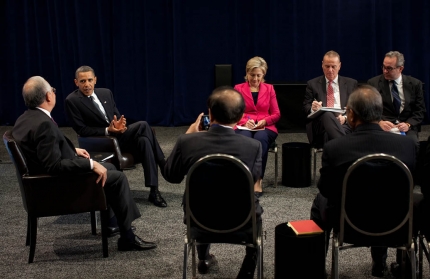
Global Engagement from Paris to the Persian Gulf

[Ed. Note: The program referenced in the following blog was first announced by the President in Cairo on June 4. Secretary of State Hillary Clinton announced the first three envoys in Marrakech in November: Bruce Alberts, Editor of Science, former National Academy of Sciences (NAS) president, and UCSF biochemistry professor; Elias Zerhouni, former National Institutes of Health director and Johns Hopkins professor; and Ahmed Zewail, who in addition to his academic work is a member of the President’s Council of Advisors on Science and Technology. Other prominent U.S. scientists will be invited to join the U.S. Science Envoy program in the coming months, expanding the scope of the program to countries and regions around the globe.

The envoys are scheduled to meet with heads of state, ministers, and representatives from the scientific, education, nonprofit, and business communities to identify opportunities for new partnerships in science and technology. They will investigate opportunities in all areas of science and technology, including math, engineering, health, energy, climate change research, and green technologies. Although the envoys are private citizens, they will share what they learn on these trips with the U.S. Government, and the relationships they build will help reaffirm our renewed commitment to global engagement. This dispatch was filed on Feb. 17.]

After catching a flight out of Washington just a half an hour before the Blizzard of 2010 shuttered National airport for the 2nd time in a week, I arrived to frigid pre-dawn temperatures at Paris’s Charles De Gaulle airport. Before long I was at the residence of the U.S. ambassador to the United Nations Educational, Scientific and Cultural Organization (UNESCO), where I was joined by U.S. Science Envoy Elias Zerhouni. Dr. Zerhouni, former Director of the National Institutes of Health (NIH) and a senior advisor to the Gates Foundation, is the second in a series of Science Envoys being sent by President Obama to build bridges and partnerships with Muslim communities and seek common solutions to global challenges—fulfilling a promise the President made in his New Beginning speech in June in Cairo.

Snow was looming on the Parisian horizon, but Dr. Zerhouni was warmly received by senior diplomats and officials from Muslim majority countries spanning the crescent from Nigeria and Morocco through Saudi Arabia to Malaysia. He also met with UNESCO General Director Irina Bokova to discuss how international cooperation in science and technology could help alleviate such pressing problems as food and water insecurity, impending shortages of teachers, and lack of access to health care as the world’s population grows to a projected 9 billion by 2300.

Next, Dr. Zerhouni met with the Paris press corps, including a number of radio and new media outlets that cater to diasporic Muslim communities in Europe. He also recorded a podcast reflecting on how he began his American life as an immigrant with an Algerian medical degree and few English skills and rose to running the NIH, the crown jewel of Federal biomedical research facilities, with 27,000 employees.

Later, Dr. Zerhouni and I parted ways on Place de la Concorde: I was on a mission to deliver two large containers of equipment to help a NASA engineer repair Morocco’s main teaching telescope located near a high dam in the mountains east of Rabat, and he had a meeting to attend in Zurich. But we met up again in Doha, Qatar, where Dr. Zerhouni continued his Envoy duties—this time teamed up with Secretary Hillary Clinton, Senator John Kerry, Special Representative Farah Pandith, Pradeep Ramamurthy of the National Security Council, U.S. Envoy Richard Holbrooke, and 150 other participants at the U.S.-Islamic World Forum for dialogue on U.S. relations with the Muslim world.

President Obama addressed the crowd by videoconference, amplifying the message of collaboration he offered in Cairo. And for three busy days Dr. Zerhouni helped fuel the process of turning that Presidential commitment into reality. He met informally with the Science and Environment Working Group at the U.S.-Islamic World Forum, whose representatives—from Muslim-majority countries across Africa and Asia—were crafting a report with recommendations to the United States and other governments. He met with the Emir of Qatar and several members of the royal family. And he met with the Prime Minister and other key ministers as well as scientists, officials, local leaders, and young people from this dynamic coastal city on the Persian Gulf. Wherever he went, he was met with a combination of enthusiasm and energy not often seen at science and technology meetings; there was a palpable sense in every forum that shared interests in science and technology have real potential to help bring diplomatic priorities to fruition.

Among the major themes discussed were the importance of education and innovation, including the need for job creation for hundreds of millions of young people in Muslim communities; the need to develop online communities of learning and exchanges of information; and the value of working together to solve issues related to food and water security, climate change, science policy, and public health. Dr. Zerhouni has now arrived in Riyadh, and will continue on to Kuwait City and Jeddah, Saudi Arabia before returning to the United States, where he will brief the President and help inform an effort to achieve some of the goals developed through this unprecedented outreach program.

Bill Lawrence is Senior Advisor for Science Partnerships at the State Department