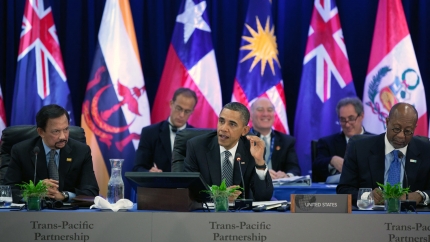
President Obama at the Asia-Pacific Economic Cooperation (APEC)

President Barack Obama meets with the Trans-Pacific Partnership at the APEC

President Barack Obama attends a meeting with the Trans-Pacific Partnership at the APEC summit in Honolulu, Hawaii, Saturday, Nov. 12, 2011. At left is Hassanal Bolkiah, the Sultan of Brunei, and right is U.S. Trade Representative Ron Kirk. (Official White House Photo by Pete Souza)


Yesterday, President Obama kicked off the annual Asia-Pacific Economic Cooperation (APEC) Ministers and Economic Leaders’ Meeting in Honolulu, Hawaii.  In the morning, the President met with Trans-Pacific Partnership (TPP) leaders, Australia, Brunei Darussalam, Chile, Malaysia, New Zealand, Peru, Singapore and Vietnam. 

President Obama announced in November 2009 the United States’ intention to participate in the Trans-Pacific Partnership (TPP) negotiations to conclude an ambitious, next-generation, Asia-Pacific trade agreement that reflects U.S. priorities and values.  This agreement will boost U.S. economic growth and support the creation and retention of high-quality jobs at home by increasing American exports to a region that includes some of the world’s most robust economies and that represents more than 40 percent of global trade. 

As the President noted yesterday:

We just had an excellent meeting, and I’m very pleased to announce that our nine nations have reached the broad outlines of an agreement.  There are still plenty of details to work out, but we are confident that we can do so.  So we've directed our teams to finalize this agreement in the coming year.  It is an ambitious goal, but we are optimistic that we can get it done.

The TPP will boost our economies, lowering barriers to trade and investment, increasing exports, and creating more jobs for our people, which is my number-one priority.  Along with our trade agreements with South Korea, Panama and Colombia, the TPP will also help achieve my goal of doubling U.S. exports, which support millions of American jobs.

 Later in the day, President Obama participated in an APEC CEO Business summit, including a question and answer session with Boeing CEO, Jim McNerney.


The White House

Office of the Press Secretary

Remarks by the President in the Meeting with Trans-Pacific Partnership

Hale Koa Hotel
Honolulu, Hawaii 

9:20 A.M. HAST

THE PRESIDENT:  I want to welcome, once again, all the leaders gathered around this table and their trade ministers to Hawaii.  Here in Hawaii, the United States wants to send a clear message:  We are a Pacific nation and we are deeply committee to shaping the future security and prosperity of the Trans-Pacific region, the fastest-growing region in the world. 

I’m very pleased to be here with my partners with whom we’re pursing a very ambitious new trade agreement, the Trans-Pacific Partnership.  I want to thank my fellow leaders from Australia, New Zealand, Malaysia, Brunei, Singapore, Vietnam, Chile and Peru. 

We just had an excellent meeting, and I’m very pleased to announce that our nine nations have reached the broad outlines of an agreement.  There are still plenty of details to work out, but we are confident that we can do so.  So we've directed our teams to finalize this agreement in the coming year.  It is an ambitious goal, but we are optimistic that we can get it done.

The TPP will boost our economies, lowering barriers to trade and investment, increasing exports, and creating more jobs for our people, which is my number-one priority.  Along with our trade agreements with South Korea, Panama and Colombia, the TPP will also help achieve my goal of doubling U.S. exports, which support millions of American jobs.

Taken together, these eight economies would be America’s fifth-largest trading partner.  We already do more than $200 billion in trade with them every single year, and with nearly 500 million consumers between us, there's so much more that we can do together.

In a larger sense, the TPP has the potential to be a model not only for the Asia Pacific but for future trade agreements.  It addresses a whole range of issues not covered by past agreements, including market regulations and how we can make them more compatible, creating opportunities for small and medium-sized businesses in the growing global marketplace.  It will include high standards to protect workers’ rights and the environment.

And I want to thank my U.S. Trade Representative, Ambassador Kirk, and all our teams for doing tireless work to achieve the progress that we’ve made so far.  I want to thank all my fellow leaders for their partnership and their commitment to making the TPP a reality, which will be a win for all our countries.

So, again, I am confident that we can get this done.  Together we can boost exports, create more goods available for our consumers, create good jobs, and compete and win in the markets of the future.

Ladies and gentlemen, thank you very much for your outstanding work.  Thank you.

END
9:23 A.M. HAST

The White House

Office of the Press Secretary

Trans-Pacific Partnership Leaders Statement

We, the Leaders of Australia, Brunei Darussalam, Chile, Malaysia, New Zealand, Peru, Singapore, United States, and Vietnam, are pleased to announce today the broad outlines of a Trans-Pacific Partnership (TPP) agreement among our nine countries.  We are delighted to have achieved this milestone in our common vision to establish a comprehensive, next-generation regional agreement that liberalizes trade and investment and addresses new and traditional trade issues and 21st-century challenges. We are confident that this agreement will be a model for ambition for other free trade agreements in the future, forging close linkages among our economies, enhancing our competitiveness, benefitting our consumers and supporting the creation and retention of jobs, higher living standards, and the reduction of poverty in our countries. 

Building on this achievement and on the successful work done so far, we have committed here in Honolulu to dedicate the resources necessary to conclude this landmark agreement as rapidly as possible.  At the same time, we recognize that there are sensitive issues that vary for each country yet to be negotiated, and have agreed that together, we must find appropriate ways to address those issues in the context of a comprehensive and balanced package, taking into account the diversity of our levels of development.  Therefore, we have instructed our negotiating teams to meet in early December of this year to continue their work and furthermore to schedule additional negotiating rounds for 2012.  

We are gratified by the progress that we are now able to announce toward our ultimate goal of forging a pathway that will lead to free trade across the Pacific.  We share a strong interest in expanding our current partnership of nine geographically and developmentally diverse countries to others across the region.  As we move toward conclusion of an agreement, we have directed our negotiating teams to continue talks with other trans-Pacific partners that have expressed interest in joining the TPP in order to facilitate their future participation.

The White House

Office of the Press Secretary

FACT SHEET: The United States in the Trans-Pacific Partnership

INCREASING AMERICAN EXPORTS, SUPPORTING AMERICAN JOBS

President Obama announced in November 2009 the United States’ intention to participate in the Trans-Pacific Partnership (TPP) negotiations to conclude an ambitious, next-generation, Asia-Pacific trade agreement that reflects U.S. priorities and values.  Through this agreement, we are seeking to boost U.S. economic growth and support the creation and retention of high-quality jobs at home by increasing American exports to a region that includes some of the world’s most robust economies and that represents more than 40 percent of global trade.  The Obama Administration has been working in partnership with Congress and consulting closely with stakeholders around the country to ensure TPP addresses the issues that American businesses and workers are facing today, and may confront in the future.

The Trans-Pacific Partnership Framework

The United States, along with Australia, Brunei Darussalam, Chile, Malaysia, New Zealand, Peru, Singapore, and Vietnam are working to craft a high-standard agreement that addresses new and emerging trade issues and 21st-century challenges.  The agreement will include:

Core issues traditionally included in trade agreements, including industrial goods, agriculture, and textiles as well as rules on intellectual property, technical barriers to trade, labor, and environment.

Cross-cutting issues not previously in trade agreements, such as making the regulatory systems of TPP countries more compatible so U.S. companies can operate more seamlessly in TPP markets, and helping innovative, job-creating small- and medium-sized enterprises participate more actively in international trade.

New emerging trade issues such as addressing trade and investment in innovative products and services, including digital technologies, and ensuring state-owned enterprises compete fairly with private companies and do not distort competition in ways that put U.S. companies and workers at a disadvantage.

Leading Asia-Pacific Regional Integration Initiative

The TPP is the most credible pathway to broader Asia-Pacific regional economic integration.  After nine rounds of negotiations, the nine countries made solid progress and have now achieved the broad outlines of an agreement.  During their meeting on the margins of the APEC meeting in Honolulu, the TPP Leaders agreed to seek to conclude the agreement as quickly as possible and instructed their negotiators to expedite their work.   The nine countries also welcomed the interest expressed by other countries in joining the agreement and will begin bilateral processes with these interested countries to discuss their readiness and ambition to meet the standards and objectives of the TPP.  Once these bilateral processes have concluded, all current Parties will decide on inclusion of new members by consensus.

American Competitiveness in the Asia-Pacific

The TPP is a key element of the Obama Administration strategy to make U.S. engagement in the Asia-Pacific region a top priority.   The huge and growing markets of the Asia-Pacific already are key destinations for U.S. manufactured goods, agricultural products, and services suppliers.  As a group, TPP countries are the fourth largest goods and services export market of the United States.  U.S. goods exports to the broader Asia-Pacific totaled $775 billion in 2010, a 25.5 percent increase over 2009 and equal to 61 percent of total U.S. goods exports to the world.  U.S. exports of agricultural products to the region totaled $83 billion in 2010 and accounted for 72 percent of total U.S. agricultural exports to the world.  U.S. private services exports totaled $177 billion in 2009 (latest data available), 37 percent of total U.S. private services exports to the world.  America’s small- and medium-sized enterprises alone exported $171 billion to the Asia-Pacific in 2009 (latest data available).

The White House

Office of the Press Secretary

Press Briefing Previewing the President's Trip to Hawaii, Australia and Indonesia, 11/9/2011

James S. Brady Press Briefing Room

12:14 P.M. EST

        MR. CARNEY:  Hello, everyone.  Welcome to today’s off-camera briefing.  I have with me to preview the President’s upcoming trip to the Asia-Pacific region Ben Rhodes, whom you all know, the Deputy National Security Advisor for Strategic Communications, and on my right, Danny Russel, who is Senior Director at the NSC for Asia.  Why don’t we let them talk you through the trip, take your questions about the trip.  And I will remain to take your questions on other pressing matters.

        Q    Can I just formally register a complaint from the television folks that this is off-camera?

        MR. CARNEY:  We think television is in decline, probably not going to last.  (Laughter.)  I hear your complaint.  Thank you.  Here’s Ben.

        MR. RHODES:  Jake, you’ve got a good blog, too.  (Laughter.)  Well, thanks.  We just want to take this chance to run through the President’s trip to Hawaii and then to the Asia-Pacific region.  This is a really important opportunity for the President to engage in this dynamic region to create American jobs, secure our interests and stand up for democratic values.

        I think from the beginning of this administration, President Obama has engaged on a personal level to restore our alliances in this part of the world, to raise U.S. standing in this part of the world, and, again, to make sure that the U.S. remains the preeminent economic and security power in the Asia Pacific and more broadly.  

        Of course, this takes place at a time when we’re making a larger pivot in our foreign policy.  We’re winding down the wars of the last 10 years.  By the end of this year, we’ll definitively end the Iraq war.  We’re beginning a drawdown in Afghanistan.  We’ve devastated al Qaeda.  And a lot of the shift in focus and priority that we are able to do because of those efforts has gone to the Asia-Pacific region.  

        And you’ve heard us talk about this, but we see this as, again, a region that is really going to shape the future of the 21st century.  It’s the fastest-growing economic region in the world.  The trade that the U.S. does with the Asia Pacific supports millions of American jobs.  

        The markets that are growing in the Asia Pacific are ones that we want to be competitive in going forward.  The U.S. exports to this region are essential to the President’s goal of doubling U.S. exports in the next several years.  In fact, nearly all of the efforts that we’re going to be making towards that export goal take place in this part of the world.  So that’s the economic context.

        On the security side, the U.S. has been an anchor of security in the Asia Pacific since World War II, essentially.  The core of that is our alliances with Australia, Korea, Japan and several other countries, of course.  But also, we’ve -- from the beginning of this administration -- engaged the emerging powers in the Asia Pacific -- China and India, Indonesia and others -- as well as engaged regional institutions, like APEC and the East Asia Summit that the President will be participating in.

        So this flows very much out of, again, a focus of our foreign policy, which is winding down the wars and refocusing on a broader set of priorities, to include U.S. leadership in the Asia Pacific.

        Just to go through the schedule, as you know, the President will leave Friday and he’ll be stopping in San Diego before moving on to Hawaii, and spending the night in Hawaii on Friday night.  

        Saturday morning, he will begin by hosting a meeting of the Trans-Pacific Partnership.  Now, as those of you who follow this know, the Trans-Pacific Partnership is really the most promising vehicle that we see for achieving economic integration across the Asia-Pacific region and advancing U.S. interests with some of the fastest-growing economies in the world.

        As we’ve concluded the Korea Free Trade Agreement, which was an essential effort in our -- both our trade agenda and our Asia policy, the TPP is really the next phase of the U.S. trade agenda, broadly and within this part of the world.  It’s nine countries that have worked together over the course of this administration to try to come up with high standards for a trade agreement that can encompass, again, the countries of the Asia-Pacific region.  And we can talk more about this in questions through the next couple of days.

        So he’ll be hosting that meeting, again, with the nine leaders of the members of the TPP.  After that, he’ll be attending the APEC CEO Business Summit.  And there’s a group of business leaders from across the Asia Pacific, who are a part of a forum that the President has participated in over the last couple of years.  At this one in particular, he’ll be engaging in a dialogue with Jim McNerney, the CEO of Boeing, about the economic potential of the region and the U.S. efforts to tap that potential.

        After his attendance at the APEC CEO forum, he will have a bilateral meeting with Japan, Prime Minister Nodo of Japan.  Again, Japan is one of our key allies in the region.  It’s a country that we have a broad range of economic and security interests with, and this is another effort to extend those consultations.  And we can discuss that more in questions if you like.

        Q    Is that Saturday morning or afternoon?

        MR. RHODES:  This is Saturday afternoon.  The bilateral meeting with Japan is at roughly 12:00 p.m.

        Q    Local time?

        MR. RHODES:  Yes, local time.  Everything is local time.  And the local times get more and more complicated vis-à-vis U.S. time as we go through this trip.

        After the meeting with Japan, the President will be having a bilateral meeting with Russia, President Medvedev of Russia.  Of course, this has been one of our key focus of our foreign policy -- has been the U.S.-Russia relationship.  This meeting will take place at a time when one of the issues that we’ve been working very hard is the next phase of the reset, is poised to come to fruition, which is Russian accession into the WTO.  There is an agreement reached between Russia and Georgia that also benefited from the participation of the Swiss government to resolve some of the outstanding questions resolving Russia accession into the WTO.  So we anticipate the leaders will have an opportunity to celebrate, again, a great deal of progress towards a key priority of the two leaders, which was completing the steps necessary to see Russia join the WTO.  We’ll, of course, address with the Russians a broad number of other issues, from nuclear security, nonproliferation, Iran, North Korea, and the full gamut of U.S.-Russia relations.

        Following the Russia bilateral meeting, later that afternoon the President will have a bilateral meeting with Hu Jintao of China.  This is the first meeting the President has had with President Hu -- formal meeting that he’s had with President Hu since the state visit earlier this year.  

        As always with the Chinese it’s an important opportunity to discuss our economic agenda, including our efforts to sustain global growth through a rebalancing of global demand as well as a range of regional security issues, including the agendas for the East Asia Summit that the President will be attending, as well as, I’m sure, nonproliferation issues and issues associated with Iran and North Korea as well.

        After the --

        Q    Ben, what time will that one be?

        MR. RHODES:  Roughly at 3:45 p.m. local time.

        Q    Saturday?

        MR. RHODES:  Saturday.  This is still Saturday.  So, busy day on Saturday.

        Following the China bilat, he will, that evening, starting at about 6:00 p.m., host a program for the APEC leaders in Honolulu.  So there will be a dinner and a cultural program that night, at which the President will be making remarks.  And I should add he’ll have the opportunity to make some brief remarks at the TPP event as well as having his discussion with Mr. McNerney at the CEO forum.

        Moving to Sunday.  Sunday is the APEC Summit, and I’d just say a few words about APEC.  As you know, this brings together 21 member economies from across the Asia-Pacific region.  I think it’s important to note that the APEC nations represent 44 percent of global trade, 55 percent of global output, and 10 -- 6 of America’s 10 largest trading partners are in APEC.

        Since it was created it’s been a forum to really address regional economic integration and ways in which we can deepen the connections between APEC nations.  Over the last couple of decades we’ve seen, again, U.S. exports with APEC countries nearly triple.  In 2010, APEC economies purchased 61 percent of total U.S. exports, supporting nearly 4 million U.S. jobs.  So what we see again here is this is a concentration of economies that are going to be essential to U.S. efforts to create jobs, to foster economic integration among the most dynamic markets in the world right now.  And the agenda at APEC very much reflects that.

        I think the three components of the agenda that we’d highlight are steps that we’re taking to increase trade within APEC and to strengthen regional economic integration; secondly, to support green growth and green jobs going forward, given both the economic benefits of that and the environmental concerns in the region; and then last, thirdly, promoting regulatory practices that facilitate trading and investment.  So part of our efforts to integrate this regional economy involves integrating our regulatory approaches.  

        So the first opening plenary will be at 9:45 a.m.  The President will make opening comments at that session.  And then that session will focus on growth and job creation.  Then at 11:30 a.m., the leaders will have a dialogue with the APEC Business Advisory Council.  Again, many different business leaders from across the region will be present.  Then there will be a leaders’ working lunch at 12:45 p.m., followed by a family photo of the APEC leaders.  And then the closing plenary session will focus on green energy, green jobs going forward.  

        Following the APEC Summit, at roughly 4:45 p.m., the President will have a press conference to wrap up the summit.  So he’ll have a chance to sum up what was done and to take your questions.  

        Following the APEC Summit, which will conclude at that point, we will be having the North American Leaders Summit that evening as well.  As you know, this is the annual meeting among the U.S. President and the Mexican President and the Canadian Prime Minister.  The leaders will have a trilateral meeting, followed by a working dinner that night.  This will start at roughly 6:30 p.m.  I think the focus of the North American Leaders Summit will be North American competitiveness and how the three nations can work together to support, again, growth and job creation among the three of us and also of course within the context of the APEC region.

        We’ll also be working together to prepare for the Summit of the Americas next year, which, again, will be the next major hemispheric event here in the Americas.  And to that end, we’re looking at a range of issues from citizen security, again, to regional economic growth, to efforts to combat climate change.  And of course, they’ll be able to follow up on their discussions at the last North American Leaders Summit, again, which hit upon, in addition to the issues I cited, support for some of the particular regional challenges such as democratic stability in Haiti.  So that concludes the day on the 13th.

        Monday, the 14th, the President will have a -- we anticipate he’ll have a fundraiser in the morning.  And that will be his only event for the day before we leave on Tuesday morning for Canberra, Australia.  Now, because of the wonders of the world, the flight to Australia takes us forward a day on the clock.  So we now move to Wednesday, November 16th, in terms of the schedule here.  And this is Australia time.

        So the President arrives in Australia -- and I’ll just say by way of introduction the U.S. really has no better ally than Australia when it comes to a range of issues.  On the security side, Australians are with us in Afghanistan.  They’ve cooperated with us on Iran sanctions.  They’ve cooperated with us on our nuclear security efforts.  So this has been a very close and reliable U.S. ally.  And the President will be marking the 60th anniversary of the U.S.-Australian alliance on this trip.

        Australia is also a dynamic economic partner for the U.S.  We actually run a trade surplus with the Australians from within the framework of our free trade agreement.  So this is a relationship with deep security and economic ties that the leaders will be able to address.  

        After an arrival ceremony with the Governor General, the President will move into his bilateral meeting with Prime Minister Gillard.  After the bilateral meeting with Prime Minister Gillard, the two leaders will have a joint press conference.  And then following that joint press conference, the President will be hosted at a parliamentary dinner at the Australian Parliament House that night where he’ll also have the chance to make some remarks about the U.S.-Australian relationship, and will spend that night in Canberra.

        Q    What time is that press conference on Wednesday?  

        MR. RHODES:  It is, let’s see -- well, Australia time, we anticipate the press conference being at 6:00 p.m.  That’s I think very early morning early hours Eastern Time.  So I think that’s like 2:00 in the morning Eastern Time.  And I’ll try to build in some Eastern times for you here going forward.

        So on Thursday, the President begins his day by going to an Australian war memorial, laying a wreath.  Then he’ll go the Australian Parliament House and he will meet with the opposition leader, Tony Abbott, briefly.  And then he’ll give a speech to the Australian Parliament at 10:15 a.m. or so, which is roughly 6:00 or 6:15 p.m. Eastern Time the previous day.  (Laughter.)  Bear with me on this.

        Q    10:15 a.m. in Australia?

        MR. RHODES:  10:15 a.m. in Australia.  That’s -- yes.  

        Q    What’s the Eastern Time?

        MR. RHODES:  6:15 p.m. on the previous day, Wednesday.

        So this -- (laughter) -- you got this, Jake?

        Q    It will be old news by then.

        MR. RHODES:  That’s good.  That is good.  There will be a lot of time zone humor throughout this trip.  (Laughter.)

        This speech will actually be about the -- again, the U.S.-Australian alliance, but also this will be a broader speech about the Asia-Pacific region by the President.  This will really be the kind of anchor speech by the President in his first term on how the U.S. sees the Asia Pacific, the efforts that we’ve taken, again, within the region over the course of the last three years to strengthen our core alliances to engage emerging powers like China and India and others, and to engage Asian regional institutions like APEC and the East Asia Summit.  

        I think he’ll focus on the economic agenda in the Asia Pacific and the enormous potential of deepening economic ties.  He’ll focus on the security agenda, including the U.S. posture in the region going forward, our defense posture as well as our alliance in political relationships.  And of course, he’ll speak about our support for Democratic values in the region.

        The last trip we took to Asia we were able to travel the four Asian democracies -- India, Indonesia, Korea, Japan.  Similarly on this trip we’re making two stops in Asia -- Australia and Indonesia -- notable that they are both democracies, and I think it speaks to the success of Democratic models in Asia.  And so the President will speak to that.  So I think both the economic -- or the economic, the security and the values components of our approach to the Asia Pacific will form that speech.

        Following that speech --

        Q    Ben, can I interrupt again?

        MR. RHODES:  Yes, yes.

        Q    Will you have prepared remarks for that speech, do you think?

        MR. RHODES:  Yes.  I mean, insofar as I can -- we will be very sympathetic to the need to get information to you guys in a timely way so that you’re able to meet your deadlines.  So we will certainly do whatever we can in that respect.

        Q    When you say “you guys,” do you mean the entire media or just The New York Times?  (Laughter.)

        MR. RHODES:  Basically we will go out of our way -- welcome back, by the way, Jake.  (Laughter.)  I’d remind you that the U.S. government did a lot to protect you over the course of the last couple weeks.  (Laughter.)

        But the -- yes, the complete news media to include ABC, ABC News.

        So after the Australian Parliament we will visit a local primary school with Prime Minister Gillard.  You may remember that when she was here the two Presidents were able to visit a local Washington school.  Education is very important to both President Obama and Prime Minister Gillard.

        Q    What day is this?  I’m sorry.

        MR. RHODES:  This is still Thursday.  This is still Thursday, November 17th.  So Wednesday, November 16th, on the East Coast.

        So they’ll go to a local primary school.  Then the President will drop by our embassy for an embassy greet.  After that the President -- again, still Thursday -- the President will fly from Canberra to Darwin, Australia.  We will arrive in Darwin around 4:00 p.m. Australia time.  This, of course, is an historic place in World War II history in terms of a Japanese attack, and there was U.S. sacrifices in Darwin.  The President will visit a memorial to the USS Peary and lay a wreath at that memorial.  

        And this is -- Darwin is also the site of a Australian military base.  And, again, to reinforce the close cooperation between the U.S. and Australia in Afghanistan and in many previous wars, and to mark the 60th anniversary of our alliance with Australia, the President and Prime Minister Gillard together will address Australian troops in Darwin about the alliance and about our security cooperation, and about the U.S. presence in the region and our commitment to the region.

        I’d also note --

        Q    Are those Australian troops?

        MR. RHODES:  Yes.

        Q    Or -- there won’t be any American troops?

        MR. RHODES:  It’s principally Australian troops.  So it’s possible that there could be, obviously, some people traveling with the President but it’s an Australian troop event.

        Then I’d also note that he’ll also be meeting with some of the community leaders in Darwin on the margins of that event as well.

        Q    Aboriginal leaders?

        MR. RHODES:  That will include aboriginal leaders as well.  Then that concludes the Australia portion of the visit.  He will fly that night to Bali and spend the night in Bali.  

        Then on Friday, November 18th, the President will have a number of bilateral meetings.  He will meet with the Prime Minister of India.  India, of course, as a rapidly growing economy, as a strong democracy and as an important security partner and counterterrorism partner in South Asia is a very important relationship to the United States.  So he and Prime Minister Singh have not had the chance to meet in some time.  They’ll have the ability to discuss regional developments, to discuss Afghanistan, to discuss our deepening economic and commercial ties with India, as well as to discuss the East Asia Summit.  

        In addition to India, he’ll be meeting for the first time with the leaders of two important U.S. allies in the region, Thailand and then the Philippines.  We don’t have specific times yet for these.  But, again, these are both important U.S. allies.  We have close security relationships with them.  We share an interest in counterterrorism and maritime security and nuclear security with Thailand and the Philippines.  So he’ll have an opportunity to discuss those issues, as well as expanding commercial ties with each of these countries as well.

        Q    Is this still in Darwin?

        MR. RHODES:  No, this is in Bali.  Friday, November 18th, this is all in Bali.

        Q    Do you have a local time for the Indian bilat?

        MR. RHODES:  We are tracking towards 9:30 in the morning.  Then we also anticipate in Bali he’ll meet with -– have a bilateral meeting with Malaysia; similarly a key partner on all of our issues in this region, but also an emerging economy with which we have a deepening commercial relationship that the leaders will be able to discuss.

        Following that, the president will meet with the ASEAN nations, the 10 Southeast Asian nations.  ASEAN has been a critical block of nations in terms of regional security and economic issues.  And the President will address those with the ASEAN nations.  Again, I think we’ve sent the signal that the U.S. wants to be at the table in these discussions, whether it relates to the Asia-Pacific economy or the Asia-Pacific security architecture.  And the ASEAN meetings have been important to that end.

        Following that ASEAN meeting, he will meet bilaterally with President Yudhoyono of Indonesia, who is the host, of course, of the East Asia Summit.  Indonesia has been, again, one of the most rapidly growing economies in the region, a key partner for the U.S. on a range of issues from counterterrorism to maritime security.  Following that, I anticipate the leaders will have the ability to -- well, we’ll update you on kind of the press components of each of these meetings.  But we’d anticipate the President will be making statements with his counterparts.

        Then that night there is an East Asia dinner that the Indonesians are hosting.  So that wraps up Friday the 18th.  And Saturday the 19th is the East Asian Summit, which will take place throughout the day.  So there are a number of summit sessions throughout the day.  Again, I think our main interests are both to reinforce the importance of the East Asia Summit as an organization that addresses political and security challenges in the region.  If you think about it, APEC is really a venue to address economic issues and economic integration in the region.

        And we’ve invested in the East Asia Summit as the venue to address political and security challenges in the region.  And all of this is in service of having institutions and organizations through which the United States can join with Asian countries to address pressing issues.  I think in the East Asia Summit context that will include our nonproliferation agenda.  A lot of our efforts on nuclear security, including the President’s goal of securing all nuclear materials in the world, depend upon cooperation from East Asian Summit members.

        Of course, you have an ongoing proliferation concern in the region with North Korea.  So I’m sure the President will be addressing in his meetings our commitment to denuclearization on the Korean Peninsula.  We also have an interest in maritime security at the East Asia Summit.  And, again, for instance, whether you look at the South China Sea specifically or maritime security generally, we have a deep security and commercial interest in seeing that there be clear rules of the road in terms of how nations approach maritime security.  And so that will be an important agenda item.

        Disaster relief will be an important agenda item.  And, again, I think I’d highlight that this is a region that saw both the Indonesian tsunami and the recent Japanese earthquake and tsunami.  So strengthening our ability to work together to respond to those types of natural disasters is very much in the interest of not just the region, but the United States as well.  

        So with that, that concludes the schedule on Saturday.  And with that, we’ll be returning to the United States.  I don’t know, Danny, if you want to make any comments.

        Q    What time is he scheduled to leave?

        MR. RHODES:  The current schedule has him leaving Indonesia in kind of the mid to late afternoon on Saturday the 19th.  And we’ll take your questions.  But, Danny, anything by way of opening?

        MR. RUSSEL:  Well, that was very comprehensive.  I’d say briefly from the Asia perspective two or three things.  Mostly, the trip needs to be looked at in context.  Part of the context is that this isn’t a trip to the far-flung corners of Asia.  This is a trip to the Asia Pacific.  The U.S. is very much an Asia-Pacific nation.  We’re a resident power.  And the fact that the President begins by hosting APEC in Honolulu is a good demonstration of that.         

        Secondly, the other continuum -- the other context of the trip is the overall policy that the President has pursued with respect to Asia and rebalancing in Asia, mainly that when he came into office, he came in with the insight that the U.S. was overall underbalanced with respect to Asia, and that in the effort to remedy that, the three basic elements of the policy that the President articulated and pursued were in the first instance to bolster, shore up, and modernize America’s alliances in the region; secondly, to develop effective strategic ways of engaging the emerging powers in the region; and thirdly, to engage with and shape and to lead the regional institutions that were developing either in embryonic form or that were already in place.

        And this trip reflects the approach very clearly in that he is, having come off the heels of a very successful state visit by President Lee, he will be on this trip meeting -- visiting Australia, meeting with the Prime Minister of Japan, and meeting with two other important allies, as Ben mentioned, Thailand and the Philippines.

        In terms of engagement with the emerging powers in Asia, he’ll be meeting with the Chinese President Hu Jintao, with the Indonesian President Yudhoyono, and with the Indian President Minister Singh.  

        And in terms of engaging with and shaping institutions, not only is, as Ben mentioned, the President putting forward an activist agenda at APEC, and not only is the President taking the Trans-Pacific Partnership trade arrangement -- a very high-quality, high-level set of standards -- to the next level in a way that’s prompted great interest in the region, but for the first time -- and this is historic -- he will be participating in the East Asia Summit.  

        While respectful of the existing agendum of that group, we have advocated for and found support to expand the dialogue among the leaders to include key strategic and security issues, specifically nonproliferation and maritime security.

        The President identified that there is a gap in Asia, that while the infrastructure for collaborative discussion on economic issues is fairly well developed, there was nothing adequate on the political and security side.  And he has already begun the effort to try to transform the existing East Asia Summit into a venue where the leaders can not only discuss but provide guidance and leadership to the other regional institutions, such as the ASEAN Regional Forum and the meetings of the ministerials.

        So I think on balance, you can see this trip as emblematic of the maturation of the Obama approach towards Asia.  It’s not declaratory, it’s not promising we’re coming back, it’s manifesting the benefits of U.S. sustained and deepened engagement in the region.  

        MR. RHODES:  Questions?  Ben?

        Q    Thanks.  I had two questions.  First, a broader one for either gentleman.  The timing of these foreign trips can often be tricky because of domestic concerns, and of course there will be things happening in Congress related to the economy, appropriations and the super committee while all this is happening.

        Can you synthesize for the American electorate why spending so much time in Asia is important?  I know you’ve talked about exports and so forth, but people will see him overseas now after the G20, APEC in Hawaii, and then all the way through to Indonesia, spending a lot of time out of the country.  How does this affect them?  How does the President --

        MR. RHODES:  Yes.  Well, I’d make a number of points.  First of all, the President’s number-one priority is job creation.  And our efforts to create American jobs are tied very directly to the engagement in the Asia Pacific.  Our trade with APEC nations supports millions of American jobs.  Our ability -- if you look at the growth of the U.S. economy and if you look at the ways in which we are creating jobs, our ability to export is critical, again, to our job creation and growth agenda.  And, again, the vast majority of the export potential in the world is in the Asia Pacific.

        So when the President sets a goal of doubling U.S. exports to support hundreds of thousands of American jobs, again, that’s very much going to be rooted in our ability to open markets in the Asia Pacific, to achieve export deals with governments in the Asia Pacific.  

        So the first -- in the first instance, the domestic portion of this trip -- and Hawaii, of course, is a domestic stop -- is going to be rooted very much in an economic agenda that supports U.S. exports, that increases trade, that breaks down barriers to markets in the region and that fosters the type of integration across the Asia Pacific that is going to be essential to U.S. jobs and U.S. competitiveness.  

        And, again -- so all the themes that we talk about domestically -- our ability to compete, our ability to create good-paying jobs, our ability to invest in the industries of the future -- all of that is going to be directly related to U.S. leadership in this particular part of the world.  

        So I think when the American people see the President traveling in the Asia Pacific, they will see him advocating for U.S. jobs and U.S. businesses.  He will be trying to open new markets, and he will be trying to achieve new export initiatives, and he will be trying to foster a trade agreement through the, for instance, the Trans-Pacific Partnership, that takes us beyond the Korea Free Trade Agreement towards a multilateral agreement that, again, has very high standards to ensure that our interests are being protected.

        So I would see -- when you ask why are we so focused on this region, an overwhelming reason why is because of the economic potential, and the direct tie-in to people at home.  

        Secondly, the U.S. is a Pacific power, and we have been a Pacific power since World War II.  And we have a deep and abiding commitment to allies in this part of the world.  And when you look at the security challenges we face, whether it’s terrorism or proliferation or piracy or natural disasters, our ability to work cooperatively and to lead in the Asia Pacific is going to be essential to our ability to remain a world leader.

        And the American people want to see America living up to its responsibilities as a world leader in a way that protects our interests.  And our ability to, again, shape the future in the Asia Pacific is going to be essential to that, particularly in a context where you have a region that’s very dynamic, that has emerging democracies, that has a rising China.  And I think the American people want to know that the United States is going to play the historic role that it’s always played in terms of being the anchor of stability in this part of the world and being able to project our influence on behalf of American interests.

        So I think that’s -- the bottom line is that they will see the President as an effective advocate for U.S. interests.  They will see him taking steps to support economic growth and job creation here at home.  And they will see him standing up for both the security interests that we have in counterterrorism and nonproliferation, but also the democratic values that have spread across Asia, frankly because of the sacrifices of the American people -- whether it was in World War II, whether it was in Korea, or in a range of other relationships.

        And then I’d just add that when the President is on these trips he’s always able to deal with any matters anywhere in the world.  So whether it was the beginning of the Libya operation on our Latin America trip, or whether it was being able to engage with his administration and other leaders back in the United States, he’s more than capable of doing that during his four days here in Asian countries.

        Q    Just a quick follow on a more narrow point.  It seems unusual that the President would take such an extensive trip and have such a down day -- which sounds like Monday will be in Hawaii with the exception of the fundraiser.  Can you explain why he’s doing that?

        MR. RHODES:  Well, look, it’s principally because we had a summit that we’re hosting in Hawaii, the APEC Summit that has been long planned.  And the Indonesians had a summit that they’re hosting in Bali, the East Asia Summit.  And we’re working an Australia stop.  But those summit schedules are set far in advance, and so therefore that created the context for the trip.  

        But, again, it’s an opportunity for him to engage supporters in Hawaii, which is obviously a place where he has a lot of backing and a lot of roots.  So I think it also presents an opportunity for him to have that engagement.

        Q    Thanks.

        Q    As you pursue this pivot to Asia, some of the allies in the region are worried about the effects of budget cuts here on the defense posture in Asia.  And I’m wondering what kind of assurances the President will be able to give them.  I understand that some of them are even following the super committee process closely, and the possible sequestration of defense funds.

        MR. RHODES:  I actually -- I do think this will be a topic throughout the trip, in which the President will be providing assurance that the U.S. is going to continue to play its role within the Asia-Pacific region, and that we see both our defense commitments and our commitments to our allies as indispensable to the United States and to the Asia-Pacific region more broadly.

        I’d also say that he will be making it clear that because the U.S. is -- the reason that the Asia Pacific has been able to develop in the way that it has with the enormous economic growth, with the emergence of democracies, is precisely because the U.S. has been able to be an anchor of security and stability.  And so our force posture, our troop presence, our naval presence in the region has been fundamental to the peaceful development and democratic development of Asia.  And so I think there will be a theme of strong reassurance from the President that we’re going to continue to play that role, even in a time of addressing fiscal consolidation and deficit reduction here at home.

        Q    And can you also talk about what the President will say in the meeting with Hu about the European crisis, and also about China’s own currency?

        MR. RHODES:  Obviously, both President Hu and President Obama were at the G20 in Cannes, and so were participating in discussions about the European crisis.  I think we saw China indicate some steps that they were prepared to take, along with emerging economies, to bolster domestic demand going forward.  They have taken steps on currency, but, again, we don’t believe that those are sufficient.  So I’m sure that the President will be raising with President Hu the broader need for global growth that is supported by demand in China and other emerging economies.  Currency is a part of that picture.

        Similarly, I think they’ll be addressing some of the APEC agenda items, which get at how do you support an innovation agenda across the region; how do you support regulatory convergence that gives businesses confidence that they can sell their products and that they can be competitive across the region.  So I think there is a broad economic agenda with President Hu that includes rebalancing, that includes currency, but also includes, again, the broader APEC themes as well.

        Brianna.

        Q    Ben, can you talk about the dialogue with the CEO of Boeing at the business summit?  I mean, whose idea was it?  How did you come to choose the Boeing CEO?  And what is the President hoping to achieve from that?

        MR. RHODES:  Well, if you look at -- the President has spoken to this group -- to those of you who covered the last two APEC summits -- he has spoken to this group the last few years.  It’s an important group.  Part of what APEC does is it structures an ability for leaders and government officials, but also business leaders to communicate about economic issues on a regular basis, and to work through problems, work through challenges.  So that’s the context for this forum.

        Given the fact that he’s spoken to this group a couple of times already, and the fact that we’re hosting it, we thought it would be an interesting venue for him to have a dialogue that focuses on, again, the potential of the Asia-Pacific region, as well as the President’s commitment to U.S. exports.  Boeing, of course, is an American company that has a great deal of -- does a great deal of export business in the Asia Pacific and around the world.  So in many respects, both the President’s engagement with Mr. McNerney, but also Boeing’s presence in the Asia Pacific and around the world makes it a natural fit to have that type of discussion.

        So I think, again, it’s allowing him to have a dialogue with the business community, allowing him to discuss his own export agenda, and also hear from leaders and business leaders about, again, how they approach the region as well.  And Mr. McNerney is a natural fit for that dialogue.

        Q    And then aside from sort of emphasizing economic and military ties, is he going to really make news?  Or is a lot of this about keeping up relations?

        MR. RHODES:  No, I’d expect over the course of this trip that there’d be specific items that we’re looking to make progress on.  I mean, at APEC, we want to take the Trans-Pacific Partnership trade agreement to the next level.  At APEC there are also going to be a number of specific items within the categories that I talked about where they’re going to be looking to reach some agreement.  

        I think in Australia we’ll be able to speak about what is the U.S. commitment to our force posture in the region; what is the next phase in the U.S.-Australian alliance.  

        And then I think at EAS there are obviously specific things that we’re trying to do on the nuclear security side that are important to us, on maritime security, on human rights.  

        So without getting ahead of the actual meetings and events, I think that the trip will -- we have very specific objectives in mind.  Similarly, we’re meeting with very -- we’re meeting with, in addition to almost all of our key allies in the region, we’re meeting with China, Russia, India.  So they will have the opportunity to discuss issues like Iran, which are particularly important in the wake of the IAEA report, as well as discussing Afghanistan in the lead-up to some important international conferences on Afghanistan.

        So it’s also an opportunity to check in on Asia-Pacific issues, but also a number of other global issues.

        Q    Ben, two quick questions.  On the TPP, what is the long-range hope for when that can finally be in place?

        MR. RHODES:  I think that there have been -- I don’t want to put a date on it.  I think we’ll have more clarity, frankly, out of these meetings.  There have been negotiations at the trade ministerial level, of course.  And now at the leaders level I think they’ll want to essentially codify the progress that’s been made and lay down a marker as to where they see those TPP negotiations, and then look to the next phase.

        So I think we’ll be able to fill in some of those details out of that -- out of their meeting.  But I wouldn’t put a timeline on it.  But Danny, do you have anything to add?  I mean, the other thing I’d note that -- is that as they seek to conclude the broad outlines of an agreement, and then -- and move forward with finalizing that, there are also a range of other countries that will continue to indicate an interest potentially in joining the Trans-Pacific Partnership.  

        So part of the innovation of the agreement is that it provides a framework for these nine countries as the charter members of the TPP, and that going forward we can also see if other nations can meet the standards that have been set on labor, environmental issues, regulatory issues going forward.

        Q    And also, on the scheduling, since you said these things, the summits are known, the dates of them far in advance, when the -- at the end of July when the debt agreement was negotiated and the provisions for the deficit committee were negotiated, was it discussed or did the White House bring up the fact that that November 23rd deadline would potentially conflict and have the President out of the country for the run-up to that?

        MR. RHODES:  No.  I mean, again, the East Asia Summit has been on the books for some time now, obviously preceding that.  And of course the President will be back in the United States the weekend before that deadline of the 23rd.  So he’ll certainly be there that week.

        Q    Have you made any special provision for him to get regular bills on what’s going on?

        MR. RHODES:  He always -- when he’s traveling like this he always gets -- he’s always in regular contact with White House staff back here.   So it’s -- I don’t think we need to do anything special beyond him having that type of contact throughout the day with his White House staff.

        Q    Couple of questions on Australia.  First of all, the much anticipated basing agreement, enhanced basing agreements between the two sides.  You didn’t mention that.

        MR. RHODES:  Yes.

        Q    What is in the offing for that?

        MR. RHODES:  Again, I don’t want to get -- I mean, what I would say is that I think what we’ll be discussing in Australia is the future bilateral cooperation between the U.S. and Australian militaries, and also the U.S. force posture in the Asia-Pacific region more generally.

        I don’t want to get ahead of the discussions that the leaders will have on those matters, but I certainly think that those issues will be key to what they’ll be talking about.

        Q    There is a new formal agreement in the works, though, right?

        MR. RHODES:  Again, before an agreement is -- I don’t want to get ahead of any agreement.  I’ll just say that we’re discussing with the Australians, again, the future of our alliance in the context, also, of our future force posture in the region.

        Q    And then one quick scheduling question on Australia.  When we’ve talked to Australians they’ve wondered why the President didn’t take that day that he’s devoting to a downtime in Hawaii and tack that onto his visit there since it had been canceled twice before.  They’re, as you know, sensitive about this.

        MR. RHODES:  Well, look, he’ll have two days in Australia, two stops -- speech to Parliament, bilateral meeting, other events.  So I think we have a very robust schedule in Australia.  Again, being in Hawaii we have two very full days there, and then the opportunity to have -- to meet with some supporters.

        MR. RUSSEL:  It’s also considered good manners to allow the host to get back to the house before the guest arrives.  (Laughter.)  

        Q    Planes are fast.

        MR. RHODES:  Very well put.  Very well put.  Do you have anything else?  

        Laura.

        Q    Thanks.  You sort of alluded to this, but I’m wondering if you could address more specifically whether the trip to the EAS, and in general to the region, is meant to reassure U.S. allies that the -- of the U.S. interest and presence in the region, at a time when China is acting in, in some cases, aggressive ways and ways that are uncertain for the future.  Is it specifically meant to sort of counter that rising Chinese influence?

        MR. RHODES:  Well, again, I think it’s absolutely the case that this is a region that sees a lot of rapidly developing change, including the rise of China.  But in that context, the U.S. wants to, again, make it clear that we are going to continue to be a strong Asia-Pacific power; that we’re going to continue to stand by our core alliances; that we’re going to build positive relationships with emerging powers like China and India.  

        But also, what we want to foster is an environment where all this change is channeled to effective regional solutions, because we want to see, essentially, the success of a rules-based system in this part of the world.  We want to see countries follow the rules of the road on economic issues.  Again, whether that’s adhering to intellectual property norms, whether it’s adhering to regulatory norms.  So on the economic side we very much want to have rules of the road in place that all nations are committed too.

        And then similarly on the security side, we want to have institutions set up like the East Asia Summit to address multinational issues like maritime security, or nuclear security, so that we have a rules-based framework to deal with that as well.  So what the U.S. can do is both reassure our allies, develop strong ties with emerging nations, and then try to build a regional framework to deal with issues.  But Danny might want to --

        MR. RUSSEL:  Yes.  Well, I’d add these are institutions in which China is an active participant.  And I would mention that China was the first country to welcome the President’s decision to join the East Asia Summit.  So it’s not as if there is a zero-sum condition being set here.

        There’s no question but that the Asia -- that the nations in the region -- the EAS members -- have warmly welcomed the President’s personal participation.  They surely see that as yet another indication of the seriousness of purpose on the part of the Obama administration and the U.S. government, not only in meeting our commitments to Asia but also the level of investment that we are making for the reasons that Ben outlined.

        Q    Do you anticipate that he’ll specifically address the South China Sea and the nine-dash line as part of the maritime issues you’re referring to?

        MR. RUSSEL:  Well, as Ben mentioned, the three areas of focus that we have identified and that the Indonesians as chair of the EAS this year have agreed will be under discussion among the leaders, are disaster relief -- where the U.S. has already provided tremendous support in specific cases and now has put forward proposals for how we can broaden and institutionalize our ability to be helpful in disaster relief; nonproliferation and the broad range of issues both on a bilateral and a multilateral issue; and maritime security.  The East Asia Summit brings together the leaders of the entire Asia-Pacific region.  They are at a forum that allows them to discuss freely the strategic and political issues of concern to their nations and to their publics.    

        And in the context of maritime security, while there are a number of technical issues about piracy, about capacity building, about information sharing, and there are a number of programs that are under discussion in the context of the East Asia summit, within that framework, clearly, the South China Sea is relevant.  It is both natural and inevitable that the leaders will address the South China Sea issues in the context of maritime security, looking at the shared principles, the consensus around these shared principles of international norms and law -- freedom of navigation, the right to unimpeded legitimate commerce, and efforts -- collaborative efforts to avoid the accidental conflict or miscalculation and see an incident that could lead to a spike in tensions.

        Now, you should be clear that this is a dialogue forum for leaders; it is not a tribunal.  So it is as if a territorial dispute is being referred to the EAS.  It’s not on the agenda, per se.  But as I said, I think it is natural, if not inevitable, that in the context of maritime security leaders will touch on the principles that should apply not just in the Bali Sea, but in the South China Sea as well.

        Q    Can I follow on China as well?  All important issues you just laid out, but you mentioned at the beginning this is the first bilateral meeting the President is going to have with President Hu since the state visit.  A lot has happened since then.  The U.S. debt, the super committee -- that’s been discussed -- but European debt, China’s role in maybe buying some of that up.  How important do you think that will be in the bilateral meeting as well?

        MR. RHODES:  Well, first of all, on the Europe issue, there was a lot of questions when we were up here as if the Chinese were going to ride into Cannes and buy up the European debt.  And I think what we’ve seen is that it was vastly overstated in terms of the role that China was going to play, per se, in that issue, that frankly it’s a European solution that we’re still trying to support.  And the Europeans have made some steps forward.  They continue to do so in terms of their agreement.

        But I do think that they will certainly discuss the global economy, the U.S. and China, the two largest economies.  So I think that they’ll discuss the progress that has been made on the European financial crisis.  I think that they’ll discuss what we’d like to see, again, on rebalancing demand by China taking steps to increase demand within their own economy, to take steps on currency and other issues.

        So I think that, yes, a lot has developed, but we had kind of a constant dialogue with the Chinese that’s grounded in one principle, which is that to sustain global growth going forward, the U.S. is going to have to grow our economy while also addressing fiscal consolidation in the medium and long term.  And the Chinese are going to be a part of rebalancing global demand, because as their economy grows, they have more capacity and ability to be consumers of goods.  

        So I think that that remains the basis for our dialogue, even as many events intervened.  That’s what they talked about in January.  They had some good progress on IPR issues -- intellectual property rights issues -- on innovation policy, and some on currency.  But I think we’re always looking to move that dialogue forward.  

        MR. CARNEY:  Margaret.
        Q    So I guess I had two.  One is, how much do you think that President Obama’s background, having grown up in Hawaii and spent some years in Indonesia, has shaped his views of Asia?  And would you say that he thinks that Americans are beginning to change the way they think of Asia?  Or does he still think -- does he think that most Americans still think of Asia as China and outsourcing?

        MR. RHODES:  We’ve invested a lot in this -- the second part of your question, so I’ll take that first.  I think that there’s both the kind of foreign policy piece of this and then the economic piece of this.  On the economic piece of this, I think for a very long time, Asia was a region that Americans associated with outsourcing and with cheap labor and cheaper products here at home.

        I think what we’ve seen over the course of the last several years is because of the enormous economic growth in Asia, that that is changing because as these countries develop, and as they develop very large middle classes, they are going to be markets for our goods.  And suddenly you’re going to have -- so when the President went to India, you saw some substantial export deals reached that supported tens of thousands of jobs.  

        In each of these countries -- countries like, of course, China, Korea, Japan, very large economies -- but even in countries that Americans don’t usually think of as markets for our goods like Thailand, Malaysia, Indonesia, you’re going to increasingly see U.S. job growth supported by exports to these countries.  

        So on the economic side, I think there is an important shift where we’ve tried to communicate clearly to the region, to the American business community and to the American people how much of an enormous stake we have in the future of this region and how much our economic growth at home is going to be tied directly to our ability to be competitive in these markets.  

        On the political and security side, similarly, I think traditionally, Americans -- well, all of us, I think when we were coming of age often the most important relationships that we saw in the world were with the then Soviet Union at the time and of course European capitals.  The Middle East has been a focus of our foreign policy for some time.

        And I think another point that we’re making is increasingly the center of gravity in the 21st century is going to make the Asia Pacific critical to all of our interests and that that is manifested in a rising China.  But, again, all of these countries are emerging.  And we have a huge stake in seeing them emerge as successful, peaceful, developing economies.  And we also have a stake, of course, in the success of a lot of the emerging democracies in this part of the world.

        And so whether it’s our ability to stop proliferation or to stop the smuggling of nuclear material, to deal effectively with a massive natural disaster like a tsunami, America’s ability to remain engaged and be a leader in the Asia Pacific is going to be directly tied to our ability to be a world leader in the 21st century.  So if you want America to be a world leader in this century, that leadership is going to have to include Asia Pacific.  

        And in terms of the President, I think he has a unique understanding of this part of the world because he has lived in it.  He obviously was born in Hawaii, which, again, symbolizes America’s Pacific presence, but also lived in Indonesia.  So I think he has a deep appreciation of Asian cultural -- Asian and Pacific culture.  

        But I think his personal engagement has been very well received in the region.  I think you’ll see he has enormous -- he’s enormously well thought of in the region as -- the perceptions of the U.S., of President Obama and of U.S. leadership are very high in nearly all of these countries.  And that, frankly, allows us to get stuff done, because it makes countries want to do business with us, it makes leaders want to have good relationships with us, and it allows us to build cooperative approaches on the issues that matter to us.

        So, again, I think his personal standing in the region and the personal investment he’s made in the region has opened a lot of doors for American business and American security interests, and it’s why trips like this are so important to us.

        MR. CARNEY:  I just want to -- I’ve just got a couple of minutes and I have to leave to make an appointment, if you had anything for me.

        Q    I may bank off the comment directly on the hot-mic comments from the G20, but I wanted to ask Ben:  Abraham Foxman of the Anti-Defamation League issued a statement yesterday, and obviously a lot of Republicans have also, but I’ll -- without getting into the politics of this, Foxman said that he was “deeply disappointed and saddened by the decidedly un-presidential exchange between Presidents Sarkozy and Obama.  President Obama’s response to Mr. Sarkozy implies that he agrees with the French leader when he called Netanyahu a liar.”  And I was just wondering if you could explain the conversation from the President’s perspective, and his opinion about President Sarkozy’s calling Prime Minister Netanyahu a liar?

        MR. RHODES:  Well, I mean, in the first instance I’ll echo what Jay said in that I don’t think we’re going to get into the details of this conversation.  I think what I will say that’s important to note is, first of all, throughout the course of the G20 -- even as we were dealing with a pressing economic crisis -- the President was personally engaging foreign leaders to review his opinion that he opposed Palestinian membership in U.N. agencies.  He personally did register his view, not just with President Sarkozy but with other leaders, that this was counterproductive, that unilateral Palestinian efforts at the U.N., whether it was to seek full U.N. membership or membership in U.N. agencies, was counterproductive.  And so I think it speaks to his commitment to Israel’s security that he was doing that even in the context of a very pressing and urgent economic crisis.

        As relates to Israel, he has a very close working relationship with Prime Minister Netanyahu.  They speak very regularly.  I think they’ve probably spent more time one on one than any other leader that the President has engaged in.  That’s rooted in the fact that the U.S. and Israel share a deep security relationship but also a values-based relationship.  And I think our actions speak very loudly, which is that this President has taken security cooperation with Israel to unprecedented levels, he has stood up time and again against delegitimization of Israel -- whether it was the Goldstone report, the flotilla or, of course most recently, Palestinian efforts to seek unilateral measures at the U.N. to shortcut negotiations.  

        So our record speaks very clearly about the President’s commitment to Israel, and he, again, I think has maintained a very close working relationship with Prime Minister Netanyahu where they’ve been able to communicate clearly on these issues.  And insofar as these matters -- insofar as the Middle East came up at all at the G20, it was President Obama raising with other leaders his opposition to Palestinian membership in U.N. agencies.

        Q    I understand that’s what you want to talk about, but the other part of it is Sarkozy insulting Netanyahu and President Obama saying something along the lines of, “You think it’s bad -- I have to deal with him every day.”  Again, getting into that close working relationship that you just referred to, I suppose, I’m wondering, has there been any attempt by the White House or the State Department to reach out to Netanyahu to explain this away, to smooth it over?  It’s obviously been covered quite a bit in the European media and the Israeli media.

        MR. RHODES:  Again, what we have here is reports of a private conversation that we’re not going to comment on the details of.  We communicate at a variety of levels with the Israeli government on a near-daily basis, so I think it’s certainly the case that we’re in contact with them about a lot of pressing issues.

        I think, frankly, in the context of the coming days we’ll be consulting with them about not just the ongoing issues at the U.N. but about a very important IAEA report on the Iranian nuclear program.  So it’s certainly true that we’re going to be in close contact at a variety of levels with the Israeli government, and I think that speaks to the depth of our relationship.

        Q    Thanks.

        MR. CARNEY:  Yes.

        Q    Jay, has the President followed the scandal at Penn State?  What’s his reaction to it, and including the retirement of Joe Paterno?

        MR. CARNEY:  I haven’t discussed it with him.  I’m sure he’s aware of it because of the widespread media reports, but I don’t have a reaction to it.

        Yes.

        Q    On the cost-cutting initiative today, how much money does the President expect it will save?  And is it going to change the budget figures that we can expect, or is it money that’s going to be used for other things?

        MR. CARNEY:  Well, on the first part, I think we’re talking about a 20 percent reduction in spending on the areas that are included.  And that would be, by my fifth-grade math, about $4 billion.  

        Q    How much?

        MR. CARNEY:  Four billion -- is that correct?

        Q    Four billion?

        MR. CARNEY:  Yes, four billion.

        Q    Does that get saved or spent elsewhere?

        MR. CARNEY:  Well, I mean, it’s saved, but, again, there are budget processes going on.  But I don’t --

        Q    Annually.

        MR. CARNEY:  Annually, yes.  

        Q    Over a year.

        MR. CARNEY:  Annually.  Yes.  (Laughter.)  Is that a trick question?

        Q    No.  But is it money that’s going to change, like, the budget figures that he’s already released or --

        MR. CARNEY:  Well, I think --

        Q    Or is it part of the savings that’s already been agreed to?

        MR. CARNEY:  I don’t -- this is a new initiative.  So -- but would that $4 billion would be all that it took to deal with our meeting the long-term deficit issues; obviously it doesn’t.  But this is important to do because it demonstrates the need to tighten our belts and make sure that we’re spending taxpayer dollars wisely.  And it’s another action that this President can take using his executive authority to make sure that we’re doing just that.

        Q    On the President’s executive authority, there is -- Fannie Mae reported their third-quarter results.  They lost a lot more money, and they’re now saying to the Treasury Department they want $7.8 billion more, even more bailout funds than they got previously at the tail end of the Bush administration.

        Is the President going to do anything to step in?  There are a lot of law makers, including Rockefeller on the Democratic side and McCain on the Republican side, saying enough is enough between the bonuses, and now they’re seeking more bailout.  

        MR. CARNEY:  Well, this is a broader issue.  I mean, our position about GSEs and the need to deal with them.  But I don’t have a specific response for that, to that request.  Maybe Treasury does.

        MR. CARNEY:  Kristen.

        Q    Thank you, Jay.  On Iran -- can you discuss what, if any, stiffer sanctions the administration might be looking into, and who the President has spoken to about the IAEA report?

        MR. CARNEY:  Well, obviously he’s had a lot of internal discussions about it, but the -- or not a lot, but he’s been briefed on it and it’s been discussed here.  I don’t have any other conversations to report, or any predictions to make about steps that we might take in our efforts to further isolate and pressure Iran to change its behavior with regards to its nuclear program.

        Q    Has he spoken to any other leaders?

        MR. CARNEY:  I don’t have any foreign leader calls or conversations to report.  

        I’ll take Ann.  Last one.

        Q    Jay, can I ask you one more on the cost-cutting?

        Q    Will he curtail his own travel under this order today?  The President?

        MR. CARNEY:  The President makes trips as part of his capacity as Commander-in-Chief and President of the United States.  There are no --

        Q    So he’s not affected by this?

        MR. CARNEY:  -- plans to change his travel.

        Q    So where is the White House going to cut under these --

        MR. CARNEY:  I can get you more details on the -- which I think there was paper put out, and we can get you more details on the actual program.  I’ll get you more details on it.

        Thanks, guys.

        Q    Thank you.

END 1:25 P.M. EST

The White House

Office of the Press Secretary

Fact Sheet: The United States and the Czech Republic - NATO Allies and Partners in Prosperity and Democracy

Today President Obama hosted Prime Minister Petr Necas of the Czech Republic for a meeting in the Oval Office.  The visit highlighted the three main areas of our bilateral relations: security cooperation, economic and commercial ties, and cooperation in support of democracy, open government and human rights around the world.
 
Security Cooperation.  U.S.-Czech security cooperation is rooted in shared values, NATO membership, and joint efforts in Afghanistan and elsewhere, where our soldiers and civilians serve bravely side-by-side.

  • Afghanistan.  The Czech Republic has been a part of the International Security Assistance Force (ISAF) since 2002 and is committed to remaining in Afghanistan through the completion of transition to Afghan security responsibility in 2014.  Roughly 700 Czech soldiers, including Special Forces, operate without caveats or restrictions in one of the most challenging areas of Afghanistan.  The United States greatly appreciates that the Czech Republic answered the call for more trainers and mentors in late 2010 and increased the size of its contingent by 200, which is directly in support of Afghan transition.  The Czechs’ civilian-staffed Provincial Reconstruction Team in Logar province, co-located with United States forces, works to increase the effectiveness and extend the reach of the Afghan government, while providing infrastructure projects to stimulate the economy.  The Czech contingent also includes aviators who are training Afghan pilots and crews to fly and maintain helicopters.  Since 2002, the Czech Republic has contributed over $100 million in bilateral aid to Afghanistan.
  • NATO.  The Czech Republic is a strong supporter of the European Phased Adaptive Approach and our common efforts to create a NATO territorial missile defense capability.  With U.S. participation, the Czech Republic hosts a NATO Center of Excellence for chemical, biological, radiological and nuclear defense, helping NATO's military commanders and civilian decision-makers meet the potential threat of WMD attacks.
  • Reciprocal Defense Procurement Agreement.  The United States and the Czech Republic intend to negotiate and sign in the coming months a Memorandum of Understanding that would facilitate trade in defense items and further strengthen bilateral commercial relations.
     

Civil Nuclear and Commercial Cooperation.   The United States and the Czech Republic share a long history of civil nuclear cooperation based on shared interests, including promoting economic prosperity, supporting regional stability, and strengthening energy security.  In the past year, the United States and the Czech Republic have taken a number of steps to continue deepening the bilateral relationship.

  • Creation of a Civil Nuclear Cooperation Center in Prague.  In December 2010, the United States and the Czech Republic signed a Joint Declaration on Civil Nuclear Energy expressing the commitment of both nations to cooperate on current and future civil nuclear projects and to encourage scientific and research cooperation.  Given the existing and expected future cooperation between the two countries in these areas, the United States and Czech Republic have agreed to establish a Civil Nuclear Cooperation Center in Prague to facilitate and coordinate joint work. 
  • Broader R&D Cooperation.  U.S. Deputy Secretary of Energy Daniel Poneman announced in September 2011 a series of innovative programs, including joint research and academic exchanges, to expand bilateral civil nuclear cooperation between the United States and Czech Republic.
  • Czech Nuclear Education Network.  Texas A&M University and the Czech Nuclear Education Network (CENEN) signed in May 2011 a memorandum of understanding that targets several areas of intensive cooperation, including an exchange of students and faculty, joint research and development projects, and exchange of scientific materials.
  • Nuclear Safety Cooperation.  Our two national regulators, the U.S. Nuclear Regulatory Commission (NRC) and the Czech State Office for Nuclear Safety (SUJB), work closely together on nuclear safety, to include holding regular coordination meetings.  Earlier this year, an SUJB representative attended the annual NRC conference and, in August 2011, a six-member team of NRC officials visited their Czech counterparts to discuss initiatives on: counterfeit, fraudulent and suspect items; approaches to physical security and cyber-terrorism; and the AP 1000, the new nuclear reactor design from Westinghouse Electric.

Support for Democracy, Open Government and Human Rights around the World.  The United States and Czech Republic cooperate closely in supporting human rights, open government and democracy around the world.  The Czech Republic’s successful and peaceful transition from a Communist regime to a thriving democracy make it a model for other countries in transition to follow.  The United States appreciates the Czech Republic’s serving as an unwavering defender of human rights and democracy worldwide, including by hosting Radio Free Europe/Radio Liberty (RFE/RL) in Prague.

  • Middle East and North Africa.   The Czech Republic supported the NATO intervention in Libya and Foreign Minister Schwarzenberg visited Benghazi June 29, offering early support to the Transitional National Council (TNC).  The Czech government has provided substantial medical supplies to Benghazi, and has offered to assist in training the TNC in the areas of rule of law and the role of a free media.  In Egypt, the Czech Republic has provided training to assist in reforming state security agencies.  The United States and Czech Republic share a strong commitment to Israel’s security.
  • Iran.  The Czech Republic has been a leader within the EU on holding Iran accountable for its abuse of human rights and its failure to comply with its international obligations under the Nonproliferation Treaty.
  • Cuba.  Within the EU, the Czech Republic is a strong advocate for human rights in Cuba.  The Czech Republic provides humanitarian aid, training, and other support for journalists, dissidents and their families.
  • Burma.  The Czech Republic provides valuable humanitarian and development aid in support of Burmese refugees and internally displaced persons on the border with Thailand and Malaysia.  The Czech Republic stands by Burmese dissidents and democracy advocates, and is a strong advocate for EU and UN sanctions against the regime.
  • Eastern Partnership.  The Czech Republic launched the European Union’s Eastern Partnership initiative under its EU presidency in 2009, and has championed providing a European perspective and forum for discussing travel, trade and strategic relations to Armenia, Azerbaijan, Belarus, Georgia, Moldova and Ukraine.  The Czech Republic has provided transition and development assistance, both bilaterally and through the International Visegrad Fund.
  • Open Government Partnership.  In September, the Czech Republic announced its intent to join the 47-member Open Government Partnership.  The Czech Republic is a strong defender of human rights and democracy promotion worldwide, and it is demonstrating its leadership on these issues by fulfilling its OGP commitment to develop a domestic action plan and by working with OGP to advance its values in the region and around the world.  The United States and the Czech Republic are exploring establishing an Open Government and Democracy Center in Prague to facilitate bilateral and regional cooperation.

The White House

Office of the Press Secretary

President Obama Announces More Key Administration Posts

WASHINGTON – Today, President Barack Obama announced his intent to nominate the following individuals to key Administration posts:

  • Grande Lum – Director, Community Relations Service, Department of Justice
  • Kamilah Oni Martin-Proctor– Member, National Council on Disability
  • Sharon “Shari” Villarosa– Ambassador to the Republic of Mauritius and the Republic of Seychelles, Department of State

President Obama said, “It gives me great confidence that such dedicated and capable individuals have agreed to join this Administration to serve the American people.  I look forward to working with them in the months and years to come.”

President Obama announced his intent to nominate the following individuals to key Administration posts:

Grande Lum, Nominee for Director, Community Relations Service, Department of Justice

Grande Lum is currently Director of the Historically Underutilized Business Zones (HUBZone) Program at the U.S. Small Business Administration, a position he has held since 2010.  Prior to joining the Small Business Administration, Mr. Lum was a clinical professor at the University of California Hastings College of the Law and Director of its Center for Negotiation and Dispute Resolution from 2008 to 2010.  Additionally, Mr. Lum was the Managing Director of Accordence Inc., a dispute resolution training firm he founded in 2005.  Prior to founding Accordence, Mr. Lum served as a principal of ThoughtBridge, a mediation firm, and a partner with the consulting firm Conflict Management Inc. He was also an adjunct professor at U.C. Berkeley School of Law and a co-manager of the Alternative Dispute Resolution externship program at Stanford Law School.  Mr. Lum currently serves on the Board of Overseers of the Baldrige Performance Excellence Program, an initiative of the U.S. Department of Commerce.  He previously served on the board of directors of the Peninsula Conflict Resolution Center and the Center for Asian American Media.  In addition, Mr. Lum was a member of the California State Bar Association Committee on Alternative Dispute Resolution.  Mr. Lum received his B.A. from the University of California at Berkeley and his J.D. from Harvard Law School.

Kamilah Oni Martin-Proctor, Nominee for Member, National Council on Disability

Kamilah Oni Martin-Proctor is the founder and Executive Director of the Martin Multiple Sclerosis Alliance Foundation (MMSAF).  Ms. Martin-Proctor was diagnosed with Multiple Sclerosis when she was sixteen.  She founded the MMSAF in 2004  in an effort to promote symptom awareness and education about Multiple Sclerosis in historically under represented and underserved populations. Prior to this, she was a Program Administrator for the Charles B. Rangel International Affairs Program at Howard University since 2003.  Ms. Martin-Proctor worked for the District of Columbia’s Government Neighborhood Services Initiative from 2000 until 2002.  She has worked as a Staff Assistant and Legislative Correspondent for Congresswoman Shelia Jackson Lee and also as an Executive Assistant in Senator Robert Menendez’s office.   Ms. Martin-Proctor received a B.A. in Political Science and an M.A. in Organizational and Cultural Communication from Howard University.

Sharon “Shari” Villarosa, Nominee for Ambassador to the Republic of Mauritius and the Republic of Seychelles, Department of State

Sharon “Shari” Villarosa, a career member of the Senior Foreign Service, currently serves as Deputy Coordinator for Regional Affairs in the Office of the Coordinator for Counterterrorism at the Department of State.   From 2005 to 2008, she served as the Chief of Mission at the U.S. Embassy in Rangoon.  Previously, Ms. Villarosa served as Director of Philippines, Malaysia, Brunei, and Singapore Affairs in the Department of State’s East Asia and Pacific Bureau; Economic Counselor at the U.S. Embassy in Jakarta; and Chargé d’Affaires of the U.S. Embassy in Dili.   Other overseas assignments have included: Songkhla, Thailand; Brasilia, Brazil; Quito, Ecuador; and Bogota, Colombia.  Ms. Villarosa holds a B.A. from the University of North Carolina at Chapel Hill and a J.D. from William and Mary School of Law.

The White House

Office of the Press Secretary

Press Gaggle by Press Secretary Jay Carney and Deputy National Security Advisor for Strategic Communications Ben Rhodes to Preview the United Nations General Assembly

James S. Brady Press Briefing Room

10:21 A.M. EDT

MR. CARNEY: Good morning, everyone. Thanks for coming to our gaggle. I have with me today Ben Rhodes, who is the Deputy National Security Advisor for Strategic Communications. Many of you know him. He will be, at the top of this briefing, discussing the President’s trip next week to New York for the United Nations General Assembly. He’ll go through the schedule. He’ll also take your questions on what the President will be doing up there and the meetings he will have.

If we could address all those questions to Ben at the top, let Ben go, I will remain to handle your questions on other topics.

And with that, Ben Rhodes.

MR. RHODES: Great. Thanks, Jay. I’ll start by just going through the President’s schedule. We go up to UNGA on Monday, September 19th, in the afternoon. The President will have a greet with the staff of USUN, but he has no further UNGA-related events that day.

But then we have two very busy days. On Tuesday morning, the President will be meeting with the chairman of the Transitional National Council, which we’ve recognized as the legitimate government of Libya, Mustafa Abdul Jalil. The President will have an opportunity to congratulate Chairman Jalil on the success of the Libyan people in ending the Qaddafi regime. He’ll be able to express U.S. support for a post-Qaddafi transition in Libya, and to discuss the TNC’s plans for a post-Qaddafi transition.

After that, you’ll recall that in his statement at Martha’s Vineyard, the President called for a meeting on the margins of UNGA to address the future of Libya. So there will be a high-level meeting, multilateral meeting on Libya at 10:30 a.m. that morning. It’s being hosted by the U.N. Secretary General. This will involve many leaders who will express their support for the future of Libya. The President will have a chance to make remarks at that meeting about the nature of U.S. support and they type of Libya we’d like to see going forward.

Again, the meeting will have several functions. First of all, it does provide a venue for leaders at the highest level to express their support for the TNC and for the Libyan people. It will be an opportunity for the U.N. to assert and underscore its critical role in a post-Qaddafi Libya. The U.N. is setting up an office in Tripoli to support the transition there. And so, therefore, the international community will also underscore the role of the U.N. going forward. And there will be a chance for the TNC to put forward some of their planning for a post-Qaddafi transition.

That’s gone on for some time now through the contact group that’s been established for many months now, even preceding the end of the Qaddafi regime. But obviously additional planning has been done in recent days. The TNC has been very affirmative about pursuing inclusive transition that brings together the Libyan people. And so they’ll have a chance to address those plans at this meeting.

After the high-level Libya meeting, the President will have a bilateral meeting with President Karzai of Afghanistan. This will be the first meeting that the two Presidents have had since President Obama laid out his plan for a U.S. transition earlier this year. So they’ll have the opportunity to discuss how the transition is going from ISAF to Afghan lead in certain provinces.

They’ll have a chance to discuss the strategic partnership that we’re pursuing with Afghanistan that would include an enduring relationship beyond 2014 when the transition is complete. And they’ll have a chance to coordinate in advance of some important upcoming summits, including meetings in Istanbul and Bonn that will address the political support for Afghanistan and the political process within Afghanistan, as well as a NATO summit that we’re hosting here in Chicago next year.

After the bilateral meeting with President Karzai, President Obama is going to meet briefly with President Rousseff of Brazil. Of course, we had a very good trip to Brazil earlier this year. The President has gotten off to a very good start with President Rousseff. I’m sure they’ll discuss issues related to energy and the global economy and the Americas.

But the primary function is, after that bilateral meeting, the United States and Brazil are launching a new Open Government Partnership Initiative. Those of you who covered UNGA last year may recall that in his speech the President called for a new initiative around open government and called for countries to come back to UNGA this year with commitments in the area of open government.

And by open government what we mean is issues related to transparency and accountability using the tools of the 21st century for governments, including democracies and emerging democracies, to put forward action plans that demonstrate how open government can be used to deliver better services, greater accountability, anticorruption measures for their citizens. So there will be a -- we’re still, I think, finalizing the number of countries, but dozens of countries will participate in this meeting.

The countries that form the core group of the Open Government Initiative are eight -- led by the United States and Brazil, who have already -- will be presenting their national action plans associated with open government. And the additional countries that are participating in the meeting will also be making their own commitments, and we anticipate this to be a multilateral initiative that will be ongoing as countries can share best practices and make commitments internationally around open government, which is, again, a critical element of the promotion of democracy and support for democracy and human rights in the 21st century. So that event will, we anticipate, run from roughly the mid-afternoon, two to four.

After the open government event, the President will meet with Prime Minister Erdogan of Turkey. We have a very close and broad alliance and working relationship with Turkey. We work with them on range of very important issues. Turkey has been a close partner of ours on issues related to the Arab Spring, and I anticipate the two leaders will talk about events in Syria, where we share grave concerns with the Turks about the actions of President Assad; Libya, where Prime Minister Erdogan and the Turks have played a constructive and critical role in supporting the end of the Qaddafi regime, and a transition to a democratic Libya.

Turkey has recently agreed to host radar as a part of NATO’s phased adaptive approach to missile defense, which is a very important marker in the alliance between the United States and Turkey and NATO. And they’ll have a chance to review that. And, of course, they’ll be able to discuss the Middle East, and Arab-Israeli issues as well. And we have, of course, encouraged Israel and Turkey, two close friends of the United States, to work to bridge their differences. So we’ll have an opportunity to discuss those issues. That completes what we’ve got on the schedule for Tuesday related to UNGA.

On Wednesday, the President will address the U.N. General Assembly. As is the case each year, it’s an opportunity for him to both provide an update on the state of American foreign policy, while focusing in on several priorities. I think he’ll have a chance to review the progress we’ve made in ending the war in Iraq as we wind down to the conclusion of our military operation at the end of this year, as well as our transition in Afghanistan.

I think he’ll have a chance to address the dramatic change that’s taken place in the course of last year, since the last meeting of the U.N. General Assembly, with Democratic transitions in many different parts of the world; from the creation of independent South Sudan, the peaceful -- or transfer of power to a democratically elected leader in Cote d’Ivoire, but, of course, also the Arab Spring and the events in Egypt and Tunisia and Libya, as well as the ongoing struggles for democratic change in Syria. He’ll, of course, address the Israeli-Palestinian issue, and express our support for a negotiated, two-state solution between the parties. And he’ll be discussing the nonproliferation agenda that has been critical to his national security policy, and that has involved actions by many of the member states of the U.N. and the United Nations itself, as well as our efforts to get the global economy moving as we approach a G20 meeting in France.

After that meeting, we will have a bilateral meeting with Prime Minister Noda of Japan. This will be the first opportunity for the President and Prime Minister to meet. There’s been a lot of leadership turnover in Japan, but I think what we’ve seen is constant support for the alliance. So they’ll discuss alliance issues, issues related to the global economy, and issues related to Asian peace and security, in advance of the President’s participation in the APEC -- or hosting the APEC summit in Honolulu and participating in the East Asia Summit in Indonesia.

After that, as is the course each year, the President will have courtesy calls with the President of the U.N. General Assembly, as well as the Secretary General of the United Nations, and then he’ll attend the luncheon that’s hosted by the U.N. Secretary General in New York. Then he’ll be delivering remarks at the Clinton Global Initiative. Each year, the President has attended the CGI to deliver brief remarks, and he will do so again this year, welcoming the work that they do and discussing issues related to global economic growth.

Following CGI, he has bilateral meetings with some of our closest allies. He’ll meet with Prime Minister Cameron of the United Kingdom, and then he will meet with President Sarkozy of France. And we anticipate that they’ll be able to continue their close coordination on global economic issues as the eurozone deals with a range of challenges. They’ll be able to review events in Libya, where we worked with the French and the Brits to, again, protect the Libyan people and to support their aspirations. He’ll have a chance to discuss other Arab Spring-related issues, including our support for change in Syria. And then I anticipate they’ll of course have the opportunity to discuss issues related to Middle East peace as well.

Following those bilateral meetings, the President will meet briefly with President Kiir of South Sudan. Again, those of you who covered UNGA last year will remember that we hosted a multilateral meeting to support a successful referendum for South Sudanese independence at a time when that was very much in doubt.

We welcome, of course, South Sudan as the newest member state of the United Nations. The United States has played a long role in supporting a resolution to the conflict in Sudan and self-determination for the South Sudanese, so this will be a meeting to mark that progress.

And after that the President will be attending a reception that he does every year for the members of the UNGA. And then the only other thing I’d add is we anticipate a meeting between the President and Prime Minister Netanyahu of Israel as well. We’re just working to lock in that time.

So with that, happy to take any questions.

Q Ben, two questions on that last point. Do you expect the President to meet with Abbas as well?

MR. RHODES: There are always -- UNGA is a very dynamic situation, so it’s quite likely that he may meet with and have exchanges with other leaders. As we lock in any additional bilateral meetings, we’ll let you know. There are no plans for that at this time. But we’ll, of course, keep you updated if the schedule changes.

Q Okay. And more broadly, does the President in his address plan to speak to the issue of Palestinian statehood, specifically what the Palestinians, as we understand it, are certainly planning to do -- either before the Security Council or the General Assembly? Beyond the President’s push for a return to direct talks, does he plan to address what the Palestinians are, in fact, doing? And is there a concern that might overshadow President Obama’s message?

MR. RHODES: Well, I’d say a number of things. First of all, every year at the U.N. General Assembly, the Israeli-Palestinian issue is of great interest and concern to all of the member states. This year, of course, that will be the case as well.

I think what the President will focus on is a number of things as it relates to the Israeli-Palestinian issue. Number one, what we’ve been focused on is creating the basis for successful negotiations going forward. Clearly, we reached an impasse earlier this year as direct talks did not continue. But what we wanted to do was lay out principles that could be the basis for the parties to come back to the table.

So that’s why in May the President took the step of laying out U.S. principles on security assurances for Israel, as well as the territory of a future Palestinian state being based upon 1967 lines with mutually agreed-upon swaps.

We believe that provides a basis for the parties to, again, negotiate peace and negotiate a two-state solution. We’re working with our international partners, again, to broaden support for the future success of negotiations, so we’re talking to our European allies, the Russians, the United Nations and members of the Quartet about ways in which we could, again, provide support for successful negotiations going forward.

So I think he will address, again, how we think the parties can come back to the table and make -- and the basis upon which they can make progress.

With regard to the Palestinian -- any Palestinian action at the U.N., you, of course, know that we’ve been very clear that we don’t believe that unilateral actions through the United Nations will lead to a Palestinian state, that the way to achieve a Palestinian state is through negotiations between the parties. That’s the only way you’re going to be able to deal with issues of borders and security, and the future of Jerusalem. And, again, the final status issues have been widely known for some time now. So we believe that for peace to be lasting, for the Palestinians to realize their aspirations, that’s going to have to be accomplished a negotiation with Israel, not through actions at the United Nations. So that will be the U.S. position in New York.

Mark.

Q Ben, does the U.N. recognize the TNC as the government of Libya?

MR. RHODES: There are discussions -- we want -- we certainly support that action. The United States recognized the TNC several weeks ago, and many other countries have. And there are talks going on in New York right now around precisely that question. So we would like to see the TNC recognized as the government of Libya. And, again, those talks are ongoing at the United Nations right now. Of course, there are issues that need to be resolved to actualize that, but it’s something we support and it’s something that’s being discussed in New York.

Q Does the U.S. have any information on where Qaddafi is?

MR. RHODES: No, of course, again, I think our estimation is that there’s no indication that he’s left Libya. There are a variety of reports of where he might be within Libya, but none of those reports have been confirmed. You’ve seen some of his family members leave the country. I think what’s perfectly clear is that that regime has collapsed, that they control very, very little territory in Libya. The opposition has fully consolidated control of Tripoli, for instance, and other major population centers. So we’re confident that the Qaddafi regime has come to an end, but we’ll continue to work with the TNC as they seek to bring Qaddafi to justice.

Q Ben, do you expect the Palestinian statehood vote to come while you’re there, either in the General Assembly or the Security Council? And would the U.S. then veto if it’s the Security Council?

MR. RHODES: The Palestinians have not yet made any formal notice or any formal action to bring this to the United Nations; there’s actually been a lot of discussion, speculation, statements made. So we have -- we cannot say with precision when there might be Palestinian action, or whether it would be next week. We’ve made our position known as relates to the Security Council, that we would veto actions through the Security Council -- and oppose action through the Security Council associated with a unilateral declaration of statehood. The UNGA is obviously a different situation in terms of the fact that we are one vote in the UNGA versus the Security Council. But, again, we have no -- there has not yet been a formal notice made by the Palestinians about what they’re going to pursue at the United Nations. So we can’t be precise with timing.

Scott.

Q Ben, what is your assessment of what would happen if the Palestinians simply ask for observer status through the General Assembly, which we can’t block? How would that complicate matters? How would the U.S. respond?

MR. RHODES: Well, again, I think from a -- we’d start from the premise that you’re not going to accomplish the objective of statehood through the U.N. General Assembly or the U.N. system at all; that for there to be a Palestinian state that realizes the aspirations of the Palestinian people, they need to work this out with Israel -- of course, the country that they will be living side by side with. So, in the first instance, we don’t think that you can accomplish statehood through the U.N. General Assembly.

Again, as it -- in terms of what the Palestinians may or may not pursue, there is a broad variety of courses of action. Again, our fundamental baseline position is those actions are not going to lead to a Palestinian state and that we are going to oppose efforts to deal with issues -- that should be negotiated between the parties -- at the U.N.

Scott.

Q Will the President use his speech to speak specifically to the Arab world about the U.S. position on the Palestinian statehood question, and why the U.S. believes the Palestinian situation is different, for example, from the situation in Syria or Libya?

MR. RHODES: Sure. I think the -- we will be speaking to the entire world, including the Arab world, given that it’s the U.N. General Assembly. I think the President will make clear why he believes that peace can only be achieved through negotiation, that these types of actions at the U.N. don’t solve the problem. We want to solve the problem. The President has called for a Palestinian state. I think he’s taken a variety of steps. We’ve pursued different channels -- we’ve pursued proximity talks with the parties, we’ve pursued direct talks; the President has put forward principles for the basis of negotiation. It’s a hard problem that’s taken, of course, decades to address. But I think our fundamental message is going to be, if you support Palestinian aspirations, and if you support a Palestinian state, that the way to accomplish that is through negotiation with Israel. That’s the only way you’re going to reach an agreement on borders; that’s the only way you’re going to reach an agreement on issues related to security.

So that will be our position, and if you look at our support for self-determination, that is -- that runs across the world. But, for instance, if you look at South Sudan -- that was -- the South Sudanese achieved their independence through a negotiated settlement that, again, allowed them to reach an agreement with the support of the international community, with Sudan and the government of Sudan there, and to have, again, an independence ceremony this year. Every situation is different; what’s constant is the U.S. support for self-determination in the world. But in the context of a conflict like this one, we believe that the way to achieve that goal is through negotiation.

Q If I could follow, in your diplomatic efforts to get talks started again or a proposal on the table that could be accepted for those talks to start again -- the Israelis say there’s no preconditions on beginning those talks, and yet I’m confused at times because they seem to suggest that the Palestinians would have to recognize Israel as a Jewish state before they begin. What is your understanding of the Israeli position on what they would accept to begin talks?

MR. RHODES: Well, again, I wouldn’t want to characterize the Israeli position. I think what is true is that the Israelis have indicated a willingness to move back into direct talks. The Israelis have, of course, sought that recognition in the past, so that’s been an enduring position of the Israeli government. The United States, of course, has expressed our belief that, again, a two-state solution would include a Jewish state of Israel as the homeland for the Jewish people. But in terms of sequencing, that’s really a question for the Israeli government. But those positions have been firmly established for some time.

Q But it obviously matters a lot if it’s a precondition or if it’s resolved in negotiation, obviously, that --

MR. RHODES: Yes, and I would -- the Israelis are the ones who would have to speak to their negotiating position.

Yes.

Q Ben, back in 1988-1989, the Palestinians also made a drive to upgrade their status at the United Nations, and at that time the -- I believe it was the Bush administration threatened that any U.N. organization that admitted them or upgraded their status, any multilateral organization, would be cut off from U.S. funding. Is the Obama administration taking the same position? And are there -- would there be any adverse consequences from the U.S. if the Palestinians go forward to seek upgraded status?

MR. RHODES: I think, at this point, we don’t even know with any degree of certainty what course of action the Palestinians are going to pursue at the U.N., what the sequencing of actions they may pursue at the U.N. will be. So I wouldn’t want to address potential consequences to those actions before we can look exactly at the situation we’re dealing with. Clearly, we don’t believe that the way for the Palestinians to realize statehood is through the U.N. system. So we’ll continue to oppose those efforts. But until we know what the precise proposal is, we’re not capable of, again, speaking about potential consequences.

Margaret.

Q Thanks, Ben. I want to make sure I understand -- I understand how the President will talk about the Libya situation in the UNGA speech, but will that be the thrust of the speech, or is the speech more about the early successes in Libya and the Arab Spring -- about that situation, or will there -- I mean, all of us talking about the setup are like, oh, the Palestinian situation. Is that what he considers the main thing he wants to talk about in that speech? And then also, how is he planning to deal, both publicly in his speech and also privately in the bilats, with the European economic crisis? I know it’s -- UNGA is more foreign policy, but that’s the elephant in the room.

MR. RHODES: Yes. No, look, the way we -- I think it’d be quite similar to how we’ve addressed this in the last two years, when this was also an issue of acute interest and concern. The President has a broad agenda, as you’ve heard here, in terms of our support for Libya, in terms of our support for the promotion of democracy through our Open Government Initiative and other measures. And I think in his speech he’ll be speaking to that broad agenda.

And it, frankly, comes at a time of great promise in many respects. The United States is winding down the two wars that have dominated our engagement with the world for the last 10 years. We have decimated the leadership of al Qaeda, and we’ve seen the advancement of human rights and democracy in parts of the world that had not known them before in the Middle East and North Africa. So it’s a time of great promise, and I think that the President will be speaking to that promise.

But, of course, there is also frustration with the lack of progress on Israeli-Palestinian peace, so he’ll be speaking to that as well. But I think it’s one part of a broader agenda and a broader message that encompasses a range of U.S. security interests, economic interests and priorities.

On the euro -- the situation in Europe and the global economy, I think it will certainly be an issue of discussion, of course, with President Sarkozy and Prime Minister Cameron, as well as President Rousseff, Prime Minister Noda. A lot of the nations coming -- that the President will be meeting with at the UNGA, of course, have a stake in dealing with the challenges in the global economy.

I’d also point out that it comes about six weeks before the meeting of the G20 in France at the beginning of November, so it’s also an opportunity for him to discuss with his G20 counterparts how they might want to, again, continue close economic coordination that has proven so critical over the course of the last two and a half years, as we lead into France. So I think there will be some of that -- those discussions as well.

Q Quick follow. What -- other than saying Europe has to do something, what can the U.S. actually do to try to effect a positive outcome of the European crisis?

MR. RHODES: Well, I think, again, we have seen that, insofar as we are able to coordinate our approaches with the Europeans, have an understanding of how they’re addressing their own challenges and have an ability to discuss with them how we’re supporting growth here in the United States, that allows us to give greater confidence in terms of what we’re doing going forward on the economy.

As it gets into some of those specifics, there are people who are better capable of me speaking to that. I know Secretary Geithner has been traveling recently as well.

So, again, I think the issue I’d underscore from my perspective is the coordination, the essential nature of the G20 as a body to foster that coordination, and, again, the ability to have kind of a constant line of communication with some of these critical partners like the French and the British.

Q May I follow up?

MR. RHODES: Yes.

Q Thank you. The BRICs are scheduled on the 22nd to discuss the issue of the BRICs helping the EU. I understand it’s the initiative of the Brazilians. So do you expect that issue to be discussed between the President and President Rousseff?

MR. RHODES: Again, I think that you’ll see him discussing the situation in Europe and the eurozone with a number of his counterparts. I couldn’t get into specifics of the [BRIC] proposal.

Q But do you agree with the approach in general?

MR. RHODES: I wouldn’t be the one to comment on that.

Q And if I may, another issue. The Russians say that they wanted the Security Council on Kosovo to at least come out and say, we think this issue should be decided through dialogue, on both sides. And they say --

MR. RHODES: Kosovo, you said? Kosovo, is that what you --

Q Kosovo. Mitrovica, northern Kosovo. They say, let’s support at least a dialogue, the principle of dialogue between all sides. And they say our Western friends did not support that. Can you tell me if you think that is true, and then why?
 
MR. RHODES: I don’t have the specifics on the discussions that have taken place at the Security Council. We’ve obviously been working for some time now to calm the situation and to provide a peaceful way forward. But, again, I think the folks in Europe would be best positioned on that.

Sam.

Q This week, the President has had a rough week, in terms of coverage, in the wake of New York 9 -- a lot of speculation that the President is losing Jewish voters. Does the administration view this speech next week as an opportunity to sort of reaffirm the President’s commitment to Israel?

MR. RHODES: Well, I think it’s an opportunity to reaffirm the actions that have been taken over the course of the last two and a half years. I think what you’ve seen, time and again, is the United States and Israel standing together, and the United States supporting Israel -- in some instances, unprecedented ways.

The security cooperation between the United States and Israel has never been stronger. Ehud Barak has made comments that make that point. We’ve provided assistance to ensure their qualitative military edge; we’ve provided assistance related to Iron Dome that’s been critical to protecting the people of Israel against the threat of incoming missiles and rockets.

Similarly, we’ve stood up against the de-legitimization of Israel at the U.N. repeatedly. In the first year, we stood up against efforts to single them out in the Goldstone Report. Last year, we stood up against efforts to single them out around the issue related to the flotilla to Gaza. And so, we have a strong record of standing up against efforts to single out Israel, to engage in the de-legitimization of Israel through the U.N. system and other venues.

And this year flows out of that. And just recently, of course, you’ve seen the United States intervene, to try to resolve a crisis in Cairo at the Israeli Embassy, for which the Israelis have made very clear that that was a symbol of the closeness of the relationship.

So, I think if you look at the security ties, the U.S. efforts to counter de-legitimization of Israel, and, again, U.S. efforts to achieve a peace through negotiated settlement, we’ve got a very strong record of support for Israel that should be evident to anybody who shares our concern for the future security and prosperity of Israel.

So I think this week comes in that continuum and will extend, again, the ties between our two countries. And the President will be able to make that point.

Q Should we expect the President to remind folks of everything you just said?

MR. RHODES: I don’t think he necessarily has to. I think that it’s evident; the security cooperation is evident; the de-legitimization efforts by us to counter those de-legitimization efforts are evident. So I think he’ll be speaking broadly to the unbreakable bond between the United States and Israel. But I think the range of steps that we’ve taken should be clear to many, to include, by the way, also a very prioritized focus on dealing with the Iranian nuclear program, including sanctions through the U.N. that go far beyond anything that existed before in the past.

Q As you’ve said, a lot depends on what the Palestinians decide to do, what their course of action is. Can you give a sense of what, if any, progress is being made by the U.S. diplomatic mission over there to try to dissuade them from taking the statehood route? The Palestinians, Abbas himself, have said in recent days that they’re going to go ahead no matter what.

MR. RHODES: I think David Hale, our envoy, and Dennis Ross, from the White House, are in the region right now. They’re having discussions with Israelis and Palestinians, but also other allies and partners of the United States. I think the principal focus of those efforts is to strengthen, again, a basis for negotiations going forward that, again, will have a greater chance of meeting Palestinian aspirations than action through the U.N.; and that, frankly, there’s going to have to be -- whatever happens at the United Nations, there’s going to have to be a process to get these parties back to the table when we get beyond next week.

So insofar as we can work with allies and partners around the world to engender greater support for a firm basis for negotiations going forward -- the President has already laid out ideas in his May speech around security and territory that could be a starting point for those negotiations -- that’s what we’re focused on. And, frankly, that’s what our discussions with the Palestinians focus upon, the fact that that’s the best way for them to achieve statehood -- and, frankly, the only way. Because you’re not going to be able to negotiate the issues associated with statehood -- territory, security, the range of final status issues, Jerusalem, refugees -- unless it’s the two parties negotiating themselves.

Q Yes, sorry. Just one other subject. This is not specifically UNGA, but there is word now that the administration has decided against selling F-16 jets to Taiwan, the new ones, but are going to put forth a proposal for a large package of -- for upgrading existing F-16s and providing other arms to the tune of about $4.2 billion. Can you confirm that Congress is being briefed on that and give a sense of when this will be announced?

MR. RHODES: We can’t brief on foreign military sales until Congress has been formally notified, so I’m not in a position to discuss that beyond saying that any actions that we take are in line with the Taiwan Relations Act, and are focused on meeting the defense needs of the Taiwanese. But at this point, I don’t want to -- we can’t speak to that until formal notification of Congress takes place.

Q Ben.

MR. RHODES: Yes.

Q The President is going to speak or talk to anybody from South Asia, including India, Pakistan or Bangladesh? Also if there will be any discussion on the expansion of the U.N. Security Council? And finally, any discussion on the China situation and the international waters?

MR. RHODES: International waters?

Q Yes, sir.

MR. RHODES: Yes. Just to address the bilateral question, we don’t have any bilateral meetings planned at this point. I think that it is our expectation that the President will be able to see -- in his travels later this year, including to the East Asia Summit and other forums, he’ll have opportunities to engage with Prime Minister Singh.

Similarly, I think -- I notice that Prime Minister Gilani is not coming to the U.N. either anymore, given the flooding in Pakistan. So there are no bilateral meetings planned. I think we anticipate opportunities later in the year to have consultations with, for instance, Prime Minister Singh and the Indians.

In terms of international waters, I think that this comes up in New York, I think we anticipate there being a discussion -- a lot of discussions around issues related to international waters -- for instance, the South China Sea and other issues -- at those meetings later in the year when we are in Indonesia at the East Asia Summit and some of those other venues. So it’s not a focus of UNGA, but we see on the horizon opportunities to address those issues.

Q And the expansion of the U.N. --

MR. RHODES: Again, there’s been no evolution in the U.S. position. We obviously have expressed our support for permanent membership for India during the President’s trip. Again, I think insofar as there’s any discussion, I think what the President will be saying is you see many aspirants to greater status at the Security Council -- on the Security Council today. And I think the President will reiterate that all nations who participate in the Security Council system have a responsibility to uphold peace and security through their actions at the Security Council. And we had a very successful vote on Libya -- two votes actually -- that I think are very strong indicators of the strength of the Security Council, in that you had, at the U.S. request, provisions for all necessary measures to protect civilians in Libya -- that has not been the case for many years -- that allowed, I think, one of the more successful humanitarian interventions to prevent a massacre to go forward, that, again, spoke to the legitimacy and the strength of U.N.-sanctioned action.

And so I think that one of the things that we take away from the Libya operation is that the U.N. has a critical role to play in these issues; that the international community can prevent a mass atrocity; and that going forward, we want to continue to work through the United Nations and with multilateral partners to accomplish those objectives.

Q Thanks. Two questions. First, can you sort of give your assessment of where U.S. standing is now in the Muslim world, a little over two years after the Cairo speech, and what impact you think a veto, if it comes to that, in the Security Council would have?

And also, just a quick scheduling question. Is there any reason why he’s not meeting with Merkel on this trip, on the European --

MR. RHODES: On the latter question -- I’m not sure if she’s -- first of all, I’m not sure if she’s coming or not. But we did just host her here for a state visit; they speak frequently on the phone. Actually, I think they’re going to speak soon, again on the phone.

So, I think we’re very closely coordinated with Chancellor Merkel. Again, she was here recently; we’ll see her again. So there’s no particular reason. We believe that we have the ability to coordinate closely with her.

On the standing question, I think what we’ve seen since President Obama took office is dramatic increases in the approval of U.S. leadership and the standing of the United States in many parts of the world. In Africa, in Asia, in Europe and the Americas, you see dramatic upticks in public opinion. We do see, again, continued challenge around public opinion in the Arab world, in particular.

So, in the first instance, I think, in different parts of the Muslim world -- Indonesia, Malaysia, concentrations in Europe, other places -- you see -- we’ve seen an increase in public opinion associated with the United States.

I think the Arab world has continued to be very challenging, and I think I’d ascribe that to two factors. Number one, what the President spoke about in Cairo, which is a very long legacy of mistrust that built up over a very long time, and that you’re not going to be able to resolve those issues quickly, but rather, what you need to do is lay out the markers of where you’re trying to go. And that provides a basis to build partnerships with people. And we feel like we’re moving in that direction on a host of issues, whether it’s ending the war in Iraq, supporting Democratic transitions in these countries that allows us to align our interests and our values in places like Egypt and Tunisia.

But I think the principal challenge has been the Israeli-Palestinian issue. And I think there’s no question that there is great frustration at the lack of progress on the Israeli-Palestinian issue, in the Arab world, which is not -- again, which is not surprising given how important that issue is to people.

I think we share that frustration. The United States would like to see progress on this issue; I think the Israelis would like to see progress on this issue. The question is how you’re going to achieve it. And, again, we don’t believe that acting through the U.N. is going to accomplish the Palestinian objective of an independent state.

We believe that the way to accomplish that objective is through negotiated settlement, and the President has been, I think, very affirmative and persistent in pursuing different ways to resolve a conflict that has, again, gone on for decades; it didn’t begin when this administration took office.

So that will continue to be an area where people in the Arab world want to see more progress. That’s not surprising to us, but I think the best way to address that is to accomplish peace, and the best way to accomplish peace is through a negotiated settlement.

Q Would a -- if it comes to that -- a high-profile veto make that worse, despite all the work that President Obama has done to try to be seen as an honest broker on this issue?

MR. RHODES: I think that there is just a -- there is a general lack of -- until you’re really making progress on resolving the issue, that that frustration is going to be ongoing. Whatever the particular manifestation of the challenge is at the time.

So I think what we’ve seen is a general frustration with the lack of progress that preceded the UNGA, and that will continue until, I think, we can signal that the parties are making progress towards peace. So I think it’s an ongoing dynamic, and it’s one that we’re focused on addressing by solving the problem.

Q And do you think that -- I mean, there’s obviously ongoing negotiations -- or efforts right now to bring them back to the table, yet we’re just a few days away. Is there much real hope that you can have some kind of a breakthrough that forestalls this? I mean, what makes you feel that there is, that this can --

MR. RHODES: Well, no, I think that whatever happens in New York, this is going to have to be resolved between Israelis and Palestinians. So therefore, we’re working now to have a basis for those negotiations. Again, that’s why the President took the step he did in May, because direct talks preceding that had reached an impasse. So our view was we wanted to put out ideas that could be the starting point for negotiations so that, again, you start from a basis that’s closer to your objective of a two-state solution, and that’s why he put out the positions on security and territory.

That’s going to continue to be the case, again, no matter what happens in New York, insofar as we’re able to broaden international support for a basis for negotiations. That’s going to be critical to getting the parties back to the table either way. So, again, we think it’s time worth investing in terms of building international support for a basis for negotiations, and that there’s going to have to be talks by the parties at some point to resolve this issue. So that’s where we’re investing our time and effort.

Q Thanks, Ben.

Q Thank you, Ben. On bilat with Japanese Prime Minister Noda, can you tell us a little bit more about what’s going to -- what they’re going to discuss on economy -- especially on economy? It’s been six months since the earthquake, and there was a supply chain disruption because of that, and which had some impact on the U.S. economy. And now Japanese economy is recovering --

MR. RHODES: Yes. No, I think that the agenda for that meeting will -- it’s their first meeting, so I think that they’ll want to address basic alliance issues, and a reaffirmation of support for the alliance. I think the United States invested a lot of time and effort in supporting the recovery efforts in Japan, so I think we’ll be discussing those efforts and what Prime Minister Noda assesses as the state of play in Japan in the aftermath of the earthquake and tsunami.

I think they will focus a lot on economic issues. I think they’ll discuss Japanese efforts to get their economy moving again, which would be critical to the global economy, to the U.S. economy as well. And I think that they’ll want to coordinate in advance of the G20 in France, where Prime Minister Noda will, of course, be attending his first G20 meeting.

So I think economic issues will be a principal focus. They may also touch on Japanese support for efforts in Afghanistan and the Middle East and North Africa, where they’ve provided a role in terms of humanitarian assistance, political support. They’ve made a strong statement on Syria, for instance, and they’ve made constructive statements on Libya. So I think that -- but I think you’re right; economic issues will be at the forefront.

Q Quick Netanyahu question, just real fast?

MR. RHODES: Yes.

Q Just, is the point of the meeting with Netanyahu to try to figure out if there’s some compromise or -- either offer to the Palestinians that can be made, or a different type of UNGA resolution if the Palestinians are intent on having one? Is that kind of the goal of that meeting?

MR. RHODES: Well, I think the goal of the meeting is to determine, again, what is the best way to get the parties back together. And, again, I think we don’t know yet the precise nature of what the Palestinians will seek at the United Nations. But, irrespective of that, we want to get a process reestablished that allows the parties to actually accomplish the goal of two states. So I think this will be a chance for them to discuss the efforts that we made diplomatically to date to support those negotiations, to address the situation at the United Nations, which will be very fluid, and to address, frankly, also our support for Israel more generally, and, again, our support for Israel and some of our other friends and allies in the region, like Turkey and Egypt, to move forward with repairing their relations as well.

MR. CARNEY: Let’s do two more for Ben.

Q Has the President tried to reach out to Mahmoud Abbas personally and convince him not to take this course in the United Nations? And I have another question on Syria, please.

MR. RHODES: He has not spoken to President Abbas recently. Again, we’ve had a team in the region, I think, that’s been consulting with the Palestinians and have consulted with President Abbas in recent weeks. We’ll keep you abreast of any conversations that he might have with President Abbas.

Q And on Syria: Now that there is a regional support and international support for action in Syria, will the President try to capitalize on that in New York and ask for specific actions to help that change that you support happen in Syria?

MR. RHODES: We have called for President Assad to go. We have put in place the most robust sanctions that we can. We’ve worked with the Europeans, too, as they’ve pursued sanctions so that we’re internationalizing our efforts to cut off funding for the regime so that it can’t bankroll its crackdown. We’ve supported efforts by the Syrian opposition to put forward ideas about a democratic transition in Syria.

I think what we’re focused on in New York, though, is we would like to see more robust action by the U.N. Security Council on Syria. We have supported a resolution out of the U.N. Security Council that would include a condemnation of Syrian actions, the types of sanctions that we’re pursuing. Thus far, the Security Council has only issued a presidential statement, which was an important signal of international concern and condemnation of the regime’s actions, but we would continue to support a U.N. Security Council resolution on Syria, and I think that will come up in New York as well.

MR. CARNEY: Last one.

Q Ben, you talked about Iran briefly on nuclear security -- nuclear issues. To what extent will he be using the speech to talk about the kinds of themes that you talked about also -- democracy, transition, and aspirations, freedom aspirations?

MR. RHODES: Yes.

Q For Iran.

MR. RHODES: I think it comes up in both contexts. First of all, on the nuclear side, I think the President has, again, a very aggressive agenda on nuclear issues that started in Prague that included efforts to reduce our own stockpiles through the START treaty; that included international efforts to lock down nuclear materials; that will continue next year in Seoul, and he’ll speak to that; and that includes efforts to strengthen the nonproliferation regime and the NPT.

Iran is the principal -- a principal outlier to that treaty. They are the only country that is a party to the IAEA that cannot convince the IAEA of the peaceful intent of its program. So I think you’ll hear the President discussing how Iran has failed repeatedly to meet its obligations to assure the peaceful nature of its program.

In terms of democracy, we saw in Tehran, a year before Tunisia, people protesting in the streets for their basic universal rights. And so I think the President will continue to speak to the fact that we want to see people everywhere have the capability of expressing themselves, of living in peace, of choosing their leaders. And Iran has, again, thus far responded to those aspirations with suppression. And there’s great hypocrisy in the Iranian government when they assert their support for democracy, and yet crack down on their own people and support a brutal crackdown in Syria by their principal ally in the region, President Assad. So I think the President will be speaking to support for democracy and universal rights across the region, and that includes Iran.

MR. CARNEY: Thank you all very much. Thanks, Ben. Appreciate it.

I’ll take questions on other subjects unless you want to continue on this one. Somebody has got a very fancy carrying case here. I like that.

I wanted to get -- you were trying to get a question. Let me see if I can help you out.

Q Just regarding Obama at bilateral meeting in New York, Prime Minister Erdogan was in region, North Africa, Egypt, Tunisia, Libya today, giving strong messages to Arab nations, Islam and democracy, but also a strong message to Israel. So what is the President’s view on this comment, or what President wants to accomplish meeting with --

MR. CARNEY: With --

Q Erdogan Tuesday.

MR. CARNEY: Well, as you know, they have an excellent relationship and it’s an incredibly important bilateral relationship. And it’s one of a series of meetings and conversations that the two leaders have had, and they’ll continue to discuss the issues that are of vital importance between their two countries.

On the issue of actions that the Palestinians may take, our position is clear. And it is driven by a very clear policy goal, which is a goal shared by and sought by the Palestinian leadership and the Palestinian people, which is the creation of their own state. We firmly believe that taking the action that’s been posited as possible would actually not help the Palestinians achieve their goal; would, in fact, be counterproductive. And our focus, the President’s focus, has been on bringing the two parties back together so that peace can be achieved and a two-state solution can be achieved, and that can only be achieved through direct negotiations between the Israelis and the Palestinians.

Q Jay.

MR. CARNEY: You’re good? Yes, sir.

Q Do you have any reaction to the -- I guess there are a couple stories out today that outline some dissatisfaction among Democrats, principally on Capitol Hill, with the style and effectiveness of the Chief of Staff here.

MR. CARNEY: Bill Daley is an excellent Chief of Staff. He is a fantastic leader both internally and externally in advancing the President’s policy goals. He brings enormous experience to the job. And I would simply say that he took over that job at a pretty critical and remarkable time if you think about the change that came with the midterm elections, the -- I believe he started, or hadn’t even started yet but was beginning to enter the office when the shootings happened in Tucson, and then everything that has gone on since. He has had -- he is the Chief of Staff for this President at a time of divided government when obviously we have had to deal, as you have chronicled and your colleagues have chronicled, with divided leadership on Capitol Hill. And he has handled those significant responsibilities with great skill and elan.

Q Some friends at the Associated Press have a story out this morning quoting some email from -- between OMB officials with regard to Solyndra. I thought I had it in my notes here. “The optics will be bad,” one reportedly writes to the other, if Solyndra were to collapse because the campaign season is “heating up.” So, sort of a follow on yesterday’s question, did politics play any role in not only generating the approval for the loan backing in the first case, or in the second case when they received more money, sort of a doubling down -- literally a doubling down -- another endorsement both financial and politically or at least economically of their business plan?

MR. CARNEY: The answer is no, and it’s supported by the very email that you reference, because the loan process was run by the Department of Energy, merit-based by career officials. The interest at the White House was in, as we’ve discussed previously, when that decision would be made, one way or the other, so that decisions about scheduling an event for the Vice President could be made.

So I think the email you reference, my understanding is from the career person internally, was -- I think demonstrated -- makes the point that approval of the loan had to do with the merits as the experts at the Department of Energy saw them, and then the decision for the Vice -- and then the decision about scheduling an event flowed from that.

Q Can I follow up on Solyndra?

MR. CARNEY: Yes. Let me work my way back. But it will be fast.

Q Just a quick one. The President, to lay out his jobs plan, went before a joint session of Congress; on Monday he is going to be announcing his recommendations for debt reduction for the super committee. How is he going to do that? What’s the -- what kind of -- ceremony, speech --

MR. CARNEY: He will communicate it, and we’ll let you know -- we’ll announce the venue and the methodology at an appropriate time.

Q When? Today?

MR. CARNEY: When will we announce it? Soon.

Q Will he -- can you say at least will he be making an appearance of some sort to do that, or would this be --

MR. CARNEY: Why don’t I just wait for the announcement. You can be sure that -- a few things. The President will deliver on his commitment to providing a detailed proposal for long-term deficit and debt -- deficit reduction and debt control. It will be consistent with the views he’s made clear, abundantly clear, since his speech at George Washington University about the need for balance, taking a balanced approach, that if we take a balanced approach, we do not have to do radical things like end welfare as we know it. Not welfare -- going back to my times as a reporter in the ‘90s -- but to end Medicare as we know it, which is -- as we know, they don’t like to talk about it anymore -- but as the House Republicans put forward in the so-called Ryan budget. What was striking about the Speaker’s jobs speech yesterday is that when he said, “No tax hikes,” he was essentially reiterating the position of the Ryan budget, because there’s no way to get from here to there if you don’t do it in a balanced way, without tattooing Medicare, without decimating programs that support vulnerable Americans.

So back to first principles here: Balance is what the American people demand; balance is what the President will put forward on Monday.

Yes, sir.

Q I think you were asked a question yesterday about the Jewish -- losing support among Jewish voters. And I know Sam earlier also posed that --

MR. CARNEY: Ben took a question on that.

Q Yes. And the question is usually answered in, “The administration continues to have strong support from the Prime Minister of Israel,” but is there any concern on the President’s part about losing support among Jewish voters?

MR. CARNEY: The President is focused on getting the policy right. And the President’s policy approach to Israel has been anchored in his unshakable commitment to Israel’s security, an unshakable commitment that was articulated not just by him, but validated recently by the Prime Minister of Israel and the formed head of Mossad in vivid language.

The President is committed to pushing a process forward that he believes will result in Israel and the Palestinian people achieving their long-sought-after goals: Israel, a secure Jewish state; and Palestinian, a state -- the Palestinians, a state of their own. So the answer is, he pursues the policy that he believes is in the best interest of the United States. It is grounded in his unshakable commitment to Israel’s security, which is a commitment that this country has and that he deeply adheres to. And then the politics of this, I think, are -- take care of themselves, as they do with all the policies the President pursues. And I would simply, again, point you to the things he has done as President to so clearly demonstrate his commitment to Israel’s security, and clearly demonstrate his commitment to pushing a process forward that, in the end, -- in answer to questions about the Palestinians as well -- that have embedded in them the ultimate goal here, which is a two-state solution that achieves both the Israelis’ and the Palestinians’ goals.

Q Thanks, Jay.

MR. CARNEY: Okay. Let me do one more. Ann Compton.

Q Thank you very much. The Wall Street Journal assessment of economists puts the possibility of a double-dip recession now at one in three. The President, with his joint session speech, said that the economy is now stalled. Does he now think it is a greater likelihood that a double-dip recession --

MR. CARNEY: I’m not going to -- again, we do not believe and -- we do not believe, based on the economic data, that there will be that kind of eventuality. But it is essential, because the economy, the economic growth, has stalled, and because job creation has slowed, that we take the kinds of actions that the President advocated in his joint session speech.

It has been described, I think accurately, as you need an insurance policy here. Let’s say it’s a one-in-three chance that that could happen. Obviously that’s below 50/50, but you need -- we need greater growth and job creation, regardless of the statistical level of growth and the numerical level of job creation.

There is no debate -- there may be a debate about forecasting and what may or may not happen if we don’t take action. What we do know is if we don’t pass the American Jobs Act, according to outside economists, we forego the opportunity provided in that act to grow the economy by up to 2 percent, and create jobs up to -- between 1.3 and 1.9 million.

So that is why the President is advocating that. That is why those who put forward plans of their own need to be asked by you --

(Mr. Carney is given a glass of water.)

Oh, you are so kind, thank you. How about that?

Q Wow.

MR. CARNEY: Need to be asked by you, do those plans -- (laughter) -- she must have heard my voice, I was a little parched.

Q It’s a signal that it’s time to stop.

MR. CARNEY: Yes, it is. Well, Ben -- clearly she’s communicating with Ben. It’s like, get out of here, take the hook.

But anyway, those people who put forward jobs proposals, economic proposals, as the President did, their speeches -- if they’re just speeches rather than concrete plans -- need to be evaluated, need to be held to the same standard. And they need to be judged as to whether they meet the test that the President’s plan met, which is look -- have outside economists look at it -- not partisan think tankers -- outside economists look at it, and judge it -- judge whether it answers this question: Does it add to economic growth and job creation in the next year? If the answer is no, then it’s not sufficient; it doesn’t meet the demand the American people are putting out there.

So, with that, I will go to my final question, because I know you’re desperate --

Q Are you going to reintroduce the American Jobs Act in the House? Are the Democrats --

MR. CARNEY: Well, as you know, we -- there are no elected members of Congress here to introduce bills. The process will go forward in the House and the Senate. We are absolutely confident of that.

There is a lot of effort right now to get you guys to pay attention to the process. Is the President meeting with this person, what’s happening here -- it’s like -- there is overwhelming support among Democrats. There is substantial majority support among Americans for the jobs proposals that the President put forward. There is also historically bipartisan support for the proposals he put forward. So that -- and economic outside analysis that says this jobs program will do, if enacted, what needs to be done for this country.

The procedural aspects of this are a nice distraction from the fact that we haven’t seen commensurate jobs proposals from others, but they are a sideshow.

The procedure will take care of itself. The Senate has been acting on urgent things that are totally consistent with the President’s vision. Let’s avoid the kind of showdown -- ridiculous showdown -- we had over the FAA extension. Let’s take care of that -- Senate acted on that. Let’s make sure that we get those construction workers who are affected by the surface transportation bill, make sure they’re employed and working. Senate is taking care of that. These are all consistent with the President’s focus on the need to create jobs.

Yes, sir. Last question.

Q Jay, you’ve said that the White House was merely interested in OMB and the timing of when they would get this thing done. Can you explain why, in several of the emails, OMB staffers are indicating that they feel that they are being rushed?

MR. CARNEY: Again, I think that there was an interest in, we need a decision, one way or the other, so that we can decide whether or not -- so we can know whether or not we’re going to schedule an event. That is -- there is just no evidence, as -- and again, this is all based on stuff that this administration has provided to a committee in Congress that then leaks it to you guys -- but this is part of a process where we’re following the rules.

There is no evidence in anything you’ve seen that suggests otherwise.

Q But there is -- the OMB staffers themselves --

MR. CARNEY: We were saying that we need a decision. If the decision is no, okay. If the decision is yes, okay. But we need a decision.

Q So did you indeed rush them then if you’re saying you need a decision?

MR. CARNEY: No. No.

Q Can we get -- why did they -- they said --

MR. CARNEY: The focus was on, can we schedule this event?

Q Several different ones said they were rushed.

MR. CARNEY: You can write it the way you want it. Write it based on the evidence.

Q I’m just quoting --

MR. CARNEY: And I’m saying that the focus was on -- as is clear in the emails -- we need to know if we’re going to have this event or not.

Thanks guys.

END
11:26 A.M. EDT 

The White House

Office of the Press Secretary

President Obama Announces More Key Administration Posts

WASHINGTON – Today, President Barack Obama announced his intent to nominate the following individuals to key Administration posts:

  • Joyce A. Barr, Assistant Secretary of State for Administration, Department of State
  • Anne W. Patterson, Ambassador to the Arab Republic of Egypt, Department of State
  • Claude M. Steele, Member, National Science Board, National Science Foundation

The President also announced his intent to appoint the following individuals to key Administration posts:

  • Dottie Bennett, Member, Commission for the Preservation of America’s Heritage Abroad
  • Catherine Bertini, Member, Board of International Food and Agricultural Development
  • Tammy Duckworth, Member, Board of Trustees of the American Folklife Center
  • Jodi Gillette, Member, Board of Trustees of the American Folklife Center
  • Debra Langford, Member, Board of Governors of the United Service Organizations, Incorporated
  • Mathew McCollough, Member, Architectural and Transportation Barriers Compliance Board Board
  • Ronald B. Rapoport, Member, Board of Trustees of the Christopher Columbus Fellowship Foundation
  • Deborah Ryan, Member, Architectural and Transportation Barriers Compliance Board

Tammy Duckworth and Jodi Gillette will continue serving in their current roles in addition to these appointments.

President Obama said, “The skill and dedication of these individuals will make them valued additions to my administration, and I look forward to working with them in the coming months and years.”
President Obama announced his intent to nominate the following individuals to key Administration posts:

Joyce A. Barr, Nominee for Assistant Secretary of State for Administration, Department of State
Joyce A. Barr is a career member of the Senior Foreign Service and currently serves as International Affairs Advisor and Deputy Commandant for the Industrial College of the Armed Forces at National Defense University. Prior to this assignment, Ms. Barr served as Executive Director for the East Asian and Pacific Affairs Bureau at the Department of State from 2007 to 2009 and as U.S. Ambassador to Namibia from 2004 to 2007. Since joining the Foreign Service in 1979, Ms. Barr has held numerous assignments both in Washington and abroad. Her overseas experience includes assignments in Malaysia, Turkmenistan, Sudan, Kenya and Sweden. In Washington Ms. Barr’s assignments have included: Recruitment Officer in the Bureau of Personnel, Human Rights Officer for the Middle East and South Asia in the former Bureau of Human Rights and Humanitarian Affairs, and Desk Officer for the U.N. Industrial Development Organization and the World Tourism Organization in the Bureau of International Organizations. Ms. Barr holds a B.A. in Business Administration from Pacific Lutheran University, an MPA from Harvard University, an M.S. from the Industrial College of the Armed Forces at National Defense University and an Honorary Doctorate from Pacific Lutheran University.

Anne W. Patterson, Nominee for Ambassador to the Arab Republic of Egypt, Department of State
Ambassador Anne W. Patterson holds the rank of Career Ambassador in the Senior Foreign Service and most recently served as U.S. Ambassador to Pakistan from July 2007 to October 2010. Prior to serving as U.S. Ambassador to Pakistan, Ambassador Patterson’s recent assignments have included: Assistant Secretary for International Narcotics and Law Enforcement Affairs, Deputy Permanent Representative and Acting Permanent Representative at the U.S. Mission to the United Nations, Deputy Inspector General, U.S. Ambassador to Colombia and U.S. Ambassador to El Salvador.  Ambassador Patterson has received numerous honors and awards for her service, including the Secretary’s Distinguished Service Award in 2008 and 2010, and the Ryan Crocker Award for Expeditionary Diplomacy in 2009. Ambassador Patterson received a B.A. from Wellesley College and joined the Foreign Service in 1973.

Claude M. Steele, Nominee for Member, National Science Board, National Science Foundation
Claude M. Steele is the Provost of Columbia University and a Professor of Psychology.  An accomplished scholar and teacher, Dr. Steele is best known for developing the theory of stereotype threat, designating a common process through which people from different groups, when threatened by different stereotypes, can have quite different experiences in the same situation.  Dr. Steele has taught at Stanford University and the Universities of Utah, Washington, and Michigan.  At Stanford, he served as the Lucie Stern Professor in the Social Sciences, Director of the Center for Comparative Studies in Race and Ethnicity, and Director of the Center for Advanced Study in the Behavioral Sciences.  He has published articles in numerous scholarly journals and wrote a book entitled Whistling Vivaldi: And Other Clues to How Stereotypes Affect Us.  He is an elected member of the National Academy of Sciences and the American Academy of Arts and Sciences.  Dr. Steele earned his Ph.D. in psychology from Ohio State University, and he received his B.A. from Hiram College.

President Obama announced his intent to appoint the following individuals to key Administration posts:

Dottie Bennett, Appointee for Member, Commission for the Preservation of America’s Heritage Abroad
Dottie Bennett is the former Vice President of the American Jewish Committee and former Chair of its National Council.  She currently serves on the Executive Committee of The Jewish Outreach Institute, The Ramer Center, Berlin, American Jewish International Relations Institute, and the Harold Rosenthal Fellowship in International Relations. She is a past chair of Project Interchange and a trustee of the United Jewish Endowment Fund. She is a recipient of the Officer’s Cross of the Order of Merit of the Federal Republic of Germany. Ms. Bennett was appointed by President Bush in 2004 to the United States Holocaust Memorial Museum Council, where she chaired the Collections and Artifacts Committee and the Education Committee.

Catherine Bertini, Appointee for Member, Board for International Food and Agriculture Development
Catherine Bertini is currently Chair of the International Relations Program and Professor of Public Administration and International Relations at the Maxwell School of Citizenship and Public Affairs of Syracuse University. Prior to her current position, Ms. Bertini served as a Senior Fellow in Agricultural Development at the Bill and Melinda Gates Foundation. From 2003 to 2005 Ms. Bertini was United Nations Under Secretary General for Management and from 1992 to 2002 she served as the Executive Director of the United Nations World Food Program. Ms. Bertini also served as Assistant Secretary for Food and Consumer Services at the US Department of Agriculture from 1989 to 1992. Through the course of her career Ms. Bertini has been recognized with numerous awards and honors including being named 2003 World Food Prize Laureate. She holds a B. A. in Political Science from the State University of New York at Albany.

Tammy Duckworth, Appointee for Member, Board of Trustees of the American Folklife Center
Tammy Duckworth was appointed by President Obama as the Assistant Secretary for Public and Intergovernmental Affairs at the Department of Veterans Affairs on April 22nd, 2009.  In this role, Ms. Duckworth is responsible for communications, intergovernmental relations, programs for homeless veterans, consumer affairs and national rehabilitative events for the Department.  Ms. Duckworth previously served as Director of the Illinois Department of Veterans' Affairs.  A Major in the Army National Guard, Ms. Duckworth served in Iraq as a Black Hawk helicopter pilot.  She received decorations for her actions, including the Purple Heart, the Air Medal, and the Combat Action Badge.  In 2007, she received the Hubert H. Humphrey Civil Rights Award and was named the 2008 Disabled Veteran of the Year by the Disabled American Veterans.  In 2009, she was named as an American Veterans (AMVETS) Silver Helmet Award recipient as well as The George Washington University’s Colin Powell Public Service Award recipient.  Ms. Duckworth earned a bachelor’s degree from the University of Hawaii and a master’s degree from The George Washington University in Washington, D.C.

Jodi Gillette, Appointee for Member, Board of Trustees of the American Folklife Center
Jodi Gillette, an enrolled member of the Standing Rock Sioux Tribe in North Dakota, is the Deputy Assistant Secretary to the Assistant Secretary-Indian Affairs for Policy and Economic Development in the U.S. Department of the Interior.  Prior to this, she served as the Deputy Associate Director of the White House Office of Intergovernmental Affairs and Associate Director of Public Engagement, where she was responsible for the communication and interaction between tribal nations and the President of the United States.  Ms. Gillette came to the White House after serving as state director of the Obama Campaign for Change’s First American Vote initiative in North Dakota.  Prior to that, Ms. Gillette served as executive director of the Native American Training Institute in Bismarck, a non-profit offering technical assistance and training to tribal, state and local governments in the area of human service delivery systems.  She also had served as an economic development planner for her tribe in Fort Yates, North Dakota.

Debra Langford, Appointee for Governor, Board of Governors of the United Service Organizations, Incorporated
Debra Langford is Vice President of Inclusion and Business Diversity at NBCUniversal, responsible for setting and advancing the Inclusion & Business Diversity strategy across the company.  Prior to joining NBCUniversal, Ms. Langford was Vice President of Strategic Sourcing for Time Warner.  She is currently the 2010-11 Southern California Vice President of the National Association of Multi-ethnicity in Communications (NAMIC) and a co-founder of ColourTV and ColourFilm, the organizations of top diverse creative executives in television and film.

Mathew McCollough, Appointee for Member, Architectural and Transportation Barriers Compliance Board
Mathew McCollough is currently the Executive Director of the DC Developmental Disabilities Council.  Previously, Mr. McCollough served as the Communications Manager for the Office for Disability Rights, the Americans with Disabilities Act (ADA) compliance office for the DC Government. From 2002 until 2008, he served as a grant manager and program specialist for the Association of University Centers on Disabilities.  In 2009, he was appointed by Mayor Adrian Fenty to serve on the DC Rehabilitation Services Council as a Government Representative.  Mr. McCollough received his master’s degree in Public Administration from American University and his bachelor’s degree in political science from James Madison University.

Ronald B. Rapoport, Appointee for Member, Board of Trustees of the Christopher Columbus Fellowship Foundation
Ronald B. Rapoport is the John Marshall Professor of Government at the College of William and Mary.  He has published more than forty articles and book chapters in the areas of political behavior, political parties, survey research, and voting and public opinion.  He co-authored Three’s a Crowd: The Dynamic of Third Parties, Ross Perot and Republican Resurgence in 2005 and he is co-editor of The Life of the Parties.  He received his B.A. from Oberlin College and his Ph.D. in political science from the University of Michigan.

Deborah A. Ryan, Appointee for Member, Architectural and Transportation Barriers Compliance Access Board
Deborah A. Ryan is the founder and Director of Deborah A. Ryan & Associates, a consulting firm specializing in ensuring compliance with state and federal accessibility requirements.  Prior to the creation of her firm in 2002, she was employed at the Massachusetts Architectural Access Board for twenty-six years, including fifteen years as the Executive Director.  She previously served on the Public Rights of Way Access Advisory Committee for the U.S. Access Board.   Ms. Ryan is also an active member of the Boston Society of Architects Access Committee.  Ms. Ryan attended Boston Architectural College and is a licensed attorney in Massachusetts.

The White House

Office of the Press Secretary

President Obama Announces More Key Administration Posts 5/18/2011

WASHINGTON – Today, President Barack Obama announced his intent to nominate the following individuals to key Administration posts:
 

  • David S. Adams, Assistant Secretary for Legislative Affairs, Department of State
  • Luis A. Aguilar, Commissioner, Securities and Exchange Commission
  • Marcos Edward Galindo, Member, Board of Trustees of the Barry Goldwater Scholarship and Excellence in Education Foundation
  • John A. Heffern, Ambassador to the Republic of Armenia, Department of State
  • Harry Hoglander, Member, National Mediation Board
  • Gregory Karawan, Member, Board of Directors of the Securities Industry Investor Corporation
  • Patricia M. Loui, Member, Export-Import Bank of the United States
  • Maria E. Ruess, Member, Board of Trustees of the Barry Goldwater Scholarship and Excellence in Education Foundation
  • Susan L. Ziadeh, Ambassador to the State of Qatar, Department of State

 
President Obama said, “It gives me great confidence that such dedicated and capable individuals have agreed to join this Administration to serve the American people. I look forward to working with them in the months and years to come.”

 
President Obama announced his intent to nominate the following individuals to key Administration posts:

David S. Adams, Nominee for Assistant Secretary for Legislative Affairs, Department of State
David S. Adams has served as Deputy Assistant Secretary of State for House Affairs in the U.S. Department of State since April 2009.   Prior to this role, Mr. Adams served in a number of capacities for Representative Gary L. Ackerman and the House Foreign Affairs Committee since 1985, most recently as the Staff Director for the Subcommittee on the Middle East and South Asia.   Mr. Adams received a B.A. from the University of Connecticut, an M.A. from American University, and an M.B.A. from Loyola College of Baltimore.

Luis A. Aguilar, Nominee for Commissioner, Securities and Exchange Commission
Luis A. Aguilar is a Commissioner at the U.S. Securities and Exchange Commission. Prior to his appointment as an SEC Commissioner, Mr. Aguilar was a partner with the international law firm of McKenna Long & Aldridge, LLP, specializing in securities law. Commissioner Aguilar's previous experience includes serving as the general counsel, executive vice president, and corporate secretary of INVESCO. His career also includes tenure as a partner at several prominent national law firms and as an attorney at the U.S. Securities and Exchange Commission. He received a J.D. from the University of Georgia School of Law, and also received a master of laws degree in taxation from Emory University.
 
Marcos Edward Galindo, Nominee for Member, Board of Trustees of the Barry Goldwater Scholarship and Excellence in Education Foundation
Marcos Edward Galindo is currently a faculty member and Director of the Natural Resources Tribal Cooperative at the University of Idaho Aquaculture Research Institute.  Dr. Galindo is also an affiliate faculty member in the biology department at Idaho State University and an affiliate faculty member in the physics department at Utah State University.  Dr. Galindo previously worked as a science teacher at Shoshone-Bannock High School at Fort Hall, Idaho for almost twenty years.  Dr. Galindo has extensive research and educational experience working with Native American students.  While serving as chairman of the science department on the Fort Hall Indian Reservation, he was twice elected as the National Indian Teacher of the Year, awarded by the National Indian School Board Association.  Dr. Galindo obtained a Ph.D. as a NASA fellow at Utah State University, an M.S. from Idaho State University, a B.S. from the University of Idaho, and an A.S. from the College of Southern Idaho.
 
John A. Heffern, Nominee for Ambassador to the Republic of Armenia, Department of State
John A. Heffern is a career member of the Senior Foreign Service and currently serves as the Deputy Chief of Mission at USNATO, Brussels.  Prior to his current post, Mr. Heffern served as Deputy Chief of Mission and Executive Assistant to the Undersecretary for Political Affairs at the U.S. Embassy in Indonesia.  Mr. Heffern’s career has also included overseas assignments to Japan, Malaysia, Ivory Coast and Guangzhou, China. From 1994-1996, Mr. Heffern served as a Pearson Fellow on the Asia Sub-Committee for the House International Relations Committee.  Prior to entering the Foreign Service, Mr. Heffern served in the Office of Senator John C. Danforth as the Senator’s Office Director and Research Assistant.   Mr. Heffern received a B.A. from Michigan State University.
 
Harry Hoglander, Nominee for Member, National Mediation Board
Harry Hoglander is currently the Chairman of the National Mediation Board, where he facilitates the resolution of labor-management disputes in the railroad and airline industries.  Prior to his appointment, Mr. Hoglander served as a Legislative Specialist in the Office of Congressman John Tierney of Massachusetts with a focus on transportation, including aviation, rail and maritime, labor, defense and Veterans issues.  He also has an extensive background in the aviation industry and labor relations, having flown as a Captain for Trans World Airline (TWA) and being elected Master Chairman of TWA’s Master Executive Council, as well as Executive Vice-President of the Air Line Pilots Association.  After leaving TWA, Mr. Hoglander was named Aviation Labor Representative to the United States Bi-Lateral Negotiating Team by then Secretary of State James Baker.  He was also a pilot in the U.S. Air Force, retiring with the rank of Lt. Colonel.  Mr. Hoglander holds a J.D. from Suffolk University Law School.

Gregory Karawan, Nominee for Member, Board of Directors of the Securities Industry Investor Corporation
Gregory Karawan is Senior Vice President and General Counsel of Retirement and Protection at Genworth Financial, Inc. Prior to joining Genworth, Mr. Karawan was at the law firm of Sonnenschein Nath and Rosenthal, where he served as a partner from 1994 to 2000. Mr. Karawan was an Associate at the law firm of Ashinoff Ross & Korff from 1988-1990. He serves as a Trustee of the Greater Richmond Chamber of Commerce and was a member of the Virginia State Bar Board of Governors Corporate Counsel Division. Mr. Karawan received a B.A. in Economics from SUNY Binghamton, and a J.D. from Fordham Law School in 1988.
 
Patricia M. Loui, Nominee for Member, Export-Import Bank of the United States
Patricia M. Loui is the Founder and Chair of OmniTrak Group Inc., an international marketing and research consultancy focused on Hawai'i and Asia. She has consulted on market growth strategies in East Asia, South Asia, and the Association of Southeast Asian Nations (ASEAN). Formerly president of the East West Center Association, Ms. Loui previously served as Vice President of Marketing, Planning, and Development at the Bank of Hawai'i and as a United Nations Development Programme and UNESCO development planner in Asia. Ms. Loui received a B.S. in Journalism from Northwestern University and an M.S. in Asian Studies from the University of Hawai’i.
 
Maria E. Ruess, Nominee for Member, Board of Trustees of the Barry Goldwater Scholarship and Excellence in Education Foundation
Maria E. Ruess is the Vice President of Business Development & Strategy for Integrated Defense Technologies under Lockheed Martin Mission Systems and Sensors.  She is a former high school Physics and Spanish teacher and was a volunteer “Hands-on-Science” teacher at her local elementary school for nine years.  She volunteers in mentoring and roundtable events with young professionals at Lockheed Martin, with the Hispanic College Fund scholarship recipients, and with the Hispanic Congressional Caucus fellows.  Ms. Ruess is a member of the Board of Directors for Great Minds in STEM, the chair of the Hispanic Leadership Council at Lockheed Martin, a member of the Executive Diversity Council at Lockheed Martin, and a member of the Women’s Success Forum. She has a B.S. in Industrial Engineering from the Pontificia Universidad Javeriana and an M.B.A. from George Washington University.
 
Susan L. Ziadeh, Nominee for Ambassador to the State of Qatar, Department of State
Susan L. Ziadeh is a career member of the Senior Foreign Service. Currently she serves as the Deputy Chief of Mission at the U.S. Embassy in Saudi Arabia.  Prior to her current assignment, Ms. Ziadeh served as the Official Spokesperson at the U.S. Embassy in Iraq from 2008 to 2009.  From 2004 to 2007 Ms. Ziadeh served as the Deputy Chief of Mission at the U.S. Embassy in Bahrain.  Ms. Ziadeh’s career has also included overseas tours in Kuwait, Jordan and Jerusalem.   Ms. Ziadeh worked in Washington from 2001 to 2003 and served as the Desk Officer for Jordan.  Ms. Ziadeh earned a Ph.D. in History from the University of Michigan, an M.A. from the American University of Beirut, Lebanon and a B.A. from the University of Washington.  She is a 2004 Distinguished Graduate of the National War College, National Defense University with an M.S. in National Security Studies.