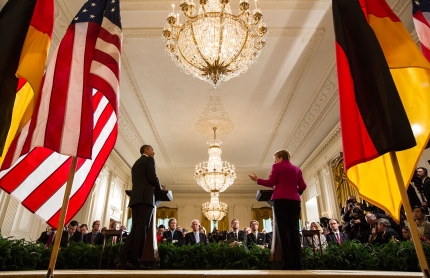
Remarks by President Obama and Chancellor Merkel in Joint Press Conference
East Room
12:04 P.M. EST
PRESIDENT OBAMA: Good morning, everybody. Please be seated. As always, it is a great pleasure to welcome my close friend and partner, Chancellor Angela Merkel, back to the White House. Angela, of course, has been here many times. But this visit is a chance for me to congratulate her on two achievements. Well into her third term, Angela is now one of Germany’s longest-serving chancellors. Perhaps more importantly, this is my first opportunity to publicly congratulate Angela and Germany on their fourth World Cup title. As we all saw in Rio, Angela is one of her team’s biggest fans. Our U.S. team, however, gets better each World Cup, so watch out in 2018. (Laughter.)
Germany is one of our strongest allies, so whenever we meet it’s an opportunity to coordinate closely on a whole range of issues critical to our shared security and prosperity. As Angela and our German friends prepare to host the G7 this spring, it’s also important for us to be able to coordinate on a set of shared goals.
And at our working lunch this afternoon, we’ll focus on what we can do to keep the economy growing and creating jobs. As strong supporters of the Transatlantic Trade and Investment Partnership, we agree that there needs to be meaningful progress this year toward an agreement that boosts our economies with strong protections for consumers and workers and the environment.
I look forward to hearing Angela’s assessment of how Europe and the IMF can work with the new Greek government to find a way that returns Greece to sustainable growth within the Eurozone, where growth is critical to both the United States and the global economy. And we’ll be discussing our work to get all major economies to take ambitious action on climate change, including our initiative to limit public financing for coal-fired power plants overseas and our global efforts to phase down some of the most dangerous greenhouse gases.
Our discussion this morning focused on global security issues. We reaffirmed our commitment to training Afghan security forces and supporting a sovereign, secure and united Afghanistan. We agree that the international community has to continue enforcing existing sanctions as part of our diplomatic effort to prevent Iran from obtaining a nuclear weapon, even as the P5-plus-1 works closely together to do everything we can to try to achieve a good, verifiable deal.
Two issues in particular that dominated our workday this morning -- Russia’s aggression against Ukraine and the international fight against ISIL.
With regard to Russia and the separatists it supports in Ukraine, it’s clear that they’ve violated just about every commitment they made in the Minsk agreement. Instead of withdrawing from eastern Ukraine, Russian forces continue to operate there, training separatists and helping to coordinate attacks. Instead of withdrawing its arms, Russia has sent in more tanks and armored personnel carriers and heavy artillery. With Russian support, the separatists have seized more territory and shelled civilian areas, destroyed villages and driven more Ukrainians from their homes. These are the facts.
But Russian aggression has only reinforced the unity of the United States and Germany and our allies and partners around the world. And I want to thank Angela for her strong leadership and partnership as we’ve met this challenge. Chancellor Merkel and Vice President Biden met with Ukrainian President Poroshenko in Munich over the weekend, and Angela also shared with me the results of her talks in Moscow. We continue to encourage a diplomatic resolution to this issue. And as diplomatic efforts continue this week, we are in absolute agreement that the 21st century cannot stand idle -- have us stand idle and simply allow the borders of Europe to be redrawn at the barrel of a gun.
So today we’ve agreed to move forward with our strategy. Along with our NATO allies, we’ll keep bolstering our presence in central and Eastern Europe -- part of our unwavering Article 5 obligation to our collective defense. We will continue to work with the IMF and other partners to provide Ukraine with critical financial support as it pursues economic and anti-corruption reforms. We discussed the issue of how best to assist Ukraine as it defends itself, and we agreed that sanctions on Russia need to remain fully in force until Russia complies fully with its obligations.
Even as we continue to work for a diplomatic solution, we are making it clear again today that if Russia continues on its current course -- which is ruining the Russian economy and hurting the Russian people, as well as having such a terrible effect on Ukraine -- Russia’s isolation will only worsen, both politically and economically.
With regard to ISIL, Germany and the United States remain united in our determination to destroy this barbaric organization. I thanked Angela for her strong support as a member of the international coalition that is working in Iraq. In a significant milestone in its foreign policy, Germany has taken the important step of equipping Kurdish forces in Iraq, and Germany is preparing to lead the training mission of local forces in Erbil. Germany is a close partner in combating the threat of foreign terrorist fighters, which was the focus of a special session of the U.N. Security Council that I chaired last fall. And under Angela’s leadership, Germany is moving ahead with new legislation to prevent fighters from traveling to and from Syria and Iraq.
At the same time, both Angela and I recognize that young people in both our countries, especially in Muslim communities, are being threatened and targeted for recruitment by terrorists like al Qaeda and ISIL. And protecting our young people from this hateful ideology, so that they’re not vulnerable to such recruitment, is, first and foremost, a task for local communities, families, neighbors, faith leaders who know their communities best. But we can help these communities, starting with the tone and the example that we set in our own countries.
So I want to commend Angela for her leadership, speaking out forcefully against xenophobia and prejudice and on behalf of pluralism and diversity. She’s made it clear that all religious communities have a place in Germany, just as they do here in the United States. And we’re grateful that our German friends will be joining us at our summit next week on countering violent extremism, because this is a challenge our countries have to meet together.
And let me end on an historic note. This year marks the 70th anniversary of the end of the Second World War. It marks the 25th anniversary of the reunification of Germany. So in a time when conflicts around the world sometimes seem intractable, when progress sometimes seems beyond grasp, Germany’s story gives us hope. We can end wars. Countries can rebuild. Adversaries can become allies. Walls can come down. Divisions can be healed. Germany’s story -- and the story of Angela’s life -- remind us that when free people stand united, our interests and our values will ultimately prevail.
And as we look to the future, as I prepare to visit Bavaria in June, I’m grateful for my partnership with Angela, as Americans are grateful for their partnership with the people of Germany.
Chancellor Merkel.
CHANCELLOR MERKEL: (As interpreted.) Thank you, President, dear Barack. I’m delighted to be back in Washington. Nine months ago, we were here for the last time, and this visit here has a lot to do with, first and foremost, the fact that we have assumed the presidency of the G7 presidency this year, and that we coordinate on these matters very closely, as we do on others. And obviously, we’ll address issues related to the global economy when we meet in Bavaria, in Schloss Elmau, in the summer.
From a European vantage point, I think we can say that we have made significant progress in a number of areas. We have countries who are now back on the growth path. Ireland comes to mind here in particular, but also Spain and Portugal. After a strong phase of structural reforms, they have now made significant progress. The new Commissioner that’s come in office has launched a growth program in which Germany will participate.
We will pin our hopes basically on growth and infrastructure, but also on other growth projects. For example, the digital economy. If I think of the state of the digital economy in the United States, there is a lot of things to be done by the Europeans now.
I would say that a free trade agreement, the conclusion of a free trade agreement, for example, would also go a long way towards boosting growth. We know that you are very much engaged in the Asia Pacific area -- there are a lot of free trade agreements there as well. And Germany will come out very forcefully in seeing that the negotiations between the EU and the United States on free trade agreements are pursued in a vigorous manner. It’s in our own vested interest -- in the interest of the United States but also in the German interest.
We are dealing basically in our G7 agenda with health issues. Let me just mention one -- what sort of lessons have we drawn, for example, from the terrible Ebola epidemic. I think the one thing that we’ve learned is that the international organizations, the international community has to be quicker in reacting to such epidemics. And the G7 can give a very important contribution to doing this.
And we’re also interested, for example, in seeing Gavi be successful. We’re delighted to be able to conclude the replenishment conference that has just been completed in Germany so successfully.
Then we dealt with security issues this morning. It is true Germany this year celebrates the 25th anniversary of its reunification. This would not have been possible, not have been achievable without our transatlantic partners, without the support of the United States of America. And we will always be grateful for this. And it is one case in point that it is well worth the effort to stand by one’s values for decades to pursue long-term goals and not relent in those efforts.
After we thought in the ‘90s maybe that things would turn out somewhat more easily, somewhat less complicated, now we see ourselves confronted with a whole wealth of conflicts, and very complex ones. We worked together in Afghanistan -- we talked about this as well. Germany has decided, in its fight against IS, to give help to deliver training missions, to deliver also weapons, and, if necessary. We work together on the Iran nuclear program, where we also enter into a crucial phase of negotiations.
One particular priority was given to the conflict between Ukraine and Russia this morning. We stand up for the same principles of inviolability of territorial integrity. For somebody who comes from Europe, I can only say if we give up this principle of territorial integrity of countries, then we will not be able to maintain the peaceful order of Europe that we’ve been able to achieve. This is not just any old point, it’s an essential, a crucial point, and we have to stand by it. And Russia has violated the territorial integrity of Ukraine in two respects: in Crimea, and also in Donetsk and Luhansk.
So we are called upon now to come up with solutions, but not in the sense of a mediator, but we also stand up for the interests of the European peaceful order. And this is what the French President and I have been trying to do over the past few days. We’re going to continue those efforts.
And I’m very grateful that throughout the Ukraine crisis, we have been in very, very close contact with the United States of America and Europe on sanctions, on diplomatic initiatives. And this is going to be continued. And I think that’s, indeed, one of the most important messages we can send to Russia, and need to send to Russia.
We continue to pursue a diplomatic solution, although we have suffered a lot of setbacks. These days we will see whether all sides are ready and willing to come to a negotiated settlement. I’ve always said I don’t see a military solution to this conflict, but we have to put all our efforts in bringing about a diplomatic solution.
So there’s a whole host of issues that we need to discuss. Over lunch, we will continue to talk about climate protection, about sustainable development and the sustainable development goals.
So yet again, thank you very much for the very close cooperation, very close coordination, and the possibility to have an exchange of views on all of these crucial issues. I think not only in hindsight can we safely say that the United States have always stood by us, have helped us to regain our unity in peace and freedom, but we can also say we continue to cooperate closely if it is about solving the conflicts of the world today. Unfortunately, there are many of them, and we will continue to do so in the future.
Thank you for your hospitality.
PRESIDENT OBAMA: First question, Steve Mufson, The Washington Post.
Q Thank you. You’ve said -- stressed that U.S. and Europe need to have cohesion on the issue of sanctions and on dealing with Ukraine, and yet the administration is discussing sending lethal weapons to Ukraine, which is very different from what the Chancellor has said over the weekend. So I was wondering whether this was a good cop-bad cop act, or is this a real reflection of difference of views in the situation on the ground.
And more broadly, if there’s no agreement this week, what lies ahead? Are we looking at a broader set of sanctions? What makes us think those set of sanction will change the Russian President’s mind any more than the current ones?
PRESIDENT OBAMA: Well, let me start with the broader point. I think both Angela and I have emphasized that the prospect for a military solution to this problem has always been low. Russia obviously has a extraordinarily powerful military. And given the length of the Russian border with Ukraine, given the history between Russia and Ukraine, expecting that if Russia is determined that Ukraine can fully rebuff a Russian army has always been unlikely.
But what we have said is that the international community, working together, can ratchet up the costs for the violation of the core principle of sovereignty and territorial integrity. And that’s exactly what we’ve done.
And Russia has paid a significant cost for its actions -- first in Crimea and now in eastern Ukraine. It has not yet dissuaded Mr. Putin from following the course that he is on, but it has created a measurable negative impact on the Russian economy, and that will continue.
My hope is that through these diplomatic efforts, those costs have become high enough that Mr. Putin’s preferred option is for a diplomatic resolution. And I won’t prejudge whether or not they’ll be successful. If they are successful, it will be in part because of the extraordinary patience and effort of Chancellor Merkel and her team. If they are not, then we will continue to raise those costs. And we will not relent in that. And one of the things I’ve very encouraged about is the degree to which we’ve been able to maintain U.S.-European unity on this issue.
Now, it is true that if, in fact, diplomacy fails, what I’ve asked my team to do is to look at all options -- what other means can we put in place to change Mr. Putin’s calculus -- and the possibility of lethal defensive weapons is one of those options that’s being examined. But I have not made a decision about that yet. I have consulted with not just Angela, but will be consulting with other allies about this issue. It’s not based on the idea that Ukraine could defeat a Russian army that was determined. It is rather to see whether or not there are additional things we can do to help Ukraine bolster its defenses in the face of separatist aggression. But I want to emphasize that a decision has not yet been made.
One of the bigger issues that we’re also concerned with, though, is making sure the Ukrainian economy is functioning and that President Poroshenko and Prime Minister Yatsenyuk can continue with the reform efforts that they’ve made. And I’m glad to see that because of our cooperation and our efforts, we’re starting to see a package come together with the IMF, with the European Union and others that can help bolster the European economy so that they have the space to continue to execute some of the reforms and anti-corruption measures that they’ve made.
One of the most important things we can do for Ukraine is help them succeed economically, because that's how people on the ground feels this change, this transformation, inside of Ukraine. If that experiment fails, then the larger project of an independent Ukraine will fail. And so we're going to do everything we can to help bolster that.
But there is no doubt that if, in fact, diplomacy fails this week, there’s going to continue to be a strong, unified response between the United States and Europe. That's not going to change. There may be some areas where there are tactical disagreements; there may not be. But the broad principle that we have to stand up for not just Ukraine, but the principle of territorial integrity and sovereignty, is one where we are completely unified.
CHANCELLOR MERKEL: (As interpreted.) The French President and I have decided to make one further attempt to make progress through diplomatic means. We have the Minsk agreement -- the Minsk agreement has never been implemented. Quite the contrary is true. The situation has actually worsened on the ground. So now there is a possibility to try and bring about a cease-fire and to also create conditions that are in place where you have not every day civilians dying, civilian victims that fall prey to this. And I’m absolutely confident that we will do this together.
I, myself, actually would not be able to live with not having made this attempt. So there is anything but an assured success in all of this -- I have to be very clear about this. But if at a certain point in time, one has to say that success is not possible even if one puts every effort into it, then the United States and Europe have to sit together and try and explore further possibilities of what one can do. Just let me point out here that foreign ministers of the European Union last week already tasked the Commission to think about further possible sanctions.
On the issue of what is effective and what not, I’m somewhat surprised sometimes. Just let me mention Iran. For a fairly long period of time we have had sanctions in place there; people don't seem to question them. And I think they have been fairly successful, if we look at the current state of affairs with the negotiations on the nuclear program. So I think, in parallel, I think it was a very good thing to put some costs onto the Russians through these sanctions that we agreed on because we see also that Russia seems to be influenced by this. And this is why I am a hundred percent behind these decisions.
As to the export of arms, I have given you my opinion. But you may rest assured that no matter what we decide, the alliance between the United States and Europe will continue to stand, will continue to be solid, even though on certain issues we may not always agree. But this partnership, be it Ukraine and Russia, be it on combating terrorism on the international state, be it on other issues, is a partnership that has stood the test of time and that is -- I mean, in Europe, we're very close. But this transatlantic partnership for Germany and for Europe is indispensable. And this will remain so. And I can say this also on behalf of my colleagues in the European Union.
Sorry, I have to call you myself. From DPA, the German Press Agency.
Q President, you said that you have not yet made a decision as to whether weapons ought to be delivered to Ukraine. What would be your red line? What would be the red line that needs to be crossed for you to decide an armament of the Ukrainian army? And what do you think -- will this hold by way of a promise? Because the Chancellor said it will make matters worse. And what can the Nobel Laureate Obama do more to defuse this conflict?
And, Madam Chancellor, President Putin today demanded yet again that the government in Kyiv negotiate directly with the separatists. When do you think the right moment has come to do this? And with looking at all of the big issues that you discussed, this breach of confidence due to the NSA affair, of the U.S.-German relations, has that played a role today?
PRESIDENT OBAMA: Do you want to go first on this?
CHANCELLOR MERKEL: (As interpreted.) I can gladly start.
The question as to how one assesses the effectiveness of certain measures has been actually dealt with. The President has not yet made a decision, as he said. What’s important for me is that we stand very closely together on the question of a renewed diplomatic effort. We keep each other informed. We’re in close touch. And nobody wishes more for a success than the two of us who stand here side by side.
But this would also mean not only having a cease-fire in place, but to also, over and above that, having certain rules in place. And you said the Russian President himself thinks there ought to be direct contacts. Let me just point out to you, these direct contacts already exist through the trilateral contact group with representatives from Donetsk and Luhansk. And the problem over the last few days, and the problem of the last meetings actually was rather more than that, there was not really that much of an end result -- if they matter at all, or if representatives from Donetsk and Luhansk were there at all. Sometimes they didn’t even arrive.
And this was, after all, for me, the core of the Minsk agreement, that there are local elections in accordance with the Ukrainian constitution and that the outcome of that is that you have representatives, authorities that can speak for those regions. And the Ukrainian President has paved the way for this, to giving certain specific status to the oblasts of Luhansk and Donetsk. And these elections are an essential point that will then enable us to say, well, maybe now there can be contacts even without a trilateral group.
And this is actually on the agenda of the many talks that we need to make. But I can very well understand the Ukrainian side, that the territory they consider to be part of their territory and that anything else would violate their territorial integrity, that they want to actually see that elections take place there. And that has also been stated by President Putin that he wishes to see those elections happening there.
Now, on the NSA issue. I think there are still different assessments on individual issues there, but if we look at the sheer dimension of the terrorist threat, we are more than aware of the fact that we need to work together very closely. And I, as German Chancellor, want to state here very clearly that the institutions of the United States of America have provided us and still continue to provide us with a lot of very significant, very important information that also ensure our security. And we don’t want to do without this. There are other possibilities, through the cyber dialogue, for example, to continue to talk about the sort of protection of privacy versus data protection and so on, and security. But this was basically -- combating terrorism was basically in the forefront today.
PRESIDENT OBAMA: On providing lethal weapons to Ukraine, it's important to point out that we have been providing assistance to the Ukrainian military generally. That’s been part of a longstanding relationship between NATO and Ukraine. And our goal has not been for Ukraine to be equipped to carry on offensive operations, but to simply defend itself. And President Poroshenko has been very clear -- he’s not interested in escalating violence, he is interested in having his country’s boundaries respected by its neighbor.
So there’s not going to be any specific point at which I say, ah, clearly lethal defensive weapons would be appropriate here. It is our ongoing analysis of what can we do to dissuade Russia from encroaching further and further on Ukrainian territory. Our hope is, is that that’s done through diplomatic means.
And I just want to emphasize here once again for the benefit not just of the American people but for the German people, we are not looking for Russia to fail. We are not looking for Russia to be surrounded and contained and weakened. Our preference is for a strong, prosperous, vibrant, confident Russia that can be a partner with us on a whole host of global challenges. And that’s how I operated throughout my first term in office.
Unfortunately, Russia has made a decision that I think is bad for them strategically, bad for Europe, bad for the world. And in the face of this aggression and these bad decisions, we can’t simply try to talk them out of it. We have to show them that the world is unified in imposing a cost for this aggression. And that’s what we’re going to continue to do.
With respect to the NSA, I’ll just make this point very briefly. There’s no doubt that the Snowden revelations damaged impressions of Germans with respect to the U.S. government and our intelligence cooperation. And what I have done over the last year, year and a half, is to systematically work through some of these issues to create greater transparency and to restore confidence not just for Germans but for our partners around the world.
And we’ve taken some unprecedented measures, for example, to ensure that our intelligence agencies treat non-U.S. citizens in ways that are consistent with due process and their privacy concerns -- something that I put in a presidential order, and has not been ever done not only by our intelligence agencies but I think by most intelligence agencies around the world.
There are going to still be areas where we’ve got to work through these issues. We have to internally work through some of these issues, because they’re complicated, they’re difficult. If we are trying to track a network that is planning to carry out attacks in New York or Berlin or Paris, and they are communicating primarily in cyberspace, and we have the capacity to stop an attack like that, but that requires us then being able to operate within that cyberspace, how do we make sure that we’re able to do that, carry out those functions, while still meeting our core principles of respecting the privacy of all our people?
And given Germany’s history, I recognize the sensitivities around this issue. What I would ask would be that the German people recognize that the United States has always been on the forefront of trying to promote civil liberties, that we have traditions of due process that we respect, that we have been a consistent partner of yours in the course of the last 70 years, and certainly the last 25 years, in reinforcing the values that we share. And so occasionally I would like the German people to give us the benefit of the doubt, given our history, as opposed to assuming the worst -- assuming that we have been consistently your strong partners and that we share a common set of values.
And if we have that fundamental, underlying trust, there are going to be times where there are disagreements, and both sides may make mistakes, and there are going to be irritants like there are between friends, but the underlying foundation for the relationship remains sound.
Christi Parsons.
Q Thank you, Mr. President. The Iran nuclear negotiators have now missed two deadlines. Should the upcoming March deadline for talks be the final one? And what are the circumstances in which you think it would be wise to extend those talks? Also, sir, some have suggested that you are outraged by the Israeli Prime Minister’s decision to address Congress. Is that so? And how would you advise Democrats who are considering a boycott?
PRESIDENT OBAMA: First of all, we understood I think from the start, when we set up the interim agreement with Iran, that it would take some time to work through incredibly complex issues and a huge trust deficit between the United States and Iran, and the world and Iran, when it comes to their nuclear program. So I think there was always the assumption that, although the interim agreement lasted a certain period of time, that we would probably need more time to move forward.
The good news is, is that there have been very serious discussions. That time has been well spent. During this period of time, issues have been clarified; gaps have been narrowed; the Iranians have abided by the agreement. So this is not a circumstance in which, by talking, they’ve been stalling and meanwhile advancing their program. To the contrary. What we know is the program has not only been frozen, but with respect to, for example, 20 percent enriched uranium, they’ve reversed it. And so we’re in a better position than we were before the interim program was set up.
Having said all that, the issues now are sufficiently narrowed and sufficiently clarified where we’re at point where they need to make a decision. We are presenting to them, in a unified fashion -- the P5-plus-1, supported by a coalition of countries around the world, are presenting to them a deal that allows them to have peaceful nuclear power but gives us the absolute assurance that is verifiable that they are not pursuing a nuclear weapon.
And if, in fact, what they claim in true -- which is they have no aspiration to get a nuclear weapon, that, in fact, according to their Supreme Leader, it would be contrary to their faith to obtain a nuclear weapon -- if that is true, there should be the possibility of getting a deal. They should be able to get to yes. But we don’t know if that’s going to happen. They have their hardliners; they have their politics.
And the point, I guess is, Christi, at this juncture, I don’t see a further extension being useful if they have not agreed to the basic formulation and the bottom line that the world requires to have confidence that they’re not pursuing a nuclear weapon.
Now, if a framework for a deal is done, if people have a clear sense of what is required and there’s some drafting and t’s to cross and i’s to dot, that’s a different issue. But my view -- and I’ve presented this to members of Congress -- is that we now know enough that the issues are no longer technical. The issues now are, does Iran have the political will and the desire to get a deal done?
And we could not be doing this were it not for the incredible cohesion and unity that’s been shown by Germany, by the other members of the P5-plus-1 -- which, I should acknowledge, includes Russia. I mean, this is an area where they’ve actually served a constructive role. And China has served a constructive role. And there has been no cracks in this on the P5-plus-1 side of the table. And I think that’s a testament to the degree to which we are acting reasonably in trying to actually solve a problem.
With respect to Prime Minister Netanyahu, as I’ve said before, I talk to him all the time, our teams constantly coordinate. We have a practice of not meeting with leaders right before their elections, two weeks before their elections. As much as I love Angela, if she was two weeks away from an election she probably would not have received an invitation to the White House -- (laughter) -- and I suspect she wouldn’t have asked for one. (Laughter.)
So this is just -- some of this just has to do with how we do business. And I think it’s important for us to maintain these protocols -- because the U.S.-Israeli relationship is not about a particular party. This isn’t a relationship founded on affinity between the Labor Party and the Democratic Party, or Likud and the Republican Party. This is the U.S.-Israeli relationship that extends beyond parties, and has to do with that unbreakable bond that we feel and our commitment to Israel’s security, and the shared values that we have.
And the way to preserve that is to make sure that it doesn’t get clouded with what could be perceived as partisan politics. Whether that’s accurate or not, that is a potential perception, and that’s something that we have to guard against.
Now, I don’t want to be coy. The Prime Minister and I have a very real difference around Iran, Iran sanctions. I have been very clear -- and Angela agrees with me, and David Cameron agrees with me, and the others who are a member of the negotiations agree -- that it does not make sense to sour the negotiations a month or two before they’re about to be completed. And we should play that out. If, in fact, we can get a deal, then we should embrace that. If we can’t get a deal, then we’ll have to make a set of decisions, and, as I’ve said to Congress, I’ll be the first one to work with them to apply even stronger measures against Iran.
But what’s the rush -- unless your view is that it’s not possible to get a deal with Iran and it shouldn’t even be tested? And that I cannot agree with because, as the President of the United States, I’m looking at what the options are if we don't get a diplomatic resolution. And those options are narrow and they're not attractive. And from the perspective of U.S. interests -- and I believe from the perspective of Israel’s interests, although I can't speak for, obviously, the Israeli government -- it is far better if we can get a diplomatic solution.
So there are real differences substantively, but that's separate and apart from the whole issue of Mr. Netanyahu coming to Washington. All right?
Q Ms. Merkel, you just said the question is what will be effective in the Ukrainian crisis. And diplomacy, as you said yourself, has not really made all that -- has not really brought about that much of a progress. Can you understand the impatience of the Americans when they say we ought to now deliver weapons? And what makes you feel confident that diplomacy will carry the day in the next few days and weeks?
And on Greece, obviously I also have to ask you, what is your comment on the most recent comments of the Greek Prime Minister who says let’s end those programs, and I’m going to stand by the promises I made during the election campaign? How do you envisage the further cooperation with the Greek government?
And to you, Mr. President, I address the question, there is quite a lot of pressure by members of your government who say weapons should be delivered to the Ukrainians. Now, you yourself have said you want to ratchet up the cost that Putin has to bear and then make him relent and give in maybe. And you said all options have to be on the table, so apparently also weapons. So what makes you so sure that these weapons will not only go into the hands of the regular Ukraine army, but will then also perhaps get into the hands of separatists or militias on the Ukrainian side, who are accused by Amnesty International and other NGOs of having violated human rights?
Thank you.
CHANCELLOR MERKEL: (As interpreted.) Whenever you have political conflict, such as the one that we have now between Russia and Ukraine, but also in many other conflicts around the world, it has always proved to be right to try again and again to solve such a conflict. We’ve spoken at some length about the Iranian conflict. Here, too, we are expected to try time and again. And there’s always a point where you say, well, all of the options are on the table, we’ve gone back and forth, but then one has to think again.
Looking just at the Middle East conflict, for example, how many people have tried to bring about a solution to this conflict? And I’ve welcomed it every time, and I’m going to participate and support it every time because I think every time it has been well worth the effort.
Now, when you have a situation now where every night you see people dying, you see civilian casualties, you see the dire conditions under which people live, it is incumbent upon us as politicians, we owe it to the people to explore every avenue until somebody gives in.
But we’ve grown up under conditions -- I have to point this again -- where we said nobody would have dreamt of German unity. The people who have said in West Germany, remember they said, well, should we keep citizenship of Germany for the GDR? They’ve been criticized by people as some who have revisionist ideas. And then think of President Reagan when he said, “Mr. Gorbachev, tear down this wall,” standing in front of the Brandenburg Gate. Many people said at the time, how can he possibly say that? But it was right.
We have no guarantee. I cannot give you a guarantee for the outcome of the Wednesday talks or for other talks. And maybe nothing will come out of it. But then we’re called upon again to think about a new possibility. And since we thought about every step of the way, will this be affective or not, we will continue to do so.
A lot of things have to be thought about, and I’m very glad that with the American President, I have always been able to put all of the cards on the table and discuss the pros and cons. In my speech in Munich, I gave you clearly where I stand. But we’ll continue to try it. I think that’s why we are politicians, that’s why we chose this profession. Others have to do other things -- researchers have to, all of the time, find new things to explore and we have to see that the well-being, the prosperity of our people is ensured. But we never have a guarantee that the policies we adopt will work, will have the effect -- oh, sorry, Greece. I almost forgot. Yes. On Wednesday, there’s going to be a Eurogroup meeting. And I think what counts is what Greece will put on the table at that Eurogroup meeting or perhaps a few days later.
The German policy, ever since 2010, has been aimed at Greece staying a member of the Eurozone. I’ve said this time and again. The basic rules have always been the same. You put in your own efforts, and on the other side, you’re being shown solidarity as a quid pro quo. The three institutions of the Troika -- the ECB, the European Union Commission, and the IMF -- have agreed on programs. These programs are the basis of any discussion we have. I’ve always said I will wait for Greece to come with a sustainable proposal and then we’ll talk about this.
PRESIDENT OBAMA: The point Angela made I think is right, which is we never have guarantees that any particular course of action works. As I’ve said before, by the time a decision reaches my desk, by definition, it’s a hard problem with no easy answers. Otherwise somebody else would have solved it and I would never even hear about it.
The issue that you raised about can we be certain that any lethal aid that we provide Ukraine is used properly, doesn’t fall into the wrong hands, does not lead to overaggressive actions that can’t be sustained by the Ukrainians, what kinds of reactions does it prompt not simply from the separatists but from the Russians -- those are all issues that have to be considered. The measure by which I make these decisions is, is it more likely to be effective than not? And that is what our deliberations will be about.
But what I do know is this -- that the United States and Europe have not stood idly by. We have made enormous efforts, enormous investments of dollars, of political capital, of diplomacy, in trying to resolve this situation. I think the Ukrainian people can feel confident that we have stood by them. People like Vice President Biden and Secretary of State Kerry have spent countless hours on this issue, as has Angela and her team on the German side. And just because we have not yet gotten the outcome that we want doesn’t mean that this pressure is not, over time, making a difference.
I think it’s fair to say that there are those inside of Russia who recognize this has been a disastrous course for the Russian economy. I think Mr. Putin is factoring that in. But, understandably, until the situation is entirely resolved, we’re going to have to keep on trying different things to see if we can get a better outcome.
What I do know is, is that we will not be able to succeed unless we maintain the strong transatlantic solidarity that’s been the hallmark of our national security throughout the last 70 years. And I’m confident that I’ve got a great partner in Angela in maintaining that.
Thank you very much, everybody.
END
12:53 P.M. EST