The JOBS Act: Encouraging Startups, Supporting Small Businesses

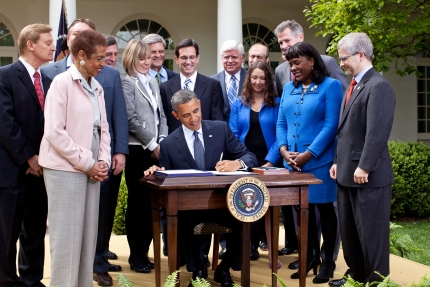
President Barack Obama signs the Jumpstart Our Business Startups (JOBS) Act

President Barack Obama signs the Jumpstart Our Business Startups (JOBS) Act, which includes key initiatives the President proposed last fall to help small businesses and startups grow and create jobs, in the Rose Garden of the White House, April 5, 2012. (Official White House Photo by Pete Souza)

Earlier this week, I was back in my home state of Iowa talking with tech entrepreneurs about the Administration’s progress leveraging technology to innovate with less, improve transparency and efficiency, and better serve the American people. As fellow tech junkies, we spent plenty of time talking about Government’s role in open data, application programming interfaces to Federal systems and more. But we also had a chance to talk more broadly about the vital role start-ups and small businesses play in strengthening our economy, creating jobs, and nurturing innovation. 

President Obama recognizes the critical role these types of high-growth startups and innovative entrepreneurs play in creating an economy that’s built to last. That’s why back in the fall – and again in his State of the Union Address – the President put forward a series of specific proposals to ease regulations that prevent aspiring entrepreneurs from accessing the capital they need to grow and create jobs. Today, the President put many of those proposals to work when he signed into law the Jumpstart Our Business Startups (JOBS) Act – a bipartisan bill that will help encourage startups and support our nation’s small businesses. 

As the President said at today’s signing, “this bill is a potential gamechanger” for America’s entrepreneurs. For the first time, Americans will be able to go online and invest in small businesses and entrepreneurs. Not only will this help small businesses and high-growth enterprises raise capital more efficiently, but it will also allow small and young firms to expand and hire faster.  

The White House

Office of the Press Secretary

Remarks by the President at JOBS Act Bill Signing

Rose Garden

2:36 P.M. EDT

THE PRESIDENT:  Thank you.  (Applause.)  Hello, everybody.  Please, please have a seat.  Good afternoon.  I want to thank all of you for coming, and in particular, I want to thank the members of Congress who are here today from both parties, whose leadership and hard work made this bill a reality.  

One of the great things about America is that we are a nation of doers -- not just talkers, but doers.  We think big.  We take risks.  And we believe that anyone with a solid plan and a willingness to work hard can turn even the most improbable idea into a successful business.  So ours is a legacy of Edisons and Graham Bells, Fords and Boeings, of Googles and of Twitters.  This is a country that’s always been on the cutting edge.  And the reason is that America has always had the most daring entrepreneurs in the world. 

Some of them are standing with me today.  When their ideas take root, we get inventions that can change the way we live.  And when their businesses take off, more people become employed because, overall, new businesses account for almost every new job that’s created in America.

Now, because we’re still recovering from one of the worst recessions in our history, the last few years have been pretty tough on entrepreneurs.  Credit has been tight.  And no matter how good their ideas are, if an entrepreneur can’t get a loan from a bank or backing from investors, it’s almost impossible to get their businesses off the ground.  And that’s why back in September, and again in my State of the Union, I called on Congress to remove a number of barriers that were preventing aspiring entrepreneurs from getting funding.  And this is one useful and important step along that journey.   

Here’s what’s going to happen because of this bill.  For business owners who want to take their companies to the next level, this bill will make it easier for you to go public.  And that’s a big deal because going public is a major step towards expanding and hiring more workers.  It’s a big deal for investors as well, because public companies operate with greater oversight and greater transparency. 

And for start-ups and small businesses, this bill is a potential game changer.  Right now, you can only turn to a limited group of investors -- including banks and wealthy individuals -- to get funding.  Laws that are nearly eight decades old make it impossible for others to invest.  But a lot has changed in 80 years, and it’s time our laws did as well.  Because of this bill, start-ups and small business will now have access to a big, new pool of potential investors -- namely, the American people.  For the first time, ordinary Americans will be able to go online and invest in entrepreneurs that they believe in.

Of course, to make sure Americans don’t get taken advantage of, the websites where folks will go to fund all these start-ups and small businesses will be subject to rigorous oversight.  The SEC is going to play an important role in implementing this bill.  And I’ve directed my administration to keep a close eye as this law goes into effect and to provide me with regular updates. 

It also means that, to all the members of Congress who are here today, I want to say publicly before I sign this bill, it's going to be important that we continue to make sure that the SEC is properly funded, just like all our other regulatory agencies, so that they can do the job and make sure that our investors get adequate protections.

This bill represents exactly the kind of bipartisan action we should be taking in Washington to help our economy.  I’ve always said that the true engine of job creation in this country is the private sector, not the government.  Our job is to help our companies grow and hire.  That’s why I pushed for this bill.  That’s why I know that the bipartisan group of legislators here pushed for this bill.  That's why I’ve cut taxes for small businesses over 17 times.  That’s why every day I’m fighting to make sure America is the best place on Earth to do business.

Our economy has begun to turn a corner, but we've still got a long way to go.  We've still got a lot of Americans out there who are looking for a job or looking for a job that pays better than the one that they've got.  And we're going to have to keep working together so that we can keep moving the economy forward. 
              
But I've never been more confident about our future.  And the reason is because of the American people.  Some of the folks beside me here today are a testimony to that.  Day after day, they’re out there pitching investors.  Some meetings go well; some meetings don't go so well.  That's true for me, too.  (Laughter.)  But no matter what, they keep at it.  And who knows, maybe one of them or one of the folks in the audience here today will be the next Bill Gates or Steve Jobs or Mark Zuckerberg.  And one of them may be the next entrepreneur to turn a big idea into an entire new industry.  That’s the promise of America.  That’s what this country is all about. 

So if these entrepreneurs are willing to keep giving their all, the least Washington can do is to help them succeed.  I plan to do that now by proudly signing this bill. 

Thank you very much, everybody.

(The bill is signed.)  (Applause.)

THE PRESIDENT:  All right, everybody.  Enjoy a great day.  (Applause.)

END             
2:44 P.M. EDT

President Obama on the Federal Taxpayer Receipt

April 05, 2012 | 1:07 | Public Domain

President Obama talks about the federal taxpayer receipt that his administration released to help the American people see exactly where their tax dollars are going. http//obamawhitehouse.archives.gov/taxreceipt

Download mp4 (32.2MB)

The White House

Office of the Press Secretary

President Obama To Sign Jumpstart Our Business Startups (JOBS) Act

Will Announce New Steps to Promote Access to Capital for Entrepreneurs and Protections for Investors

WASHINGTON, DC – Today President Obama will sign the Jumpstart Our Business Startups (JOBS) Act, a bipartisan bill that enacts many of the President’s proposals to encourage startups and support our nation’s small businesses. 

The President believes that our small businesses and startups are driving the recovery and job creation.  That’s why he put forward a number of specific ways to encourage small business and startup investment in the American Jobs Act last fall, and worked with members on both sides of the aisle to sign these common-sense measures into law today.   The JOBS Act will allow Main Street small businesses and high-growth enterprises to raise capital from investors more efficiently, allowing small and young firms across the country to grow and hire faster. 

“America’s high-growth entrepreneurs and small businesses play a vital role in creating jobs and growing the economy,” said President Obama.  “I’m pleased Congress took bipartisan action to pass this bill.  These proposals will help entrepreneurs raise the capital they need to put Americans back to work and create an economy that’s built to last.”

Throughout this effort, the President has maintained a strong focus on ensuring that we expand access to capital for young firms in a way that is consistent with sound investor protections. To that end, the President today will call on the Treasury, Small Business Administration and Department of Justice to closely monitor this legislation and report regularly to him with its findings. In addition, major crowfunding organizations sent a letter to the President today committing to core investor protections, including a new code of conduct for crowdfunding platforms.

In March of last year, the President directed his Administration to host a conference titled “Access to Capital: Fostering Growth and Innovation for Small Companies.”  The conference brought together policymakers and key stakeholders whose ideas directly led to many of the proposals contained in the JOBS Act. A primary takeaway from the conference was that capital from public and private investors helps entrepreneurs achieve their dreams and turn ideas into startups that create jobs and fuel sustainable economic growth. 

Key Elements of the JOBS Act

The JOBS Act includes all three of the capital formation priorities that the President first raised in his September 2011 address to a Joint Session of Congress, and outlined in more detail in his Startup America Legislative Agenda to Congress in January 2012: allowing “crowdfunding,” expanding “mini-public offerings,” and creating an “IPO on-ramp” consistent with investor protections. 

The JOBS Act is a product of bipartisan cooperation, with the President and Congress working together to promote American entrepreneurship and innovation while maintaining important protections for American investors.  It will help growing businesses access financing while maintaining investor protections, in several ways:

• Allowing Small Businesses to Harness “Crowdfunding”:  The Internet already has been a tool for fundraising from many thousands of donors.  Subject to rulemaking by the U.S. Securities and Exchange Commission (SEC), startups and small businesses will be allowed to raise up to $1 million annually from many small-dollar investors through web-based platforms, democratizing access to capital.  Because the Senate acted on a bipartisan amendment, the bill includes key investor protections the President called for, including a requirement that all crowdfunding must occur through platforms that are registered with a self-regulatory organization and regulated by the SEC.  In addition, investors’ annual combined investments in crowdfunded securities will be limited based on an income and net worth test.

• Expanding “Mini Public Offerings”:  Prior to this legislation, the existing “Regulation A” exemption from certain SEC requirements for small businesses seeking to raise less than $5 million in a public offering was seldom used.  The JOBS Act will raise this threshold to $50 million, streamlining the process for smaller innovative companies to raise capital consistent with investor protections.

• Creating an “IPO On-Ramp”:  The JOBS Act makes it easier for young, high-growth firms to go public by providing an incubator period for a new class of “Emerging Growth Companies.” During this period, qualifying companies will have time to reach compliance with certain public company disclosure and auditing requirements after their initial public offering (IPO).  Any firm that goes public already has up to two years after its IPO to comply with certain Sarbanes-Oxley auditing requirements.  The JOBS Act extends that period to a maximum of five years, or less if during the on-ramp period a company achieves $1 billion in gross revenue, $700 million in public float, or issues more than $1 billion in non-convertible debt in the previous three years.

Additionally, the JOBS Act changes some existing limitations on how companies can solicit private investments from “accredited investors,” tasks the SEC with ensuring that companies take reasonable steps to verify that such investors are accredited, and gives companies more flexibility to plan their access to public markets and incentivize employees.

Additional Initiatives Announced Today to Promote Capital Access and Investor Protection

• Monitoring of JOBS Act Implementation:  The President is directing the Treasury Department, Small Business Administration and Department of Justice to closely monitor the implementation of this legislation to ensure that it is achieving its goals of enhancing access capital while maintaining appropriate investor protections. These agencies, consulting closely with the SEC and key non-governmental stakeholders, will report their findings to the President on a biannual basis, and will include recommendations for additional necessary steps to ensure that the legislation achieves its goals.

• Crowdfunding Platforms Commit to Investor Protections:  In a letter to President Obama, a consortium of crowdfunding companies are committing to work with the SEC to develop appropriate regulation of the industry, as required by the JOBS Act.  Members of this leadership group are committing to establish core investor protections, including an enforceable code of conduct for crowdfunding platforms, standardized methods to ensure that investors do not exceed statutory limits, thorough vetting of companies raising funds through crowdfunding, and an industry standard “Investors’ Bill of Rights.”
President Obama Drops By Personal Finance Online Summit

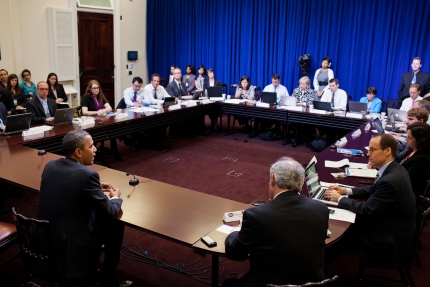
President Obama dropped by a meeting at the White House to speak with journalists and editors from a range of personal finance and financial news sites.

Before the President stopped by, senior White House officials discussed the Administration’s policies to address key issues, including rising gas prices, jobs, housing and the economy at large. And with tax day just around the corner, speakers highlighted the new federal taxpayer receipt on WhiteHouse.gov and discussed the importance of passing the Buffett Rule.

Participating officials included Alan Krueger, Chairman of the Council of Economic Advisers; Gene Sperling, Director of the National Economic Council; Jason Furman, Principal Deputy Director of the National Economic Council; Brian Deese, Deputy Director of the National Economic Council; and Heather Zichal, Deputy Assistant to the President for Energy and Climate Change. Additionally, Dan Pfeiffer, Director of Communications, Macon Phillips, Director of Digital Strategy, Sarah Bernard, Deputy Director of Digital Strategy, and Jon Carson, Director of the Office of Public Engagement, participated in a candid dialogue about online engagement and communications.

Obama at Personal Fiance Summit

President Barack Obama drops by the Personal Finance Online Summit and delivers remarks in the Eisenhower Executive Office Building. April 4, 2012. (Official White House Photo by Pete Souza)

The summit was part of an ongoing series aimed to reach out to online communities. The White House invited personal finance sites for the first time last year. Additional discussions have included African-American and Latino-focused online publishers, as well as editors of prominent women's sites

Thanks to everyone who took the time to attend the event:

Related Topics: Buffett Rule, Economy

A Passover Message from the Obama Family

Starting tomorrow night, the Jewish community in the United States, Israel, and throughout the world will come together to celebrate the holiday of Passover. 

President and Mrs. Obama will join them, continuing their tradition of hosting a small Seder at the White House. By now, the story of how that tradition began has been told and retold, but in the spirit of Passover, I’ll tell it again: In April of 2008, the President and his staff were on the trail in Pennsylvania in the midst of a long primary campaign. Weary from a long day of work and away from their families, a small group of staffers came together to hold an impromptu Seder. When then-Senator Obama got wind of the Seder, he gathered some other staff and friends and decided to join. At the end of the Seder, the President followed the traditional “Next year in Jerusalem” declaration with a pledge of his own – “Next year in the White House.” Each year since, he has followed through on that promise. This year, he also added a new touch, a video message to Jews everywhere wishing them Chag Sameach as they continue their own traditions or start new ones this Passover.

Here it is:

Watch and Engage: White House Forum on Women and the Economy

Today, more than ever before, women are a driving force behind the success of the American economy. Expanding economic opportunities for women and ending discriminatory practices is critical to building an economy that restores security for middle class families, one where hard work and responsibility are rewarded, and where everyone who wants to can find a good job.

This Friday, April 6th, the White House Council on Women and Girls is hosting a Forum on Women and the Economy. President Obama will deliver remarks at the Forum to highlight ways the Administration has helped create economic security for women and recognizes that women are key to economic growth and competitiveness. Starting at 8:30 a.m. EDT, the half-day forum will also include a panel discussion with Senior Administration officials, followed by breakout sessions on: Women at Work, Education, Health, Women’s Entrepreneurship, and Violence Against Women and Girls (check out the complete Forum schedule below).

People from across the country can watch the event live at www.wh.gov/live. During the Forum, Administration officials will answer questions from a live audience and also take questions submitted through a form on WhiteHouse.gov and via Twitter with the hashtag #WomenEconForum.

Here's how you can participate:

  • Right now, you can ask the White House your questions about women and the economy through a web form or on Twitter with the hashtag #WomenEconForum
  • On Friday, April 6th from 8:45 a.m. EDT to 12:30 p.m. EDT watch the forum live at wh.gov/live. President Obama will deliver remarks at 10:15 a.m. EDT.
  • Join the discussion live on Twitter and follow what others are saying with the hashtag #WomenEconForum
  • If you miss the live event, the full video will be posted on WhiteHouse.gov

We hope you can join us. Here's the full schedule:

The White House

Office of the Press Secretary

Readout of the President’s Call with Baylor University’s Women’s Basketball Coach Kim Mulkey

Today, President Obama called Coach Kim Mulkey to congratulate her and the Baylor University women’s basketball team on their historic 40-0 season and 2012 NCAA championship victory.  The President told Coach Mulkey that her team was a great pick as he had the Lady Bears picked to win the championship from the beginning of the tournament.  President Obama told Coach Mulkey that he looked forward to seeing her and the team at the White House later this year.

President Obama Signs the STOCK Act

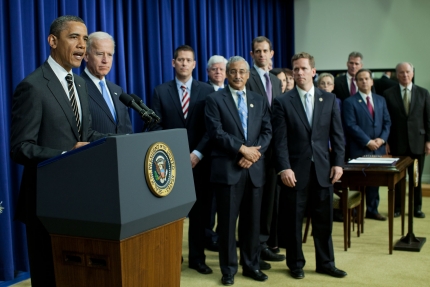
President Barack Obama delivers remarks prior to signing the STOCK Act (April 4, 2012)

President Barack Obama delivers remarks prior to signing the STOCK Act in the South Court Auditorium at the Eisenhower Executive Building (EEOB) of the White House, April 4, 2012. (Official White House Photo by Pete Souza)

Recently, President Obama has spent a lot of time talking about fairness.

As he says, "The powerful shouldn’t get to create one set of rules for themselves and another set of rules for everybody else."

That's why he stood before Congress during the State of the Union and asked lawmakers to pass the Stop Trading on Congressional Knowledge Act.

Today, in a ceremony at the White House, he signed their bill into law:

The STOCK Act makes it clear that if members of Congress use nonpublic information to gain an unfair advantage in the market, then they are breaking the law. It creates new disclosure requirements and new measures of accountability and transparency for thousands of federal employees. That is a good and necessary thing. We were sent here to serve the American people and look out for their interests -- not to look out for our own interests.

But the President also said that no one's work is done:

There’s obviously more that we can do to close the deficit of trust and limit the corrosive influence of money in politics. We should limit any elected official from owning stocks in industries that they have the power to impact.  We should make sure people who bundle campaign contributions for Congress can’t lobby Congress, and vice versa. These are ideas that should garner bipartisan support. They certainly have wide support outside of Washington. And it’s my hope that we can build off today’s bipartisan effort to get them done.

Read the full remarks here.


Related Topics: Ethics

Easter Prayer Breakfast at the White House

President Barack Obama delivers remarks before the Easter Prayer Breakfast (April 4, 2012)

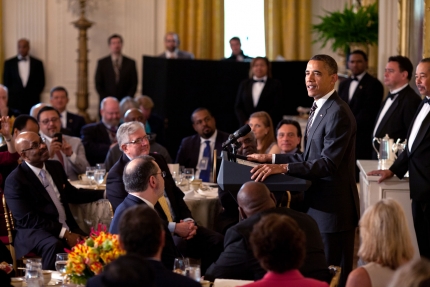
President Barack Obama delivers remarks before the Easter Prayer Breakfast, in the East Room of the White House, April 4, 2012. (Official White House Photo by Pete Souza)

To mark Easter, President Obama this morning hosted a prayer breakfast at the White House.

In his remarks, he talked about how the holiday is an opportunity for Christians to remember that Jesus was a human being -- with doubts and fears:

In the garden of Gethsemane, with attackers closing in around him, Jesus told His disciples, “My soul is overwhelmed with sorrow to the point of death.” He fell to his knees, pleading with His Father, saying, “If it is possible, may this cup be taken from me.” And yet, in the end, He confronted His fear with words of humble surrender, saying, “If it is not possible for this cup to be taken away unless I drink it, may your will be done.”

So it is only because Jesus conquered His own anguish, conquered His fear, that we’re able to celebrate the resurrection. It’s only because He endured unimaginable pain that wracked His body and bore the sins of the world that He burdened -- that burdened His soul that we are able to proclaim, “He is Risen!”

This is President Obama's third annual Easter Prayer Breakfast. Read the full remarks from today's event here.