The White House

Office of the Press Secretary

President Obama Announces More Key Administration Posts

WASHINGTON, DC – Today, President Barack Obama announced his intent to nominate the following individuals to key Administration posts:

·         Kevin F. O’Malley – Ambassador to Ireland, Department of State

·         Jessie H. Roberson – Member, Defense Nuclear Facilities Safety Board, and upon appointment to be designated Vice Chair

·         Daniel J. Santos – Member, Defense Nuclear Facilities Safety Board

President Obama said, “I am proud to nominate such impressive men and women to these important roles, and I am grateful they have agreed to lend their considerable talents to this Administration. I look forward to working with them in the months and years ahead.”

President Obama announced his intent to nominate the following individuals to key Administration posts:

Kevin F. O’Malley, Nominee for Ambassador to Ireland, Department of State

Kevin F. O’Malley is an officer in the Litigation Department at Greensfelder, Hemker and Gale in St. Louis, Missouri and has been a practicing trial lawyer for over 35 years.  Mr. O’Malley has been an adjunct professor at Washington University School of Law since 2013, and taught at St. Louis University School of Law from 1979 to 1985.  He served as an Assistant U.S. Attorney in St. Louis from 1979 to 1983 and was a Special Attorney in the Organized Crime and Racketeering Section of the Department of Justice from 1974 to 1979.  In 2009, Missouri Governor Jay Nixon appointed Mr. O’Malley to the Missouri Board of Healing Arts.  Mr. O'Malley served as a legal instructor for the American Bar Association's Central and East European Law Initiative in Moscow in 1996 and Warsaw in 1999.  He received an A.B. and a J.D. from Saint Louis University.

Jessie H. Roberson, Nominee for Member, Defense Nuclear Facilities Safety Board, and upon appointment to be designated Vice Chair

Jessie H. Roberson is currently Vice Chair and Member of the Defense Nuclear Facilities Safety Board (DNFSB), positions she has held since 2010. In 2007, Ms. Roberson was the Senior Vice President for Environmental Affairs at Atlantic Sea Harbor Group/Safe Harbor Energy. From 2006 to 2007, Ms. Roberson served as the Director of the Nuclear Services Division at CH2M Hill. She was the Director of Nuclear Regulatory Programs at Exelon Corporation from 2004 to 2006. From 2001 to 2004, Ms. Roberson served at the Department of Energy as Assistant Secretary for the Environmental Management Program. She was a member of the DNFSB from 2000 to 2001. From 1994 to 2000, Ms. Roberson served as a Site Manager for the Rocky Flats Environmental Technology Site. She was a Waste Management and Environmental Deputy Assistant Manager for the Department of Energy from 1989 to 1994. Ms. Roberson worked for Georgia Power Company as a Senior Systems Electrical Engineer from 1987 to 1989. She was also a Nuclear Operations Manager at the Savannah River Plant for E.I. DuPont from 1981 to 1987. Ms. Roberson received a B.S. from the University of Tennessee.

Daniel J. Santos, Nominee for Member, Defense Nuclear Facilities Safety Board

Daniel J. Santos is currently Senior Technical Advisor at the Nuclear Regulatory Commission (NRC), a position he has held since 2007. Since 2011, Mr. Santos has served at the NRC as the Chairman of the Multinational Design Evaluation Program in the Digital Instrumentation and Controls Group. Prior to joining the NRC, Mr. Santos served in a number of positions at the Naval Nuclear Propulsion Headquarters in the Instrumentation and Control Division from 1997 to 2007, including Deputy Manager from 2004 to 2007 and Senior Engineer from 2002 to 2004. He began his career as an Officer in the United States Navy in 1997. Mr. Santos received a B.S. from the University of Puerto Rico, an M.S. from the Naval Postgraduate School, and an M.B.A. from the University of Maryland.

Announcing the President's First-Ever Tumblr Q&A

Update: This live event has concluded. Watch the full Tumblr Q&A here.

We’re excited to announce that on Tuesday, June 10, at 4:00pm ET President Obama will take to Tumblr to answer your questions about education, college affordability, and reducing student loan debt.

Getting a higher education is the single-most important investment students can make in their own futures. At the same time, it’s never been more expensive. That’s why since taking office, the President has made historic investments to make college more affordable – and it's why he's inviting you to join a conversation about the issue. Starting today, you can submit questions for the President at ObamaIRL.tumblr.com.

The White House

Office of the Press Secretary

Remarks by Secretary of Education Arne Duncan and Dr. Biden

Roosevelt Room
 
11:07 A.M. EDT
     
SECRETARY DUNCAN:  We just appreciate you folks making an effort.  It’s a really interesting group of people; different backgrounds, different experiences, but with a sort of shared passion to figure out what we as a country can do to make college both more accessible and more affordable.  
     
And what you all recognize is that going to college has never been more important than it is today; unfortunately, it’s also never been more expensive.  And somehow we have to find ways to reduce that.  And we’re working on lots of stuff, as are many of you, and give you -- have you give us your best thinking -- obviously, if you tell us what we need to hear, not what we want to hear.  And the President, the Vice President, the First Lady, Dr. Biden, this is one where -- the highest levels of the White House.  It’s this huge passion and commitment.  
 
As Dr. Biden said, she has been teaching for a couple of decades now.  That’s where her heart is.  (Laughter.)  That’s where her passion is.  She hasn’t taken the easiest of jobs.  She’s taught in therapeutic situations, she’s taught in prisons, she teaches at a community college.  This is her passion.  This is her life’s work.  As I always say, she could be spending all her time at fancy parties and fancy lunches, and she teaches students every single day.
 
So we’re so lucky to have someone of her passion and commitment work on this every single day.  I’ll turn it over to her then we’ll go to Dexter, and we’ll just sort of open it up and get folks thinking.
 
Dr. Biden.
     
DR. BIDEN:  Thanks.  I leave all the fancy parties to Arne.  (Laughter.)  
     
SECRETARY DUNCAN:  I wish.  I wish.  (Laughter.)
    
DR. BIDEN:  Well, hello, everyone.  And it’s my pleasure to welcome everybody here to the White House.  And as a lifelong educator -- I like that a little better.  (Laughter.)
     
SECRETARY DUNCAN:  I’ll work it out.  I owe you one.  (Laughter.) 
     
DR. BIDEN:  Anyway, I’ve seen firsthand the power, really, of college education, and -- as well as many barriers to success, as Arne talked about.  And as I said, I teach full time at a community college in Northern Virginia.  And really, my students are juggling a lot.  They’re working full time, and balancing family and community obligations, along with taking classes.  But I see over and over, they are so committed to furthering their education because they know it’s the way to a better life for themselves and for their families.
     
And that’s why college affordability is so critical.  And we need to make sure that there’s an affordable path to higher education for all, and not just a luxury for a few.  And that’s why affordable student loans are essential.
    
And over the past three decades, the average tuition at a public four-year college has more than tripled.  The average undergraduate student who borrows for college graduates with almost $30,000 of debt.  So we all agree -- all of us -- that we need to do more.  And I’m proud to be part of an administration that has made college affordability a priority, reforming the student loan system and doubling the Pell grants. 
 
But we all know that we need to do more to make college affordable, and that’s why I’m so pleased to announce that the Senate Democrats are working on a proposal that would help more young people afford to repay college debt.  We will also hear from -- this issue from the President on Monday.  
    
So together, we can do more to lift this burden off our students.  I thank you all for being here, and I really look forward to hearing your stories.
                             
END
 

The White House

Office of the Press Secretary

Op-Ed by President Obama in Indian Country Today

This morning, in an op-ed published in Indian Country Today, President Obama announced his upcoming travel to Cannonball N.D. to visit the Standing Rock Sioux Tribe on Friday, June 13. The President will be accompanied by the First Lady in his first visit to Indian Country since taking office.

The following op-ed by President Obama appeared this morning in Indian Country Today:
https://indiancountrytodaymedianetwork.com/2014/06/05/my-upcoming-trip-i...

Six years ago, I made my first trip to Indian Country. I visited the Crow Nation in Montana – an experience I’ll never forget. I left with a new Crow name, an adoptive Crow family, and an even stronger commitment to build a future that honors old traditions and welcomes every Native American into the American Dream.

Next week, I’ll return to Indian Country, when Michelle and I visit the Standing Rock Sioux Tribe in Cannonball, N.D. We’re eager to visit this reservation, which holds a special place in American history as the home of Chief Sitting Bull. And while we’re there, I’ll announce the next steps my Administration will take to support jobs, education, and self-determination in Indian Country.

As President, I’ve worked closely with tribal leaders, and I’ve benefited greatly from their knowledge and guidance. That’s why I created the White House Council on Native American Affairs – to make sure that kind of partnership is happening across the federal government. And every year, I host the White House Tribal Nations Conference, where leaders from every federally recognized tribe are invited to meet with members of my Administration. Today, honoring the nation-to-nation relationship with Indian Country isn’t the exception; it’s the rule. And we have a lot to show for it.

Together, we’ve strengthened justice and tribal sovereignty. We reauthorized the Violence Against Women Act, giving tribes the power to prosecute people who commit domestic violence in Indian Country, whether they’re Native American or not. I signed the Tribal Law and Order Act, which strengthened the power of tribal courts to hand down appropriate criminal sentences. And I signed changes to the Stafford Act to let tribes directly request disaster assistance, because when disasters strike, you shouldn’t have to wait for a middleman to get the help you need.

Together, we’ve resolved longstanding disputes. We settled a discrimination suit by Native American farmers and ranchers, and we’ve taken steps to make sure that all federal farm loan programs are fair to Native Americans from now on. And I signed into law the Claims Resolution Act, which included the historic Cobell settlement, making right years of neglect by the Department of the Interior and leading to the establishment of the Land Buy-Back Program to consolidate Indian lands and restore them to tribal trust lands.

Together, we’ve increased Native Americans’ access to quality, affordable health care. One of the reasons I fought so hard to pass the Affordable Care Act is that it permanently reauthorized the Indian Health Care Improvement Act, which provides care to many in tribal communities. And under the Affordable Care Act, Native Americans across the country now have access to comprehensive, affordable coverage, some for the first time.

Together, we’ve worked to expand opportunity. My Administration has built roads and high-speed internet to connect tribal communities to the broader economy. We’ve made major investments in job training and tribal colleges and universities. We’ve tripled oil and gas revenues on tribal lands, creating jobs and helping the United States become more energy independent. And we’re working with tribes to get more renewable energy projects up and running, so tribal lands can be a source of renewable energy and the good local jobs that come with it.

We can be proud of the progress we’ve made together. But we need to do more, especially on jobs and education. Native Americans face poverty rates far higher than the national average – nearly 60 percent in some places. And the dropout rate of Native American students is nearly twice the national rate. These numbers are a moral call to action. As long as I have the honor of serving as President, I’ll do everything I can to answer that call.

That’s what my trip next week is all about. I’m going to hear from as many people as possible – ranging from young people to tribal leaders – about the successes and challenges they face every day. And I’ll announce new initiatives to expand opportunity in Indian country by growing tribal economies and improving Indian education.

As I’ve said before, the history of the United States and tribal nations is filled with broken promises. But I believe that during my Administration, we’ve turned a corner together. We’re writing a new chapter in our history – one in which agreements are upheld, tribal sovereignty is respected, and every American Indian and Alaskan Native who works hard has the chance to get ahead. That’s the promise of the American Dream. And that’s what I’m working for every day – in every village, every city, every reservation – for every single American.

The White House

Office of the Press Secretary

The Brussels G-7 Summit Declaration

Brussels, Belgium
June 5, 2014

1.       We, the Leaders of Canada, France, Germany, Italy, Japan, the United Kingdom, the United States, the President of the European Council and the President of the European Commission, met in Brussels on 4 and 5 June 2014. This Group came together because of shared beliefs and shared responsibilities. We are profoundly committed to the values of freedom and democracy, and their universality and to fostering peace and security. We believe in open economies, open societies and open governments, including respect for human rights and the rule of law, as the basis for lasting growth and stability.  For nearly forty years, we have shown through our actions that collective will can be a powerful catalyst for progress. Our efforts to address major global challenges have also been guided by a commitment to transparency, accountability and partnership with other concerned members of the international community. We remain bound together as a group by these values and this vision. Guided by these shared values and principles, we will continue to work together to meet the challenges of our times. We thank the European Union for hosting this Summit and welcome Germany’s Presidency.

Global Economy

2.       Supporting growth and jobs remains our top priority. The global economy has strengthened since we met at Lough Erne, downside risks remain which will need to be managed carefully. Advanced economies are recovering, but continued and sustained growth is needed to bring down unemployment, particularly among young people and the long-term unemployed.

3.       We will take further steps to support strong, sustainable and balanced growth, with a common goal of increasing the resilience of our economies. We will present ambitious and comprehensive growth strategies at the G-20 Summit in Brisbane, to include action across a broad front including in the areas of investment, small and medium enterprises, employment and participation of women, and trade and innovation, in addition to macroeconomic policies. We will continue to implement our fiscal strategies flexibly to take into account near-term economic conditions, so as to support economic growth and job creation, while putting debt as a share of GDP on a sustainable path.

4.       We agreed that 2014 will be the year in which we focus on substantially completing key aspects of the core financial reforms that we undertook in response to the global financial crisis: building resilient financial institutions; ending too-big-to-fail; addressing shadow banking risks; and making derivatives markets safer. We remain committed to the agreed G-20 roadmap for work on relevant shadow banking activities with clear deadlines and actions to progress rapidly towards strengthened and comprehensive oversight and regulation appropriate to the systemic risks posed. We will remain vigilant in the face of global risk and vulnerabilities. And we remain committed to tackling tax avoidance including through the G-20/Organisation of Economic Cooperation and Development (OECD) Base Erosion and Profit Shifting Action Plan as set out in the agreed timetable, and tax evasion, where we look forward to the rapid implementation of the new single global standard for automatic exchange of tax information. We call on all jurisdictions to take similar action.

5.       Trade and investment are key engines for jobs and growth. We reaffirm our commitment to keep our markets open and to fight all forms of protectionism including through standstill and rollback. We are committed to strengthening the rules-based multilateral trading system. We will protect and promote investment and maintain a level playing field for all investors. International standards for public export finance are crucial for avoiding or reducing distortions in global trade. Since we met at Lough Erne, we have made substantial progress on major trade negotiations: Canada-EU; Japan-EU; Canada-Japan; EU-US; the Trans-Pacific Partnership; and the Trade in Services Agreement. We aim to finalise them as soon as possible. We are committed to liberalising trade in environmental goods and services, including through an Environmental Goods agreement. We will work to conclude an expanded Information Technology Agreement as soon as possible. These agreements and initiatives can help support and will be consistent with the multilateral trading system and act as building blocks for future multilateral deals. We welcome the successful outcomes of the 9th World Trade Organisation (WTO) Ministerial Conference.  We will prioritise full and swift implementation of the Bali Package, in particular the Trade Facilitation Agreement. We will continue to provide, within our current Aid for Trade commitments, substantial support and capacity building to help implement this agreement, in particular to the benefit of the Least Developed Countries. We fully support efforts in the WTO to secure swift agreement to a balanced work programme for completing the Doha Round.

Energy

6.       The use of energy supplies as a means of political coercion or as a threat to security is unacceptable. The crisis in Ukraine makes plain that energy security must be at the centre of our collective agenda and requires a step change to our approach to diversifying energy supplies and modernising our energy infrastructure. Under the Rome G-7 Energy Initiative, we will identify and implement concrete domestic policies by each of our governments separately and together, to build a more competitive, diversified, resilient and low-carbon energy system.  This work will be based on the core principles agreed by our Ministers of Energy on May 5-6 2014, in Rome:

  • Development of flexible, transparent and competitive energy markets, including gas markets.
  • Diversification of energy fuels, sources and routes, and encouragement of indigenous sources of energy supply.
  • Reducing our greenhouse gas emissions, and accelerating the transition to a low carbon economy as a key contribution to sustainable energy security.
  • Enhancing energy efficiency in demand and supply, and demand response management.
  • Promoting deployment of clean and sustainable energy technologies and continued investment in research and innovation.
  • Improving energy systems resilience by promoting infrastructure modernization and supply and demand policies that help withstand systemic shocks.
  • Putting in place emergency response systems, including reserves and fuel substitution for importing countries, in case of major energy disruptions.

7.       Based on these principles we will take the following immediate actions:

  • We will complement the efforts of the European Commission to develop emergency energy plans for winter 2014-2015 at a regional level.
  • Working with international organisations such as the International Energy Agency  (IEA), the International Renewable Energy Agency, and the international financial institutions, we will supply technical assistance, including leveraging the private sector, and facilitate exchanges with Ukraine and other European countries seeking to develop indigenous hydrocarbon resources and renewable energies, as well as to improve energy efficiency.
  • We will conduct assessments of our energy security resilience and enhance our joint efforts, including on critical infrastructure, transit routes, supply chains and transport.
  • We will ask the IEA, in close cooperation with the European Commission, to present by the end of 2014 options for individual and collective actions of the G-7 in the field of gas security.

8.       We will also:

  • Promote the use of low carbon technologies (renewable energies, nuclear in the countries which opt to use it, and carbon capture and storage) including those which work as a base load energy source; and
  • Promote a more integrated Liquefied Natural Gas (LNG) market, including through new supplies, the development of transport infrastructures, storage capabilities, and LNG terminals, and further promotion of flexible gas markets, including relaxation of destination clauses and producer-consumer dialogue.

9.       We ask our Energy Ministers to take forward this Rome G-7 Energy Initiative and report back to us in 2015.

Climate Change

10.      Urgent and concrete action is needed to address climate change, as set out in the Intergovernmental Panel on Climate Change’s Fifth Assessment Report. We therefore remain committed to low-carbon economies with a view to doing our part to limit effectively the increase in global temperature below 2°C above pre-industrial levels. We affirm our strong determination to adopt in 2015 a global agreement – a new protocol, another legal instrument or an agreed outcome with legal force under the convention applicable to all parties - that is ambitious, inclusive and reflects changing global circumstances. We will communicate our intended nationally determined contributions well in advance of the 21st session of the Conference of the Parties (COP21) in Paris (by the first quarter of 2015 by those Parties ready to do so) and call on others to follow our lead. We welcome the Climate Summit of the United Nations Secretary General in September and his invitation to all Parties to prepare for ambitious contributions and to deliver concrete action to reduce emissions and strengthen resilience. We look forward to a successful Summit.

11.      We reaffirm our support for the Copenhagen Accord commitments to mobilise USD 100 billion per year by 2020 from a wide variety of sources, both public and private, to address the climate mitigation and adaptation needs of developing countries in the context of their meaningful and transparent mitigation actions. We welcome the adoption of the Green Climate Fund’s operating rules and the decision to commence its initial resource mobilisation in the coming months.  We remain committed to the elimination of inefficient fossil fuel subsidies and continued discussions in the OECD on how export credits can contribute to our common goal to address climate change. We will strengthen efforts to improve measurement, reporting, verification and accounting of emissions and improve the reporting of international climate finance flows, consistent with agreed decisions of the United Nations Framework Convention on Climate Change.  We will work together and with others to phase down the production and consumption of hydrofluorocarbons (HFC) under the Montreal Protocol. We will also continue to take action to promote the rapid deployment of climate-friendly and safe alternatives in motor vehicle air-conditioning and we will promote public procurement of climate-friendly HFC alternatives.

Development

12.      The pursuit of sustainable and inclusive development and greater prosperity in all countries remains a foundational commitment that unites our people and our countries. We continue to implement the commitments we have made at previous Summits. To be accountable we will provide a report in 2015 on progress toward their attainment.

13.      We commit to work with all partners to agree an ambitious and universal post-2015 agenda, anchored in a single set of clear and measurable goals. That agenda should complete unfinished business of the Millennium Development Goals. It should be centred on people and focused both on the eradication of extreme poverty, promoting development and on balancing the environmental, economic and social dimensions of sustainable development, including climate change. It should also promote peace and security, democratic governance, the rule of law, gender equality and human rights for all. We are committed to build a global partnership with shared responsibility and mutual accountability to ensure its implementation. We await the synthesis report of the United Nations Secretary General in the second half of 2014. We welcome the African Union’s common position.

14.      We will continue to promote inclusive and resilient growth in Africa, working with governments and citizens in Africa to enhance governance and transparency, improve infrastructure, notably in the energy sector, eliminate trade barriers, facilitate trade and investment, and strengthen the responsible and sustainable management of natural resources and the revenues they generate. We welcome the active role of the African Union and the New Partnership for Africa’s Development in the process of reforming the Africa Partnership Forum.

15.      Security and development are the prerequisite of a lasting peace in regions affected by the scourge of war, terrorism, organized crime, corruption, instability and poverty, notably the Sahel region, Somalia, Nigeria, South Sudan and Central African Republic. We welcome efforts by African partners and the African Union, supported by the international community, aimed at building their capacities to respond to crises and support stabilisation.

16.      We confirm our strong commitment to the Deauville Partnership and our support to Arab countries in transition in their efforts to improve governance and stimulate inclusive growth and job creation, particularly for their youth and women. Our Foreign and Finance Ministers will meet in the margins of United Nations General Assembly, and the International Monetary Fund/World Bank Annual Meetings, to take forward the Partnership.

17.      We remain committed to work towards common global standards that raise extractives transparency, which ensure disclosure of companies’ payments to all governments.  We welcome the progress made among G-7 members to implement quickly such standards. These global standards should continue to move towards project-level reporting. Those governments that are signing up to the Extractive Industries Transparency Initiative standard will voluntarily report their revenues. We confirm our commitment to implement fully the extractive partnerships launched in 2013.

18.      We today announce a new initiative on Strengthening Assistance for Complex Contract Negotiations (CONNEX) to provide developing country partners with extended and concrete expertise for negotiating complex commercial contracts, focusing initially on the extractives sector, and working with existing fora and facilities to avoid duplication, to be launched in New York in June and to deliver improvements by our next meeting, including as a first step a central resource hub that brings together information and guidance.

19.      We will continue to work to tackle tax evasion and illicit flows of finance, including by supporting developing countries to strengthen their tax base and help create stable and sustainable states. We renew our commitment to deny safe haven to the proceeds of corruption, and to the recovery and return of stolen assets. We remain committed to prevent the misuse of companies and other legal arrangements such as trusts to hide financial flows stemming from corruption, tax evasion, money laundering, and other crimes, ensuring that beneficial ownership information is available in a timely fashion to financial intelligence units, tax collection and law enforcement agencies, for example through central registries or other appropriate mechanisms, leading by example in implementing the Financial Action Task Force and other relevant international standards and our national action plans in line with the principles we agreed at Lough Erne. Greater transparency in this area will help developing countries.

20.      Recent events illustrate that corruption undermines trust in governments and limits economic growth. We will build on existing efforts, including in the G-20, to take additional steps to prevent this. We continue our engagement to and support of United Nations Office on Drugs and Crime and the World Bank's Stolen Asset Recovery Initiative. We welcome the outcomes of the Ukraine Forum on Asset Recovery and look forward to the third Arab Forum on Asset Recovery. The G-7 remains committed to working with governments and global financial centres to follow up on asset recovery efforts.

21.      We remain committed to the Muskoka Initiative on maternal, newborn and child health, and welcome the call made at the Saving Every Woman, Every Child Summit in Toronto to accelerate progress on this global priority. In addition we are committed to ensuring sexual and reproductive health and reproductive rights, and ending child, early and forced marriage and female genital mutilation and other harmful practices. The health and well-being of women and children are improved through ensuring universal access to affordable, quality, essential health services, strengthening health, education and child protection systems and improving nutrition and access to immunisation. We recognise the impact of the GAVI Alliance (Global Alliance for Vaccines and Immunisation) and welcome its efforts to expand access to vaccines to an additional 300 million children during 2016-2020. We welcome Germany’s offer to host the second replenishment in early 2015, reaffirm our commitment, and call on other public and private donors to contribute to the replenishment of the GAVI Alliance. We reaffirm our commitment to an AIDS free generation and to the Global Fund to fight AIDS, Tuberculosis and Malaria to reduce the burden of these three major infectious diseases on eligible countries and regions.

22.      To address the threat posed by infectious diseases, we support the Global Health Security Agenda and commit to working with partner countries to strengthen compliance with the World Health Organisation’s (WHO) International Health Regulations and enhance health security around the world.  We commit to working across sectors to prevent, detect and respond to infectious diseases, whether naturally occurring, accidental, or the result of a deliberate act by a state or non-state actor. That includes building global capacity so that we are better prepared for threats such as the recent Ebola outbreak in West Africa and working together, in close cooperation with WHO, to develop a Global Action Plan on antimicrobial resistance.

23.      We continue to strongly support comprehensive approaches to achieve global food security and nutrition. We look forward to the second International Conference on Nutrition in November 2014 and the Expo Milan 2015, which will provide a platform for the global post-2015 debate on sustainability and food and nutrition security. We continue to support the New Alliance for Food Security and Nutrition under strong African leadership and the successful completion of principles for responsible agricultural investment by the Committee on World Food Security. These will better enable smallholder farmers, especially women, to benefit from sustainable rural development. We continue to support the consistent implementation of the Voluntary Guidelines on Responsible Governance of Tenure of Land, Fisheries and Forests, including by building on the land partnerships we launched in 2013 and the Global Agriculture and Food Security Programme.

Ukraine

24.   We welcome the successful conduct under difficult circumstances of the election in Ukraine on 25 May. The strong voter turnout underlined the determination of Ukraine’s citizens to determine the future of their country.  We welcome Petro Poroshenko as the President-elect of Ukraine and commend him for reaching out to all the people of Ukraine.

25.   In the face of unacceptable interference in Ukraine’s sovereign affairs by the Russian Federation, we stand by the Ukrainian government and people. We call upon the illegal armed groups to disarm. We encourage the Ukrainian authorities to maintain a measured approach in pursuing operations to restore law and order. We fully support the substantial contribution made by the Organisation for Security and Cooperation in Europe (OSCE) to the de-escalation of the crisis through the Special Monitoring Mission and other OSCE instruments. We commend the willingness of the Ukrainian authorities to continue the national dialogue in an inclusive manner. We welcome the "Memorandum of Peace and Unity" adopted by the Verkhovna Rada on 20 May and express the wish that it can be implemented rapidly.  We also encourage the Ukrainian parliament and the Government of Ukraine to continue to pursue constitutional reform in order to provide a framework for deepening and strengthening democracy and accommodating the rights and aspirations of all people in all regions of Ukraine.

26.   The G-7 are committed to continuing to work with Ukraine to support its economic development, sovereignty and territorial integrity. We encourage the fulfilment of Ukraine's commitment to pursue the difficult reforms that will be crucial to support economic stability and unlock private sector-led growth. We welcome the decision of the International Monetary Fund (IMF) to approve a $17 billion programme for Ukraine, which will anchor other bilateral and multilateral assistance and loans, including around $18 billion foreseen to date from G-7 partners.  We welcome the swift disbursement of macro-economic support for Ukraine. We support an international donor coordination mechanism to ensure effective delivery of economic assistance and we welcome the EU’s intention to hold a high-level coordination meeting in Brussels. We welcome ongoing efforts to diversify Ukraine's sources of gas, including through recent steps in the EU towards enabling reverse gas flow capacities and look forward to the successful conclusion of the talks, facilitated by the European Commission, on gas transit and supply from the Russian Federation to Ukraine.

27.   We are united in condemning the Russian Federation’s continuing violation of the sovereignty and territorial integrity of Ukraine.  Russia’s illegal annexation of Crimea, and actions to de-stabilise eastern Ukraine are unacceptable and must stop. These actions violate fundamental principles of international law and should be a concern for all nations.  We urge the Russian Federation to recognise the results of the election, complete the withdrawal of its military forces on the border with Ukraine, stop the flow of weapons and militants across the border and to exercise its influence among armed separatists to lay down their weapons and renounce violence. We call on the Russian Federation to meet the commitments it made in the Geneva Joint Statement and cooperate with the government of Ukraine as it implements its plans for promoting peace, unity and reform.

28.   We confirm the decision by G-7 countries to impose sanctions on individuals and entities who have actively supported or implemented the violation of Ukraine’s sovereignty and territorial integrity and who are threatening the peace, security and stability of Ukraine. We are implementing a strict policy of non-recognition with respect to Crimea/Sevastopol, in line with UN General Assembly Resolution 68/262. We stand ready to intensify targeted sanctions and to implement significant additional restrictive measures to impose further costs on Russia should events so require.

29.   The projects funded by the donor community to convert the Chernobyl site into a stable and environmentally safe condition have reached an advanced stage of completion. While recognizing the complexity of these first of a kind projects, we call upon all concerned parties to make an additional effort to bring them to a satisfactory conclusion and call upon project parties to keep costs under control. This remains a high priority for us.

Syria

30.   We strongly condemn the Assad regime’s brutality which drives a conflict that has killed more than 160,000 people and left 9.3 million in need of humanitarian assistance. We denounce the 3 June sham presidential election: there is no future for Assad in Syria. We again endorse the Geneva Communiqué, which calls for a transitional governing body exercising full executive powers and agreed by mutual consent, based on a vision for a united, inclusive and democratic Syria.  We strongly condemn the violations of international humanitarian law and human rights and indiscriminate artillery shelling and aerial bombardment by the Syrian regime. There is evidence that extremist groups have also perpetrated grave human rights abuses. All those responsible for such abuses must be held to account. We welcome the commitment of the National Coalition and Free Syrian Army to uphold international law.  We deplore Russia and China’s decision to veto the UN Security Council (UNSC) Resolution draft authorising referral to the International Criminal Court and demanding accountability for the serious and ongoing crimes committed in Syria.

31.   We are committed to supporting the neighbouring countries bearing the burden of Syrian refugee inflows and deplore the failure to implement UNSC Resolution 2139 on humanitarian assistance. We urge all parties to the conflict to allow access to aid for all those in need, by the most direct routes, including across borders and conflict lines, and support further urgent action by the UNSC to that end. In our funding we decide to give particular support to humanitarian actors that can reach those most in need, including across borders. We call for the international community to meet the enormous funding needs of the UN appeals for Syria and its neighbours. We resolve to intensify our efforts to address the threat arising from foreign fighters travelling to Syria. We are deeply concerned by allegations of repeated chemical agent use and call on all parties in Syria to cooperate fully with the Organisation for the Prohibition of Chemical Weapons (OPCW) fact-finding mission. We call on Syria to comply with its obligations under UNSC Resolution 2118, decisions of the Executive Council of the OPCW and the Chemical Weapons Convention to ensure the swift removal of its remaining chemical stockpile for destruction, and to destroy its production facilities immediately and answer all questions regarding its declaration to the OPCW.

Libya

32.   We reaffirm our support for a free, prosperous and democratic Libya which will play its role in promoting regional stability.  We express serious concern at the recent violence and urge all Libyans to engage with the political process through peaceful and inclusive means, underpinned by respect for the rule of law.  We urge continued and coordinated engagement by the international community to support the Libyan transition and efforts to promote political dialogue, in coordination with the UN and with the UN Support Mission in Libya fulfilling its mandate in that respect.   We ask all in the international community to respect fully Libyan’s sovereignty and the principle of non-intervention in its affairs. In this framework, we commend the proposal of the High National Electoral Commission, endorsed by the General National Congress, to convene the elections on June 25. We emphasise the importance of these elections in restarting the political process and appreciate the vital work of the Constitution Drafting Assembly.

Mali and Central African Republic

33.   We welcome the ceasefire signed on May 23 by the Malian Government and armed groups in the North of Mali, thanks to efforts by the African Union, through its Presidency, and the UN. We reaffirm our strong commitment to a political solution and to an inclusive dialogue process that must start without delay, as prescribed by the Ouagadougou agreement and UNSC decisions. We fully support the United Nation’s Multidimensional Integrated Stabilisation Mission in Mali efforts in stabilising the country and, with the commitment of neighbouring countries, including Algeria, Mauritania and the Economic Community of West African States, in working for a durable settlement respectful of the unity, territorial integrity and national sovereignty of Mali.

34.   We commend the role played on the ground in the Central African Republic by the AU-led International Support Mission to the Central African Republic, together with the forces sent by France and the European Union, to support the transition and encourage the Transitional Authorities to take urgent concrete steps toward holding free, fair, transparent and inclusive elections. We fully support the UN efforts in the areas of security, reconciliation, preparation of the elections, and humanitarian assistance.

Iran

35.   We reaffirm our strong commitment to a diplomatic resolution of the Iranian nuclear issue and welcome the efforts by the E3+3, led by High Representative Ashton, and Iran to negotiate a comprehensive solution that provides confidence in the exclusively peaceful nature of Iran's nuclear programme. We underline the importance of the continuing effective implementation by the E3+3 and Iran of the Joint Plan of Action. We call on Iran to cooperate fully with the International Atomic Energy Agency on verification of Iran's nuclear activities and to resolve all outstanding issues, including, critically, those relating to possible military dimensions.   We strongly urge Iran to fully respect its human rights obligations. We call on Iran to play a more constructive role in supporting regional security, in particular in Syria, and to reject all acts of terrorism and terrorist groups.

North Korea

36.   We strongly condemn North Korea's continued development of its nuclear and ballistic missile programmes.  We urge North Korea to abandon all nuclear weapons and existing nuclear and ballistic missile programmes and to comply fully with its obligations under relevant UNSC resolutions and commitments under the September 2005 Joint Statement of the Six-Party Talks. We call on the international community to implement fully UN sanctions. We reiterate our grave concerns over the ongoing systematic, widespread and gross human rights violations in North Korea documented in the report of the UN Commission of Inquiry, and urge North Korea to take immediate steps to address these violations, including on the abductions issue, and cooperate fully with all relevant UN bodies. We continue to work to advance accountability for North Korea's serious human rights violations.

Middle East Peace Process

37.   We fully support the United States’ efforts to secure a negotiated two-state solution.  We regret that greater progress has not been made by the parties and urge them to find the common ground and political strength needed to resume the process. A negotiated two-state solution remains the only way to resolve the conflict. We call on both sides to exercise maximum restraint and to avoid any unilateral action which may further undermine peace efforts and affect the viability of a two-state solution.

Afghanistan

38.   We renew our long-term commitment to a democratic, sovereign, and unified Afghanistan and our enduring partnership with the Government of Afghanistan based on the principles of mutual respect and mutual accountability. The first round of presidential elections and the provincial council elections marked a historic achievement, especially for the more than 2.5 million women who voted, and we look forward to the completion of the electoral process. We continue to assist the Government of Afghanistan to strengthen their institutions of governance, reduce corruption, combat terrorism, support economic growth, and counter narcotics.  We continue to actively support an inclusive Afghan-led and Afghan-owned process of reconciliation.

Maritime Navigation and Aviation

39. We reaffirm the importance of maintaining a maritime order based upon the universally-agreed principles of international law. We remain committed to international cooperation to combat piracy and other maritime crime, consistent with international law and internationally recognised principles of jurisdiction in international waters. We are deeply concerned by tensions in the East and South China Sea. We oppose any unilateral attempt by any party to assert its territorial or maritime claims through the use of intimidation, coercion or force. We call on all parties to clarify and pursue their territorial and maritime claims in accordance with international law. We support the rights of claimants to seek peaceful resolution of disputes in accordance with international law, including through legal dispute settlement mechanisms.  We also support confidence-building measures. We underscore the importance of the freedom of navigation and overflight and also the effective management of civil air traffic based on international law and International Civil Aviation Organization standards and practices.

Other Issues

40.   We reaffirm our commitment to the protection and promotion of all human rights and fundamental freedoms, including religious freedom, for all persons. We recognise the need to show unprecedented resolve to promote gender equality, to end all forms of discrimination and violence against women and girls, to end child, early and forced marriage and to promote full participation and empowerment of all women and girls. We look forward to the Global Summit to End Sexual Violence in Conflict taking place in London later this month.

41.   We reiterate our condemnation of terrorism and our commitment to cooperate in all relevant fora to prevent and respond to terrorism effectively, and in a comprehensive manner, while respecting human rights and the rule of law. We condemn the kidnapping of hundreds of schoolgirls by Boko Haram as an unconscionable crime and intend do everything possible to support the Nigerian government to return these young women to their homes and to bring the perpetrators to justice.

42.   We confirm that non-proliferation/disarmament issues remain a top priority and welcome the G-7 Non-proliferation Directors Group statement issued today.

Conclusion

43.    We look forward to meeting under the Presidency of Germany in 2015.

The White House

Office of the Press Secretary

FACT SHEET: The 2014 G-7 Summit in Brussels

The leaders of the G-7 met in Brussels on June 4-5 after the previously scheduled G-8 Summit in Sochi, Russia, was cancelled when G-7 leaders suspended Russia’s participation in response to its violation of Ukraine’s sovereignty and territorial integrity.  The G-7 is a group of like-minded, advanced industrial economies capable of acting together to advance common interests across the full range of its economic, security and development priorities.

RUSSIA AND UKRAINE

G-7 leaders discussed the situation in Ukraine and stand united in support of the efforts of the people of Ukraine to build a deeper and stronger democracy that accommodates the rights and aspirations of all people in all regions of Ukraine.  Despite violence and intimidation, strong voter turnout for the May 25 presidential election underscores the determination of Ukraine’s citizens to determine the future of their country.  Against this backdrop, G-7 leaders discussed their commitment to support Ukraine as it works to unite the country and transition to an inclusive democracy and prosperous market-driven economy and their determination to raise the cost for Russia of continued actions to undermine Ukraine’s sovereignty and territorial integrity.

Response to Russian Actions

G-7 leaders also agreed that coordinated actions must continue to raise the cost of Russia’s unacceptable interference in Ukraine, including the occupation of Crimea in violation of international law and the ongoing efforts to destabilize Ukraine’s east and south.  G-7 leaders have taken a number of steps to impose economic costs on Russia and committed to take further intensified measures if needed.  Specifically, all G-7 members have:

  • Imposed sanctions on individuals and entities who have actively supported or implemented the violation of Ukraine’s sovereignty and territorial integrity or who are threatening the peace, security, and stability of Ukraine.
  • Committed to supporting a diplomatic solution and called on Russia to fulfill the commitments it made in the Geneva Joint Statement to pursue a diplomatic path and cooperation with the government of Ukraine as it implements it plans for promoting peace, unity, and reform.
  • Called on Russia to recognize the results of the Ukrainian election, complete the withdrawal of its military forces on the border with Ukraine, stop the flow of weapons and militants across the border, and exercise its influence among armed separatists to lay down their weapons and renounce violence.
  • Affirmed their readiness to intensify targeted sanctions and to implement significant additional restrictive measures to impose further costs on Russia if necessary.

Support for Ukraine

G-7 leaders pledged to support Ukraine as it pursues reforms needed to transform its economy.

  • The G-7, IMF, and World Bank together have disbursed around $5 billion in rapid macroeconomic support for Ukraine in May 2014, including a $1 billion loan guarantee from the United States.  Over the next two years, the international community will provide around $27 billion to support Ukraine, anchored by Ukraine’s $17 billion IMF program, provided that Ukraine continues to pursue reforms.
  • The G-7 will help Ukraine implement its own reform plans in crucial areas including reforming its constitution, stabilizing the economy, fighting corruption, strengthening energy security and improving the business environment and investment climate.  The United States has committed $50 million in additional assistance to support these efforts.
  • The G-7 committed to create a donor coordination mechanism to ensure the success of efforts to support Ukraine’s reform process and promote the effective delivery of resources committed to Ukraine’s stabilization and reform.

Energy Security AND CLIMATE

The crisis in Ukraine has brought energy security to the forefront of the G-7’s agenda.  Following the meeting of Energy Ministers convened on May 5-6 in Rome at the request of G-7 leaders to chart a coordinated strategy to strengthen energy security across the G-7, in Brussels G-7 leaders agreed on new commitments to enhanced energy security.

Energy Security

G-7 leaders denounced the use of energy supplies as a tool of political coercion, affirmed core principles to guide energy policy, and identified steps to enhance their shared energy security.  This incorporates continued commitment to promote low carbon technologies and development of a more integrated and secure global natural gas market.  G-7 leaders have directed their energy ministers to undertake concrete steps to advance these goals in the coming year, including:

Energy Security Assessments:  Each G-7 country, and other interested countries, will conduct a comprehensive assessment of its energy system to identify ways to increase the resilience of critical infrastructure, transit routes, supply chains and transport.  These assessments will evaluate G-7 countries’ ability to respond to a variety of potential disruptions and guide commitments to increase the diversity of supplies and modernize energy infrastructure.  Earlier this year, President Obama announced the first ever Quadrennial Energy Review (QER), which will be completed by January 2015 and will identify threats, risks, and opportunities to U.S. energy transmission and distribution infrastructure.

Contingency Plans for Winter:  Advance planning can dramatically enhance a country’s capacity to respond to a temporary energy disruption, ahead of colder winter months, and G-7 leaders therefore committed to help develop emergency energy plans in Europe for next winter, complementing the work of the European Commission.  To support these efforts, the United States will provide technical assistance to help Central and Eastern European countries develop contingency plans for this coming winter to ensure provision of essential service in the event of an energy disruption. 

Ukraine Energy Assistance:  G-7 leaders pledged to accelerate help for Ukraine and other European countries seeking to develop their own hydrocarbon resources and renewable energies, as well as to improve energy efficiency.  Working bilaterally and through international organizations, G-7 countries intend to provide technical assistance and leverage private sector investment.  The United States is advancing programs to help Ukraine safely and responsibly develop domestic natural gas resources, reform the energy sector, reduce wasteful energy consumption, expand “reverse flow” pipeline connections with its neighbors, and diversify nuclear fuel sources.     

Climate

G-7 leaders agreed that concrete action on climate change is an essential complement to steps to strengthen energy security. 

2015 Climate Agreement:  Leaders share a strong commitment to reaching a new global climate agreement in 2015 that is ambitious and reflects changing global circumstances.  The largest developed economies must lead by example by putting forward national emission reduction contributions by March 2015.  Earlier this week, the Obama Administration sent a powerful signal by unveiling one of the most ambitious national climate actions proposed by any country:  a proposed domestic rule that would reduce emissions from existing power plants by 30 percent by 2030 compared to 2005 levels, a reduction of over 700 million tons per year.

Addressing Short-Lived Climate Pollutants:  In addition to reaffirming their determination to phase down hydrofluorocarbons (HFCs) under the Montreal Protocol, G-7 leaders committed to promote the rapid deployment of climate-friendly and safe alternatives to HFCs in motor vehicle air-conditioning and to promote public procurement of climate-friendly HFC alternatives.  These concrete actions signal the G-7’s commitment to take action on highly potent greenhouse gases.  In addition, the United States is moving forward with two separate HFC-related regulatory actions under the Clean Air Act.  The first is expanding the list of climate-friendly alternatives to HFCs.  The second will propose to prohibit the use of certain HFCs for specific applications, including in motor vehicle air conditioning.  Both proposed rules will be issued during summer 2014.

Green Climate Fund (GCF):  The G-7 leaders noted their ongoing commitment to climate finance and welcomed recent progress by the Green Climate Fund (GCF) Board that will enable the launch of the fund’s resource mobilization process later this year.  The United States has been working alongside other board members to encourage the design of an effective, innovative, and efficient GCF that can catalyze private investment in green and low-carbon infrastructure.

Reducing Incentives for Carbon-Intensive Investment:  Promoting green finance flows requires a complementary commitment to reducing incentives for high-carbon investment and aligning official financing practices with climate objectives, including through the work of export credit agencies.  G-7 leaders agreed on the need for continued work in the Organization for Economic Cooperation and Development (OECD) to shift export credit flows away from carbon intensive investment.  Last year, the United States became the first country to end public financing, including through export credit support, for new conventional coal plants overseas except in rare circumstances. 

DEVELOPMENT

Development has been a longstanding common priority of G-7 leaders, and this year was no different.  The United States and the G-7 are the world’s leading donors to global development and are strongly committed to working with partner nations to promote inclusive and resilient economic growth, expand access to power, promote food security and nutrition, and improve health by advancing global health security and supporting the GAVI Alliance and the Global Fund to Fight AIDS, Tuberculosis, and Malaria.  G-7 leaders agreed on a number of shared priorities:

  • Global Health Security:  G-7 leaders committed to support the Global Health Security Agenda (GHSA) to accelerate progress toward a world safe and secure from infectious diseases.  G-7 leaders pledged to develop concrete commitments in coordination with partners to advance the GHSA and implement the World Health Organization (WHO) International Health Regulations (IHR); address capability needs in West Africa underscored by the recent Ebola outbreak; and support a Global Action Plan on antimicrobial resistance in close cooperation with the WHO.  The United States has published specific targets to measure its support for at least 30 nations over the next 5 years and will host a White House event on September 26 for partners to highlight new commitments and review progress. 
  • GAVI and The Global Fund:  In Brussels, leaders committed to support a successful replenishment of the GAVI Alliance hosted by Germany in 2015 to support efforts to end preventable child deaths.  The President is seeking to increase our commitment to this essential global institution to $200 million in the FY2015 budget.  Leaders also welcomed the successful replenishment of the Global Fund to Fight AIDS, Tuberculosis, and Malaria, hosted by the United States in December 2013, which leveraged over $12 billion to fund effective programs in high burden and low-income countries.
  • Support for Complex Contract Negotiations:  In response to direct requests from the African Union and other developing countries during the 2013 G-8 Summit in Loch Erne, Northern Ireland, the G-7 announced the creation of a new platform to support developing countries with complex contract negotiations, especially with multinational companies in the extractives sector.  In order to provide faster and more effective in-kind support for complex contract negotiations, G-7 leaders committed to centralize resources and recommendations to connect countries in need of assistance to existing assistance providers.   G-7 leaders also committed to establish a G-7-led steering committee to lead the further process of improving expert assistance for negotiation support, including identifying any gaps in existing assistance as a first step toward developing rapid response teams to provide contract negotiation assistance to developing countries as soon as it is needed.  The platform will launch on June 17 in New York in association with the Columbia Center on Sustainable Investment at Columbia University.
  • Food Security and Nutrition:  G-7 leaders continue to strongly support comprehensive approaches to achieve global food security and nutrition and welcomed the progress made by the New Alliance for Food Security and Nutrition under strong African leadership.  Two years after its launch at the 2012 Camp David Summit, the New Alliance has grown to ten African countries, more than 160 companies, and approximately $7 billion in planned investments, of which $970 million were realized in 2013.  Leaders also welcomed the successful completion of principles for responsible agricultural investment by the Committee on World Food Security, reaffirmed their support for the Global Agriculture and Food Security Programme, and supported the consistent implementation of the Voluntary Guidelines on Responsible Governance of Tenure of Land, Fisheries and Forests.
  • Post-2015 Development Agenda:  To chart the development agenda in the years to come, the G-7 agreed on the importance of an ambitious and universal post-2015 agenda, anchored in a set of clear and measurable targets, that delivers on the unfinished business of the Millennium Development Goals and is focused on eradicating extreme poverty and addressing climate change.  

The White House

Office of the Press Secretary

G-7 Leaders Statement – Foreign Policy

Brussels, Belgium
June 4, 2014

Ukraine

  • We welcome the successful conduct under difficult circumstances of the election in Ukraine on 25 May. The strong voter turnout underlined the determination of Ukraine’s citizens to determine the future of their country.  We welcome Petro Poroshenko as the President-elect of Ukraine and commend him for reaching out to all the people of Ukraine.
  • In the face of unacceptable interference in Ukraine’s sovereign affairs by the Russian Federation, we stand by the Ukrainian government and people. We call upon the illegal armed groups to disarm. We encourage the Ukrainian authorities to maintain a measured approach in pursuing operations to restore law and order. We fully support the substantial contribution made by the Organisation for Security Cooperation in Europe (OSCE) to the de-escalation of the crisis through the Special Monitoring Mission and other OSCE instruments. We commend the willingness of the Ukrainian authorities to continue the national dialogue in an inclusive manner. We welcome the "Memorandum of Peace and Unity" adopted by the Verkhovna Rada on 20 May and express the wish that it can be implemented rapidly.  We also encourage the Ukrainian parliament and the Government of Ukraine to continue to pursue constitutional reform in order to provide a framework for deepening and strengthening democracy and accommodating the rights and aspirations of all people in all regions of Ukraine.
  • The G-7 are committed to continuing to work with Ukraine to support its economic development, sovereignty and territorial integrity. We encourage the fulfilment of Ukraine's commitment to pursue the difficult reforms that will be crucial to support economic stability and unlock private sector-led growth. We welcome the decision of the International Monetary Fund (IMF) to approve a $17 billion programme for Ukraine, which will anchor other bilateral and multilateral assistance and loans, including around $18 billion foreseen to date from G-7 partners.  We welcome the swift disbursement of macro-economic support for Ukraine. We support an international donor coordination mechanism to ensure effective delivery of economic assistance and we welcome the EU’s intention to hold a high-level coordination meeting in Brussels. We welcome ongoing efforts to diversify Ukraine's sources of gas, including through recent steps in the EU towards enabling reverse gas flow capacities and look forward to the successful conclusion of the talks, facilitated by the European Commission, on gas transit and supply from the Russian Federation to Ukraine.
  • We are united in condemning the Russian Federation’s continuing violation of the sovereignty and territorial integrity of Ukraine.  Russia’s illegal annexation of Crimea, and actions to de-stabilize eastern Ukraine are unacceptable and must stop. These actions violate fundamental principles of international law and should be a concern for all nations.  We urge the Russian Federation to recognize the results of the election, complete the withdrawal of its military forces on the border with Ukraine, stop the flow of weapons and militants across the border and to exercise its influence among armed separatists to lay down their weapons and renounce violence. We call on the Russian Federation to meet the commitments it made in the Geneva Joint Statement and cooperate with the government of Ukraine as it implements its plans for promoting peace, unity and reform.
  • We confirm the decision by G-7 countries to impose sanctions on individuals and entities who have actively supported or implemented the violation of Ukraine’s sovereignty and territorial integrity and who are threatening the peace, security and stability of Ukraine. We are implementing a strict policy of non-recognition with respect to Crimea/Sevastopol, in line with UN General Assembly Resolution 68/262. We stand ready to intensify targeted sanctions and to implement significant additional restrictive measures to impose further costs on Russia should events so require.
  • The projects funded by the donor community to convert the Chernobyl site into a stable and environmentally safe condition have reached an advanced stage of completion. While recognizing the complexity of these first of a kind projects, we call upon all concerned parties to make an additional effort to bring them to a satisfactory conclusion and call upon project parties to keep costs under control. This remains a high priority for us.

Syria

  • We strongly condemn the Assad regime’s brutality which drives a conflict that has killed more than 160,000 people and left 9.3 million in need of humanitarian assistance. We denounce the 3 June sham presidential election: there is no future for Assad in Syria. We again endorse the Geneva Communiqué, which calls for a transitional governing body exercising full executive powers and agreed by mutual consent, based on a vision for a united, inclusive and democratic Syria.  We strongly condemn the violations of international humanitarian law and human rights and indiscriminate artillery shelling and aerial bombardment by the Syrian regime. There is evidence that extremist groups have also perpetrated grave human rights abuses. All those responsible for such abuses must be held to account. We welcome the commitment of the National Coalition and Free Syrian Army to uphold international law.  We deplore Russia and China’s decision to veto the UN Security Council (UNSC) Resolution draft authorizing referral to the International Criminal Court and demanding accountability for the serious and ongoing crimes committed in Syria.
  • We are committed to supporting the neighboring countries bearing the burden of Syrian refugee inflows and deplore the failure to implement UNSC Resolution 2139 on humanitarian assistance. We urge all parties to the conflict to allow access to aid for all those in need, by the most direct routes, including across borders and conflict lines, and support further urgent action by the UNSC to that end. In our funding we decide to give particular support to humanitarian actors that can reach those most in need, including across borders. We call for the international community to meet the enormous funding needs of the UN appeals for Syria and its neighbours. We resolve to intensify our efforts to address the threat arising from foreign fighters travelling to Syria. We are deeply concerned by allegations of repeated chemical agent use and call on all parties in Syria to cooperate fully with the Organization for the Prohibition of Chemical Weapons (OPCW) fact-finding mission. We call on Syria to comply with its obligations under UNSC Resolution 2118, decisions of the Executive Council of the OPCW and the Chemical Weapons Convention to ensure the swift removal of its remaining chemical stockpile for destruction, and to destroy its production facilities immediately and answer all questions regarding its declaration to the OPCW.

Libya

  • We reaffirm our support for a free, prosperous and democratic Libya which will play its role in promoting regional stability.  We express serious concern at the recent violence and urge all Libyans to engage with the political process through peaceful and inclusive means, underpinned by respect for the rule of law.  We urge continued and coordinated engagement by the international community to support the Libyan transition and efforts to promote political dialogue, in coordination with the UN and with the UN Support Mission in Libya fulfilling its mandate in that respect.   We ask all in the international community to respect fully Libyan’s sovereignty and the principle of non-intervention in its affairs. In this framework, we commend the proposal of the High National Electoral Commission, endorsed by the General National Congress, to convene the elections on June 25. We emphasize the importance of these elections in restarting the political process and appreciate the vital work of the Constitution Drafting Assembly.

Mali and Central African Republic

  • We welcome the ceasefire signed on May 23 by the Malian Government and armed groups in the North of Mali, thanks to efforts by the African Union, through its Presidency, and the UN. We reaffirm our strong commitment to a political solution and to an inclusive dialogue process that must start without delay, as prescribed by the Ouagadougou agreement and UNSC decisions. We fully support the United Nation’s Multidimensional Integrated Stabilization Mission in Mali efforts in stabilizing the country and, with the commitment of neighboring countries, including Algeria, Mauritania and the Economic Community of West African States, in working for a durable settlement respectful of the unity, territorial integrity and national sovereignty of Mali.
  • We commend the role played on the ground in the Central African Republic by the AU-led International Support Mission to the Central African Republic, together with the forces sent by France and the European Union, to support the transition and encourage the Transitional Authorities to take urgent concrete steps toward holding free, fair, transparent and inclusive elections. We fully support the UN efforts in the areas of security, reconciliation, preparation of the elections, and humanitarian assistance.

Iran

  • We reaffirm our strong commitment to a diplomatic resolution of the Iranian nuclear issue and welcome the efforts by the E3+3, led by High Representative Ashton, and Iran to negotiate a comprehensive solution that provides confidence in the exclusively peaceful nature of Iran's nuclear programme. We underline the importance of the continuing effective implementation by the E3+3 and Iran of the Joint Plan of Action. We call on Iran to cooperate fully with the International Atomic Energy Agency on verification of Iran's nuclear activities and to resolve all outstanding issues, including, critically, those relating to possible military dimensions.   We strongly urge Iran to fully respect its human rights obligations. We call on Iran to play a more constructive role in supporting regional security, in particular in Syria, and to reject all acts of terrorism and terrorist groups.

North Korea

  • We strongly condemn North Korea's continued development of its nuclear and ballistic missile programmes.  We urge North Korea to abandon all nuclear weapons and existing nuclear and ballistic missile programmes and to comply fully with its obligations under relevant UNSC resolutions and commitments under the September 2005 Joint Statement of the Six-Party Talks. We call on the international community to implement fully UN sanctions. We reiterate our grave concerns over the ongoing systematic, widespread and gross human rights violations in North Korea documented in the report of the UN Commission of Inquiry, and urge North Korea to take immediate steps to address these violations, including on the abductions issue, and cooperate fully with all relevant UN bodies. We continue to work to advance accountability for North Korea's serious human rights violations.

Middle East Peace Process

  • We fully support the United States’ efforts to secure a negotiated two-state solution.  We regret that greater progress has not been made by the parties and urge them to find the common ground and political strength needed to resume the process. A negotiated two-state solution remains the only way to resolve the conflict. We call on both sides to exercise maximum restraint and to avoid any unilateral action which may further undermine peace efforts and affect the viability of a two-state solution.

Afghanistan

  • We renew our long-term commitment to a democratic, sovereign, and unified Afghanistan and our enduring partnership with the Government of Afghanistan based on the principles of mutual respect and mutual accountability. The first round of presidential elections and the provincial council elections marked a historic achievement, especially for the more than 2.5 million women who voted, and we look forward to the completion of the electoral process. We continue to assist the Government of Afghanistan to strengthen their institutions of governance, reduce corruption, combat terrorism, support economic growth, and counter narcotics.  We continue to actively support an inclusive Afghan-led and Afghan-owned process of reconciliation.

Maritime Navigation and Aviation

  • We reaffirm the importance of maintaining a maritime order based upon the universally-agreed principles of international law. We remain committed to international cooperation to combat piracy and other maritime crime, consistent with international law and internationally recognized principles of jurisdiction in international waters. We are deeply concerned by tensions in the East and South China Sea. We oppose any unilateral attempt by any party to assert its territorial or maritime claims through the use of intimidation, coercion or force. We call on all parties to clarify and pursue their territorial and maritime claims in accordance with international law. We support the rights of claimants to seek peaceful resolution of disputes in accordance with international law, including through legal dispute settlement mechanisms.  We also support confidence-building measures. We underscore the importance of the freedom of navigation and overflight and also the effective management of civil air traffic based on international law and International Civil Aviation Organization standards and practices.

Other Issues

  • We reaffirm our commitment to the protection and promotion of all human rights and fundamental freedoms, including religious freedom, for all persons. We recognise the need to show unprecedented resolve to promote gender equality, to end all forms of discrimination and violence against women and girls, to end child, early and forced marriage and to promote full participation and empowerment of all women and girls. We look forward to the Global Summit to End Sexual Violence in Conflict taking place in London later this month.
  • We reiterate our condemnation of terrorism and our commitment to cooperate in all relevant fora to prevent and respond to terrorism effectively, and in a comprehensive manner, while respecting human rights and the rule of law. We condemn the kidnapping of hundreds of schoolgirls by Boko Haram as an unconscionable crime and intend do everything possible to support the Nigerian government to return these young women to their homes and to bring the perpetrators to justice.
  • We confirm that non-proliferation/disarmament issues remain a top priority and welcome the G-7 Non-proliferation Directors Group statement issued today.

Day 2: The President Wraps Up His Visit to Poland

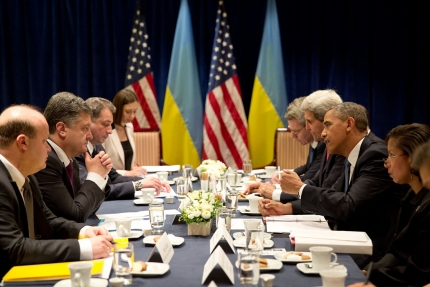
President Barack Obama meets with President-elect Petro Poroshenko of Ukraine during a bilateral meeting in Warsaw

President Barack Obama meets with President-elect Petro Poroshenko of Ukraine during a bilateral meeting in Warsaw, Poland, June 4, 2014. (Official White House Photo by Pete Souza)

Kicking off the second day of his trip to Europe, President Obama took part in a bilateral meeting with Ukrainian President-elect Petro Poroshenko in Warsaw, Poland.

In remarks following the meeting, President Obama said that they discussed the President-elect's plans to bring "peace and order to the east," along with the need for the international community to step up and support Poroshenko's efforts:

The challenge now for the international community is to make sure that we are supporting Petro’s efforts. And the United States has already stepped up in a number of ways. We’re supplementing the assistance that the IMF is providing with $1 billion in additional loan guarantees, and we’ve discussed additional steps that we might take to help during this reform and transition process. We’ve discussed additional steps that we can take to help train and professionalize the Ukrainian law enforcement and military so they can deal with some of the challenges that are still taking place in certain portions of the country. And, in fact, today we announced some additional non-lethal assistance that we can provide -- things like night vision goggles that will help a professional Ukrainian military force do its job.

President Obama Meets with President-elect Poroshenko

June 04, 2014 | 9:17 | Public Domain

President Obama and President-elect Petro Poroshenko of Ukraine deliver remarks after a bilateral meeting in Warsaw, Poland.

Download mp4 (340MB) | mp3 (9MB)

Read the Transcript

Remarks by President Obama and President-elect Petro Poroshenko of Ukraine After Bilateral Meeting

Warsaw Marriott Hotel
Warsaw, Poland

10:45 A.M. CET

PRESIDENT OBAMA:  Well, it is a great pleasure for me to have the opportunity to have my first extended meeting with President-elect Poroshenko and to hear about his plans for a peaceful and prosperous Ukraine.  Obviously, Ukraine has gone through a very challenging time.  And what we have seen has been a incredible outpouring of democracy in the face of actions by Russia as well as armed militias in certain portions of the east that violate international law, violate sovereignty, and have spurred great violence.

Despite all that, what the Ukrainians said in the election that resulted in President-elect Poroshenko’s inauguration on Saturday is that they reject that past.  They reject violence.  They reject corruption.  And what they’re interested in is the opportunity for Ukrainians to make their own decisions about their own future -- a future in which if people work hard, if they are willing to educate themselves and apply themselves, that they can succeed and that they can choose their own representatives, and that those representatives will look out for their interests and not the interests of only those in power. 

That’s the hope that President-elect Poroshenko represents.  And in my discussions with him today it’s clear that he understands the aspirations and the hopes of the Ukrainian people.  And when I say the Ukrainian people, I mean all the Ukrainian people.  I think that President-elect Poroshenko recognizes that his mandate is not just to help certain portions of his country succeed, but all portions of his country succeed.

We had the opportunity to discuss President-elect Poroshenko’s plans for bringing peace and order to the east that is still experiencing conflict.  We discussed his economic plans and the importance of rooting out corruption, increasing transparency, and creating new models of economic growth.  We discussed issues of energy -- making sure that Ukraine becomes a more energy-efficient economy but also one that is less dependent solely on energy sources from Russia.  And I have been deeply impressed by his vision, in part because of his experience as a businessman, in understanding what’s required to help Ukraine grow and to be effective. 

The challenge now for the international community is to make sure that we are supporting Petro’s efforts.  And the United States has already stepped up in a number of ways.  We’re supplementing the assistance that the IMF is providing with $1 billion in additional loan guarantees, and we’ve discussed additional steps that we might take to help during this reform and transition process.  We’ve discussed additional steps that we can take to help train and professionalize the Ukrainian law enforcement and military so they can deal with some of the challenges that are still taking place in certain portions of the country.  And, in fact, today we announced some additional non-lethal assistance that we can provide -- things like night vision goggles that will help a professional Ukrainian military force do its job. 

And finally, we discussed how in my meetings today with the G7 and tomorrow with the G7, as well as conversations that I’m having with other European leaders, it’s important for the international community to stand solidly behind the efforts of Petro to broker with the Russians a process whereby Russia no longer is financing or supporting or arming separatists on Ukraine’s sovereign territory, and that a unified international community that is clear that that is a violation of international law and that is willing to back up those principles with consequences for Russia should Mr. Putin not seize this opportunity to develop a lawful and better relationship with his neighbors -- that that has to be part of our mission over the next several days. 

So I’m excited about the opportunities.  I think that the Ukrainian people made a wise selection in somebody who has the ability to lead them through this difficult period.  And the United States is absolutely committed to standing behind the Ukrainian people and their aspirations not just in the coming days and weeks but in the coming years, because we’re confident that Ukraine can, in fact, be a thriving, vital democracy that has strong relationships with Europe and has strong relationships with Russia.  But that can only happen if we stand clearly behind them during this difficult time.

Thank you so much for taking the time to meet.

PRESIDENT-ELECT POROSHENKO:  I want to thank President Obama, the United States people, the United States government and Congress for the continuous support demonstrating for the fight, the Ukrainian people, for freedom, for democracy, for building up independent sovereign European state.  This is crucially important for us, and now we feel a friend in need is a friend indeed.  The American position of the American people is very, very important for us.  

Point number two is that from the very beginning, from the first day of inauguration, we are ready to present the plan for peaceful relation, the situation in the east.  And we think that the next several days will be very important, crucial, for the Ukrainian -- history of Ukrainian perspective.  We pay very much attention about the G7 meeting, about the statement, about the possibility for finding out the position for peaceful process on Normandy, when we have -- first Ukraine were invited as a member of anti-Hitler coalition and celebration of the D-Day.  And I think this will be very symbolic because exactly in Normandy we can start to find out this peaceful process in Ukraine.

I want to thank the President for the support in our initiative in the reforming in the energy sector.  I’m very satisfied about our future cooperation in the anti-corruption deal that I think this is crucially important points for the modernization of the country.  I think that our top two very important issue -- we thank you for supporting Ukraine in solving our Crimea problem.  We demonstrate that -- the whole world demonstrate the solidarity in Ukraine in not accepting the aggression in Crimea, in not accepting this whole fake referendum, and not accepting the annexing of the part of Ukrainian territory.  And all the time we will demand restoring law and order, and withdraw the foreign troops from the Crimean territory.

And also, I think it is very important that the United States support the European aspiration of the Ukrainian people.  That is half a year Ukrainian people, millions of Ukrainian people on the street fighting for now and signing a association agreement for the European perspective for my country.  And I think that the modernization of the country, providing the reform of the -- creating the good investment climate, building on the independent coal system, providing the energy efficiency and energy diversification helps Ukrainian people to receive membership perspective for the European Union in very near future after successful program for the modernization, with the strong assistance of the United States of America.

I thank you very much for that.  And I think this was very fruitful and effective negotiation.

END
10:55 A.M. CET

Close Transcript

President Obama Commemorates 25th Anniversary of Polish Freedom Day

June 04, 2014 | 21:07 | Public Domain

President Obama delivers remarks at an event marking the 25th anniversary of Freedom Day in Warsaw, Poland.

Download mp4 (777MB) | mp3 (20MB)

Read the Transcript

Remarks by President Obama at at 25th Anniversary of Freedom Day -- Warsaw, Poland

Castle Square
Warsaw, Poland

12:10 P.M. CET

PRESIDENT OBAMA:  Hello, Warsaw!  (Applause.)  Witaj, Polsko!  (Applause.)    

Mr. President; Mr. Prime Minister; Madam Mayor; heads of state and government, past and present -- including the man who jumped that shipyard wall to lead a strike that became a movement, the prisoner turned president who transformed this nation -- thank you, Lech Walesa, for your outstanding leadership.  (Applause.)   

Distinguished guests, people of Poland, thank you for your extraordinary welcome and for the privilege of joining you here today.  I bring with me the greetings and friendship of the American people -- and of my hometown of Chicago, home to so many proud Polish Americans.  (Applause.)  In Chicago, we think of ourselves as a little piece of Poland.  In some neighborhoods, you only hear Polish.  The faithful come together at churches like Saint Stanislaus Kostka.  We have a parade for Polish Constitution Day.  And every summer, we celebrate the Taste of Polonia, with our kielbasa and pierogies, and we’re all a little bit Polish for that day.  (Applause.)  So being here with you, it feels like home.  (Applause.) 

Twenty-five years ago today, we witnessed a scene that had once seemed impossible -- an election where, for the first time, the people of this nation had a choice.  The Communist regime thought an election would validate their rule or weaken the opposition.  Instead, Poles turned out in the millions.  And when the votes were counted, it was a landslide victory for freedom.  One woman who voted that day said, “There is a sense that something is beginning to happen in Poland.  We feel the taste of Poland again.”  She was right.  It was the beginning of the end of Communism -- not just in this country, but across Europe.

The images of that year are seared in our memory.  Citizens filling the streets of Budapest and Bucharest.  Hungarians and Austrians cutting the barbed wire border.  Protestors joining hands across the Baltics.  Czechs and Slovaks in their Velvet Revolution.  East Berliners climbing atop that wall.  And we have seen the extraordinary progress since that time.  A united Germany.  Nations in Central and Eastern Europe standing tall as proud democracies.  A Europe that is more integrated, more prosperous and more secure.  We must never forget that the spark for so much of this revolutionary change, this blossoming of hope, was lit by you, the people of Poland.  (Applause.) 

History was made here.  The victory of 1989 was not inevitable.  It was the culmination of centuries of Polish struggle, at times in this very square.  The generations of Poles who rose up and finally won independence.  The soldiers who resisted invasion, from the east and the west.  The Righteous Among the Nations -- among them Jan Karski -- who risked all to save the innocent from the Holocaust.  The heroes of the Warsaw Ghetto who refused to go without a fight.  The Free Poles at Normandy and the Poles of the Home Army who -- even as this city was reduced to rubble -- waged a heroic uprising. 

We remember how, when an Iron Curtain descended, you never accepted your fate.  When a son of Poland ascended to the Chair of Saint Peter, he returned home, and here, in Warsaw, he inspired a nation with his words -- “there can be no just Europe without the independence of Poland.”  (Applause.)  And today we give thanks for the courage of the Catholic Church and the fearless spirit of Saint John Paul II.  (Applause.)   

We also recall how you prevailed 25 years ago.  In the face of beatings and bullets, you never wavered from the moral force of nonviolence.  Through the darkness of martial law, Poles lit candles in their windows.  When the regime finally agreed to talk, you embraced dialogue.  When they held those elections -- even though not fully free -- you participated.  As one Solidarity leader said at the time, “We decided to accept what was possible.”  Poland reminds us that sometimes the smallest steps, however imperfect, can ultimately tear down walls, can ultimately transform the world.  (Applause.)  

But of course, your victory that June day was only the beginning.  For democracy is more than just elections.  True democracy, real prosperity, lasting security -- these are neither simply given, nor imposed from the outside.  They must be earned and built from within.  And in that age-old contest of ideas -- between freedom and authoritarianism, between liberty and oppression, between solidarity and intolerance -- Poland’s progress shows the enduring strength of the ideals that we cherish as a free people.

Here we see the strength of democracy:  Citizens raising their voices, free from fear.  Here we see political parties competing in open and honest elections.  Here we see an independent judiciary working to uphold the rule of law.  Here in Poland we see a vibrant press and a growing civil society that holds leaders accountable -- because governments exist to lift up their people, not to hold them down.  (Applause.)   

Here we see the strength of free markets and the results of hard reforms -- gleaming skyscrapers soaring above the city, and superhighways across this country, high-tech hubs and living standards that previous generations of Poles could only imagine. This is the new Poland you have built -- an economic “Miracle on the Vistula” -- Cud nad Wisłą.  (Applause.)

Here we see the strength of free nations that stand united. Across those centuries of struggle, Poland’s fate too often was dictated by others.  This land was invaded and conquered, carved up and occupied.  But those days are over.  Poland understands as few other nations do that every nation must be free to chart its own course, to forge its own partnerships, to choose its own allies.  (Applause.)

This year marks the 15th anniversary of Poland’s membership in NATO.  We honor Polish service in the Balkans, in Iraq and Afghanistan.  And as Americans, we are proud to call Poland one of our strongest and closest allies.  (Applause.)  

This is the Poland we celebrate today.  The free and democratic Poland that your forebears and some who are here today dreamed of and fought for and, in some cases, died for.  The growing and secure Poland that you -- particularly the young people who are here today -- have enjoyed for your entire lives.

It’s a wonderful story, but the story of this nation reminds us that freedom is not guaranteed.  And history cautions us to never take progress for granted.  On the same day 25 years ago that Poles were voting here, tanks were crushing peaceful democracy protests in Tiananmen Square on the other side of the world.  The blessings of liberty must be earned and renewed by every generation -- including our own.  This is the work to which we rededicate ourselves today.  (Applause.) 

Our democracies must be defined not by what or who we’re against, but by a politics of inclusion and tolerance that welcomes all our citizens.  Our economies must deliver a broader prosperity that creates more opportunity -- across Europe and across the world -- especially for young people.  Leaders must uphold the public trust and stand against corruption, not steal from the pockets of their own people.  Our societies must embrace a greater justice that recognizes the inherent dignity of every human being.  And as we’ve been reminded by Russia’s aggression in Ukraine, our free nations cannot be complacent in pursuit of the vision we share -- a Europe that is whole and free and at peace.  We have to work for that.  We have to stand with those who seek freedom.  (Applause.)   

I know that throughout history, the Polish people were abandoned by friends when you needed them most.  So I’ve come to Warsaw today -- on behalf of the United States, on behalf of the NATO Alliance -- to reaffirm our unwavering commitment to Poland’s security.  Article 5 is clear -- an attack on one is an attack on all.  And as allies, we have a solemn duty -- a binding treaty obligation -- to defend your territorial integrity.  And we will.  We stand together -- now and forever -- for your freedom is ours. (Applause.)  Poland will never stand alone.  (Applause.)  But not just Poland -- Estonia will never stand alone.  Latvia will never stand alone.  Lithuania will never stand alone.  Romania will never stand alone.  (Applause.)  


These are not just words.  They’re unbreakable commitments backed by the strongest alliance in the world and the armed forces of the United States of America -- the most powerful military in history.  (Applause.)  You see our commitment today. In NATO aircraft in the skies of the Baltics.  In allied ships patrolling the Black Sea.  In the stepped-up exercises where our forces train together.  And in our increased and enduring American presence here on Polish soil.  We do these things not to threaten any nation, but to defend the security and territory of ourselves and our friends. 

Yesterday, I announced a new initiative to bolster the security of our NATO allies and increase America’s military presence in Europe.  With the support of Congress, this will mean more pre-positioned equipment to respond quickly in a crisis, and exercises and training to keep our forces ready; additional U.S. forces -- in the air, and sea, and on land, including here in Poland.  And it will mean increased support to help friends like Ukraine, and Moldova and Georgia provide for their own defense.  (Applause.) 

Just as the United States is increasing our commitment, so must others.  Every NATO member is protected by our alliance, and every NATO member must carry its share in our alliance.  This is the responsibility we have to each other.

Finally, as free peoples, we join together, not simply to safeguard our own security but to advance the freedom of others. Today we affirm the principles for which we stand. 

We stand together because we believe that people and nations have the right to determine their own destiny.  And that includes the people of Ukraine.  Robbed by a corrupt regime, Ukrainians demanded a government that served them.  Beaten and bloodied, they refused to yield.  Threatened and harassed, they lined up to vote; they elected a new President in a free election -- because a leader’s legitimacy can only come from the consent of the people.

Ukrainians have now embarked on the hard road of reform.  I met with President-elect Poroshenko this morning, and I told him that, just as free nations offered support and assistance to Poland in your transition to democracy, we stand with Ukrainians now.  (Applause.)  Ukraine must be free to choose its own future for itself and by itself.  (Applause.)  We reject the zero-sum thinking of the past -- a free and independent Ukraine needs strong ties and growing trade with Europe and Russia and the United States and the rest of the world.  Because the people of Ukraine are reaching out for the same freedom and opportunities and progress that we celebrate here today -- and they deserve them, too.

We stand together because we believe that upholding peace and security is the responsibility of every nation.  The days of empire and spheres of influence are over.  Bigger nations must not be allowed to bully the small, or impose their will at the barrel of a gun or with masked men taking over buildings.  And the stroke of a pen can never legitimize the theft of a neighbor’s land.  So we will not accept Russia’s occupation of Crimea or its violation of Ukraine’s sovereignty.  (Applause.)   Our free nations will stand united so that further Russian provocations will only mean more isolation and costs for Russia. (Applause.)  Because after investing so much blood and treasure to bring Europe together, how can we allow the dark tactics of the 20th century to define this new century?

We stand together because we know that the spirit of Warsaw and Budapest and Prague and Berlin stretches to wherever the longing for freedom stirs in human hearts, whether in Minsk or Caracas, or Damascus or Pyongyang.  Wherever people are willing to do the hard work of building democracy -- from Tbilisi to Tunis, from Rangoon to Freetown -- they will have a partner in our nations.  For in the struggles of these citizens we recall our own struggles.  In their faces we see our own.  And few see this more clearly than the people of Poland.

The Ukrainians of today are the heirs of Solidarity -- men and women like you who dared to challenge a bankrupt regime.  When your peaceful protests were met with an iron fist, Poles placed flowers in the shipyard gate. 

Today, Ukrainians honor their fallen with flowers in Independence Square.  We remember the Polish voter who rejoiced to “feel the taste of Poland again.”  Her voice echoes in the young protestor in the Maidan who savored what she called “a taste of real freedom.”  “I love my country,” she said, and we are standing up for “justice and freedom.”  And with gratitude for the strong support of the Polish people, she spoke for many Ukrainians when she said, “Thank you, Poland.  We hear you and we love you.”  (Applause.)   

Today we can say the same.  Thank you, Poland -- thank you for your courage.  Thank you for reminding the world that no matter how brutal the crackdown, no matter how long the night, the yearning for liberty and dignity does not fade away.  It will never go away.  Thank you, Poland, for your iron will and for showing that, yes, ordinary citizens can grab the reins of history, and that freedom will prevail -- because, in the end, tanks and troops are no match for the force of our ideals. 

Thank you, Poland -- for your triumph -- not of arms, but of the human spirit, the truth that carries us forward. There is no change without risk, and no progress without sacrifice, and no freedom without solidarity.  (Applause.) 

Dziękuję, Polsko!  God bless Poland.  (Applause.)  God bless America.  God bless our unbreakable alliance.  Thank you very much.  (Applause.)

END
12:28 P.M. CET

Close Transcript