The White House

Office of the Press Secretary

Presidential Nominations Sent to the Senate

NOMINATIONS SENT TO THE SENATE:

Julián Castro, of Texas, to be Secretary of Housing and Urban Development, vice Shaun L.S. Donovan.

Shaun L.S. Donovan, of New York, to be Director of the Office of Management and Budget, vice Sylvia Mathews Burwell.

The White House

Office of the Press Secretary

Presidential Memorandum -- Response to the Influx of Unaccompanied Alien Children Across the Southwest Border

MEMORANDUM FOR THE HEADS OF EXECUTIVE DEPARTMENTS AND AGENCIES

SUBJECT: Response to the Influx of Unaccompanied Alien Children Across the Southwest Border

The influx of unaccompanied alien children (UAC) across the southwest border of the United States has resulted in an urgent humanitarian situation requiring a unified and coordinated Federal response. Accordingly, I have directed the Secretary of Homeland Security (Secretary) to establish an interagency Unified Coordination Group to ensure unity of effort across the executive branch in responding to the humanitarian aspects of this situation, consistent with the Homeland Security Act of 2002 and Homeland Security Presidential Directive-5 (Management of Domestic Incidents)(HSPD-5), including coordination with State, local, and other nonfederal entities. The Secretary shall establish and manage this Unified Coordination Group consistent with the authorities in 6 U.S.C. 111(b)(1)(D), 112(a)(3), 112(b)(1), 112(c), and HSPD-5. The Secretary has advised me that he will direct the Administrator of the Federal Emergency Management Agency (Administrator), subject to the oversight, direction, and guidance of the Secretary, to serve as the Federal Coordinating Official who shall lead and coordinate the Unified Coordination Group consistent with the functions of the Administrator pursuant to 6 U.S.C. 313, 314(a)(1) and (10). As the Federal Coordinating Official, the Administrator (or his designee) shall lead and coordinate Federal response efforts to ensure that Federal agency authorities and the resources granted to the departments and agencies under Federal law (including personnel, equipment, supplies, facilities, and managerial, technical, and advisory services) are unified in providing humanitarian relief to the affected children, including housing, care, medical treatment, and transportation. The Administrator shall execute these responsibilities consistent with all applicable laws and regulations, including legal requirements governing the appropriate care and custody of UAC.

Nothing in this memorandum alters, or impedes the ability to carry out, the authorities of Federal departments and agencies to perform their responsibilities under law. All Federal departments and agencies are directed to provide their full and prompt cooperation, resources, and support, as appropriate and consistent with their own responsibilities for addressing this situation, and shall cooperate with the Secretary and the Federal Coordinating Official to ensure a unified Federal response. The Secretary shall lead the coordination of the Federal response to this urgent humanitarian situation and other departments and agencies supporting this effort shall provide support to address this situation as appropriate and to the extent permitted by law.

This memorandum does not obligate any agency to reimburse another agency for the resources used to address the UAC humanitarian situation nor does it limit the use of the Economy Act (31 U.S.C. 1535), as appropriate.

BARACK OBAMA

Myths and Facts: Cutting Carbon Pollution

Today, as part of the President’s plan to cut carbon pollution, the Environmental Protection Agency (EPA) unveiled the first-ever national limits on carbon pollution from existing power plants, the single-largest source of carbon pollution in the United States. The steady, responsible steps EPA is taking today will help prevent up to 6,500 premature deaths and spare American children as many as 150,000 asthma attacks a year. It will also eliminate waste, save Americans money on their electric bills, and spark innovation and job creation.

But just because this common-sense proposal will have huge benefits for hard-working Americans across the country, that doesn’t mean some people won’t spread misinformation and launch false attacks.

Throughout our history, when America has taken steps to cut pollution and protect public health, opponents have made dire predictions about destroying jobs and harming the economy – and throughout our history they’ve been wrong. This time will be no different. So let’s look at some of the myths they will try to spread and the facts that dispel them.


Myth: Carbon pollution standards will destroy jobs and hurt the economy.

Fact: Americans know we can cut pollution and protect the health of our kids while creating jobs.

Over the years, this has been the polluters’ favorite myth. When we passed the Clean Air Act to combat smog, they said new pollution standards would decimate the auto industry. In 1990, when we took steps to stop acid rain, they claimed the lights would go out and businesses around the country would suffer.

The facts tell a different story.

EPA has been protecting air quality for more than 40 years, and in that time we've cut pollution by 70 percent while the economy has more than tripled.

Dan Utech is the Special Assistant to the President for Energy and Climate Change.
Related Topics: Energy and Environment

By the Numbers: The EPA's Proposed New Carbon Pollution Standards for Power Plants

Today, as part of the President’s Climate Action Plan, the EPA proposed new carbon pollution standards for power plants. These standards represent a commonsense proposal that will have huge benefits for all Americans. In fact, for every dollar of investment spurred by this proposal, there is roughly seven dollars’ worth of health benefits in return.

Here are some numbers that help explain today’s announcement:

  • Nearly 40 is the number of percentage points of total carbon pollution that comes from power plants. The President’s Climate Action Plan has focused on modernizing our buildings, factories, cars, and trucks – but altogether, they make up a little over half of all the carbon pollution. It makes sense, then, that our next logical step would be to modernize the power sector, putting in place the first-ever carbon pollution standards for power plants.
  • More than 300 is the number of groups EPA engaged with across the country – including 11 public listening sessions that hosted more than 3,000 people – in order to develop its proposal. And the outreach continues. After the proposed rule is published, there will be a 120-day public comment period to make sure the final standards reflect all the best ideas and input from everyone includes states, utilities, labor, health advocates, environmental groups and industry.
  • 30 is the number of percentage points of total carbon pollution that will be cut from our power sector by 2030 – relative to 2005 levels. That is like erasing the annual carbon pollution from two-thirds of all cars and trucks in America. And if you add up what we will avoid between 2020 and 2030 under the proposal, it’s more than the carbon pollution from every power plant in America in 2012 – times two. 
Dan Utech is the Special Assistant to the President for Energy and Climate Change.
Related Topics: Energy and Environment

President Obama Speaks on the Recovery of Sgt. Bowe Bergdahl: "It's a Good Day"

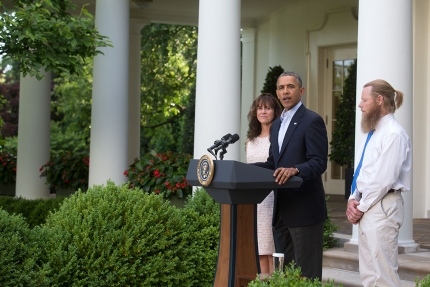
President Barack Obama announces the release of Sgt. Bowe Bergdahl

President Barack Obama announces the release of Sgt. Bowe Bergdahl, an American soldier held captive for nearly five years by militants during the Afghanistan war, during a statement in the Rose Garden of the White House, Saturday, May 31, 2014. With the President are Sgt. Bergdahl's parents, Jani and Bob Bergdahl. (Official White House Photo by Chuck Kennedy)

Watch on YouTube

Earlier this evening, in the White House Rose Garden, President Obama spoke about the recovery of Sgt. Bowe Bergdahl — an American soldier who spent nearly five years in captivity during the war in Afghanistan.

Standing with Sgt. Bergdahl's parents, Bob and Jani, the President made clear that "while Bowe was gone, he was never forgotten."

His parents thought about him and prayed for him every single day, as did his sister Sky, who prayed for his safe return. He wasn't forgotten by his community in Idaho, or the military, which rallied to support the Bergdahls through thick and thin. And he wasn't forgotten by his country, because the United States of America does not ever leave our men and women in uniform behind.

Related Topics: Defense, Idaho

President Obama Speaks on the Recovery of Sgt. Bowe Bergdahl

May 31, 2014 | 5:40 | Public Domain

In the White House Rose Garden, President Obama delivers a statement about the recovery of Sgt. Bowe Bergdahl -- an American soldier who has spent nearly five years in captivity in Afghanistan.

Download mp4 (206MB) | mp3 (6MB)

Read the Transcript

Statement by the President on the Release of Sergeant Bowe Bergdahl

Rose Garden

6:16 P.M. EDT

THE PRESIDENT:  Good afternoon, everybody.  This morning, I called Bob and Jani Bergdahl and told them that after nearly five years in captivity, their son, Bowe, is coming home. 

Sergeant Bergdahl has missed birthdays and holidays and the simple moments with family and friends, which all of us take for granted.  But while Bowe was gone he was never forgotten.  His parents thought about him and prayed for him every single day, as did his sister, Sky, who prayed for his safe return.

He wasn’t forgotten by his community in Idaho, or the military, which rallied to support the Bergdahls through thick and thin.  And he wasn’t forgotten by his country, because the United States of America does not ever leave our men and women in uniform behind. 

As Commander-in-Chief, I am proud of the servicemembers who recovered Sergeant Bergdahl and brought him safely out of harm’s way.  As usual, they performed with extraordinary courage and professionalism, and they have made their nation proud.

Right now, our top priority is making sure that Bowe gets the care and support that he needs and that he can be reunited with his family as soon as possible.

I'm also grateful for the tireless work of our diplomats, and for the cooperation of the government of Qatar in helping to secure Bowe’s release.  We've worked for several years to achieve this goal, and earlier this week I was able to personally thank the Emir of Qatar for his leadership in helping us get it done.  As part of this effort, the United States is transferring five detainees from the prison in Guantanamo Bay to Qatar.  The Qatari government has given us assurances that it will put in place measures to protect our national security.

I also want to express gratitude to the Afghan government, which has always supported our efforts to secure Bowe’s release. Going forward, the United States will continue to support an Afghan-led process of reconciliation, which could help secure a hard-earned peace within a sovereign and unified Afghanistan.

As I said earlier this week, we're committed to winding down the war in Afghanistan, and we are committed to closing Gitmo.  But we also made an ironclad commitment to bring our prisoners of war home.  That's who we are as Americans.  It's a profound obligation within our military, and today, at least in this instance, it's a promise we've been able to keep.

I am mindful, though, that there are many troops who remain missing in the past.  That's why we're never going to forget; we're never going to give up our search for servicemembers who remain unaccounted for.  We also remain deeply committed to securing the release of American citizens who are unjustly detained abroad and deserve to be reunited with their families, just like the Bergdahls soon will be.

Bob and Jani, today families across America share in the joy that I know you feel.  As a parent, I can't imagine the hardship that you guys have gone through.  As President, I know that I speak for all Americans when I say we cannot wait for the moment when you are reunited and your son, Bowe, is back in your arms.

So, with that, I'd like Bob to have an opportunity to say something, and Jani, if she’d like as well.  Please.

MRS. BERGDAHL:  I just want to say thank you to everyone who has supported Bowe.  He’s had a wonderful team everywhere.  We will continue to stay strong for Bowe while he recovers.  Thank you.

MR. BERGDAHL:  I'd like to say to Bowe right now, who is having trouble speaking English -- (speaks in Pashto) -- I'm your father, Bowe. 

To the people of Afghanistan, the same -- (speaks in Pashto) -- the complicated nature of this recovery was -- will never really be comprehended.  To each and every single one who effected this, in this country, in the service branches, at the State Department, throughout the whole of American government, and around the world, international governments around the world, thank you so much.  We just can't communicate the words this morning when we heard from the President.

So we look forward to continuing the recovery of our son, which is going to be a considerable task for our family.  And we hope that the media will understand that that will keep us very preoccupied in the coming days and weeks as he gets back home to the United States.

Thank you all for being here very much.

END
6:23 P.M. EDT     

Close Transcript

The White House

Office of the Press Secretary

Statement by the President on the Release of Sergeant Bowe Bergdahl

Rose Garden

6:16 P.M. EDT

THE PRESIDENT:  Good afternoon, everybody.  This morning, I called Bob and Jani Bergdahl and told them that after nearly five years in captivity, their son, Bowe, is coming home. 

Sergeant Bergdahl has missed birthdays and holidays and the simple moments with family and friends, which all of us take for granted.  But while Bowe was gone he was never forgotten.  His parents thought about him and prayed for him every single day, as did his sister, Sky, who prayed for his safe return.

He wasn’t forgotten by his community in Idaho, or the military, which rallied to support the Bergdahls through thick and thin.  And he wasn’t forgotten by his country, because the United States of America does not ever leave our men and women in uniform behind. 

As Commander-in-Chief, I am proud of the servicemembers who recovered Sergeant Bergdahl and brought him safely out of harm’s way.  As usual, they performed with extraordinary courage and professionalism, and they have made their nation proud.

Right now, our top priority is making sure that Bowe gets the care and support that he needs and that he can be reunited with his family as soon as possible.

I'm also grateful for the tireless work of our diplomats, and for the cooperation of the government of Qatar in helping to secure Bowe’s release.  We've worked for several years to achieve this goal, and earlier this week I was able to personally thank the Emir of Qatar for his leadership in helping us get it done.  As part of this effort, the United States is transferring five detainees from the prison in Guantanamo Bay to Qatar.  The Qatari government has given us assurances that it will put in place measures to protect our national security.

I also want to express gratitude to the Afghan government, which has always supported our efforts to secure Bowe’s release. Going forward, the United States will continue to support an Afghan-led process of reconciliation, which could help secure a hard-earned peace within a sovereign and unified Afghanistan.

As I said earlier this week, we're committed to winding down the war in Afghanistan, and we are committed to closing Gitmo.  But we also made an ironclad commitment to bring our prisoners of war home.  That's who we are as Americans.  It's a profound obligation within our military, and today, at least in this instance, it's a promise we've been able to keep.

I am mindful, though, that there are many troops who remain missing in the past.  That's why we're never going to forget; we're never going to give up our search for servicemembers who remain unaccounted for.  We also remain deeply committed to securing the release of American citizens who are unjustly detained abroad and deserve to be reunited with their families, just like the Bergdahls soon will be.

Bob and Jani, today families across America share in the joy that I know you feel.  As a parent, I can't imagine the hardship that you guys have gone through.  As President, I know that I speak for all Americans when I say we cannot wait for the moment when you are reunited and your son, Bowe, is back in your arms.

So, with that, I'd like Bob to have an opportunity to say something, and Jani, if she’d like as well.  Please.

MRS. BERGDAHL:  I just want to say thank you to everyone who has supported Bowe.  He’s had a wonderful team everywhere.  We will continue to stay strong for Bowe while he recovers.  Thank you.

MR. BERGDAHL:  I'd like to say to Bowe right now, who is having trouble speaking English -- (speaks in Pashto) -- I'm your father, Bowe. 

To the people of Afghanistan, the same -- (speaks in Pashto) -- the complicated nature of this recovery was -- will never really be comprehended.  To each and every single one who effected this, in this country, in the service branches, at the State Department, throughout the whole of American government, and around the world, international governments around the world, thank you so much.  We just can't communicate the words this morning when we heard from the President.

So we look forward to continuing the recovery of our son, which is going to be a considerable task for our family.  And we hope that the media will understand that that will keep us very preoccupied in the coming days and weeks as he gets back home to the United States.

Thank you all for being here very much.

END
6:23 P.M. EDT     

Weekly Address: Reducing Carbon Pollution in Our Power Plants

In this week’s address, President Obama discussed new actions by the Environmental Protection Agency to cut dangerous carbon pollution, a plan that builds on the efforts already taken by many states, cities and companies. These new commonsense guidelines to reduce carbon pollution from power plants were created with feedback from businesses, and state and local governments, and they would build a clean energy economy while reducing carbon pollution.

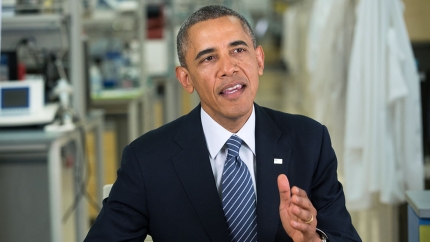
The President discussed this new plan from the Children’s National Medical Center in Washington, D.C., where he visited children whose asthma is aggravated by air pollution. As a parent, the President said he is dedicated to make sure our planet is cleaner and safer for future generations.

Transcript | mp4 | mp3

President Barack Obama tapes the Weekly Address at the Children's National Medical Center in Washington, D.C., May 30, 2014.

President Barack Obama tapes the Weekly Address at the Children's National Medical Center in Washington, D.C., May 30, 2014. (Official White House Photo by Amanda Lucidon)

Related Topics: Energy and Environment

The White House

Office of the Press Secretary

Weekly Address: Reducing Carbon Pollution in Our Power Plants

WASHINGTON, DC — In this week’s address, President Obama discussed new actions by the Environmental Protection Agency to cut dangerous carbon pollution, a plan that builds on the efforts already taken by many states, cities and companies. These new commonsense guidelines to reduce carbon pollution from power plants were created with feedback from businesses, and state and local governments, and they would build a clean energy economy while reducing carbon pollution. The President discussed this new plan from the Children’s National Medical Center in Washington, D.C., where he visited children whose asthma is aggravated by air pollution.  As a parent, the President said he is dedicated to make sure our planet is cleaner and safer for future generations.

Remarks of President Barack Obama
Weekly Address
Children’s National Medical Center in Washington, D.C.
May 31, 2014

Hi, everybody.  I’m here at Children’s National Medical Center in Washington, D.C., visiting with some kids being treated here all the time for asthma and other breathing problems.  Often, these illnesses are aggravated by air pollution – pollution from the same sources that release carbon and contribute to climate change.  And for the sake of all our kids, we’ve got to do more to reduce it.

Earlier this month, hundreds of scientists declared that climate change is no longer a distant threat – it “has moved firmly into the present.” Its costs can be measured in lost lives and livelihoods, lost homes and businesses; and higher prices for food, insurance, and rebuilding.

That’s why, last year, I put forward America’s first climate action plan.  This plan cuts carbon pollution by building a clean energy economy – using more clean energy, less dirty energy, and wasting less energy throughout our economy. 

One of the best things we can do for our economy, our health, and our environment is to lead the world in producing cleaner, safer energy – and we’re already generating more clean energy than ever before.  Thanks in part to the investments we made in the Recovery Act, the electricity America generates from wind has tripled.  And from the sun, it’s increased more than tenfold. In fact, every four minutes, another American home or business goes solar – and every panel is pounded into place by a worker whose job cannot be shipped overseas.

We’re wasting less energy, too.  We’ve doubled how far our cars and trucks will go on a gallon of gas by the middle of the next decade, saving you money at the pump – and we’re helping families and businesses save billions with more efficient homes, buildings, and appliances.

This strategy has created jobs, grown our economy, and helped make America more energy independent than we’ve been in decades – all while holding our carbon emissions to levels not seen in about 20 years.  It’s a good start.  But for the sake of our children, we have to do more. 

This week, we will.  Today, about 40% of America’s carbon pollution comes from power plants.  But right now, there are no national limits to the amount of carbon pollution that existing plants can pump into the air we breathe. None. We limit the amount of toxic chemicals like mercury, sulfur, and arsenic that power plants put in our air and water.  But they can dump unlimited amounts of carbon pollution into the air.  It’s not smart, it’s not safe, and it doesn’t make sense.

That’s why, a year ago, I directed the Environmental Protection Agency to build on the efforts of many states, cities, and companies, and come up with commonsense guidelines for reducing dangerous carbon pollution from our power plants.  This week, we’re unveiling these proposed guidelines, which will cut down on the carbon pollution, smog, and soot that threaten the health of the most vulnerable Americans, including children and the elderly.  In just the first year that these standards go into effect, up to 100,000 asthma attacks and 2,100 heart attacks will be avoided – and those numbers will go up from there. 

These standards were created in an open and transparent way, with input from the business community.  States and local governments weighed in, too.  In fact, nearly a dozen states are already implementing their own market-based programs to reduce carbon pollution.  And over 1,000 mayors have signed agreements to cut their cities’ carbon pollution. 

So the idea of setting higher standards to cut pollution at our power plants is not new.  It’s just time for Washington to catch up with the rest of the country.

Now, special interests and their allies in Congress will claim that these guidelines will kill jobs and crush the economy.  Let's face it, that’s what they always say. 

But every time America has set clear rules and better standards for our air, our water, and our children’s health – the warnings of the cynics have been wrong.  They warned that doing something about the smog choking our cities, and acid rain poisoning our lakes, would kill business.  It didn’t.  Our air got cleaner, acid rain was cut dramatically, and our economy kept growing.

These excuses for inaction somehow suggest a lack of faith in American businesses and American ingenuity.  The truth is, when we ask our workers and businesses to innovate, they do.  When we raise the bar, they meet it.  When we restricted cancer-causing chemicals in plastics and leaded fuel in our cars, American chemists came up with better substitutes.  When we phased out the gases that depleted the ozone layer, American workers built better refrigerators and air conditioners.  The fuel standards we put in place a few years ago didn’t cripple automakers; the American auto industry retooled, and today, they’re selling the best cars in the world, with more hybrids, plug-in, and fuel-efficient models to choose from than ever before.

In America, we don’t have to choose between the health of our economy and the health of our children.  The old rules may say we can’t protect our environment and promote economic growth at the same time, but in America, we’ve always used new technology to break the old rules.

As President, and as a parent, I refuse to condemn our children to a planet that’s beyond fixing.  The shift to a cleaner energy economy won’t happen overnight, and it will require tough choices along the way.  But a low-carbon, clean energy economy can be an engine of growth for decades to come.  America will build that engine.  America will build the future.  A future that’s cleaner, more prosperous, and full of good jobs – a future where we can look our kids in the eye and tell them we did our part to leave them a safer, more stable world.

Thanks, and have a great weekend.

Reducing Carbon Pollution in Our Power Plants

May 31, 2014 | 6:25 | Public Domain

In this week’s address, President Obama discussed new actions by the Environmental Protection Agency to cut dangerous carbon pollution, a plan that builds on the efforts already taken by many states, cities and companies.

Download mp4 (238MB) | mp3 (6MB)

Read the Transcript

Weekly Address: Reducing Carbon Pollution in Our Power Plants

In this week’s address, President Obama discussed new actions by the Environmental Protection Agency to cut dangerous carbon pollution, a plan that builds on the efforts already taken by many states, cities and companies. These new commonsense guidelines to reduce carbon pollution from power plants were created with feedback from businesses, and state and local governments, and they would build a clean energy economy while reducing carbon pollution.

The President discussed this new plan from the Children’s National Medical Center in Washington, D.C., where he visited children whose asthma is aggravated by air pollution. As a parent, the President said he is dedicated to make sure our planet is cleaner and safer for future generations.

Transcript | mp4 | mp3

[[nid:280156]]

Close Transcript