The White House

Office of the Press Secretary

Obama Administration Holds Major Gulf of Mexico Oil and Gas Lease Sale

Latest Step by Administration to Deliver on Goals for Expanded, Responsible Production Announced by President Obama

WASHINGTON, DC — Tomorrow, Secretary of the Interior Ken Salazar will travel to New Orleans to hold a major oil and gas lease sale covering more than 21 million acres in the Gulf of Mexico that are currently not leased. This is the latest step by the Administration to meet a series of directives announced by President Obama in May 2011, which included additional lease sales, certain offshore lease extensions, and steps to streamline permitting, all towards the President’s goal of expanding safe and responsible domestic oil and gas production. Last week, as part of this effort, the Department of the Interior held a lease sale that covered over 140,000 acres in the National Petroleum Reserve in Alaska.

Since 2008, domestic oil and gas production has continued to increase, with total U.S. crude oil production higher in 2010 than in any year since 2003. In May, President Obama announced additional steps his Administration would undertake to continue to expand responsible and safe domestic oil production, leveraging existing authorities as part of his long-term plan to reduce our reliance on foreign oil.

In addition to tomorrow’s Gulf of Mexico sale and last week’s National Petroleum Reserve sale, the strategy outlined by the President in May included extending certain offshore leases in the Gulf of Mexico and Alaska, creating a new interagency working group to coordinate energy permitting in Alaska, incentivizing industry to develop their unused leases, and expediting evaluation of oil and gas resources in the mid and south Atlantic. As of today, all of those major steps have or are being implemented by the Obama Administration.

The Department of the Interior estimates that tomorrow’s lease sale could result in the production of 222 to 423 million barrels of oil and 1.49 to 2.65 trillion cubic feet of natural gas. In the last two years, oil production from the federal OCS has increased by more than a third, from 446 million barrels in 2008 to an estimated more than 600 million barrels in 2010. In fact, the U.S. Energy Information Agency (EIA) projects that U.S. crude oil production increased by roughly 200,000 barrels per day in 2011, and expects a similar increase in 2012.

The Administration continues to focus on ensuring that as we expand domestic oil and gas production, it is done safely. That is why, following the Deepwater Horizon oil spill, the Administration put in place unprecedented safety reforms for offshore drilling, working with industry to improve practices and oversight while also continuing oil and gas production. Since new safety standards were put into place, the Administration has approved 97 shallow water permits in the Gulf of Mexico, and 211 permits for activities at 60 deepwater wells – all of which meet these important new safety standards.

The President’s May, 2011 announcement of steps to increase responsible domestic oil production is available here: http://obamawhitehouse.archives.gov/the-press-office/2011/05/13/weekly-address-president-obama-announces-new-plans-increase-responsible-\

The White House

Office of the Press Secretary

Remarks by the President at a Campaign Event

Hyatt Regency Washington on Capitol Hill
Washington, D.C.
 

12:05 P.M. EST

THE PRESIDENT:  Hello, everybody!  (Applause.)  Hello, hello, hello!  (Applause.)  Thank you.  Love you guys.  Thank you so much.  (Applause.)  All right, everybody have a seat.  I don't want to milk this too much here.  (Laughter.)

To Matthew, thank you for your extraordinary leadership.  We could not be prouder of you.  And for you to have made all the life-changing sacrifices to take on this job -- it's something that I couldn't be prouder of.  So please give Matthew a big round of applause.  He's working hard.  (Applause.)

Jane Stetson, Andy Tobias -- they are doing remarkable work for the DNC.  And our outstanding chairwoman of the DNC, Debbie Wasserman Schultz, is in the house.  Give her a big round of applause as well.  (Applause.)

I don't want to give a long speech.  I want to save most of my time for questions and discussion with all of you.  I've got two simple messages.  Number one, thank you.  I look around the room -- everybody here has gone above and beyond the call of duty, not just for the last few months but for several years now. I'm reminded of what my friend, Ab Mikva said about being friends with a politician; it's like having a perpetual child in college. (Laughter.)  It just never stops.  (Laughter.)  But all of you have just done incredible work with great cheer and great determination.  And I'm thankful for it.

Which brings me to the second point.  The reason you do it, I'd like to think, is a little bit because you like me and you think I'm a pretty good guy.  (Laughter.)  I definitely know that part of it is because you love Michelle and think she's one of the best First Ladies we've ever had.  (Applause.)  But the main reason you do it is because you know what's at stake.

Back in 2008, we used to talk about this being a historic moment for America, that we were at a crossroads in our history. Well, we haven't fully crossed the road, and in some ways, 2012 is even more important than it was four years ago.  The choices could not be starker.  The vision about where we want to take the country could not be more different.

I gave a speech in Kansas last week where I talked about -- (applause) -- where we need to go as a country; a country that's based on everybody having a fair shot, a country that depends on everybody doing their fair share, a country where fair play applies across the board.  And I talked about how, for decade, now, people have felt that the basic compact that if you worked hard, you acted responsibly, you looked after your family, that you would be able to be in the middle class, stay in the middle class, get into the middle class, that your kids would have a better life than you did, that you'd have some semblance of security -- that that compact had eroded. 

And it hadn’t happened overnight, it wasn’t going to be solved overnight, but there were going to be some critical things that we had to do to make sure that compact was restored:  Making investments in education so our kids are better prepared than anybody in the world.  Making sure that we've got the best infrastructure to move products and services, and our businesses can thrive.  Making sure that we're investing in science and basic research.  Making sure that the rules of the road apply to everybody; so we're not building a bubble economy but we're building an economy based on making stuff and exporting it around the world -- stamped with the words, Made in America.  And most fundamentally, understanding that we're all in this together -- it's not a few of us doing well and then the rest of us hoping that we get lucky, but rather, everybody, as a team, moving this country forward.

And that vision, in contrast to a vision that basically says you are on your own, is what this election was about in 2008; it's what this election is going to be about in 2012.  I am confident that the vision that we believe in so deeply and that we've worked so hard for is the vision that is truest to our history and most representative of the core decency of the American people. 

But we're going to have to fight for it.  It's not a slam-dunk.  We're going to have to deliver this message effectively all across the country.  And at a time when people have been battered by the worst financial crisis since the Great Depression and the worst economic crisis since the 1930s, it's understandable if people aren’t feeling as chipper as they were back in 2008.  There's going to be some skepticism.  There's going to be some pushback. 

All of the things that we've done over the last three years -- to rescue the economy and rescue the auto industry, and end the war in Iraq and end "don't ask, don't tell," and make sure that health care is in place, and financial reform brings back some integrity to the financial sector -- all those things don't mean that much to somebody if they're still out of work right now, or their house is still underwater by $100,000.

So, yeah, this is going to be tough.  But I just want to remind all of you that you didn’t decide to support Barack Hussein Obama because it was going to be easy.  There were always easier choices to make, just as there would have been easier political choices for me to make.  We took a flyer on this thing because we believe passionately in an America in which everybody is getting ahead.

That's worth fighting for.  And here's my message to you.  If you guys stick with this, if you don't falter, if you stay steady, we are going to win this thing.  (Applause.)  We are going to win this thing, and America is going to win as a consequence.  (Applause.)

All right?  Thank you, everybody.  Thank you.  (Applause.)

END   
12:15 P.M. EST

The End of the Iraq War: A Timeline

From Day One, President Obama has promised to bring our troops home from Iraq.

In his Inauguration speech, he said, "We will begin to responsibly leave Iraq to its people."

In the time since, the President has worked to make good on that promise -- and ensure that our veterans get the care and benefits they've earned through their service.

This month, after nearly nine years, the final American military units in the country will return to the United States, and the war will end.

We've put together a timeline to show the milestones that have brought us to this point. Take a look: WH.gov/Iraq

President Obama’s Press Conference with Prime Minister Maliki

December 12, 2011 | 39:35 | Public Domain

President Obama and Prime Minister Nouri al-Maliki of Iraq reaffirm their common vision of a long-term partnership between the United States and Iraq.

Download mp4 (378MB) | mp3 (36MB)

Read the Transcript

Remarks by President Obama and Prime Minister al-Maliki of Iraq in a Joint Press Conference

South Court Auditorium

12:24 P.M. EST

PRESIDENT OBAMA:  Please have a seat.  Good afternoon, everyone.

When I took office, nearly 150,000 American troops were deployed in Iraq, and I pledged to end this war, responsibly.  Today, only several thousand troops remain there, and more are coming home every day. 

This is a season of homecomings, and military families across America are being reunited for the holidays.  In the coming days, the last American soldiers will cross the border out of Iraq, with honor and with their heads held high.  After nearly nine years, our war in Iraq ends this month.

Today, I’m proud to welcome Prime Minister Maliki -- the elected leader of a sovereign, self-reliant and democratic Iraq. We're here to mark the end of this war; to honor the sacrifices of all those who made this day possible; and to turn the page -- begin a new chapter in the history between our countries -- a normal relationship between sovereign nations, an equal partnership based on mutual interests and mutual respect. 

Iraq faces great challenges, but today reflects the impressive progress that Iraqis have made.  Millions have cast their ballots -- some risking or giving their lives -- to vote in free elections.  The Prime Minister leads Iraq’s most inclusive government yet.  Iraqis are working to build institutions that are efficient and independent and transparent.

Economically, Iraqis continue to invest in their infrastructure and development.  And I think it's worth considering some remarkable statistics.  In the coming years, it’s estimated that Iraq’s economy will grow even faster than China's or India's.  With oil production rising, Iraq is on track to once again be one of the region’s leading oil producers.

With respect to security, Iraqi forces have been in the lead for the better part of three years -- patrolling the streets, dismantling militias, conducting counterterrorism operations.  Today, despite continued attacks by those who seek to derail Iraq’s progress, violence remains at record lows. 

And, Mr. Prime Minister, that’s a tribute to your leadership and to the skill and the sacrifices of Iraqi forces.

Across the region, Iraq is forging new ties of trade and commerce with its neighbors, and Iraq is assuming its rightful place among the community of nations.  For the first time in two decades, Iraq is scheduled to host the next Arab League Summit, and what a powerful message that will send throughout the Arab world.  People throughout the region will see a new Iraq that’s determining its own destiny -- a country in which people from different religious sects and ethnicities can resolve their differences peacefully through the democratic process.

Mr. Prime Minister, as we end this war, and as Iraq faces its future, the Iraqi people must know that you will not stand alone.  You have a strong and enduring partner in The United States of America. 

And so today, the Prime Minister and I are reaffirming our common vision of a long-term partnership between our nations.  This is in keeping with our Strategic Framework Agreement, and it will be like the close relationships we have with other sovereign nations.  Simply put, we are building a comprehensive partnership. 

Mr. Prime Minister, you’ve said that Iraqis seek democracy, “a state of citizens and not sects.”  So we’re partnering to strengthen the institutions upon which Iraq’s democracy depends  -- free elections, a vibrant press, a strong civil society, professional police and law enforcement that uphold the rule of law, an independent judiciary that delivers justice fairly, and transparent institutions that serve all Iraqis. 

We’re partnering to expand our trade and commerce.  We’ll make it easier for our businesses to export and innovate together.  We’ll share our experiences in agriculture and in health care.  We’ll work together to develop Iraq’s energy sector even as the Iraqi economy diversifies, and we’ll deepen Iraq’s integration into the global economy.

We’re partnering to expand the ties between our citizens, especially our young people.  Through efforts like the Fulbright program, we’re welcoming more Iraqi students and future leaders to America to study and form friendships that will bind our nations together for generations to come.  And we’ll forge more collaborations in areas like science and technology. 

We’ll partner for our shared security.  Mr. Prime Minister, we discussed how the United States could help Iraq train and equip its forces -- not by stationing American troops there or with U.S. bases in Iraq -- those days are over -- but rather, the kind of training and assistance we offer to other countries.  Given the challenges we face together in a rapidly changing region, we also agreed to establish a new, formal channel of communication between our national security advisors.

And finally, we’re partnering for regional security.  For just as Iraq has pledged not to interfere in other nations, other nations must not interfere in Iraq.  Iraq’s sovereignty must be respected.  And meanwhile, there should be no doubt, the drawdown in Iraq has allowed us to refocus our resources, achieve progress in Afghanistan, put al Qaeda on the path to defeat, and to better prepare for the full range of challenges that lie ahead. 

So make no mistake, our strong presence in the Middle East endures, and the United States will never waver in defense of our allies, our partners, or our interests. 

This is the shared vision that Prime Minister Maliki and I reaffirm today -- an equal partnership, a broad relationship that advances the security, the prosperity and the aspirations of both our people. 

Mr. Prime Minister, you’ve said it yourself -- building a strong and “durable relationship between our two countries is vital.”  And I could not agree more.
  
So this is a historic moment.  A war is ending.  A new day is upon us.  And let us never forget those who gave us this chance -- the untold number of Iraqis who've given their lives; more than one million Americans, military and civilian, who have served in Iraq; nearly 4,500 fallen Americans who gave their last full measure of devotion; tens of thousands of wounded warriors, and so many inspiring military families.  They are the reason that we can stand here today.  And we owe it to every single one of them -- we have a moral obligation to all of them -- to build a future worthy of their sacrifice. 

Mr. Prime Minister.

PRIME MINISTER AL-MALIKI:  (As interpreted, and in progress) -- positive atmosphere that prevailed among us, and for the obligations, the common obligations, of ending the war, and the commitment to which the American forces will withdraw from Iraq, which is a withdrawal that affects -- that indicates success, and not like others have said that it was negative, but the goals that we established were achieved.

Iraq had a political process established, a democratic process, and adoption of the principles of elections and the transfer -- peaceful transfer of authority.  Iraq is following a policy, a foreign policy, which does not intervene in the affairs of others and does not allow the others to intervene in its own affairs.  Iraq is looking for common grounds with the others, and establishes its interest at the forefront and the interest of the others, which it is concerned about, like from any confusion.

Your Excellency, today we meet in Washington after we have completed the first page of a constructive cooperation in which we also thank you and appreciate you for your commitment to everything that you have committed yourself to.  And anyone who observes the nature of the relationship between the two countries will say that the relationship will not end with the departure of the last American soldier.  It only started when we signed in 2008, in addition to the withdrawal treaty, the Strategic Framework Agreement for the relationship between our two countries.

And because we have proven success in the first mission, a very unique success -- nobody imagined that we would succeed in defeating terrorism and the al Qaeda -- we must also establish the necessary steps in order to succeed in our second stage, which is the dual relationship under the Strategic Framework Agreement, in the economic sphere, as well as in educational and commercial and cultural and judicial and security cooperation fields.

Iraq now has become -- reliant completely on its own security apparatus and internal security as a result of the expertise that it gained during the confrontations and the training and the equipping.  But it remains in need of cooperation with the United States of America in security issues and information and combating terrorism, and in the area of training and the area of equipping, which is needed by the Iraqi army.  And we have started that.  And we want to complete the process of equipping the Iraqi army in order to protect our sovereignty, and does not violate the rights of anybody -- or do not take any missions that sovereignty of others. 

Today, the joint mission is to establish the mechanisms and the commitments that will expedite our -- we have reached an agreement, and we have held a meeting for the higher joint committee under the chairmanship of Mr. Biden, the Vice President, and myself in Baghdad, and we spoke about all the details that would put the framework agreement into implementation.

And here we talked about it and its activation.  And there will be other discussions and other meetings with the higher committee here in Washington in order to put the final touches regarding the necessary mechanisms for cooperation and achieving the common vision that we followed, which was based on our common wills and political independent decision, and the desire to respect the sovereignty of each other. 

And we feel that we need political cooperation as well, in addition to cooperating in the security and economic and commercial fields.  We need a political cooperation, particularly with regard to the matters that are common and are of concern for us as two parties that want to cooperate.

The common vision that we used as a point of departure we have confirmed today.  And I am very happy, every time we meet with the American side, I find determination and a strong will to activate the Strategic Framework Agreement.  And I will say, frankly, this is necessary and it serves the interests of Iraq, as it is necessary and serves the interests of the United States of America. 

This makes us feel that we will succeed with the same commitment, common commitment that we had in combating terrorism and accomplishing the missions, the basis of which Iraq was independent.  Iraq today has a lot of wealth and it needs experience and expertise, and American and foreign expertise to help Iraq exploiting its own wealth in an ideal way.  Iraq is still suffering from a shortage of resources, and we have established a strategy to increase the Iraqi wealth.  And we hope that the American companies will have the largest role in increasing our wealth in the area of oil and other aspects as well.

Iraq wants to rebuild all these sectors that were harmed because of the war and because of the adventurous policies that were used by the former regime, and we need a wide range of reform in the area of education.

We have succeeded in signing several agreements through the educational initiative, which put hundreds of our college graduates to continue their graduate studies and specialized subject in American universities.  And I am putting it before everyone who is watching the relationship between the U.S. and Iraq.  It is a very -- it has very high aspirations. 

And I would like to renew my thanks for His Excellency the President for giving me this opportunity, and I wish him more success, God willing.  Thank you very much.

PRESIDENT OBAMA:  We have time for a few questions.  I’m going to start with Ben Feller of AP.

Q    Thank you, Mr. President, and Mr. Prime Minister.  Mr. President, I have two questions for you on the region.  In Syria, you have called for President Assad to step down over the killing of his people, but Prime Minister Maliki has warned that Assad’s removal could lead to a civil war that could destabilize the whole region.  I’m wondering if you’re worried that Iraq could be succumbing to Iran’s influence on this matter and perhaps helping to protect Assad.

And speaking of Iran, are you concerned that it will be able to weaken America’s national security by discovering intelligence from the fallen drone that it captured?

Prime Minister Maliki, I’d like to ask you the question about Syria.  Why haven’t you demanded that Assad step down, given the slaughter of his people?

PRESIDENT OBAMA:  First of all, the Prime Minister and I discussed Syria, and we share the view that when the Syrian people are being killed or are unable to express themselves, that’s a problem.  There’s no disagreement there.

I have expressed my outrage in how the Syrian regime has been operating.  I do believe that President Assad missed an opportunity to reform his government, chose the path of repression, and has continued to engage in repressive tactics so that his credibility, his capacity to regain legitimacy inside Syria I think is deeply eroded.

It’s not an easy situation.  And I expressed to Prime Minister Maliki my recognition that given Syria is on Iraq’s borders, Iraq is in a tough neighborhood; that we will consult closely with them as we move forward. 

But we believe that international pressure, the approach we’ve taken along with partners around the world to impose tough sanctions and to call on Assad to step down, a position that is increasingly mirrored by the Arab League states, is the right position to take.

Even if there are tactical disagreements between Iraq and the United States at this point in how to deal with Syria, I have absolutely no doubt that these decisions are being made based on what Prime Minister Maliki believes is best for Iraq, not based on considerations of what Iran would like to see.

Prime Minister Maliki has been explicit here in the United States, he’s been explicit back in Iraq in his writings, in his commentary, that his interest is maintaining Iraqi sovereignty and preventing meddling by anybody inside of Iraq.  And I believe him.  And he has shown himself to be willing to make very tough decisions in the interest of Iraqi nationalism even if they cause problems with his neighbor.

And so we may have some different tactical views in terms of how best to transition to an inclusive, representative government inside of Syria, but every decision that I believe Prime Minister Maliki is making he is making on the basis of what he thinks is best for the Iraqi people.  And everything that we’ve seen in our interactions with Prime Minister Maliki and his government over the last several years would confirm that.

With respect to the drone inside of Iran, I’m not going to comment on intelligence matters that are classified.  As has already been indicated, we have asked for it back.  We’ll see how the Iranians respond.

PRIME MINISTER AL-MALIKI:  (As interpreted, in progress.) -- difficult in Syria, and perhaps in other states as well.  But I know that peoples must get their freedom and their will and democracy and equal citizenship.  We are with these rights, the rights of people and with their wills because we have achieved that ourselves.  And if we could compare Iraq today with the past, we find that there is a great difference in democracy and elections and freedom. 

Therefore, we honor the aspirations of the Syrian people.  But I cannot have -- I do not have the right to ask a president to abdicate.  We must play this role, and we cannot give ourselves this right. 

Iraq is a country that is bordering on Syria, and I am concerned about the interest of Iraq and the interest of the security of the region.  And I wish that what is required by the Syrian people would be achieved without affecting the security of Iraq.  And I know the two countries are related to each other, and we must be very prudent in dealing with this matter.

We were with the initiative by the Arab League.  But, frankly speaking, because we suffered from the blockade and the military interventions, we do not encourage a blockade because it exhausts the people and the government.  But we stood with the Arab League, and we were very frank with ourselves when they visited us in Baghdad, and we agreed on an initiative.  Perhaps it will be the last initiative that we’ll see in this situation and will achieve the required change in Syria without any violent operations that could affect the area in general.

I believe that the parties, all the parties realize the dangers of a sectarian war in Iraq, in Syria, and in the region, because it will be like a snowball that it will expand and it will be difficult to control it. 

We will try to reach a solution, and I discussed the matter with His Excellency, the President, President Obama, and the Secretary General of the Arab League.  And there is agreement even from the Syrian opposition, who are leading the opposition in Syria, to search for a solution.  If we can reach a solution, it will avoid all the evils and the dangers.  And if we don’t, there must be another way to reach a solution that will calm the situation in Syria and in the area in general.

Q    (As interpreted, in progress.) -- establish a new relationship -- to establish the characteristics of a new relationship with the United States after the withdrawal of the U.S. forces from Iraq?  Relying on the Strategic Framework Agreement, have you reached a specific mechanism for the implementation of the framework agreement? 

Your Excellency, President Obama, you said that there will be long-range relationships with Iraq.  Can you tell us exactly, will Iraq be an ally of the United States or just a friend, or will have a different type of relationship?

Thank you very much.

PRIME MINISTER AL-MALIKI:  (As interpreted.)  Definitely, without mechanisms, we will not be able to achieve anything we have.  These mechanisms will control our continuous movement.  Therefore, the framework agreement has a higher committee, or a joint committee from the two countries that meets regularly, and it has representatives from all the sectors that we want to develop relationship in -- commerce, industry, agriculture, economy, security.

So the joint higher committee is the mechanism in which the ideas will be reached in relationship between the ministries that will implement what is agreed upon.  We believe through these two mechanisms, the mechanism of the joint committee and the mechanism of contact between each minister and his counterpart, we will achieve success, and this will expedite achieving our goal.

PRESIDENT OBAMA:  As the Prime Minister described, I think our goal is to have a comprehensive relationship with Iraq.  And what that means is, is that on everything from expanding trade and commerce, to scientific exchanges, to providing assistance as Iraq is trying to make sure that electricity and power generation is consistent for its people, to joint exercises militarily -- to a whole range of issues, we want to make sure that there is a constant communication between our governments; that there are deep and rich exchanges between our two governments -- and between our peoples -- because what’s happened over the last several years has linked the United States and Iraq in a way that is potentially powerful and could end up benefiting not only America and Iraq but also the entire region and the entire world.

It will evolve over time.  What may be discovered is, is that there are certain issues that Prime Minister Maliki and his government think are especially important right now -- for example, making sure that oil production is ramped up, and we are helping to encourage global investment in that sector. 

I know that the Prime Minister has certain concerns right now, militarily, that five years from now or 10 years from now, when the Iraqi air force is fully developed or the Iraqi navy is fully developed, he has less concern about.

Our goal is simply to make sure that Iraq succeeds, because we think a successful, democratic Iraq can be a model for the entire region.  We think an Iraq that is inclusive and brings together all people -- Sunni, Shia, Kurd -- together to build a country, to build a nation, can be a model for others that are aspiring to create democracy in the region. 

And so we've got an enormous investment of blood and treasure in Iraq, and we want to make sure that, even as we bring the last troops out, that it's well understood both in Iraq and here in the United States that our commitment to Iraq's success is going to be enduring.

Christi Parsons.

Q    Thank you.  You were a little delayed coming out today -- I was wondering if you could talk about any agreements that you may have reached that you haven't detailed already.  For instance, can you talk a little bit more about who will be left behind after the U.S. leaves, how big their footprint will be, and what their role will be?

And, Mr. President, could you also address how convinced you are that the Maliki government is ready to govern the country and protect the gains that have been made there in recent years?  I also wonder if, on this occasion, you still think of this as "a dumb war"?

PRESIDENT OBAMA:  I'll take the last question first.  I think history will judge the original decision to go into Iraq.  But what's absolutely clear is, as a consequence of the enormous sacrifices that have been made by American soldiers and civilians -- American troops and civilians -- as well as the courage of the Iraqi people, that what we have now achieved is an Iraq that is self-governing, that is inclusive, and that has enormous potential.

There are still going to be challenges.  And I think the Prime Minister is the first one to acknowledge those challenges. Many of them, by the way, are economic.  After many years of war and, before that, a brutal regime, it's going to take time to further develop civil society, further develop the institutions of trade and commerce and the free market, so that the extraordinary capacity of the Iraqi people is fully realized.  But I have no doubt that Iraq can succeed.

With respect to security issues, look, when I came into office, I said we’re going to do this in a deliberate fashion.  We’re going to make sure that we leave Iraq responsibly, and that's exactly what we’ve done.  We did it in phases.  And because we did it in phases, we were continually able to build up Iraqi forces to a point where when we left the cities, violence didn't go up in the cities; when we further reduced our footprint, violence didn't go up.  And I have no doubt that that will continue.

First question you had had to do with what footprint is left.  We’re taking all of our troops out of Iraq.  We will not have any bases inside of Iraq.  We will have a strong diplomatic presence inside of Iraq.  We’ve got an embassy there that is going to be carrying out a lot of the functions of this ongoing partnership and executing on the Strategic Framework Agreement. 

We will be working to set up effective military-to-military ties that are no different from the ties that we have with countries throughout the region and around the world.  The Iraqi government has already purchased F-16s from us.  We've got to train their pilots and make sure that they're up and running and that we have an effective Iraqi air force.

We both have interests in making sure that the sea lanes remain open in and around Iraq and throughout the region, and so there may be occasion for joint exercises.  We both have interests in counterterrorism operations that might undermine Iraqi sovereignty but also could affect U.S. interests, and we’ll be working together on those issues.

But what we are doing here today, and what we’ll be executing over the next several months, is a normalization of the relationship.  We will have a strong friend and partner in Iraq; they will have a strong friend and partner in us, but as one based on Iraqi sovereignty and one based on equal partnerships of mutual interest and mutual respect.  And I’m absolutely confident that we’re going to be able to execute that over the long term.

While I’m at it, since this may be the last question I receive, I just want to acknowledge -- none of this would have been successful, obviously, without our extraordinary men and women in uniform.  And I’m very grateful for the Prime Minister asking to travel to Arlington to recognize those sacrifices. 

There are also some individuals here who've been doing a bang-up job over the last year to help bring us to this day.  And I just want to acknowledge General Lloyd Austin, who was a warrior and, turns out, is also a pretty good diplomat -- as well as Ambassador Jim Jeffreys [sic].  Both of them have done extraordinary work on the ground, partnering with their Iraqi counterparts. 

And I’m going to give a special shout-out to my friend and partner, Joe Biden, who I think ever since I came in has helped to establish high-level, strong links and dialogue between the United States and Iraq, through some difficult times.  And I think Prime Minister Maliki would agree that the Vice President’s investment in making this successful has been hugely important.

PRIME MINISTER AL-MALIKI:  Thank you very much.  I believe the remaining of the question that was given was answered by His Excellency the President.  And I also -- I said at the beginning, the dialogues that were to confirm the confidence and to move into the implementation of the framework agreement, and to find the companies and to train our soldiers on the weapons that were bought from America, and the need for expertise in other civil fields, and the protection of their movement in Iraq.

We talked also about the political issues, which is a common interest for us.  And we spoke also about the question of armament.  As the President said, Iraq has bought some weapons and now is applying for buying other weapons to develop its capabilities in the protection of Iraq.

These are all titles of what we discussed, but it was done in an atmosphere of harmony. 

Q    (As interpreted.)  Mr. Prime Minister, you stated that there is cooperation in the area of armament.  Can you tell us the amount of military cooperation between the United States and Baghdad in this area?  Specifically, have you received any promises from President Obama in this regard, specifically -- of the U.S. embassy in Baghdad?  There is argument going on inside Iraqi politician now regarding the size -- it’s 15,000.  And I wonder if you discussed with Prime Minister to reduce the number of the diplomats.  Thank you.

PRIME MINISTER AL-MALIKI:  Definitely, we have raised the issue of Iraqi need for weapons, for aerial protection and naval and ground protection.  We have a lot of weapons, American weapons, and it requires trainers.  And we received promises for cooperation from His Excellency the President for some weapons that Iraq is asking for, especially those related to its protection of its airspace.  And we hope that the Congress will approve another group of F-16 airplanes to Iraq because our air force was destroyed completely during the war that Iraq entered into. 

And this is not all.  We also need technical equipment related to the security field.  These are issues that are being discussed by the concerned people in both countries, between the ministers of defense and interior, with their counterparts in the United States, and we received promises and facilitations.  And we agreed on how to make this relationship continuous in the security field, because both of us need each other and need cooperation, especially in chasing al Qaeda, which we started and was not defeated anywhere except in Iraq.  And we hope to cooperate with all those who feel the dangers of this organization -- to cooperate with us as well.

PRESIDENT OBAMA:  Our view is a sovereign Iraq that can protect its borders, protect its airspace, protect its people.  And our security cooperation with other countries I think is a model for our security cooperation with Iraq.  We don't want to create big footprints inside of Iraq -- and that's I think demonstrated by what will happen at the end of this month, which is we’re getting our troops out.  But we will have a very active relationship, military-to-military, that will hopefully enhance Iraqi capabilities and will assure that we’ve got a strong partner in the region that is going to be effective.

With respect to the embassy, the actual size of our embassy with respect to diplomats is going to be comparable to other countries' that we think are important around the world.  There are still some special security needs inside of Iraq that make the overall number larger.  And we understand some questions have been raised inside of Iraq about that. 

Look, we’re only a few years removed from an active war inside of Iraq.  I think it's fair to say that there are still some groups, although they are greatly weakened, that might be tempted to target U.S. diplomats, or civilians who are working to improve the performance of the power sector inside of Iraq or are working to help train agricultural specialists inside of Iraq.  And as President of the United States, I want to make sure that anybody who is out in Iraq trying to help the Iraqi people is protected.

Now, as this transition proceeds, it may turn out that the security needs for our diplomats and for our civilians gradually reduces itself, partly because Iraq continues to make additional progress.  But I think the Iraqi people can understand that, as President of the United States, if I'm putting civilians in the field in order to help the Iraqi people build their economy and improve their productivity, I want to make sure that they come home -- because they are not soldiers.

So that makes the numbers larger than they otherwise would be, but the overall mission that they're carrying out is comparable to the missions that are taking place in other countries that are big, that are important, and that are friends of ours.  Okay? 

Thank you very much, everybody.

END
1:04 P.M. EST

Close Transcript

President Obama Welcomes Iraqi Prime Minister Nouri al-Maliki

20111212 POTUS Maliki Handshake

President Barack Obama and Prime Minister Nouri al-Maliki shake hands during a joint press availability in the Eisenhower Executive Office Building South Court Auditorium, Dec. 12, 2011. (Official White House Photo by Lawrence Jackson)

President Obama met with Iraqi Prime Minister Nouri al-Maliki on Monday to discuss the end of the Iraq war and the steps necessary to realize a new phase in the relationship between the two countries.

Since the President has taken office, nearly 150,000 U.S. servicemembers have left Iraq, and hundreds of bases have been closed. Before the end of the year, the last of our troops will cross the border and return home. After nine years, the war is over.

The President and the Prime Minister met at the White House -- first for a bilateral session in the Oval Office where they were joined by Vice President Joe Biden, then for a joint press conference.

Before answering questions from reports, President Obama said:

Today, I’m proud to welcome Prime Minister Maliki -- the elected leader of a sovereign, self-reliant and democratic Iraq. We're here to mark the end of this war; to honor the sacrifices of all those who made this day possible; and to turn the page -- begin a new chapter in the history between our countries -- a normal relationship between sovereign nations, an equal partnership based on mutual interests and mutual respect. 

Iraq faces great challenges, but today reflects the impressive progress that Iraqis have made.  Millions have cast their ballots -- some risking or giving their lives -- to vote in free elections. The Prime Minister leads Iraq’s most inclusive government yet. Iraqis are working to build institutions that are efficient and independent and transparent.

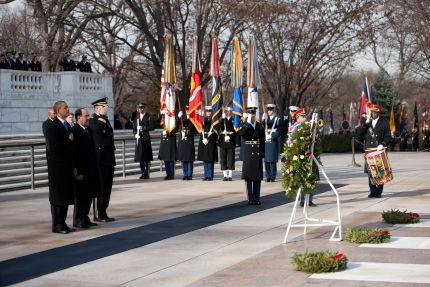
Nearly 4,500 Americans lost their lives in the Iraq War. After the press conference, President Obama and Prime Minister Maliki visited the Arlington National Cemetery where they participated in a wreath-laying ceremony at the Tomb of the Unknown Soldier.

20111212 Arlington

President Barack Obama and Prime Minister Nouri al-Maliki participate in a wreath laying ceremony at the Tomb of the Unknowns at Arlington National Cemetery, in Arlington, Va., Dec. 12, 2011. (Official White House Photo by Lawrence Jackson)

The White House

Office of the Press Secretary

Remarks by President Obama and Prime Minister al-Maliki of Iraq in a Joint Press Conference

South Court Auditorium

12:24 P.M. EST

PRESIDENT OBAMA:  Please have a seat.  Good afternoon, everyone.

When I took office, nearly 150,000 American troops were deployed in Iraq, and I pledged to end this war, responsibly.  Today, only several thousand troops remain there, and more are coming home every day. 

This is a season of homecomings, and military families across America are being reunited for the holidays.  In the coming days, the last American soldiers will cross the border out of Iraq, with honor and with their heads held high.  After nearly nine years, our war in Iraq ends this month.

Today, I’m proud to welcome Prime Minister Maliki -- the elected leader of a sovereign, self-reliant and democratic Iraq. We're here to mark the end of this war; to honor the sacrifices of all those who made this day possible; and to turn the page -- begin a new chapter in the history between our countries -- a normal relationship between sovereign nations, an equal partnership based on mutual interests and mutual respect. 

Iraq faces great challenges, but today reflects the impressive progress that Iraqis have made.  Millions have cast their ballots -- some risking or giving their lives -- to vote in free elections.  The Prime Minister leads Iraq’s most inclusive government yet.  Iraqis are working to build institutions that are efficient and independent and transparent.

Economically, Iraqis continue to invest in their infrastructure and development.  And I think it's worth considering some remarkable statistics.  In the coming years, it’s estimated that Iraq’s economy will grow even faster than China's or India's.  With oil production rising, Iraq is on track to once again be one of the region’s leading oil producers.

With respect to security, Iraqi forces have been in the lead for the better part of three years -- patrolling the streets, dismantling militias, conducting counterterrorism operations.  Today, despite continued attacks by those who seek to derail Iraq’s progress, violence remains at record lows. 

And, Mr. Prime Minister, that’s a tribute to your leadership and to the skill and the sacrifices of Iraqi forces.

Across the region, Iraq is forging new ties of trade and commerce with its neighbors, and Iraq is assuming its rightful place among the community of nations.  For the first time in two decades, Iraq is scheduled to host the next Arab League Summit, and what a powerful message that will send throughout the Arab world.  People throughout the region will see a new Iraq that’s determining its own destiny -- a country in which people from different religious sects and ethnicities can resolve their differences peacefully through the democratic process.

Mr. Prime Minister, as we end this war, and as Iraq faces its future, the Iraqi people must know that you will not stand alone.  You have a strong and enduring partner in The United States of America. 

And so today, the Prime Minister and I are reaffirming our common vision of a long-term partnership between our nations.  This is in keeping with our Strategic Framework Agreement, and it will be like the close relationships we have with other sovereign nations.  Simply put, we are building a comprehensive partnership. 

Mr. Prime Minister, you’ve said that Iraqis seek democracy, “a state of citizens and not sects.”  So we’re partnering to strengthen the institutions upon which Iraq’s democracy depends  -- free elections, a vibrant press, a strong civil society, professional police and law enforcement that uphold the rule of law, an independent judiciary that delivers justice fairly, and transparent institutions that serve all Iraqis. 

We’re partnering to expand our trade and commerce.  We’ll make it easier for our businesses to export and innovate together.  We’ll share our experiences in agriculture and in health care.  We’ll work together to develop Iraq’s energy sector even as the Iraqi economy diversifies, and we’ll deepen Iraq’s integration into the global economy.

We’re partnering to expand the ties between our citizens, especially our young people.  Through efforts like the Fulbright program, we’re welcoming more Iraqi students and future leaders to America to study and form friendships that will bind our nations together for generations to come.  And we’ll forge more collaborations in areas like science and technology. 

We’ll partner for our shared security.  Mr. Prime Minister, we discussed how the United States could help Iraq train and equip its forces -- not by stationing American troops there or with U.S. bases in Iraq -- those days are over -- but rather, the kind of training and assistance we offer to other countries.  Given the challenges we face together in a rapidly changing region, we also agreed to establish a new, formal channel of communication between our national security advisors.

And finally, we’re partnering for regional security.  For just as Iraq has pledged not to interfere in other nations, other nations must not interfere in Iraq.  Iraq’s sovereignty must be respected.  And meanwhile, there should be no doubt, the drawdown in Iraq has allowed us to refocus our resources, achieve progress in Afghanistan, put al Qaeda on the path to defeat, and to better prepare for the full range of challenges that lie ahead. 

So make no mistake, our strong presence in the Middle East endures, and the United States will never waver in defense of our allies, our partners, or our interests. 

This is the shared vision that Prime Minister Maliki and I reaffirm today -- an equal partnership, a broad relationship that advances the security, the prosperity and the aspirations of both our people. 

Mr. Prime Minister, you’ve said it yourself -- building a strong and “durable relationship between our two countries is vital.”  And I could not agree more.
  
So this is a historic moment.  A war is ending.  A new day is upon us.  And let us never forget those who gave us this chance -- the untold number of Iraqis who've given their lives; more than one million Americans, military and civilian, who have served in Iraq; nearly 4,500 fallen Americans who gave their last full measure of devotion; tens of thousands of wounded warriors, and so many inspiring military families.  They are the reason that we can stand here today.  And we owe it to every single one of them -- we have a moral obligation to all of them -- to build a future worthy of their sacrifice. 

Mr. Prime Minister.

PRIME MINISTER AL-MALIKI:  (As interpreted, and in progress) -- positive atmosphere that prevailed among us, and for the obligations, the common obligations, of ending the war, and the commitment to which the American forces will withdraw from Iraq, which is a withdrawal that affects -- that indicates success, and not like others have said that it was negative, but the goals that we established were achieved.

Iraq had a political process established, a democratic process, and adoption of the principles of elections and the transfer -- peaceful transfer of authority.  Iraq is following a policy, a foreign policy, which does not intervene in the affairs of others and does not allow the others to intervene in its own affairs.  Iraq is looking for common grounds with the others, and establishes its interest at the forefront and the interest of the others, which it is concerned about, like from any confusion.

Your Excellency, today we meet in Washington after we have completed the first page of a constructive cooperation in which we also thank you and appreciate you for your commitment to everything that you have committed yourself to.  And anyone who observes the nature of the relationship between the two countries will say that the relationship will not end with the departure of the last American soldier.  It only started when we signed in 2008, in addition to the withdrawal treaty, the Strategic Framework Agreement for the relationship between our two countries.

And because we have proven success in the first mission, a very unique success -- nobody imagined that we would succeed in defeating terrorism and the al Qaeda -- we must also establish the necessary steps in order to succeed in our second stage, which is the dual relationship under the Strategic Framework Agreement, in the economic sphere, as well as in educational and commercial and cultural and judicial and security cooperation fields.

Iraq now has become -- reliant completely on its own security apparatus and internal security as a result of the expertise that it gained during the confrontations and the training and the equipping.  But it remains in need of cooperation with the United States of America in security issues and information and combating terrorism, and in the area of training and the area of equipping, which is needed by the Iraqi army.  And we have started that.  And we want to complete the process of equipping the Iraqi army in order to protect our sovereignty, and does not violate the rights of anybody -- or do not take any missions that sovereignty of others. 

Today, the joint mission is to establish the mechanisms and the commitments that will expedite our -- we have reached an agreement, and we have held a meeting for the higher joint committee under the chairmanship of Mr. Biden, the Vice President, and myself in Baghdad, and we spoke about all the details that would put the framework agreement into implementation.

And here we talked about it and its activation.  And there will be other discussions and other meetings with the higher committee here in Washington in order to put the final touches regarding the necessary mechanisms for cooperation and achieving the common vision that we followed, which was based on our common wills and political independent decision, and the desire to respect the sovereignty of each other. 

And we feel that we need political cooperation as well, in addition to cooperating in the security and economic and commercial fields.  We need a political cooperation, particularly with regard to the matters that are common and are of concern for us as two parties that want to cooperate.

The common vision that we used as a point of departure we have confirmed today.  And I am very happy, every time we meet with the American side, I find determination and a strong will to activate the Strategic Framework Agreement.  And I will say, frankly, this is necessary and it serves the interests of Iraq, as it is necessary and serves the interests of the United States of America. 

This makes us feel that we will succeed with the same commitment, common commitment that we had in combating terrorism and accomplishing the missions, the basis of which Iraq was independent.  Iraq today has a lot of wealth and it needs experience and expertise, and American and foreign expertise to help Iraq exploiting its own wealth in an ideal way.  Iraq is still suffering from a shortage of resources, and we have established a strategy to increase the Iraqi wealth.  And we hope that the American companies will have the largest role in increasing our wealth in the area of oil and other aspects as well.

Iraq wants to rebuild all these sectors that were harmed because of the war and because of the adventurous policies that were used by the former regime, and we need a wide range of reform in the area of education.

We have succeeded in signing several agreements through the educational initiative, which put hundreds of our college graduates to continue their graduate studies and specialized subject in American universities.  And I am putting it before everyone who is watching the relationship between the U.S. and Iraq.  It is a very -- it has very high aspirations. 

And I would like to renew my thanks for His Excellency the President for giving me this opportunity, and I wish him more success, God willing.  Thank you very much.

PRESIDENT OBAMA:  We have time for a few questions.  I’m going to start with Ben Feller of AP.

Q    Thank you, Mr. President, and Mr. Prime Minister.  Mr. President, I have two questions for you on the region.  In Syria, you have called for President Assad to step down over the killing of his people, but Prime Minister Maliki has warned that Assad’s removal could lead to a civil war that could destabilize the whole region.  I’m wondering if you’re worried that Iraq could be succumbing to Iran’s influence on this matter and perhaps helping to protect Assad.

And speaking of Iran, are you concerned that it will be able to weaken America’s national security by discovering intelligence from the fallen drone that it captured?

Prime Minister Maliki, I’d like to ask you the question about Syria.  Why haven’t you demanded that Assad step down, given the slaughter of his people?

PRESIDENT OBAMA:  First of all, the Prime Minister and I discussed Syria, and we share the view that when the Syrian people are being killed or are unable to express themselves, that’s a problem.  There’s no disagreement there.

I have expressed my outrage in how the Syrian regime has been operating.  I do believe that President Assad missed an opportunity to reform his government, chose the path of repression, and has continued to engage in repressive tactics so that his credibility, his capacity to regain legitimacy inside Syria I think is deeply eroded.

It’s not an easy situation.  And I expressed to Prime Minister Maliki my recognition that given Syria is on Iraq’s borders, Iraq is in a tough neighborhood; that we will consult closely with them as we move forward. 

But we believe that international pressure, the approach we’ve taken along with partners around the world to impose tough sanctions and to call on Assad to step down, a position that is increasingly mirrored by the Arab League states, is the right position to take.

Even if there are tactical disagreements between Iraq and the United States at this point in how to deal with Syria, I have absolutely no doubt that these decisions are being made based on what Prime Minister Maliki believes is best for Iraq, not based on considerations of what Iran would like to see.

Prime Minister Maliki has been explicit here in the United States, he’s been explicit back in Iraq in his writings, in his commentary, that his interest is maintaining Iraqi sovereignty and preventing meddling by anybody inside of Iraq.  And I believe him.  And he has shown himself to be willing to make very tough decisions in the interest of Iraqi nationalism even if they cause problems with his neighbor.

And so we may have some different tactical views in terms of how best to transition to an inclusive, representative government inside of Syria, but every decision that I believe Prime Minister Maliki is making he is making on the basis of what he thinks is best for the Iraqi people.  And everything that we’ve seen in our interactions with Prime Minister Maliki and his government over the last several years would confirm that.

With respect to the drone inside of Iran, I’m not going to comment on intelligence matters that are classified.  As has already been indicated, we have asked for it back.  We’ll see how the Iranians respond.

PRIME MINISTER AL-MALIKI:  (As interpreted, in progress.) -- difficult in Syria, and perhaps in other states as well.  But I know that peoples must get their freedom and their will and democracy and equal citizenship.  We are with these rights, the rights of people and with their wills because we have achieved that ourselves.  And if we could compare Iraq today with the past, we find that there is a great difference in democracy and elections and freedom. 

Therefore, we honor the aspirations of the Syrian people.  But I cannot have -- I do not have the right to ask a president to abdicate.  We must play this role, and we cannot give ourselves this right. 

Iraq is a country that is bordering on Syria, and I am concerned about the interest of Iraq and the interest of the security of the region.  And I wish that what is required by the Syrian people would be achieved without affecting the security of Iraq.  And I know the two countries are related to each other, and we must be very prudent in dealing with this matter.

We were with the initiative by the Arab League.  But, frankly speaking, because we suffered from the blockade and the military interventions, we do not encourage a blockade because it exhausts the people and the government.  But we stood with the Arab League, and we were very frank with ourselves when they visited us in Baghdad, and we agreed on an initiative.  Perhaps it will be the last initiative that we’ll see in this situation and will achieve the required change in Syria without any violent operations that could affect the area in general.

I believe that the parties, all the parties realize the dangers of a sectarian war in Iraq, in Syria, and in the region, because it will be like a snowball that it will expand and it will be difficult to control it. 

We will try to reach a solution, and I discussed the matter with His Excellency, the President, President Obama, and the Secretary General of the Arab League.  And there is agreement even from the Syrian opposition, who are leading the opposition in Syria, to search for a solution.  If we can reach a solution, it will avoid all the evils and the dangers.  And if we don’t, there must be another way to reach a solution that will calm the situation in Syria and in the area in general.

Q    (As interpreted, in progress.) -- establish a new relationship -- to establish the characteristics of a new relationship with the United States after the withdrawal of the U.S. forces from Iraq?  Relying on the Strategic Framework Agreement, have you reached a specific mechanism for the implementation of the framework agreement? 

Your Excellency, President Obama, you said that there will be long-range relationships with Iraq.  Can you tell us exactly, will Iraq be an ally of the United States or just a friend, or will have a different type of relationship?

Thank you very much.

PRIME MINISTER AL-MALIKI:  (As interpreted.)  Definitely, without mechanisms, we will not be able to achieve anything we have.  These mechanisms will control our continuous movement.  Therefore, the framework agreement has a higher committee, or a joint committee from the two countries that meets regularly, and it has representatives from all the sectors that we want to develop relationship in -- commerce, industry, agriculture, economy, security.

So the joint higher committee is the mechanism in which the ideas will be reached in relationship between the ministries that will implement what is agreed upon.  We believe through these two mechanisms, the mechanism of the joint committee and the mechanism of contact between each minister and his counterpart, we will achieve success, and this will expedite achieving our goal.

PRESIDENT OBAMA:  As the Prime Minister described, I think our goal is to have a comprehensive relationship with Iraq.  And what that means is, is that on everything from expanding trade and commerce, to scientific exchanges, to providing assistance as Iraq is trying to make sure that electricity and power generation is consistent for its people, to joint exercises militarily -- to a whole range of issues, we want to make sure that there is a constant communication between our governments; that there are deep and rich exchanges between our two governments -- and between our peoples -- because what’s happened over the last several years has linked the United States and Iraq in a way that is potentially powerful and could end up benefiting not only America and Iraq but also the entire region and the entire world.

It will evolve over time.  What may be discovered is, is that there are certain issues that Prime Minister Maliki and his government think are especially important right now -- for example, making sure that oil production is ramped up, and we are helping to encourage global investment in that sector. 

I know that the Prime Minister has certain concerns right now, militarily, that five years from now or 10 years from now, when the Iraqi air force is fully developed or the Iraqi navy is fully developed, he has less concern about.

Our goal is simply to make sure that Iraq succeeds, because we think a successful, democratic Iraq can be a model for the entire region.  We think an Iraq that is inclusive and brings together all people -- Sunni, Shia, Kurd -- together to build a country, to build a nation, can be a model for others that are aspiring to create democracy in the region. 

And so we've got an enormous investment of blood and treasure in Iraq, and we want to make sure that, even as we bring the last troops out, that it's well understood both in Iraq and here in the United States that our commitment to Iraq's success is going to be enduring.

Christi Parsons.

Q    Thank you.  You were a little delayed coming out today -- I was wondering if you could talk about any agreements that you may have reached that you haven't detailed already.  For instance, can you talk a little bit more about who will be left behind after the U.S. leaves, how big their footprint will be, and what their role will be?

And, Mr. President, could you also address how convinced you are that the Maliki government is ready to govern the country and protect the gains that have been made there in recent years?  I also wonder if, on this occasion, you still think of this as "a dumb war"?

PRESIDENT OBAMA:  I'll take the last question first.  I think history will judge the original decision to go into Iraq.  But what's absolutely clear is, as a consequence of the enormous sacrifices that have been made by American soldiers and civilians -- American troops and civilians -- as well as the courage of the Iraqi people, that what we have now achieved is an Iraq that is self-governing, that is inclusive, and that has enormous potential.

There are still going to be challenges.  And I think the Prime Minister is the first one to acknowledge those challenges. Many of them, by the way, are economic.  After many years of war and, before that, a brutal regime, it's going to take time to further develop civil society, further develop the institutions of trade and commerce and the free market, so that the extraordinary capacity of the Iraqi people is fully realized.  But I have no doubt that Iraq can succeed.

With respect to security issues, look, when I came into office, I said we’re going to do this in a deliberate fashion.  We’re going to make sure that we leave Iraq responsibly, and that's exactly what we’ve done.  We did it in phases.  And because we did it in phases, we were continually able to build up Iraqi forces to a point where when we left the cities, violence didn't go up in the cities; when we further reduced our footprint, violence didn't go up.  And I have no doubt that that will continue.

First question you had had to do with what footprint is left.  We’re taking all of our troops out of Iraq.  We will not have any bases inside of Iraq.  We will have a strong diplomatic presence inside of Iraq.  We’ve got an embassy there that is going to be carrying out a lot of the functions of this ongoing partnership and executing on the Strategic Framework Agreement. 

We will be working to set up effective military-to-military ties that are no different from the ties that we have with countries throughout the region and around the world.  The Iraqi government has already purchased F-16s from us.  We've got to train their pilots and make sure that they're up and running and that we have an effective Iraqi air force.

We both have interests in making sure that the sea lanes remain open in and around Iraq and throughout the region, and so there may be occasion for joint exercises.  We both have interests in counterterrorism operations that might undermine Iraqi sovereignty but also could affect U.S. interests, and we’ll be working together on those issues.

But what we are doing here today, and what we’ll be executing over the next several months, is a normalization of the relationship.  We will have a strong friend and partner in Iraq; they will have a strong friend and partner in us, but as one based on Iraqi sovereignty and one based on equal partnerships of mutual interest and mutual respect.  And I’m absolutely confident that we’re going to be able to execute that over the long term.

While I’m at it, since this may be the last question I receive, I just want to acknowledge -- none of this would have been successful, obviously, without our extraordinary men and women in uniform.  And I’m very grateful for the Prime Minister asking to travel to Arlington to recognize those sacrifices. 

There are also some individuals here who've been doing a bang-up job over the last year to help bring us to this day.  And I just want to acknowledge General Lloyd Austin, who was a warrior and, turns out, is also a pretty good diplomat -- as well as Ambassador Jim Jeffreys [sic].  Both of them have done extraordinary work on the ground, partnering with their Iraqi counterparts. 

And I’m going to give a special shout-out to my friend and partner, Joe Biden, who I think ever since I came in has helped to establish high-level, strong links and dialogue between the United States and Iraq, through some difficult times.  And I think Prime Minister Maliki would agree that the Vice President’s investment in making this successful has been hugely important.

PRIME MINISTER AL-MALIKI:  Thank you very much.  I believe the remaining of the question that was given was answered by His Excellency the President.  And I also -- I said at the beginning, the dialogues that were to confirm the confidence and to move into the implementation of the framework agreement, and to find the companies and to train our soldiers on the weapons that were bought from America, and the need for expertise in other civil fields, and the protection of their movement in Iraq.

We talked also about the political issues, which is a common interest for us.  And we spoke also about the question of armament.  As the President said, Iraq has bought some weapons and now is applying for buying other weapons to develop its capabilities in the protection of Iraq.

These are all titles of what we discussed, but it was done in an atmosphere of harmony. 

Q    (As interpreted.)  Mr. Prime Minister, you stated that there is cooperation in the area of armament.  Can you tell us the amount of military cooperation between the United States and Baghdad in this area?  Specifically, have you received any promises from President Obama in this regard, specifically -- of the U.S. embassy in Baghdad?  There is argument going on inside Iraqi politician now regarding the size -- it’s 15,000.  And I wonder if you discussed with Prime Minister to reduce the number of the diplomats.  Thank you.

PRIME MINISTER AL-MALIKI:  Definitely, we have raised the issue of Iraqi need for weapons, for aerial protection and naval and ground protection.  We have a lot of weapons, American weapons, and it requires trainers.  And we received promises for cooperation from His Excellency the President for some weapons that Iraq is asking for, especially those related to its protection of its airspace.  And we hope that the Congress will approve another group of F-16 airplanes to Iraq because our air force was destroyed completely during the war that Iraq entered into. 

And this is not all.  We also need technical equipment related to the security field.  These are issues that are being discussed by the concerned people in both countries, between the ministers of defense and interior, with their counterparts in the United States, and we received promises and facilitations.  And we agreed on how to make this relationship continuous in the security field, because both of us need each other and need cooperation, especially in chasing al Qaeda, which we started and was not defeated anywhere except in Iraq.  And we hope to cooperate with all those who feel the dangers of this organization -- to cooperate with us as well.

PRESIDENT OBAMA:  Our view is a sovereign Iraq that can protect its borders, protect its airspace, protect its people.  And our security cooperation with other countries I think is a model for our security cooperation with Iraq.  We don't want to create big footprints inside of Iraq -- and that's I think demonstrated by what will happen at the end of this month, which is we’re getting our troops out.  But we will have a very active relationship, military-to-military, that will hopefully enhance Iraqi capabilities and will assure that we’ve got a strong partner in the region that is going to be effective.

With respect to the embassy, the actual size of our embassy with respect to diplomats is going to be comparable to other countries' that we think are important around the world.  There are still some special security needs inside of Iraq that make the overall number larger.  And we understand some questions have been raised inside of Iraq about that. 

Look, we’re only a few years removed from an active war inside of Iraq.  I think it's fair to say that there are still some groups, although they are greatly weakened, that might be tempted to target U.S. diplomats, or civilians who are working to improve the performance of the power sector inside of Iraq or are working to help train agricultural specialists inside of Iraq.  And as President of the United States, I want to make sure that anybody who is out in Iraq trying to help the Iraqi people is protected.

Now, as this transition proceeds, it may turn out that the security needs for our diplomats and for our civilians gradually reduces itself, partly because Iraq continues to make additional progress.  But I think the Iraqi people can understand that, as President of the United States, if I'm putting civilians in the field in order to help the Iraqi people build their economy and improve their productivity, I want to make sure that they come home -- because they are not soldiers.

So that makes the numbers larger than they otherwise would be, but the overall mission that they're carrying out is comparable to the missions that are taking place in other countries that are big, that are important, and that are friends of ours.  Okay? 

Thank you very much, everybody.

END
1:04 P.M. EST
The White House

Office of the Press Secretary

President Obama Names Commerce Secretary John Bryson, NEC Chair Gene Sperling as Co-Chairs of White House Office of Manufacturing Policy

WASHINGTON - President Obama today announced that Secretary John Bryson would join National Economic Council Director Gene Sperling as co-chair of the White House Office of Manufacturing Policy.  The Office of Manufacturing Policy is part of the National Economic Council in the White House and works across federal government agencies to coordinate the execution of manufacturing programs and the development of manufacturing policy.

“At this make or break time for the middle class and our economy, we need a strong manufacturing sector that will put Americans back to work making products stamped with three proud words: Made in America,” said President Obama.  “I am grateful that Secretary Bryson and Gene Sperling will head up this office to continue our efforts to revitalize this great American industry and fight for American workers and jobs.”

“John Bryson brings to this role decades of business leadership, a passion for manufacturing, and a strong understanding of its importance for jobs and our nation's economic competitiveness. He will play a key leadership role for the President and his economic team on these critical issues,” said Gene Sperling.

Secretary Bryson led Southern California Edison as Chairman and CEO for 18 years, served as Boeing’s longest-serving director, as well as served as an adviser to Coda Automotive.  Secretary Bryson’s business experience, combined with the Commerce Department’s strengths, including promoting U.S. exports, advising small manufacturers, developing tomorrow’s cutting edge standards, commercializing federally funded research, and protecting America’s intellectual property, uniquely position Secretary Bryson to help lead the Administration’s manufacturing efforts.

“Supporting the manufacturing sector will further our ability to innovate at home and compete around the world while generating more high-wage American jobs,” Secretary Bryson said. “Since day one, President Obama has been focused on supporting the entire United States manufacturing sector but especially small and medium sized businesses on the cutting edge of advanced manufacturing. We are introducing an ‘all hands on deck’ approach that coordinates all of our assets - public and private, federal, state, and regional.”

The White House Office of Manufacturing Policy will convene cabinet-level meetings to aggressively implement the Administration’s priority manufacturing initiatives.  Consistent with the President’s focus on small and growing businesses, Administrator Karen Mills will lead efforts on access to capital for small and medium manufacturers.

In his first month in office, Secretary Bryson has led trade talks with China to level the playing field for American companies and workers.   He is reaching out to CEOs, has met with the Steering Committee of the President’s Advanced Manufacturing Partnership, and has directed the Manufacturing Extension Partnership (MEP) housed within the Department’s National Institute of Standards and Technology (NIST) to expand their efforts to connect competitive, U.S. based suppliers with upper tier domestic and foreign companies, wherever located.

Upon taking office, the President made the tough choice to provide the auto industry temporary support – assistance which has helped the auto industry add back more than 140,000 jobs and positions the United States to lead the world in advanced vehicle manufacturing.  In addition, the Administration has taken steps to reduce costs for manufacturers, expand markets abroad, and invest in infrastructure and innovation to make our manufacturers globally competitive.

Those actions have included passing three free trade agreements that will significantly boost exports as well as support tens of thousands of good-paying American jobs.  These agreements also support the President’s National Export Initiative launched in 2010, with the goal of doubling U.S. exports by 2014.  Over 60% of exports are manufactured goods, and exports support over one quarter of all U.S. manufacturing jobs.  The initiative is on track to reach that goal, and has already helped U.S. businesses expand exports 17 percent in 2010 and 16 percent so far this year.

The President has also called on Congress to help revitalize American manufacturing, including continuing to push for an expanded, simplified, and permanent research and development tax credit which would provide the certainty and predictability manufacturers need to invest in innovation.  In addition, the President’s American Jobs Act would extend the 100 percent capital purchase expensing provision signed into law in December 2010 and make an immediate $50 billion investment for highway, highway safety, transit, passenger rail, and aviation activities.

Since the bottom of the recession in 2009, manufacturing production has grown 14 percent while real goods exports have grown 29 percent.  Over this same period, U.S. manufacturing has added over 300,000 jobs, the first time the sector has experienced sustained job growth in over a decade, but more must be done to revitalize American manufacturing.

The White House

Office of the Press Secretary

Remarks by the President at "Christmas in Washington"

National Building Museum
Washington, D.C.

7:31 P.M. EST

THE PRESIDENT:  Thank you.  Thank you very much.  (Applause.)  Good evening.  Thank you.  Thank you.  Everybody, please, have a seat. 

Good evening, everybody.  I just want to start by thanking all the folks who have joined us at the National Building Museum.  Let’s give it up for our host, who also happens to be the host of the best late night show on TBS, Conan O’Brien.  (Laughter and applause.)  And I want to thank all the spectacular artists and choirs and glee clubs who have made this such a spectacular evening.  Please give them a big round of applause.  (Applause.) 

I want to congratulate 30 years of “Christmas in Washington.”  It’s always such an extraordinary honor to be a part of this event because it benefits such a special place –- the Children’s National Medical Center.  For so many children and their parents, the work that they do to save lives and improve care is nothing short of a miracle.  And that’s fitting, because this is the season to celebrate miracles.

This is the season to celebrate the story of how, more than two thousand years ago, a child was born to two faithful travelers who could find rest only in a stable, among cattle and sheep.  He was no ordinary child.  He was the manifestation of God’s love.  And every year we celebrate His birth because the story of Jesus Christ changed the world.  For me, and for millions of Americans, His story has filled our hearts and inspired our lives.  It moves us to love one another; to help and serve those less fortunate; to forgive; to draw close to our families; to be grateful for all that has been given to us; to keep faith; and to hold on to an enduring hope in humanity.

Service to others.  Compassion to all.  Treating others as we wish ourselves to be treated.  Those values aren’t just at the center of Christianity; those are values that are shared by all faiths.  So tonight let us all rededicate ourselves to each other.  And, in that spirit, from my family to yours, happy holidays.  Merry Christmas.  God bless you all, and God bless the United States of America.  (Applause.)

END               
7:34 P.M. EST

Christmas in Washington

December 11, 2011 | 4:09 | Public Domain

President Obama speaks during the "Christmas in Washington" celebration at the National Building Museum in Washington, DC.

Download mp4 (40MB) | mp3 (4MB)

The White House

Office of the Press Secretary

WEEKLY ADDRESS: Ensuring a Fair Shot for the Middle Class

WASHINGTON— In this week’s address, President Obama told the American people that the United States succeeds when everyone gets a fair shot, does their fair share, and engages in fair play.  This is why the President nominated Richard Cordray to lead a new consumer-watchdog agency designed to protect families from being taken advantage of, but Republicans in Congress have blocked the nomination. They have also stood in the way of a balanced plan to extend the payroll tax cut for working families – and the President made clear he believes that elected officials should not go home for the holidays until they’ve done what is right for the American people and for the economy by extending this tax cut.

Remarks of President Barack Obama
As Prepared for Delivery
The White House
Saturday, December 10, 2011

Today, America faces a make-or-break moment for the middle class. 

After the worst economic crisis of our lifetimes, some still want to return to the same policies that got us into this mess.  They’re the same policies that have stacked the deck against working Americans for too long.  They’re part of a philosophy that says we’re better off when everyone is left to fend for themselves and play by their own rules.

But I have a different vision.  I believe that we are greater together than we are on our own.  I believe that this country succeeds when everyone gets a fair shot, everyone does their fair share, and everyone engages in fair play.

To ensure fair play, last year, we passed the toughest financial reform in generations.

See, for too long, the rules weren’t the same on Wall Street as they were on Main Street.  Risky bets were made with other people’s money.  Some folks made a lot of money taking advantage of consumers.  It was wrong.  And this irresponsible behavior on the part of some contributed to the worst financial crisis since the Great Depression.

So this financial reform refocuses the financial sector on what’s really important: getting capital to entrepreneurs who want to grow their businesses, and financing to millions of families who want to buy a house or send their kids to college. 

A key part of that was putting in place the first-ever consumer watchdog – someone whose job it is to protect American families from being taken advantage of by mortgage lenders, payday lenders, and debt collectors. 

Tens of millions of Americans use these services.  Protecting them from unscrupulous practices is an important job.  And that’s why I nominated Richard Cordray to serve as the head of this consumer watchdog agency.

As the former Attorney General of Ohio, Richard helped recover billions of dollars on behalf of retirees and stood up to dishonest lending practices.  He has the support of most Attorneys General across the country, both Democrats and Republicans.  Members of Congress from both parties say he’s more than qualified for the job.  And yet on Thursday, Republicans blocked his nomination.  They refused to even allow it to come up for a vote.

That doesn’t make any sense.  Do Republicans in Congress think our financial crisis was caused by too much oversight of mortgage lenders or debt collectors?  Of course not.   And every day America has to wait for a new consumer protection watchdog is another day that dishonest businesses can target and take advantage of students, seniors, and service members. 

So I refuse to take “no” for an answer.  Financial institutions have plenty of high-powered lawyers and lobbyists looking out for them.  It’s time consumers had someone on their side. 

And while they’re at it, Republicans in Congress should stop the games and extend the payroll tax cut for working Americans. Because if they don’t, nearly 160 million Americans will see their taxes go up at the end of this month.   

Congress can’t end the year by taking money out of the pockets of working Americans.  Now is not the time for playing politics.  Now is the time to do what’s right for the American people. 

No one should go home for the holidays until we get this done.  So tell your Members of Congress, don’t be a Grinch.  Tell them to do the right thing for you and for our economy.  Thank you.