The White House

Office of the Press Secretary

President Obama Announces Presidential Delegation to Argentina to Attend the Inauguration of President Cristina Fernandez de Kirchner

President Barack Obama today announced the designation of a Presidential Delegation to Buenos Aires, Argentina to attend the Inauguration of President Cristina Fernandez de Kirchner on December 10, 2011.

The Honorable Hilda L. Solis, U.S. Secretary of Labor, will lead the delegation.

Members of the Presidential Delegation:

The Honorable Vilma S. Martinez, U.S. Ambassador to the Republic of Argentina

Mr. Daniel Restrepo, Special Assistant to the President and Senior Director for Western Hemisphere Affairs, National Security Staff

President Obama Speaks on Confirming Richard Cordray

December 08, 2011 | 19:54 | Public Domain

President Obama says he’s not giving up on confirming Richard Cordray as Director of the Consumer Financial Protection Bureau after the Senate blocks a vote to put Cordray in place to help protect American consumers from unscrupulous financial operators.

Download mp4 (190MB) | mp3 (18MB)

Read the Transcript

Statement by the President

James S. Brady Press Briefing Room

11:40 A.M. EST

THE PRESIDENT:  Good morning, everybody.  A couple of days ago I said that we are in a make-or-break moment when it comes to America's middle class.  We either have a country where everybody fends for themselves, or we create a country where everybody does their fair share, everybody has got a fair chance, and we ensure that there's fair play out there.

Now, to ensure fair play, one of the things that I talked about was the importance of making sure we implement financial reform, Wall Street reform that was passed last year.  And a key component of that was making sure that we have a consumer watchdog in place who can police what mortgage brokers and payday lenders and other non-bank financial entities are able to do when it comes to consumers. 

This is a big deal.  About one-in-five people use these kinds of mechanisms to finance everything from buying a house to cashing their checks.  And we passed a law last year that said we need this consumer watchdog in place to make sure that people aren’t taken advantage of.

Now, we have nominated somebody -- Richard Cordray, former attorney general and treasurer of Ohio -- who everybody says is highly qualified.  The majority of attorney generals, Republican and Democrat, from across the country have said this is somebody who can do the job with integrity, who has a tradition of being a bipartisan individual who looks out for the public interest, and is ready to go.  And he actually helped set up the Consumer Finance Protection Board. 

This morning, Senate Republicans blocked his nomination, refusing to let the Senate even go forward with an up or down vote on Mr. Cordray.  This makes absolutely no sense.

Consumers across the country understand that part of the reason we got into the financial mess that we did was because regulators were not doing their jobs.  People were not paying attention to what was happening in the housing market; people weren’t paying attention to who was being taken advantage of.  There were folks who were making a lot of money taking advantage of American consumers.

This individual's job is to make sure that individual consumers are protected -- everybody from seniors to young people who are looking for student loans, to members of our Armed Services who are probably more vulnerable than just about anybody when it comes to unscrupulous financial practices.

There is no reason why Mr. Cordray should not be nominated, and should not be confirmed by the Senate, and should not be doing his job right away in order to carry out his mandate and his mission.

So I just want to send a message to the Senate:  We are not giving up on this.  We're going to keep on going at it.  We are not going to allow politics as usual on Capitol Hill to stand in the way of American consumers being protected by unscrupulous financial operators.  And we're going to keep on pushing on this issue.

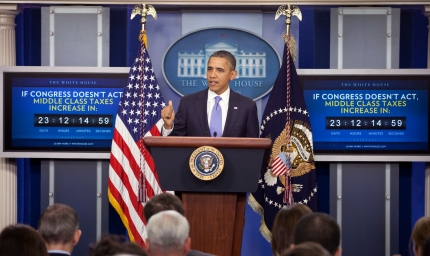
Now, the second thing I want to make clear about is that, with respect to the payroll tax -- you guys have all seen our countdown clock behind us.  This is about doing -- making sure that everybody is doing their fair share and that the middle class does not see their taxes go up by $1,000 in 23 days. 

And we've heard recently some intimations from the Senate Majority Leader and from the Speaker of the House -- or the Senate Minority Leader and the Speaker of the House that they think we should do a payroll tax, but the question is what price will they extract from the President in order to get it done. 

And I just want to make clear:  This is not about me.  They shouldn’t extend the payroll tax cut for me.  They shouldn’t extend unemployment insurance for me.  This is for 160 million people who, in 23 days, are going to see their taxes go up if Congress doesn’t act.  This is for 5 million individuals who are out there looking for a job and can't find a job right now in a tough economy who could end up not being able to pay their bills or keep their house if Congress doesn’t act.

So rather than trying to figure out what can they extract politically from me in order to get this thing done, what they need to do is be focused on what's good for the economy, what's good for jobs and what's good for the American people.

And I made very clear I do not expect Congress to go home unless the payroll tax cut is extended and unless unemployment insurance is extended.  It would be wrong for families, but it would also be wrong for the economy as a whole.

With that, I'm going to take a couple of questions.  Ben.

Q    Thank you, Mr. President.  It's a very busy time.  If I may, I'd like to ask you about two other important issues in the news.  Republican candidates have taken aim at your approach to foreign policy, particularly the Middle East and Israel, and accused you of appeasement.  I wanted to get your reaction to that.  And also, I'm wondering if you personally intervened in any way in halting the sale of the "morning after" pill to those under 17, and whether you think politics trumps science in this case.

THE PRESIDENT:  Ask Osama bin Laden and the 22-out-of-30 top al Qaeda leaders who've been taken off the field whether I engage in appeasement.  Or whoever is left out there, ask them about that.

With respect to the Plan B, I did not get involved in the process.  This was a decision that was made by Kathleen Sebelius, the Secretary of HHS. 

I will say this, as the father of two daughters.  I think it is important for us to make sure that we apply some common sense to various rules when it comes to over-the-counter medicine.  And as I understand it, the reason Kathleen made this decision was she could not be confident that a 10-year-old or an 11-year-old go into a drugstore, should be able -- alongside bubble gum or batteries -- be able to buy a medication that potentially, if not used properly, could end up having an adverse effect.  And I think most parents would probably feel the same way. 

So the expectation here is -- I think it's very important to understand that, for women, for those over 17, this continues to be something that you can go in and purchase from a drugstore.  It has been deemed safe by the FDA.  Nobody is challenging that. When it comes to 12-year-olds or 13-year-olds, the question is can we have confidence that they would potentially use Plan B properly.  And her judgment was that there was not enough evidence that this potentially could be used improperly in a way that had adverse health effects on those young people.

Q    Do you fully support the decision?

THE PRESIDENT:  I do. 

Q    Mr. President, is a recess appointment for Richard Cordray on the table, number one.  And number two, the Italian Prime Minister, the new Prime Minister indicated today he may be coming to the White House next month.  Do you think he and other European leaders are stepping up in the way you've urged them to, to sort of clear up the debt crisis?

THE PRESIDENT:  I will not take any options off the table when it comes to getting Richard Cordray in as director of the Consumer Finance Protection Board.  And I want to repeat what I said earlier:  This is a law that was passed by Congress that I signed into law that is designed solely to protect American consumers. 

I don't think there's any consumer out there -- I don't think there's any American out there -- who thinks that the reason we got into the big financial mess that we did was because of too much regulation of Wall Street or the financial services industry.  I take it back.  I'm sure there are some folks in the financial service industry who make that argument, although I'm not sure that they make it with a straight face.

So let's just take a very specific example:  All the families out there who have now lost their home, after having paid their mortgage over and over again, because they were told that they could afford this home; they didn’t understand all the documentation that was involved -- this was peddled deliberately to them, even though a mortgage broker might have known that there was no way that they could keep up with these payments -- and now they're out on the street because nobody was making sure that there's fair play and fair dealing in the mortgage industry on it.  Now, why wouldn’t we want to have somebody just to make sure that people are being treated fairly?  Especially when not only is that family affected, but our whole economy is affected. 

This is part of what I was talking about a couple of days ago.  We have a Congress right now, Republicans in Congress right now, who seem to have entirely forgotten how we got into this mess.  And part of the reason was because we did not empower our regulators to make sure that they were ensuring fair play.  That’s what the Consumer Finance Protection Board is designed to do. 

We had Holly Petraeus, wife of General Petraeus, who's been working to make sure that our Armed Services personnel aren’t taken advantage of.  They get transferred to a base, and next thing they know they’re taking out loans that they think are a good deal, but it turns out that they’re paying 100-150-200 percent interest rates.  Why wouldn’t we want somebody in place to make sure that doesn’t happen?  It doesn’t make any sense.

So the bottom line is -- you asked about the recess appointment -- we’re going to look at all our options.  My hope and expectation is, is that the Republicans who blocked this nomination come to their senses.  And I know that some of them have made an argument, well, we just want to sort of make some modifications in the law.  Well, they’re free to introduce a bill and get that passed. 

But part of what’s happened over on Capitol Hill -- not just on this issue, but on every issue -- is they will hold up nominations, well-qualified judges aren’t getting a vote -- I’ve got assistant secretaries to the Treasury who get held up for no reason, just because they’re trying to see if they can use that to reverse some sort of law that’s already been passed.  And that’s part of what gets the American people so frustrated -- because they don’t feel like this thing is on the level.

Q    The European crisis, do you have any sense --

THE PRESIDENT:  Oh, on the European debt crisis -- I am obviously very concerned about what’s happening in Europe.  I've expressed those concerns repeatedly to President Sarkozy, Chancellor Merkel, all the key leaders involved.  I think they now recognize the urgency of doing something serious and bold.  The question is whether they can muster the political will to get it done.

Look, Europe is wealthy enough that there's no reason why they can’t solve this problem.  It’s not as if we’re talking about some impoverished country that doesn’t have any resources, and is being buffeted by the world markets, and they need to come hat in hand and get help.  This is Europe, with some of the wealthiest countries on Earth; collectively one of the largest markets on Earth, if not the largest.  And so if they muster the political will, they have the capacity to settle markets down, make sure that they are acting responsibly, and that governments like Italy are able to finance their debt. 

And I think that Chancellor Merkel has made some progress with other European leaders in trying to move towards a fiscal compact where everybody is playing by the same rules and nobody is acting irresponsibly.  I think that's all for the good, but there's a short-term crisis that has to be resolved to make sure that markets have confidence that Europe stands behind the euro.

And we're going to do everything we can to push them in a good direction on this, because it has a huge impact on what happens here in the United States.  They are our largest trading partner, and we're seeing some positive signs in our economy, but if we see Europe tank, that obviously could have a big impact on our ability to generate the jobs that we need here in the United States.

I'm going to answer one last question.  Kristen -- Kristen Welker.

Q    Mr. President, thank you.  You just called on Congress not to leave until they resolve this issue over the payroll tax cuts and unemployment insurance benefits.  Can you say definitively that you will postpone your own vacation until these two matters are resolved? 

And also, on Iran, we've heard some sharper language from members of your administration about Iran recently.  Are you intentionally trying to ramp up the pressure on Iran?  And given that you stated that no options are off the table, should we take that to mean that you are considering some other options?

THE PRESIDENT:  No options off the table means I’m considering all options. 

Q    Can you tell us specifically what those options might be?

THE PRESIDENT:  No.  But what I can say with respect to Iran, I think it's very important to remember, particularly given some of the political noise out there, that this administration has systematically imposed the toughest sanctions on Iraq -- on Iran ever. 

When we came into office, the world was divided, Iran was unified and moving aggressively on its own agenda.  Today, Iran is isolated, and the world is unified in applying the toughest sanctions that Iran has ever experienced.  And it's having an impact inside of Iran.  And that's as a consequence of the extraordinary work that's been done by our national security team.

Now, Iran understands that they have a choice:  They can break that isolation by acting responsibly and foreswearing the development of nuclear weapons, which would still allow them to pursue peaceful nuclear power, like every other country that's a member of the Non-Proliferation Treaty, or they can continue to operate in a fashion that isolates them from the entire world.  And if they are pursuing nuclear weapons, then I have said very clearly, that is contrary to the national security interests of the United States; it's contrary to the national security interests of our allies, including Israel; and we are going to work with the world community to prevent that.

With respect to my vacation, I would not ask anybody to do something I'm not willing to do myself.  So I know some of you might have been looking forward to a little sun and sand -- (laughter) -- but the bottom line is, is that we are going to stay here as long as it takes to make sure that the American people's taxes don't go up on January 1st, and to make sure that folks who desperately need unemployment insurance get that help. And there's absolutely no excuse for us not getting it done. 

Keep in mind, on the payroll tax cut, this is something that Democrats and Republicans agreed to last year with little fanfare, and it was good for the economy.  And independent economists estimate that for us to not extend it right now -- to not extend payroll tax cut, not extend unemployment insurance -- would have a significant, adverse impact on our economy, right at a time when we're supposed to be growing the economy.

So when I hear the Speaker or the Senate Republican leader wanting to dicker, wanting to see what can they extract from us in order to get this done, my response to them is, just do the right thing:  Focus on the American people, focus on the economy right now. 

I know the suggestion right now is, is that somehow, well, this Keystone issue will create jobs.  That's being determined by the State Department right now, and there is a process.  But here's what I know:  However many jobs might be generated by a Keystone pipeline, they're going to be a lot fewer than the jobs that are created by extending the payroll tax cut and extending unemployment insurance. 

Get it done.  And if not, maybe we'll have a white Christmas here in Washington.   And I look forward to spending a lot of time with you guys -- (laughter) -- between now and the New Year.

All right.  Thank you, guys.

END
12:00 P.M. EST

Close Transcript

The White House

Office of the Press Secretary

Strategic Implementation Plan for Empowering Local Partners to Prevent Violent Extremism in the United States

Attached is the Strategic Implementation Plan for Empowering Local Partners to Prevent Violent Extremism in the United States.

President Obama Discusses Richard Cordray and the Payroll Tax Cut

20111208 POTUS briefing clock

President Barack Obama remarks on the Republican obstruction of Richard Cordray’s nomination to head the Consumer Financial Protection Bureau during a statement in the James S. Brady Press Briefing Room of the White House, Dec. 8, 2011. (Official White House Photo by Chuck Kennedy)


This morning, Senate Republicans blocked the confirmation of Richard Cordray.

Shortly after, President Obama walked into the briefing room here at the White House to address that vote -- and the refusal of Congress to extend the payroll tax cut.

The President spoke first about his nominee to head the Consumer Financial Protection Bureau:

Consumers across the country understand that part of the reason we got into the financial mess that we did was because regulators were not doing their jobs.  People were not paying attention to what was happening in the housing market; people weren’t paying attention to who was being taken advantage of.  There were folks who were making a lot of money taking advantage of American consumers.  

This individual's job is to make sure that individual consumers are protected -- everybody from seniors to young people who are looking for student loans, to members of our Armed Services who are probably more vulnerable than just about anybody when it comes to unscrupulous financial practices. 

There is no reason why Mr. Cordray should not be nominated, and should not be confirmed by the Senate, and should not be doing his job right away in order to carry out his mandate and his mission.

President Obama promised to explore all options and take nothing "off the table" with respect to ensuring that the CFPB is able to fulfill its mission of protecting consumers. 

Related Topics: Economy, Financial Reform, Taxes

The White House

Office of the Press Secretary

Statement by the President

James S. Brady Press Briefing Room

11:40 A.M. EST

THE PRESIDENT:  Good morning, everybody.  A couple of days ago I said that we are in a make-or-break moment when it comes to America's middle class.  We either have a country where everybody fends for themselves, or we create a country where everybody does their fair share, everybody has got a fair chance, and we ensure that there's fair play out there.

Now, to ensure fair play, one of the things that I talked about was the importance of making sure we implement financial reform, Wall Street reform that was passed last year.  And a key component of that was making sure that we have a consumer watchdog in place who can police what mortgage brokers and payday lenders and other non-bank financial entities are able to do when it comes to consumers. 

This is a big deal.  About one-in-five people use these kinds of mechanisms to finance everything from buying a house to cashing their checks.  And we passed a law last year that said we need this consumer watchdog in place to make sure that people aren’t taken advantage of.

Now, we have nominated somebody -- Richard Cordray, former attorney general and treasurer of Ohio -- who everybody says is highly qualified.  The majority of attorney generals, Republican and Democrat, from across the country have said this is somebody who can do the job with integrity, who has a tradition of being a bipartisan individual who looks out for the public interest, and is ready to go.  And he actually helped set up the Consumer Finance Protection Board. 

This morning, Senate Republicans blocked his nomination, refusing to let the Senate even go forward with an up or down vote on Mr. Cordray.  This makes absolutely no sense.

Consumers across the country understand that part of the reason we got into the financial mess that we did was because regulators were not doing their jobs.  People were not paying attention to what was happening in the housing market; people weren’t paying attention to who was being taken advantage of.  There were folks who were making a lot of money taking advantage of American consumers.

This individual's job is to make sure that individual consumers are protected -- everybody from seniors to young people who are looking for student loans, to members of our Armed Services who are probably more vulnerable than just about anybody when it comes to unscrupulous financial practices.

There is no reason why Mr. Cordray should not be nominated, and should not be confirmed by the Senate, and should not be doing his job right away in order to carry out his mandate and his mission.

So I just want to send a message to the Senate:  We are not giving up on this.  We're going to keep on going at it.  We are not going to allow politics as usual on Capitol Hill to stand in the way of American consumers being protected by unscrupulous financial operators.  And we're going to keep on pushing on this issue.

Now, the second thing I want to make clear about is that, with respect to the payroll tax -- you guys have all seen our countdown clock behind us.  This is about doing -- making sure that everybody is doing their fair share and that the middle class does not see their taxes go up by $1,000 in 23 days. 

And we've heard recently some intimations from the Senate Majority Leader and from the Speaker of the House -- or the Senate Minority Leader and the Speaker of the House that they think we should do a payroll tax, but the question is what price will they extract from the President in order to get it done. 

And I just want to make clear:  This is not about me.  They shouldn’t extend the payroll tax cut for me.  They shouldn’t extend unemployment insurance for me.  This is for 160 million people who, in 23 days, are going to see their taxes go up if Congress doesn’t act.  This is for 5 million individuals who are out there looking for a job and can't find a job right now in a tough economy who could end up not being able to pay their bills or keep their house if Congress doesn’t act.

So rather than trying to figure out what can they extract politically from me in order to get this thing done, what they need to do is be focused on what's good for the economy, what's good for jobs and what's good for the American people.

And I made very clear I do not expect Congress to go home unless the payroll tax cut is extended and unless unemployment insurance is extended.  It would be wrong for families, but it would also be wrong for the economy as a whole.

With that, I'm going to take a couple of questions.  Ben.

Q    Thank you, Mr. President.  It's a very busy time.  If I may, I'd like to ask you about two other important issues in the news.  Republican candidates have taken aim at your approach to foreign policy, particularly the Middle East and Israel, and accused you of appeasement.  I wanted to get your reaction to that.  And also, I'm wondering if you personally intervened in any way in halting the sale of the "morning after" pill to those under 17, and whether you think politics trumps science in this case.

THE PRESIDENT:  Ask Osama bin Laden and the 22-out-of-30 top al Qaeda leaders who've been taken off the field whether I engage in appeasement.  Or whoever is left out there, ask them about that.

With respect to the Plan B, I did not get involved in the process.  This was a decision that was made by Kathleen Sebelius, the Secretary of HHS. 

I will say this, as the father of two daughters.  I think it is important for us to make sure that we apply some common sense to various rules when it comes to over-the-counter medicine.  And as I understand it, the reason Kathleen made this decision was she could not be confident that a 10-year-old or an 11-year-old go into a drugstore, should be able -- alongside bubble gum or batteries -- be able to buy a medication that potentially, if not used properly, could end up having an adverse effect.  And I think most parents would probably feel the same way. 

So the expectation here is -- I think it's very important to understand that, for women, for those over 17, this continues to be something that you can go in and purchase from a drugstore.  It has been deemed safe by the FDA.  Nobody is challenging that. When it comes to 12-year-olds or 13-year-olds, the question is can we have confidence that they would potentially use Plan B properly.  And her judgment was that there was not enough evidence that this potentially could be used improperly in a way that had adverse health effects on those young people.

Q    Do you fully support the decision?

THE PRESIDENT:  I do. 

Q    Mr. President, is a recess appointment for Richard Cordray on the table, number one.  And number two, the Italian Prime Minister, the new Prime Minister indicated today he may be coming to the White House next month.  Do you think he and other European leaders are stepping up in the way you've urged them to, to sort of clear up the debt crisis?

THE PRESIDENT:  I will not take any options off the table when it comes to getting Richard Cordray in as director of the Consumer Finance Protection Board.  And I want to repeat what I said earlier:  This is a law that was passed by Congress that I signed into law that is designed solely to protect American consumers. 

I don't think there's any consumer out there -- I don't think there's any American out there -- who thinks that the reason we got into the big financial mess that we did was because of too much regulation of Wall Street or the financial services industry.  I take it back.  I'm sure there are some folks in the financial service industry who make that argument, although I'm not sure that they make it with a straight face.

So let's just take a very specific example:  All the families out there who have now lost their home, after having paid their mortgage over and over again, because they were told that they could afford this home; they didn’t understand all the documentation that was involved -- this was peddled deliberately to them, even though a mortgage broker might have known that there was no way that they could keep up with these payments -- and now they're out on the street because nobody was making sure that there's fair play and fair dealing in the mortgage industry on it.  Now, why wouldn’t we want to have somebody just to make sure that people are being treated fairly?  Especially when not only is that family affected, but our whole economy is affected. 

This is part of what I was talking about a couple of days ago.  We have a Congress right now, Republicans in Congress right now, who seem to have entirely forgotten how we got into this mess.  And part of the reason was because we did not empower our regulators to make sure that they were ensuring fair play.  That’s what the Consumer Finance Protection Board is designed to do. 

We had Holly Petraeus, wife of General Petraeus, who's been working to make sure that our Armed Services personnel aren’t taken advantage of.  They get transferred to a base, and next thing they know they’re taking out loans that they think are a good deal, but it turns out that they’re paying 100-150-200 percent interest rates.  Why wouldn’t we want somebody in place to make sure that doesn’t happen?  It doesn’t make any sense.

So the bottom line is -- you asked about the recess appointment -- we’re going to look at all our options.  My hope and expectation is, is that the Republicans who blocked this nomination come to their senses.  And I know that some of them have made an argument, well, we just want to sort of make some modifications in the law.  Well, they’re free to introduce a bill and get that passed. 

But part of what’s happened over on Capitol Hill -- not just on this issue, but on every issue -- is they will hold up nominations, well-qualified judges aren’t getting a vote -- I’ve got assistant secretaries to the Treasury who get held up for no reason, just because they’re trying to see if they can use that to reverse some sort of law that’s already been passed.  And that’s part of what gets the American people so frustrated -- because they don’t feel like this thing is on the level.

Q    The European crisis, do you have any sense --

THE PRESIDENT:  Oh, on the European debt crisis -- I am obviously very concerned about what’s happening in Europe.  I've expressed those concerns repeatedly to President Sarkozy, Chancellor Merkel, all the key leaders involved.  I think they now recognize the urgency of doing something serious and bold.  The question is whether they can muster the political will to get it done.

Look, Europe is wealthy enough that there's no reason why they can’t solve this problem.  It’s not as if we’re talking about some impoverished country that doesn’t have any resources, and is being buffeted by the world markets, and they need to come hat in hand and get help.  This is Europe, with some of the wealthiest countries on Earth; collectively one of the largest markets on Earth, if not the largest.  And so if they muster the political will, they have the capacity to settle markets down, make sure that they are acting responsibly, and that governments like Italy are able to finance their debt. 

And I think that Chancellor Merkel has made some progress with other European leaders in trying to move towards a fiscal compact where everybody is playing by the same rules and nobody is acting irresponsibly.  I think that's all for the good, but there's a short-term crisis that has to be resolved to make sure that markets have confidence that Europe stands behind the euro.

And we're going to do everything we can to push them in a good direction on this, because it has a huge impact on what happens here in the United States.  They are our largest trading partner, and we're seeing some positive signs in our economy, but if we see Europe tank, that obviously could have a big impact on our ability to generate the jobs that we need here in the United States.

I'm going to answer one last question.  Kristen -- Kristen Welker.

Q    Mr. President, thank you.  You just called on Congress not to leave until they resolve this issue over the payroll tax cuts and unemployment insurance benefits.  Can you say definitively that you will postpone your own vacation until these two matters are resolved? 

And also, on Iran, we've heard some sharper language from members of your administration about Iran recently.  Are you intentionally trying to ramp up the pressure on Iran?  And given that you stated that no options are off the table, should we take that to mean that you are considering some other options?

THE PRESIDENT:  No options off the table means I’m considering all options. 

Q    Can you tell us specifically what those options might be?

THE PRESIDENT:  No.  But what I can say with respect to Iran, I think it's very important to remember, particularly given some of the political noise out there, that this administration has systematically imposed the toughest sanctions on Iraq -- on Iran ever. 

When we came into office, the world was divided, Iran was unified and moving aggressively on its own agenda.  Today, Iran is isolated, and the world is unified in applying the toughest sanctions that Iran has ever experienced.  And it's having an impact inside of Iran.  And that's as a consequence of the extraordinary work that's been done by our national security team.

Now, Iran understands that they have a choice:  They can break that isolation by acting responsibly and foreswearing the development of nuclear weapons, which would still allow them to pursue peaceful nuclear power, like every other country that's a member of the Non-Proliferation Treaty, or they can continue to operate in a fashion that isolates them from the entire world.  And if they are pursuing nuclear weapons, then I have said very clearly, that is contrary to the national security interests of the United States; it's contrary to the national security interests of our allies, including Israel; and we are going to work with the world community to prevent that.

With respect to my vacation, I would not ask anybody to do something I'm not willing to do myself.  So I know some of you might have been looking forward to a little sun and sand -- (laughter) -- but the bottom line is, is that we are going to stay here as long as it takes to make sure that the American people's taxes don't go up on January 1st, and to make sure that folks who desperately need unemployment insurance get that help. And there's absolutely no excuse for us not getting it done. 

Keep in mind, on the payroll tax cut, this is something that Democrats and Republicans agreed to last year with little fanfare, and it was good for the economy.  And independent economists estimate that for us to not extend it right now -- to not extend payroll tax cut, not extend unemployment insurance -- would have a significant, adverse impact on our economy, right at a time when we're supposed to be growing the economy.

So when I hear the Speaker or the Senate Republican leader wanting to dicker, wanting to see what can they extract from us in order to get this done, my response to them is, just do the right thing:  Focus on the American people, focus on the economy right now. 

I know the suggestion right now is, is that somehow, well, this Keystone issue will create jobs.  That's being determined by the State Department right now, and there is a process.  But here's what I know:  However many jobs might be generated by a Keystone pipeline, they're going to be a lot fewer than the jobs that are created by extending the payroll tax cut and extending unemployment insurance. 

Get it done.  And if not, maybe we'll have a white Christmas here in Washington.   And I look forward to spending a lot of time with you guys -- (laughter) -- between now and the New Year.

All right.  Thank you, guys.

END
12:00 P.M. EST

President Obama meets with Prime Minister Stephen Harper

20111207 POTUS PM Harper

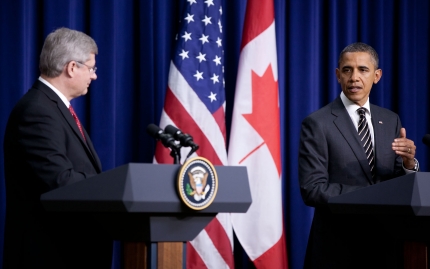
President Barack Obama and Prime Minister Stephen Harper of Canada hold a press conference in the Eisenhower Executive Office Building South Court Auditorium, Dec. 7, 2011. (Official White House Photo by Pete Souza)

Yesterday afternoon, President Obama welcomed Canadian Prime Minister Stephen Harper to the White House. Their conversation was wide-ranging, touching on the Eurozone crisis, the war in Afghanistan and the democratic transitions in the Middle East and North Africa. But the central focus of their talks was on creating jobs and boosting the economy:

[In] this mission, Canada has a special role to play. As most of you know, Canada is our single largest trading partner, our top export market, and those exports -- from cars to food -- support some 1.7 million good-paying American jobs. Canada, in turn, is one of the top foreign investors in the United States, and that creates even more jobs and prosperity.

And the Prime Minister and I are determined not just to sustain this trade but to expand it, to grow it even faster, so we’re creating even more jobs and more opportunity for our people. Canada is key to achieving my goal of doubling American exports and putting folks back to work.

The President and the Prime Minister announced two new iniatives to help achieve those aims.

First, our two nations will coordinate to introduce new technology to improve cargo security and screening at points of entry along the border. That will ease congestion and reduce the time it takes to transport products between the U.S. and Canada. That in turn will make it easier for businesses to export their goods.

Second, the U.S. and Canada will work to streamline regulations and, in some cases, eliminate them altogether. The goal here will be to align standards where possible, and this effort will focus on series of key sectors -- starting with automobiles, agriculture, and health care. The aim here is also to reduce costs for businesses.

Watch President Obama and Prime Minister Harper speak here.

Related Topics: Economy, Foreign Policy

The White House

Office of the Press Secretary

We Can’t Wait: Obama Administration Announces $2 Billion in Resources to Support Job-Creating Startups

Today, the White House announced administrative and private sector actions that will help entrepreneurs grow their businesses and create jobs by increasing their access to capital and resources. The U.S. Small Business Administration (SBA) is moving forward with launching a $1 billion Early Stage Innovation Fund, originally announced as part of Startup America, which will provide matching capital to Small Business Investment Companies (SBICs), targeting early-stage small businesses seeking private institutional capital. Today, the White House is also hosting the first board meeting of the Startup America Partnership, where board members will announce commitments from more than 50 private-sector partners to deliver over $1 billion in value – from free software to free consulting and legal services – to 100,000 startups over the next three years. The President also renewed his call for Congress to work on a bipartisan basis to develop ideas from his American Jobs Act plan that will help our small and growing businesses access capital while continuing to protect investors. Specifically, the President has called for increasing limits on “miniofferings,” allowing “crowdfunding,” and phasing in some requirements for small firms as they go public.

“Today, we’re announcing $2 billion in public and private resources to help entrepreneurs start and grow their businesses. Now it’s time for Congress to do its part. It was encouraging to see members of both parties in the House come together to pass legislation that will help small businesses get ahead, and I’m calling on the Senate to do the same. But America’s small businesses can’t wait for these important tools to grow and hire faster,” said President Obama.

The Early Stage Innovation Fund will leverage the successful SBIC program to allow privately managed investment funds to put more capital into the hands of small business startups. SBA is acting on this commitment by proposing a modification of its rules allowing private funds that invest in early stage companies to participate in the SBIC program. The proposed modifications are now up for public display, and the fund will be fully implemented in 2012. Today’s announcement is the latest in a series of executive actions the Obama Administration is taking to strengthen the economy and move the country forward because we can’t wait for Congress to act.

The Startup America Partnership is a nonprofit alliance of entrepreneurs, major corporations, and service providers committing private-sector resources to accelerate the growth of new companies. The Partnership, led by iconic entrepreneurs like Steve Case (AOL) and Reid Hoffman (LinkedIn), was launched earlier this year in response to the President’s call to action to dramatically increase the success of America’s high-growth entrepreneurs. New startup businesses create most of the net new jobs each year, in every industry and all across the country.

In September, when the President announced his American Jobs Act, he called on Congress to take steps to help small businesses raise the funds they need to innovate and grow. He urged Congress to work on a bipartisan basis to develop these ideas in ways that will help our small businesses while continuing to protect American investors.

  • Regulation A “miniofferings:” Small businesses owners who are seeking private capital of less than $5 million are currently exempt from a variety of regulations. The President has called for raising that limit to up to $50 million, while still protecting investors, in order to make it easier for small companies to raise the capital they need to grow.
  • Crowdfunding: Already, nonprofits have harnessed the power of online fundraising and social media to help meet their mission. In a similar way, we can allow entrepreneurs to raise money from many small-dollar investors, while also modifying the rules to build in strong investor protections to these new platforms.
  • Easing costs for small, young firms: Research shows that most job creation for public firms occurs after they go public. By phasing in certain regulations for small, high-growth firms, we can provide a transition period to help these companies ramp up to the full costs of being public, while still protecting investors.

Additional commitments announced today include:

  • Startup America Policy Challenge. In the spirit of open and participatory government, the White House will use online platforms to ask entrepreneurs and the broader public how to accelerate entrepreneurial innovation in three priority industries: healthcare, clean energy, and education. Students and other solvers will then compete to translate the best ideas into “Policy Business Plans,” which will be shared with relevant Cabinet Secretaries from the Depts. of Health and Human Services, Energy, and Education.
  • Administration Commits to Advance Entrepreneurship Education. The Dept. of Education and the Dept. of Labor are advancing a youth entrepreneurship agenda that infuses entrepreneurship education into a range of existing programs involving K-12 education, career and technical education, community colleges, universities, and low-income youth. As part of this effort, the Dept. of Education is launching a new National Education Startup Challenge, inviting middle school, high school, and college students to develop an innovative solution to an education problem and prepare a business plan for a new company or non-profit organization to deliver that solution.
  • NFTE Expands Entrepreneurship Education for Underserved Youth. The Network for Teaching Entrepreneurship (NFTE) provides a first-class entrepreneurship education for at-risk high school students from low-income communities. Today, NFTE and the Pearson Foundation are launching Connect, a free online community for teacher collaboration and training focused on entrepreneurship education, fulfilling a commitment made at the launch of Startup America earlier this year. The Connect community is open to all educators who want to infuse entrepreneurship education best practices into their classroom, with a goal of at least 5,000 registered educators in the next 24 months. In addition, SuperCamp/Quantum Learning Network, one of the top academic summer camp providers in America, is partnering with NFTE to making its BizCamps widely available to young people across the country.
  • Junior Achievement Announces Entrepreneurial Reinvention. Junior Achievement, the nation’s oldest and largest youth entrepreneurship program, is announcing a historic reinvention of its century-old JA Company Program to be more contemporary and relevant to today’s dynamic entrepreneurial landscape. Supported by global technology leader Emerson, this program is designed to reach at least 50,000 students over the next five years.
  • Over 100 Community College Presidents Commit to Entrepreneurial Transformation. The National Association for Community College Entrepreneurship (NACCE) is launching the Presidents for Entrepreneurship Forum, through which community college presidents make specific commitments to advance entrepreneurship and the impact these colleges have on the economic well-being of their communities. Over 100 community college presidents have signed on at launch, with the goal of at least 600 by the end of 2012, comprising around half of all community colleges in the U.S.

The White House

Office of the Press Secretary

President to Honor Troops Returning from Iraq at Fort Bragg; Attend 112th Army-Navy Football Game

WASHINGTON, DC – On Saturday, December 10, President Obama, Vice President Biden and Dr. Jill Biden will attend the 112th edition of the annual Army vs. Navy football game at FedEx Field.  More information regarding their attendance will be released when it becomes available.

In addition, on Wednesday, December 14th, President Obama and First Lady Michelle Obama will travel to Ft. Bragg, North Carolina where they will deliver remarks to troops.  As we definitively end America’s war in Iraq this month, the President wanted to speak directly to the troops at Ft. Bragg and to members of the Armed Forces and their families everywhere. The President will speak about the enormous sacrifices and achievements of the brave Americans who served in the Iraq War, and he will speak about the extraordinary milestone of bringing the war in Iraq to an end.   Like many other military installations across this nation, during the war in Iraq, service members from Ft. Bragg – and their families – have provided remarkable service to our country through their deployments to Iraq. More details regarding their visit to Ft. Bragg will be released when they are available.

President Obama’s Bilateral Meeting with Prime Minister Harper of Canada

December 07, 2011 | 18:40 | Public Domain

President Obama holds a bilateral meeting with Prime Minister Stephen Harper of Canada at the White House.

Download mp4 (178MB) | mp3 (17MB)

Read the Transcript

Statements by President Barack Obama and Prime Minister of Canada Stephen Harper of Canada

South Court Auditorium

3:16 P.M. EST

PRESIDENT OBAMA:  Good afternoon, everybody.  Please be seated.

I am very pleased to welcome my friend and partner, Prime Minister Harper, back to the White House.  Whenever we get together it’s a chance to reaffirm the enduring alliance between our nations, the extraordinary bonds between our peoples, the excellent cooperation between our governments, and my close personal friendship to the Prime Minister.

Stephen, I believe this is the 11th time that we’ve sat down and worked together, not including our many summits around the world.  And on occasions like this, unfortunately, I only speak one language; Stephen moves effortlessly between two.  But no matter what language we speak, we always understand each other.  In Stephen, I've got a trusted partner, and I think he’ll agree that perhaps no two nations match up more closely together, or are woven together more deeply, economically, culturally, than the United States and Canada. 

And that deep sense of interconnection, our shared values, our shared interests, infused the work that we have done today -- from supporting a resolution to the eurozone crisis to moving ahead with the transition in Afghanistan, from deepening security cooperation here in the Americas to supporting reform and democratic transitions in the Middle East and North Africa. 

Our focus today, however, is on our highest priority, and my top priority as President, and that's creating jobs faster and growing the economy faster.  And in this mission, Canada has a special role to play.  As most of you know, Canada is our single largest trading partner, our top export market, and those exports -- from cars to food -- support some 1.7 million good-paying American jobs.  Canada, in turn, is one of the top foreign investors in the United States, and that creates even more jobs and prosperity. 

And the Prime Minister and I are determined not just to sustain this trade but to expand it, to grow it even faster, so we’re creating even more jobs and more opportunity for our people.  Canada is key to achieving my goal of doubling American exports and putting folks back to work.  And the two important initiatives that we agreed to today will help us do just that.

First, we’re agreeing to a series of concrete steps to bring our economies even closer and to improve the security of our citizens -- not just along our shared border, but “beyond the border.”  Put simply, we’re going to make it easier to conduct the trade and travel that creates jobs, and we’re going to make it harder for those who would do us harm and threaten our security. 

For example, some 90 percent of all our trade -- more than a billion dollars in trade every single day -- passes through our roads, our bridges and our ports.  But because of old systems and heavy congestion, it still takes too many products too long to cross our borders.  And for every business, either Canadian or American, time is money. 

So we’re going to improve our infrastructure, we’re going to introduce new technologies, we’re going to improve cargo security and screening -- all designed to make it easier for our companies to do business and create jobs.  And that, by the way, includes our small businesses, which create most of the new jobs here in America.  And when they look to export, typically, Canada is one of the most likely places they are to start getting a foothold in the global economy.  So it’s hugely important for our small and medium-sized businesses.

Last year, more than 100 million people crossed our shared border, including lots of Canadians who, I’d note, spend more money in the United States than any other visitors.  So I want to make a pitch:  We want even more Canadians visiting the United States.  And please spend more money here.  We want to make it easier for frequent travelers and our businesspeople to travel, and we’re going to create a simplified entry-exit system. 

I’d add that along with better screening and sharing more information, this will help us be even smarter about our joint security, concentrating our resources where they’re needed most  -- identifying real threats to our security before they reach our shores.

The second thing we’re doing is we’re ramping up our effort to get rid of outdated, unjustified regulations that stifle trade and job creation.  This is especially important in sectors like the auto industry, where so many cars and products are built on both sides of the border.  But sometimes that's slowed down by regulations and paperwork that, frankly, just doesn't make sense.

So we're going to strike a better balance with sensible regulations that unleash trade and job creation, while still protecting public health and safety.  And this builds on the efforts that we have here in the United States, led by Cass Sunstein at OIRA, where we're eliminating billions of dollars in costs from regulations.

Now our two nations are going to be going further, streamlining, eliminating and coordinating regulations, slashing red tape, and we're going to focus on several key sectors, including autos, agriculture and health care.  So this can be a win-win situation, where not only are we making our regulatory systems more efficient in our respective countries, but we're also seeing greater convergence between our two countries.

Even as we pursue these two new initiatives, the Prime Minister and I discussed our broader economic relationship.  I'm pleased that Canada has expressed an interest in the Trans-Pacific Partnership.  Many of you accompanied me to the APEC meeting where you know that this has generated a great deal of interest.  So we look forward to consulting with Canada, as well as our TPP partners and others, about how all of us can meet the high standards demanded by this trade agreement.  And it can be I think a real model, not only for the region but for the world.

We did discuss the proposed Keystone Xl pipeline, which is very important to Canada.  And I think the Prime Minister and our Canadian friends understand that it's important for us to make sure that all the questions regarding the project are properly understood, especially its impact on our environment and the health and safety of the American people.  And I assured him that we will have a very rigorous process to work through that issue. 

So we're going to continue to work as partners and as friends.  And, Stephen, on this day and in all the discussions that we have, I want to thank you again for your candor, your sense of common purpose, what you bring -- and your team brings to this partnership.  It's been extraordinary.  And I want to personally thank you for the progress that our teams made in these two very important announcements that we made today.

I'm confident, by the way, that we are going to implement them diligently.  We have folks like Secretary Napolitano from Department of Homeland Security, and Cass Sunstein, who are going to be heading up our team, and making sure that these things go into effect in a way that benefits both the Canadian people and the American people.
    
And so, Stephen, to all the people of Canada, thank you.  To you, thank you.  And I wish everybody a wonderful holiday season.

PRIME MINISTER HARPER:  Well, thank you, Barack.  Thank you for, first of all, our candid conversation today, as always.  We always appreciate that.  We appreciate all the work that’s been done on this.  I did mention Bob Hamilton, Simon Kennedy working on our side.  But I do want to thank all the officials on both sides who've been working hard over very many months to do what is a very important initiative. 

And of course, I do want to thank you for your friendship, not just personally, Barack, but I know the friendship you feel for the entire nation of Canada, and we all do appreciate it.

Today, we are pleased to announce ambitious agreements on perimeter security and economic competitiveness, as well as on regulatory cooperation.  These agreements create a new, modern order for a new century.  Together, they represent the most significant steps forward in Canada-U.S. cooperation since the North American Free Trade Agreement.

The first agreement merges U.S. and Canadian security concerns with our mutual interest in keeping our border as open as possible to legitimate commerce and travel.

As I said in February, Canada has no friend among America’s enemies.  What threatens the security and well-being of the United States threatens the security and well-being of Canada.  Nevertheless, measures to deal with criminal and terrorist threats can thicken the border, hindering our efforts to create jobs and growth.

Today, our two governments are taking practical steps to reverse that direction.  We are agreed, for example, that the best place to deal with trouble is at the continental perimeter; that smarter systems can reduce the needless inconvenience posed to manufacturers and travelers by multiple inspections of freight and baggage.

We also believe that just as threats should be stopped at the perimeter, trusted travelers should cross the border more quickly.  Indeed, these priorities are complementary.  The key that locks the door against terrorists also opens a wider gate to cross-border trade and travel.

The second joint initiative will reduce regulatory barriers to trade by streamlining and aligning standards where it makes sense to do so.  Naturally, in this area, as in all others, no loss of sovereignty is contemplated by either of our governments. However, every rule needs a reason.  Where no adequate reason exists for a rule or standard and that rule hinders us from doing business on both sides of the border, then that rule needs to be reexamined.

Ladies and gentlemen, today’s agreements will yield lasting benefits to travelers, traders, manufacturers, in fact everybody whose legitimate business or pleasure takes them across the border.  And we take these steps, both of us, to protect jobs, to grow our economies, and to keep our citizens safe.  And I say “we” because we are each other’s largest export customers.  The benefits of cooperation will, therefore, be enjoyed on both sides of the border.

Let me also take this opportunity, Barack, to recognize your leadership in this work.  This does reflect the vision -- the large vision -- that you have for continental trade and security, and your commitment to the creation of jobs and growth.  And it is, I believe -- these agreements today -- it’s always necessary to say it -- the next chapter in a marvelous relationship, and a relationship that really is a shining example to the world. 

We talked today about other parts of the world that are more troubled, and believe me, if we could replicate our relationship anywhere in the world, the world would be a better place.  We’re always delighted to be here, always thankful of having the United States as our great friend and neighbor, and once again, delighted to be here today.

PRESIDENT OBAMA:  Thank you so much. 

We’ve got one question each.  David Jackson.

Q    Thank you, Mr. President.  I have Keystone questions for both of you.  Mr. President, we’ve got some House Republicans who are saying they won’t approve any extension of the payroll tax cut unless you move up this oil pipeline project.  Is that a deal you would consider?  And also, how do you respond to their criticism that you punted this issue past the election for political reasons?

And, Prime Minister Harper, you seemed to suggest the other day that politics is behind the way the Keystone issue has been handled.  Do you really feel that way?

PRESIDENT OBAMA:  First of all, any effort to try to tie Keystone to the payroll tax cut I will reject.  So everybody should be on notice.  And the reason is because the payroll tax cut is something that House Republicans, as well as Senate Republicans, should want to do regardless of any other issues.  The question is going to be, are they willing to vote against a proposal that ensures that Americans, at a time when the recovery is still fragile, don’t see their taxes go up by $1,000.  So it shouldn’t be held hostage for any other issues that they may be concerned about.

And so my warning is not just specific to Keystone.  Efforts to tie a whole bunch of other issues to something that they should be doing anyway will be rejected by me.

With respect to the politics, look, this is a big project with big consequences.  We’ve seen Democrats and Republicans express concerns about it.  And it is my job as President of the United States to make sure that a process is followed that examines all the options, looks at all the consequences before a decision is made. 

Now, that process is moving forward.  The State Department is making sure that it crosses all its t’s and dots all its i’s before making a final determination.  And I think it’s worth noting, for those who want to try to politicize this issue, that when it comes to domestic energy production, we have gone all in, because our belief is, is that we’re going to have to do a whole range of things to make sure that U.S. energy independence exists for a long time to come -- U.S. energy security exists for a long time to come. 

So we have boosted oil production.  We are boosting natural gas production.  We’re looking at a lot of traditional energy sources, even as we insist on transitioning to clean energy.  And I think this shouldn't be a Democratic or a Republican issue; this should be an American issue -- how do we make sure that we’ve got the best possible energy mix to benefit our businesses, benefit our workers, but also benefit our families to make sure that the public health and safety of the American people are looked after.  And that’s what this process is designed to do.

PRIME MINISTER HARPER:  I think my position, the position of the government of Canada, on this issue is very well known, and, of course, Barack and I have discussed that on many occasions.  He’s indicated to me, as he’s indicated to you today, that he's following a proper project to eventually take that decision here in the United States, and that he has an open mind in regards to what the final decision may or may not be.

And that’s -- I take that as his answer.  And you can appreciate that I would not comment on the domestic politics of this issue or any other issue here in the United States.

Q    Excuse me, Mr. President.  By rejecting a veto, would you veto any payroll tax cuts if it had something else on it?

PRESIDENT OBAMA:  I think it’s fair to say that if the payroll tax cut is attached to a whole bunch of extraneous issues not related to making sure that the American people’s taxes don't go up on January 1st, then it’s not something that I’m going to accept.  And I don't expect to have to veto it because I expect they’re going to have enough sense over on Capitol Hill to do the people’s business, and not try to load it up with a bunch of politics.

PRIME MINISTER HARPER:  I have Lee-Anne Goodman, Canadian Press.

Q    Hi, there.  Prime Minister, will Canada warn Americans about visitors to Canada from suspect countries like Pakistan, even if they have no intention of coming to the U.S. under this new agreement? 

And, Mr. President, do you want to be warned?  Do you want that kind of information?  And in French, please, Mr. Harper.

PRIME MINISTER HARPER:  We do -- I think, as you know, our two countries cooperate on international security issues very closely and very regularly.  That cooperation, at the same time, is governed by agreements and defined protocols.  And those will remain in effect.

PRESIDENT OBAMA:  I don't think I can expand any more on that.  (Laughter.)  Far more eloquent than I could ever express it.  Okay?

Thank you so much, everybody.

PRIME MINISTER HARPER:  Thanks, everybody.

END
3:34 P.M. EST

Close Transcript

The White House

Office of the Press Secretary

President Obama Announces More Key Administration Posts

WASHINGTON, DC – Today, President Barack Obama announced his intent to appoint the following individuals to key Administration posts:

  • Preeta D. Bansal – Member, Council of the Administrative Conference of the United States
  • Boris Bershteyn – Member (Government Official), Council of the Administrative Conference of the United States

President Obama said, “I am proud to appoint such impressive individuals to these important roles, and I am grateful they have agreed to lend their considerable talents to this Administration.  I look forward to working with them in the months and years ahead.”

President Obama announced his intent to appoint the following individuals to key Administration posts:

Preeta D. Bansal, Appointee for Member, Council of the Administrative Conference of the United States
Preeta D. Bansal served as the General Counsel and Senior Policy Advisor for the Office of Management and Budget from 2009 to 2011.  In that capacity, she was also a government member of the Council of the Administrative Conference of the United States, serving as Vice Chair from 2010 until 2011.  She is a Henry Crown Fellow at the Aspen Institute and a member of the Council on Foreign Relations.  Prior to joining the Obama Administration, Ms. Bansal was a Partner and Head of the Appellate Litigation Practice at Skadden, Arps, Slate, Meagher and Flom, LLP, in New York City.  She is the former Solicitor General of the State of New York and a former law clerk to U.S. Supreme Court Justice John Paul Stevens.  From 2003 to 2009, while in private law practice, Ms. Bansal also was a Commissioner of the bipartisan United States Commission on International Religious Freedom, serving as its Chair from 2004 to 2005.  Ms. Bansal received a J.D., magna cum laude, from Harvard Law School and an A.B., magna cum laude, from Harvard-Radcliffe College. 

Boris Bershteyn, Appointee for Member (Government Official), Council of the Administrative Conference of the United States
Boris Bershteyn currently serves as the General Counsel of the Office of Management and Budget.  He served as Special Assistant to the President and Associate White House Counsel at the Office of White House Counsel from 2010 until the summer of 2011 and as the Deputy General Counsel of the Office of Management of Budget from 2009 to 2010.  Prior to joining the Administration, Mr. Bershteyn practiced law at Skadden, Arps, Slate, Meagher and Flom, LLP, and at Wachtell, Lipton, Rosen and Katz in New York.  He served as a Law Clerk for Justice David H. Souter of the U.S. Supreme Court and Judge José A. Cabranes of the U.S. Court of Appeals for the Second Circuit.  He holds a B.A. in Economics and Political Science from Stanford University and a J.D. from Yale Law School.