A Promise Kept: Pauline and Homecare Workers

December 14, 2011 | 2:00 | Public Domain

In 2007 then-Senator Barack Obama spent a day with Pauline Beck, a homecare worker. He worked alongside her, getting to know the daily life and concerns of a homecare worker. Now, as President, he has taken action that will require hommecare workers recieve at least a minimum wage and overtime protections - which many were previously exempt from.

Download mp4 (44MB)

The White House

Office of the Press Secretary

President Obama Announces More Key Administration Posts

WASHINGTON, DC – Today, President Barack Obama announced his intent to nominate the following individuals to key Administration posts:

  • Sharon Block– Member, National Labor Relations Board
  • Richard Griffin– Member, National Labor Relations Board
  • Michael A. Raynor – Ambassador to the Republic of Benin, Department of State
  • Jacob Walles – Ambassador to the Tunisian Republic, Department of State

President Obamasaid, “Our nation will be greatly served by the talent and expertise these individuals bring to their new roles.  I am grateful they have agreed to serve in this Administration, and I look forward to working with them in the months and years ahead.”

President Obama announced his intent to nominate the following individuals to key Administration posts:

Sharon Block, Nominee for Member, National Labor Relations Board (NLRB)
Sharon Block is the Deputy Assistant Secretary for Congressional Affairs at the U.S. Department of Labor.  Between 2006 and 2009, Ms. Block was Senior Labor and Employment Counsel for the Senate HELP Committee, where she worked for Senator Edward M. Kennedy. Ms. Block previously served at the National Labor Relations Board as senior attorney to Chairman Robert Battista from 2003 to 2006 and as an attorney in the appellate court branch from 1996 to 2003.  From 1994 to 1996, she was Assistant General Counsel at the National Endowment for the Humanities, and from 1991 to 1993, she was an associate at Steptoe & Johnson.  She received a B.A. in History from Columbia University and a J.D. from Georgetown University Law Center where she received the John F. Kennedy Labor Law Award.

Richard Griffin, Nominee for Member, National Labor Relations Board
Richard Griffin is the General Counsel for International Union of Operating Engineers (IUOE).  He also serves on the board of directors for the AFL-CIO Lawyers Coordinating Committee, a position he has held since 1994.  Since 1983, he has held a number of leadership positions with IUOE from Assistant House Counsel to Associate General Counsel.   From 1985 to 1994, Mr. Griffin served as a member of the board of trustees of the IUOE’s central pension fund.  From 1981 to 1983, he served as a Counsel to NLRB Board Members.  Mr. Griffin holds a B.A. from Yale University and a J.D. from Northeastern University School of Law.

Michael A. Raynor, Nominee for Ambassador to the Republic of Benin, Department of State
Michael A. Raynor, a career member of the Senior Foreign Service, is currently the Executive Director of the Bureau of African Affairs.  Previously, from 2008 to 2010, he was Deputy Executive Director of the same bureau.  From 2004 to 2008, Mr. Raynor was the Management Counselor at the U.S. Embassy in Zimbabwe.  Other overseas posts include: Management Officer in Namibia, Guinea, and Djibouti; Consular Officer in Luxembourg; and General Services Officer in Brazzaville, Congo.  Prior positions in Washington include: Desk Officer for Zimbabwe, and Legislative Management Officer and Special Assistant in the Bureau of Legislative Affairs.  Mr. Raynor received a B.A. from Lafayette College and an M.I.A. and Certificate of Institute on Western Europe from Columbia University.

Jacob Walles, Nominee for Ambassador to the Tunisian Republic, Department of State
Jacob Walles is a career member of the Senior Foreign Service with the rank of Minister Counselor.  He is currently Deputy Assistant Secretary of State for Near Eastern Affairs, responsible for U.S. relations with Egypt, Israel, Jordan, Syria, Lebanon and the Palestinians.  From 2009 to 2010, he was a Senior Fellow at the Council on Foreign Relations.  He served as Consul General and Chief of Mission in Jerusalem from 2005 to 2009.  Prior to this assignment, he was Deputy Chief of Mission at the U.S. Embassy in Greece from 2003 to 2005.  Previously, he served as the Director of the Office of Israel and Palestinian Affairs and as Deputy Principal Officer at the U.S. Consulate General in Jerusalem.  Earlier in his career, Mr. Walles served in a number of other positions involving Middle Eastern affairs, including Special Assistant to the Under Secretary of State for Economic Affairs, Special Assistant for the Middle East Peace Process in the Bureau of Near Eastern Affairs and First Secretary at the U.S. Embassy in Tel Aviv.  Mr. Walles received a B.A. from Wesleyan University and an M.A. from the School of Advanced International Studies of Johns Hopkins University.

President Obama and the First Lady Speak to Troops at Fort Bragg

December 14, 2011 | 33:46

President Obama and First Lady Michelle Obama welcome home troops at Fort Bragg in North Carolina and thank them all for their service.

Download mp4 (322MB)

President Obama at Fort Bragg: "Welcome Home"

20111215 Soldiers at Fort Bragg

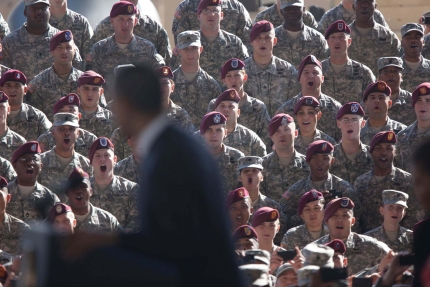
Soldiers respond as President Barack Obama delivers remarks on the end of America’s war in Iraq at the 440th Squadron Maintenance Building at Pope Army Airfield, Fort Bragg, North Carolina, Dec. 14, 2011. (Official White House Photo by Lawrence Jackson)

President Obama traveled to Fort Bragg, North Carolina on Wednesday -- home of the Airborne and Special Operations Forces -- to salute the service of the soldiers, sailors, airmen, Coast Guardsmen, and Marines who fought in Iraq and helped to bring the war to an end.

"As your commander in chief, and on behalf of a grateful nation, I’m proud to finally say these two words," he said, "Welcome home."

Related Topics: Defense, Veterans, North Carolina

The White House

Office of the Press Secretary

Statement by the President on the Legacy of Laura Pollán

Today, as the National Endowment for Democracy awards the Democracy Service Medal posthumously to Laura Pollán, the founder of Las Damas de Blanco, we honor and celebrate her life by recognizing her significant contributions to the struggle to defend human rights in Cuba.

Laura Pollán and the quiet dignity of the Ladies in White have courageously voiced the core desire of the Cuban people and of people everywhere to live in liberty.  Taking to the streets in peaceful protest to draw attention to the plight of those unjustly held in Cuba’s prisons, Laura Pollán and the Ladies in White have stood bravely against Cuban authorities who unleash mobs, and resort to house arrest, and temporary detention in a failed attempt to silence them. Through Laura Pollán’s and the Damas’ brave actions, the world bore witness to the repressive actions of Cuban authorities, eventually leading to the release of political prisoners wrongly jailed in the Spring of 2003.

Though Laura is not with us today, her bravery in the face of repression and her selfless commitment to democracy and human rights in Cuba, offer a living legacy that inspires us to keep moving forward.  To Las Damas de Blanco who will  watch or listen to today’s ceremony, you have our utmost respect for your efforts to stand up for the rights of the Cuban people even in the face of this weekend’s crackdown directed at you and we honor each of you as well. 

The United States is steadfast in supporting the simple desire of the Cuban people to freely determine their future and to enjoy the rights and freedoms that define the Americas, and that should be universal to all human beings.  I remain committed to supporting civil society in Cuba, including by protecting the ability of Cuban Americans to support their families in Cuba through unrestricted family visits and remittances.

The White House

Office of the Press Secretary

Remarks by the President and First Lady on the End of the War in Iraq

Fort Bragg, North Carolina

11:52 A.M. EST

MRS. OBAMA:  Hello, everyone!  I get to start you all off.  I want to begin by thanking General Anderson for that introduction, but more importantly for his leadership here at Fort Bragg.  I can’t tell you what a pleasure and an honor it is to be back here.  I have so many wonderful memories of this place. 

A couple of years ago, I came here on my very first official trip as First Lady.  And I spent some -- a great time with some of the amazing military spouses, and I visited again this summer to help to put on the finishing touches on an amazing new home for a veteran and her family.  So when I heard that I had the opportunity to come back and to be a part of welcoming you all home, to say I was excited was an understatement. 

And I have to tell you that when I look out at this crowd, I am simply overwhelmed.  I am overwhelmed and proud, because I know the level of strength and commitment that you all display every single day.  Whenever this country calls, you all are the ones who answer, no matter the circumstance, no matter the danger, no matter the sacrifice. 

And I know that you do this not just as soldiers, not just as patriots, but as fathers and mothers, as brothers and sisters, as sons and daughters.  And I know that while your children and your spouses and your parents and siblings might not wear uniforms, they serve right alongside you. 

AUDIENCE:  Hooah!  (Applause.)

MRS. OBAMA:  I know that your sacrifice is their sacrifice, too.  So when I think of all that you do and all that your families do, I am so proud and so grateful.  But more importantly, I’m inspired.  But like so many Americans, I never feel like I can fully convey just how thankful I am, because words just don’t seem to be enough. 

And that’s why I have been working so hard, along with Jill Biden, on a campaign that we call Joining Forces.  It’s a campaign that we hope goes beyond words.  It’s a campaign that is about action.  It’s about rallying all Americans to give you the honor, the appreciation and the support that you have all earned.  And I don’t have to tell you that this hasn’t been a difficult campaign.  We haven’t had to do much convincing because American have been lining up to show their appreciation for you and your families in very concrete and meaningful ways. 

Businesses are hiring tens of thousands of veterans and military spouses.  Schools all across the country and PTAs are reaching out to our military children.  And individuals are serving their neighbors and their communities all over this country in your honor.

So I want you to know that this nation’s support doesn’t end as this war ends.  Not by a long shot.  We’re going to keep on doing this.  We have so much more work to do.  We’re going to keep finding new ways to serve all of you as well as you have served us.  And the man leading the way is standing right here.  (Applause.)  He is fighting for you and your families every single day.  He’s helped more than half a million veterans and military family members go to college through the Post-9/11 G.I. Bill.  (Applause.)

He’s taken unprecedented steps to improve mental health care.  He’s cut taxes for businesses that hire a veteran or a wounded warrior.  And he has kept his promise to responsibly bring you home from Iraq. 

So please join me in welcoming someone who’s your strongest advocate, someone who shows his support for our military not only in words, but in deeds, my husband, our President, and your Commander-in-Chief, Barack Obama.  (Applause.)

THE PRESIDENT:  Hello, everybody!  (Applause.)  Hello, Fort Bragg!  All the way!

AUDIENCE:  Airborne!

THE PRESIDENT:  Now, I’m sure you realize why I don’t like following Michelle Obama.  (Laughter.)  She’s pretty good.  And it is true, I am a little biased, but let me just say it:  Michelle, you are a remarkable First Lady.  You are a great advocate for military families.  (Applause.)  And you’re cute.  (Applause.)  I’m just saying -- gentlemen, that’s your goal:  to marry up.  (Laughter.)  Punch above your weight. 

Fort Bragg, we’re here to mark a historic moment in the life of our country and our military.  For nearly nine years, our nation has been at war in Iraq.  And you -- the incredible men and women of Fort Bragg -- have been there every step of the way, serving with honor, sacrificing greatly, from the first waves of the invasion to some of the last troops to come home.  So, as your Commander-in-Chief, and on behalf of a grateful nation, I’m proud to finally say these two words, and I know your families agree:  Welcome home!  (Applause.)  Welcome home.  Welcome home.  (Applause.)  Welcome home.

It is great to be here at Fort Bragg -- home of the Airborne and Special Operations Forces.  I want to thank General Anderson and all your outstanding leaders for welcoming us here today, including General Dave Rodriguez, General John Mulholland.  And I want to give a shout-out to your outstanding senior enlisted leaders, including Command Sergeant Major Roger Howard, Darrin Bohn, Parry Baer.  And give a big round of applause to the Ground Forces Band.  (Applause.)

We’ve got a lot of folks in the house today.  We’ve got the 18th Airborne Corps -- the Sky Dragons.  (Applause.)  We’ve got the legendary, All-American 82nd Airborne Division.  (Applause.)  We’ve got America’s quiet professionals -- our Special Operations Forces.  (Applause.)  From Pope Field, we’ve got Air Force.  (Applause.)  And I do believe we’ve got some Navy and Marine Corps here, too. 

AUDIENCE MEMBER:  Yes!  (Laughter.)  

THE PRESIDENT:  And though they’re not here with us today, we send our thoughts and prayers to General Helmick, Sergeant Major Rice and all the folks from the 18th Airborne and Bragg who are bringing our troops back from Iraq.  (Applause.)  We honor everyone from the 82nd Airborne and Bragg serving and succeeding in Afghanistan, and General Votel and those serving around the world.  

And let me just say, one of the most humbling moments I’ve had as President was when I presented our nation’s highest military decoration, the Medal of Honor, to the parents of one of those patriots from Fort Bragg who gave his life in Afghanistan -- Staff Sergeant Robert Miller.

I want to salute Ginny Rodriguez, Miriam Mulholland, Linda Anderson, Melissa Helmick, Michelle Votel and all the inspiring military families here today.  We honor your service as well.  (Applause.)

And finally, I want to acknowledge your neighbors and friends who help keep your -- this outstanding operation going, all who help to keep you Army Strong, and that includes Representatives Mike McIntyre, and Dave Price, and Heath Shuler, and Governor Bev Perdue.  I know Bev is so proud to have done so much for our military families.  So give them a big round of applause.  (Applause.)

Today, I’ve come to speak to you about the end of the war in Iraq.  Over the last few months, the final work of leaving Iraq has been done.  Dozens of bases with American names that housed thousands of American troops have been closed down or turned over to the Iraqis.  Thousands of tons of equipment have been packed up and shipped out.  Tomorrow, the colors of United States Forces-Iraq -- the colors you fought under -- will be formally cased in a ceremony in Baghdad.  Then they’ll begin their journey across an ocean, back home.

Over the last three years, nearly 150,000 U.S. troops have left Iraq.  And over the next few days, a small group of American soldiers will begin the final march out of that country.  Some of them are on their way back to Fort Bragg.  As General Helmick said, “They know that the last tactical road march out of Iraq will be a symbol, and they’re going to be a part of history.”

As your Commander-in-Chief, I can tell you that it will indeed be a part of history.  Those last American troops will move south on desert sands, and then they will cross the border out of Iraq with their heads held high.  One of the most extraordinary chapters in the history of the American military will come to an end.  Iraq’s future will be in the hands of its people.  America’s war in Iraq will be over.

AUDIENCE:  Hooah!

THE PRESIDENT:  Now, we knew this day would come.  We’ve known it for some time.  But still, there is something profound about the end of a war that has lasted so long.

Now, nine years ago, American troops were preparing to deploy to the Persian Gulf and the possibility that they would be sent to war.  Many of you were in grade school.  I was a state senator.  Many of the leaders now governing Iraq -- including the Prime Minister -- were living in exile.  And since then, our efforts in Iraq have taken many twists and turns.  It was a source of great controversy here at home, with patriots on both sides of the debate.  But there was one constant -- there was one constant:  your patriotism, your commitment to fulfill your mission, your abiding commitment to one another.  That was constant.  That did not change.  That did not waiver.

It’s harder to end a war than begin one.  Indeed, everything that American troops have done in Iraq -– all the fighting and all the dying, the bleeding and the building, and the training and the partnering -– all of it has led to this moment of success.  Now, Iraq is not a perfect place.  It has many challenges ahead.  But we’re leaving behind a sovereign, stable and self-reliant Iraq, with a representative government that was elected by its people.  We’re building a new partnership between our nations.  And we are ending a war not with a final battle, but with a final march toward home.

This is an extraordinary achievement, nearly nine years in the making.  And today, we remember everything that you did to make it possible.

We remember the early days -– the American units that streaked across the sands and skies of Iraq; the battles from Karbala to Baghdad, American troops breaking the back of a brutal dictator in less than a month.

We remember the grind of the insurgency -– the roadside bombs, the sniper fire, the suicide attacks.  From the “triangle of death” to the fight for Ramadi; from Mosul in the north to Basra in the south -– your will proved stronger than the terror of those who tried to break it.

We remember the specter of sectarian violence -– al Qaeda’s attacks on mosques and pilgrims, militias that carried out campaigns of intimidation and campaigns of assassination.  And in the face of ancient divisions, you stood firm to help those Iraqis who put their faith in the future.

We remember the surge and we remember the Awakening -– when the abyss of chaos turned toward the promise of reconciliation.  By battling and building block by block in Baghdad, by bringing tribes into the fold and partnering with the Iraqi army and police, you helped turn the tide toward peace.

And we remember the end of our combat mission and the emergence of a new dawn -– the precision of our efforts against al Qaeda in Iraq, the professionalism of the training of Iraqi security forces, and the steady drawdown of our forces.  In handing over responsibility to the Iraqis, you preserved the gains of the last four years and made this day possible.

Just last month, some of you -- members of the Falcon Brigade --

AUDIENCE:  Hooah!

THE PRESIDENT:  -- turned over the Anbar Operations Center to the Iraqis in the type of ceremony that has become commonplace over these last several months.  In an area that was once the heart of the insurgency, a combination of fighting and training, politics and partnership brought the promise of peace.  And here’s what the local Iraqi deputy governor said:  “This is all because of the U.S. forces’ hard work and sacrifice.”

That’s in the words of an Iraqi.  Hard work and sacrifice.  Those words only begin to describe the costs of this war and the courage of the men and women who fought it.

We know too well the heavy cost of this war.  More than 1.5 million Americans have served in Iraq -- 1.5 million.  Over 30,000 Americans have been wounded, and those are only the wounds that show.  Nearly 4,500 Americans made the ultimate sacrifice -- including 202 fallen heroes from here at Fort Bragg -- 202.  So today, we pause to say a prayer for all those families who have lost their loved ones, for they are part of our broader American family.  We grieve with them.

We also know that these numbers don’t tell the full story of the Iraq war -– not even close.  Our civilians have represented our country with skill and bravery.  Our troops have served tour after tour of duty, with precious little dwell time in between.  Our Guard and Reserve units stepped up with unprecedented service.  You’ve endured dangerous foot patrols and you’ve endured the pain of seeing your friends and comrades fall.  You’ve had to be more than soldiers, sailors, airmen, Marines and Coast Guardsmen –- you’ve also had to be diplomats and development workers and trainers and peacemakers.  Through all this, you have shown why the United States military is the finest fighting force in the history of the world. 

AUDIENCE:  Hooah!  (Applause.)

THE PRESIDENT:  As Michelle mentioned, we also know that the burden of war is borne by your families.  In countless base communities like Bragg, folks have come together in the absence of a loved one.  As the Mayor of Fayetteville put it, “War is not a political word here.  War is where our friends and neighbors go.”  So there have been missed birthday parties and graduations.  There are bills to pay and jobs that have to be juggled while picking up the kids.  For every soldier that goes on patrol, there are the husbands and the wives, the mothers, the fathers, the sons, the daughters praying that they come back.

So today, as we mark the end of the war, let us acknowledge, let us give a heartfelt round of applause for every military family that has carried that load over the last nine years.  You too have the thanks of a grateful nation.  (Applause.)  

Part of ending a war responsibly is standing by those who fought it.  It’s not enough to honor you with words.  Words are cheap.  We must do it with deeds.  You stood up for America; America needs to stand up for you.

AUDIENCE:  Hooah!

THE PRESIDENT:  That’s why, as your Commander-in Chief, I am committed to making sure that you get the care and the benefits and the opportunities that you’ve earned. For those of you who remain in uniform, we will do whatever it takes to ensure the health of our force –- including your families.  We will keep faith with you. 

We will help our wounded warriors heal, and we will stand by those who’ve suffered the unseen wounds of war.  And make no mistake -- as we go forward as a nation, we are going to keep America’s armed forces the strongest fighting force the world has ever seen.  That will not stop.

AUDIENCE:  Hooah!  (Applause.)

THE PRESIDENT:  That will not stop.  But our commitment doesn’t end when you take off the uniform.  You’re the finest that our nation has to offer.  And after years of rebuilding Iraq, we want to enlist our veterans in the work of rebuilding America.  That’s why we’re committed to doing everything we can to extend more opportunities to those who have served.

That includes the Post-9/11 G.I. Bill, so that you and your families can get the education that allows you to live out your dreams.  That includes a national effort to put our veterans to work.  We’ve worked with Congress to pass a tax credit so that companies have the incentive to hire vets.  And Michelle has worked with the private sector to get commitments to create 100,000 jobs for those who’ve served. 

AUDIENCE:  Hooah!

THE PRESIDENT:  And by the way, we’re doing this not just because it’s the right thing to do by you –- we’re doing it because it’s the right thing to do for America.  Folks like my grandfather came back from World War II to form the backbone of this country’s middle class.  For our post-9/11 veterans -– with your skill, with your discipline, with your leadership, I am confident that the story of your service to America is just beginning.

But there’s something else that we owe you.  As Americans, we have a responsibility to learn from your service.  I’m thinking of an example -- Lieutenant Alvin Shell, who was based here at Fort Bragg.  A few years ago, on a supply route outside Baghdad, he and his team were engulfed by flames from an RPG attack.  Covered with gasoline, he ran into the fire to help his fellow soldiers, and then led them two miles back to Camp Victory where he finally collapsed, covered with burns.  When they told him he was a hero, Alvin disagreed.  “I’m not a hero,” he said.  “A hero is a sandwich. “  (Laughter.)  “I’m a paratrooper.”

AUDIENCE:  Hooah!

THE PRESIDENT:  We could do well to learn from Alvin.  This country needs to learn from you.  Folks in Washington need to learn from you.

AUDIENCE:  Hooah!

THE PRESIDENT:  Policymakers and historians will continue to analyze the strategic lessons of Iraq -- that’s important to do.  Our commanders will incorporate the hard-won lessons into future military campaigns -- that’s important to do.  But the most important lesson that we can take from you is not about military strategy –- it’s a lesson about our national character.

For all of the challenges that our nation faces, you remind us that there’s nothing we Americans can’t do when we stick together. 

AUDIENCE:  Hooah!

THE PRESIDENT:  For all the disagreements that we face, you remind us there’s something bigger than our differences, something that makes us one nation and one people regardless of color, regardless of creed, regardless of what part of the country we come from, regardless of what backgrounds we come out of.  You remind us we’re one nation.

And that’s why the United States military is the most respected institution in our land because you never forget that.  You can’t afford to forget it.  If you forget it, somebody dies.  If you forget it, a mission fails.  So you don’t forget it.  You have each other’s backs.  That’s why you, the 9/11 Generation, has earned your place in history.

Because of you -- because you sacrificed so much for a people that you had never met, Iraqis have a chance to forge their own destiny.  That’s part of what makes us special as Americans.  Unlike the old empires, we don’t make these sacrifices for territory or for resources.  We do it because it’s right.  There can be no fuller expression of America’s support for self-determination than our leaving Iraq to its people.  That says something about who we are.

Because of you, in Afghanistan we’ve broken the momentum of the Taliban.  Because of you, we’ve begun a transition to the Afghans that will allow us to bring our troops home from there.  And around the globe, as we draw down in Iraq, we have gone after al Qaeda so that terrorists who threaten America will have no safe haven, and Osama bin Laden will never again walk the face of this Earth.  

AUDIENCE:  Hooah!  (Applause.)

THE PRESIDENT:  So here’s what I want you to know, and here’s what I want all our men and women in uniform to know:  Because of you, we are ending these wars in a way that will make America stronger and the world more secure.  Because of you. 

That success was never guaranteed.  And let us never forget the source of American leadership:  our commitment to the values that are written into our founding documents, and a unique willingness among nations to pay a great price for the progress of human freedom and dignity.  This is who we are.  That’s what we do as Americans, together.

The war in Iraq will soon belong to history.  Your service belongs to the ages.  Never forget that you are part of an unbroken line of heroes spanning two centuries –- from the colonists who overthrew an empire, to your grandparents and parents who faced down fascism and communism, to you –- men and women who fought for the same principles in Fallujah and Kandahar, and delivered justice to those who attacked us on 9/11.

Looking back on the war that saved our union, a great American, Oliver Wendell Holmes, once paid tribute to those who served.  “In our youth,” he said, “our hearts were touched with fire.  It was given to us to learn at the outset that life is a profound and passionate thing.”

All of you here today have lived through the fires of war.  You will be remembered for it.  You will be honored for it -- always.  You have done something profound with your lives.  When this nation went to war, you signed up to serve.  When times were tough, you kept fighting.  When there was no end in sight, you found light in the darkness.

And years from now, your legacy will endure in the names of your fallen comrades etched on headstones at Arlington, and the quiet memorials across our country; in the whispered words of admiration as you march in parades, and in the freedom of our children and our grandchildren.  And in the quiet of night, you will recall that your heart was once touched by fire.  You will know that you answered when your country called; you served a cause greater than yourselves; you helped forge a just and lasting peace with Iraq, and among all nations.

I could not be prouder of you, and America could not be prouder of you.

God bless you all, God bless your families, and God bless the United States of America.  (Applause.)

END
12:26 P.M. EST

The White House

Office of the Press Secretary

Press Gaggle by Press Secretary Jay Carney en route Fort Bragg, NC

Aboard Air Force One
En Route Fort Bragg, North Carolina

11:04 A.M. EST

MR. CARNEY:  Good morning, everyone.  Thank you for coming with us on this trip to Fort Bragg where, as you know, the President will be meeting with troops and addressing the troops.  He’s joined by the First Lady.

This is a trip in which the President will thank our servicemen and women for their remarkable sacrifice, their remarkable contributions, their incredible professionalism -- all of which has led to this day where we are now in the final weeks of bringing all American forces home from Iraq.  The Iraq war, an eight-and-a-half-year war, is over.  The President promised when he was running for this office that he would end the war responsibly, and he is keeping that commitment.

But the focus today is really on the extraordinary sacrifice that our men and women in uniform have made and their remarkable professionalism and success.

On another note, before I take your questions, I just happened to be reading before I came back here to speak with you an account of an encounter that the Speaker of the House had with reporters this morning, and I had to laugh because he was asked, the Speaker was, about whether or not he could name any small businesses that were affected by a surtax on millionaires and billionaires, the likes of which the Senate Democrats have put forward as a pay-for for the payroll tax cut extension and expansion.  He said a lot but he didn’t name any, and the fact of the matter is, it’s more evidence that the number-one talking point of Republicans in refusing to ask millionaires and billionaires to pay just a little bit more so that 160 million working Americans can get a tax break is bogus, even by their definition of small businesses, which allows for investment advisors and law partners and others who file their small business -- their business income under personal income at more than a million dollars -- it’s still fewer than 1 percent of all small businesses.

So I just urge everyone who reports on this, when they dutifully repeat the pushback from Republicans about why doing what the American public overwhelmingly supports is not a good thing to do, that their number-one reason for that is false.  Just not backed up by the facts.

Q    It’s clear that the White House and Republicans are still very far apart on this.  How do you see this all playing out?  Do you think it’s going -- the debate over this is going to drag on into next week, and is the President going to keep insisting that people stay here for the holidays?  Do you think that will be necessary for people to do that? 

MR. CARNEY:  Well, if I had a crystal ball, I would have predicted that Denver would go on this remarkable run after Tim Tebow started as quarterback for the Broncos, and I would have made a lot of money in Vegas. 

I don’t have a crystal ball, so I don’t know what the endgame will look like, how this will all end.  What is the case is that there is still time for Congress to do all of its work; both finish its business and the American people’s business in time for their scheduled vacation by the end of this week. 

It really isn’t that complicated.  Democrats, Republicans, the President all support -- at least Republicans say they support -- at the very least extending the existing payroll tax cut to 160 million Americans into next -- for 2012.  They should pass a bill that does that -- that pays for it in a fair way, does not have within it entirely extraneous issues like pipelines and other things, and then get on with the business of wrapping up this omnibus spending bill.  It’s easily doable. 

Q    Can you tell us, at Fort Bragg -- he’s not there for that long today -- before he goes out on stage who he’ll be talking to, meeting with, and what else is not on the public schedule that you can share with us?

MR. CARNEY:  I know he has some meetings.  I’ll get that to you.  I mean, he and the First Lady are meeting with troops, maybe some Gold Star families.  But let me just double-check that. 

Q    Can you explain why you are supportive of a short-term CR in this case, while in the past you’ve been very critical of that approach and described it as “governing by tollbooth,” or words to that effect?

MR. CARNEY:  Look, it’s not ideal to engage in that practice.  But we’re long -- in the calendar year of 2011, we’re long past achieving an ideal in terms of congressional functionality. 

What I am saying is that there is no reason for anyone to talk about shutting down the government when this Congress has seven times previously this year shown its willingness to pass a short-term CR in order to allow for a little more time to get its work done.  We don’t even need to get to that point, but if we were, later in the week, to be in that situation, then they should just pass a short-term CR to ensure that there’s no disruption in the functioning of government, and then finish their business.

And it’s just that it’s a pretty straightforward and easy thing to do, as they’ve demonstrated in the past.  So that’s the reason why we’ve taken that position.  We’re not suggesting that it’s the ideal way for Congress to do its work.  But I think anybody who’s witnessed the dysfunctionality in Congress brought on by Republican obstructionism this year would suggest that this Congress is capable of achieving an ideal.  In fact, in the NBC-Wall Street Journal poll I think -- wasn’t it more than 40 percent of Americans deemed this Congress to be the worst in history over these many, many years?  Many, many Congresses -- the worst -- the very worst in history.

I mean, I guess if they want to cement that role they could leave town without doing anything on the payroll tax and thereby ensuring that 160 million working and middle-class Americans have their taxes go up on January 1st.  We don’t think they’ll do that.

Q    On the Iraq war piece, two questions.  The first is, are you -- there was some suggestion yesterday that the message today would also be about returning veterans and economic issues.  Are you going to be trying to essentially put an economic message into what is sort of at core a national security speech?  But is the economic message part of this as well?

MR. CARNEY:  It is part of it.  And it’s part of the very important work that the First Lady has done and Dr. Biden has done.  And it’s very much a part of the President’s agenda to ensure that those veterans who have fought so bravely for us in foreign wars do not return home and have to fight for a job.  And that was why the President pushed so hard for the veterans employment component of the American Jobs Act, and why we were pleased that, thus far, that is the only element of the American Jobs Act that we’ve been able to get some cooperation out of Republicans on.  But there is still a lot of work to be done, and there are a variety of components to this push, including the -- working with private industry to pledge themselves to hire more returning veterans. 

Q    Given how dominant the economy is as an issue for most Americans, is that a way to make what’s happening this week a little more irrelevant to their --

MR. CARNEY:  Absolutely not, because this is a theme that we’ve been pushing quite aggressively for a long time, because it’s incredibly important to both the President and the First Lady, as well as the Vice President and Dr. Biden.  And it’s important to a community like the one surrounding Fort Bragg, because you have a lot of servicemen and women returning from Iraq and Afghanistan, and who are trying to enter the workforce and facing the kinds of challenges that still exist out there in this challenging economy.

So our commitment to the men and women who put on our uniform should not end when they take it off.

Q    The President is going to talk about all the sacrifices that this nation has given for this war in Iraq.  Was it worth it?

MR. CARNEY:  Well, he was asked this question in the press conference he gave with Prime Minister Maliki and --

Q    Well, he wasn’t exactly asked that question; he was asked if it was still “a dumb war.”  He was --

MR. CARNEY:  So I think the answer is the same, which is that --

Q    And he didn’t answer that question.

MR. CARNEY:  -- history will judge whether the war was worth it.  The President’s position has not changed, which is that he did not support getting into this war, did not support the way that the previous administration led us to war in Iraq.  And he made that clear during the campaign and that’s not a position that’s changed.  But he committed, as a candidate, and has reiterated that commitment as President, to ending this war responsibly; to making sure that the steps he took as Commander-in-Chief were the right ones to ensure that America’s national security interests were protected, and that the incredible sacrifice of our men and women in uniform, of their families and of the broader American public in Iraq were validated.

Q    So does that mean -- if he still believes it was a mistake, does that mean that it wasn’t worth it?

MR. CARNEY:  No, I think history judges that.  His view --

Q    It’s a fair question to ask you guys.

MR. CARNEY:  No, I’m not saying it’s not a fair question, but I’m answering it as best I can, which is that the President’s position on how we got into the war hasn’t changed.  But he didn’t get to make that decision when he took the oath of office in January of 2009.  We already had more than 150,000 troops in Afghanistan [sic], and we were -- so it was two and a half years ago, entering the -- coming up on our eighth year of war -- or rather our sixth year of war there.

So his responsibility was to make sure that his policies created the best possible environment for Iraq going forward, which would thereby make the extraordinary sacrifices of the men and women in uniform, as well as the broader American public, validated, if you will; that it is his responsibility to put -- to pursue a policy that allowed us to withdraw our forces by the end of this year, which is happening, and to give Iraq the best chance possible to have a prosperous and democratic future.  And that’s what he’s done.

Q    Is it worth it for you to have a democracy there?  And do you think now -- I mean, looking back is it worth it to have a democracy like that in the Middle East right now?  And do you think that democracy will be able to be sustained with Iran influences that are infiltrating the country now?

MR. CARNEY:  Well, I think -- I’ll start with your end question.  The President addressed this, too, as did Prime Minister Maliki, that the significantly overstated issue of Iranian influence -- I mean, the actions that the Prime Minister has taken, the government of Iraq have taken, that demonstrate the opposite and demonstrate I think a feeling felt broadly by the Iraqi people, which is a profound sense of national identity and a resistance to outside influence.

I think it was said at the time when the Vice President was making so many trips to Iraq and I was joining him that the elections in Iraq demonstrated that while the Iranians spent a great deal of money to try to influence the outcome there, they failed miserably.  So it’s impossible to foretell the future.  But as I said yesterday, what is a very positive sign is the fact that the major parties and players in Iraq have now for a number of years chosen to resolve their differences through the political process, through the democratic political process and not through violence.

And while there will be challenges, security challenges in the future as Iraq progresses, they are moving in the right direction.  There’s no question.

Q    How many more visits one-on-one with troops before year’s end, before the war is officially over?  Is this the last one?
MR. CARNEY:  Well, I don’t have any other scheduling announcements to make.

Q    Thanks.

Q    Why is tonight’s fundraiser closed press?

MR. CARNEY:  Because, as you know, when the President doesn’t give an address, we don’t have the pool in.  I can tell you as a veteran of many driveways in serving pool duty when we weren’t let in at all under previous Presidents that this White House endeavors to bring -- to give the press the greatest possible access and certainly greater than any predecessor -- or at least as great as any of his predecessors, so the vast majority of events that this President does -- campaign events -- include a print pooler.  But when he doesn’t speak, we don’t include it.

All set?  Thanks.

Q    Thanks, Jay.

END
11:18 A.M. EST

The White House

Office of the Press Secretary

Statement by NSC Spokesman Tommy Vietor on International Engagement Conference for South Sudan

On December 14th and 15th, the U.S. Government and the Republic of South Sudan will co-host an International Engagement Conference for South Sudan in Washington D.C. to support the world’s newest nation as it unveils its vision for development and economic growth priorities.  The conference will bring together international partners, private sector and civil society leaders, to discuss opportunities for collaboration and investment in South Sudan.  The conference is co-sponsored with several key international partners, including the governments of United Kingdom, Norway, Turkey, the European Union, the African Union, the United Nations, the World Bank, the International Finance Corporation, the Corporate Council on Africa, and InterAction.

The White House

Office of the Press Secretary

Executive Order -- 2011 Amendments to the Manual for Courts-Martial, United States

By the authority vested in me as President by the Constitution and the laws of the United States of America, including chapter 47 of title 10, United States Code (Uniform Code of Military Justice, 10 U.S.C. 801-946), and in order to prescribe amendments to the Manual for Courts-Martial, United States, prescribed by Executive Order 12473, as amended, it is hereby ordered as follows:

Section 1. Parts III and IV of the Manual for Courts-Martial, United States, are amended as described in the Annex attached and made a part of this order.

Sec. 2. These amendments shall take effect 30 days from the date of this order.

(a) Nothing in these amendments shall be construed to make punishable any act done or omitted prior to the effective date of this order that was not punishable when done or omitted.

(b) Nothing in these amendments shall be construed to invalidate any nonjudicial punishment proceedings, restraint, investigation, referral of charges, trial in which arraignment occurred, or other action begun prior to the effective date of this order, and any such nonjudicial punishment, restraint, investigation, referral of charges, trial, or other action may proceed in the same manner and with the same effect as if these amendments had not been prescribed.

BARACK OBAMA

THE WHITE HOUSE,
December 13, 2011.
 

The White House

Office of the Press Secretary

Press Briefing by Press Secretary Jay Carney, 12/13/2011

James S. Brady Press Briefing Room

12:57 P.M. EST

MR. CARNEY:  Hi, everybody.  Good afternoon.  Thanks for being here.  Welcome to your daily briefing.  I do not have an announcement at the top -- sorry to disappoint.  So I will go to Mr. Feller.

Q    Thank you, Jay.  The omnibus bill looks like it’s on its way toward passage; negotiators are having some good luck on that one.  And we now know that the President and the Senate Democratic leadership are working to hold that one up until the payroll tax gets done.  But of course that has some peril, too; if the omnibus doesn’t get done and there’s no CR, then we have a government shutdown.  Is the President willing to take that risk?

MR. CARNEY:  What the President is not willing to do is leave town, or allow Congress to leave town, without ensuring that 160 million Americans do not see their taxes go up next year on average $1,000.  There is ample time for Congress to finish its business and to finish America’s business.  They should pass a payroll tax cut extension, extension of unemployment insurance, and they can finish the spending bill -- all before leaving on their vacation.  There’s no reason that this can’t be done.

I’ll make another point, which is that there are still issues to be resolved with the spending bill.  Despite some of what you’re heard, there’s been no bill filed, there’s been no language shared.  But we do know through conversations that there are issues that concern us, including outstanding issues with the funding levels to ensure that the Wall Street Reform and Consumer Protection Act can be implemented successfully.  You know the President feels very strongly that Congress should do nothing to impede the effective implementation of that very important legislation.

So there are issues to resolve with the spending bill.  They can be resolved.  It is essential, too, that Congress act to extend the payroll tax cut and unemployment insurance.  All of this can be done and still allow Congress to go on vacation.

Q    Well, you talk about the consequences if the payroll tax isn’t extended.  But there are also enormous consequences for the country if we should get to the brink of a shutdown.  I know you say there’s time to do both, but is it responsible to even bring that into the conversation?

MR. CARNEY:  We’re not bringing that into the conversation.  There is ample time to get it done.  There has been substantial progress made, even though there are still issues to be resolved on the spending bill.  If there is the need, come the end of the week, for Congress to pass another short-term CR, as it has done seven times this year, then they should do that to avoid a shutdown.  We don’t need to get to that point, but if we do, this is certainly not a exceptional action that Congress would have to take to ensure that there is time to get the work done that it needs to get done.

What Congress can’t do is make vague promises -- Republicans in Congress make vague promises about a payroll tax cut, and then finish its business, the business that it has to get done -- the spending bill -- and then leave town and let -- leave the American middle class holding the bag.  We’re just not going to let that happen.  It’s not fair to the 160 million Americans who would see their taxes go up on average $1,000 next year, as we’re emerging, still, from the worst recession since the Great Depression.

Q    One other quick one, please.  Lawmakers have taken some steps to -- apparently to amend the defense bill to address concerns the President has about terrorism suspects.  Is that an effort that’s assuaging the President’s concerns?

MR. CARNEY:  Well, it’s true that they have made some changes.  They were released last night, and we’re looking at that language.  The statement of administration principle that, “any bill that challenges or constrains the President’s critical authorities to collect intelligence, incapacitate dangerous terrorists, and protect the nation would prompt the President’s senior advisors to recommend a veto.”  So we’re in the process of reviewing the changes that were made to the legislation, and to see if those changes address the concerns that we have.

Q    Thank you.

MR. CARNEY:  Yes, Matt.

Q    So the President has spoken to Senator Reid about the prospects for getting the payroll tax cut extension passed.  But is he ready to get his hands dirty and start dealing with the Republicans directly and not -- do you see that in the cards --

MR. CARNEY:  The President has always been committed to working with Congress, members of both parties, leaders of both parties, to get the essential work that Congress needs to get done, done -- and that, in this case, includes the payroll tax cut extension. 

Now, what we have seen from Republicans in Congress is the promulgation of this idea that passing a tax cut for middle-class Americans is somehow a favor they would be doing for the President of the United States.  Most of my adult life, the Republican theology has been tax cuts for everyone are the highest priority.  But suddenly now, because the President is pushing them to extend a tax cut for middle-class Americans, they’re looking to load up their bill that would do that with extraneous issues, or they want to re-litigate old political battles through this legislation, to extract some political victory in exchange for doing the people’s business, for giving middle-class and working Americans a tax cut.  We don’t find that acceptable.

I think it’s worth pointing out that on the Keystone issue, which they have attached as one of these extraneous, ideological issues to the payroll tax cut extension, the State Department, which is conducting the review, has made clear that it would be absolutely counterproductive to the stated goal of those who insist on having the provision in the bill because it would not allow the State Department the time it needs to properly review alternative routes.  Therefore, they would have to say no.

So if that’s their objective, it’s a strange way of going about it.  The process needs to be done responsibly.  The delay in the review was brought about because of concerns by folks in Nebraska, including the Republican governor.   The desire to search for an alternate route -- that is now happening.  But it’s a process that needs to be done in the way that it has always been done, which takes time.  And that requires careful consideration of all the criteria that the President has made clear are important to this decision.  And to insert as a political objective a provision like this that would try to speed up the process would only result in its -- in the State Department -- based on my reading of their statement -- in the State Department having to say, given no other course, having to say no.

Jake. 

Q    First of all, congratulations on the three Pinocchios from The Washington Post Fact Check.

MR. CARNEY:  We obviously disagree with that.  Thank you.

Q    So how is this reluctance to bring up these spending bills -- how is that any different from the brinksmanship that the President and the White House have decried in the past?  The President wants an objective and he’s holding back another piece of legislation in order to achieve his objective.

MR. CARNEY:  Jake, as I just said, what’s at stake here is potentially a $1,000, on average, tax hike for every American family -- or 160 million Americans --

Q    Republicans have done similar things for different tax cuts that were about to expire and the White House --

MR. CARNEY:  Let’s be clear, that Republicans uniformly have supported tax cuts.  Republicans now say they are for the payroll tax cut extension.  All they have to do is pass a payroll tax cut extension and unemployment insurance extension, and then move on to the spending bill.  And they could do it all -- heck, they could leave a day early, have a month and a day vacation.  There’s ample time to do this. 

But what we simply cannot allow is Republicans to take care of the spending bill and leave town because the absolute effect of that would be a tax hike for middle-class Americans.  That’s just not acceptable.  And I think if they were to do that, they would test the proposition that Congress’s job-approval rating cannot go below 9 percent, because I think that -- my expectation is that it would go lower if Congress walked out of town, refusing to extend this payroll tax cut for middle-class Americans.

Q    They’re down to immediate friends and family now.  But the question is, is it not --

MR. CARNEY:  Paid staff.

Q    -- is it not the same kind of ploy?  Republicans and Democratic staffers with whom I’ve spoken have said this was actually like a really bipartisan achievement; there was a handshake from the Senate Democratic chief of staff and the House Republican chief of staff and this was a bipartisan accomplishment.  And now the President is standing in its way because he wants something else.  And it’s the same kind of brinksmanship you guys -- I’m not sure if you were at this podium at the time or not, but there was a lot of talk of holding things hostage, Republicans were holding legislation hostage -- I guess you were here -- and I’m wondering, is that not exactly the same thing that you’re doing?

MR. CARNEY:  Look, the comparative -- I could spend a lot of time on why what you’re talking about is distinct, say, from the way that some members of one party held the country hostage and threatened to allow the full faith and credit of the United States to be cast in doubt.

Q    Right, you’re just threatening a government shutdown.

MR. CARNEY:  That’s a significant difference, okay?  And we’re not --

Q    But there was a government shutdown threat before that.

MR. CARNEY:  Let me go back to the spending bill.  It is absolutely the case that there has been good progress made and that they are getting closer to a resolution.  But it is also absolutely a fact that there’s not even been a bill filed; that the language of the so-called agreement that you reference hasn’t been shared.  So to say that work is done is not accurate.  And we know for a fact that there are very important issues that remain to be resolved.  We’re very confident they can be resolved, they will be resolved.  And we’re also confident that Congress will not leave town without extending the payroll tax cut for 160 million Americans, because the President is going to insist that they stay here until they get it done. 

Q    And just a follow-up on the question about the defense bill.  Human rights groups have looked at the language -- the new language -- and they say it still mandates the detention, the military detention, of members of al Qaeda or affiliated groups, and still allows indefinite detention.  And I’m wondering if you could be more precise with the veto threat.  If the legislation contains either of those provisions -- allowing indefinite detention, and mandating detentions of a subset of terrorist groups, or accused terrorist members -- would the President veto it, if that provision still allows that or mandates that?

MR. CARNEY:  I’m going to disappoint you by saying that we’re reviewing the language.  I don’t want to make an assessment of what made --

Q    But I’m asking if you’re sticking with the principle.  If those --

MR. CARNEY:  Well, the principle that elicited --

Q    It’s either going to be changed or it’s not.

MR. CARNEY:  -- that elicited the language I quoted from our statement of policy, that, as written -- as it was written, that the President’s senior advisors would recommend a veto; that stands.  But I don’t want to make an assessment, without having seen it myself or without others having reviewed it, about whether or not the changes in the language are adequate and resolve those issues that we have with the bill at this point.  I’m sure we will be doing that, but at this point I don’t want to get ahead of that process.

Q    All right.  Thank you. 

MR. CARNEY:  Cheryl.

Q    Going back to the omnibus.  You’ve mentioned you had specific concerns, and you mentioned Dodd-Frank spending levels.  Can you give me a couple more examples of particular issues with the omnibus?

MR. CARNEY:  Well, there is -- there are attempts to attach riders that have an impact on our foreign policy goals, that have an impact on environmental issues and others.  So I don’t have a list of particulars.

Again, there has not been formal language submitted, a bill submitted.  So it’s a little difficult to make a judgment on a product that, as of yet, doesn’t even exist.  But based on our conversations -- and we’re having plenty of them up on the Hill -- these are some of the issues that still need to be resolved.

Mike.

Q    Thanks, Jay.  Two quick issues, following up on what Jake was asking about earlier on the linkage with the payroll tax and the budget.  The President said that he would reject any effort to link the payroll tax to extraneous issues, but doesn’t this contradict that by essentially linking the payroll tax cut to everything in the budget?

MR. CARNEY:  Well, let me just make clear.  The premise of that question is to suggest that somehow Republicans are being forced to support what they claim they support.  If they support tax cuts for middle-class Americans with anything like the fervor that they support tax breaks for wealthy Americans, this should be done.  Should not be an issue.  The President supports it, Democrats support it, Republicans say they support it.  Done, right? 

So that’s the very large difference here.  The President makes clear that there’s no reason the Congress can’t get its business done with its annual spending bills and getting this payroll tax cut and unemployment insurance extended.  And there’s simply no excuse for Congress to leave on vacation until the American people know that they’ve been taken care of in this process; that they don’t have to contend with a spike in their taxes on January 1st. 

So the President is going to insist that that work gets done.  He’s confident it will get done.  There is ample time to get it done.  And this isn’t about a shutdown; we’ve had seven CRs already this year.  If that were to become necessary, that would certainly be the right thing to do, just to finish up the process on the spending bill.

Q    And the second issue, also on payroll tax.  The administration has contended that the Republican pay-fors would cut education.  Republicans say there’s nothing in their proposal that would cut education --

MR. CARNEY:  No, it’s very cleverly written to prevent that from being obvious.

Q    Well, The Washington Post Fact Check has agreed with them.  Does the administration stand by that, or do you retract it?

MR. CARNEY:  No, we stand by it, because the simple fact is, the spending levels were set by the Budget Control Act.  If you lower those spending levels, and, as they’ve said, we’ll institute a freeze, the only way to reach the already significantly reduced level set into law by the Budget Control Act would be to do things like put the pay freeze in place, to do things that were very tough. 

Because after all, as I know you’ve reported many times, that Budget Control Act would bring us down, or it will bring us down to the lowest non-defense discretionary spending since Eisenhower was President.  I’m sure you’ve reported that.  And what the result would be is, if you use the pay freeze that they write into this proposed legislation, or this legislation, is that then the cuts would have to come from somewhere else.  And there is nowhere else to go but programs like education, programs like energy -- those kinds of programs that serve the very middle-class and working Americans you’re supposed to be helping with the payroll tax cut.

And again, I don’t understand why there is so much resistance within the Republican Party to tax cuts for the middle class. 

Norah.

Q    Simple question:  When the President called Senator Reid, what did he ask him to do?

MR. CARNEY:  I don’t have a word-for-word readout for you.  They discussed, obviously, the business at hand here in December before Congress goes on its vacation, the President goes away with his family.  And there are a lot of issues to be dealt with, including the ones we’ve talked about here -- the end-of-the-year spending bill, the so-called omnibus, the payroll tax cut extension, the extension of unemployment insurance.

Q    What did the President suggest Senator Reid do?

MR. CARNEY:  The President made clear -- and the Senator agreed -- that Congress needs to make sure that the payroll tax cut is extended for middle-class and working Americans; that unemployment insurance is extended, because that is of great benefit to the economy and of great need to the Americans who need it.

Q    Did the President suggest to the Senator that he instruct Democrats not to sign the conference report?

MR. CARNEY:  The President made clear that we should not take as a promise that Republicans are going to not leave town without ensuring that Americans, 160 million Americans, have this payroll tax cut extended.  So, I mean, we’re being very --

Q    My question is whether the President -- it was the President’s directive -- I just --

MR. CARNEY:  The President and Senator Reid --

Q    Did the President instruct President Reid to tell Democrats not to sign the conference report?

MR. CARNEY:  Senator Reid is the Majority Leader of the Senate.  The Senator and the President agreed that they need to, this week, ensure that the payroll tax cut is extended, unemployment insurance is extended, the remaining issues in the spending bill are worked out, and that that final piece of business is taken care of.  There is time to do it, but it has to all be done.

And unfortunately, we’ve learned from experience that a promise of action --

Q    Why won’t you say what the President asked Senator Reid to do?

MR. CARNEY:  I’m telling you, very clearly, that they agreed to a course of action here that would ensure, on behalf of the American people, on behalf of 160 million Americans who get a paycheck, that their taxes don’t go up on January 1st.  We’re not hiding from that at all.  That is the President’s absolute priority.  And there is no reason that Congress can’t do that and get its work done on the spending bill.

I think, Dan, I said I’d call on you.

Q    Thanks.  Speaking to supporters this morning at the National Finance Committee meeting, the President repeated a theme that we’ve heard quite often, and that is that he understands the frustration of Americans who can’t find jobs and can’t stay in their homes.  At what point does “feeling your pain” get a little old?  I mean, what else does the President have to offer to Americans to convince them that he deserves another term?

MR. CARNEY:  Well, that’s a very broad question.  But I would say, as you heard him discuss in his interview on “60 Minutes” on Sunday, that this President, working with Congress, has taken action for the first three years of his time in office to reverse the catastrophic decline in our economy, the likes of which we had not seen since the Great Depression; a shrinkage of our GDP that we now know was 9 percent, or close to 9 percent, at the end of 2008; the next quarter was close to 7 percent, or 6.5 percent; the loss of 8 million jobs because of that recession.

That’s a deep hole.  And because of the action that he took, the decisions he took -- not always popular decisions, but the right decisions -- we have reversed the trajectory of this economy.  It has been growing now for nine quarters, as you know.  It has been creating, for 21 straight months, private sector jobs -- close to 3 million private sector jobs now.  But there remains much work to be done.

And he is so focused on exactly those Americans who are struggling in this economy.  That’s why he insists that Congress not leave until they pass a bill that ensures working Americans, everybody who gets a paycheck, will get a tax cut again in 2012.  He thinks it’s unacceptable, in this economy, with so many Americans still struggling, with unemployment still too high, that Congress would leave town and thereby condemn 160 million Americans to a tax hike of up to, on average, $1,000 -- unacceptable to him.

And he is working in a variety of ways, through both the legislative process and the use of his executive authority, to help regular Americans deal with this still challenging economic environment.  And he will continue that work every day that he’s President of the United States.

Q    But the “deep hole” narrative, though, is getting old for a lot of people who still have not been able to get work and still can’t hang on to their homes.  So --

MR. CARNEY:  It’s not about a narrative, Dan.  It’s about facts and it’s about getting up every day and ensuring that he’s doing everything he can, and that he’s asking his team to do everything they can, to put the American people first, to take measures that we can do without Congress, and to work with Congress on those measures that require congressional approval to grow the economy and create jobs.  That’s essential medicine to the economic challenges that face us right now.

He is also committed, more broadly, to not just our short-term problems, but to resolving our long-term challenges, which is why he has insisted from the day he took office that we make the kinds of investments in education and innovation and infrastructure that will build the economy that we need as we go forward in the 21st century.  We can’t win the future, we can’t compete with other countries around the world if we don’t have kids who are getting the best education possible, if we don’t have the kind of investment in innovation that will ensure that we win the battles over new products and new areas of industry in the 21st century.

So that’s -- he’s got a short-term vision for helping those who need it most now, for helping this economy when it needs help now, and he’s got a medium- and long-term vision.  That medium- and long-term vision also includes the substantial proposal he put forward in September to get control of our deficits and debt, which takes a very balanced approach, the kind of approach that Americans broadly say they support.

So he’s going to work every day, but he has said on numerous occasions that he completely understands why Americans are frustrated.  Of course they’re frustrated.  This economy is not good enough.  Unemployment is not low enough; far from it.  That’s why the challenges we face need to be dealt with and that we shouldn’t be messing around with extraneous ideological fights that only prevent us in Washington from doing the people’s business.

Q    One quick question on Iraq.  Yesterday there was talk from the President and the Prime Minister that Iraq was ready to handle its own security, and yet over the last 24 hours we’ve seen continued violence.  Is the White House, is the administration being overly optimistic that in fact Iraq will be prepared to handle its security once U.S. troops pull out by the end of the year?

MR. CARNEY:  No, because we have worked on this very closely -- and I would remind you of the history here, that when U.S. forces were withdrawn from the cities, there was concern that violence would go up.  We did not expect it to go up.  We expected that Iraqi forces were ready to deal with the security situation in the cities.  That turned out to be the case; violence went down.  When we drew down to 50,000 troops and ended our combat mission, there were some concerns expressed that that might result in a spike in violence, that the Iraqis weren’t ready, their security forces weren’t ready.  We believed, and our military men and women as well as our civilians in Iraq believed, that that would not be the case, that the Iraqi forces at that point were ready for that period of transition.  That turned out to be the case; violence continued to go down.

We believe that the Iraqis are ready to deal with their own security.  We have expended a great deal of resources, the hard work of our men and women in uniform, the hard work of our civilians; the sacrifice, including nearly 4,500 who died in Iraq, to get to this point.

There will be violence.  It is not a violence-free society.  And I am sure that the violence that you referred to will not be the last.  What we have seen, however, is a trajectory that has resulted in lower and lower levels of violence, and more and more willingness by all the major players in Iraq to resolve their differences through the political process. 

As the Vice President says, the big change in Iraq was the decision by the relevant players and parties and sects to engage in politics, to work out their differences peacefully.  And that’s a major development.  So we continue to believe that Iraq will move towards -- if not always in a direct, straight line -- move towards greater stability and greater security.

Yes, Ed, and then I’ll go to Jared.  Yes.

Q    I just want to follow on the budget, because you told Jake before that the budget bill has not even been filed yet -- so Republicans are wrong because the budget bill has not been filed yet.  But then when Norah asked you about the President’s conversation with Senator Reid, you’re basically saying they didn’t want to move forward on this because they wanted to wait and get the payroll thing done first.  So, in fact, how can you tell Jake that the bill hasn’t been filed yet, when it’s the President and Senator Reid who didn’t want the bill filed?  It’s not the Republicans who stopped it, they stopped it.

MR. CARNEY:  No, no, no, no.  There hasn’t been -- the appropriators, the participants in this process, while there have been reports of a general agreement and a handshake, there is not formal language, there is not a bill.  What I said to Jake is absolutely true --

Q    Hal Rogers, the Appropriations Chairman, says there is and that you’re holding it hostage.

MR. CARNEY:  Is the bill filed?

Q    He said he was ready to file it but it was stopped --

MR. CARNEY:  Well, look --

Q    He was ready to file it but the Democrats wouldn’t sign the conference report --

MR. CARNEY:  There are still issues to resolve.  Despite what you’ve heard, there are still issues to resolve, including the one that I highlighted, which is very important, that we can’t have a provision in there that makes it harder or restricts the ability to implement the Wall Street reform and consumer protection reforms that are so vital to Americans around the country and very important to this President.  So it’s not --

Q    But you said -- it’s not -- the American people don’t want you to play games here in Washington, right?  Basically the President and Senator Reid decided that they’ll lose leverage if you pass this omnibus budget bill and you don’t do the payroll thing.

MR. CARNEY:  Let me be clear -- you seem to be trying to catch me in plain sight here.  I have made clear that the President and Senator Reid agreed that we cannot take the word -- unfortunately, through past experience, we cannot take promises by Republicans that they’ll get that payroll tax cut extended for 160 million Americans at some point at face value, because we know from past experience that we can’t --

Q    But that’s another way of saying they stopped the budget bill so that you can pass the payroll tax cut extension first.

MR. CARNEY:  Look, Ed, it is absolutely a fact that there are issues that still need to be resolved in the spending bill.  Absolutely a fact -- A.  B, it is absolutely a fact that this President does not believe Congress should leave on vacation until it has extended the tax cut to working and middle-class Americans that they received this year.  And --

Q    And House Republicans say they have a version they’re going to pass this week.

MR. CARNEY:  What’s that?

Q    House Republicans say they’ve introduced a bill.

MR. CARNEY:  Right.  And Senator Collins, among others, has said that that is a complete non-starter in the Senate because it contains -- here’s the irony, which you haven’t addressed in your question, so I will -- is that it contains a provision, a highly ideological political provision, extraneous, on -- that would mandate a fast-track of the review process for the Keystone pipeline --

Q    That the President could sanction after 30 days.

MR. CARNEY:  -- that the agency charged, through historic precedent -- historical precedent, to review this says it is not enough time and therefore would result in the project not happening.  So the very people who support this idea want to include a provision in the payroll tax cut that would result in the State Department not approving -- or not recommending the approval of the Keystone project.  So that just seems counterproductive to their goals.

Everyone has to be clear here.  If Republicans support giving middle-class and working Americans a tax cut next year, they should move a payroll tax cut bill that does that.  They should not move a bill that won’t get anywhere in the Senate, that has a provision within it which is counterproductive to its own -- or counter entirely to its own ends, and is filled with other things that are simply not acceptable.  If they want it done, they should get it done. 

There is ample time to do this.  There is ample time to get the spending bill finished.  And the President expects that, as he discussed with Senator Reid, Congress will pass the payroll tax cut extension, they’ll pass unemployment insurance extension, and will finish its business with its spending bill.

Jared, and then Mara.

Q    Jay, former Vice President Cheney was on television saying, “I was told the President had three options” -- this is regarding the drone in Iran -- “three options on his desk and he rejected all of them.”  Is the former Vice President getting inside information from the White House about this or any other foreign affairs?

MR. CARNEY:  Any steps that the United States has taken on this issue reflect the unanimous views of our national security team.  These are the senior military and intelligence officials in the U.S. government who are privy to all the relevant facts. 

I’m not sure what information Mr. Cheney was basing his recommendation off of, but this was the course of action that was recommended unanimously by the entire national security team.

Q    And with that answer, the President has no concerns about information gleaned from the drone, either internal data or data based on analysis of the physical drone?

MR. CARNEY:  Well, as you know, I won’t get into intelligence matters.  But I can tell you that we’re highly confident in our own unique capabilities. 

What Iran is engaging in is essentially a diversion here by trying to get people to focus on this issue to divert their attention from the fact that their economy has ground to a halt, and as we’ve discussed many times in this room, that they’ve become more isolated than ever within the international community. 

So, just to reiterate, we’re very confident in our own unique capabilities, and we’ll leave it at that.

Q    What does that mean?  “Unique capabilities” to do what?

MR. CARNEY:  Well, it was in response to the question --

Q    To do what?

MR. CARNEY:  -- related to what Iran may or may not do.  And I’m just -- without commenting on intelligence matters, we have confidence in our unique capabilities.

Mara.

Q    Is that unique capabilities related to what we can do with the drone, or our unique capabilities to deal with Iran in a state-to-state situation?

MR. CARNEY:  Well, I would go back and see what it was in answer to in terms of concerns we might have about what Iran may or may not be able to do with regard to this matter.

Mara.

Q    Is it fair to say that the President will not sign the omnibus spending bill unless the payroll tax cut and UI are extended?

MR. CARNEY:  I think it is fair to say that the President intends to stay in Washington and he will insist that Congress stay in Washington until the payroll tax cut is extended and unemployment insurance is extended.

Q    So it’s not fair to say that he won’t sign the spending bill unless he gets the payroll tax cut --

MR. CARNEY:  We believe that Congress will move on the payroll tax cut, will move on the --

Q    Right, I know --

MR. CARNEY:  So I don’t want to speculate about sequencing or thinks like that.  But I believe --

Q    I’m not asking about sequencing.  I’m just asking, will he sign an omnibus spending bill if he doesn’t have the payroll tax and UI extension in hand?

MR. CARNEY:  I think it’s pretty clear, as I’ve said now on a number of occasions, that we simply cannot take a promise of -- to deal with the payroll tax cut extension based on the actions that we’ve seen taken by some members of Congress thus far on the payroll tax cut extension.  Therefore, we believe that that thing ought to be passed and signed into law. 

Q    Right, I get that.  But that’s different than saying --

MR. CARNEY:  But I don’t want to -- there are a lot of hypotheticals that could get you there, to that point, so I’m not going to rule out --

Q    Well, if the President is laying down a line in the sand or something, we need to know what it is.

MR. CARNEY:  He’s making clear that he is not going to accept Congress leaving Washington and the middle class holding the bag here by seeing its taxes go up.  So he will do what he needs to do, working with likeminded members of Congress, to ensure that Congress extends the payroll tax cut, extends unemployment insurance, and gets the rest of its work done.

Q    Can you give us a preview of tomorrow at Fort Bragg?  Isn’t that tomorrow?

MR. CARNEY:  It is tomorrow, yes.   

Q    Well, just taking a standard visit with the troops, or is there something --

MR. CARNEY:  Well, I think that you may have noticed this week that there’s been a certain amount of discussion of the end of the Iraq war; the tremendous sacrifice made by our men and women in uniform; the more than 1 million Americans, both military and civilian, who have served in Iraq.  And the President looks forward tomorrow to thanking the troops, thanking those who served, and discussing what that sacrifice that Americans have made means now, as the Iraq war comes to an end -- which is, as you know, what the President promised he would do when he was running for President, which was to end this war responsibly.  That is happening now.  The remaining U.S. forces still in Iraq will be leaving Iraq before the end of the year.  And it’s a significant moment.

We live in a world where sometimes we travel at warp speed, in terms of our attention to events.  But it wasn’t that long ago that Iraq was the most dominant issue in America, the most pressing issue in our political discourse.  And it is worth taking a moment to remember that, and to thank those who served, and to mark the fact that we’re going to have a very important and continuing relationship with Iraq going forward.

Kristen.

Q    Thanks, Jay.  Going back to Iran for a moment -- Iran’s President Ahmadinejad was quoted as saying, “Those who have been in control of the spy plane surely will analyze the plane’s system.”  I know you can’t discuss intelligence matters, but what’s the administration’s reaction to that?

MR. CARNEY:  Well, I gave it, which is that I won’t comment on intelligence matters.  But we are highly confident in our unique capabilities.

Q    Do those words not instill some sort of concern, some level of concern?

MR. CARNEY:  I think what you’re seeing from Iran is an attempt to distract attention from a lot of internal strife, an economy that has ground to a halt, and a level of isolation that they have never experienced -- because of the work of this administration, this President, and our partners and allies around the world, who have come together to insist that Iran live up to its international obligations; that it change its behavior with regards to its nuclear programs; and through the actions that we’ve taken, via sanctions and other measures, to continue to put pressure on Iran and the regime to begin to behave in accordance with international norms.

Q    And going back to the payroll tax cut debate -- as you’ve been discussing, the President’s tactic seems to be a little bit different than what we saw this summer, in terms of when we were discussing the debt ceiling debate.  Is he intentionally trying to sort of distance himself from this gridlock by not having sort of daily meetings with congressional leaders, highly publicized meetings?

MR. CARNEY:  Well, or secret meetings as the case may be, which was the case this summer.  I’m not going to get into reading out phone calls, meetings.  Suffice it to say that there is a great deal of interaction between the White House, the administration and members of Congress, relevant members, as we enter this end-phase and as we grapple with the remaining issues:  payroll tax cut extension, unemployment insurance extension and the omnibus spending bill.  And that intense level of communication and contact will continue, but I don’t have any specific conversations to read out to you that have taken place or any conversations or meetings that may take place in the future to preview for you.

But we will work with Congress.  We’re very committed to getting this business done, the business that Congress needs to get done:  its annual responsibility in terms of funding bills and also the absolutely essential work that needs to get done to ensure that Americans don’t see their taxes go up on January 1st.

April and then Dave.

Q    Jay, you just said that the President will continue to talk with likeminded people.  Some of the problem is that he keeps talking to people likeminded and not reaching into that group that’s not thinking like him.  Will he be --

MR. CARNEY:  I think I just took this question.  Will
he -- he may be --

Q    Okay, you did, but you didn’t --

MR. CARNEY:  Well, what I said is that I’m not going to preview meetings or conversations that may take place in the future.  The President has worked with members of Congress of both parties his entire time in office.  He will continue to do that.  He pursues a strategy, in terms of getting things done in Congress, that he believes increases the chances of doing the things that need to get done and decreases the chance that there will be a conflict that prevents that from happening.

So right now he is focused on making sure that Congress does the right thing and extends the payroll tax cut, does the right thing and extends unemployment insurance, and does the right thing by finishing its spending bills.

Q    Okay, well, what are the conversations within this building about how a conversation should take place with the other side to make this happen before the end of the year?

MR. CARNEY:  Through all available modes of communication, including face-to-face conversations, telephone conversations, email -- probably not Twitter or Facebook, so maybe not all available conversations.  But, I mean, seriously, there’s a lot going on now.  We have folks on the Hill.  We have people here on the phone.  And I’m sure there will be meetings and conversations as the hours and days go by.

The goal here is not to create the theater of a meeting that can be covered.  The goal here is to get to a result that works for the American people -- in this case, ensuring that their taxes don’t go up and ensuring that the government spending bills, its funding bills are passed.

Q    I understand what you’re saying, but I’m going to go back to the past and use it as an example.  When he was trying to get health care reform through, many people on the Hill were saying he needed to put his shoulder in, he needed to put skin in the game -- he needed to come, because this was what he wanted.  There’s a difference between Leg Affairs and the President of the United States. 

MR. CARNEY:  Sure.

Q    So if he were to actually -- and beyond media theatrics, or whatever you’re trying to say -- for the President to actually talk to the political opposition on middle-class taxes, that’s a big deal.  And do you think that that could --

MR. CARNEY:  You can be sure that this White House has had conversations with members of both parties about the need to pass a middle-class tax cut, and that the President has had conversations with members of Congress about this. 

Q    Both sides?

MR. CARNEY:  But again, we’re interested in a result here.  And an interest in a result, as a goal, does not -- and often, not only does it not require us to spell out every conversation that’s had by the President or other members of his team, but it requires us to limit how much we talk about those conversations, because we’re trying to get something done here.  I’m not trying to be -- send signals about anything surprising that might be happening.  I’m just saying that we’re interested in delivering on the tax cut bill, delivering on extension of unemployment insurance, and delivering on Congress getting its work done so that it can go home.  We’re working on all those tracks to get it all done.

Q    And lastly, on issues of pay-fors:  With the savings from the troops in Iraq, can you quantify how that money, those savings, will go into -- help defray any of the costs from all this end-of-the-year haggling? 

MR. CARNEY:  No, I can’t.  I mean, this is a broader question on a broader process.  What is the case, as you know from the Budget Control Act, is that there are already savings in both non-defense and defense discretionary spending.  And it is also the case, broadly speaking, that our ability to end the war in -- to draw down and now end the war in Iraq responsibly has allowed us to focus the way we have on the AfPak region, on the fight against al Qaeda.  So that has to do with alignment of resources and policy priorities.  But I don’t have anything more to specify in terms of what the reduction of spending in Iraq means specifically in terms of other spending priorities.

Q    Thank you, Jay.

MR. CARNEY:  I did promise Kate.  So you’re up.

Q    Speaking of the middle class, oil rose the most in about four weeks because of concerns that Iran may disrupt supply.  Is the administration aware of this?  What are you going to do about it?  Going to be higher gas prices going into the holidays?

And then also, any reaction to this billionaire who is going to be challenging Putin?  Is this is a positive sign, much like the peaceful protests happening in Russia?

MR. CARNEY:  On Russia I would simply say we are not in the business of picking candidates in any country.  We support the democratic process.  And to the extent that this is a sign of the democratic process functioning, that would be a good thing.

I haven’t had a discussion internally about oil prices today.  Some days I do, some days I don’t.  Today I did not have them.  We always monitor them, obviously.  But again, we focus on the things that we can control when it comes to our economy, and one of the things we can control is ensuring that Americans get a tax cut next year, 160 million Americans, and we will continue to press for the kinds of measures that were included in the American Jobs Act but Congress unfortunately did not pass that Republicans blocked because those are essential to our economic growth as well.

Thanks, all.

Q    Thank you.

END
1:42 P.M. EST