The White House

Office of the Press Secretary

Readout of the President's Call with Chancellor Merkel of Germany

The President and German Chancellor Angela Merkel spoke by phone this afternoon, continuing their ongoing consultations on the financial situation in the eurozone.  As before, the President expressed his appreciation for the efforts the Chancellor and other European leaders are making to resolve the crisis. Both leaders agreed on the importance of a lasting and credible solution to the crisis, and agreed continue their close cooperation on these issues.

The White House

Office of the Press Secretary

Statements by President Barack Obama and Prime Minister of Canada Stephen Harper of Canada

South Court Auditorium

3:16 P.M. EST

PRESIDENT OBAMA:  Good afternoon, everybody.  Please be seated.

I am very pleased to welcome my friend and partner, Prime Minister Harper, back to the White House.  Whenever we get together it’s a chance to reaffirm the enduring alliance between our nations, the extraordinary bonds between our peoples, the excellent cooperation between our governments, and my close personal friendship to the Prime Minister.

Stephen, I believe this is the 11th time that we’ve sat down and worked together, not including our many summits around the world.  And on occasions like this, unfortunately, I only speak one language; Stephen moves effortlessly between two.  But no matter what language we speak, we always understand each other.  In Stephen, I've got a trusted partner, and I think he’ll agree that perhaps no two nations match up more closely together, or are woven together more deeply, economically, culturally, than the United States and Canada. 

And that deep sense of interconnection, our shared values, our shared interests, infused the work that we have done today -- from supporting a resolution to the eurozone crisis to moving ahead with the transition in Afghanistan, from deepening security cooperation here in the Americas to supporting reform and democratic transitions in the Middle East and North Africa. 

Our focus today, however, is on our highest priority, and my top priority as President, and that's creating jobs faster and growing the economy faster.  And in this mission, Canada has a special role to play.  As most of you know, Canada is our single largest trading partner, our top export market, and those exports -- from cars to food -- support some 1.7 million good-paying American jobs.  Canada, in turn, is one of the top foreign investors in the United States, and that creates even more jobs and prosperity. 

And the Prime Minister and I are determined not just to sustain this trade but to expand it, to grow it even faster, so we’re creating even more jobs and more opportunity for our people.  Canada is key to achieving my goal of doubling American exports and putting folks back to work.  And the two important initiatives that we agreed to today will help us do just that.

First, we’re agreeing to a series of concrete steps to bring our economies even closer and to improve the security of our citizens -- not just along our shared border, but “beyond the border.”  Put simply, we’re going to make it easier to conduct the trade and travel that creates jobs, and we’re going to make it harder for those who would do us harm and threaten our security. 

For example, some 90 percent of all our trade -- more than a billion dollars in trade every single day -- passes through our roads, our bridges and our ports.  But because of old systems and heavy congestion, it still takes too many products too long to cross our borders.  And for every business, either Canadian or American, time is money. 

So we’re going to improve our infrastructure, we’re going to introduce new technologies, we’re going to improve cargo security and screening -- all designed to make it easier for our companies to do business and create jobs.  And that, by the way, includes our small businesses, which create most of the new jobs here in America.  And when they look to export, typically, Canada is one of the most likely places they are to start getting a foothold in the global economy.  So it’s hugely important for our small and medium-sized businesses.

Last year, more than 100 million people crossed our shared border, including lots of Canadians who, I’d note, spend more money in the United States than any other visitors.  So I want to make a pitch:  We want even more Canadians visiting the United States.  And please spend more money here.  We want to make it easier for frequent travelers and our businesspeople to travel, and we’re going to create a simplified entry-exit system. 

I’d add that along with better screening and sharing more information, this will help us be even smarter about our joint security, concentrating our resources where they’re needed most  -- identifying real threats to our security before they reach our shores.

The second thing we’re doing is we’re ramping up our effort to get rid of outdated, unjustified regulations that stifle trade and job creation.  This is especially important in sectors like the auto industry, where so many cars and products are built on both sides of the border.  But sometimes that's slowed down by regulations and paperwork that, frankly, just doesn't make sense.

So we're going to strike a better balance with sensible regulations that unleash trade and job creation, while still protecting public health and safety.  And this builds on the efforts that we have here in the United States, led by Cass Sunstein at OIRA, where we're eliminating billions of dollars in costs from regulations.

Now our two nations are going to be going further, streamlining, eliminating and coordinating regulations, slashing red tape, and we're going to focus on several key sectors, including autos, agriculture and health care.  So this can be a win-win situation, where not only are we making our regulatory systems more efficient in our respective countries, but we're also seeing greater convergence between our two countries.

Even as we pursue these two new initiatives, the Prime Minister and I discussed our broader economic relationship.  I'm pleased that Canada has expressed an interest in the Trans-Pacific Partnership.  Many of you accompanied me to the APEC meeting where you know that this has generated a great deal of interest.  So we look forward to consulting with Canada, as well as our TPP partners and others, about how all of us can meet the high standards demanded by this trade agreement.  And it can be I think a real model, not only for the region but for the world.

We did discuss the proposed Keystone Xl pipeline, which is very important to Canada.  And I think the Prime Minister and our Canadian friends understand that it's important for us to make sure that all the questions regarding the project are properly understood, especially its impact on our environment and the health and safety of the American people.  And I assured him that we will have a very rigorous process to work through that issue. 

So we're going to continue to work as partners and as friends.  And, Stephen, on this day and in all the discussions that we have, I want to thank you again for your candor, your sense of common purpose, what you bring -- and your team brings to this partnership.  It's been extraordinary.  And I want to personally thank you for the progress that our teams made in these two very important announcements that we made today.

I'm confident, by the way, that we are going to implement them diligently.  We have folks like Secretary Napolitano from Department of Homeland Security, and Cass Sunstein, who are going to be heading up our team, and making sure that these things go into effect in a way that benefits both the Canadian people and the American people.
    
And so, Stephen, to all the people of Canada, thank you.  To you, thank you.  And I wish everybody a wonderful holiday season.

PRIME MINISTER HARPER:  Well, thank you, Barack.  Thank you for, first of all, our candid conversation today, as always.  We always appreciate that.  We appreciate all the work that’s been done on this.  I did mention Bob Hamilton, Simon Kennedy working on our side.  But I do want to thank all the officials on both sides who've been working hard over very many months to do what is a very important initiative. 

And of course, I do want to thank you for your friendship, not just personally, Barack, but I know the friendship you feel for the entire nation of Canada, and we all do appreciate it.

Today, we are pleased to announce ambitious agreements on perimeter security and economic competitiveness, as well as on regulatory cooperation.  These agreements create a new, modern order for a new century.  Together, they represent the most significant steps forward in Canada-U.S. cooperation since the North American Free Trade Agreement.

The first agreement merges U.S. and Canadian security concerns with our mutual interest in keeping our border as open as possible to legitimate commerce and travel.

As I said in February, Canada has no friend among America’s enemies.  What threatens the security and well-being of the United States threatens the security and well-being of Canada.  Nevertheless, measures to deal with criminal and terrorist threats can thicken the border, hindering our efforts to create jobs and growth.

Today, our two governments are taking practical steps to reverse that direction.  We are agreed, for example, that the best place to deal with trouble is at the continental perimeter; that smarter systems can reduce the needless inconvenience posed to manufacturers and travelers by multiple inspections of freight and baggage.

We also believe that just as threats should be stopped at the perimeter, trusted travelers should cross the border more quickly.  Indeed, these priorities are complementary.  The key that locks the door against terrorists also opens a wider gate to cross-border trade and travel.

The second joint initiative will reduce regulatory barriers to trade by streamlining and aligning standards where it makes sense to do so.  Naturally, in this area, as in all others, no loss of sovereignty is contemplated by either of our governments. However, every rule needs a reason.  Where no adequate reason exists for a rule or standard and that rule hinders us from doing business on both sides of the border, then that rule needs to be reexamined.

Ladies and gentlemen, today’s agreements will yield lasting benefits to travelers, traders, manufacturers, in fact everybody whose legitimate business or pleasure takes them across the border.  And we take these steps, both of us, to protect jobs, to grow our economies, and to keep our citizens safe.  And I say “we” because we are each other’s largest export customers.  The benefits of cooperation will, therefore, be enjoyed on both sides of the border.

Let me also take this opportunity, Barack, to recognize your leadership in this work.  This does reflect the vision -- the large vision -- that you have for continental trade and security, and your commitment to the creation of jobs and growth.  And it is, I believe -- these agreements today -- it’s always necessary to say it -- the next chapter in a marvelous relationship, and a relationship that really is a shining example to the world. 

We talked today about other parts of the world that are more troubled, and believe me, if we could replicate our relationship anywhere in the world, the world would be a better place.  We’re always delighted to be here, always thankful of having the United States as our great friend and neighbor, and once again, delighted to be here today.

PRESIDENT OBAMA:  Thank you so much. 

We’ve got one question each.  David Jackson.

Q    Thank you, Mr. President.  I have Keystone questions for both of you.  Mr. President, we’ve got some House Republicans who are saying they won’t approve any extension of the payroll tax cut unless you move up this oil pipeline project.  Is that a deal you would consider?  And also, how do you respond to their criticism that you punted this issue past the election for political reasons?

And, Prime Minister Harper, you seemed to suggest the other day that politics is behind the way the Keystone issue has been handled.  Do you really feel that way?

PRESIDENT OBAMA:  First of all, any effort to try to tie Keystone to the payroll tax cut I will reject.  So everybody should be on notice.  And the reason is because the payroll tax cut is something that House Republicans, as well as Senate Republicans, should want to do regardless of any other issues.  The question is going to be, are they willing to vote against a proposal that ensures that Americans, at a time when the recovery is still fragile, don’t see their taxes go up by $1,000.  So it shouldn’t be held hostage for any other issues that they may be concerned about.

And so my warning is not just specific to Keystone.  Efforts to tie a whole bunch of other issues to something that they should be doing anyway will be rejected by me.

With respect to the politics, look, this is a big project with big consequences.  We’ve seen Democrats and Republicans express concerns about it.  And it is my job as President of the United States to make sure that a process is followed that examines all the options, looks at all the consequences before a decision is made. 

Now, that process is moving forward.  The State Department is making sure that it crosses all its t’s and dots all its i’s before making a final determination.  And I think it’s worth noting, for those who want to try to politicize this issue, that when it comes to domestic energy production, we have gone all in, because our belief is, is that we’re going to have to do a whole range of things to make sure that U.S. energy independence exists for a long time to come -- U.S. energy security exists for a long time to come. 

So we have boosted oil production.  We are boosting natural gas production.  We’re looking at a lot of traditional energy sources, even as we insist on transitioning to clean energy.  And I think this shouldn't be a Democratic or a Republican issue; this should be an American issue -- how do we make sure that we’ve got the best possible energy mix to benefit our businesses, benefit our workers, but also benefit our families to make sure that the public health and safety of the American people are looked after.  And that’s what this process is designed to do.

PRIME MINISTER HARPER:  I think my position, the position of the government of Canada, on this issue is very well known, and, of course, Barack and I have discussed that on many occasions.  He’s indicated to me, as he’s indicated to you today, that he's following a proper project to eventually take that decision here in the United States, and that he has an open mind in regards to what the final decision may or may not be.

And that’s -- I take that as his answer.  And you can appreciate that I would not comment on the domestic politics of this issue or any other issue here in the United States.

Q    Excuse me, Mr. President.  By rejecting a veto, would you veto any payroll tax cuts if it had something else on it?

PRESIDENT OBAMA:  I think it’s fair to say that if the payroll tax cut is attached to a whole bunch of extraneous issues not related to making sure that the American people’s taxes don't go up on January 1st, then it’s not something that I’m going to accept.  And I don't expect to have to veto it because I expect they’re going to have enough sense over on Capitol Hill to do the people’s business, and not try to load it up with a bunch of politics.

PRIME MINISTER HARPER:  I have Lee-Anne Goodman, Canadian Press.

Q    Hi, there.  Prime Minister, will Canada warn Americans about visitors to Canada from suspect countries like Pakistan, even if they have no intention of coming to the U.S. under this new agreement? 

And, Mr. President, do you want to be warned?  Do you want that kind of information?  And in French, please, Mr. Harper.

PRIME MINISTER HARPER:  We do -- I think, as you know, our two countries cooperate on international security issues very closely and very regularly.  That cooperation, at the same time, is governed by agreements and defined protocols.  And those will remain in effect.

PRESIDENT OBAMA:  I don't think I can expand any more on that.  (Laughter.)  Far more eloquent than I could ever express it.  Okay?

Thank you so much, everybody.

PRIME MINISTER HARPER:  Thanks, everybody.

END
3:34 P.M. EST

The White House

Office of the Press Secretary

Fact Sheet: U.S.-Canada Beyond the Border and Regulatory Cooperation Council Initiatives

Today, the United States and Canada enjoy the largest bilateral trade and investment relationship in the world.  Total trade and investment between the United States and Canada topped $1.1 trillion in 2010, and those numbers are growing. 

The United States and Canada are each other’s largest export market, with roughly 20 percent of all U.S. goods exports destined to Canada.  U.S. exports to Canada already support 1.7 million jobs, and in 2010 U.S. exports to Canada grew more than U.S. exports to the rest of the world.  Canada is the top export destination for 36 U.S. states. 

We share common infrastructure, including bridges, tunnels, pipelines, and electricity grids, and our supply chains are integrally linked, with a single good often crossing the shared border multiple times during its production cycle.

Recognizing these dynamics, on February 4, 2011, President Barack Obama and Prime Minister Stephen Harper announced two initiatives to ensure that the vital economic partnership that joins our two countries continues to be the cornerstone of our economic competitiveness and security as we together face the challenges of the 21st century. 

Since the Leaders’ announcement, representatives from across the United States Government have worked with their Canadian counterparts to formulate the Beyond the Border (BTB) Action Plan and the Regulatory Cooperation Council (RCC) Action Plan being unveiled today.

Together, these initiatives build on our well-established bilateral cooperation on trade, investment, emergency preparedness, security, and defense.  BTB and RCC are complementary and promote transparency, efficiency, and the free and secure flow of people and trade across our borders while maintaining and expanding our already robust relationships that keep people, goods, and services safe and secure.

Beyond the Border

The BTB Action Plan sets out joint priorities for achieving a new long-term security partnership in four key areas, guided by mutual respect for sovereignty and our separate constitutional and legal frameworks that protect individual privacy: 

• addressing threats early;
• promoting trade facilitation, economic growth, and jobs;
• strengthening cross-border law enforcement; and
• protecting shared critical infrastructure, including enhancing continental and global cybersecurity. 

The BTB Executive Steering Committee (ESC) will hold annual meetings to advance shared border management efforts and identify areas for further progress.  To ensure continued transparency and accountability, the BTB ESC will generate a joint, public “Beyond the Border Implementation Report” to summarize BTB cooperation annually.  Implementation of the BTB Action Plan will be carried out in close consultation with the wide array of interested stakeholders through appropriate lead agencies and will be subject to normal regulatory, legislative, and appropriations processes.

Through implementation of the BTB Action Plan, the United States and Canada will address threats at the earliest possible point by enhancing our common understanding of the shared threat environment through joint, integrated threat assessments, and by improving our intelligence and national security information sharing.  We will enhance domain awareness in air, maritime, and land environments, cooperate to counter violent extremism, and develop harmonized commercial passenger and cargo screening processes that will expedite the secure passage of people and goods.  We will conduct joint assessments of plant, animal, and food systems in third countries to keep our food supplies safe.  

Additionally, the United States and Canada will enhance our trusted traveler and trader programs by aligning requirements, enhancing member benefits, and providing applicants with the opportunity to submit one application to be enrolled in multiple programs.  We will strive to facilitate business travel across our border, provide a single “window” for importers to submit information needed to comply with customs and other regulations, promote supply chain connectivity by harmonizing low-value shipment processes, and increase public transparency regarding application of border fees, with a view to providing greater accountability for costs to businesses and promoting trade competitiveness.

To keep the flow of goods and people moving smoothly, we will enhance and expand the work of the twenty land border Binational Port Operations Committees established in 2011, coordinate our border infrastructure investment at key border crossings and at small and remote ports of entry to, where possible, align hours of operation and co-manage facilities.

Building on existing cross-border law enforcement frameworks, we will implement a “Next Generation” pilot project to cooperate on national security and transnational criminal investigations and provide law enforcement radio interoperability.

Finally, under the BTB Action Plan the United States and Canada will develop and enhance cross-border critical infrastructure and resilience, protect vital government and critical digital infrastructure of binational importance, and make cyberspace safer for all our citizens, while expanding our joint leadership on international cybersecurity efforts.  We also intend to mitigate the impact of binational disasters on communities by establishing procedures to manage land and maritime traffic in the event of a border area emergency, and enhance our collective preparedness for security threats of all types -- health, chemical, biological, radiological, nuclear, and explosive.

Regulatory Cooperation

The February Statement on Regulatory Cooperation recognized the critical importance of our $1 trillion annual bilateral trade and investment relationship and established the RCC with a two-year mandate to promote economic growth, job creation, and benefits to our consumers and businesses through increased regulatory transparency and coordination.  The United States and Canada intend to eliminate unnecessary burdens on cross-border trade, reduce costs, foster cross-border investment, and promote certainty for the general public and businesses, particularly small- and medium-sized enterprises operating near the border, by coordinating, simplifying, and ensuring where possible the compatibility of regulations.

In March, a Federal Register Notice requested that the public submit ideas for suggested changes to existing regulations that would ease the transport and sale of goods and services on the other side of the border.  Given the integrated nature of our economies, greater alignment and better mutual reliance on our regulatory approaches will lead to lower costs for consumers and businesses, create more efficient supply chains, increase trade and investment, generate new export opportunities, and create jobs on both sides of the border.  Building on the numerous comments received from the public, we have agreed to focus our initial work on: 

• agriculture and food;
• transportation;
• health, personal care products, and workplace chemicals; and
• the environment.

As we implement the Action Plans for BTB and RCC, U.S. and Canadian departments and agencies will continue to incorporate public feedback they receive through traditional mechanisms such as Federal Register Notices, websites, public meetings, and other public engagement.

For more than forty years, the increasing integration of the economies of the United States and Canada has been the key to our two countries’ prosperity and security.  With these initiatives, we intend to work together to reduce and eliminate barriers to trade and investment, securing our shared competitiveness for the 21st century.

The White House

Office of the Press Secretary

Press Gaggle with Press Secretary Jay Carney and Deputy Treasury Secretary Neal Wolin on Cordray Nomination, 12/7/2011

James S. Brady Press Briefing Room  

10:31 A.M. EST

MR. CARNEY:  Good morning, everybody.  Thanks for coming to this gaggle.  I'm pleased to be joined today by Neal Wolin, the Deputy Treasury Secretary, to discuss the need to get Richard Cordray, our nominee to lead the Consumer Financial Protection Bureau, confirmed so the bureau can exercise its full ability to protect consumers.  As you all know, the Senate will vote today  -- or rather tomorrow -- on Cordray's nomination.   

Before we start, I wanted to run through a few things that we are doing today to continue to make the case to the American people on the need to get Cordray confirmed.  This afternoon, a bipartisan group of attorneys general from across the country will renew their call for the Senate to confirm Cordray.  Earlier this fall, 37 attorneys general from across the country urged the Senate to confirm Cordray, who was a former attorney general of Ohio, to lead the CFPB.

At 2:00 p.m., Maryland Attorney General Douglas Gansler, Mississippi Attorney General Jim Hood, North Carolina Attorney General Roy Cooper, and Republican Utah Attorney General Mark Shurtleff will hold an avail at the stakeout location here at the White House.  If the rain persists, we will advise a new location here.

Also this afternoon, we will be hosting a call with Iowa Attorney General Tom Miller, Philadelphia Mayor Michael Nutter and Salt Lake City Mayor Ralph Becker on the Cordray nomination. That call will happen at 12:30 p.m., and you can email us for call-in information. 

I would note that today the Conference of Mayors, 61 mayors from across the country, called on Congress to confirm Richard Cordray.  In addition, senior economic officials will be doing regional satellite time into key targeted states in advance of the vote.

And as you all know, the CFPB is holding an event in Cleveland today where they will be announcing new "know before you owe" efforts to streamline and simplify credit card forms and help consumers better understand the terms and conditions of their credit card agreements.

And with that, I will turn I turn it over to Deputy Secretary Wolin.  I will stay after -- if you address your questions to him on this issue, and I will remain to take your questions on other issues.  I'm aiming for a hard out at 11:00 a.m. because I have a meeting.  Thanks.

DEPUTY SECRETARY WOLIN:  Thanks very much, Jay.

Good morning.  As you all know, Congress passed financial reform 18 months ago, after a financial crisis that cost 9 million jobs and trillions of dollars in Americans' wealth.  The CFPB was a critical piece of that reform, and it's already doing groundbreaking work on behalf of American consumers.

As part of its "know before you owe" campaigns, the CFPB has launched commonsense initiatives on mortgage disclosure forms and student aid agreements, and as Jay just mentioned, today they're launching a new initiative to create a model credit card agreement that is shorter, clearer, and explains terms up front.

These three commonsense initiatives can help millions make more informed financial decisions and avoid the traps of confused and fine print. 

Although the CFPB is doing excellent work already, the Dodd-Frank statute left critical authorities for protecting consumers contingent on their having a director.  Six months ago, the President nominated Ohio Attorney General Richard Cordray -- former Ohio Attorney General Richard Cordray to serve as its first director.  He is exceptionally qualified.  Many industry and advocacy groups and in government have voiced strong support for him.  Thirty-seven state attorneys general, including a number of Republicans, have signed a letter in support.

Despite those outstanding qualifications and the broad support for Mr. Cordray, many Senate Republicans have said they will not confirm any individual without fundamental changes to the Dodd-Frank statute.  Their position continues to leave the door wide open for the same abuses that occurred prior to, and were an important cause of the financial crisis that we are still feeling the effects of.

Without a director, the CFPB cannot oversee payday lenders, private student loan providers, and other non-bank lenders, including certain mortgage originators and servicers, as well as debt collectors and credit reporting agencies. 

This non-bank sector has been the source of some of the most harmful, deceptive, unfair and predatory lending practices.  And until a director is confirmed, these institutions will operate without supervision and oversight, just like before the crisis.  That means that millions of American people will remain vulnerable to some of the same regulatory gaps that helped to create the financial crisis, and they will lack basic common-sense protections of the sort I mentioned at the top.

Now, some have asserted that the CFPB will not have adequate accountability, and I wanted to address those assertions right now, because the CFPB has an unprecedented set of accountability provisions that make it, frankly, more accountable, uniquely amongst bank regulators.

For example, the CFPB has to consult with other bank regulators before issuing rules.  They have to do small business assessments and subject themselves to small business panels.  Their rules can be overturned by another body of the government, the Financial Stability Oversight Council.  All of these things are unique amongst federal bank regulators.  No other federal bank regulator has to go through those levels of oversight and scrutiny and accountability.  Moreover, it is the only federal bank regulator that has a funding cap, again, making it more constrained than any other federal banking agency.

And finally, there is a kind of very thorough arrangement of oversight for this bureau.  It is required to report to Congress twice a year with respect to its financial reports.  It is required to testify before the Congress twice a year.  The GAO is explicitly tasked with performing an independent audit of its operations.  And of course, it is susceptible to an inspection general who is independent.

And in all of these ways, Congress, in considering and ultimately enacting the CFPB provisions of the Dodd-Frank statute, made sure that this was a bureau that would be both transparent and accountable to the Congress, to the American people, in ways that are unprecedented amongst its federal banking regulatory colleagues.

So the sum of all this of course is that both because the American consumers need to have the protections that they deserve and because the President has nominated an extremely qualified, outstanding individual to be its first director, we believe the Senate should act in the best interest of the American people and confirm tomorrow Richard Cordray as the first director of the CFPB.

I’d be happy to take questions.

Q    Neal, one of the concerns is raised by Senator Susan Collins who voted for Dodd-Frank, I believe, is that she thinks Congress should have oversight over the budget of this board.  She said, in a time of crippling deficits, having the board be able to -- the bureau be able to decide its own budget up to $500 million doesn't make any sense.  I’m wondering if you could address that, and also the fact that Senator McConnell said that Republican senators wrote seven months ago to the White House noting -- or maybe this is a better question for Jay -- but noting their concerns, and they have yet to hear back from the White House in an official capacity about those concerns. 

DEPUTY SECRETARY WOLIN:  I think on the funding thing, Jake, first of all, no federal bank regulator has appropriated funds.  And the reason for that is we want to make sure that our bank regulators are free of political influence.  And so they all have independence, and we think that, like all the others, in terms of raising the funds for their own operations, the CFPB should be treated similarly.

Unique among them, however, as I noted in my introduction, the CFPB does have a funding cap, and if they wanted any more money beyond that they will have to go to Congress to seek that money.  That is more constrained than any other federal bank regulator. 

And so we think it’s important, both because we want bank regulation in this country to be free of political influence, and we want to make sure that the CFPB is treated as much as possible similarly to its banking colleagues, that the provisions that are in the statute are appropriate. 

Now, on the question of the letter from the 44 senators, I would say this:  The Congress spent many, many months discussing what the appropriate governance structure of the CFPB should be  -- I would say both Democrats and Republicans very much involved in those conversations.  And in the end, Congress decided on a set of checks and balances; a governance structure that would have all kinds of accountability provisions that were, as I noted above, unprecedented. 

And so Congress then passed that legislation; the President signed it.  It is now the law of the country.  And it’s our view that we should go ahead and implement the law of the country, especially when what we’re talking about here is a law that in very common-sense, very practical, very sort of real ways, is about protecting consumers from the kinds of complicated language and traps that they were all too often subjected to before the statute was enacted, and were, meaningfully, a cause of the financial crisis that we’ve just been going through.

Q    One quick follow.  Do you view the concerns raised by Republican senators as legitimate, principled concerns about this bureau, or does the Obama administration view this as obstructionism and they just oppose the bureau and they’ll do everything they can do stop it?

DEPUTY SECRETARY WOLIN:  Look, I think Congress had an opportunity and did, in fact, have a very robust discussion about what the appropriate governance and accountability structures for this agency would be.  Most of these concerns were not raised at the time.  In fact, one of the things that some Republican senators have objected to is having a single head of the agency. Now, they haven’t objected to the fact that the Office of the Comptroller of the Currency, which is another very important bank regulator, has for 100 years had a single director.  And in fact, in the Dodd-Frank statute itself, not only was there no effort to make the Office of the Comptroller of the Currency subject to a multimember commission as its governing structure, but the OCC was actually given additional authorities.  The Office of Thrift Supervision was folded into this entity that has a single director.

So, look, I think in the end, Jake, what’s important here is that the work of the CFPB is critically important for American consumers and for our economy.  The Congress had a very robust, very thorough debate about what the structure should look like.  They came up with a set of solutions that is unprecedented in terms of its level of accountability vis-à-vis any other bank regulator, and the President has put forward an extraordinary individual to be the first director.  And we think we should get on now with the business of -- the Senate should get on with the business of confirming Mr. Cordray as director so that this agency can protect American consumers.

Q    If Cordray’s confirmation does not go through, and getting him in place is as important as you all say it is, will the President consider a recess appointment?

DEPUTY SECRETARY WOLIN:  Well, look, as Jay noted at the top, the Senate has a vote scheduled for tomorrow on Mr. Cordray. We think it’s important for the Senate to act.  I would note, by the way, that at least one Republican senator has already announced his support for Mr. Cordray.

So the Senate should act on this matter.  We think that the case for their doing so, both because of the importance of the substance and because of the quality of the individual, is overwhelming.  And it’s not for me to speculate about what comes thereafter.

Q    But, I mean, the vote is going to fail.  I mean, there are 45 Republican senators who said they’re going to vote against it.  The outcome of the vote is not really in doubt.

DEPUTY SECRETARY WOLIN:  Again, let’s see what the vote is. It’s scheduled for tomorrow.  The Senate should vote.  As I said, again, I’ll repeat it, that one Republican senator has announced his support.  Let’s see what happens.  But it’s not for me here today to announce what comes thereafter.  We hope that the Senate takes into account the importance of this.

And we should all take a step back -- because the question here is should the American people have commonsense, clear disclosure?  Should they understand when they take out a mortgage, when they take out a student loan, when they buy a car and so forth, what are they getting themselves into and what aren’t they getting themselves into, or shouldn’t they?

And that's really what’s at the heart of this.  When you abstract all of the rhetoric and you pull away from all of the tos and fros here, the question is, is that something that the American people should have, or shouldn’t they?  And our view overwhelmingly, of course, is that they should.

MR. CARNEY:  And if I could just add on that, Hans, everything I read at the top about what state attorneys general are doing and what mayors are doing -- this is not an exercise designed for anything except to put pressure on the Senate to do the right thing.  And we’re doing it because we still believe there is a chance and there is a hope, and certainly the American people deserve this vote to clear the bar and for the obstructionist behavior to stop.

And what I also believe, Hans, politically, is that those senators who vote against or said -- they’ve come out and said they wouldn’t vote for anybody.  So they will then have to explain to their constituents why they did not support commonsense reforms, the implementation of the kind of consumer protections that Neal was talking about.  So there’s some time now for them to reconsider that position, and we hope they do.

Q    Well, what they're saying about that is that you just go ahead and have the commission, right, set it up like the FTIC, set it up like -- I mean --

MR. CARNEY:  I just refer to what Neal said about all the deliberations that went into the governing structure. 

Q    -- assuming that the vote --

MR. CARNEY:  You're saying this as though we should then never have a vote, never hold senators to account and never have them on the record for their opposition to something the American people overwhelmingly support.

Q    So is this just an exercise in holding their feet to the fire?

MR. CARNEY:  No, I think that politics is a wondrous thing, and sometimes opinions change.

Laura.

Q    Thanks.  Two questions.  One is, do you think that essentially what the Republican opposition to this has done is forced sort of a relitigation of this entire debate, both on their side, trying to open up what the law says, and on your side, making the case, again, as you did initially?  I mean, is this essentially redoing that debate?

And the second question I would have is, why didn't you guys nominate a director sooner when -- before they sent this letter and before when you maybe had a little more momentum coming out of passage?

DEPUTY SECRETARY WOLIN:  Look, on redoing the debate, I think -- the statute passed.  It is the law of the country.  And we think we should get on with implementing it.  It’s not just an academic exercise.  It’s not just a political exercise.  It’s an exercise about protecting American consumers and ultimately our financial system from the kinds of catastrophic outcomes that we’ve all just experienced.  This is very real, very tangible, very present.

I think one has to ask themselves the question of who is it that the Senate Republicans are trying to protect.  It’s clearly not the American consumers, because having a director is critical to making sure that consumers have the protections they need with respect to payday lenders and mortgage servicers and so forth. 

It’s clearly not the banks, because the Consumer Financial Protection Bureau already has authority vis-à-vis the banks.  And what is happening right now is there’s an unlevel playing field in which the banks are subject to supervision and enforcement and the non-banks are able to do the kinds of predatory behavior that caused this problem in the first place.

It’s not for the financial system, because we know that the financial system is going to be stronger when everyone is subject to these good, commonsense rules and supervision around those rules.

So the question is what is this about.  And from our perspective, what this is about is making sure, as I said now a number of times, that our financial system and the American consumers are well looked after in the way that Congress, when they passed the statute in the first place, contemplated.

Q    So who are they looking out for?

DEPUTY SECRETARY WOLIN:  I think you have to ask them that question.  I don’t know.  I mean, because it doesn’t -- there’s no obvious -- there’s no obvious answer to me to that question.  I think it’s a good question to ask.

Q    Why didn’t you nominate someone sooner?

DEPUTY SECRETARY WOLIN:  Well, it’s not for me to --

Q    It’s been a year.

DEPUTY SECRETARY WOLIN:  -- speak to that.  But we have now -- the President has now nominated, and did some time ago, an exceptionally qualified individual, and he’s been pending before the Senate for a long, long time.  And it’s time for the Senate to act.

MR. CARNEY:  I agree with what Neal said.  (Laughter.) 

Jen and then Mark.

Q    It's not for you to say?

MR. CARNEY:  No, he went on to answer the question.  Mr. Cordray has been nominated now for quite a long period of time.  He’s enormously qualified, has the support of Republicans and Democrats across the country, and is the right person for the job.  It was a very deliberate effort to find the right person for the job; we found the right person for the job.  And a suggestion that you put forward, that Republican obstructionism was less fervent a few months ago than it is now, is a novel reimagining of recent history.

Jen.

Q    Has the President reached out to any of these Republican senators who are being targeted?

DEPUTY SECRETARY WOLIN:  Well, I would say this:  The administration broadly, at a whole range of levels, has been working very actively for a long time on Mr. Cordray’s nomination, reaching out to senators.  And Jay has obviously outlined earlier what today’s elements are, but there has been plenty of outreach up and down the line.  And Jay can comment more specifically.

MR. CARNEY:  The answer is yes.

Q    He has directly --

MR. CARNEY:  The President -- well, the White House has.  I mean, I don’t have any specific communications to read out that the President has had.  But we have been actively engaged in trying to turn no to yes.

Q    So there’s been direct contact this week with some of those Republicans asking for -- from the White House?

MR. CARNEY:  Without giving a timeframe to it, within the context of this effort to get this confirmation, yes.

Sorry, I said Mark.

Q    Can this agency function without a director?

DEPUTY SECRETARY WOLIN:  Well, it’s doing awfully good work right now as I tried to describe, and I just gave a summary of it.  But the point is -- and so it can do a series of things.  But it is hamstrung in the sense that its full set of authorities are not available to it by statute until it has a director in place.  And so the key element that it needs to focus on, and it cannot focus on until it has a director in place, is this non-bank sector and the financial services industry -- so payday lenders, mortgage servicers, credit card companies and so forth.

And these are places where a lot of damage was done to consumers and to our financial system in the years leading up to our financial crisis.  So this is a place where we really need as a country to make sure that consumers are being properly protected and that they’re being brought within the regulatory fold so that we can avoid precisely what we’ve all just been through.  That’s why I say this is not just a academic or a political exercise.  This is one that’s very real and ought to be in the memories of every American.  I mean, we live -- we're still living through that damage.

Q    So what’s the most important, specific thing that the agency can’t do that it could do if you got Mr. Cordray approved?

DEPUTY SECRETARY WOLIN:  It cannot supervise or largely enforce the rules that exist on consumer protection vis-à-vis non-bank entities -- so payday lenders, student loan providers, credit rating agencies, debt collectors, mortgage servicers unless they happen to be part of a bank. 

So if it’s not a bank -- and millions and millions of Americans, tens and tens of millions of Americans, engage with those entities every day -- payday lenders, debt collectors, student loan companies, and so forth.  And the CFPB does not have capacity, does not have authority, to supervise those entities until there's a director.

MR. CARNEY:  Knoller, and then I’m going to let Neal go so I can take five minutes for other issues.

Q    Neal, how did those provisions get written into the law?  Usually, an agency is given powers, but here it’s the director himself, right?

DEPUTY SECRETARY WOLIN:  Well, you know --

Q    Did you realize it at the time you went along with the legislation?

DEPUTY SECRETARY WOLIN:  Well, the legislative process, Mark, is obviously a very complicated thing.  And some parts of it we contributed to directly and other parts, obviously, the Hill contributed to.  It’s not how we would have done it, to be sure, but we knew from enactment that in order to get these additional powers there would need to be a director confirmed. 

Q    And, Jay, did this come up in the meeting with the Dem leadership?

MR. CARNEY:  I don't have the readout of that meeting, yes. 
DEPUTY SECRETARY WOLIN:  Thanks, Jay.

MR. CARNEY:  All right, Neal.  Thanks very much. 

I've got five minutes on other stuff.

Q    Can I clarify something you said earlier?

MR. CARNEY:  Yes.

Q    You said that administration officials had contacted some of the senators' offices, but we have a statement we got earlier today from a spokesman from McConnell’s office that said they checked with all their members and they say no administration officials had called them.

MR. CARNEY:  Well, I just know for a fact that’s not true.

Q    Okay.  Thank you.

MR. CARNEY:  Yes.

Q    Jay, I want to follow up on Matt’s question.  There are times when the President will anticipate congressional action and say, if they do that, here is how I'll respond.  Yesterday, he said, if there is any effort to weaken Wall Street reforms I'll veto it.  So isn’t it viable or even in fact likely that if Cordray isn’t confirmed that he’ll be the subject of a recess appointment?

MR. CARNEY:  We took this question, and I want to focus for today on what we don't believe is an exercise, and that we don't believe we should let Republicans who oppose this for the wrong reasons off the hook.  They need to vote.  And we hope enough of them will vote to confirm -- to allow this nomination to go through, and for Mr. Cordray to be confirmed.  I don't want to get ahead of that important vote tomorrow.

Q    And I know you said you didn't have a readout on the Senate Dems' meeting as it relates to this issue, but could you speak more broadly about what the President wanted to accomplish today with that meeting?

MR. CARNEY:  With the Senate Democrats?

Q    Yes.

MR. CARNEY:  There are obviously a lot of important issues going on in Congress, as I've talked about from this podium.  The President and every member of his team will be engaged in working with Congress to try to get the many issues that need to be resolved before Congress adjourns on its vacation completed in time. 

Yes, Matt.

MR. CARNEY:  Syrian President Assad denied in an interview with Barbara Walters that he's ordered a crackdown on his people, and he said, “Only the crazy leader kills his own people.”  Does the White House put any credibility in these kind of claims?

MR. CARNEY:  No.

Q    Response to it, Jay?

MR. CARNEY:  Well, I mean it’s just not credible.  Everyone is -- the world has witnessed what’s happened in Syria.  The United States and many, many other nations around the world who have come together to condemn the atrocious violence in Syria perpetrated by the Assad regime know exactly what’s happening and who is responsible.  And I don't think anybody who watched that interview would find Mr. Assad’s answers credible.

MR. EARNEST:  Jay has got time for two more.

MR. CARNEY:  Two more.  Landler and Kristen.

Q    Do you have any additional information on President Zardari’s trip to Dubai for medical treatment, whether that is, in fact, what it is, or whether, as some have suggested, there’s more going on?

MR. CARNEY:  Well, I don’t have anything beyond to say that we have seen the reports, we’ve heard what the -- I guess the government spokesman has said.  And we certainly hope -- wish him a speedy recovery from his medical condition.

Yes.

Q    Does the White House have a reaction to Babbitt’s resignation beyond what --

MR. CARNEY:  No. 

Andrei -- we’re moving so fast.  I’ll go to Andrei, and then yes.

Q    Because of the election in Russia, I was looking at the issue of voting rights, and I came across an NAACP report here out this week, and they described in very dramatic terms the efforts to suppress voting rights for African Americans, Latino Americans throughout this country, in 34 states.  Sounds counterintuitive to me, given the current President at the White House.  My question to you is, are you aware of that, and if so, what are you doing about it?

MR. CARNEY:  Well, I would refer you to the Justice Department.  We obviously take very seriously any effort to disenfranchise Americans or somehow restrict or prevent them from voting.  So that’s a very serious matter.  And I believe the Justice Department can answer more fully with regard to specific issues around the country in that regard.

Last question.  Yes.

Q    Jay, is the President aware of the role of DEA in money-laundering with the Mexican drug cartels, as was reported in The New York Times on Sunday?  I mean, if not, he is requesting information, and is aware -- when he was first informed about it?

MR. CARNEY:  Informed about?

Q    The role of the DEA on the money-laundering for the Mexican drug --

MR. CARNEY:  I’ll have to take that question.  I haven’t had that discussion with him, and I just don’t know the answer. 

Thank you.

END
10:58 A.M. EST

The White House

Office of the Press Secretary

Statement by President Barack Obama on the 70th Anniversary of the Attack on Pearl Harbor

Seventy years ago today, a bright Sunday morning was darkened by the unprovoked attack on Pearl Harbor.  Today, Michelle and I join the American people in honoring the memory of the more than 2,400 American patriots—military and civilian, men, women and children—who gave their lives in our first battle of the Second World War.  Our thoughts and prayers are with the families for whom this day is deeply personal—the spouses, brothers and sisters, and sons and daughters who have known seven decades without a loved one but who have kept their legacy alive for future generations.

We salute the veterans and survivors of Pearl Harbor who inspire us still.  Despite overwhelming odds, they fought back heroically, inspiring our nation and putting us on the path to victory.  They are members of that Greatest Generation who overcame the Depression, crossed oceans and stormed the beaches to defeat fascism, and turned adversaries into our closest allies.  When the guns fell silent, they came home, went to school on the G.I. Bill, and built the largest middle class in history and the strongest economy in the world.  They remind us that no challenge is too great when Americans stand as one.  All of us owe these men and women a profound debt of gratitude for the freedoms and standard of living we enjoy today.
    
On this National Pearl Harbor Remembrance Day, we also reaffirm our commitment to carrying on their work—to keeping the country we love strong, free and prosperous.  And as today’s wars in Iraq and Afghanistan come to an end and we welcome home our 9/11 Generation, we resolve to always take care of our troops, veterans and military families as well as they’ve taken care of us.  On this solemn anniversary, there can be no higher tribute to the Americans who served and sacrificed seventy years ago today.

What a Fair Shot at Success Means

Watch President Obama's full remarks here.

In the state where his mother was born, President Obama made an argument about laying a new foundation for broad-based prosperity in America.

"It starts," he said, "with making sure that everyone has a fair shot at success."

That means giving Americans the education, infrastructure, and resources necessary to out-innovate our global competitors, structuring our tax system fairly to pay for those investments, and it means creating an environment where everyone -- from Main Street to Wall Street -- plays by the same set of rules. The President said:

As infuriating as it was for all of us, we rescued our major banks from collapse, not only because a full blown financial meltdown would have sent us into a second Depression, but because we need a strong, healthy financial sector in this country. 

But part of the deal was that we would not go back to business as usual.  That’s why last year we put in place new rules of the road that refocus the financial sector on this core purpose:  getting capital to the entrepreneurs with the best ideas, and financing to millions of families who want to buy a home or send their kids to college.  We’re not all the way there yet, and the banks are fighting us every inch of the way. 

And Republicans are standing with Wall Street to block broader reform by refusing to confirm a head of the Consumer Financial Protection Bureau -- the watchdog group is charged with protecting everyday Americans from lenders who are out to take advantage of them. Here's what President Obama had to say:

The man we nominated for the post, Richard Cordray, is a former Attorney General of Ohio who has the support of most Republican and Democratic Attorneys General throughout the country.  

But the Republicans in the Senate refuse to let him do his job.  Why?  Does anyone think the problem before that led to this crisis was too much oversight of mortgage lenders or debt collectors?  Every day we go without a consumer watchdog in place is another day when a student, or a service member, or a senior citizen could be tricked into a loan they can’t afford – something that happens all the time.  Financial institutions have plenty of lobbyists looking out for their interests.  Consumers deserve to have someone whose job it is to look out for theirs.  And I intend to make sure they do.

The Senate is slated to vote on Richard Cordray's confirmation later this week. Check back at WhiteHouse.gov for more information.

Related Topics: Economy, Financial Reform, Ohio

President Obama: "In America, We Are Greater Together"

20111206 POTUS in Osawatomie

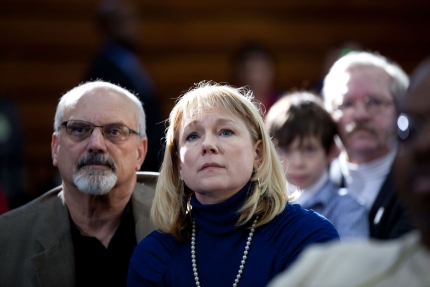
Members of the audience listen as President Barack Obama delivers remarks at Osawatomie High School in Osawatomie, Kansas, Dec. 6, 2011. (Official White House Photo by Pete Souza)

More than a century after Teddy Roosevelt outlined a vision for a "New Nationalism" in a Kansas town called Osawatomie, President Obama visited the same community to talk about what he called a make-or-break moment of the middle class.

He described how the world has undergone an economic transformation unlike any other in our collective history -- and how that change has upended our expectations of social mobility in this country. Where professionals ranging from factory workers to travel agents to accountants once enjoyed the promise of a good job and steady income in exchange for their hard work, today they and a range of people like them must compete with new technology and individuals from around the world. 

The President told the 1,200 people gathered in Osawatomie that there are two ways to respond to these challenges.

Some in Washington, he said, argue that we should let the markets take care of everything -- rolling back regulation and slashing taxes:

Now, it’s a simple theory. And we have to admit, it’s one that speaks to our rugged individualism and our healthy skepticism of too much government. That’s in America’s DNA. And that theory fits well on a bumper sticker.  But here’s the problem:  It doesn’t work. It has never worked. It didn’t work when it was tried in the decade before the Great Depression.  It’s not what led to the incredible postwar booms of the ‘50s and ‘60s. And it didn’t work when we tried it during the last decade.

Thankfully, President Obama said, we can choose a different path:

[T]here’s another view about how we build a strong middle class in this country -- a view that’s truer to our history, a vision that’s been embraced in the past by people of both parties for more than 200 years.
 
It’s not a view that we should somehow turn back technology or put up walls around America. It’s not a view that says we should punish profit or success or pretend that government knows how to fix all of society’s problems. It is a view that says in America we are greater together -- when everyone engages in fair play and everybody gets a fair shot and everybody does their fair share. 

Read the entire speech here.

Related Topics: Economy, Taxes, Kansas

The White House

Office of the Press Secretary

Remarks by the President on the Economy in Osawatomie, Kansas

Osawatomie High School
Osawatomie, Kansas

12:59 P.M. CST

THE PRESIDENT: Thank you, everybody. Please, please have a seat. Thank you so much. Thank you. Good afternoon, everybody.

AUDIENCE: Good afternoon.

THE PRESIDENT: Well, I want to start by thanking a few folks who’ve joined us today. We’ve got the mayor of Osawatomie, Phil Dudley is here. (Applause.) We have your superintendent Gary French in the house. (Applause.) And we have the principal of Osawatomie High, Doug Chisam. (Applause.) And I have brought your former governor, who is doing now an outstanding job as Secretary of Health and Human Services -- Kathleen Sebelius is in the house. (Applause.) We love Kathleen.

Well, it is great to be back in the state of Tex -- (laughter) -- state of Kansas. I was giving Bill Self a hard time, he was here a while back. As many of you know, I have roots here. (Applause.) I’m sure you’re all familiar with the Obamas of Osawatomie. (Laughter.) Actually, I like to say that I got my name from my father, but I got my accent -- and my values -- from my mother. (Applause.) She was born in Wichita. (Applause.) Her mother grew up in Augusta. Her father was from El Dorado. So my Kansas roots run deep.

My grandparents served during World War II. He was a soldier in Patton’s Army; she was a worker on a bomber assembly line. And together, they shared the optimism of a nation that triumphed over the Great Depression and over fascism. They believed in an America where hard work paid off, and responsibility was rewarded, and anyone could make it if they tried -- no matter who you were, no matter where you came from, no matter how you started out. (Applause.)

And these values gave rise to the largest middle class and the strongest economy that the world has ever known. It was here in America that the most productive workers, the most innovative companies turned out the best products on Earth. And you know what? Every American shared in that pride and in that success -- from those in the executive suites to those in middle management to those on the factory floor. (Applause.) So you could have some confidence that if you gave it your all, you’d take enough home to raise your family and send your kids to school and have your health care covered, put a little away for retirement.

Today, we’re still home to the world’s most productive workers. We’re still home to the world’s most innovative companies. But for most Americans, the basic bargain that made this country great has eroded. Long before the recession hit, hard work stopped paying off for too many people. Fewer and fewer of the folks who contributed to the success of our economy actually benefited from that success. Those at the very top grew wealthier from their incomes and their investments -- wealthier than ever before. But everybody else struggled with costs that were growing and paychecks that weren’t -- and too many families found themselves racking up more and more debt just to keep up.

Now, for many years, credit cards and home equity loans papered over this harsh reality. But in 2008, the house of cards collapsed. We all know the story by now: Mortgages sold to people who couldn’t afford them, or even sometimes understand them. Banks and investors allowed to keep packaging the risk and selling it off. Huge bets -- and huge bonuses -- made with other people’s money on the line. Regulators who were supposed to warn us about the dangers of all this, but looked the other way or didn’t have the authority to look at all.

It was wrong. It combined the breathtaking greed of a few with irresponsibility all across the system. And it plunged our economy and the world into a crisis from which we’re still fighting to recover. It claimed the jobs and the homes and the basic security of millions of people -- innocent, hardworking Americans who had met their responsibilities but were still left holding the bag.

And ever since, there’s been a raging debate over the best way to restore growth and prosperity, restore balance, restore fairness. Throughout the country, it’s sparked protests and political movements -- from the tea party to the people who’ve been occupying the streets of New York and other cities. It’s left Washington in a near-constant state of gridlock. It’s been the topic of heated and sometimes colorful discussion among the men and women running for president. (Laughter.)

But, Osawatomie, this is not just another political debate. This is the defining issue of our time. This is a make-or-break moment for the middle class, and for all those who are fighting to get into the middle class. Because what’s at stake is whether this will be a country where working people can earn enough to raise a family, build a modest savings, own a home, secure their retirement.
 
Now, in the midst of this debate, there are some who seem to be suffering from a kind of collective amnesia. After all that’s happened, after the worst economic crisis, the worst financial crisis since the Great Depression, they want to return to the same practices that got us into this mess. In fact, they want to go back to the same policies that stacked the deck against middle-class Americans for way too many years. And their philosophy is simple: We are better off when everybody is left to fend for themselves and play by their own rules.

I am here to say they are wrong. (Applause.) I’m here in Kansas to reaffirm my deep conviction that we’re greater together than we are on our own. I believe that this country succeeds when everyone gets a fair shot, when everyone does their fair share, when everyone plays by the same rules. (Applause.) These aren’t Democratic values or Republican values. These aren’t 1 percent values or 99 percent values. They’re American values. And we have to reclaim them. (Applause.)

You see, this isn’t the first time America has faced this choice. At the turn of the last century, when a nation of farmers was transitioning to become the world’s industrial giant, we had to decide: Would we settle for a country where most of the new railroads and factories were being controlled by a few giant monopolies that kept prices high and wages low? Would we allow our citizens and even our children to work ungodly hours in conditions that were unsafe and unsanitary? Would we restrict education to the privileged few? Because there were people who thought massive inequality and exploitation of people was just the price you pay for progress.

Theodore Roosevelt disagreed. He was the Republican son of a wealthy family. He praised what the titans of industry had done to create jobs and grow the economy. He believed then what we know is true today, that the free market is the greatest force for economic progress in human history. It’s led to a prosperity and a standard of living unmatched by the rest of the world.

But Roosevelt also knew that the free market has never been a free license to take whatever you can from whomever you can. (Applause.) He understood the free market only works when there are rules of the road that ensure competition is fair and open and honest. And so he busted up monopolies, forcing those companies to compete for consumers with better services and better prices. And today, they still must. He fought to make sure businesses couldn’t profit by exploiting children or selling food or medicine that wasn’t safe. And today, they still can’t.

And in 1910, Teddy Roosevelt came here to Osawatomie and he laid out his vision for what he called a New Nationalism. “Our country,” he said, “…means nothing unless it means the triumph of a real democracy…of an economic system under which each man shall be guaranteed the opportunity to show the best that there is in him.” (Applause.)

Now, for this, Roosevelt was called a radical. He was called a socialist -- (laughter) -- even a communist. But today, we are a richer nation and a stronger democracy because of what he fought for in his last campaign: an eight-hour work day and a minimum wage for women -- (applause) -- insurance for the unemployed and for the elderly, and those with disabilities; political reform and a progressive income tax. (Applause.)

Today, over 100 years later, our economy has gone through another transformation. Over the last few decades, huge advances in technology have allowed businesses to do more with less, and it’s made it easier for them to set up shop and hire workers anywhere they want in the world. And many of you know firsthand the painful disruptions this has caused for a lot of Americans.

Factories where people thought they would retire suddenly picked up and went overseas, where workers were cheaper. Steel mills that needed 100 -- or 1,000 employees are now able to do the same work with 100 employees, so layoffs too often became permanent, not just a temporary part of the business cycle. And these changes didn’t just affect blue-collar workers. If you were a bank teller or a phone operator or a travel agent, you saw many in your profession replaced by ATMs and the Internet.

Today, even higher-skilled jobs, like accountants and middle management can be outsourced to countries like China or India. And if you’re somebody whose job can be done cheaper by a computer or someone in another country, you don’t have a lot of leverage with your employer when it comes to asking for better wages or better benefits, especially since fewer Americans today are part of a union.

Now, just as there was in Teddy Roosevelt’s time, there is a certain crowd in Washington who, for the last few decades, have said, let’s respond to this economic challenge with the same old tune. “The market will take care of everything,” they tell us. If we just cut more regulations and cut more taxes -- especially for the wealthy -- our economy will grow stronger. Sure, they say, there will be winners and losers. But if the winners do really well, then jobs and prosperity will eventually trickle down to everybody else. And, they argue, even if prosperity doesn’t trickle down, well, that’s the price of liberty.

Now, it’s a simple theory. And we have to admit, it’s one that speaks to our rugged individualism and our healthy skepticism of too much government. That’s in America’s DNA. And that theory fits well on a bumper sticker. (Laughter.) But here’s the problem: It doesn’t work. It has never worked. (Applause.) It didn’t work when it was tried in the decade before the Great Depression. It’s not what led to the incredible postwar booms of the ‘50s and ‘60s. And it didn’t work when we tried it during the last decade. (Applause.) I mean, understand, it’s not as if we haven’t tried this theory.

Remember in those years, in 2001 and 2003, Congress passed two of the most expensive tax cuts for the wealthy in history. And what did it get us? The slowest job growth in half a century. Massive deficits that have made it much harder to pay for the investments that built this country and provided the basic security that helped millions of Americans reach and stay in the middle class -- things like education and infrastructure, science and technology, Medicare and Social Security.

Remember that in those same years, thanks to some of the same folks who are now running Congress, we had weak regulation, we had little oversight, and what did it get us? Insurance companies that jacked up people’s premiums with impunity and denied care to patients who were sick, mortgage lenders that tricked families into buying homes they couldn’t afford, a financial sector where irresponsibility and lack of basic oversight nearly destroyed our entire economy.

We simply cannot return to this brand of “you’re on your own” economics if we’re serious about rebuilding the middle class in this country. (Applause.) We know that it doesn’t result in a strong economy. It results in an economy that invests too little in its people and in its future. We know it doesn’t result in a prosperity that trickles down. It results in a prosperity that’s enjoyed by fewer and fewer of our citizens.

Look at the statistics. In the last few decades, the average income of the top 1 percent has gone up by more than 250 percent to $1.2 million per year. I’m not talking about millionaires, people who have a million dollars. I’m saying people who make a million dollars every single year. For the top one hundredth of 1 percent, the average income is now $27 million per year. The typical CEO who used to earn about 30 times more than his or her worker now earns 110 times more. And yet, over the last decade the incomes of most Americans have actually fallen by about 6 percent.

Now, this kind of inequality -- a level that we haven’t seen since the Great Depression -- hurts us all. When middle-class families can no longer afford to buy the goods and services that businesses are selling, when people are slipping out of the middle class, it drags down the entire economy from top to bottom. America was built on the idea of broad-based prosperity, of strong consumers all across the country. That’s why a CEO like Henry Ford made it his mission to pay his workers enough so that they could buy the cars he made. It’s also why a recent study showed that countries with less inequality tend to have stronger and steadier economic growth over the long run.

Inequality also distorts our democracy. It gives an outsized voice to the few who can afford high-priced lobbyists and unlimited campaign contributions, and it runs the risk of selling out our democracy to the highest bidder. (Applause.) It leaves everyone else rightly suspicious that the system in Washington is rigged against them, that our elected representatives aren’t looking out for the interests of most Americans.

But there’s an even more fundamental issue at stake. This kind of gaping inequality gives lie to the promise that’s at the very heart of America: that this is a place where you can make it if you try. We tell people -- we tell our kids -- that in this country, even if you’re born with nothing, work hard and you can get into the middle class. We tell them that your children will have a chance to do even better than you do. That’s why immigrants from around the world historically have flocked to our shores.

And yet, over the last few decades, the rungs on the ladder of opportunity have grown farther and farther apart, and the middle class has shrunk. You know, a few years after World War II, a child who was born into poverty had a slightly better than 50-50 chance of becoming middle class as an adult. By 1980, that chance had fallen to around 40 percent. And if the trend of rising inequality over the last few decades continues, it’s estimated that a child born today will only have a one-in-three chance of making it to the middle class -- 33 percent.

It’s heartbreaking enough that there are millions of working families in this country who are now forced to take their children to food banks for a decent meal. But the idea that those children might not have a chance to climb out of that situation and back into the middle class, no matter how hard they work? That’s inexcusable. It is wrong. (Applause.) It flies in the face of everything that we stand for. (Applause.)

Now, fortunately, that’s not a future that we have to accept, because there’s another view about how we build a strong middle class in this country -- a view that’s truer to our history, a vision that’s been embraced in the past by people of both parties for more than 200 years.
 
It’s not a view that we should somehow turn back technology or put up walls around America. It’s not a view that says we should punish profit or success or pretend that government knows how to fix all of society’s problems. It is a view that says in America we are greater together -- when everyone engages in fair play and everybody gets a fair shot and everybody does their fair share. (Applause.)

So what does that mean for restoring middle-class security in today’s economy? Well, it starts by making sure that everyone in America gets a fair shot at success. The truth is we’ll never be able to compete with other countries when it comes to who’s best at letting their businesses pay the lowest wages, who’s best at busting unions, who’s best at letting companies pollute as much as they want. That’s a race to the bottom that we can’t win, and we shouldn’t want to win that race. (Applause.) Those countries don’t have a strong middle class. They don’t have our standard of living.

The race we want to win, the race we can win is a race to the top -- the race for good jobs that pay well and offer middle-class security. Businesses will create those jobs in countries with the highest-skilled, highest-educated workers, the most advanced transportation and communication, the strongest commitment to research and technology.

The world is shifting to an innovation economy and nobody does innovation better than America. Nobody does it better. (Applause.) No one has better colleges. Nobody has better universities. Nobody has a greater diversity of talent and ingenuity. No one’s workers or entrepreneurs are more driven or more daring. The things that have always been our strengths match up perfectly with the demands of the moment.

But we need to meet the moment. We’ve got to up our game. We need to remember that we can only do that together. It starts by making education a national mission -- a national mission. (Applause.) Government and businesses, parents and citizens. In this economy, a higher education is the surest route to the middle class. The unemployment rate for Americans with a college degree or more is about half the national average. And their incomes are twice as high as those who don’t have a high school diploma. Which means we shouldn’t be laying off good teachers right now -- we should be hiring them. (Applause.) We shouldn’t be expecting less of our schools –- we should be demanding more. (Applause.) We shouldn’t be making it harder to afford college -- we should be a country where everyone has a chance to go and doesn’t rack up $100,000 of debt just because they went. (Applause.)

In today’s innovation economy, we also need a world-class commitment to science and research, the next generation of high-tech manufacturing. Our factories and our workers shouldn’t be idle. We should be giving people the chance to get new skills and training at community colleges so they can learn how to make wind turbines and semiconductors and high-powered batteries. And by the way, if we don’t have an economy that’s built on bubbles and financial speculation, our best and brightest won’t all gravitate towards careers in banking and finance. (Applause.) Because if we want an economy that’s built to last, we need more of those young people in science and engineering. (Applause.) This country should not be known for bad debt and phony profits. We should be known for creating and selling products all around the world that are stamped with three proud words: Made in America. (Applause.)

Today, manufacturers and other companies are setting up shop in the places with the best infrastructure to ship their products, move their workers, communicate with the rest of the world. And that’s why the over 1 million construction workers who lost their jobs when the housing market collapsed, they shouldn’t be sitting at home with nothing to do. They should be rebuilding our roads and our bridges, laying down faster railroads and broadband, modernizing our schools -- (applause) -- all the things other countries are already doing to attract good jobs and businesses to their shores.

Yes, business, and not government, will always be the primary generator of good jobs with incomes that lift people into the middle class and keep them there. But as a nation, we’ve always come together, through our government, to help create the conditions where both workers and businesses can succeed. (Applause.) And historically, that hasn’t been a partisan idea. Franklin Roosevelt worked with Democrats and Republicans to give veterans of World War II -- including my grandfather, Stanley Dunham -- the chance to go to college on the G.I. Bill. It was a Republican President, Dwight Eisenhower, a proud son of Kansas -- (applause) -- who started the Interstate Highway System, and doubled down on science and research to stay ahead of the Soviets.

Of course, those productive investments cost money. They’re not free. And so we’ve also paid for these investments by asking everybody to do their fair share. Look, if we had unlimited resources, no one would ever have to pay any taxes and we would never have to cut any spending. But we don’t have unlimited resources. And so we have to set priorities. If we want a strong middle class, then our tax code must reflect our values. We have to make choices.

Today that choice is very clear. To reduce our deficit, I’ve already signed nearly $1 trillion of spending cuts into law and I’ve proposed trillions more, including reforms that would lower the cost of Medicare and Medicaid. (Applause.)

But in order to structurally close the deficit, get our fiscal house in order, we have to decide what our priorities are. Now, most immediately, short term, we need to extend a payroll tax cut that’s set to expire at the end of this month. (Applause.) If we don’t do that, 160 million Americans, including most of the people here, will see their taxes go up by an average of $1,000 starting in January and it would badly weaken our recovery. That’s the short term.

In the long term, we have to rethink our tax system more fundamentally. We have to ask ourselves: Do we want to make the investments we need in things like education and research and high-tech manufacturing -- all those things that helped make us an economic superpower? Or do we want to keep in place the tax breaks for the wealthiest Americans in our country? Because we can’t afford to do both. That is not politics. That’s just math. (Laughter and applause.)

Now, so far, most of my Republican friends in Washington have refused under any circumstance to ask the wealthiest Americans to go to the same tax rate they were paying when Bill Clinton was president. So let’s just do a trip down memory lane here.

Keep in mind, when President Clinton first proposed these tax increases, folks in Congress predicted they would kill jobs and lead to another recession. Instead, our economy created nearly 23 million jobs and we eliminated the deficit. (Applause.) Today, the wealthiest Americans are paying the lowest taxes in over half a century. This isn’t like in the early ‘50s, when the top tax rate was over 90 percent. This isn’t even like the early ‘80s, when the top tax rate was about 70 percent. Under President Clinton, the top rate was only about 39 percent. Today, thanks to loopholes and shelters, a quarter of all millionaires now pay lower tax rates than millions of you, millions of middle-class families. Some billionaires have a tax rate as low as 1 percent. One percent.

That is the height of unfairness. It is wrong. (Applause.) It’s wrong that in the United States of America, a teacher or a nurse or a construction worker, maybe earns $50,000 a year, should pay a higher tax rate than somebody raking in $50 million. (Applause.) It’s wrong for Warren Buffett’s secretary to pay a higher tax rate than Warren Buffett. (Applause.) And by the way, Warren Buffett agrees with me. (Laughter.) So do most Americans -- Democrats, independents and Republicans. And I know that many of our wealthiest citizens would agree to contribute a little more if it meant reducing the deficit and strengthening the economy that made their success possible.

This isn’t about class warfare. This is about the nation’s welfare. It’s about making choices that benefit not just the people who’ve done fantastically well over the last few decades, but that benefits the middle class, and those fighting to get into the middle class, and the economy as a whole.

Finally, a strong middle class can only exist in an economy where everyone plays by the same rules, from Wall Street to Main Street. (Applause.) As infuriating as it was for all of us, we rescued our major banks from collapse, not only because a full-blown financial meltdown would have sent us into a second Depression, but because we need a strong, healthy financial sector in this country.

But part of the deal was that we wouldn’t go back to business as usual. And that’s why last year we put in place new rules of the road that refocus the financial sector on what should be their core purpose: getting capital to the entrepreneurs with the best ideas, and financing millions of families who want to buy a home or send their kids to college.

Now, we’re not all the way there yet, and the banks are fighting us every inch of the way. But already, some of these reforms are being implemented.

If you’re a big bank or risky financial institution, you now have to write out a “living will” that details exactly how you’ll pay the bills if you fail, so that taxpayers are never again on the hook for Wall Street’s mistakes. (Applause.) There are also limits on the size of banks and new abilities for regulators to dismantle a firm that is going under. The new law bans banks from making risky bets with their customers’ deposits, and it takes away big bonuses and paydays from failed CEOs, while giving shareholders a say on executive salaries.

This is the law that we passed. We are in the process of implementing it now. All of this is being put in place as we speak. Now, unless you’re a financial institution whose business model is built on breaking the law, cheating consumers and making risky bets that could damage the entire economy, you should have nothing to fear from these new rules.

Some of you may know, my grandmother worked as a banker for most of her life -- worked her way up, started as a secretary, ended up being a vice president of a bank. And I know from her, and I know from all the people that I’ve come in contact with, that the vast majority of bankers and financial service professionals, they want to do right by their customers. They want to have rules in place that don’t put them at a disadvantage for doing the right thing. And yet, Republicans in Congress are fighting as hard as they can to make sure that these rules aren’t enforced.

I’ll give you a specific example. For the first time in history, the reforms that we passed put in place a consumer watchdog who is charged with protecting everyday Americans from being taken advantage of by mortgage lenders or payday lenders or debt collectors. And the man we nominated for the post, Richard Cordray, is a former attorney general of Ohio who has the support of most attorney generals, both Democrat and Republican, throughout the country. Nobody claims he’s not qualified.

But the Republicans in the Senate refuse to confirm him for the job; they refuse to let him do his job. Why? Does anybody here think that the problem that led to our financial crisis was too much oversight of mortgage lenders or debt collectors?

AUDIENCE: No!

THE PRESIDENT: Of course not. Every day we go without a consumer watchdog is another day when a student, or a senior citizen, or a member of our Armed Forces -- because they are very vulnerable to some of this stuff -- could be tricked into a loan that they can’t afford -- something that happens all the time. And the fact is that financial institutions have plenty of lobbyists looking out for their interests. Consumers deserve to have someone whose job it is to look out for them. (Applause.) And I intend to make sure they do. (Applause.) And I want you to hear me, Kansas: I will veto any effort to delay or defund or dismantle the new rules that we put in place. (Applause.)

We shouldn’t be weakening oversight and accountability. We should be strengthening oversight and accountability. I’ll give you another example. Too often, we’ve seen Wall Street firms violating major anti-fraud laws because the penalties are too weak and there’s no price for being a repeat offender. No more. I’ll be calling for legislation that makes those penalties count so that firms don’t see punishment for breaking the law as just the price of doing business. (Applause.)

The fact is this crisis has left a huge deficit of trust between Main Street and Wall Street. And major banks that were rescued by the taxpayers have an obligation to go the extra mile in helping to close that deficit of trust. At minimum, they should be remedying past mortgage abuses that led to the financial crisis. They should be working to keep responsible homeowners in their home. We’re going to keep pushing them to provide more time for unemployed homeowners to look for work without having to worry about immediately losing their house.

The big banks should increase access to refinancing opportunities to borrowers who haven’t yet benefited from historically low interest rates. And the big banks should recognize that precisely because these steps are in the interest of middle-class families and the broader economy, it will also be in the banks’ own long-term financial interest. What will be good for consumers over the long term will be good for the banks. (Applause.)

Investing in things like education that give everybody a chance to succeed. A tax code that makes sure everybody pays their fair share. And laws that make sure everybody follows the rules. That’s what will transform our economy. That’s what will grow our middle class again. In the end, rebuilding this economy based on fair play, a fair shot, and a fair share will require all of us to see that we have a stake in each other’s success. And it will require all of us to take some responsibility.

It will require parents to get more involved in their children’s education. It will require students to study harder. (Applause.) It will require some workers to start studying all over again. It will require greater responsibility from homeowners not to take out mortgages they can’t afford. They need to remember that if something seems too good to be true, it probably is.

It will require those of us in public service to make government more efficient and more effective, more consumer-friendly, more responsive to people’s needs. That’s why we’re cutting programs that we don’t need to pay for those we do. (Applause.) That’s why we’ve made hundreds of regulatory reforms that will save businesses billions of dollars. That’s why we’re not just throwing money at education, we’re challenging schools to come up with the most innovative reforms and the best results.

And it will require American business leaders to understand that their obligations don’t just end with their shareholders. Andy Grove, the legendary former CEO of Intel, put it best. He said, “There is another obligation I feel personally, given that everything I’ve achieved in my career, and a lot of what Intel has achieved…were made possible by a climate of democracy, an economic climate and investment climate provided by the United States.”

This broader obligation can take many forms. At a time when the cost of hiring workers in China is rising rapidly, it should mean more CEOs deciding that it’s time to bring jobs back to the United States -- (applause) -- not just because it’s good for business, but because it’s good for the country that made their business and their personal success possible. (Applause.)

I think about the Big Three auto companies who, during recent negotiations, agreed to create more jobs and cars here in America, and then decided to give bonuses not just to their executives, but to all their employees, so that everyone was invested in the company’s success. (Applause.)

I think about a company based in Warroad, Minnesota. It’s called Marvin Windows and Doors. During the recession, Marvin’s competitors closed dozens of plants, let hundreds of workers go. But Marvin’s did not lay off a single one of their 4,000 or so employees -- not one. In fact, they’ve only laid off workers once in over a hundred years. Mr. Marvin’s grandfather even kept his eight employees during the Great Depression.

Now, at Marvin’s when times get tough, the workers agree to give up some perks and some pay, and so do the owners. As one owner said, “You can’t grow if you’re cutting your lifeblood -- and that’s the skills and experience your workforce delivers.” (Applause.) For the CEO of Marvin’s, it’s about the community. He said, “These are people we went to school with. We go to church with them. We see them in the same restaurants. Indeed, a lot of us have married local girls and boys. We could be anywhere, but we are in Warroad.”

That’s how America was built. That’s why we’re the greatest nation on Earth. That’s what our greatest companies understand. Our success has never just been about survival of the fittest. It’s about building a nation where we’re all better off. We pull together. We pitch in. We do our part. We believe that hard work will pay off, that responsibility will be rewarded, and that our children will inherit a nation where those values live on. (Applause.)

And it is that belief that rallied thousands of Americans to Osawatomie -- (applause) -- maybe even some of your ancestors -- on a rain-soaked day more than a century ago. By train, by wagon, on buggy, bicycle, on foot, they came to hear the vision of a man who loved this country and was determined to perfect it.

“We are all Americans,” Teddy Roosevelt told them that day. “Our common interests are as broad as the continent.” In the final years of his life, Roosevelt took that same message all across this country, from tiny Osawatomie to the heart of New York City, believing that no matter where he went, no matter who he was talking to, everybody would benefit from a country in which everyone gets a fair chance. (Applause.)

And well into our third century as a nation, we have grown and we’ve changed in many ways since Roosevelt’s time. The world is faster and the playing field is larger and the challenges are more complex. But what hasn’t changed -- what can never change -- are the values that got us this far. We still have a stake in each other’s success. We still believe that this should be a place where you can make it if you try. And we still believe, in the words of the man who called for a New Nationalism all those years ago, “The fundamental rule of our national life,” he said, “the rule which underlies all others -- is that, on the whole, and in the long run, we shall go up or down together.” And I believe America is on the way up. (Applause.)

Thank you. God bless you. God bless the United States of America. (Applause.)

END
1:55 P.M. CST

The White House

Office of the Press Secretary

Statement by the President on Republican Filibuster of Caitlin Halligan

I am deeply disappointed that a minority of the United States Senate has blocked the nomination of Caitlin Halligan to serve on the U.S. Court of Appeals for the District of Columbia Circuit.  Ms. Halligan has the experience, integrity, and judgment to serve with distinction on this court, and she has broad bipartisan support from the legal and law enforcement communities.  But today, her nomination fell victim to the Republican pattern of obstructionism that puts party ahead of country. Today’s vote dramatically lowers the bar used to justify a filibuster, which had required “extraordinary circumstances.”  The only extraordinary things about Ms. Halligan are her qualifications and her intellect.

Currently, Senate Republicans are blocking 20 other highly qualified judicial nominees, half of whom I have nominated to fill vacancies deemed “judicial emergencies” by the Administrative Office of the Courts.  These are distinguished nominees who, historically, would be confirmed without delay.  All of them have already been approved by the Senate Judiciary Committee – most of them unanimously – only to run into partisan roadblocks on the Senate floor.  The American people deserve a fair and functioning judiciary.  So I urge Senate Republicans to end this pattern of partisan obstructionism and confirm Ms. Halligan and the other judges they have blocked for purely partisan reasons.

The White House

Office of the Press Secretary

Press Gaggle by Press Secretary Jay Carney, 12/6/2011

Aboard Air Force One
En Route Kansas City, Missouri

10:58 A.M. EST

MR. CARNEY:  I want to thank you all for coming on this trip today to Osawatomie, Kansas.  As I’m sure you’re aware, this is the location where Teddy Roosevelt gave his New Nationalism speech, a speech that really set the course for the 20th century in terms of ensuring that the free market system operated under rules of the road that gave everyone a fair share and a fair shot and ensured that everyone also paid their fair share.

The President today will give a speech that will really make clear that the middle class is facing a make-or-break moment, and that we need to get back to those values that ensure that the middle class and those who would join the middle class have the opportunity to share in the prosperity that we need to continue to build this 21st century.

He will argue that -- sorry, can’t read my own writing here -- we’re facing a choice between a country where too few do well and too many struggle to get by, or one where we’re all in it together, and everyone engages in fair play, everyone gets a fair shake and a fair shot.

And as I said yesterday, the importance of this speech is broader than the debates that we’re having at this very moment, although it encompasses them.  Certainly the debate we’ve been having about the payroll tax cut extension and expansion fits into the frame that the President will set forward today, where just last week we had a vote in the United States Senate where 51 senators voted in favor of giving middle-class Americans a tax break for next year but Republicans blocked that vote rather than ask just 300,000 millionaires and billionaires to pay a little bit extra, to pay their fair share.  And that was very unfortunate.

We’re going to continue to press with our friends in the Senate, as well as the House, to get this payroll tax cut done, because it’s essential for the economy, it’s essential for the American people, especially the middle class and those who are struggling to get by.

And with that I will take your questions.

Q    Jay, has the President been doing anything special to prepare for this speech?  Is there a book he’s been reading or a historian that he’s been speaking with?

MR. CARNEY:  Well, nothing besides working on the speech, which he has done quite a bit of and he’s continuing right now to put the finishing touches on the speech.

He has, of course, read Theodore Roosevelt’s New Nationalism speech, and I recommend it to all of you.  What is astounding about it when you read it is how much of it could be delivered today. 

And as you know, Teddy Roosevelt was a Republican, son of a wealthy family who celebrated the remarkable progress that industry had made in America and that the free market had contributed to economic growth and job creation, but said that we had to ensure that we set up rules of the road that ensure that everyone played by the same rules and everybody had a fair shot.  And that thinking is what propelled the United States to the kind of remarkable economic growth and explosive growth of the middle class that we saw in the 20th century.

Q    Teddy Roosevelt was called a socialist and a communist after he gave this speech.  Is the President mindful of that, and keeping that in part of his target?

MR. CARNEY:  No, I think -- I think that is an irony, because I don’t think -- I would assume that this President’s critics share in his admiration for Teddy Roosevelt as a titan in American history and a hugely important and progressive leader in this country, and a Republican.  The fact of the matter is that Teddy Roosevelt was advocating for the same sectors of American society that this President is advocating for, that so many leaders, between the two of them have -- in the years between the two were on the scene, have advocated for.  And, again, bringing it back to the specific debate that we’re talking about today and the payroll tax cut, I mean, that’s hardworking Americans -- middle-class Americans who just need a more level playing field to ensure that they can have the kind of economic security that they deserve and that results in a more prosperous, dynamic and successful country.

You all know about the CBO report -- the nonpartisan CBO report that so dramatically elucidates the problem that we face in this country, and the explosive growth and the share of the country’s wealth that the top 1 percent of America has seen, while the rest of the country -- most of the rest of the country has struggled to stay above water.

So the speech today will really try to put the economic debates that we’ve had this year, and the policy debates that we’ll have going forward, into perspective.  And it will be a very clear elucidation of this President’s position on these issues and his vision for the country.

Q    Jay, does the President believe that candidates like Mitt Romney and Newt Gingrich and Republicans in Congress are not fighting for the middle class?

MR. CARNEY:  I’m not going to address questions about candidates in the Republican primary specifically.  I mean, if you want to ask me about the President’s policies, I’m happy to address those. 

The President believes that, unfortunately, Republican members of Congress have been too often of late on the wrong side of this debate, as demonstrated by the vote we had last week on the payroll tax cut extension; as demonstrated by the votes we’ve seen in the Senate on whether or not to put 400,000 teachers back to work, or construction workers back on the job -- and I would say, as demonstrated in part by, again, as it relates to a specific policy discussion and a very heated policy debate that we had this summer, by that debate that we saw where Republican contenders for the office of the President all said they would refuse a deal on deficit reduction that asked for simply one dollar in new revenue for every $10 in spending cuts.  And that, again, suggests in the President’s view and our view that they’re on the wrong side of this debate. 

Q    Here’s one on the President’s policies and stuff.  It’s on the payroll tax cut -- and that is, Romney said yesterday that he would support a one-year extension.  Does the White House welcome that in any fashion?

MR. CARNEY:  Well, we welcome specifically support in the Congress for extension of the payroll tax cut, paid for in a way that’s economically responsible, as opposed to economically irresponsible or unfair. 

So we’re looking for movement among Republicans who have a vote, in this case, on this specific policy debate.

Q    Including candidates?

MR. CARNEY:  Well, sure, to the extent that they have an impact on their fellow travelers in Congress, I think that would be welcome.  I mean, no matter where you’ve been on the issue in the last days or weeks, if you land right now, that’s okay by us. 

Q    Jay, on the payroll tax cut, if Congress were to adjourn without passing the tax cut and also the unemployment benefits, would the President call Congress back into session before the end of the year?  And then secondly, is he willing to skip his vacation if need be to get this done?

MR. CARNEY:  The President said himself quite explicitly that he, if necessary, will -- I think the phrasing was, be here through Christmas. 

Now, you guys are better analysts of Congress now than I am, probably, but I’d be awfully surprised if Republicans decide to turn off the lights in Congress and head off on a one-month vacation without -- while having decided that 160 million Americans ought to have a tax hike next year.  Maybe that will come to pass, but I’d be surprised.

Q    A question about Iran, the drone shot down over Iran.  I know you keep referring us to the Pentagon.  Is the United States preparing for military action against Iran?

MR. CARNEY:  Our position on -- generally, setting aside the issue of reports about this plane, our position on Iran is well known, which is we take nothing off the table, but we have been aggressively pursuing a strategy that has effectively isolated and pressured Iran through sanctions and other measures, including diplomatic pressure.  And we continue to pursue that strategy.

Q    It’s very possible that we’re spying on Iran from the air to keep all those options --

MR. CARNEY:  -- you asked me whether we were considering military action --

Q    But if you’re keeping that --

MR. CARNEY:  My response to that is what it always was -- has been, which is we don’t take any options off the table, broadly speaking, and that’s not really in any specific way a response to the incident at hand.

Q    Is the White House concerned that S&P may downgrade the credit facility?  And what’s the status on the talks in the eurozone?

MR. CARNEY:  Well, as you know, Secretary Geithner is in Europe -- I think he’s in Germany today -- and very involved and engaged in discussions over there with his European counterparts on the steps they’re taking to decisively and conclusively deal with this crisis.  They have taken some important steps and they need to take more to get the job done.  But I don’t have a status update.  I would refer you to the Treasury Department.

Q    Are you worried, though, specifically about the S&P downgrade threat on Europe, that that might affect the U.S. economy and the world economy more?

MR. CARNEY:  Well, as we’ve said often, the reality of the global economy that we live in and participate in means that problems in Europe create headwinds for our own economy.  That’s been the case this year and is always a concern.  So it obviously matters significantly to us and we have engaged with our European counterparts for that reason and also because they’re our friends and allies, and where we can offer advice and counsel based on our own experience we are happy and ready to do so.

But it reminds us, of course, that we need to do -- take actions on the things that we can control, and in this case, that brings me back to the American Jobs Act and to the tax cut provisions that the President supports and wants to see the Senate and the House pass, to make sure that Congress doesn’t raise taxes on middle-class Americans on January 1st.

Q    How did the President react to Merkel and Sarkozy’s latest proposals yesterday?

MR. CARNEY:  I don’t have a presidential reaction to them.  We’re obviously monitoring events in Europe and will continue to do so.  And obviously Secretary Geithner himself is there in person to evaluate them and have discussions with European counterparts.

Q    Jay, have you looked at the Collins-McCaskill proposal to have a millionaires’ tax but somehow carve out small business owners?

MR. CARNEY:  I haven’t -- I’ve heard about it, but I haven’t had a chance to study it and I haven’t had a discussion with our economic team about it.  Broadly speaking, as I’ve said before, there are possible pay-fors, alternative pay-fors that we would support, and there are alternative pay-fors that we would not.  And I don’t know -- I haven’t had a chance to assess this new proposal, so I can’t tell you where that fits. 

Q    It seems like it could take away a GOP talking point about any kind of tax increase on high earners if you took job creators out of the equation.

MR. CARNEY:  The GOP talking point is based on a fallacy, as you all well know and has been abundantly documented.  The percentage of small businesses -- even as they define small businesses, which means partners in law firms and other things that file their business earnings under the personal income tax and earn more than a million dollars is less than 1 percent of all small businesses in America, based on a Treasury report that was done to evaluate the extension of the high-income Bush tax cuts. 

So we’re really not talking about small business here.  Small businesses are just simply not broadly affected by the proposed surtax on millionaires and billionaires.  And it’s a perfect example of window dressing or rather a fig leaf and maybe a little gorilla dust to suggest that that’s the case.

Q    Just on the Cordray nomination -- do you have any sense of whether you’re making any breakthroughs with any of the Republican senators you’ve been targeting?  And what exactly is the President doing to try to get those senators’ support?

MR. CARNEY:  Well, the President has made clear that this is a high priority and he is -- he and his team have been conveying that to members of the Senate.  And, unfortunately, those who say they will vote against Richard Cordray by and large concede that he is highly qualified for the job, that he has won high praise from Republicans as well as Democrats in his role as attorney general in Ohio, but that they want to prevent the confirmation of any consumer watchdog because they don’t want that agency to be able to fully function and operate and protect consumers. 

That’s unacceptable.  And it’s not acceptable to the President and it’s unacceptable to the American people who deserve to have rules of the road in place that protect them in their dealings with financial institutions.  It’s as simple as that.  And so the President will continue to press for the confirmation of Richard Cordray and hopes that those senators who control his fate, if you will, in terms of this confirmation process will change their mind.

Q    Will he talk about Cordray today?

MR. CARNEY:  Why don’t we wait and see what he says in the speech.  Anything else?  Oh, speaking of nominees, I just wanted to reiterate what I mentioned yesterday but was -- for good reason did not get a lot of attention because the President spoke at the briefing.  But we have a judicial nominee for the D.C. Circuit today who is enormously qualified, and if the Senate were not so dysfunctional, would easily be confirmed with bipartisan support

The vote out of committee is today.  We continue to hope that the kind of obstructionism that we’ve seen from Senator McConnell and others on this issue of judicial nominees will stop and that she will be confirmed, because it’s really -- it is a terribly damaging thing to do to suggest that someone of her caliber cannot be confirmed to this important seat on the court, D.C. Circuit, for political reasons.  It’s a perfect example of the kind of stuff that drives Americans crazy about how Congress operates. 

Q    Anything on the string in bombings and attacks in Afghanistan overnight?  There apparently were three throughout the country.

MR. CARNEY:  We strongly condemn the bombings in -- I think it was in Mazar-i-Sharif and in Kabul.  And I think I have some language on that if you want it:

The United States strongly condemns the two suicide bombings that killed dozens of worshippers today, many of them women and children in Kabul and Mazar-i-Sharif.  Many of the killed and wounded were marking a Shia holy day, Ashura, when the suicide bombs detonated nearly simultaneously.  The United States continues to stand with the Afghan people against terrorism.  Our thoughts and condolences are with those affected by these heinous acts.
 
Anything else?  All right, thanks.

END
11:19 A.M. EST