The White House

Office of the Vice President

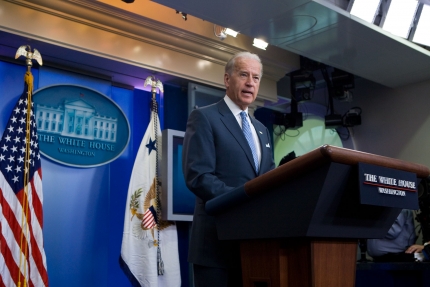
Remarks by the Vice President Announcing Recovery Act "Retrofit Ramp-Up" Awards on Eve of Earth Day

Eisenhower Executive Office Building, Washington, D.C.

THE VICE PRESIDENT:  Secretary Salazar, Carol Browner is here, Secretary Ray Mabus, Ben Cardin -- I miss seeing you guys every day, Ben.  Dennis Cardoza, I’m told Emanuel Cleaver is here.  I see Marcy is here, Congresswoman Marcy Kaptur.  Ed Markey, who has gained his congressional Ph.D. on this issue.  I don’t know anybody who knows more about it than he does.  And we also have the -- Mayor Michael Bell, the mayor of Toledo here, Mayor Phil Gordon, the Mayor of Phoenix, and Mayor Michael McGinn of Seattle.  And you’re all welcome.  And I’m sure there’s other very distinguished guests here as well that I have overlooked and I apologize.

Let me start off by saying, and I mean this sincerely, I was a senator a long time.  As a matter of fact, as I left the Senate, as Ben may remember, the Senate historian came in and said -- thinking that he was going to make me feel better -- he pointed out that only 17 senators in American history ever served as long as I did.  And I could feel my heart sinking into my stomach.  I said, “If my father were here, he’d define that as a misspent adulthood.”  (Laughter.) 

But all kidding aside, I have been around awhile.  I served a long time with Gaylord Nelson, who -- he and his wife, Carrie, were great friends.  They were real pioneers back in those early days when I got there, talked about the environment.

I was put on the Public Works Committee when I first got there.  And the first -- the first recommendation I made is we change the name, the Environment and Public Works Committee.  And Mayor Jennings Randolph, or Jennings as he liked to be called, told me that if I made that recommendation again, I was off the committee.  (Laughter.)  You think I’m joking, I’m not.  There’s a lot that’s changed, a lot that’s changed.

And I expected when I took this job I’d have some real opportunities to impact on the formation of policy.  But one of the things I didn’t expect, I didn’t expect to have the opportunity to work with such a tutor.  And I’m not being solicitous.  To have an opportunity to work with the Secretary of Energy on something that I cared a great deal about when I was a senator, to have a man of Secretary Chu’s caliber and his depth of his knowledge and his commitment has genuinely been sort of an ongoing tutorial for me.  And I want to publicly thank you, Mr. Secretary.  (Applause.)

And as that old joke goes, the Secretary has forgotten more about this subject than I’m ever going to know.  But I am as passionately committed to this transition he refers to as I think anyone, as is the President.  I hadn’t planned on doing what I’m about to do today, but today’s announcement by General Motors that it’s paid back -- it’s paid back its TARP loan in full -- in full is a huge accomplishment.

The President of the United States took a lot of heat for that effort, to keep that company alive while it was transitioning.  And I would just like to point out that I am proud to be associated with the guy who saw the necessity to do this.  And this has even exceeded our expectations.  We’ve worked hard to help turn around the nation’s auto industry and give the car companies a chance to be viable without government assistance.  And we helped GM -- we helped out GM so that they could retool, so that they could become a leader in the 21st century.

And we know that building energy-efficient cars with better gas mileage and cleaner emissions is going to be a big part of us being able to succeed, not only the auto industry, but also succeed in our quest for a better environment.  Today, GM paid back the loan in full five years ahead of schedule.  And now GM is in a better position to make them -- make what the market demands, energy-efficient vehicles for a cleaner world.  And that leads me to Earth Day, the reason why we’re here today.

I also want to point out -- I want to thank, by the way, Lisa Jackson, our EPA administrator.  She couldn’t be here today, but we all appreciate the tremendous work that she’s doing having once again -- we now have again an Environmental Protection Agency again.  (Applause.) 

And a happy almost Earth Day to all of you.  I say that because tomorrow is actually the day that officially marks the occasion.  But the truth is we’re here kicking off an entire earth week.  And I hope our administration has kicked off an entire earth administration.  Over the next few days, officials from across our administration will participate in more than a dozen events to celebrate Earth Day.  We’re getting everyone in the administration involved.  And today, the day before Earth Day, we kick off a week for an administration that for -- literally for every day it’s Earth Day for us.  Because this implicates every aspect of our country’s self-interest, from foreign policy to economic policy to environmental policy to health care policy.  This impacts on every aspect -- every aspect of what kind of country we’re going to leave our kids.

And 40 years ago, when Gaylord conceived and celebrated the first Earth Day, the world looked pretty different.  Some of us can remember the public health and environmental catastrophes that propelled Earth Day, the Earth Day movement in the first place, the Cuyahoga River literally catching on fire from all the oil and dumped trash that was in it.  Days of heavy smog in New York City so thick that people actually were dying from being unable to breathe the air.  The list goes on and on and on.  Our planet was sick.  It’s not healthy yet.  But our planet was sick and in need of desperate help.  It’s still in need of real help.       

Because of Gaylord Nelson, and millions of Americans like some of you that are here today who joined him, we begin to make things a little bit better.  Forty years later, the first Earth Day -- from the first Earth Day, the people of the first Earth Day celebration would look around and look out at all of you and they’d be very proud of what all of you have done.  They’d see recycling bins in your houses.  They’d see business spending money to make their facilities more energy efficient.  They’d see men and women heading to work to build and install wind turbines and solar panels and other components for the new energy future.  They’d see an administration building on his legacy, Gaylord’s legacy, protecting and restoring the Great Lakes, the Chesapeake Bay, the Gulf Coast; designating millions of acres of wilderness; saving 1.8 billion barrels of oil by reducing Greenhouse gases by raising fuel efficiency and emissions standards on cars and trucks, pulling us on the right track and by doubling the renewal energy that will be generated in this country.

Since the beginning of the environmental movement, we’ve been trying to transform the way we use energy and reduce our dependence on foreign oil and fossil fuels to tap into the vast, untapped, renewable energy sources and to use energy more efficiently.  The fact is we’ve been trying for 40 years, and we’ve made some progress.  But we’re now poised to make significantly greater strides, in our view, than ever because of the unprecedented investment in the Recovery Act and the leadership of the President and the Secretary of Energy. 

Even before we took office, the President and myself and our economic team planned to use parts of what we knew had to be -- we didn’t name it the Recovery Act then, but we knew we were going to have to have a Recovery Act.  There were significant parts of that Recovery Act to make investments that would create good jobs today, but while planting the seeds for great industries of tomorrow with clean energy being at the forefront and the heart of all of it.

The world already is transforming, as the Secretary said, to a new energy economy.  And the question is, are we going to lead it or are we going to continue to try to catch up?  We are going to be left behind.  We need to catch up.  With around $80 billion in clean energy investments, the Recovery Act is the largest single investment in clean energy in our history.  If you just took that piece out of the Recovery Act and passed it as a stand-alone bill, it’s the largest investment ever made in the history of the country in clean energy. 

But we’re not just doing this with government funds.  We’re using government to provide the seed money to grow private industries.  And some of the initiatives that you mayors have going with the private sector in your communities is a model for what we should be doing.  Twenty-three billion dollars in renewable energy generation and advanced energy manufacturing, which will likely leverage more than $43 billion in additional investment; $2.4 billion in battery technology, matched by another $2.4 billion in private capital to help build energy-efficient cars of the future.

In January of ’09, there were two advanced battery factories in America.  By 2015, there will be 30.  The smart grid, $3.4 billion in government investment led to $4.7 billion in private investment to help get us to a stronger, more efficient, more reliable energy grid; $2.3 billion, which is likely to leverage $5.4 billion in private capital to put us back on track to double our capacity to manufacture the components of a new, green economy in America from wind turbines to solar panels to create energy that’s renewable.  Renewable resources to batteries and smart grid systems to store that -- and transmit that energy, to technologies like advanced lighting that help conserve energy.

We’re going to start making that stuff here in America with American workers.  We’re going to be coming up to you guys in the House and the Senate and asking for 48C to be bumped up to $5 billion so we could be making this stuff in America. 

And today, we’re announcing another important Recovery Act program, the “Retrofit Ramp-Up.”  Now, I wonder what sometimes our constituents think when we come up with these names.  (Laughter.)  The “Retrofit Ramp-Up.”  We all in this room know what it is.  We may be the only ones who know exactly what it means.  (Laughter.)  But it’s a kind of a buzz word, retrofits.  But what we’re really talking about here is simple.  It’s about making our homes and our office buildings more efficient and more comfortable and more affordable, replacing windows and doors.  I have visited, along with some of the people in the front row, new window and door factories making incredibly -- incredibly energy-efficient windows and doors, which can save billions of dollars over time.  Putting in new air conditioning or heating units that are much more efficient.  Sealing up cracks and openings where air can leak into and out of your home.  That’s retrofitting -- small stuff, but big, big, big savings.

In fact, retrofitting existing homes has the potential to cut more than $21 billion a year annually in our energy cost.  There are more than 100 million homes in America.  In the last year, only 40,000 took advantage of the energy-saving retrofits.  It’s not that homeowners don’t want to lower their energy bills; it’s just that they found that the process was too difficult, from accessing energy audits to finding skilled retrofit workers to simply being able to afford it. 

Now, last fall the Middle Class Task Force, which the President asked me to chair, and the Council on Environmental Equality released a report that called the recovery retrofit -- explaining how we’re working to overcome the challenges that got in the way of homeowners taking advantage of this.  And these grants that we’re announcing today are grants to 25 communities nationwide, and are a major step in the direction of making this much easier to do, much more efficient, and much more likely to happen.

This program is all about developing innovative models that can be expanded throughout the country.  And there are a couple that are particularly important things about these grants that we should mention.  First, these grants are focused on encouraging entire neighborhoods, entire neighborhoods to take advantage of the retrofits all at the same time.  Right now, most retrofit work programs are on a house by house basis.  The construction crew may come into a neighborhood, upgrade one home one week, and then they have to come back to work in a neighborhood home a few weeks later, maybe the same neighborhood. 

Well, the Retrofit* Ramp-up* award winners are taking a different approach.  Now, that -- the same construction crew would upgrade all the homes on the same block at the same time.  That saves contractors time and money.  They can pass the savings on to their customers.  And it’s just a much more efficient way to operate.  And these communities aren’t just relying on these grants.  They’ll use this as seed money to leverage an additional $2.8 billion over the next three years.  That’s a total of five dollars for every dollar -- every dollar of grant money.  And they’re doing this by building partnerships between local governments, utility companies, financial institutions, and nonprofits.  Whole communities are coming together to get this going, and when we look around you’ll see it.  And you’ll see more and more of it as the months go on.          

I know there are some people from the Philadelphia mayor’s office that are here today.  This has been one of Mayor Nutter’s hobby horses.  Well, their city has a plan to work with private lenders to connect homeowners to easy access, affordable loans to pay for retrofit work.  The Mayor of Toledo, Mike Bell, is here.  Toledo’s program will provide career training, job placement, and mentoring for people actually going to be doing this work.  The Mayor of Phoenix, Phil Gordon, is here.  Just about -- just talk about partnerships, his city is partnering with Arizona State University Community Colleges, local utility companies, and five local banks to carry out a comprehensive retrofit program focusing on buildings surrounding Phoenix’s new light rail line. 

Investing in retrofits is a triple win.  It’s a win for consumers who save money on their energy bill.  It’s a win for the environment because we’re using less energy, which cuts down on harmful emissions from greenhouse gases.  And, finally, it’s a win for the American economy, because it creates green jobs, jobs that can’t be outsourced. 

Now, with so many worthy applications, not everyone got funds today.  But the Department of Energy is still working to find more opportunities to get cities to get involved in programs like this.  But it’s not just cities.  We also want to encourage millions of Americans across the country to retrofit their homes.  That’s why the President has made it a priority to pass legislation creating a new energy-efficient rebate program that we call “Homestar.”

And, by the way, I was home the last two weekends going to Home Depot both times, one, to buy a 30-inch hedge clipper, because my wife was very dissatisfied with our hedges.  (Laughter.)  You all think I’m kidding.  (Laughter.)  I am not kidding.  (Laughter.)  Anyway -- anyway, and the other one was to take my almost four-year-old grandson, Hunter, who said, “Pop, I don’t got a tape measurer.”  So he had to get a tape measurer.  He’s stolen four of mine.  He can’t find them.  But we went to get another tape measurer.  (Laughter.)  But all kidding aside, they asked about the program, the guys working the aisles, the women working the aisles, they asked about the program.

Under this program homeowners will be eligible for rebates worth up to $1,005 for simple home upgrades like replacing an old water heater, putting in those new windows that I talked about.  If you decide to do a comprehensive retrofit of your whole house, you’d be eligible for a rebate up to $3,000.  Homeowners won’t have to fill out forms, send it in the mail, and wait for the check to arrive.  They’ll get rebates up front from the hardware store or the contractor.

The Homestar rebate program is going to create tens of thousands of jobs in industries like construction, manufacturing, and I might add, sales.  These people, there are going to be people in Home Depot and -- I shouldn’t just be talking about Home Depot -- but, you know, a lot of other places.  (Laughter.)  Lowes, that's the other one in my neighborhood.  (Laughter.)

Anyway -- (laughter) -- they’re jobs, and people need jobs -- jobs in manufacturing, in all those areas where people have suffered very badly because of this recession.

At the same time, we’re going to reduce our energy consumption, and families are going to save hundreds of dollars on the utility bills.  And that makes a big difference.

You know, in the -- it’s a commonsense idea that has bipartisan support.  So we’re calling on Congress to get this bill on the President’s desk as soon as possible.  But of course to really get this right, to really free ourselves from the grip of foreign oil, to really preserve our planet for generations to come, we need a comprehensive energy climate bill.  That's something that Chairman Markey has been working on and my good friend, John Kerry, along with Lindsay Graham and others in the Senate side.  I am hopeful, I am hopeful.

We’re grateful to the House for passing the bill last year.  And I want to thank all the House members because that was not an easy vote at the time to take.  But you were dead right.  The bill was a good, solid bill.  You passed a bill and we continue working with both Democrats and Republicans to get it passed through the Senate.

You know, it’s a political cliché to say we’re trying to change the world.  But, you know, it’s most -- in it’s most literal sense, that's what we’re trying to begin to do here today.  We’ve got to change the world. 

Does anybody think we can lead the world in the 21st century with the energy policy we’ve had in the last century?  Does anybody think we can leave a planet to my grandchildren and their grandchildren that is sustainable without a fundamental change in the way we do business? 

But this is a case where, as the Secretary pointed out, not just for the United States but for the world, this can become a win-win situation.  You know, it used to be when the construction trades and the building trades would support us, when we’d say, “green” that meant, oh, god, the snail darter, we’re not going to have a building, we’re not going to build a dam, we’re not going to -- people are beginning to understand green means a cleaner economy, and green means jobs, green.  Green means economic advancement across the board.

You know, making the world itself better, the air we breathe, the water we drink, the mountains our children will climb, the lakes they’ll swim in, that's why Gaylord Nelson started Earth Day 40 years ago, and that's why you’re all here today. 

And I want to thank you all for helping us literally change the world.  So thank you all folks.  And may God bless you all and may God bless protect our troops.  Keep it up.  Thank you.  (Applause.)

END

President Obama at a Bipartisan Meeting on the Supreme Court

April 21, 2010 | 04:01 | Public Domain

The President describes his hope for the confirmation process for the next Supreme Court Justice before meeting with bipartisan leaders of the Senate in the Oval Office.

Download mp4 (114MB) | mp3 (4MB)

Read the Transcript

Remarks by The President before Meeting with Bipartisan Leaders of the Senate and the Senate Judiciary Committee

Oval Office

10:43 A.M. EDT

THE PRESIDENT:  All right, everybody.  We are here to talk about the Supreme Court.  Obviously, we have lost one of -- the services of one of the finest Supreme Court Justices that we’ve seen.  Justice Stevens announced that he will be retiring at the end of this term.  Those are going to be some tough shoes to fill.  This is somebody who operated with extraordinary integrity and fidelity to the law.

But I’m confident that we can come up with a nominee who will gain the confidence of the Senate and the confidence of the country, and the confidence of individuals who look to the Court to provide evenhanded justice to all Americans.

Last time, when I nominated Sonia Sotomayor, I have to say that all the individuals who are sitting here -- Mitch McConnell, Harry Reid, Jeff Sessions and Patrick Leahy -- worked very cooperatively on what I considered to be a smooth, civil, thoughtful nomination process and confirmation process.  And I very much thank particularly the Ranking Member and the Chairman of the Judiciary Committee for running a smooth process.

My hope is, is that we can do the exact same thing this time.  Last time the nomination went up at the end of May.  We are certainly going to meet that deadline and we hope maybe we can accelerate it a little bit so that we have some additional time.  But my hope is that we’re going to be able to get a Supreme Court nominee confirmed in time for the next session.

As Justice Stevens said, I think it’s very important, particularly given the important cases that may be coming before the Supreme Court, that we get this process wrapped up so that a new justice can be seated and staffed and can work effectively with his or her colleagues in time for the fall session.

So I just want to again thank all of these gentlemen for their input.  They are here to consult with me.  One of the things that we did last time was to listen to the thoughts and views of our colleagues before I nominated a candidate.  I take this process very seriously.  And so I’m going to be interested in hearing their thoughts and concerns before any final decisions are made.

All right.  With that, let me call on one question.  Ben, you get the shot.

Q    Thank you, Mr. President.  Would you be willing to nominate someone who did not support a woman’s right to choose?

THE PRESIDENT:  You know, I am somebody who believes that women should have the ability to make often very difficult decisions about their own bodies and issues of reproduction.  Obviously this has been a hugely contentious issue in our country for a very long time.  I will say the same thing that every President has said since this issue came up, which is I don’t have litmus tests around any of these issues.

But I will say that I want somebody who is going to be interpreting our Constitution in a way that takes into account individual rights, and that includes women’s rights.  And that’s going to be something that’s very important to me, because I think part of what our core Constitution -- constitutional values promote is the notion that individuals are protected in their privacy and their bodily integrity, and women are not exempt from that.

All right.  Thank you.  I appreciate it.

Q    Are you getting close to a decision?

THE PRESIDENT:  You know, I think we’ve got some terrific potential candidates.
 
END
10:48 A.M. EDT

Close Transcript

The White House

Office of the Press Secretary

Vice President Biden Kicks Off Five Days of Earth Day Activities with Announcement of Major New Energy Efficiency Effort

25 Communities Selected for Recovery Act “Retrofit Ramp-Up” Awards

Washington, D.C. - Vice President Biden will today kick off five days of Administration events around the 40th anniversary of Earth Day with the announcement of the selection of 25 communities for up to $452 million in Recovery Act funding to “ramp-up” energy efficiency building retrofits.  Under the Department of Energy’s Retrofit Ramp-Up initiative, communities, governments, private sector companies and non-profit organizations will work together on pioneering and innovative programs for concentrated and broad-based retrofits of neighborhoods and towns – and eventually entire states.  These partnerships will support large-scale retrofits and make energy efficiency accessible to hundreds of thousands of homeowners and businesses.  The models created through this program are expected to save households and businesses about a $100 million annually in utility bills, while leveraging private sector resources, to create what funding recipients estimate at about 30,000 jobs across the country during the next three years.

"For forty years, Earth Day has focused on transforming the way we use energy and reducing our dependence on fossil fuel - but this year, because of the historic clean energy investments in the Recovery Act, we're poised to make greater strides than ever in building a nationwide clean energy economy," said Vice President Biden.  “This investment in some of the most innovative energy-efficiency projects across the country will not only help homeowners and businesses make cost-cutting retrofit improvements, but also create jobs right here in America."
 
“This initiative will help overcome the barriers to making energy efficiency easy and accessible to all – inconvenience, lack of information, and lack of financing,” said Energy Secretary Steven Chu.  "Block by block, neighborhood by neighborhood, we will make our communities more energy efficient and help families save money.  At the same time, we’ll create thousands of jobs and strengthen our economy."

In addition to the $452 million Recovery Act investment, the 25 projects announced today will leverage an estimated $2.8 billion from other sources over the next 3 years to retrofit hundreds of thousands of homes and businesses across the country.  Overall, the program funding was eight times oversubscribed, with more than $3.5 billion in applications received for the just over $450 million in Recovery Act funds available, indicating significant demand for investment in energy-saving and job-creating projects like these nationwide.  

Grantees will employ innovative financing models to make these savings accessible, for example by offering low and no-interest loans that are repaid through property tax and utility bills.  In implementing these projects, grantees will deliver verified energy savings and incorporate sustainable business models, to ensure that buildings will continue to be retrofitted after Recovery Act funds are spent.  The Department will use the lessons learned from these pilot programs to develop best-practice guides to comprehensive retrofit programs that can be adopted and implemented by other communities across the country.

The Retrofit Ramp-Up projects, which are part of the overall $80 billion Recovery Act investment in clean energy and energy efficiency, complement the Obama Administration’s ‘Recovery through Retrofit’ initiative, which lays the groundwork for a self-sustaining and robust home energy efficiency industry.  The awards are the competitive portion of DOE’s Energy Efficiency and Conservation Block Grant (EECBG) Program, which was funded for the first time under the Recovery Act to help state, local, and tribal communities make strategic investments in improving energy efficiency, reduce energy use and fossil fuel emissions. 

Secretary Chu, Interior Secretary Ken Salazar, and Carol Browner, Assistant to the President for Energy and Climate Change, joined Vice President Biden today for the announcement, which was the first of more than two dozen events and activities Administration officials will participate in around Earth Day.  In addition to today’s event, the President will host an Earth Day reception with environmental leaders on Thursday, April 22nd, a video message from the President will air as part of events on the National Mall on Sunday, April 25th, and Administration officials will participate in educational programs with school children, visit wetland and coastal restoration projects and participate in community service projects as part of the President’s Earth Day call to action.  The events will highlight some of the ways the Administration is working to improve the environment, transform American infrastructure for greater energy-efficiency and build a clean energy economy that supports the jobs of the future.  As part of the events, Administration officials will also continue the push for Congress to act on HOME STAR legislation and comprehensive energy and climate change legislation.  A full roster of Administration Earth Day activities is below and more information on the President’s Earth Day call to action is available at www.WhiteHouse.gov/EarthDay.   
 
Retrofit Ramp-Up Awards

The following governments and non-profit organizations have been selected for Retrofit Ramp-Up awards.  These projects are planned to begin in fall 2010.  Final award amounts are subject to negotiation:

Austin, Texas - $10 million
Boulder County, Colorado - $25 million
Camden, New Jersey - $5 million
Chicago Metropolitan Agency for Planning - $25 million 
Greater Cincinnati Energy Alliance, Ohio - $17 million
Greensboro, North Carolina - $5 million 
Indianapolis, Indiana - $10 million
Kansas City, Missouri - $20 million
Los Angeles County, California - $30 million
Lowell, Massachusetts - $5 million
State of Maine - $30 million
State of Maryland - $20 million
State of Michigan - $30 million
State of Missouri - $5 million
Omaha, Nebraska - $10 million
State of New Hampshire - $10 million
New York State Research and Development Authority - $40 million
Philadelphia, Pennsylvania - $25 million
Phoenix, Arizona - $25 million
Portland, Oregon - $20 million
San Antonio, Texas - $10 million
Seattle, Washington - $20 million
Southeast Energy Efficiency Alliance - $20 million
Toledo-Lucas County Port Authority, Ohio - $15 million
Wisconsin Energy Conservation Corporation  - $20 million
For more information on the selected projects, visit HERE.  A map of the selected projects is available HERE.

Retrofit By the Numbers

• Residential and commercial buildings consume 40 percent of the energy and represent 40 percent of the carbon emissions in the United States.  Building efficiency represents one of the easiest, most immediate and most cost effective ways to reduce carbon emissions and save money on energy bills while creating new jobs:

• Existing techniques and technologies in energy efficiency retrofitting can reduce energy use by up to 40 percent per home and lower total associated greenhouse gas emissions by up to 160 million metric tons annually. 

• Residential and commercial retrofits also have the potential to cut energy bills by $40 billion annually. 

Administration Official Earth Day Events and Activities

Interior Secretary Ken Salazar
Thursday, April 22 – Washington, DC
Secretary Salazar will make remarks on the National Mall for Take a Child to Work/40th Anniversary Earth Day/Buddy the Bison Hike sponsored by the National Park Service.  Five hundred local students will participate in the event.

Commerce Secretary Gary Locke
Wednesday, April 21 – Washington, DC
Secretary Locke will deliver keynote remarks at the Creating Climate Wealth Summit at Georgetown University’s McDonough School of Business. He will address how energy reform can strengthen our security and spur economic growth.

Thursday, April 22 – Jersey City, NJ
Secretary Locke will speak in Jersey City, N.J., at the Lincoln Park restoration project that is turning a landfill into a healthy wetland. NOAA funded this habitat restoration project through the American Recovery and Reinvestment Act.

Labor Secretary Hilda Solis
Thursday, April 22 – Online Webchat
On Thursday, Secretary Hilda Solis will host a webchat to discuss issues and opportunities related to Earth Day. Also on Thursday, the Department of Labor will issue a report detailing green job training opportunities made available over the past year, including $490 million in Recovery Act funding for green jobs training.

Friday, April 23 – Washington, DC
On Friday, a Job Corps ceremony will honor a winning Job Corps Center for their green construction project.

Health and Human Services Secretary Kathleen Sebelius
Thursday, April 22 – Chicago, IL
Secretary Sebelius will hold an Earth Day health event with Housing and Urban Development Deputy Secretary Ron Sims at a Chicago Public Housing Authority site. 

Housing and Urban Development Secretary Shaun Donovan
Thursday, April 22 – Washington, DC
Secretary Donovan will deliver remarks at the Earth Day Network’s 40th Anniversary of Earth Day rally on the National Mall, in which he will highlight the President’s Earth Day Call to Action and HUD’s efforts to develop more sustainable, inclusive neighborhoods, while increasing green job and green housing opportunities for families across the country.

Transportation Secretary Ray LaHood
Thursday, April 22, Secretary LaHood – Chicago, IL
Secretary LaHood will attend an Earth Day event at Daley Plaza in Chicago.  The event includes a school climate video competition for participating school groups and will have alternative fuel vehicles on display. 

Energy Secretary Steven Chu
Thursday, April 22 - Washington, DC
Secretary Chu will speak at an Earth Day celebration for Department of Energy employees.

Friday, April 23 – Philadelphia, PA
Secretary Chu will hold a clean energy event in Philadelphia, Pennsylvania, focusing on the benefits of energy efficiency.

Education Secretary Arne Duncan
Thursday April 22 – Washington, DC
Secretary of Education Arne Duncan will deliver remarks at a ceremony commemorating the 40th anniversary of Earth Day Thursday at the National Mall in Washington.  Secretary Duncan will discuss how education can play a role in developing a green economy.

Environmental Protection Agency Administrator Lisa Jackson
Wednesday, April 21 – Pittsburgh, PA
Administrator Jackson will be in Pittsburgh for an Energy Star event with children from the Sarah Heinz House Boys and Girls Club. This is a club that provides children and teenagers with strong role models and a safe, fun place to go after school, on weekends, and during the summer.

Thursday, April 22nd - New York City
The Administrator will participate in an urban-focused community service project with Green For All at the Grant Houses Community Garden in Manhattan. Administrator Jackson will take a tour of the garden, deliver remarks to press, students and volunteers and participate in a planting activity with volunteers.  The Administrator will also be a guest on the David Letterman Show to talk about the 40th anniversary of Earth Day and the President’s clean energy and green jobs agenda.

Friday, April 23rd to Sunday, April 25th - Washington, DC
To commemorate the 40th anniversary of Earth Day, the EPA will be hosting a celebration event Saturday and Sunday, April 24-25, on the National Mall. The event will feature a variety of interactive, family friendly exhibits that highlight the work of the Agency and celebrate its 40th anniversary this year.  Administrator Jackson will appear on The National Mall on Friday to visit the Office of Research and Development’s P3 student participants and recognize winners. P3 is the next step beyond P2 – pollution prevention – and focuses on the three components of sustainability: people, prosperity, and the planet.

White House Council on Environmental Quality Chair Nancy Sutley
Sunday, April 25 – Washington, DC
Chair Sutley will deliver remarks at the Earth Day Network’s 40th Anniversary of Earth Day festivities on the National Mall.  She will focus on the Obama Administration’s environmental agenda, and how the transition to a clean energy economy can create millions of American jobs while reducing our dependence on foreign oil.

Acting Deputy Attorney General Gary Grindler
Thursday, April 22 – Washington, DC
The Acting Deputy Attorney General Gary Grindler will attend the Department of Justice’s Environment and Natural Resources Division’s (ENRD) Earth Day 2010 event on April 22 at Marvin Gaye Park where it has held its annual Earth Day service celebration since 2004.  In those five years, the Division has been able to help the park purchase over $7,500 worth of trees and landscaping materials as part of the park revitalization event.  ENRD has also devoted over 2,500 hours of employee time to planting trees, removing trash, laying sod, and gardening.

Deputy Agriculture Secretary Kathleen Merrigan and Agriculture Undersecretary for Rural Development Dallas Tonsager
Friday April 23 – Sussex County, DE
Deputy Agriculture Secretary Kathleen Merrigan will travel to Delaware on Friday to participate in a groundbreaking ceremony for a project that will modernize water quality and public sanitation services in Sussex County through the upgrading of the Inland Bays Wastewater Treatment Facility. 

Friday April 23 – Woodland Park, CO
Agriculture Undersecretary for Rural Development Dallas Tonsager will travel to Woodland Park, Colorado, where he will participate in an event marking the use of Recovery Act funds to improve drinking water quality in a subdivision. 

Commerce Department Senior Officials
Earth Day Week - Huntington Beach, CA; Cape Hatteras, NC; Seattle, WA; Muskegon Lake, MI; Grande Isle, LA; Maunalua Bay, HI; Jersey City, NJ; and Florida Keys, FL
April 17 through 23, the Commerce Department’s National Oceanic and Atmospheric Administration (NOAA) leadership will hold events at American Recovery and Reinvestment Act coastal restoration projects in eight states. The events will highlight job creation in Huntington Beach, California; Cape Hatteras, North Carolina; Seattle, Washington; Muskegon Lake, Michigan; Grande Isle, Louisiana; Maunalua Bay, Hawaii; Jersey City, New Jersey; and Florida Keys, Florida.

Office of Science and Technology Policy Director John Holdren
Thursday April 22 – Berkley, California
OSTP Director John Holdren will be in Berkeley, Calif., where he will give a free, public, evening lecture on the topic of: “Science and Technology for Sustainable Well-Being: Priorities and Policies in the Obama Administration,” to be held in Sibley Auditorium in the Bechtel Engineering Center at the University of California, Berkeley.

Veterans Affairs Officials
Week-long
Hospital Directors and Regional Office Directors will lead Earth Day events at VA health facilities across the country including Martinsburg, WV; North Texas; Clarksburg, VA; Saginaw, MI; Battle Creek, MI; San Diego, CA; Spokane. WA; Fresno, CA Los Angeles, CA; Long Beach, CA; Reno, NV; Tucson, AZ, Boise, ID; Menlo Park, CA;, Palo Alto, CA and Ft. Harrison, MT.

Treasury Department Initiative
Earth Day Week
With Americans poised to celebrate the 40th anniversary of Earth Day this week, the U.S. Department of the Treasury announced a broad new initiative to dramatically increase the number of electronic transactions that involve Treasury and millions of citizens and businesses, a move that is expected to save more than $400 million and 12 million pounds of paper in the first five years alone.  Treasury will also make an announcement about a change in the Department’s energy consumption that, when coupled with the move from paper to electronic transactions, will greatly reduce Treasury’s environmental impact.

NASA
Earth Day Week – Washington, DC
NASA is taking part in the celebration of Earth Day's fortieth anniversary on the National Mall in Washington beginning Saturday, April 17. The agency's involvement includes 9 consecutive days of activities and exhibits open to the public.  The 'NASA Village,' which contains three domed tents, will highlight the use of NASA science and technology to advance knowledge and awareness about our planet and sustain our environment.

VP Biden on Economic Expansion for the Middle Class

April 20, 2010 | 23:20 | Public Domain

Vice President Biden speaks at the Brookings Institution’s Hamilton Project forum, “From Recession to Recovery to Renewal,” at the Mayflower Hotel in Washington, D.C. The Vice President emphasizes the importance of making policy choices now that will lead to economic growth and development for the American middle class in the next economic expansion.

Download mp4 (293MB) | mp3 (21MB)

Read the Transcript

Remarks by the Vice President at the Brookings Institution's Hamilton Project Forum

THE VICE PRESIDENT:  Roger, thank you very much.  And let me thank everyone who participated in the program this morning and for those putting on this program.  It’s an honor to be here.

Were I standing before you one year ago today, we’d be discussing the first quarter in which the economy had hemorrhaged over 2 million jobs, 750,000 per month.  As we meet here today, the economy is clearly on the mend.  In the first quarter of this year, we added 54,000 jobs per month.  Now, I know -- and we all know -- that that rate of job growth is too slow to bring down the unemployment rate, and the continued weakness in the job creation remains a major challenge, one the President and the whole administration is committed to meeting, and a very difficult challenge.

But the arrival of net job creation in three out of the last five months represents an important swing in the right direction.  Independent analysts, including some of the very people in this room, confirmed that our policies thus far have helped.  The Recovery Act, which was credited widely with creating about two and a half million jobs so far, and in the most recent quarter, most analysts acknowledge that it lifted the real GDP by as much as 3 percent.

And with Tax Day just behind us, I should note that nearly $100 billion of Recovery Act tax cuts are doing double duty.  They help families make ends meet through their multiplier effects.  They are also boosting economic activity throughout the economy.

We all know how important it is to learn from the past in order to step steadily into the future.  But I want to make it clear I’m not here to look backwards, I’m here today to look toward tomorrow.  I’m well aware that economists are arguing about just where we are in the business cycle, but I think it’s fair to say that most believe we’re generally turning the corner and moving from contraction to expansion.

I know it’s a very important debate, but I must say when the President and I talk about the state of the economy, recession dating is not what motivates us most.  The goals that we set when we ran and took office were not fixed dates on a calendar; they were instead markers for real progress for real American families.  Most Americans, at least in the neighborhoods I grew up in, don’t feel GDP growth.  They don’t sit around the table if they’ve lost their jobs and talk about how the NASDAQ is climbing.  We’re far more interested -- we’re far more interested in when growth is going to reach, which it has not yet, the broad middle class and those who aspire to join it.

In the view of our administration, an economic expansion is absolutely necessary but it’s not sufficient to meet our economic goals.  If the next expansion fails to lift the middle class, if it bubbles and bursts, if it gives a high five to Wall Street while stiff-arming Main Street, then it will be an expansion that we will not be proud of and it will not be the expansion that the President and I believe this nation so badly needs.

If on the other hand the next expansion is characterized by prosperity that is broadly shared by new economic opportunities for the middle class, by finally tearing down the barriers to health care and education, by starting us down a path toward energy independence, then we’ll be building the America we need in order to compete, in our view, and lead in the 21st century.  That’s the kind of expansion we need, and I suspect everyone here would agree with that.  But how to achieve that expansion is what I’d like to talk about with you today.

Let’s begin by recognizing that the choices we made at the beginning of the expansion -- of an expansion are going to determine where we’re going to end up, assuming the expansion takes place and continues.  Think back to the last time the nation’s economy was poised for expansion in the early 2000s.  Consider the choices that we made then and their ultimate consequences.  Tough economic inequity already was highly elevated, yet we made it a lot worse by massive, unpaid-for tax cuts primarily for the wealthy.  Anti-regulatory zeal and the belief that markets would self-regulate led to an oversight failure in fiscal markets and dire consequences that I would argue are still reverberating today.

An anti-union stance dramatically weakened the ability of rank and file workers to share in the wealth they were helping create as a consequence of increased productivity.  The belief that deficits don’t matter and the death of PAYGO led to the decisions not to pay for expensive -- very expensive initiatives, including two major wars, the aforementioned tax cuts, and an expensive and expansive prescription drug program, which in turn led to a huge swing from surplus to deficit.

The decision to continue ignoring the unsustainable path of health care not only had clear negative fiscal implications causing our deficits to soar, it also meant an erosion of health coverage for millions, not just those who were the least advantaged, but for the broad middle class as well.  And consider the impact of this path on the living standard of working families.

The 2000s saw the worst job creation of any recovery on record.  And relatedly, the first recovery on record were middle-income homes, actually incomes actually remained stagnant.  The economy was moving forward and the middle class was running in place, running as hard as it ever had but, quite frankly, getting nowhere.  All of this planted the seeds of the deepest recession since the Great Depression, and the terrible cost that had come with that.

So let me be extremely clear on this point.  When you’re at the beginning of an economic expansion, as I believe we are, when you’re standing and starting from a place where you have to make choices, they make a great deal of difference on the ultimate character of that expansion, how robust it will be, who it reaches, whether it truly advances the American standard of living.

Now, I know you know there’s -- maybe you don’t know this, but there’s an old Irish saying.  I only quote Irish sayings because they’re the best, that’s not because I'm Irish.  (Laughter.)  But there’s an old Irish saying my grandpop would use, he said, “You’ve got to do your own growing, no matter how tall your grandfather was.”  You’ve got to do your own growing no matter how tall your grandfather was.

Well, folks, ladies and gentlemen, we can’t just rely on America’s past to build America’s future.  Past recoveries can serve as lessons, but this recovery ultimately belongs to us.  And we have an opportunity to do our own growing, and we plan on seizing that.

And so our administration is plotting a very different path than the one plotted the last time this country found itself with such an important set of choices to make about our economic future.  To us the choices are clear, common-sense rules and regulations in financial markets that protect consumers, taxpayers, and I might add, the overall economy.  New, forward-looking investments that would create new domestic markets here, export markets abroad.  And lasting opportunities for the middle class in areas like clean energy, the smart grid, high-speed rail, and high-technology changes will take place.

True health care security, which I believe we accomplished by passing the health care reform that expands coverage and, equally as important, controls costs over the long haul, a level playing field for those who would pursue collective bargaining in the workplace.  A primary education system that meets out and, I would add, meets the needs of and the aspirations of American families so each child can overcome the barriers that keep them from achieving their potential.  An aggressive focus on college access, which all of you know is the only ticket to the middle class in the 21st century.  A fiscal plan that meets the short-term needs of a troubled economy and then moves quickly toward a path of fiscal sustainability by paying for what we spend.

Folks, ultimately, we believe that this is the right path -- the path that will lead us to a robust economic recovery, one that fuels broadly shared prosperity, driven by hardworking people filling good jobs, not by speculators inflating bubbles and financial shell games.  You might be saying, yes, it’s true, I got that.  We all agree that we have to have a -- we need a different path.  But good luck in getting it done.

So let me talk about some of the specific steps along the path that the President and I think we have to take and discuss how I think we’re going to get it done.  Looking forward, one of the most important legislative tasks that we face is now before Congress -- the reform of the financial markets.  Our goals are well known:  an independent consumer agency that is not beholden to the banks; new rules for derivatives that bring the light of day into that shadowy risky market; leverage requirements to create the necessary capital buffers against destabilizing systemic risk; and when such risks do find their way into the system, the ability to unwind interconnected banks without dragging down the market for the taxpayers once again.

The President and I are committed to fully, quickly, and forcefully taking these steps to reform this system; that even as we speak, after all that has happened, still protects the gains of the privileged while assigning the losses to the rest of us. 

Every day we see developments that remind us of the overriding imperative here, the need to restore trust and credibility in America’s financial markets.  Too many market participants themselves, through short-sighted greed, have squandered that credibility, and I would argue to their own detriment long-term.  Wall Street reform must put a stop to this.

In order to restore that credibility, we have to end the practice of hiding opaque derivatives in invisible accounts antiseptically labeled “Structured Investment Vehicles.”  So investors in markets can once again receive clear transparent price signals they need in order to function efficiently.

It must block banks from steering clients toward a pit of toxic investments with one hand while betting against those very investments with the other hand.  It must prevent underwriting practices that inflate the housing bubble that ultimately deflated the economy.

The President and I will not support any reform that fails to address these fundamental problems; powerful, political lobby, the cynical tactics of opponents, opponents of reform are not going to stop us from getting this right. 

Of course, choosing the right path means not only preventing disaster; it also means generating opportunity.  Even before we took office, the President, myself and our economic team planned to use part of what we even knew then was a need for a Recovery Act to make investments that would both create good jobs today while planning the seeds of great industries for tomorrow with clean energy being at the heart of those investments.

With around $80 billion in clean energy investments, the Recovery Act doubles America’s capacity to generate renewable energy.  If it were a stand-alone bill, it would have been the largest energy bill in the history of the United States of America. 

Now, look, I recognize -- and in my own shop, as well -- there are some folks here who study the issue who may question whether these energy investments create enough jobs to actually make a real difference.  But we believe they will.

But let me put it in another way.  Let me ask you this.  Do you any of you believe that we can fully recover and lead the world in the 21st century with the same energy policy that we’ve had in the last century?  Do any of you believe we can reduce the dependence on foreign oil without investing in alternative sources of energy, renewable energy?  And do any of you believe we can gain a political consensus for doing that without growing clean energy industries here in America?

Even if you’re right about the economic impact, let me suggest to you that the entire energy policy will fail for lack of a political consensus.  The world is already transitioning to a new energy economy, and we’ve got a long way to go to catch up.  Wouldn’t it be ironic if we freed ourselves of the dependence on foreign oil simply to become dependent on foreign sources of clean energy and technologies? 

That's what a lot of my former colleagues up on Capitol Hill are looking at now -- almost independent of how many jobs such investments will create.  We want true energy independence, and we need a political consensus to arrive at it.

That's why I think one of the tax credits from the Recovery Act is so important and should be expanded.  I know you heard from Senator Sherrod Brown who spoke earlier who feels just as strongly about this as I do -- the advanced energy manufacturing tax credit known in the code as 48C supports investments in advanced energy technology, from wind turbines and solar panels that create energy from renewable resources to batteries and smart grid systems that store and transmit that energy, to technologies like the advanced lighting that helped conserve that energy.  We need it all.  Historically, we’ve used incentives to encourage generation and the use of clean energy, but we’ve never before taken the extra step to incentivize the actual manufacturing of that equipment used to generate energy here in the United States.  And I know there are barriers sitting in the chairs out there to doing that.  But you’re politically, at a minimum, mistaken and I think you’re mistaken economically.

With programs like 48C that leverage private capital by a factor of three to one thus far, we’re going to make sure that we don’t just build the same old economy on top of the one that just collapsed.  Instead, we want to remake what we do, what we build, what we manufacture, what we design, what we produce -- all with an eye toward bringing the middle class back and moving America forward.

Another step -- another step we must take, one that I know is clear to the Brookings Institution, is moving towards sustainable federal spending.  When the President and I got here, we were immediately confronted with two fiscal realities, first, a $1.3 trillion deficit and projected deficits of $8 trillion over the next 10 years.  Second, we were staring down the barrel of the deepest recession short of a depression this country has seen.  Government spending had to ramp up, as you all suggested and we believed, had to ramp up to offset the contraction of the private sector spending as well as demand -- which, by the way, was a difficult concept to translate and transmit to the American people.

Now, you’ll all recall that back in 2000 the budget was in surplus to the tune of more than $200 billion.  I think Secretary Rubin might remember that.  But the surplus was squandered as the bills for two wars, tax cuts, and the drug benefit went unpaid.  In the short run, we had to add to that long-term debt figure in order to stimulate the economy and keep us from moving into a depression.

And one of the first things we did, as I’ve referenced earlier, was pass the Recovery Act, which created or preserved millions of jobs while boosting GDP in ways that also helped generate needed revenue.  And even as we did that, we also began to put in place the mechanisms to take hold once the economy was back on the track to turn our fiscal ship around.  It wasn’t like all of a sudden we realized, well, now that we did this stimulus we better now go look at what we do about deficits.  We did it simultaneously.

But they could not be done at the same time, to state the obvious.  So what we put in place was a modest first proposal, including freezing non-security discretionary spending.  Then reinstating statutory PAYGO.  And then beginning to deal with the long-term deficit reduction by dealing with our entitlements -- most importantly, the entitlement that was skyrocketing the most was health care.  We always talk about -- particularly Democrats -- we talk about health care in terms of the moral imperative.  Well, as a fiscal imperative, we deal with health care.

And lastly, over the objection of some in my own party when I suggested -- when we suggested it was by -- establishing by executive order a bipartisan commission to gain control of our deficits with the requirement of bringing down the deficit to 3 percent of GDP by 2015 to create some backfire to force these increasingly and still remaining difficult decisions.  We’re serious about this.  We’re serious about it.

As I said at the outset, the one thing about policy choices at the beginning of an economic expansion is that the stakes are really, really high.  If we start down the wrong path, we’re clearly going to end up at the wrong destination.  And with this in mind, we won’t simply be back in recession after the next bubble bursts; we’ll have failed to take advantage of the precious opportunities that are staring us in the face.  We’ll have confirmed our middle -- excuse me, we’ll have confined our middle class to another decade of running faster just to stay in place.

I know you all know this, but history doesn’t belong to any political party; it belongs to each of us individually and all of us collectively.  And it’s our choice -- it’s our choice right now, what kind of economic history we want to begin to write.

And so the current moment also poses a challenge to folks like you, who work so hard to give advice to policymakers, especially at times like this.  And I have one question.  I have one challenge to you all.  What policy steps will once again link productivity growth and middle-class incomes?  Let me say it again.  What are the policy objectives we need to put in place that will once again, as existed in the ‘50s, link productivity growth and middle-class incomes?  So I do no believe we can politically sustain the path we have been on, watching as market outcomes, what folks in this room call primary distribution income, grow increasingly unequal and hope to address these vast inequities through tax policies and transfer that politically cannot be sustained, in my view.

So I came with a question.  I hope, collectively, we can find an answer.  The middle class needs to get its fair share again.  It sounds like a trite political slogan, but, folks, the system is not going to work if they do not believe they’re getting a fair share commensurate with the effort they put in.

You know, I can think of no greater minds than the ones in this room, and I mean that sincerely, to address the question -- one that if answered successfully will shape the expansion we need in an era in American history that follows and that will allow us to lead the world in the 21st century.  That sounds like hyperbole, but I mean it literally.

It was Oliver Wendell Holmes who said, “The great thing in the world is not so much where we stand as in what direction we’re moving.”  It’s our choice now to move us in a direction worthy of our rich history and worthy of the bold new future we seek together.  And as I say, I can’t think of a brighter group of people to ask for help in shaping that history.

So I thank you all.  May God bless you, and may God protect our troops.  Thank you very much.  (Applause.)

Close Transcript

"The Godmother of the Civil Rights Movement"

The President joined the rest of the nation in mourning  Dorothy Height:

Michelle and I were deeply saddened to hear about the passing of Dorothy Height - the godmother of the Civil Rights Movement and a hero to so many Americans.  Ever since she was denied entrance to college because the incoming class had already met its quota of two African American women, Dr. Height devoted her life to those struggling for equality. She led the National Council of Negro Women for 40 years, and served as the only woman at the highest level of the Civil Rights Movement - witnessing every march and milestone along the way. And even in the final weeks of her life – a time when anyone else would have enjoyed their well-earned rest – Dr. Height continued her fight to make our nation a more open and inclusive place for people of every race, gender, background and faith. Michelle and I offer our condolences to all those who knew and loved Dr. Height – and all those whose lives she touched.

The President welcomed Dorothy Height to the Roosevelt Room of the White House for a meeting on Martin Luther King Jr. Day this year:

A Kiss for Dorothy Height

President Barack Obama kisses Dr. Dorothy Height during a meeting on Martin Luther King Jr. Day in the Roosevelt Room of the White House. President Obama met with a group of African American seniors and their grandchildren on the legacy of the civil rights movement January 18, 2010. (Official White House Photo by Pete Souza)


Related Topics: Civil Rights

The White House

Office of the Vice President

Vice President Biden Announces Strengthening of Title IX

Washington, D.C. - Today, Vice President Biden announced that the Administration has issued a ‘Dear Colleague’ letter that withdraws a 2005 interpretation of Title IX policy. Enacted in 1972, Title IX mandates that any educational institution receiving federal funding for programs and activities cannot discriminate on the basis of sex.  The 2005 policy issued compliance standards that were widely criticized for being inadequate and inconsistent with Title IX's nondiscrimination goals. Today’s announcement reverses this interpretation, and returns to a more thorough test for assessing compliance with Title IX.  Secretary of Education Arne Duncan and Senior White House Advisor Valerie Jarrett, Chair of the White House Council on Women and Girls, joined the Vice President at George Washington University for this announcement.

“Making Title IX as strong as possible is a no-brainer,” said Vice President Biden. “What we’re doing here today will better ensure equal opportunity in athletics, and allow women to realize their potential - so this nation can realize its potential.”

“There is no doubt that Title IX has dramatically increased athletic, academic, and employment opportunities for women and girls, and educational institutions have made big strides in providing equal opportunities in sports,” said Secretary Duncan. “Yet discrimination continues to exist in college athletic programs--and we should be vigilant in enforcing the law and protecting this important civil right.”
 
For more than three decades, the Department of Education’s Office for Civil Rights (OCR) has provided three options to determine whether athletic programs at colleges, universities and secondary schools provide equal opportunities for athletic participation. Under one of these three options, OCR policy evaluated multiple indicators to determine the athletic interests and abilities of the underrepresented sex at educational institutions. The new ‘Dear Colleague’ letter clarifies that OCR does not consider survey results alone to be sufficient evidence of a lack of student interest or ability in sports.
 
Today’s event at George Washington University also provided sports activities for youth.

“Title IX has helped women to compete at all levels in athletics, which today’s event showcased,” said Valerie Jarrett. “By working through the agencies, the White House Council on Women and Girls will continue to support laws such as Title IX that provide opportunities for young girls to get ahead in life.”

Today’s ‘Dear Colleague’ letter also provides recommendations for effective procedures for collecting, maintaining, and evaluating information on students’ interests and abilities, including technical assistance on the nondiscriminatory design and implementation of surveys as one indicator among others of student interests and abilities.
 
For more information about Title IX, or to review the ‘Dear Colleague’ letter, please visit:
http://www2.ed.gov/about/offices/list/ocr/publications.html#TitleIX-Docs
 

The White House

Office of the Vice President

Remarks by the Vice President at the Brookings Institution's Hamilton Project Forum

Mayflower Hotel, Washington, D.C.

THE VICE PRESIDENT:  Roger, thank you very much.  And let me thank everyone who participated in the program this morning and for those putting on this program.  It’s an honor to be here.

Were I standing before you one year ago today, we’d be discussing the first quarter in which the economy had hemorrhaged over 2 million jobs, 750,000 per month.  As we meet here today, the economy is clearly on the mend.  In the first quarter of this year, we added 54,000 jobs per month.  Now, I know -- and we all know -- that that rate of job growth is too slow to bring down the unemployment rate, and the continued weakness in the job creation remains a major challenge, one the President and the whole administration is committed to meeting, and a very difficult challenge.

But the arrival of net job creation in three out of the last five months represents an important swing in the right direction.  Independent analysts, including some of the very people in this room, confirmed that our policies thus far have helped.  The Recovery Act, which was credited widely with creating about two and a half million jobs so far, and in the most recent quarter, most analysts acknowledge that it lifted the real GDP by as much as 3 percent.

And with Tax Day just behind us, I should note that nearly $100 billion of Recovery Act tax cuts are doing double duty.  They help families make ends meet through their multiplier effects.  They are also boosting economic activity throughout the economy.

We all know how important it is to learn from the past in order to step steadily into the future.  But I want to make it clear I’m not here to look backwards, I’m here today to look toward tomorrow.  I’m well aware that economists are arguing about just where we are in the business cycle, but I think it’s fair to say that most believe we’re generally turning the corner and moving from contraction to expansion.

I know it’s a very important debate, but I must say when the President and I talk about the state of the economy, recession dating is not what motivates us most.  The goals that we set when we ran and took office were not fixed dates on a calendar; they were instead markers for real progress for real American families.  Most Americans, at least in the neighborhoods I grew up in, don’t feel GDP growth.  They don’t sit around the table if they’ve lost their jobs and talk about how the NASDAQ is climbing.  We’re far more interested -- we’re far more interested in when growth is going to reach, which it has not yet, the broad middle class and those who aspire to join it.

In the view of our administration, an economic expansion is absolutely necessary but it’s not sufficient to meet our economic goals.  If the next expansion fails to lift the middle class, if it bubbles and bursts, if it gives a high five to Wall Street while stiff-arming Main Street, then it will be an expansion that we will not be proud of and it will not be the expansion that the President and I believe this nation so badly needs.

If on the other hand the next expansion is characterized by prosperity that is broadly shared by new economic opportunities for the middle class, by finally tearing down the barriers to health care and education, by starting us down a path toward energy independence, then we’ll be building the America we need in order to compete, in our view, and lead in the 21st century.  That’s the kind of expansion we need, and I suspect everyone here would agree with that.  But how to achieve that expansion is what I’d like to talk about with you today.

Let’s begin by recognizing that the choices we made at the beginning of the expansion -- of an expansion are going to determine where we’re going to end up, assuming the expansion takes place and continues.  Think back to the last time the nation’s economy was poised for expansion in the early 2000s.  Consider the choices that we made then and their ultimate consequences.  Tough economic inequity already was highly elevated, yet we made it a lot worse by massive, unpaid-for tax cuts primarily for the wealthy.  Anti-regulatory zeal and the belief that markets would self-regulate led to an oversight failure in fiscal markets and dire consequences that I would argue are still reverberating today.

An anti-union stance dramatically weakened the ability of rank and file workers to share in the wealth they were helping create as a consequence of increased productivity.  The belief that deficits don’t matter and the death of PAYGO led to the decisions not to pay for expensive -- very expensive initiatives, including two major wars, the aforementioned tax cuts, and an expensive and expansive prescription drug program, which in turn led to a huge swing from surplus to deficit.

The decision to continue ignoring the unsustainable path of health care not only had clear negative fiscal implications causing our deficits to soar, it also meant an erosion of health coverage for millions, not just those who were the least advantaged, but for the broad middle class as well.  And consider the impact of this path on the living standard of working families.

The 2000s saw the worst job creation of any recovery on record.  And relatedly, the first recovery on record were middle-income homes, actually incomes actually remained stagnant.  The economy was moving forward and the middle class was running in place, running as hard as it ever had but, quite frankly, getting nowhere.  All of this planted the seeds of the deepest recession since the Great Depression, and the terrible cost that had come with that.

So let me be extremely clear on this point.  When you’re at the beginning of an economic expansion, as I believe we are, when you’re standing and starting from a place where you have to make choices, they make a great deal of difference on the ultimate character of that expansion, how robust it will be, who it reaches, whether it truly advances the American standard of living.

Now, I know you know there’s -- maybe you don’t know this, but there’s an old Irish saying.  I only quote Irish sayings because they’re the best, that’s not because I'm Irish.  (Laughter.)  But there’s an old Irish saying my grandpop would use, he said, “You’ve got to do your own growing, no matter how tall your grandfather was.”  You’ve got to do your own growing no matter how tall your grandfather was.

Well, folks, ladies and gentlemen, we can’t just rely on America’s past to build America’s future.  Past recoveries can serve as lessons, but this recovery ultimately belongs to us.  And we have an opportunity to do our own growing, and we plan on seizing that.

And so our administration is plotting a very different path than the one plotted the last time this country found itself with such an important set of choices to make about our economic future.  To us the choices are clear, common-sense rules and regulations in financial markets that protect consumers, taxpayers, and I might add, the overall economy.  New, forward-looking investments that would create new domestic markets here, export markets abroad.  And lasting opportunities for the middle class in areas like clean energy, the smart grid, high-speed rail, and high-technology changes will take place.

True health care security, which I believe we accomplished by passing the health care reform that expands coverage and, equally as important, controls costs over the long haul, a level playing field for those who would pursue collective bargaining in the workplace.  A primary education system that meets out and, I would add, meets the needs of and the aspirations of American families so each child can overcome the barriers that keep them from achieving their potential.  An aggressive focus on college access, which all of you know is the only ticket to the middle class in the 21st century.  A fiscal plan that meets the short-term needs of a troubled economy and then moves quickly toward a path of fiscal sustainability by paying for what we spend.

Folks, ultimately, we believe that this is the right path -- the path that will lead us to a robust economic recovery, one that fuels broadly shared prosperity, driven by hardworking people filling good jobs, not by speculators inflating bubbles and financial shell games.  You might be saying, yes, it’s true, I got that.  We all agree that we have to have a -- we need a different path.  But good luck in getting it done.

So let me talk about some of the specific steps along the path that the President and I think we have to take and discuss how I think we’re going to get it done.  Looking forward, one of the most important legislative tasks that we face is now before Congress -- the reform of the financial markets.  Our goals are well known:  an independent consumer agency that is not beholden to the banks; new rules for derivatives that bring the light of day into that shadowy risky market; leverage requirements to create the necessary capital buffers against destabilizing systemic risk; and when such risks do find their way into the system, the ability to unwind interconnected banks without dragging down the market for the taxpayers once again.

The President and I are committed to fully, quickly, and forcefully taking these steps to reform this system; that even as we speak, after all that has happened, still protects the gains of the privileged while assigning the losses to the rest of us. 

Every day we see developments that remind us of the overriding imperative here, the need to restore trust and credibility in America’s financial markets.  Too many market participants themselves, through short-sighted greed, have squandered that credibility, and I would argue to their own detriment long-term.  Wall Street reform must put a stop to this.

In order to restore that credibility, we have to end the practice of hiding opaque derivatives in invisible accounts antiseptically labeled “Structured Investment Vehicles.”  So investors in markets can once again receive clear transparent price signals they need in order to function efficiently.

It must block banks from steering clients toward a pit of toxic investments with one hand while betting against those very investments with the other hand.  It must prevent underwriting practices that inflate the housing bubble that ultimately deflated the economy.

The President and I will not support any reform that fails to address these fundamental problems; powerful, political lobby, the cynical tactics of opponents, opponents of reform are not going to stop us from getting this right. 

Of course, choosing the right path means not only preventing disaster; it also means generating opportunity.  Even before we took office, the President, myself and our economic team planned to use part of what we even knew then was a need for a Recovery Act to make investments that would both create good jobs today while planning the seeds of great industries for tomorrow with clean energy being at the heart of those investments.

With around $80 billion in clean energy investments, the Recovery Act doubles America’s capacity to generate renewable energy.  If it were a stand-alone bill, it would have been the largest energy bill in the history of the United States of America. 

Now, look, I recognize -- and in my own shop, as well -- there are some folks here who study the issue who may question whether these energy investments create enough jobs to actually make a real difference.  But we believe they will.

But let me put it in another way.  Let me ask you this.  Do you any of you believe that we can fully recover and lead the world in the 21st century with the same energy policy that we’ve had in the last century?  Do any of you believe we can reduce the dependence on foreign oil without investing in alternative sources of energy, renewable energy?  And do any of you believe we can gain a political consensus for doing that without growing clean energy industries here in America?

Even if you’re right about the economic impact, let me suggest to you that the entire energy policy will fail for lack of a political consensus.  The world is already transitioning to a new energy economy, and we’ve got a long way to go to catch up.  Wouldn’t it be ironic if we freed ourselves of the dependence on foreign oil simply to become dependent on foreign sources of clean energy and technologies? 

That's what a lot of my former colleagues up on Capitol Hill are looking at now -- almost independent of how many jobs such investments will create.  We want true energy independence, and we need a political consensus to arrive at it.

That's why I think one of the tax credits from the Recovery Act is so important and should be expanded.  I know you heard from Senator Sherrod Brown who spoke earlier who feels just as strongly about this as I do -- the advanced energy manufacturing tax credit known in the code as 48C supports investments in advanced energy technology, from wind turbines and solar panels that create energy from renewable resources to batteries and smart grid systems that store and transmit that energy, to technologies like the advanced lighting that helped conserve that energy.  We need it all.  Historically, we’ve used incentives to encourage generation and the use of clean energy, but we’ve never before taken the extra step to incentivize the actual manufacturing of that equipment used to generate energy here in the United States.  And I know there are barriers sitting in the chairs out there to doing that.  But you’re politically, at a minimum, mistaken and I think you’re mistaken economically.

With programs like 48C that leverage private capital by a factor of three to one thus far, we’re going to make sure that we don’t just build the same old economy on top of the one that just collapsed.  Instead, we want to remake what we do, what we build, what we manufacture, what we design, what we produce -- all with an eye toward bringing the middle class back and moving America forward.

Another step -- another step we must take, one that I know is clear to the Brookings Institution, is moving towards sustainable federal spending.  When the President and I got here, we were immediately confronted with two fiscal realities, first, a $1.3 trillion deficit and projected deficits of $8 trillion over the next 10 years.  Second, we were staring down the barrel of the deepest recession short of a depression this country has seen.  Government spending had to ramp up, as you all suggested and we believed, had to ramp up to offset the contraction of the private sector spending as well as demand -- which, by the way, was a difficult concept to translate and transmit to the American people.

Now, you’ll all recall that back in 2000 the budget was in surplus to the tune of more than $200 billion.  I think Secretary Rubin might remember that.  But the surplus was squandered as the bills for two wars, tax cuts, and the drug benefit went unpaid.  In the short run, we had to add to that long-term debt figure in order to stimulate the economy and keep us from moving into a depression.

And one of the first things we did, as I’ve referenced earlier, was pass the Recovery Act, which created or preserved millions of jobs while boosting GDP in ways that also helped generate needed revenue.  And even as we did that, we also began to put in place the mechanisms to take hold once the economy was back on the track to turn our fiscal ship around.  It wasn’t like all of a sudden we realized, well, now that we did this stimulus we better now go look at what we do about deficits.  We did it simultaneously.

But they could not be done at the same time, to state the obvious.  So what we put in place was a modest first proposal, including freezing non-security discretionary spending.  Then reinstating statutory PAYGO.  And then beginning to deal with the long-term deficit reduction by dealing with our entitlements -- most importantly, the entitlement that was skyrocketing the most was health care.  We always talk about -- particularly Democrats -- we talk about health care in terms of the moral imperative.  Well, as a fiscal imperative, we deal with health care.

And lastly, over the objection of some in my own party when I suggested -- when we suggested it was by -- establishing by executive order a bipartisan commission to gain control of our deficits with the requirement of bringing down the deficit to 3 percent of GDP by 2015 to create some backfire to force these increasingly and still remaining difficult decisions.  We’re serious about this.  We’re serious about it.

As I said at the outset, the one thing about policy choices at the beginning of an economic expansion is that the stakes are really, really high.  If we start down the wrong path, we’re clearly going to end up at the wrong destination.  And with this in mind, we won’t simply be back in recession after the next bubble bursts; we’ll have failed to take advantage of the precious opportunities that are staring us in the face.  We’ll have confirmed our middle -- excuse me, we’ll have confined our middle class to another decade of running faster just to stay in place.

I know you all know this, but history doesn’t belong to any political party; it belongs to each of us individually and all of us collectively.  And it’s our choice -- it’s our choice right now, what kind of economic history we want to begin to write.

And so the current moment also poses a challenge to folks like you, who work so hard to give advice to policymakers, especially at times like this.  And I have one question.  I have one challenge to you all.  What policy steps will once again link productivity growth and middle-class incomes?  Let me say it again.  What are the policy objectives we need to put in place that will once again, as existed in the ‘50s, link productivity growth and middle-class incomes?  So I do no believe we can politically sustain the path we have been on, watching as market outcomes, what folks in this room call primary distribution income, grow increasingly unequal and hope to address these vast inequities through tax policies and transfer that politically cannot be sustained, in my view.

So I came with a question.  I hope, collectively, we can find an answer.  The middle class needs to get its fair share again.  It sounds like a trite political slogan, but, folks, the system is not going to work if they do not believe they’re getting a fair share commensurate with the effort they put in.

You know, I can think of no greater minds than the ones in this room, and I mean that sincerely, to address the question -- one that if answered successfully will shape the expansion we need in an era in American history that follows and that will allow us to lead the world in the 21st century.  That sounds like hyperbole, but I mean it literally.

It was Oliver Wendell Holmes who said, “The great thing in the world is not so much where we stand as in what direction we’re moving.”  It’s our choice now to move us in a direction worthy of our rich history and worthy of the bold new future we seek together.  And as I say, I can’t think of a brighter group of people to ask for help in shaping that history.

So I thank you all.  May God bless you, and may God protect our troops.  Thank you very much.  (Applause.)

Press Briefing

April 19, 2010 | 52:54 | Public Domain

Before today’s press briefing with Press Secretary Robert Gibbs, Vice President Biden discusses the news that Iraqi security forces and U.S. forces killed the two most senior leaders of al Qaeda Iraq during a series of joint security operations. The Vice President called this morning’s events an "extremely important development in Iraq."

Download mp4 (348MB) | mp3 (48MB)

Read the Transcript

Briefing by White House Press Secretary Robert Gibbs, 4/19/10

James S. Brady Press Briefing Room

1:40 P.M. EDT

MR. GIBBS: Good afternoon. Before we get started, let me see if I can make this gizmo work -- there we go.

The Internal Revenue Service today began mailing postcards to more than 4 million small businesses and tax-exempt organizations to make them aware of the benefits of the recently enacted Small Business Health Care Tax Credit. The credit, which takes effect this year, is designed to encourage small employers to offer health insurance coverage for the first time, or maintain coverage they already provide.

We want to make sure small employers across the nation realize that effective this tax year you may be eligible for a valuable new tax credit. We urge every small employer to take advantage of this credit if they qualify. In general, the credit is available to small employers that pay at least half the cost of single coverage for their employees in 2010. The credit is specifically targeted to help small businesses and tax-exempt organizations that primarily employ low and moderate-income workers. So those postcards are being mailed today.

And with those two announcements, Mr. Babington.

Q Thank you, Robert. The Vice President said that this operation was carried out by Iraqis based on intelligence that they gathered themselves. What was the American role in this operation?
 
MR. GIBBS: The American role was to continue to provide necessary help and support as the Iraqis undertook the security operation itself.

Q Can you give us just some idea --

MR. GIBBS: You know, I think there’s a statement out from General Odierno and others and I would point you to that.

Yes, ma’am.

Q Two questions, if I may. One about Iran, the other about financial regulation.

MR. GIBBS: Sure.

Q Iran said it’s going to start work on a new uranium enrichment plant and we’re looking for any response. And do you think it will help gain support for sanctions?

MR. GIBBS: Well, let me take that one first. Look, I would point you -- well, first and foremost, obviously Iran continues to fail to live up to the important obligations that -- obligations that they signed years ago.

I would point out, though, that as is often the case, the rhetoric of Iran and their nuclear program does not always meet the reality of what they’re capable of. And to that end, I would point you to the IAEA saying -- IAEA report that demonstrates the trouble that they’ve had over the course of the past year in, again, matching what they say and what they do.

Q So what you’re saying is that they might be saying this about a reactor, but we don’t really know?

MR. GIBBS: Again, I think the -- I think Iran routinely puts out -- makes pronouncements and statements about a whole host of their programs that may or may not actually meet the facts of, again, what they’re capable of doing.

That’s not to say we don’t take the fact that they’re not living up to their obligations seriously. That’s why the President has taken the steps he’s taken to put together an international coalition to address that.

Q And on financial regulatory reform, can you talk more about what’s going -- the President is going to talk about on Thursday? Will he be making a general case or talking about any more specific policy ideas? And also, can you talk about the Goldman Sachs, do you think the charges will galvanize the push for reform at all or if it --

MR. GIBBS: Well, I will say this. Obviously -- I’m not going to get into discussing a regulatory action -- or, I’m sorry, an action taken by an independent regulatory authority. The SEC doesn’t notify the White House of its enforcement actions and certainly didn’t do so in this case.

I’ll be honest with you, I’m not entirely sure that given the depth of the economic downturn caused in many ways by financial irresponsibility, I’m not entirely sure you needed a prescient reminder of what’s at stake. Quite honestly, there was plenty of evidence Friday morning before the SEC got involved of the need to create new rules of the road and the desire by the American people to see those put into law.

The President will travel to New York on Thursday to once again make the case to the American people about why financial reform is so important to get done and to get done quickly. We are approaching, as I said, the second anniversary of this collapse. And I think the American people want us not to play politics with this important issue but instead to get something done, and that's the case that the President will push this week.

Yes, ma’am.

Q I’ve got a follow-up on Iran. The deadline -- we’re into the middle of April. The deadline to Iran seems to be stretching out quite a lot. Can you give us an idea, where do we stand --

MR. GIBBS: Well, I wouldn’t -- as the President discussed with President Sarkozy at the White House just a couple of weeks ago, we are at the United Nations right now and we expect to have sanctions that the U.N. Security Council will pass in place by spring.

Q “By spring,” meaning this month or May?

MR. GIBBS: Well, I’m not a good person to tell you when spring ends or when it begins, but I would say in the next several weeks.

Q On another subject, the British elections are coming up in May, May 6th. Can you give us an update on where this special relationship stands?

MR. GIBBS: We continue to have -- we continue to have that relationship with Great Britain. Regardless of the outcome of that election, they will be one of our closest allies in the world. We have had that type of relationship for quite some time. We have a very strong relationship with them now, and that will continue regardless of the outcome of that election on May the 6th.

Q But there is a group -- there’s a report coming out from the Parliament, from the House of Commons, saying that the phrase shouldn’t even be used anymore because it really doesn’t mean anything; it’s ridiculous to even use it. And I noticed you didn’t use it just now. I mean, is the U.S. still using that “special relationship” or is it just a relationship?

 MR. GIBBS: I don’t have a special relationship with the phrase “special relationship.” We have a special relationship with Britain. This is a -- I would forward -- I’d have the report forwarded in and around to the media and you guys can banter back and forth on the banner that we use it with.

I think what’s testament to the special relationship are the actions that the two countries undertake together, whether it is working hand in hand to ensure that our economy at the global -- the response of the global economy is met; whether it has to do with our efforts, both efforts, in Afghanistan -- a very important place in the world for our security and for theirs; on dealing with issues like energy and climate change. There’s no stronger relationship in the world.

Yes, ma’am.

Q What’s the prospect for the financial reform -- of anything --

MR. GIBBS: I’m sorry, tell me the last phrase?

Q Financial reform.

MR. GIBBS: Yes, I think as Secretary Geithner said that -- and others have said, I think this will, over the next few weeks, the Senate will take this up. Obviously they’re going to hopefully begin later this week. And I think we’ll have a strong bipartisan vote on financial reform in the next couple weeks.

Q Bipartisan?

MR. GIBBS: I absolutely believe so. I think that the President, the Secretary of the Treasury, and others have met throughout this process with Republicans who are interested in ensuring we have strong rules governing our financial system. And I think in the end, I do think there will be a bipartisan vote on this.

Q Even the top Republicans?

MR. GIBBS: Well, it would be awkward for me to trade in my current job and be his spokesperson. (Laughter.) I think that -- I don’t know whether Senator McConnell is interested in putting Wall Street in charge or putting the American people back in charge, but, Helen, he’ll have a chance to register whose side he’s on later on this month.

Q Well, what has changed since he produced that letter with 41 senators’ names on it?

MR. GIBBS: Well, again, Secretary Geithner met with Senator Shelby on Friday; he’s going to meet with Senator Collins today. Chuck, I believe in the end this is going to be something that Democrats and Republicans alike are going to see the strong benefit of ensuring that, again, we don't mark the second anniversary of our financial collapse by having in place the same rules that led to that collapse.

Q Is the Goldman Sachs charge an essential part of the change that you're seeing from the Republican Leader appearing to have enough votes to filibuster?

MR. GIBBS: In all honesty, again, I want stress again that we play no role in what the SEC does; it’s an independent agency. Again, Chuck, I think there was plenty of evidence of the necessity for financial reform long before the announcement on Friday. The actions that Wall Street undertook over the course of many years to get us to the point where we saw the collapse that we did is proof enough that something has to change, and something has to change this year.

Chip.

Q You said the SEC did not tell the White House that this action was coming -- but sometimes in government, you know, information finds other routes. Were people in the White House or --

MR. GIBBS: No.

Q -- at Treasury aware that this was coming?

MR. GIBBS: No.

Q Absolutely nobody knew this was coming?

MR. GIBBS: Absolutely not. Right.

Q You said that he’s meeting with Senator Collins today. Does he have a particular argument that he’s making and are there others he has met with in the last few days and will meet with, and what’s --

MR. GIBBS: You know, Secretary Geithner has -- I can try to get from them the list of people that -- you know, he’s met with Senator Corker, Senator Shelby. I mean, he’s met with --

Q I mean with the President. Did you say the President?

MR. GIBBS: No, no, Secretary Geithner.

Q Okay, I’m sorry.

MR. GIBBS: Secretary Geithner.

Q Who has the President met with recently on this -- what Republicans?

MR. GIBBS: Mitch McConnell and John Boehner.

Q I mean, of the ones who are potential votes on this.

MR. GIBBS: Well, I don't know that there have been any -- you guys would know as well as I -- I haven’t seen any meetings on the President’s schedule. Obviously --

Q Any phone calls? Any contact with them at all?

MR. GIBBS: Not that I’m aware of. I can check my call log, but I think that this is -- Secretary Geithner has been meeting with -- Chairman Dodd has been meeting with -- met with Senator Shelby for quite some time before Senator Shelby decided he couldn’t be part of it anymore. Senator Corker came. They worked together until Senator Corker decided he couldn’t be involved. And Senator Shelby came back.

So I think that there is -- I think there is a desire to get something done. We’ll see if the -- hopefully this week that we’ll be able to proceed to this legislation in order to send a strong message to the American people that we’re going to put some common-sense regulations back in place to prevent the type of shenanigans -- this type of shenanigans from happening again.

Q Is the President willing to compromise on any specific measures in order to get some of those Republican votes?

MR. GIBBS: Not if that compromise means we’re doing something on behalf of watering down this legislation on behalf of the banks.

Q So no give at all. There will be no give.

MR. GIBBS: No, there’s -- we outlined a proposal last June. Again, Senator Dodd, Secretary Geithner have met with Republicans throughout this process. But Chip, as I said here last week and as the President told Senator McConnell and Congressman Boehner, we are not watering down financial reform on behalf of big banks. We’re just not going to do that. If that's the price of what Republicans want for them to call reform, that's not a price that the President is willing to do. And I'll be honest with you, Chip, I don't think it’s a price that the American people are willing to give.

Q Well, it sounds like a categorical statement that he won’t make any concessions, changes, compromises at all, in any way.

MR. GIBBS: We’re not watering this down. We’re not putting this -- Chip, the big banks for years had regulation on their side and it led to what I think most people would say was the worst economic downturn in their lifetimes. I don’t know why we would meet that economic downturn -- why would it be met with handing regulatory power to the big banks and watering this down?

Q Where does the President stand on the $50 billion fund?

MR. GIBBS: Well, obviously Senator Dodd is -- included that in his legislation. As you know, it was not in our original -- it was not in our original proposal that we outlined last June. It was an idea I believe -- and you can check with Chairman Dodd’s committee on this -- I believe it was an idea that was first birthed by Sheila Bair at the FDIC.

We’ll continue to work with Chairman Dodd. I would say that many of the characterizations that you’ve heard are curious. This is a fund that is -- this is a fund that was -- that is paid by banks in order to provide the government with the type of resolution authority it needs to ensure that taxpayers aren’t on the hook. But there are certainly some on the other side that would lead you to believe that on behalf of strong regulation, they are taking up the fight on this.

Q But you’re not offering your support for the curiously characterized $50 billion bill right now?

MR. GIBBS: Hans, I’m just saying it was not in our original proposal.

Q And is it something the President would be willing to compromise on?

MR. GIBBS: Well, again, I mean -- again, it was not in our original proposal.

Q You’d prefer it not to be in the bill -- is that right? I mean, Treasury Secretary Geithner has testified that it’s a bad idea.

MR. GIBBS: Well, again --

Q In his words, he said it creates a moral hazard.

MR. GIBBS: -- we had a -- I forget the length of the white paper that was introduced when we laid out our plan, it was a pretty long thing and that wasn’t in there.

Chuck.

Q A few follow-ups, Robert. One, on Iraq, could this mission have happened without the support of U.S. troops?

MR. GIBBS: I don’t -- I honestly don’t know the answer to that, Chuck. I think that -- obviously the Iraqis were in the lead and as we have and as General Odierno has pulled back forces from different areas, the Iraqis have been more and more in the lead. I think the mission demonstrates their continued growing capability to deal with a very tricky security situation. And I think that will only increase as we get closer to both, as the Vice President mentioned, the next two deadlines coming up in terms of pulling back our forces in Iraq.

Q On Iran, what is the spring deadline about now? Is it about sanctions or is it about an entirely new -- is this comparative to when you guys had the strategic review on Afghanistan and Pakistan? Are we in that same period right now when it comes to Iran?

MR. GIBBS: I don’t follow.

Q Well, given the leak of the memo that Secretary Gates -- we saw over the weekend, and I understand you’re not going to comment on --

MR. GIBBS: Well, no, no, I’ll be happy to comment on the memo, I just -- hold on, hold on, let me just do this.

Q But my point is, is it looks like there’s a whole policy review going on in Iran beyond just the --

MR. GIBBS: No, well, let me just say this. I hope everyone -- I hope everyone actually read what Secretary Gates said yesterday, okay, because -- I want to choose my words carefully here -- to write an entire story based on the description from somebody leaking a memo to a reporter, without actually having --

Q Good.

MR. GIBBS: -- but Helen, without actually having seen the memo, it’s fairly extraordinary.

I think I would ensure that -- and I would certainly hope that you would all look at what Secretary Gates, the author of the memo, said. Again, had you read the story, you would have thought that hair -- the reaction was hair on fire and hair scurrying around to implement a series of steps that changed our thinking.

Those that read the memo here and Secretary Gates -- neither of them believes that's the case. So again, I go to those extraordinary lengths simply to say that I thought the story was extraordinary in its ability to convey what wasn’t part of what was conveyed.

Q So, I guess, to go back, are we in the middle of a strategy review on how to deal with Iran, or right now is it still about sanctions?

MR. GIBBS: No, we have a dual-track approach. We have offered --

Q But it’s all sanctions-related right now?

MR. GIBBS: Well, no, the international community has on many occasions made overtures to the Iranian government to live up to its responsibilities. We have said that failure to live up to those responsibilities will result in action by the U.N. Security Council on sanctions. Over the past couple of weeks, you have seen statements and reactions from the Russians and from the Chinese in support of that process. That's where that process is multilaterally.

Q And that's the --

MR. GIBBS: Right. You’ve also seen over the course of the past several months the U.S. government has tightened its sanctions on aspects of the Iranian government. And obviously there are -- there’s still also the possibility at looking at additional sanctions that could be implemented outside of something in the U.N. Security Council.

And I would say this. There have been announcements -- you’ve seen also in the last week -- in the last couple of weeks, announcements by companies that have unilaterally decided to no longer do business within Iran.

So I think all of those are positive developments leading to what the U.N. Security Council will do.

Q Two financial reform follow-ups. One, you’ve avoided talking about what the Goldman SEC issue means, yet the DNC seemed to buy advertising around it -- Google ads. I mean, do you think that was appropriate that the DNC do that in the name of the President --

MR. GIBBS: You should ask the DNC on that. I would say this, Chuck. Again --

Q Because I mean, politically it’s certainly not --

MR. GIBBS: But my point on this, Chuck, is it’s not as if the President began talking about financial reform sometime on Friday afternoon. The conditions that led to what happened in this economy two years ago -- the President quite frankly is going to speak at Cooper Union, where he gave a speech in I believe March of 2008, calling for financial reform. He gave a speech right after Labor Day in 2007 also calling for financial reform on NASDAQ. So again, Chuck, I don't -- I understand that it has taken up a big chunk of real estate in the news world. I don't, in all honesty, believe though -- you had plenty of evidence out there of the need for financial reform well before the --

Q So you don't have an issue -- the White House doesn’t have an issue with the DNC buying -- the key word -- Goldman Sachs SEC? If you did, you would say something?

MR. GIBBS: I don't -- (laughter) -- you’re talking to somebody who’s fundamentally ill-equipped to talk about ad buys and key words. (Laughter.)

Q Okay, fair enough.

MR. GIBBS: My sense is that I’m not the only one swimming in that pool, but yes. (Laughter.)

Q And finally on the issue of Goldman, is there going to be -- are you guys at all concerned, on a perception issue, that anybody with Goldman ties, going back to what’s going on -- are they going to be asked to recuse themselves? I’m thinking right now about the highest person, the Chief of Staff to Secretary Geithner. I mean, are you going to ask various Goldman folks to sort of recuse themselves right now, because --

MR. GIBBS: Chuck, let me check. I don't -- I mean, again, I don't know what the degree to which what the SEC alleges any of those people -- I think the SEC was pretty clear in naming in that suit who was involved.

Q I mean, is this something that the Counsel’s Office, you guys have to go back and anybody that's with Goldman at that time --

MR. GIBBS: I will check.

Q -- hey, what do you know type of thing?

Q You talked a little bit about your relation to the press and the administration’s relation to the press over the weekend. Are you planning changes in the way you deal with the press? Are you unhappy with the way you deal with the press?

MR. GIBBS: Am I unhappy with the way I deal with the press? No.

Q Robert Gibbs on Robert Gibbs -- that's great. (Laughter.)

MR. GIBBS: I'm doing this, by the way, on background as somebody who has intimate knowledge of the thinking of the Press Secretary. (Laughter.)

No, look -- I will say this, Ann. I think as long as there’s a press and a press office there will always be some level of --

Q Adversity.

MR. GIBBS: -- adversity, in the words of the very astute Helen Thomas. Again, we had a very cordial meeting that lasted about 75 minutes, with the White House Correspondents’ Association.

Q Any changes coming out of that?

MR. GIBBS: Well, we talked to them -- I talked to them about -- actually, they talked to me about changes they’d like to see in terms of, for instance, access for news photographers to a greater number of events. I discussed a few things that were of concern to me, not the least of which was the sheer level of support that our office can provide on overseas trips in which there’s not a press charter, which we recently experienced in Prague.

So, look, I think there were some good -- you know, on each side of it there was hopefully some good suggestions that we can all incorporate.

Q Frank and open.

MR. GIBBS: Productive. Courteous.

Q Do you think access is going to change, or do you feel you've been as transparent and as open as you’d like to be?

MR. GIBBS: This is the most transparent administration in the history of our country.

Q To the general public?

MR. GIBBS: Okay. (Laughter.) I don’t know how many are in this room, but this room minus 300 hundred million. I would say this -- it’s an example I tend to use, but I don't use it because it happens every so often -- the previous administration, in order to prevent many of you all from knowing who were in meetings, went to the Supreme Court of the United States of America. In our administration, it comes out once a month. I think -- that’s the type of transparency I think the American people -- I know I’m enormously proud of and I think the American people can be proud of it too.

Jonathon.

Q You were careful to say that the -- that no one at the White House or the administration had word from the SEC that an action was coming, but was there -- were there any cues from the White House or from the administration that you would like to see enforcement actions taken on Wall Street?

MR. GIBBS: No. Again, I want to reiterate just so everyone is clear, the SEC is by law an independent agency. What it does, it does not coordinate with the White House and we receive no advance notice of any enforcement action.

Q But did you give a signal to either Justice or the SEC that you would like to see somebody held to account?

MR. GIBBS: Jonathon, by law -- again, by law the SEC is an independent agency. This White House did not give and this administration did not give any signal about enforcement mechanisms. Again, I think it has been clear for far more than two years about where the President -- the role the President believes financial reform needs to play in cleaning up our system. Again, we’re going -- the President will speak at Cooper Union, where he spoke at in March of 2008, about this very same subject.

Q And on the $50 billion fund, some of the concern expressed by Republicans is who exactly would get this money. Is there a way to clarify if, in the event that, you know, a Lehman Brothers collapse happened, would this money be for shareholders, creditors --

MR. GIBBS: Lehman doesn’t exist anymore, right?

Q -- right, if a future Lehman Brothers -- would that money, that $50 billion be for creditors, or would it be for unwinding?

MR. GIBBS: This was a proposal inserted by Senator Dodd. I would point you to him and to his committee.

Yes, sir.

Q The British government is talking about using naval ships and other assets to bring back people who were stranded by this volcano situation involving aviation. What’s the U.S. government going to do for Americans who were impacted by this?

MR. GIBBS: We received a call this morning from our ambassador, Lou Susman, to give an update here. I think there are approximately, according to him, about 40,000 Americans in England that are trying, because of the disruption in air travel, to get back to this country. We are working closely with the State Department to examine all the opportunities that we have to speed this process along, understanding that people -- some people may have gone on vacation, they’re running out of medicine, they don’t have a place to stay. So we’ve been in coordination with our ambassador there to see what can be done to facilitate that.

Obviously, as you all know the President’s travel just this weekend to Europe was canceled because of the Air Force’s concern relating to travel through the volcanic ash.

Q What kind -- what are you talking about when you say “exploring opportunities?”

MR. GIBBS: Well, we are just looking at -- and we haven’t -- I will explore more with State what in fact -- what specifics they’re talking about. Again, the concern came from the ambassador today in just underscoring the level of disruption that a seemingly simple thing has caused.

Q And that’s just England, so --

MR. GIBBS: Right. But this is -- now, as I understand it, and don’t talk my word for it, but I understand that there are some airports that are beginning to open, some airspace that is opening that will likely speed some of -- what we want to do is examine what opportunities do we have, even as other parts of Europe open, not having to have 40,000 from England go elsewhere on the Continent just to come back. So we’re looking through a whole host of --

Q Would the administration consider what Britain is talking about, using military assets?

MR. GIBBS: Well, I don't -- we’ve got some big ships, but that would be a pretty big ship. I don't want to get ahead of the discussions we’ve had. I have, at least up to this point, not heard something like that.

Q One more on this. What’s the level of concern about the impact on the airline industry, which is already on shaky financial grounds?

MR. GIBBS: Well, again, I think this is -- I mean, we’ve all seen the pictures of the boards in airports with hundreds of flights canceled, the disruption it's caused not just to the traveling public, but the economic disruption both in commerce and, as you mentioned, in the airlines.

So, again, we are -- we’re seeking every opportunity to help facilitate a solution to this and watching it closely.

Q On financial reform, it is pretty clear the President negotiating with Senate Republicans wouldn’t water anything down.

MR. GIBBS: Right.

Q And you’re also pretty clear it’s going to be bipartisan. How many do you think you’re going to get? And is one bipartisan?

MR. GIBBS: I’m not going to guess on --

Q Well, what’s your definition of bipartisanship then? Is it just one?

MR. GIBBS: I think you’ll have Republicans that support this. I don’t know what the exact -- Hans, I don’t know what the exact number is.

Q More than one, though -- Republicans, plural?

MR. GIBBS: Yes. I’ll be honest with you, I don’t think anybody wants to go home and explain why they were spending their time focused on putting the big -- keeping the big banks in charge. I just --

Q And then on derivatives, the President pretty clear the other day that he’d veto something that didn’t have strong derivatives language. Is he going to go ahead and endorse Blanche Lincoln’s language on derivatives? Is he there yet?

MR. GIBBS: I know that Secretary Geithner and Senator Lincoln have been working together. Obviously there is a tremendous amount of overlap in what we would like to see and what she has in her bill, but I don’t know what the final resolution is.

Q Are you getting closer to --

MR. GIBBS: I think we’re getting -- I think they’ve had some good meetings together. I think that there was a concern that -- that obviously Senator Lincoln didn’t share. There was concern that what could eventually come out of this process was something that was watered down on derivatives and I think Senator Lincoln has clearly taken a strong stand to ensure that these types of instruments are dealt with in financial reform.

Q Is that for a Lincoln TV ad? (Laughter.)

MR. GIBBS: She’s going to do that on “The Daily Rundown,” Chuck.

I’m sorry?

Q You didn’t think her language went far enough?

MR. GIBBS: No, no, no -- no, I’m -- I think there was concern that -- this is leaving Senator Lincoln out of it -- I think there was concern that there was going to be -- that the legislation, as it dealt with derivatives writ large, was not going to be strong. I think obviously Senator Lincoln has proved in her bill that that's not the case and it’s certainly not the case in what we’ve written and what the President has seen.

Major.

Q Robert, did the President request the memo he received from the Defense Secretary?

MR. GIBBS: No, I think, as Secretary Gates has said, this was a memo that he wrote as part of the regular planning process that has gone on for -- since the beginning of the administration in preparing for virtually any type of contingency either on Iran or on any other topic.

I don't think anybody -- Major, suffice to say there are hundreds of memos being written right now throughout this government and throughout the Pentagon as part of the normal policy planning process. I think that's why those of us who opened up the newspaper and saw what this memo was categorized to be found it -- and the author found it -- not to be in the ballpark of what the memo was.

Q Was it close? (Laughter.)

MR. GIBBS: Major, you’re a smart guy. You should go on the DOD Web site and see --

Q I read it.

MR. GIBBS: Well, if you’ve read it, I don't think there’s -- I don't think there is a moment that you would read that and think that what you read in The New York Times was in the ballpark.

But again, Major, this is -- again, we talked a little bit about the press access and we talked about these other things. I do find it, again, fairly astounding that somebody could leak something, call up a reporter and say, here’s what the memo says, and no one -- the reporters didn’t see the memo. I mean, it’s a pretty amazing thing, in my estimation, to lead The New York Times Sunday coverage based on something that the author of the memo --

Q Well, why don't you release it?

MR. GIBBS: It’s a top secret memo, Peter.

Q So redact the part that's top secret and release the rest of it.

MR. GIBBS: Why don’t you -- if you can provide The New York Times’ copy of the memo, I'd be happy to take a look at it. But I’m --

Q We were straightforward about what we said about it.

MR. GIBBS: Straightforward about the fact that you guys hadn’t seen the memo.

Q No, the timing is important because --

Q The people we talked to have.

MR. GIBBS: Purportedly.

Q Was January a time internally when you were commencing a different set of discussion or policy evaluations because that was the end of the established deadline or year of engagement?

MR. GIBBS: I would put that question to the Defense Department, but, again, to explain to you that this was a course of the normal policy planning process.

Q All right, let me ask you about the value-added tax. Is there anything that this administration is doing to consider, calculate, pose in any way, shape or form, weigh or measure potential deficit implications or economic implications of a value-added tax?

MR. GIBBS: No, this is not something the President has proposed nor is it under consideration.

Q At any level of this White House at all?

MR. GIBBS: I’d point you to --

Q You said there were hundreds of memos being written all throughout the government at any given time. Couldn’t one of them be written -- get written --

MR. GIBBS: As I said, the President has not proposed this idea nor is it under consideration.

Q Let me ask you a transparency question, since it came up a little bit earlier. Senators Collins and Lieberman are currently considering -- haven’t done it yet -- but they’re considering issuing subpoenas to the Defense Department for access to interviews and documents related to the Fort Hood investigation.

MR. GIBBS: Again, I would point you over to -- the Defense Department has handled this investigation and we pointed I think you and others over to the Defense Department last week as to how they’re conducting their investigation.

Q Does this strike you as a transparency issue or something else? It’s entirely DOD?

MR. GIBBS: Again, the Department of Defense is handling this investigation --

Q Would you urge upon them -- matter of transparency?

MR. GIBBS: -- I would urge you to call them and seek an answer to your question. You’re good.

Yes, sir.

Q Robert, can you talk about the President’s meeting on Sudan and what you all think of the elections there?

MR. GIBBS: I think the President was running probably 15 or 20 minutes behind schedule. That meeting started -- was taking place while we -- while I was out here. We’ll have a statement out of the meeting and a reaction to the elections as soon as I get back.

Yes, sir.

Q Thank you, Robert. Two political questions, if I may. Has the President had any conversations with Florida’s Governor Crist about possibly changing parties or his political --

MR. GIBBS: None that I’m aware of, no.

Q Right. And I just returned from three days in Pennsylvania -- first in Philadelphia, then Harrisburg -- and talked to a number of the political figures. The race is very tight in western Pennsylvania for the seat of the late Congressman Murtha. Will the President make an appearance on behalf of Mark Critz, the Democrat?

MR. GIBBS: I’d have to look at the schedule. I haven’t focused too much farther ahead on the block schedule than the next couple weeks, but I can see if there’s anything planned on that.

Q Can I follow?

MR. GIBBS: Sure. You can follow the fact that I don’t have an answer to that, so I’m happy to entertain.

Q On the subject of the race, though, last week the President was happy to point to the Florida special election as a referendum on health care. I wonder if the White House --

Q Pennsylvania.

Q -- to the fact that the Democratic candidate is now up with an ad in Pennsylvania saying he’s against the health care bill?

MR. GIBBS: Again, I have any number of things that I have focused on during my day. I have not spent a tremendous amount of time looking at the ads in this. But I do not doubt that there will be people in this season that will campaign on a whole host of policy positions. I think given where we’ve spent our time and our energy, know where we are, particularly on health care.

Margaret.

Q Thanks, Robert. As far as Thursday’s speech goes, can you tell us is the President primarily looking to sway Democrats to act, Republicans to act, cast a message, roll out a new policy -- what are the main points of --

MR. GIBBS: Well, look, I think that Senator Reid has said that his hope is to proceed to the legislation later this week. So I don’t -- I don’t think the message is intended for Democrats. I think the message is intended for those in Washington and throughout the country, primarily in Washington, that we need to act, that our failure not to act simply perpetuates the system and the set of rules that got us into this mess.

And, again, to reiterate our strong desire that this happen quickly, we are, as I said, moving up on the second anniversary of this. The President believes that this is enormously important to get done this year. We know there’s a -- we know there will be a busy calendar in the next several months, and the Senate should take this up with [sic] delay so that we can get a final product to the President’s desk in the next few months and change the rules going forward.

Q Let me ask you to -- quickly to talk to us a little bit about tomorrow in California and also about how Wednesday will work -- Supreme Court.

MR. GIBBS: In terms of tomorrow, William is the cruise director and you should point any questions on that to him. In terms of Wednesday, bipartisan Senate leaders and Judiciary Committee leaders will be over here to speak with the President. The President will, as he did in the lead up to him naming a Supreme Court nominee as he did last year, lead up to seeking their advice on process, on procedure, on names that they’re interested in, as well as to I think discuss with them the notion of getting as financial reform -- like financial reform, getting this done well before the Senate leaves in August, which given the time frame in which Justice Stevens announced his retirement vis-à-vis where we were last year, that seems eminently doable.

Q Coverage of that meeting?

MR. GIBBS: We will probably do some pictures. Let me say this, I don’t know whether we’re doing -- whether it’s a readout or whether it’s going to be open, but I will --

Q No pool?

MR. GIBBS: I don’t know. That’s a good question. Let me check on it.

April.

Q Robert, back on the Supreme Court list, can you quantify at least today on --

MR. GIBBS: I did tell you, you should rephrase your question for the beginning of the week, and I didn’t realize you in fact would.

Q Well, I did, yes.

MR. GIBBS: I don’t think I would dissuade you from the scope and the numbers that have been talked about over the last several weeks. I said this last week, that we’re in a process in which the President and his team are adding names to be considered, not in a process whereby --

Q Still.

MR. GIBBS: -- which still -- we’re not in the process of winnowing those names down. So I think the team here wants to give the President as many options to look at over the next several weeks as is possible.

Q So much more than 10, maybe 20? I mean, you were talking about the list has expanded. I mean --

MR. GIBBS: Yes, I don’t know -- I’ll be honest with you, I don’t want to put an upper limit on the number of people that the President -- highly-qualified individuals that the President could consider over the course of this process.

Q And then also, going back to the Vice President’s statement, any time someone talks about a capture or killing of al Qaeda -- al Qaeda members or top echelon -- people always think about Osama bin Laden. What is the priority of this administration on Osama bin Laden? And do you think you will be successful in his capture or death during this administration?

MR. GIBBS: Well, without getting into specific targets like him, I will say this, April, that I think if you examine the tempo with which this administration has prosecuted the war on terror in rooting out and helping to, as we did in Iraq, root out high-value targets, we’ve done so in a way I think that by all accounts has greatly damaged the capabilities of al Qaeda. But we know that as long as there are those members that seek to do this country harm, the President will remain vigilant in pursuing those targets.

Q He’s still the head and everyone -- after 9/11, everyone was talking about him and trying to capture him --unsuccessfully, he’s eluded --

MR. GIBBS: Right, and I would say this. Obviously, bringing him to justice, capturing or killing him obviously remains a priority. But I think, April, I think if you were to only focus on one and not on, quite frankly, a broad array of important players in al Qaeda, we wouldn’t be discussing today an important and debilitating step that helps further cripple al Qaeda in Iraq.

David.

Q Thanks, Robert. Back to financial reform. Just a few minutes ago Senator Reid put out a statement calling on Senators McConnell and Cornyn to explain what they talked about when they had that meeting with Wall Street executives a few weeks ago that the President referred to this weekend during his address. Would you second that call, that the President also would like to see them explain what went on in that meeting?

MR. GIBBS: Well, I’d, David, refer you to what the President said this weekend. I think, again, it is curious -- a curious series of events that might be helped through explanation. I watched Senator McConnell struggle to define and explain that on television this weekend and I think I would probably just leave it at that.

Yes.

Q Thanks, Robert. I have two quick questions on the Tea Party. First of all, I was at the rally last Thursday and there was -- socialist rhetoric was predominant. I think somebody sang a song about there being communists in the White House. And yet the President said that the tea partiers ought to be thanking him. I’m wondering if there’s any plan going forward to try and bridge that pretty large disconnect, or is that a lost cause?

MR. GIBBS: Look, the President is -- and I think what the President referred to was the notion that in a time of great economic calamity, the President has taken a series of albeit sometimes unpopular but fully warranted activities to ensure that our economy didn’t further collapse, that our financial sector didn’t melt down, and that it didn’t take a greater portion of the economy down with it.

In the meantime, he also cut taxes for 95 percent of working Americans. I think that the President will continue to take the steps that he thinks is necessary to get our economy moving again to put people back to work and to get our fiscal house in order -- a lot of which is the concern of those that have protested.

Q And my other question is, given the predominance of this socialist rhetoric -- comments like Tom Tancredo’s this weekend; he said something about the President should be sent back to Kenya --

MR. GIBBS: You know what, I’m not going to do --

Q My question is --

MR. GIBBS: No, you know what, I could probably fill the better part of my afternoons responding to the general lunacy of somebody like Tom Tancredo. And given the fact that I’ve got a relatively busy schedule and no real desire to do that, I’ll --

Q But my question is --

MR. GIBBS: -- I’m not going -- Ken.

Q Robert, there have been some -- there are some concerns in New York City that going forward with financial reforms could actually hurt the tax revenue base in the city; that some of these reforms could obviously lead to job losses, whatever. What do you say to criticism that financial reforms actually could hurt the local economy in New York City?

MR. GIBBS: Well, I'd say this, Ken. I think that the President believes that we can put important and strong rules in place that do not impede on people being able to make money to represent their clients and to invest. That's certainly what -- the President wants to protect all of those activities.

But what we have to do is ensure that there are not rules that are either in place that ignore the circumstances that surround the type of activities or provide an incentive to ignore those rules in order to pursue risky investments, obscene profits that ultimately lead to the taxpayer being on the hook for their solution. That happened in 2008. The crisis both at the end of the Bush administration and now has been managed to the point where the amount of money that hasn’t been paid back to taxpayers is very small, given what was loaned to them. We just have to make sure that rules are in place so that the taxpayers also in New York City don’t get handed a bill when a group of individuals decide to take some risky actions that cause a significant portion of the economy to collapse with it.

I would bet that if you looked at and asked some of those in New York whether what led up to and caused what happened two years ago has been good for the local economy or not, my sense is that many of them would say the resulting calamity has not been a strong help to the local economy.

The President wants -- is a strong and ardent believer in our capitalist system. We just have to have rules in place that ensures that it can’t be that somebody gets all of the benefit and shoulders none of the risks for the types of behavior that we saw led to this calamity.

Thanks, guys.

END
2:29 P.M. EDT

Close Transcript

"An Extremely Important Development in Iraq"

This afternoon before the press briefing with Press Secretary Gibbs, Vice President Biden discussed the news that Iraqi security forces and U.S. forces killed the two most senior leaders of al Qaeda Iraq during a series of joint security operations. The Vice President called this morning’s events an “extremely important development in Iraq.”

The former leaders of AQI are the ones who plotted, planned, and executed terrorist attacks against the Iraqis in recent past, as well as against Americans. Their deaths are potentially devastating blows to al Qaeda Iraq.  But equally important, in my view, is this action demonstrates the improved security strength and capacity of Iraqi security forces.  The Iraqis led this operation, and it was based on intelligence the Iraqi security forces themselves developed following their capture of a senior AQI leader last month.

In short, the Iraqis have taken the lead in securing Iraq and its citizens by taking out both of these individuals.  This counterterrorism operation is the culmination of a lot of cooperation and very hard work by Iraqi and U.S. forces to degrade AQI over the past several months and years. 

Our thoughts and prayers go out to the family of the U.S. soldier who was killed while supporting this assault.  I apologize.  I hate to mention the death of an individual American without mentioning their name because I don’t want it to sound like it’s just a line.  But the family has not been informed yet, and that’s the only reason I’m not releasing the name of this young hero.


Vice President Gives Statement about Death of al Qaeda Iraq Leaders

Vice President Joe Biden gives a statement on the death of two Al Qaeda leaders in Iraq, in the press briefing room of the White House, April 19, 2010. (Official White House Photo by David Lienemann)

The Vice President thanked the troops and civilians who are serving in Iraq and reaffirmed that the U.S. remains “committed to end our combat mission in Iraq this summer.”


As we complete this security transition, we will continue to work to build a lasting partnership with the Iraqi people and their government based on the many shared interests we have that go beyond the military cooperation we’ve had of late, including the economy, education, cultural exchanges, and the development of a strong economy for Iraq.

For today, I want to mark this important milestone as the Iraqi people stand up to those who would deny them peace, freedom, as well as security.  There will be more difficult days ahead, but this operation is evidence, in my view, that the future of Iraq will not be shaped by those who seek to destroy that country, but belong to those who are building a strong and unified Iraq as I’m confident the Iraqis will do. 

The White House

Office of the Vice President

Statement by The Vice President on Iraq

James S. Brady Press Briefing Room

1:37 P.M. EDT

THE VICE PRESIDENT:  Good afternoon, folks.  I want to give you a brief update on an extremely important development in Iraq.  Early this morning on -- early in the morning October 18th (sic April 18th), Iraqi security forces with the support of U.S. forces killed the two most senior leaders of al Qaeda Iraq during a series of joint security operations near Tikrit, Abu Ayyub al-Masri and Abu Umar al-Baghdadi.  The former leaders of AQI are the ones who plotted, planned, and executed terrorist attacks against the Iraqis in recent past, as well as against Americans.

Their deaths are potentially devastating blows to al Qaeda Iraq.  But equally important, in my view, is this action demonstrates the improved security strength and capacity of Iraqi security forces.  The Iraqis led this operation, and it was based on intelligence the Iraqi security forces themselves developed following their capture of a senior AQI leader last month.

In short, the Iraqis have taken the lead in securing Iraq and its citizens by taking out both of these individuals.  This counterterrorism operation is the culmination of a lot of cooperation and very hard work by Iraqi and U.S. forces to degrade AQI over the past several months and years.

Our thoughts and prayers go out to the family of the U.S. soldier who was killed while supporting this assault.  I apologize.  I hate to mention the death of an individual American without mentioning their name because I don’t want it to sound like it’s just a line.  But the family has not been informed yet, and that’s the only reason I’m not releasing the name of this young hero.

We also commend all the troops and civilians serving in Iraq who continue to put themselves in harm’s way in service of our country, and in the service of a secure and peaceful Iraq.

To consolidate these security gains and honor the sacrifice that so many have made is now incumbent upon Iraqis’ political leaders to take the next and important necessary step to form an inclusive and representative government that meets the needs and aspirations of the Iraqi people.

We remain committed to end our combat mission in Iraq this summer, by the end of August 2010, and in accordance with the U.S.-Iraqi security agreement that was signed a couple of years ago to remove all U.S. forces from Iraq by the end of 2011.

As we complete this security transition, we will continue to work to build a lasting partnership with the Iraqi people and their government based on the many shared interests we have that go beyond the military cooperation we’ve had of late, including the economy, education, cultural exchanges, and the development of a strong economy for Iraq.

For today, I want to mark this important milestone as the Iraqi people stand up to those who would deny them peace, freedom, as well as security.  There will be more difficult days ahead, but this operation is evidence, in my view, that the future of Iraq will not be shaped by those who seek to destroy that country, but belong to those who are building a strong and unified Iraq as I’m confident the Iraqis will do.

Thank you very much.

END
1:40 P.M. EDT