The White House

Office of the Vice President

Statement by the Vice President on the Passing of Dr. Benjamin Hooks

Jill and I are deeply saddened by the loss of a true civil rights hero, Benjamin Hooks. As head of the NAACP from 1977-1992, and throughout a distinguished legal career, his voice stood out among a generation of African-American men and women seeking together to eliminate racism and create a fairer, more just America for our nation’s children than the one Benjamin inherited as a child in Memphis, Tennessee. He was an ordained minister and he used the power of faith to inspire others to believe in the importance of civil rights—not just for the sake of black men and women, but for America as a whole. Benjamin once said that, “You can read the history of a country through its actions.” Benjamin’s actions helped write a better history. Those who follow his lead will help build a better future.  

The White House

Office of the Vice President

Readout of The Vice President's Meeting with Georgian President Mikheil Saakashvili

Earlier today, the Vice President met with Georgian President Mikheil Saakashvili at the White House.  The Vice President thanked President Saakashvili for Georgia's substantial contribution to the international effort in Afghanistan, with its battalion serving alongside United States’ troops in Afghanistan's Helmand Province.  The Vice President reiterated the United States' support for Georgia's sovereignty and territorial integrity.  The Vice President encouraged President Saakashvili's efforts to strengthen Georgia through democratic and economic reforms designed to ensure stability and prosperity.  They discussed the deep and abiding friendship between the people of the United States and Georgia based on the shared values of democracy, freedom and respect for human rights.

The White House

Office of the Vice President

Text of The Vice President's Condolence Note to the People of Poland

Earlier today, the Vice President visited the Polish Embassy in Washington, DC, to sign the condolence book for President Lech Kaczynski, First Lady Maria Kaczynska and all those who lost their lives in the tragic plane crash last Saturday in Russia.

Below is the text of the Vice President’s condolence note:

"It is with a heavy heart that I write these words. I had the honor and privilege of knowing President Kaczynski - recently having been with him in Poland as we worked out the new missile defense agreement.
His loss and the loss of Mrs. Kaczynski along with so many dedicated servants of the Polish people is almost too much to ask the Polish people to endure - but endure you will as you always have.
Please know that I am an admirer of all that is Polish - and that you can count on my country and all Americans to continue to stand with you.
With deep sympathy.
Joe Biden"

To view a photograph of the Vice President signing the condolence book at the Polish Embassy, please click HERE.

The White House

Office of the Vice President

Readout of Vice President Biden's Meeting with Nuclear Industry Leaders

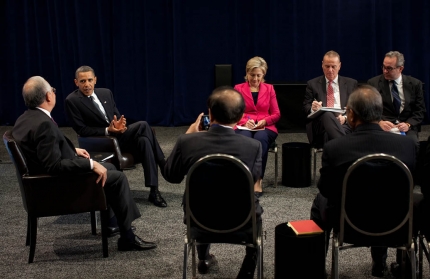
Today, the Vice President hosted a group of leaders from the American and international nuclear industry to encourage them to adopt and promote higher nuclear security standards.  One day after the President hosted the historic Nuclear Security Summit, over 20 industry leaders from the United States, Argentina, China, France, Japan, South Africa, Russia, South Korea met with the Vice President to discuss how industry could help advance the President's goal of securing all vulnerable nuclear materials in four years.

"We have a chance to build a public-private partnership to ensure Americans and citizens all over the world are safe from a very real nuclear danger," the Vice President said.  "We have said from the beginning that the big problems we face cannot be solved by the United States alone.  Equally, they cannot be solved by governments alone.  We all have to work together." 

The Vice President made clear that since roughly half of the world’s nuclear materials are in the hands of industry, public-private cooperation is essential to preventing the spread of nuclear materials to terrorists. The Vice President also challenged the nuclear industry to prepare a set of best practices to be delivered at the Nuclear Security Summit in South Korea in 2012.

The White House

Office of the Vice President

Vice President Biden Hosts Conference Call with Governors to Discuss Recovery Act Implementation

Earlier today, the Vice President hosted a conference call with Governors from across the country to discuss implementation of the American Recovery and Reinvestment Act.

The following elected officials participated:

  • Governor Chet Culver (D-Iowa)
  • Governor Jay Nixon (D-Missouri)
  • Governor Sean Parnell (R-Alaska)
  • Governor David Paterson (D-New York)


VP Biden Welcomes Nuclear Summit Participants

April 12, 2010 | 5:29 | Public Domain

Vice President Biden hosts a lunch meeting at the Vice President’s Residence, the largest gathering of foreign leaders ever at the United States Naval Observatory. He is joined by dignitaries who are in Washington, D.C. to attend the historic Nuclear Security Summit.

Download mp4 (157MB) | mp3 (5MB)

Read the Transcript

Remarks by The Vice President before a Lunch Meeting with Foreign Leaders and Dignitaries

Naval Observatory
Washington, D.C.

THE VICE PRESIDENT:  Before we begin, I would like to ask for a moment of silence for the passing of our colleague, Polish President Lech Kaczynski, who with other members of the Polish government perished this week.  Thank you.

Once again, I welcome all of you to Washington and welcome you to our home.  This week, in my view and the President’s view, represents a historic gathering of leaders working toward a historic task of creating a better and a safer world for all our peoples.

The President and I are honored that you’ve all agreed to be here this week.  We value deeply the ability to bring so many important voices together, so many diverse opinions, in search of a common goal.

The goals of the non-aligned movement and my country on the important issues of nuclear security, non-proliferation, as well as other issues have never been closer than they are today, in our view.  Our nuclear posture review that we’ve just completed has made it clear that the United States is committed to reducing the number of nuclear weapons in our arsenal and reducing their role in our defense.

Along with the START treaty signed with Russia last week, we’ve made clear that the reductions that are going to take place between our countries are going to be real, transparent, and legally binding.

And the President of the United States has committed our country to seek peace and security of a world without nuclear weapons.  We believe that is ultimately an achievable goal, and that is our goal.

We know that some of the countries here and elsewhere believe that we have not been moving fast enough or that we can do more.  Well, there is room to disagree on the exact approach of reducing nuclear weapons, but make no mistake about it this administration is intent on reducing and continuing to reduce our nuclear weapons.

The one thing we can all agree on, I hope, is that adding more nuclear weapons or more nuclear-weapon states is the exact wrong approach at this moment in the world’s history, one that endangers the entire community of nations were we allow it to happen.

We can also agree, I hope, that controlling all nuclear materials that can produce a bomb is in the interest of every one of us gathered around this table and everyone in the world.  As world leaders, we all know that there are extremist groups and non-state actors seeking that capability right now, seeking to gain access to nuclear materials to make a nuclear bomb.

There are hundreds of tons of nuclear material scattered over 40 countries, including the United States of America and many in the countries here.  And just 50 pounds of high purity uranium smaller than a soccer ball could destroy the downtown of all our capital cities and kill tens if not hundreds of thousands of individuals.  So it’s very much in our interest to gain control.

This is the horrific threat that we all face together, and one that we are determined we will defeat together.  This week is testament to the common ground we all share.  But just as we all agree on the need to prevent a nuclear disaster, we also agree on the benefits of nuclear technology and peaceful nuclear power, what it can do to bring the world -- if properly managed and protected -- to a better place.

The United States of America stands fully committed to supporting the promotion of peaceful benefits of nuclear power, in the context though -- in the context of the nuclear non-proliferation treaty.  But, again, here we can all agree that those who have developed nuclear technology should do so -- are going to develop a peaceful nuclear technology must do so wisely, with a proper attention to security, good governance, and as safely as it can possibly be done.

As countries seeking to develop your nuclear sectors, we stand ready to support you, to share our experience with you.

And we recognize that it is not a problem for governments alone to control this fissile material, it requires good regulations and public-private partnerships to get it right.

More than half the world’s dangerous nuclear materials are owned not by governments but by industry.  And we will work with them, as we will work with you, to address our common concerns.

Later this week, I’ll be hosting a roundtable for companies from the world’s leading nuclear industries to see how we can further enhance a partnership and guarantee their safety and security.

So, again, let me thank each and every one of you for coming today this afternoon to our home.  And I ask that this week we help each other seize this historic opportunity that is in front of us to make the world we share together a safer and a more harmonious place.

I thank you all for coming, and I thank the press for being here.  And now we’ll have some lunch, and have a discussion.  Thank you.

END
Close Transcript

The White House

Office of the Vice President

Informacion sobre la Reunion Durante el Almuerzo Ofrecido por el Vicepresidente a Manditarios y Dignitarios de Paises Extranjeros

El Vicepresidente recibió hoy a líderes y funcionarios de 11 países en anticipación a la Cumbre de Seguridad Nuclear. Entre los presentes estuvieron jefes de estado y otros representantes de países en África, Asia y América Latina que son miembros del Movimiento No Alineado. El propósito fue intercambiar puntos de vista sobre asuntos relacionados con la seguridad nuclear y proliferación, y la urgencia de abordar los peligros mundiales del terrorismo nuclear.
 
El Vicepresidente destacó el interés común de todos los países en garantizar la seguridad de los materiales nucleares que se puedan usar en armamento nuclear y reforzar las normas internacionales de no proliferación. Dichas normas se centran en el Tratado sobre la No Proliferación de las Armas Nucleares (Nuclear Non-Proliferation Treaty o NPT), un acuerdo que establece los requisitos para evitar la diseminación de armas nucleares a otros países y promueve el progreso hacia el desarme y el uso seguro y pacífico de la energía nuclear.
 
Los participantes destacaron la estrecha relación entre la seguridad nuclear y el desarrollo de energía nuclear. El Vicepresidente señaló que los usos nucleares pacíficos pueden prosperar en un mundo en el que los peligros nucleares se reducen constantemente y las normas de no proliferación se respetan y aplican. Ya que se tiene previsto que el número de países con programas de energía nuclear aumente al doble para mediados de siglo y ya que gran parte de ese crecimiento sucederá en los países en desarrollo, es esencial que la seguridad nuclear se aplique internacionalmente, conforme a los más altos estándares. El Vicepresidente afirmó que cualquier país que esté cumpliendo sus obligaciones con respecto a la no proliferación, y esté interesado en obtener energía nuclear y necesite asistencia, encontrará un socio en Estados Unidos.

###
 

Vice President Biden Discusses the Historic Opportunity to Create a Better, Safer World

Before a lunch meeting with foreign leaders and dignitaries, Vice President Biden delivered remarks about the significance of the Nuclear Security Summit and the “historic task of creating a better and a safer world for all our peoples.” He discussed the goal of reducing the number of nuclear weapons arsenals worldwide and the importance of controlling nuclear materials to prevent extremists groups from gaining access to them. He also talked about the United States’ support for peaceful benefits of nuclear power and technology.

The United States of America stands fully committed to supporting the promotion of peaceful benefits of nuclear power, in the context though -- in the context of the nuclear non-proliferation treaty.  But, again, here we can all agree that those who have developed nuclear technology should do so -- are going to develop a peaceful nuclear technology must do so wisely, with a proper attention to security, good governance, and as safely as it can possibly be done.

As countries seeking to develop your nuclear sectors, we stand ready to support you, to share our experience with you.

And we recognize that it is not a problem for governments alone to control this fissile material, it requires good regulations and public-private partnerships to get it right.

More than half the world’s dangerous nuclear materials are owned not by governments but by industry.  And we will work with them, as we will work with you, to address our common concerns. 

Later this week, the Vice President will host a roundtable discussion with leading nuclear industries to talk about forming partnerships and working to guarantee safety and security. Today, the President is holding several bilateral discussions with world leaders at the Nuclear Security Summit.

President Obama at Bilateral Meeting with Prime Minister of Malaysia

President Barack Obama participates in an expanded bilateral meeting with Prime Minister Mohamed Najib Abdul Razak of Malaysia, during the Nuclear Security Summit at the Walter E. Washington Convention Center in Washington, D.C., April 12, 2010. (Official White House Photo by Pete Souza)

Related Topics: Defense

The White House

Office of the Vice President

Readout of Lunch Meeting Hosted by The Vice President with Foreign Leaders and Dignitaries

Vice President Biden hosted leaders and officials from 11 nations today in advance of the Nuclear Security Summit.  Those attending included heads of government and other representatives from nations in Africa, Asia and Latin America that are members of the Non-Aligned Movement.  The purpose was to exchange views on nuclear security and proliferation issues and the urgency of addressing global risks of nuclear terrorism.

The Vice President underlined the interest shared by all nations in ensuring the security of nuclear materials that can be used in nuclear weapons and in shoring up international non-proliferation rules.  Those rules are centered in the Nuclear Non-Proliferation Treaty (NPT), an agreement that sets requirements for preventing the spread of nuclear weapons to additional states and encourages progress towards disarmament and the safe and secure peaceful use of nuclear energy.

Participants emphasized the close relationship between nuclear security and the development of nuclear energy.  The Vice President noted that peaceful nuclear uses can flourish in a world in which nuclear risks are steadily reduced and non-proliferation rules are respected and enforced.  With the number of nations with nuclear energy programs expected to double by mid-century, and with much of that growth in the developing world, it will be essential that nuclear security be applied globally in line with the highest international standards. The Vice President affirmed that any state in good standing on its non-proliferation obligations that is interested in pursuing nuclear energy and needs assistance would find a ready partner in the United States.

The White House

Office of the Vice President

Remarks by The Vice President before a Lunch Meeting with Foreign Leaders and Dignitaries

Naval Observatory
Washington, D.C.

THE VICE PRESIDENT:  Before we begin, I would like to ask for a moment of silence for the passing of our colleague, Polish President Lech Kaczynski, who with other members of the Polish government perished this week.  Thank you.

Once again, I welcome all of you to Washington and welcome you to our home.  This week, in my view and the President’s view, represents a historic gathering of leaders working toward a historic task of creating a better and a safer world for all our peoples.

The President and I are honored that you’ve all agreed to be here this week.  We value deeply the ability to bring so many important voices together, so many diverse opinions, in search of a common goal.

The goals of the non-aligned movement and my country on the important issues of nuclear security, non-proliferation, as well as other issues have never been closer than they are today, in our view.  Our nuclear posture review that we’ve just completed has made it clear that the United States is committed to reducing the number of nuclear weapons in our arsenal and reducing their role in our defense.

Along with the START treaty signed with Russia last week, we’ve made clear that the reductions that are going to take place between our countries are going to be real, transparent, and legally binding.

And the President of the United States has committed our country to seek peace and security of a world without nuclear weapons.  We believe that is ultimately an achievable goal, and that is our goal.

We know that some of the countries here and elsewhere believe that we have not been moving fast enough or that we can do more.  Well, there is room to disagree on the exact approach of reducing nuclear weapons, but make no mistake about it this administration is intent on reducing and continuing to reduce our nuclear weapons.

The one thing we can all agree on, I hope, is that adding more nuclear weapons or more nuclear-weapon states is the exact wrong approach at this moment in the world’s history, one that endangers the entire community of nations were we allow it to happen.

We can also agree, I hope, that controlling all nuclear materials that can produce a bomb is in the interest of every one of us gathered around this table and everyone in the world.  As world leaders, we all know that there are extremist groups and non-state actors seeking that capability right now, seeking to gain access to nuclear materials to make a nuclear bomb.

There are hundreds of tons of nuclear material scattered over 40 countries, including the United States of America and many in the countries here.  And just 50 pounds of high purity uranium smaller than a soccer ball could destroy the downtown of all our capital cities and kill tens if not hundreds of thousands of individuals.  So it’s very much in our interest to gain control.

This is the horrific threat that we all face together, and one that we are determined we will defeat together.  This week is testament to the common ground we all share.  But just as we all agree on the need to prevent a nuclear disaster, we also agree on the benefits of nuclear technology and peaceful nuclear power, what it can do to bring the world -- if properly managed and protected -- to a better place.

The United States of America stands fully committed to supporting the promotion of peaceful benefits of nuclear power, in the context though -- in the context of the nuclear non-proliferation treaty.  But, again, here we can all agree that those who have developed nuclear technology should do so -- are going to develop a peaceful nuclear technology must do so wisely, with a proper attention to security, good governance, and as safely as it can possibly be done.

As countries seeking to develop your nuclear sectors, we stand ready to support you, to share our experience with you.

And we recognize that it is not a problem for governments alone to control this fissile material, it requires good regulations and public-private partnerships to get it right.

More than half the world’s dangerous nuclear materials are owned not by governments but by industry.  And we will work with them, as we will work with you, to address our common concerns.

Later this week, I’ll be hosting a roundtable for companies from the world’s leading nuclear industries to see how we can further enhance a partnership and guarantee their safety and security.

So, again, let me thank each and every one of you for coming today this afternoon to our home.  And I ask that this week we help each other seize this historic opportunity that is in front of us to make the world we share together a safer and a more harmonious place.

I thank you all for coming, and I thank the press for being here.  And now we’ll have some lunch, and have a discussion.  Thank you.

END