#AskVP Your Questions About College Affordability

On Tuesday, April 3rd, Vice President Biden is traveling to Norfolk, VA to discuss how the Obama Administration is tackling rising college costs. Higher education can’t be a luxury – it’s an economic imperative for every family in America, so that our students and workers are prepared for the jobs of the 21st century.

In the afternoon, the Vice President will answer questions about college affordability on Twitter. People from across the country can ask questions using the hashtag #AskVP and follow the chat live from the @VP Twitter account.

Here's how you can participate:

  • Starting now, ask the Vice President about college affordability using the hashtag #AskVP
  • On Tuesday, April 3rd at 3:45 p.m. EDT the Vice President will answer some of your questions from the @VP account
  • Follow the whole chat live on Twitter live through the @VP handle
  • If you miss the live event, the full conversation will be posted on WhiteHouse.gov and on Storify

We hope you can join us.

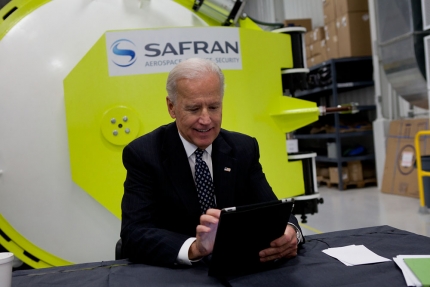
VP Twitter Interview

Vice President Biden participates in a Twitter interview at Albany Engineered Composites in Rochester, NH, Jan 26, 2012. January 26, 2012. (Official White House Photo by David Lienemann)

Be sure to follow @VP on Twitter for the latest from the Vice President's office. If you missed the Vice President's first Twitter interview following the President's State of the Union Address, you can check out the full conversation here.

Related Topics: Economy, Education, New Hampshire

The White House

Office of the Vice President

Remarks by Vice President Joe Biden on Manufacturing at a Campaign Event

PCT ENGINEERING
DAVENPORT, IOWA

12:26 P.M. CDT

THE VICE PRESIDENT:  Hello, everybody.  How are you?  (Applause.)  It’s good to be back in Davenport, the Quad Cities.  (Applause.)

Mr. Mayor, thank you for flying back from Brazil and getting off a plane and coming straight here.  If I were you, I’d be home in bed trying to catch up on my sleep.  And I want to tell you something, I know I’m back in Iowa when the guy introducing you from the factory floor speaks better than you do, I know I’m back in -- I know I’m back in Iowa.  (Laughter and applause.)  Incredible state.  You’re an incredible state.

I understand the Mayor of Eldridge is here and -- Martin O’Boyle.  Terry, thank you for the opportunity of allowing me on the factory floor here, and I understand the chancellor of Eastern Iowa Community College, Don Doucette, is here.  Don, where are you?  Thank you very much, Don.  I’m going to talk about what you guys are doing in just a minute.

And, folks, first of all, as it relates to the story that was just told by Chuck, it reminds me, my dad used to have an expression.  He’d say -- I mean this sincerely, a guy who had lost jobs, a guy who had to move and move his family -- he said, Joey, you got to understand one thing, a job is about a lot more than a paycheck.  It’s about your dignity.  It’s about your respect.  It’s about your sense of yourself.  It’s about your place in the community.

And too many people have been stripped of their dignity as a consequence of this God-awful recession we’ve inherited.  And we’re determined -- we’re determined -- I think all of us, Republican and Democrat -- are determined to turn that around.

But first I want to thank -- I want to thank Terry, the president of PCT, and I also want to thank the community college for doing what is a remarkable thing that's happening all across America, for partnering -- for partnering with this great company and producing jobs, making sure the skills available match the needs.

Ladies and gentlemen, I come here today with a very, very simple message:  Manufacturing is back.  Manufacturing is back.  (Applause.)

And, folks, that's not only good news for Chuck and all the fellow workers here on this factory floor, it’s good news for America.  But it’s even better news for America’s middle class.  (Applause.)  They’ve taken an awful beating over the last decade or more, and what’s happened just in the last couple years:  430,000 new manufacturing jobs just since 2010; more than 15,000 new manufacturing jobs here in the state of Iowa; the fastest growth in manufacturing since the ‘90s.

After years of hearing the word outsourcing, our children are going to hear a new word as much as we heard outsourcing.  It’s called insourcing.  It’s called insourcing.  (Applause.)

Because, folks, the facts are -- and you’re going to see more of them -- the facts are that the jobs that left the United States are coming back to the United States.  Plants that closed are opening, opening and reinvented.  Companies like John Deere expanding here in Davenport and in Waterloo and in Des Moines, where they added nearly 500 new jobs in the past two years, good paying jobs.  Siemens Wind employs 500 people at Fort Madison.  Sixty-five percent of them used to work in companies in the area that are either closed or downsized.  So, folks, America is coming back.  It’s not a political slogan; it’s a reality.  And it’s happening in the sector that built the middle class in manufacturing.

Look, you know a lot of my Republican friends and some of our political opponents wonder why the President and I have spent so much time working to bring manufacturing back.  No one in the Heartland has to wonder about that.  You all know why.  You all know why because you were the manufacturing center of the world, and you saw what happened when those jobs were lost. 

You know that manufacturing jobs just aren’t any old jobs.  They are good paying jobs; jobs you can raise a family on.  Jobs that allow you to own a home and not just rent; jobs that give you the promise of being able to send your kid to college.  And here in Iowa, the average manufacturing job pays almost $50,000 a year.  And they’re jobs that matter to everyone, as was mentioned by Chuck, because they not only are good for America -- they’re good for America, because they make America competitive again.  And they’re jobs of building products of the future in industries of the future for an economy that’s able to compete for the future, products like the electronic beam systems built here at PCT -- remarkable.

These are jobs building products that export to consumers not just here but all around the world, expanding world markets for the United States of America.  You know about that too.  Fifty percent -- all the workers here know that 50 percent of what they produce here at PCT Engineering are sales that are destined to be exported.  That’s a big deal.
 
They’re jobs that anchor our communities.  They’re jobs that get the local community moving again, manufacturing jobs.  Manufacturing jobs create more jobs, other jobs -- jobs in diners, hardware stores, schools, police departments.  But most importantly, they’re jobs that can help rebuild the middle class, which has been battered.  And nobody knows it better than all of you.

Look, it matters because real growth, growth that is widely shared, the only growth that really matters -- growth that is widely shared by everyone in this country -- can only happen when the middle class is growing again.  When the middle class is growing, everyone does well.  The wealthy do very well, as they should, and those who are not wealthy have a shot, a ladder maybe they can climb up to change their circumstance.

But the middle class will only grow if we build an economy that can support the middle class.  And manufacturing is not the only part, but it’s a critical part to bringing back the middle class.  And no one knows that better than the people of Iowa, who know the essential role that -- it’s not only manufacturing.  Look at Iowa and agriculture and the role agriculture plays in the economic health and well-being of this nation.  That’s why the President and I are so proud that last year farm exports reached a record high of $137 billion, $23 billion higher than ever before.
 
That’s not only good for the economic well-being of Iowa farmers, it’s good for the economic well-being of the entire country.  And with the new trade agreements the President negotiated, we expect an additional $2.3 billion in the coming years in agricultural products supporting an additional 20,000 jobs here at home.  But it’s not only the agricultural sector that’s going to benefit from these new trade agreements.  It will create tens of thousands of more jobs in manufacturing in the high-tech sector because of these agreements.

And, folks, we’re not just fighting harder to be able to export our products -- agriculture or manufactured -- abroad.  They’re important, but we’re fighting to export complex, high-tech services as well, services that Americans provide better than any other people in the world, but things most people don’t think about -- (applause) -- things most don't think about, that they contribute and contribute tens of billions of dollars to our economy like construction, engineering, health care technology, IT.  We do that better than anyone in the world.

We recently signed an agreement, after my negotiations with the Vice President of China, opening America’s automobile insurance industry to the largest automobile market in the world.  You say, what does that have to do?  If you have access for American automobile insurance companies to sell insurance, which has been blocked up to now, in China to the largest number of folks in the world who drive automobiles, that’s real money.  That’s real jobs.  That’s real jobs back here at home.
   
But ultimately, it all comes down to the same question, the real question, quite frankly, of this election and the challenge of our time -- will we be a country that values the role of workers in the success of businesses and values the middle class in the success of the economy or are we going to move backwards to the same disastrous philosophy that rewarded speculators rather than builders?

Look, this is the third in a series of speeches I’m giving on behalf of our administration laying out the stark choices we believe the American people are going to face in November and what’s at stake for the middle class.  Today, I want to focus primarily on manufacturing because President Obama and I -- President Obama and I have been working to rebuild our manufacturing sector and rebuild our country because we think they're one and the same.  We don't know how you do one without the other.  We don't know how you leave it out, manufacturing and rebuild the country.

So let me tell you what we’ve done, but maybe equally as important, let me tell you what we think we have to do, what more we have to do.  When we came into office, the manufacturing sector, had been neglected badly and was getting devastated.

During the 2000s, before we came in, 5.8 million manufacturing jobs were lost in the United States of America.  Right here in Iowa, you lost 53,000 manufacturing jobs.  You saw companies like Maytag and Electolux and many others close shop.  Thousands of factories closed out and laid off workers, a lot of them reopened in places like Vietnam, Mexico, China, “cheaper markets.”  And we were told -- how many times have you been told over the last 15 years that America’s days as a leading manufacturer in the world had passed? 

Look, the President and I said, where is it written, where is it written that says our day has passed in anything?  The President and I fundamentally disagreed with that proposition.  And by the way, it was a widely held proposition, not just with our friends on the other side, with a whole lot of people. 

We knew -- we knew we had to get manufacturing back on its feet again because for every one of those manufacturing jobs lost, somebody lost their place in the middle class.  For every one of those jobs lost.

So we went to work first and foremost over significant opposition, and with Mitt Romney arguing that we should let Detroit go bankrupt. 

AUDIENCE MEMBERS:  Booo!

THE VICE PRESIDENT:  What we did is we rescued the auto industry.  We administered some of the very toughest medicine -- (Applause.)  We were criticized by many on our side.  We administered some very tough medicine, but together we saved literally 1 million jobs.

And since restructuring, the industry has already added back another 200,000 jobs and GM is leading the world again as the world’s largest automobile manufacturer.  (Applause.)

Folks, we knew that was essential, but not enough, so we went to work to provide a skilled workforce for companies that have already come back or are bringing their folks back.  We met with the leading companies in the world who came to the White House in January.  They pointed out to us that right now there are 600,000 manufacturing jobs in the United States that companies who have come back home can't fill because of their inability to match the workers’ skills with the need of the companies.

So we launched a partnership between what my wife, Jill, who is a community college professor, calls the best-kept secret -- (Applause.)  Beautiful.  What my wife, Jill, calls the best-kept secret in America, American community colleges.  And businesses looking to fill those 600,000 slots married up with them.

We’ve also proposed an $8 billion partnership to give more momentum to this effort.  My wife and the Secretary of Labor, Secretary Solis, just did an 800-mile bus trip, starting off in Iowa, working all the way -- their way through Tennessee, Kentucky, Virginia, North Carolina, visiting community college and business after community college and business, providing hundreds and hundreds of good paying jobs because they're training directly, exactly what the companies need. 

And it was all over the countryside, from Tennessee, to North Carolina, to Michigan, Ohio, New Hampshire, and it’s working.  So let me say it again, thank you, Terry.  And thank you, Dr. Paper, and thank you, Chancellor -- Dr. Paper, and thank you, Chancellor, for this partnership of yours.  You are one of the reasons why.  You’re literally one of the reasons why American companies are now insourcing instead of outsourcing.

We’ve committed to breaking down barriers that block access of American products to overseas markets, so the rest of the world and the consumers can understand what we already know, that we make the best products.  No one makes a better product than American workers, and there’s no worker in the world more productive than an American worker.  That's not hyperbole.  That is a fact.  That is literally a fact.  (Applause.)

In addition, the President has signed into law three free trade agreement with Korea, Colombia and Panama.  They're going to open up markets for the best products in the world -- for the best products in the world, Made in America products, to all those countries, which now can't get into those countries and are committed to leveling the playing field across the board.

To that end, we created for the first time a thing we call the Trade Enforcement Unit, whose sole job is to crack down on countries that pursue unfair trade practices.  We’re not -- we don't think that's a trade war.  We think that's a fair way to trade.  And so just this month, we brought a new trade case against China. 

China is unfairly limiting American access to so-called rare earth materials that they possess, that are needed by American manufacturers to make high-tech products like electronic vehicles and advanced electronics.

We changed the tax code to give a 30 percent tax credit to a company that builds wind turbines, solar panels or other clean energy products here in the United States rather than abroad.  (Applause.)  The result so far -- the result so far is $2.3 billion of new investment in factories built here in the United States of America, rather than abroad.  (Applause.)

Look, even more to come as they invest in new plants and equipment right now, right now if they invest, by allowing them to write off more rapidly the cost of the factory, the cost of the equipment, the cost of their vehicles so they can expand opportunities.  That means more people being hired.

The bottom line is we’re changing the paradigm here.  We’re rewarding instead of penalizing American companies that invest in building and hiring here in America, and manufacturers are responding.  They're hiring workers by the hundreds of thousands.  They're exploiting products all around the world. 

With this added incentive, we’re on pace to double, as the President committed to, double American exports by the year 2015.  And let me translate what that means, if we double American exports by the year 2015, that creates another 2 million American jobs.  (Applause.)

So, folks -- so all those skeptics and our Republican opponents who -- especially don't tell me that America can't make things anymore; can't compete in the world market anymore; can't lead the world again any more.  We will lead the world again in every aspect of the economy.  (Applause.)

And, folks, we’ve already begun.  You’ve begun -- not me -- you’ve begun, and we’re not done.  For years, American manufacturers have faced one of the highest tax rates in the world.  We want to reduce that by over 20 percent.  We want to drop the rate particularly for high-tech manufacturers like you, Mr. President, even further than the 20 percent.  We want to create what’s called a global minimum tax, because American taxpayers shouldn’t be providing a larger subsidy for investing abroad than investing at home.  (Applause.)

Look, we want to end and we want to end it right now, the practice of getting a tax break, which you saw happen here in Iowa for dismantling a factory, floor to ceiling, and shipping it abroad and getting a moving expense to go abroad.  Instead, we should be giving a tax credit to companies that dismantle factories abroad and bring them back home.  (Applause.)
 
Look, this and a lot of other ways is why we’re bringing American manufacturing back and it’s how we’re going to grow the middle class.  Look, folks, conventional wisdom that manufacturing is dead in this country is dead wrong -- dead wrong -- and we’ve got to maintain this momentum.  But if you’ll forgive me for saying this, one thing that could bring this momentum to a screeching halt is turning over the keys of the White House to Santorum or Romney.  (Applause.)

Look, they’re both good guys.  They’re both good guys and I’ve worked with Rick for a long time.  Senator Santorum is the only one of them who is even claiming to care about manufacturing, but his Senate record tells a different story.  He voted against ending loopholes for companies that move manufacturing jobs offshore, from America offshore.  And just like Mitt Romney, when asked if we should have rescued the automobile industry, he said, “No, absolutely not.”

But if Senator Santorum has been inconsistent in what he has said and what he has done, Mitt Romney has been remarkably consistent -- (laughter) -- as an investor/businessman, as the governor of Massachusetts, and now as a candidate for President, remarkably consistent and I respectfully suggest, consistently wrong.  (Applause.)

Ladies and gentlemen, ladies and gentlemen, when he was CEO of Bain Capital, Bain Capital closed down two factories in South Florida that made medical devices, moving the production to Germany.  They shut down a plant in South Carolina and cut jobs in another one in Rhode Island that made photo albums and picture frames and outsourced production overseas.  I’m tempted to say, Mitt, thanks for the memories.  (Laughter.)  You know what I mean?

As governor of Massachusetts, he repeatedly slashed funding for workforce training in manufacturing specifically.  And despite the fact that millions of taxpayer dollars were flowing to companies outsourcing state services like overseas call centers, he vetoed a bill passed by the Massachusetts legislature that would have stopped the state from outsourcing contracts overseas, state contracts.

Look, think about it, a Massachusetts taxpayer with a question -- this is how it works -- with a question about Massachusetts state services, picks up the phone, dials an 800 number expecting to talk to somebody in the Massachusetts government to get an answer to their question.  And instead, he talking to -- or she’s talking to someone on the other side of the world and all of it paid for by his or her tax dollars.  I find that kind of fascinating.  (Laughter.)  No, I really mean it.  I mean, that’s one when I was told about, I said, I’m not going to say that until you fact check that for me again.
  
But think about it, it’s one thing for the local company to outsource a call service, but for the state government to outsource a call service that’s set up to answer questions for people in the state about a problem they have with the government, to outsource that, denying folks in Massachusetts the jobs that are attendant to that?  Is it any surprise to you that Massachusetts, under Governor Romney, was losing manufacturing jobs twice as fast as the rest of the country?
 
Now, as a presidential candidate, he has proposed a new international tax system that zeroes out taxes for companies that create jobs outside the United States of America.  I’m not making this stuff up.
 
Look, your -- President Obama and Governor Romney, Joe Biden, and whoever the nominee is going to be, we are talking about taxes and the burden on manufacturers.  But there’s a big difference.  Our tax cuts go to companies that create jobs over here.  The Romney tax cut goes to companies that create jobs overseas.  It’s a fundamentally different philosophy from ours.
 
When China was dumping tires into the international marketplace, hurting American manufacturers of tires and their workers, President Obama stepped up and enforced our trade laws and won.  Governor Romney, at the time, called what the President has done protectionism.  That’s his quote -- “protectionism.”  Now, when it’s politically expedient, he wants to get really tough on China.
 
Look, it’s a different philosophy.  Governor Romney has called the President of the United States “out of touch” -- that's a quote, “out of touch” -- for encouraging young people to try to get manufacturing jobs.  Out of touch?  Romney?  (Laughter and applause.)  I mean, pretty remarkable, pretty remarkable.  As an old friend of mine says, that’s chutzpah.  (Laughter.)  Look, the Wall Street Journal wrote, “Romney appeared to scoff first in Detroit, then in Florida at the notion of manufacturing as a job engine for the future.”
 
So, look, folks, we have a choice in this election between our philosophy that believes manufacturing is central to our economy and their philosophy that scoffs at it, between our philosophy that says there is nothing out of touch about fighting for the future of the middle class by creating manufacturing jobs -- a philosophy that says if the folks at the top -- and their philosophy says if the folks at the top do well, everything else will do well.  How many times have you heard about the job creators?
 
Look, Governor Romney’s business practices and his policies have clearly benefited the wealthy and most powerful among us, often at the expense of working and middle-class families.  They actually believe it’s the best way.  I’m not doubting their belief.  But it just doesn’t work that way.

As the President said, and I quote, "this" -- meaning the middle class -- "this is the defining issue of our time.  This is a make-or-break moment for the middle class, and for all those who are fighting to get into the middle class.”

Folks, I stood outside of a lot of plant gates in my career, both here in this state, the state of Iowa, and in my home state of Delaware, shaking hands and asking for support.  I've also stood outside those gates -- like the General Motors gate of my home state -- asking those -- when those workers needed my help because the plant was shutting down, going somewhere else.  Those are the days that stick with me the most in my career.

Those are the days when the longest walk that these folks were taking wasn't from the factory floor to the parking lot for the last time, it was up that flight of stairs they had to go up once they got home into their child's bedroom to say, Honey, I'm sorry but you're not going to be able to go back to Roosevelt High School, or St. Mary's, or not be able to be in that little league; Daddy, Mommy, I lost my job.  We've got to do something else.

My dad made that walk when I was young.  An awful lot of kids heard the same words I heard, except the difference between then and now was that my father said everything was going to be okay.  In the mid ‘50s he believed it, and I believed it.  So many people have made that walk in the recent past five, six, seven years, and they can't even say with certainty when they look at their child up until now, it's going to be okay. 

But the good news is that today, hundreds of thousands of workers are replacing that longest walk with walks of a totally different journey.  (Applause.)  A journey that ends with workers who are able to come home and say, I've got a job -- just like you were.  (Applause.)  I've got a job.

They've been able to say, I've got a good job building amazing products that the world wants to buy.  That’s what makes me so optimistic.  We've got a way to go yet, but knowing these journeys are taking place again in the thousands -- more of them every single day. 

Look, some of you know me fairly well.  My entire career I've been characterized as an optimist, since I got elected as a 29-year-old kid to the Senate.  Well, I've got to tell you, I mean this sincerely, I've never been more optimistic in my life about the prospects for America.  (Applause.)  America today is better positioned than any country in the world to lead the 21st Century.  (Applause.) 

Folks, it's not just manufacturing that’s coming back.  The middle class is coming back.  America is coming back.  Worker by worker, home by home, neighborhood by neighborhood, the country is coming back.  So as my grandpop would say, keep the faith.  And thank you.  May God bless you all, and may God protect our troops.  Thank you.  (Applause.)

END
12:55 P.M. CDT

Vice President and Dr Biden Celebrate Women's History Month

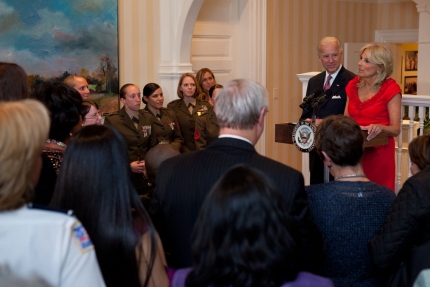
Vice President and Dr. Biden host a Women’s History Month reception

Dr. Jill Biden gives remarks at a reception in honor of Women's History Month at the Naval Observatory on March 26, 2012. (Official White House Photo by David Lienemann)

As Women’s History Month comes to a close, the Vice President and Dr. Biden hosted a reception last night in honor of Women’s History Month to celebrate the history, accomplishments, and contributions of women across the spectrum of American life, from academia and science, business and labor, philanthropy and advocacy, athletics and the arts, to the military and government. 

Speaking to a distinguished crowd of women (and some men) who are at the pinnacle of their careers, the Vice President applauded their courage and achievements over the last few decades, saying “you’ve empowered entire generations” of women. He continued, “I’ve learned it from Jill, I learned it from my sister, and I’ve learned from the over thousand hours of hearings we held in the Violence Against Women Act that the single most important thing that empowers young women is powerful women – powerful women.” 

Dr. Biden praised the guests for their "courage, strength and resilience." In addition, she paid special tribute to several members of the U.S. Marine Corps’ Female Engagement Team, known as the FETs, who attended the reception. These women volunteer to join otherwise all-male Marine patrols in Afghanistan, where they build relationships with Afghan women – a population mostly off-limits to male troops – learn about the country’s culture, and support our battlefield operations in Afghanistan. To highlight the incredible work of FETs, the Vice President and Dr. Biden also installed this photo exhibit of Female Engagement Teams at work in Afghanistan on the walls of the Naval Observatory.

Evan Ryan is the Special Assistant to the President and Assistant to the Vice President for Intergovernmental Affairs and Public Engagement
Related Topics: Women

The White House

Office of the Vice President

Campaign Event Remarks by the Vice President on Seniors

Wynmoor Village
Coconut Creek, Florida

12:51 P.M. EDT

THE VICE PRESIDENT:  Howard, thank you very much and my colleagues, Ted and Debbie.  And I understand State Senator Jeremy Ring is here, and I understand that State Representative Jim Waldman is here.  (Applause.)  It’s kind of a busman’s holiday for you all, but thank you very much for being here.

Folks, this is the second of four speeches that I’ll be making this spring on what’s at stake from our perspective, what’s at stake for the middle class in this election.  The issue I’m going to focus on today with your permission is retirement security.  But I have to tell you, I come at this issue of retirement security from a slightly different angle, a slightly different perspective than it’s usually talked about.

My dad used to have an expression.  He’d say, Joe -- when someone would say, this is what I value and my dad would look at him and say, don’t tell me what you value.  Show me your budget and I will tell you what you value.  Don’t tell me what you value, show me your budget and I will tell you what you really value.

Like many of you here, I had the privilege of having my mom and dad live with me in their -- my dad’s final months and my mom’s final years.  Neither my siblings nor I -- just like when you had your parents and were helping them, neither my siblings nor I could separate the security of my mom and dad from our own well being.  Neither my siblings nor I could separate the needs of our parents from the needs of our children.  This is all family.  This is all about -- it’s not just seniors or just the young.  We talk about it like it’s an either/or proposition.  This is about who we are as a people.  This is about what we value.

That’s how our parents lived their lives and how we lived ours.  I was raised in my mom and dad’s house.  And I can say, with the single exception of a two-year period through my entire youth, there was never a time in our three-bedroom home one of my parents’ relatives did not live with us, like many of you as you grew up, because there was no alternative.  And I think that’s what’s really missing in this debate today, how connected -- the connective tissue here, the notion that we’re all in this together, every generation -- every generation.
 
There is no question that the baby boom generation, which I was at the front end of, puts incredible pressure on Medicare and Social Security.  The number of seniors will be doubling by the year 2040.  So the question is are we going to strengthen and sustain these programs of Medicare and [Medicaid] now and for the future or are we going to use these challenges -- it’s a real challenge, are we going to use these challenges as a pretense to do what so many have been trying to do from the beginning, dismantle both of these programs?

I said to the overflow room, which were kind enough to come -- and I went to see them before I came to see you.  At the end of the day -- we’re all old enough, we’ve been around enough to know that it’s not just what you hear, it’s not just what you see, but what you feel, what you taste, what your heart tells you -- what your heart tells you about whether or not someone speaking to you means what they say.  The one good aspect of growing older is that mechanism in this gets more acute.  We understand better.

The President and I believe that every American, after a lifetime of hard work, should be able to look forward to the security and dignity that Social Security and Medicare provide.  (Applause.)  And you know, folks, it’s about dignity.  It’s not just about health.  It’s about dignity.  It’s about our dignity.

If we had any doubt about the clarity of the choice, just how high the stakes are with regard to both these programs, we got a reminder a couple of days ago from a good man -- he is a decent, smart guy, a guy named Congressman Ryan, a Republican in the House of Representatives.  No, no -- I disagree fundamentally with him.  But this is not a -- this is a smart, decent guy.  But they have a totally different view than the President and I have.

He is the Republican leader on what the budget should look like.  This week, Congressman Ryan reintroduced what was called the Republican budget, embraced by every Republican candidate for President and passed overwhelmingly by the Republicans in the Congress.  They voted for it.  He and they made a clear choice.  The choice they made was in order to save “the programs,” they lowered the standard of living for those on Medicare rather than asking the wealthiest among us to help deal with the problem.

You may remember the first Ryan budget -- nothing subtle about it, nothing subtle about it.  It dismantled Medicare, within 10 years it was a voucher system.  It dismantled the system and meant that the average senior would be paying another $6,000 a year out of pocket for the Medicare benefits they now receive.  And the reaction of the nation wasn’t very subtle either.

So after an overwhelming rejection of the last year Ryan Republican budget plan, they went to work to draw up a new one.  But if you take a look at it, they really didn’t change anything they’re trying to do.  And so, if you don’t change much on the substance, well, what changed?  What’s the difference between these two budgets that have been introduced?  Well, it’s the way they talk about it, literally the way they talk about.

And don’t take my word for this.  All of you are adept with computers.  Go online to an outfit called politico.com -- an extremely well respected publication that all the major papers look to.  Go on politico.com and read an article that’s in yesterdays or the day before -- it says how Paul Ryan sold his budget plan.  He sold it to all of his Republican colleagues by telling them there’s a new way to talk about what they’re going to do without getting hurt politically.
 
He told them, he told his colleagues, that they could win this debate this time with essentially the same plan if you use “the right poll-tested words.”  If you use “the right poll” -- now, again, don’t take my word for it.  Go look at the article.  He said, if you use words like bipartisan, if you use phrases like fix Medicare, if you use phrases like choice, the American people will not punish you for being for this plan.  The American people, though, especially us -- where we are in our lives -- we’re not about to be fooled.

I have more faith in the American people than I think our Republican colleagues do of being able to cut the wheat from the chaff here and see what’s going on.  (Applause.)
 
Look, folks, the vast majority of the American people -- whether they’re Democrats, Republicans, or independents -- know there is a fundamental difference between us and the Republicans on this issue.  We believe in strengthening Medicare, they don’t.  Make no mistake about it, if the Republicans in Congress -- and their amen corner of Romney, Santorum, and Gingrich -- if any one of them gets their hands on the White House, the keys of the White House, I promise you will see Medicare ended as you know it.
 
And it’s not just about what they want to do to Medicare.  It’s about the other benefits for seniors that they want to undo.  We passed a law that has been referenced already to close the donut hole -- a significant portion closed already, but it will be totally closed when this law comes fully into effect in 2014, saving the average senior with high drug costs $600 just this last year alone.  And that will increase.  They want to repeal it.  They simply say they want to repeal it.

We passed a law that provides for preventative services -- Debbie talked about it.  I can remember sitting there -- and thank God my mother had at least one -- two financially successful children, not me.  (Laughter.)  Well, when my mom lived with me, my mom -- we’d go up and get my mom’s prescriptions.  And we had to literally lie to mom and tell her, no, all her savings covered everything, because my mom, my mom, she did not want her children having to make sacrifices.  But we all chipped in about $6,000 a month all told among us for not only that, but at the very end when my mom needed some care.  My mom needed somebody there just to help her with her lunch when she wasn’t -- as it got toward the end.

But my mom, it was all about her pride.  Joey, show me my checkbook.  Show me my checkbook.  And my brother would quickly run and deposit more money in my mom’s checkbook -- (laughter) -- because she had dignity that she wanted to preserve.  (Applause.)  This is about what these guys don’t get.  It’s more than whether or not my mother and father got the care they needed.  It was how they got the care they needed.  (Applause.)

I built a new house.  When my kids went off to school, we sold the big house we had and we built another house.  And on the ground floor, we put in -- it was sort of on a hill, I built a whole suite for my mom and dad.  They would not move in.  Joey, my whole life I had someone living with me, which is a great asset for her kids -- my whole life, but I’m not going to do that to my kids.  You all know the deal.  You know it.  You feel it.  You taste it.  Every one of you feels that way.

And what do they want to do?  They want to go in and the ability of my mom just to say, I don’t feel well, I’m going to get a checkup, she knew it would cost 20 percent she would have to pay to get that checkup, for the cost of the checkup.  And she didn’t want to ask her kids.  Obviously, if we knew, we’d work out something with the doctor beforehand.  But she didn’t want to ask her kids.

How many times do any one of you feel that pain and you’re not sure what it means?  How many of you wonder whether or not that thing that just happened to you, is it a harbinger of something more serious?  You just want to go ask the doc.
 
Folks, these guys want to repeal all that and, in the process, I would argue they’ll be repealing that sense of dignity, which is an incredible part of what this is all about.  They want to repeal all.  They want to repeal all of the things that I’ve mentioned.  The end result is you’re going to have to pay at least $600 more a year for your drugs, 20 more percent for your visits to the doctor.  You’re going to see traditional Medicare change as you know it.

Look, we’d be so much better off as a country if we spent a lot less time and energy fighting off these efforts to dismantle Medicare, and I mean dismantle it.  If we just spent a little more time -- a little more time together, Democrats who are working to figure out how to preserve and strengthen Medicare.  We can make Medicare solvent again.  We don’t have to gut it to make it last.
 
Look, in our health care law we’ve already extended the life of Medicare and its solvency to the year 2024 just by one thing.  We’ve uncovered or recovered over $10.7 billion just since we’ve been in -- in waste, fraud, and abuse that we put back into the system.  If our Republican colleagues would join us, we could reduce the cost of Medicare by $100 billion just by doing one thing, saying drug companies cannot charge Medicare any more than they charge for any other federal program.  (Applause.)  Saying they can’t charge our elderly any more than they charge our veterans -- that’s $100 billion.

We could save another $20 billion by asking the very wealthy of us, those who could easily afford health care if they have retirement incomes that are significant to pay a little more.  That would add another $20 billion.  Look, there’s a lot more we can do to save this program, but it requires someone on the other side who wants to preserve the system, really cares about preserving it and not gutting it.
 
Look, we’re prepared to sit down -- the President and I -- and already have; it was blown up -- sit down and work with our Republican colleagues.  You may remember all this talk about the Biden budget talks with the Republicans.  We talked about all these things, but not one single thing was able to get done.  But if you don’t start from the premise that this program, Medicare, must be preserved in its current form.

Look, folks, Social Security is in better shape.  But here again, Republicans have come up with an approach on Social Security that they say “saves Social Security for the next 75 years.”  And they do it by cutting the benefits -- some salvation.

A plan like the one that Governor Romney has introduced would cut Social Security benefits for your kids and your grandkids -- it would cut by $2,400 a year the typical worker in their 40s would get by the time they get it, and it would cut by $4,700 a year the Social Security coverage anyone working in their 20s would get by the time they retire.
 
And here’s the thing -- here’s another thing, nobody has really noticed.  Governor Romney and the rest have supported also a thing that the Republican leaders call “cut, cap, and balance.”  They call it “cut, cap, and balance.”  Now, that’s another one of those new Republican Party plans which would --probably are the right tested words.  Who can be against cut, cap, and balance?  Except nobody knows what it really means.  Nobody knows exactly what they intend, because like so many of the most damaging things, it looks and sounds innocuous.
 
So let me cut through -- no pun intended -- and tell you what it means in plain English.  The cut are significant cuts in Social Security benefits.  They’ll tell you, don’t worry, you won’t be cut -- you won’t be cut, as if all you care about is yourself.  See, the thing that I get angry about -- they look at people like you and me, and they think all we care about -- after all you’ve done for the nation is that all we care about is ourselves after a lifetime -- a lifetime -- of you not only caring for yourselves, but caring for all those people you love, caring for your community.  (Applause.) 

And they turn around and say, no, no -- as long as we tell you, you won’t be cut, you won’t mind if your children, you won’t mind if your grandchildren, you won’t mind if your younger neighbors and friends end up having to pay.
 
They don’t understand us.  Look, the cap they talk about is the cap on what we ask of the wealthiest Americans, the top percentage of Americans and what they pay to make this country work.
 
And the balance they talk about is they balance the budgets on the backs of seniors and middle-class Americans.  Why?  So that they can preserve -- this is not your father’s Republican Party, guys, so that they can preserve a trillion dollar tax cut, a new trillion dollar tax cut for the wealthiest Americans.  And that’s not hyperbole, folks.  That is not hyperbole.  That’s what this is about.

Governor Romney supports cut, cap, and balance, which is yet another demonstration that there is no daylight between Governor Romney and the Republican leaders on the most important issues facing this country.  And not even Romney’s Etch A Sketch can change that.  (Laughter and applause.)  You’re not going to be able to do that.  I mean, he may buy a new one but he can’t do it.
 
Folks, we can resolve the challenges Social Security faces and we can do it in good faith.  We did it before.  I was there.  In 1983, it looked like Social Security was going to run out of money.  Remember?  It was coming to an end.  In 1983, I sat down in a room as one of the junior guys with leaders like Republican Bob Dole, Bill Roth, Chairman of the Finance Committee, President Ronald Reagan, Democrats like Pat Moynihan and Tip O’Neill.  And we shook hands.  We shook hands.  Everybody gave something.  And we preserved the system through 2028.  Together we solved it for generations at that time.

Look, folks, you know in your gut -- you know in your gut what I know, it’s about willing -- being willing to put politics aside just for a moment, just put it aside for a moment to preserve the single most, significant and consequential government initiative in American history, Social Security.

Look, some of you remember, I remember -- these two guys won’t remember.  (Laughter.)  But some of you and I remember, we don't remember a day when we didn't have Social Security, but we remember a day when our grandparents didn't have Medicare.  And remember what it meant?  Remember what it meant?  We remember.

Look, what we need today is just a temporary, like they say in grade school, a timeout, just a timeout.  And so, okay, what are we going to do to deal with preserving both these programs?  And that's what’s missing this time, folks.  It was there in 1981 and ’82 and ’85 and ’89.  Because today’s new Republican Party is fixed on one thing:  additional tax cuts for the very wealthy. 

When we tried to put 400,000 teachers back to work and 18,000 cops back to work because the city budgets are being crunched, we said, okay, we’ll have a .5 of 1 percent tax on every dollar after the first million you make.  That would have paid for the whole thing.  No Republican would vote for that.  Millionaires were calling me saying they were for it.  I come from the wealthy state of Delaware.  The people up there, the people who have the money knew they should be paying just a little more to preserve that.

Folks, these guys won’t budge a single inch on a trillion dollar problem.  Look, we know we have to bring our budget back into balance.  It was a Democratic President who last balanced the budget, I’ll remind you all of.  (Applause.)

And, folks, the day that President Obama and I were sworn in -- the day we were sworn in, that magnificent day on January 20th, looking out a million people on the mall, watching, we were handed that day a gigantic deficit and an economy that was in free fall, and we moved ahead.  We moved ahead to get the economy moving again, but we also moved ahead to begin to cut the deficit.

Last year with the help of my two colleagues, we cut spending by $1 trillion.  We also made a deal -- we also made a deal with our Republican friends to cut it by another $1.2 trillion and set up that super committee, remember?  What did they come up with?  Nothing.

And we were on our way, on the cusp of negotiating -- I was doing most of the negotiation for an agreement that would have cut the overall deficit by $4 trillion.  But the Republicans, they walked away from it.  Why?  Because they wanted to maintain every major tax cut for the very wealthiest and have them move in perpetuity.

Look, they wanted an additional trillion dollars in tax cuts.  And I want to explain to you -- when you say that, it’s like, a trillion, that doesn't -- I mean a trillion, I can't even -- you can't even calculate that. 

Let me put it this way, of that trillion dollars, $813 million of that trillion dollar tax cut will go to households making over $1 million a year.  Three hundred and fifty -- 315,000 of the wealthiest families in America, average income $3.1 million a year, would get a $100,000 tax break per year for the next 10 years through that.

Look, we’re not asking anybody very wealthy to change their standard of living.  We’re not -- no serious.  We’re not asking them to do anything they can't do now.  On $3.1 million, you don't need another $100,000 to maintain your home, to drive the vehicle you drive, to vacation where you want to vacation.  But when we ask you to take a 20 percent cut or a 30 percent cut in your Medicare or your Social Security or your children, that changes the standard of living.

Ladies and gentlemen, we don't think it’s fair, and we don't think it’s right.  And more importantly, we don't think it’s in the interest of the economic growth of this country.  Folks, it’s simple math, either preserve Medicare and fix Social Security and draw down the deficit, or you spend another trillion dollars on tax cuts for the wealthiest.  You can't do both of these things.  You can't do both, and we refuse -- we refuse to shift the burden and responsibility of putting America’s fiscal house in order on the backs of those who will have to change their standard of living, who have played by the rules, who have worked hard all their life and have earned the retirement benefits they're getting.  (Applause.)

Ladies and gentlemen, like so many of you I came from a family where Medicare and Social Security made the difference in the lives of the people I love the most.  I’m not sure, as I said, that these guys remember what it was like when folks didn't have Medicare.  But I can remember -- a lot of you can remember it, as I said, and it wasn’t an era -- it’s not an era that we want to go back to again.  Without Social Security, nearly half of American seniors, 17 million men and women would be struggling in poverty, just that -- just that alone.

Before Medicare, nearly half of all Americans, age 65, lacked health care, one-half of all Americans lacked health care.  These programs have afforded the elderly a sense -- and I don't like the world elderly anymore, man.  (Laughter.)  I’m not big on that word, are you?  I don't like that elderly.

I mean for years I used to rip up the AARP bulletins I got.  (Laughter.)  But I’m not ripping up my Social Security checks, you know what I mean?  (Laughter.)  But I don't like elderly -- those of us who are more mature.  Those of us who are more mature.  (Applause.)

But I tell you what, it’s about -- it’s about our independence.  It’s about the dignity everybody craves.  They argue that cutting now is the only way to save programs for the next generation -- I read an article in the paper today here about that.  That's not how I see it.  Retirement is multigenerational.  It’s a matter -- it matters to your children if you have a decent retirement.  Every one of you -- it matters to your children.  Because if you don't, your children feel obliged to step up.  Caring for a parent is a privilege and one that any honorable child will try to undertake.  But for some families it would come at an incredibly high cost because they're struggling so badly themselves. 

The cost for my family was de minimis because of the circumstance my mom’s four children were in.  But there’s a lot of families you know that can't get their kid to college, they're having trouble paying the mortgage, they're out of a job, and the added burden of looking at mom and dad and knowing they don't have the health care they need or having to make these choices that you talked about when you go into the drugstore.  That's something that is multigenerational.

When families are stretched thin, it forces very hard choices.  And I say families -- not when we are stretched thin, when our children as well are stretched thin.  So, folks, this is about more than the monthly payment or access to health care, it’s about who we are.

The last thing my mother and father wanted to do was be a burden to me, my brothers or my sister or to our children.  Social Security and Medicare helped them live independently right to the very end, preserve their dignity, and most importantly from my dad’s perspective, his pride.

So when these guys in the name of saving the next generation choose to cut Social Security and voucherize Medicare rather than asking for shared responsibility from all, they're not saving the next generation, they're thrusting an incredible burden on the next generation.  And they're thrusting it on them right now.  (Applause.)

They're making it even harder for the middle class at a time when we know if we were -- if we want our economy to be strong, the middle class has to be strong.  They're tearing the bonds that connect us, generation to generation at the very moment we should be strengthening those bonds.

Ladies and gentlemen, this year you’re going to make some choices about what you want -- who you want to lead this country and who will speak up for you and speak in the way you want on this and many other issues. 

On this issue, I ask you to do one thing, as I said in the beginning, when you look at Barack and me, when you look at our opponents, take our measure.  I used to say when I ran as a kid, look me over.   If you like what you see, vote for me.  If not, vote for the other guy.  (Laughter.)  But look us over, and look into your heart.  Look into your heart, and ask yourself the question after all the speeches are done:  Who do you believe?  Who do you believe is genuinely committed to preserving the dignity of people in terms of their health care and their basic, basic ability to live?

Thank you all, very, very much.  (Applause.)   I love you.  Thanks for having me.

END
1:21 P.M. EDT

The White House

Office of the Vice President

Campaign Event Remarks by the Vice President on Seniors

Wynmoor Village
Coconut Creek, Florida

12:51 P.M. EDT

THE VICE PRESIDENT:  Howard, thank you very much and my colleagues, Ted and Debbie.  And I understand State Senator Jeremy Ring is here, and I understand that State Representative Jim Waldman is here.  (Applause.)  It’s kind of a busman’s holiday for you all, but thank you very much for being here.

Folks, this is the second of four speeches that I’ll be making this spring on what’s at stake from our perspective, what’s at stake for the middle class in this election.  The issue I’m going to focus on today with your permission is retirement security.  But I have to tell you, I come at this issue of retirement security from a slightly different angle, a slightly different perspective than it’s usually talked about.

My dad used to have an expression.  He’d say, Joe -- when someone would say, this is what I value and my dad would look at him and say, don’t tell me what you value.  Show me your budget and I will tell you what you value.  Don’t tell me what you value, show me your budget and I will tell you what you really value.

Like many of you here, I had the privilege of having my mom and dad live with me in their -- my dad’s final months and my mom’s final years.  Neither my siblings nor I -- just like when you had your parents and were helping them, neither my siblings nor I could separate the security of my mom and dad from our own well being.  Neither my siblings nor I could separate the needs of our parents from the needs of our children.  This is all family.  This is all about -- it’s not just seniors or just the young.  We talk about it like it’s an either/or proposition.  This is about who we are as a people.  This is about what we value.

That’s how our parents lived their lives and how we lived ours.  I was raised in my mom and dad’s house.  And I can say, with the single exception of a two-year period through my entire youth, there was never a time in our three-bedroom home one of my parents’ relatives did not live with us, like many of you as you grew up, because there was no alternative.  And I think that’s what’s really missing in this debate today, how connected -- the connective tissue here, the notion that we’re all in this together, every generation -- every generation.
 
There is no question that the baby boom generation, which I was at the front end of, puts incredible pressure on Medicare and Social Security.  The number of seniors will be doubling by the year 2040.  So the question is are we going to strengthen and sustain these programs of Medicare and [Medicaid] now and for the future or are we going to use these challenges -- it’s a real challenge, are we going to use these challenges as a pretense to do what so many have been trying to do from the beginning, dismantle both of these programs?

I said to the overflow room, which were kind enough to come -- and I went to see them before I came to see you.  At the end of the day -- we’re all old enough, we’ve been around enough to know that it’s not just what you hear, it’s not just what you see, but what you feel, what you taste, what your heart tells you -- what your heart tells you about whether or not someone speaking to you means what they say.  The one good aspect of growing older is that mechanism in this gets more acute.  We understand better.

The President and I believe that every American, after a lifetime of hard work, should be able to look forward to the security and dignity that Social Security and Medicare provide.  (Applause.)  And you know, folks, it’s about dignity.  It’s not just about health.  It’s about dignity.  It’s about our dignity.

If we had any doubt about the clarity of the choice, just how high the stakes are with regard to both these programs, we got a reminder a couple of days ago from a good man -- he is a decent, smart guy, a guy named Congressman Ryan, a Republican in the House of Representatives.  No, no -- I disagree fundamentally with him.  But this is not a -- this is a smart, decent guy.  But they have a totally different view than the President and I have.

He is the Republican leader on what the budget should look like.  This week, Congressman Ryan reintroduced what was called the Republican budget, embraced by every Republican candidate for President and passed overwhelmingly by the Republicans in the Congress.  They voted for it.  He and they made a clear choice.  The choice they made was in order to save “the programs,” they lowered the standard of living for those on Medicare rather than asking the wealthiest among us to help deal with the problem.

You may remember the first Ryan budget -- nothing subtle about it, nothing subtle about it.  It dismantled Medicare, within 10 years it was a voucher system.  It dismantled the system and meant that the average senior would be paying another $6,000 a year out of pocket for the Medicare benefits they now receive.  And the reaction of the nation wasn’t very subtle either.

So after an overwhelming rejection of the last year Ryan Republican budget plan, they went to work to draw up a new one.  But if you take a look at it, they really didn’t change anything they’re trying to do.  And so, if you don’t change much on the substance, well, what changed?  What’s the difference between these two budgets that have been introduced?  Well, it’s the way they talk about it, literally the way they talk about.

And don’t take my word for this.  All of you are adept with computers.  Go online to an outfit called politico.com -- an extremely well respected publication that all the major papers look to.  Go on politico.com and read an article that’s in yesterdays or the day before -- it says how Paul Ryan sold his budget plan.  He sold it to all of his Republican colleagues by telling them there’s a new way to talk about what they’re going to do without getting hurt politically.
 
He told them, he told his colleagues, that they could win this debate this time with essentially the same plan if you use “the right poll-tested words.”  If you use “the right poll” -- now, again, don’t take my word for it.  Go look at the article.  He said, if you use words like bipartisan, if you use phrases like fix Medicare, if you use phrases like choice, the American people will not punish you for being for this plan.  The American people, though, especially us -- where we are in our lives -- we’re not about to be fooled.

I have more faith in the American people than I think our Republican colleagues do of being able to cut the wheat from the chaff here and see what’s going on.  (Applause.)
 
Look, folks, the vast majority of the American people -- whether they’re Democrats, Republicans, or independents -- know there is a fundamental difference between us and the Republicans on this issue.  We believe in strengthening Medicare, they don’t.  Make no mistake about it, if the Republicans in Congress -- and their amen corner of Romney, Santorum, and Gingrich -- if any one of them gets their hands on the White House, the keys of the White House, I promise you will see Medicare ended as you know it.
 
And it’s not just about what they want to do to Medicare.  It’s about the other benefits for seniors that they want to undo.  We passed a law that has been referenced already to close the donut hole -- a significant portion closed already, but it will be totally closed when this law comes fully into effect in 2014, saving the average senior with high drug costs $600 just this last year alone.  And that will increase.  They want to repeal it.  They simply say they want to repeal it.

We passed a law that provides for preventative services -- Debbie talked about it.  I can remember sitting there -- and thank God my mother had at least one -- two financially successful children, not me.  (Laughter.)  Well, when my mom lived with me, my mom -- we’d go up and get my mom’s prescriptions.  And we had to literally lie to mom and tell her, no, all her savings covered everything, because my mom, my mom, she did not want her children having to make sacrifices.  But we all chipped in about $6,000 a month all told among us for not only that, but at the very end when my mom needed some care.  My mom needed somebody there just to help her with her lunch when she wasn’t -- as it got toward the end.

But my mom, it was all about her pride.  Joey, show me my checkbook.  Show me my checkbook.  And my brother would quickly run and deposit more money in my mom’s checkbook -- (laughter) -- because she had dignity that she wanted to preserve.  (Applause.)  This is about what these guys don’t get.  It’s more than whether or not my mother and father got the care they needed.  It was how they got the care they needed.  (Applause.)

I built a new house.  When my kids went off to school, we sold the big house we had and we built another house.  And on the ground floor, we put in -- it was sort of on a hill, I built a whole suite for my mom and dad.  They would not move in.  Joey, my whole life I had someone living with me, which is a great asset for her kids -- my whole life, but I’m not going to do that to my kids.  You all know the deal.  You know it.  You feel it.  You taste it.  Every one of you feels that way.

And what do they want to do?  They want to go in and the ability of my mom just to say, I don’t feel well, I’m going to get a checkup, she knew it would cost 20 percent she would have to pay to get that checkup, for the cost of the checkup.  And she didn’t want to ask her kids.  Obviously, if we knew, we’d work out something with the doctor beforehand.  But she didn’t want to ask her kids.

How many times do any one of you feel that pain and you’re not sure what it means?  How many of you wonder whether or not that thing that just happened to you, is it a harbinger of something more serious?  You just want to go ask the doc.
 
Folks, these guys want to repeal all that and, in the process, I would argue they’ll be repealing that sense of dignity, which is an incredible part of what this is all about.  They want to repeal all.  They want to repeal all of the things that I’ve mentioned.  The end result is you’re going to have to pay at least $600 more a year for your drugs, 20 more percent for your visits to the doctor.  You’re going to see traditional Medicare change as you know it.

Look, we’d be so much better off as a country if we spent a lot less time and energy fighting off these efforts to dismantle Medicare, and I mean dismantle it.  If we just spent a little more time -- a little more time together, Democrats who are working to figure out how to preserve and strengthen Medicare.  We can make Medicare solvent again.  We don’t have to gut it to make it last.
 
Look, in our health care law we’ve already extended the life of Medicare and its solvency to the year 2024 just by one thing.  We’ve uncovered or recovered over $10.7 billion just since we’ve been in -- in waste, fraud, and abuse that we put back into the system.  If our Republican colleagues would join us, we could reduce the cost of Medicare by $100 billion just by doing one thing, saying drug companies cannot charge Medicare any more than they charge for any other federal program.  (Applause.)  Saying they can’t charge our elderly any more than they charge our veterans -- that’s $100 billion.

We could save another $20 billion by asking the very wealthy of us, those who could easily afford health care if they have retirement incomes that are significant to pay a little more.  That would add another $20 billion.  Look, there’s a lot more we can do to save this program, but it requires someone on the other side who wants to preserve the system, really cares about preserving it and not gutting it.
 
Look, we’re prepared to sit down -- the President and I -- and already have; it was blown up -- sit down and work with our Republican colleagues.  You may remember all this talk about the Biden budget talks with the Republicans.  We talked about all these things, but not one single thing was able to get done.  But if you don’t start from the premise that this program, Medicare, must be preserved in its current form.

Look, folks, Social Security is in better shape.  But here again, Republicans have come up with an approach on Social Security that they say “saves Social Security for the next 75 years.”  And they do it by cutting the benefits -- some salvation.

A plan like the one that Governor Romney has introduced would cut Social Security benefits for your kids and your grandkids -- it would cut by $2,400 a year the typical worker in their 40s would get by the time they get it, and it would cut by $4,700 a year the Social Security coverage anyone working in their 20s would get by the time they retire.
 
And here’s the thing -- here’s another thing, nobody has really noticed.  Governor Romney and the rest have supported also a thing that the Republican leaders call “cut, cap, and balance.”  They call it “cut, cap, and balance.”  Now, that’s another one of those new Republican Party plans which would --probably are the right tested words.  Who can be against cut, cap, and balance?  Except nobody knows what it really means.  Nobody knows exactly what they intend, because like so many of the most damaging things, it looks and sounds innocuous.
 
So let me cut through -- no pun intended -- and tell you what it means in plain English.  The cut are significant cuts in Social Security benefits.  They’ll tell you, don’t worry, you won’t be cut -- you won’t be cut, as if all you care about is yourself.  See, the thing that I get angry about -- they look at people like you and me, and they think all we care about -- after all you’ve done for the nation is that all we care about is ourselves after a lifetime -- a lifetime -- of you not only caring for yourselves, but caring for all those people you love, caring for your community.  (Applause.) 

And they turn around and say, no, no -- as long as we tell you, you won’t be cut, you won’t mind if your children, you won’t mind if your grandchildren, you won’t mind if your younger neighbors and friends end up having to pay.
 
They don’t understand us.  Look, the cap they talk about is the cap on what we ask of the wealthiest Americans, the top percentage of Americans and what they pay to make this country work.
 
And the balance they talk about is they balance the budgets on the backs of seniors and middle-class Americans.  Why?  So that they can preserve -- this is not your father’s Republican Party, guys, so that they can preserve a trillion dollar tax cut, a new trillion dollar tax cut for the wealthiest Americans.  And that’s not hyperbole, folks.  That is not hyperbole.  That’s what this is about.

Governor Romney supports cut, cap, and balance, which is yet another demonstration that there is no daylight between Governor Romney and the Republican leaders on the most important issues facing this country.  And not even Romney’s Etch A Sketch can change that.  (Laughter and applause.)  You’re not going to be able to do that.  I mean, he may buy a new one but he can’t do it.
 
Folks, we can resolve the challenges Social Security faces and we can do it in good faith.  We did it before.  I was there.  In 1983, it looked like Social Security was going to run out of money.  Remember?  It was coming to an end.  In 1983, I sat down in a room as one of the junior guys with leaders like Republican Bob Dole, Bill Roth, Chairman of the Finance Committee, President Ronald Reagan, Democrats like Pat Moynihan and Tip O’Neill.  And we shook hands.  We shook hands.  Everybody gave something.  And we preserved the system through 2028.  Together we solved it for generations at that time.

Look, folks, you know in your gut -- you know in your gut what I know, it’s about willing -- being willing to put politics aside just for a moment, just put it aside for a moment to preserve the single most, significant and consequential government initiative in American history, Social Security.

Look, some of you remember, I remember -- these two guys won’t remember.  (Laughter.)  But some of you and I remember, we don't remember a day when we didn't have Social Security, but we remember a day when our grandparents didn't have Medicare.  And remember what it meant?  Remember what it meant?  We remember.

Look, what we need today is just a temporary, like they say in grade school, a timeout, just a timeout.  And so, okay, what are we going to do to deal with preserving both these programs?  And that's what’s missing this time, folks.  It was there in 1981 and ’82 and ’85 and ’89.  Because today’s new Republican Party is fixed on one thing:  additional tax cuts for the very wealthy. 

When we tried to put 400,000 teachers back to work and 18,000 cops back to work because the city budgets are being crunched, we said, okay, we’ll have a .5 of 1 percent tax on every dollar after the first million you make.  That would have paid for the whole thing.  No Republican would vote for that.  Millionaires were calling me saying they were for it.  I come from the wealthy state of Delaware.  The people up there, the people who have the money knew they should be paying just a little more to preserve that.

Folks, these guys won’t budge a single inch on a trillion dollar problem.  Look, we know we have to bring our budget back into balance.  It was a Democratic President who last balanced the budget, I’ll remind you all of.  (Applause.)

And, folks, the day that President Obama and I were sworn in -- the day we were sworn in, that magnificent day on January 20th, looking out a million people on the mall, watching, we were handed that day a gigantic deficit and an economy that was in free fall, and we moved ahead.  We moved ahead to get the economy moving again, but we also moved ahead to begin to cut the deficit.

Last year with the help of my two colleagues, we cut spending by $1 trillion.  We also made a deal -- we also made a deal with our Republican friends to cut it by another $1.2 trillion and set up that super committee, remember?  What did they come up with?  Nothing.

And we were on our way, on the cusp of negotiating -- I was doing most of the negotiation for an agreement that would have cut the overall deficit by $4 trillion.  But the Republicans, they walked away from it.  Why?  Because they wanted to maintain every major tax cut for the very wealthiest and have them move in perpetuity.

Look, they wanted an additional trillion dollars in tax cuts.  And I want to explain to you -- when you say that, it’s like, a trillion, that doesn't -- I mean a trillion, I can't even -- you can't even calculate that. 

Let me put it this way, of that trillion dollars, $813 million of that trillion dollar tax cut will go to households making over $1 million a year.  Three hundred and fifty -- 315,000 of the wealthiest families in America, average income $3.1 million a year, would get a $100,000 tax break per year for the next 10 years through that.

Look, we’re not asking anybody very wealthy to change their standard of living.  We’re not -- no serious.  We’re not asking them to do anything they can't do now.  On $3.1 million, you don't need another $100,000 to maintain your home, to drive the vehicle you drive, to vacation where you want to vacation.  But when we ask you to take a 20 percent cut or a 30 percent cut in your Medicare or your Social Security or your children, that changes the standard of living.

Ladies and gentlemen, we don't think it’s fair, and we don't think it’s right.  And more importantly, we don't think it’s in the interest of the economic growth of this country.  Folks, it’s simple math, either preserve Medicare and fix Social Security and draw down the deficit, or you spend another trillion dollars on tax cuts for the wealthiest.  You can't do both of these things.  You can't do both, and we refuse -- we refuse to shift the burden and responsibility of putting America’s fiscal house in order on the backs of those who will have to change their standard of living, who have played by the rules, who have worked hard all their life and have earned the retirement benefits they're getting.  (Applause.)

Ladies and gentlemen, like so many of you I came from a family where Medicare and Social Security made the difference in the lives of the people I love the most.  I’m not sure, as I said, that these guys remember what it was like when folks didn't have Medicare.  But I can remember -- a lot of you can remember it, as I said, and it wasn’t an era -- it’s not an era that we want to go back to again.  Without Social Security, nearly half of American seniors, 17 million men and women would be struggling in poverty, just that -- just that alone.

Before Medicare, nearly half of all Americans, age 65, lacked health care, one-half of all Americans lacked health care.  These programs have afforded the elderly a sense -- and I don't like the world elderly anymore, man.  (Laughter.)  I’m not big on that word, are you?  I don't like that elderly.

I mean for years I used to rip up the AARP bulletins I got.  (Laughter.)  But I’m not ripping up my Social Security checks, you know what I mean?  (Laughter.)  But I don't like elderly -- those of us who are more mature.  Those of us who are more mature.  (Applause.)

But I tell you what, it’s about -- it’s about our independence.  It’s about the dignity everybody craves.  They argue that cutting now is the only way to save programs for the next generation -- I read an article in the paper today here about that.  That's not how I see it.  Retirement is multigenerational.  It’s a matter -- it matters to your children if you have a decent retirement.  Every one of you -- it matters to your children.  Because if you don't, your children feel obliged to step up.  Caring for a parent is a privilege and one that any honorable child will try to undertake.  But for some families it would come at an incredibly high cost because they're struggling so badly themselves. 

The cost for my family was de minimis because of the circumstance my mom’s four children were in.  But there’s a lot of families you know that can't get their kid to college, they're having trouble paying the mortgage, they're out of a job, and the added burden of looking at mom and dad and knowing they don't have the health care they need or having to make these choices that you talked about when you go into the drugstore.  That's something that is multigenerational.

When families are stretched thin, it forces very hard choices.  And I say families -- not when we are stretched thin, when our children as well are stretched thin.  So, folks, this is about more than the monthly payment or access to health care, it’s about who we are.

The last thing my mother and father wanted to do was be a burden to me, my brothers or my sister or to our children.  Social Security and Medicare helped them live independently right to the very end, preserve their dignity, and most importantly from my dad’s perspective, his pride.

So when these guys in the name of saving the next generation choose to cut Social Security and voucherize Medicare rather than asking for shared responsibility from all, they're not saving the next generation, they're thrusting an incredible burden on the next generation.  And they're thrusting it on them right now.  (Applause.)

They're making it even harder for the middle class at a time when we know if we were -- if we want our economy to be strong, the middle class has to be strong.  They're tearing the bonds that connect us, generation to generation at the very moment we should be strengthening those bonds.

Ladies and gentlemen, this year you’re going to make some choices about what you want -- who you want to lead this country and who will speak up for you and speak in the way you want on this and many other issues. 

On this issue, I ask you to do one thing, as I said in the beginning, when you look at Barack and me, when you look at our opponents, take our measure.  I used to say when I ran as a kid, look me over.   If you like what you see, vote for me.  If not, vote for the other guy.  (Laughter.)  But look us over, and look into your heart.  Look into your heart, and ask yourself the question after all the speeches are done:  Who do you believe?  Who do you believe is genuinely committed to preserving the dignity of people in terms of their health care and their basic, basic ability to live?

Thank you all, very, very much.  (Applause.)   I love you.  Thanks for having me.

END
1:21 P.M. EDT

President Obama meets with Irish Prime Minister Enda Kenny

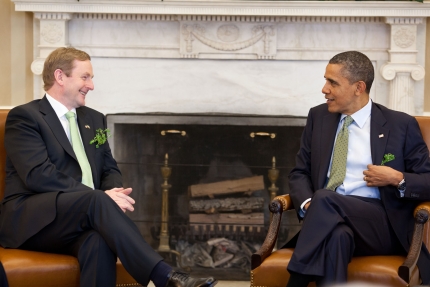
President Barack Obama meets with Taoiseach Enda Kenny of Ireland (March 20, 2012)

President Barack Obama meets with Taoiseach Enda Kenny of Ireland in the Oval Office, March 20, 2012. (Official White House Photo by Pete Souza)

Today, President Obama welcomed Enda Kenny, the Taoiseach of Ireland, to the White House. While both men have had the opportunity to engage in a bit of St. Patrick's Day revelry, there was plenty of serious business on the agenda for this morning's meeting.

President Obama explained:

We have had a terrific discussion about a wide range of issues. Obviously for both our countries, one of the biggest priorities is getting the economy moving in the right direction and putting our people back to work. And the Taoiseach described to me the steps that they've taken to try to stabilize the banking system there, to get control of their budget, and to be in position to grow in the future. 

And it is important that both the people of Ireland and the American people understand the extraordinary benefits of trade, commerce, and investment between our two countries. We are, obviously, an extraordinary contributor to investment in Ireland, and that's something of great importance to the people of Ireland. Conversely, Irish businesses invest and employ huge numbers of Americans as well.

Earlier, Vice President Biden hosted the Taoiseach for breakfast at the Naval Observatory, and all three leaders attended a St. Patrick’s Day lunch at the United States Capitol.

Later tonight, President Obama and First Lady Michelle Obama will host a St. Patrick’s Day reception in the East Room. You can watch live at 7:00 PM ET.

Related Topics: Economy, Foreign Policy

The White House

Office of the Vice President

Remarks by Vice President Biden, Secretary of State Clinton and British Prime Minister Cameron at an Official Luncheon

Remarks by Vice President Joseph Biden and Secretary of State Hillary Clinton at an Official Luncheon Honoring British Prime Minister David Cameron

Benjamin Franklin Room
U.S. Department of State

1:30 P.M. EDT

SECRETARY CLINTON:  Thank you all very much.  Please be seated.  Welcome to the State Department.  We are thrilled and so pleased to host this luncheon for our very special guests, Prime Minister and Mrs. Cameron.  It is wonderful to see all of you celebrating spring with us and knowing that our relationship, it’s always spring.  It’s always being renewed, it is always durable, it is a cornerstone of both of our nations’ foreign policies, and it has such a great resonance between our two peoples. 

Now I want to recognize our chef today.  A native of Birmingham, England -– not Alabama -– (laughter) –- who made herself a home in New York City as the executive chef of a couple of very hip restaurants.  One, The Spotted Pig, the other The Breslin.  So it’s really a delight to have April Bloomfield with us.  She was just talking with the Prime Minister –- (applause) –- it was a very timely introduction because when the Prime Minister and President Obama exchanged gifts, President Obama gave the Prime Minister a barbeque.  I mean a real, down-home American barbeque with a smoking compartment and everything else.  So April stands ready to help, Prime Minister. 

We joke about the special relationship, but that’s because we’re so comfortable with it.  It means such a great deal to us.  It is not just because of a wide range of shared interests, but our deeply rooted history and the unbreakable friendship between our countries.  Now, of course the President did remind the Prime Minister at the White House ceremony this morning that we are at the 200th anniversary of the War of 1812.  (Laughter.) 

And I was pleased to tell my counterpart and friend, the Foreign Secretary, and also the Chancellor of the Exchequer, that it was my predecessor in one of my other lives, Dolly Madison, who actually saved the extraordinary portraits of George and Martha Washington.  Having received word from her husband, who was truly being a Commander-in-Chief in the field, that unfortunately the British truly were coming.  And -– (laughter) -– so she rushed from the White House, taking some treasures with her, leaving behind the meal that she had prepared for her husband and his officers.  And the British officers ate the meal before they burned the White House.  So -– (laughter) –- we are looking forward, but nevertheless, there are certain memories that are also of significance. 

And how wonderful it is, here we are today and working together in so many important parts of the world:  helping to bring peace and stability to Afghanistan; helping to promote successful transitions and democratic reforms in the Arab world.  We worked alongside each other to end a dictator’s rule in Libya.  We are now focused on helping the people of Syria realize a better future for themselves.   We are grateful for the leadership that the Prime Minister and his government have shown on so many issues -– just recently, I was in London for a conference on Somalia that they sponsored.  No matter what the issue, we are standing together.

So I know, Prime Minister and Samantha, that this is just a small measure of hospitality to try to demonstrate our commitment and appreciation for this relationship.  We were so well treated when the President and I and our teams were on a state visit last year sponsored by the government, of course, Her Majesty’s government.  So, we did the best we could with the weather.  We think we pulled that off quite well.  But it is now my great pleasure to welcome a dear friend, a great American, and a superb vice president, Joe Biden.   (Applause.)

VICE PRESIDENT BIDEN:  Well, Madam Secretary, thank you very, very much.  Mr. Prime Minister, Mrs. Cameron, like you we host a large number of visiting dignitaries for high-level meetings.  But sometimes they’re freighted with challenges that require us to forge whole new relationships.  And sometimes, they’re preoccupied with hammering out agreements or producing what the policy wonks refer to as ‘deliverables.’  This one is easy.  This one is easy.

Today is entirely different.  The diplomatic engagement with a full agenda of critical issues, yes, that was on -- it’s on the agenda.  But there’s also something more like a family gathering and very little disagreement.  When we sat in the Cabinet Room today, it was like a Cabinet meeting.  It wasn’t like meeting with foreign dignitaries.

And together, we have -- we, the United States and Great Britain, are very, very proud stewards of the deepest international partnership.  The bond between our countries and our people has stood the test of time and it’s grown stronger through the ravages of two world wars.  We’ve weathered ever shifting fortunes, even the political fortunes in each of our countries and nothing changes except it gets better.

So, Mr. Prime Minister, we’re deeply honored to welcome you on your first official visit to Washington.  And we’re also always anxious to welcome a British Prime Minister back to Washington, even on the anniversary of the War of 1812.  (Laughter.)
 
But I must tell you, Mr. Prime Minister -- the Secretary knows this, and a few of my friends like John Kerry know it -- in my family, it wasn’t the War of 1812 that really bothered anybody about the British.  The Bidens emigrated from Liverpool in 1825.  But the other side of the family, the Finnegan side of the family -- (laughter) -- they had a different problem and it wasn’t the War of 1812.  (Laughter.)  So my grandfather, Ambrose Finnegan, please, things have changed.  (Laughter.)  I just want you to know.  (Applause.)

Mr. Prime Minister, we are truly deeply honored that you’re here.  In your op-ed you co-authored with President Obama, you wrote, “What makes our relationship special, a unique and essential asset, is that we join hands across so many endeavors.  Put simply,” you said, “we count on each other and the world counts on our alliance.”  That is absolutely true.

The United States and the United Kingdom cooperate on a breathtaking array of issues, none more important than the six military campaigns we’ve waged alongside of one another just in the last 20 years.  As you said, the world counts on us -- it was true in Libya.  And, Mr. Prime Minister, I’d like to personally commend you for your leadership you personally showed alongside President Obama in championing the international effort to help drive Qaddafi from power and give the Libyan people a better future.

It’s true in Afghanistan as well, where 9,500 British soldiers stand shoulder to shoulder with American comrades and warriors, preparing the Afghan security forces to take responsibility for their country in 2014.  And, as the President said today in the Cabinet Room, Mr. Prime Minister, no country has made a greater sacrifice than yours in that endeavor.

And it’s true as well in the fight against al Qaeda, which has menaced both our countries.  Together, we’ve substantially degraded al Qaeda and we’ll continue to work toward its destruction, dismantlement and ultimate defeat.
 
It’s true that our efforts to strengthen the global economy after the deepest financial crisis since the Depression have been remarkable.  I remember when we first took office, within the first weeks when the G8 was meeting and then the G20 was meeting.  The question was, could we get a internationally coordinated effort?  And I remember what the President said.  He said, the Brits will be with us.  It’s an interesting comment.  We had only been in office a matter of days, if not -- it couldn’t have been more than two weeks.

And our efforts to fight hunger and disease, end famine wherever it strikes, Mr. Prime Minister, you’ve just -- you’re always there.  Your country has always been there.
 
To keep our shared sacred obligation to our military veterans and those who have served us so well, you have been a stalwart.  And we’ll see a strong symbol of that shared sacrifice when the British Wounded Warriors compete alongside American counterparts in the Wounded Warrior Games in Colorado, in May.
 
And I commend you, Mr. Prime Minister, on the new US-UK Service Personnel and Veterans Joint Task Force, which is helping our troops transition to civilian life, which has been a difficult circumstance for many of our veterans who have been deployed multiple times into God-awful circumstances.

Graham Greene, in The Quiet American, said and wrote, “Friendship is something in the soul.  It’s the thing one feels.  It’s not a return for something.”  I think that is a simple, best definition of the relationship between the United States and Great Britain.
 
So to honor our friendship, please raise your glasses when you get them.  Please raise your glasses to the Prime Minister of Great Britain, Prime Minister Cameron, to the people of the United Kingdom and the enduring, special relationship that we have between us.

(A toast is offered.)  (Applause.)

PRIME MINISTER CAMERON:  Thank you so much for those speeches and thank you for that warm welcome.  Of course, it is slightly embarrassing being here on the 200th anniversary of 1812.  And because of that, I asked a historian friend of mine, Andrew Roberts, before coming on this visit -- I said, Andrew, why is it that in Britain we don’t properly commemorate and recognize this rather embarrassing episode in our history?  And, he said, well, the thing is that of course we’re coming up to the 200th anniversary of the Battle of Waterloo.  And we so much more enjoy talking about defeating the French than anything that went wrong with our American cousins.  (Laughter and applause.)

It’s great to know that there is a chef from Birmingham, England who is here cooking our meal today.  Actually, my political party did make the mistake in a recent Birmingham election of putting out a leaflet and the person who had designed the leaflet took off the Internet the scene, the city scene of Birmingham, but not being a native of Birmingham actually put in the city scene of Birmingham, Alabama on this leaflet.  (Laughter.)  And the great shock and surprise was when the city council was reelected with this leaflet.  (Laughter.)  So anything can happen in politics.

You also mentioned, Madam Secretary, the exchange of gifts between President Obama and I.  I think we’ve got it slightly wrong, because I’ve given him a table tennis table and he has given me a barbecue.  But when you see us standing next to each other, it is quite clear that the person who needs the exercise is the British Prime Minister and the person who needs the barbecue is the President of the United States.  (Laughter and applause.)

Thank you also for putting together such an amazing guest list.  We were looking through it last night -- Samantha and I -- in bed and looking through this guest list, and Samantha said, that is my favorite -- the star from my favorite movie is going to be here.  I said, my God, is it Ben Kingsley from “Gandhi?”  No, he is not coming.  Is Peter O’Toole still okay from “Lawrence of Arabia?”  Is he coming?  No.  It is Chevy Chase from “Caddyshack.”  That’s the great movie.  (Laughter.)
 
So, Mr. Vice President, Dr. Biden, Madam Secretary, Ladies and gentlemen, thank you for this wonderful reception.  Samantha and I are thrilled to be with you at the State Department and even more thrilled to be here in the Ben Franklin room.        
   
Franklin epitomizes so much of what’s good about the character of our two countries:  innovative, passionate, diligent.  He was a man who was prepared to stand up for his values and back his words with deeds.  And in the best tradition of our two nations, he was also a straight talker.  In fact he once said, guests are a bit like fish, they begin to smell after three days.  (Laughter.)  So you’ll be relieved to know having arrived yesterday, I’m leaving tomorrow.  (Laughter.)

I want to start by paying a personal tribute to Mr. Vice President, to Joe Biden, for your sustained and outstanding contribution as a legislator, as a campaigner, as a statesman.  I remember in the 1990s when you spoke out consistently for the need for military intervention to stop the ethnic cleansing in Bosnia and in Kosovo.  You were right to do that.  And in Libya, I believe we showed we’d learned the lessons.  We were able to intervene.  We were able to act and change the course of that country’s history, and we were right to do so.  So today, we applaud your vision and your courage, Mr. Vice President.  (Applause.)

Also a word of deep gratitude to you, Madam Secretary:  You’ve been a great friend to Britain for 20 years, and no one will ever forget your contribution in Northern Ireland, your incredible resilience and your conviction that peace really could be achieved after so many decades of conflict.

And I hope, Mr. Vice President, with your relatives looking down, they will see -- (laughter) -- that the relations between Britain and the Republican of Ireland have never been better.  And it’s a testament to one woman, Her Majesty the Queen, on the 60th year on the throne, that her visit to the Republic of Ireland did so much to restore relations between our countries, and we should pay tribute to her.  (Applause.)

Now, Secretary of State Hillary, in just three years you’ve visited 95 countries.  You’ve traveled over 700,000 miles.  And some people wondered how two British conservatives like William Hague and I would get along with this great force of the Democratic Party.  But as we in Britain say, quite simply, we have been bowled over.

Whenever we come together to discuss the most difficult issues, whether it’s Afghanistan, Libya, Somalia, Syria, you always speak with the greatest precision and the greatest power.  Every one of us is in awe of the passion, the intellect and the relentless energy you bring to every aspect of international affairs.  And you also bring great energy and effort to something else -- to one of the greatest pieces of unfinished business in human history, the emancipation and the empowerment of women.  (Applause.)

There are a generation of young women out there in the world today who owe you much more than they will ever know because they can live safer, more dignified, more fulfilling lives than the generations who came before them.

And you are also a great champion of smart power, and that's where I wanted to just say a word about today because after two years working hand-in-glove with the United States, I know that we’re at our best when we’re not just strong, but we are smart; when we deploy everything we have at our disposal. 

In a world of complex problems, there are no simple, easy solutions.  Take Somalia, where there is a vicious circle of state failure, economic collapse, piracy, terrorism, kidnapping, famine; as our conference in London showed last month, a credible solution cannot just be about military action or even aid in isolation.

We will only succeed when we bring together all of our military, diplomatic, economic, politic effort to achieve peace and prosperity.  And that's also why we in Britain don't just see our increased spending on aid as doing the right thing morally, although we do believe that, we also think it’s the right thing diplomatically and politically, as well.  It enhances our ability to get things done.

Now, this kind of smart power is one of the great strengths that Britain and America have in common, and I think it’s very much on show looking around this room today.

This morning, once again, young British and American men and women in uniform got up to serve together in the Persian Gulf, in Afghanistan, in the Indian Ocean; and we honor their incredible service and their sacrifice.  But we’re not just strong because of our military alone.  We’re strong too because of the power of British and American diplomacy.

As Secretary Clinton put it, the tide of war is receding, but as troops come home, civilians remain to carry out the critical missions of diplomacy and development.

Across the world our specialists are working to understand and influence other countries in shaping the big issues, including in very challenging and very dangerous locations.  Minute by minute, hour by hour, there are phone calls between London and Washington as our diplomats work together to assess the latest intelligence and work out the best ways forward.

In fact, our national security advisors last year talked so often, that I think the President was beginning to believe there was someone called Ricketts-Donilon, who was just one individual, rather than two working together.

But this is not just a security relationship; our smart power comes from more than our ability to defend our security.  It is rooted in the intertwining of two peoples and two communities.  Britain and America continually shape the world because whether you are scientists, innovators, businessmen and women, athletes or stars of fashion, art or music, all of you look across the Atlantic in both directions to find kindred spirits with the same big ideas and the same big ambitions.

So at this, the home of smart power, in the midst of this memorable visit, let me end with a tribute to all of you, to the people who day in, day out make this the essential relationship that it is today, and what it will be tomorrow and the years to come.  And let me ask all of you, please, to raise your glasses to the Vice President, Dr. Biden and the Secretary of State. 

(A toast is offered.)  (Applause.)

END
1:50 P.M. EDT

Vice President Biden Honors Prime Minister Cameron

March 14, 2012 | 20:26 | Public Domain

Vice President Biden speaks before a lunch at the State Department in honor of Prime Minister Cameron and Mrs. Cameron.

Download mp4 (195MB) | mp3 (47MB)

The White House

Office of the Vice President

Vice President Biden to Deliver Commencement Addresses at the U.S. Military Academy at West Point and High Schools in Virginia and Florida

WASHINGTON, DC – Vice President Biden will deliver three commencement addresses this spring at the U.S. Military Academy at West Point on May 26, Cypress Bay High School in Weston, Florida on June 4, and Tallwood High School in Virginia Beach, Virginia on June 14. More details regarding these events will be released as they become available. 

The White House

Office of the Vice President

Readout of Vice President Biden’s Calls with Prime Minister Maliki and Amir Al-Sabah

Vice President Biden spoke by phone this morning with Iraqi Prime Minister Nouri al-Maliki and this afternoon with Kuwaiti Amir Sheikh Sabah Al-Ahmad Al-Jaber Al-Sabah. The Vice President discussed with the two leaders recent regional developments, including their upcoming meeting in Kuwait City and the March 29 Arab League Summit in Baghdad, and reaffirmed the United States’ enduring partnership with both nations.