Vice President and Dr. Biden Host the Third Annual Black History Month Reception

Remarks from the 3rd Annual Black History Month Recpetion

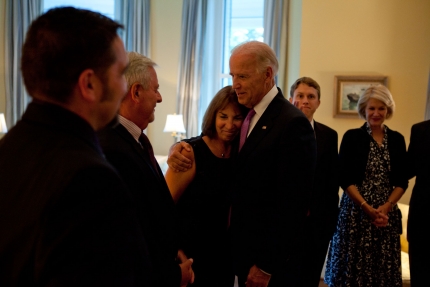
Vice President Biden speaks to guests at the third annual Black History Month reception at the Naval Observatory, February 27, 2012 (Official White House Photo by David Lienemann)

This week, Vice President Biden and Dr. Biden hosted their third annual Black History Month reception at the Naval Observatory.  More than 140 guests were in attendance, including Attorney General Eric Holder, U.S. Trade Representative Ron Kirk, and EPA Administrator Lisa Jackson, as well as members of the Congressional Black Caucus, the National Black Caucus of State Legislators, the National Conference of Black Mayors and the National Organization of Black County Officials.

In addition to hearing from the Vice President, Dr. Biden and civil rights leader Congressman John Lewis, guests had the opportunity to see a collection of photos from the Delaware Historical Society’s special exhibit, Wilmington in the 1930s: Focus on the East Side. Henry Szymanski, Sr.’s collection provides a rare Depression-era glimpse into the daily lives of people living in the city’s East side community.

Training Workers with the Skills Employers Need

The Community College to Career Tour at Davidson County Community College

Vice President Joe Biden, Dr. Jill Biden, and Secretary of Labor Hilda Solis make remarks at Davidson County Community College, in Thomasville, North Carolina, February 24, 2012. The Vice President Joined Dr. Biden and Secretary Solis for the last stop of their community college tour to announce the availability of $500 million to fund partnerships between community colleges and businesses to train workers with skills employers need. (Official White House Photo by David Lienemann)

Last Friday, Vice President Biden joined Dr. Jill Biden and Secretary of Labor Hilda Solis at Davidson County Community College in Thomasville, North Carolina to discuss the importance of training workers with the skills employers need right now. This visit was the final leg of a five-state, three-day Community College to Career Bus Tour that Dr. Biden and Secretary Solis took to highlight the $8 billion Community College to Career Fund recently proposed as part of the President’s FY 2013 Budget.

Speaking to over 300 faculty, students, and other members of the Davidson community, the Vice President argued that America’s skilled workforce is one of our greatest economic assets.  But now that many American manufacturers and other businesses are growing again, too many are having trouble finding workers with the exact skills they need.  That’s why it’s so important to forge partnerships between community colleges and businesses to train workers with the skills that employers need for jobs that are open right now.  On Friday, the Vice President announced that the Administration is taking further steps to do exactly that by making available another $500 million to create and expand these partnerships as part of the Trade Adjustment Assistance (TAA) Community College and Career Training grant program. 

The Administration’s efforts to create and expand these training partnerships are already showing results at places like Davidson County Community College (DCCC).  Thanks to a grant they received in the first round of this program, DCCC has been able to expand their partnerships with local companies to train workers with the skills they need—companies like Ingersoll Rand, which is working with DCCC to train workers with computer numerically controlled manufacturing skills, or Unilin Flooring, which is training workers in electronics engineering.  And these programs are working—in fact, every single graduate of the electronics engineering program at Davidson County Community College has been able to secure a job, many of them at companies like Unilin.  

Tobin Marcus is Deputy Economic Policy Advisor to the Vice President

Together We Must End Dating Violence

Vice President Biden with Ann Burke at the Naval Observatory

Vice President Biden with Ann Burke at a reception to mark the 17th anniversary of the passage of the Violence Against Women Act at the Naval Observatory, September 13th, 2012 (Official White House Photo by David Lienemann)

Over the past month, college newspapers across the country have run an op-ed penned by Vice President Biden in which he urges college students to take action to help put an end to dating violence and sexual assault on their campuses. February is Teen Dating Violence Awareness and Prevention Month, and Vice President Biden took the opportunity to remind students that dating violence is still a very real problem in our country. 

The facts are clear: nearly one in five college women will be the victim of a sexual assault, and one in ten teens will be hurt by someone they are dating. As the Vice President wrote, these are not merely statistics, “these are the people you know: your roommates, your friends, your sisters, and your classmates.” 

As the Vice President has often said, we all have an absolute obligation to try to stop abuse when we see it – no matter what. That’s why this Administration is working so hard to confront the problem head on. 

Last April, new standards were announced that make it clear that colleges are responsible for creating campus environments that refuse to tolerate dating violence. And in September, the Vice President launched the “1 is 2 Many” project – an effort to change attitudes that lead to violence and educate the public on the realities of abuse. 

The White House

Office of the Vice President

Vice President Joe Biden, Dr. Jill Biden, and Secretary of Labor Hilda L. Solis Announce Availability of $500 Million to Fund Partnerships Between Community Colleges and Businesses to Train Workers with Skills Employers Need

Announcement of new round of grants made at Davidson County Community College in Thomasville, North Carolina as part of Community College to Career tour

WASHINGTON – Vice President Joe Biden, Dr. Jill Biden, and Labor Secretary Hilda L. Solis today announced that the Administration is making another $500 million available to create and expand innovative partnerships between community colleges and businesses to train workers with the skills employers need.  This funding is part of the Trade Adjustment Assistance (TAA) Community College and Career Training grant program.  The Administration is issuing the next Solicitation for Grant Applications (SGA) for this program today; community colleges can apply for these grants, and later this year, the Department of Labor, working with the Department of Education, will announce approximately $500 million in new awards. 

Today’s announcement was made at Davidson County Community College in Thomasville, North Carolina, which is part of a consortium of nine North Carolina community colleges previously awarded $18.8 million through the grant program to expand their training partnerships with local employers.  The announcement comes on the final stop of Dr. Biden and Secretary Solis’ Community College to Career bus tour.  The five-state, three-day bus tour has focused on innovative programs at community colleges, in partnership with area employers, helping train students to meet local workforce needs.
“This new round of funding will help community colleges forge new partnerships with local businesses to train workers with the skills they need for jobs available right now,” said Vice President Joe Biden.  “I am proud to join Secretary Solis and my wife – a community college professor herself – on the final stop of the Community College to Career tour to announce this new round of support for these innovative training partnerships.”

“Building a well-educated workforce is critical for the ongoing strengthening of our economy,” said Secretary of Labor Hilda L. Solis.  “This week’s tour has been an extraordinary opportunity to meet students, educators and employers alike, highlighting how these grants bring community colleges and businesses together to give students the skills they need to compete for good jobs in growing industries.”

"After hearing so many inspiring stories of successful community college career partnerships over the last few days on our bus tour, I am thrilled to join Joe and Secretary Solis to announce the kickoff of a new round of grants makings to our community colleges to train workers with the skills they need for good jobs," said Dr. Jill Biden.

The resources provided by these grants will enable eligible institutions of higher education to partner with businesses to expand and improve education and career training programs that can be completed in two years or less and are suited for TAA-eligible workers and other adults. 

This program complements President Obama’s broader agenda of helping every American have at least one year of post-secondary education and will help reach his goal of America having the highest proportion of college graduates in the world by 2020. 

To be eligible to compete for funding under this round of grants, applicants must be institutions of higher education, as defined in the Higher Education Act of 1965, which offer programs that can be completed in not more than 2 years.  By statute, the program is designed to ensure that every state, the District of Columbia, and  Puerto Rico, through their eligible institutions of higher education, will each receive at least $2.5 million in grant awards.

The Department of Labor awarded approximately $500 million in September 2011 in the first round of the program, announced in partnership with the Department of Education.  A list of the original round of grants, organized by state, is available here:  http://www.dol.gov/opa/media/press/eta/eta20111409fs.htm

The American Recovery and Reinvestment Act of 2009 amended the Trade Adjustment Assistance Act to authorize the TAA Community College and Career Training program.  The Health Care and Education Reconciliation Act, signed by President Barack Obama on March 30, 2010, included $2 billion over four years to fund this program.

More information about the TAA Community College and Career Training program can be found at www.doleta.gov/taaccct.  Prospective applicants are encouraged to view the online tutorial, “Grant Applications 101:  A Plain English Guide to ETA Competitive Grants,” available through Workforce3One at:  http://www.workforce3one.org/page/grants_toolkit.  Prospective applicants can register on www.Grants.gov to access the SGA.  In addition, DOL posts grant information at www.doleta.gov/grants.

The White House

Office of the Vice President

Vice President Biden to Travel to Mexico and Honduras

Vice President Joe Biden will travel to Mexico and Honduras from March 4-6.  In Mexico City, the Vice President will meet with President Calderón and will underscore the United States’ commitment to deepening our close dialogue and cooperation with Mexico on a broad range of issues.   In Tegucigalpa, the Vice President will hold a bilateral meeting with President Lobo.  In addition, he will take part in a meeting with Central American leaders, who have been invited to a joint meeting by President Lobo, the current President Pro Tempore of the Central American Integration System.  In both countries, the Vice President will also consult with our partners about the Summit of the Americas, scheduled to be held in Colombia in mid-April, which will focus on leveraging Hemispheric connections and partnerships to improve the lives of people throughout the region.  Additional details about the Vice President’s trip will be released at a later date.

New Report Highlights Wireless Broadband Benefits for Public Safety and Job Creation

Vice President Biden Meets with Law Enforcement Officials, Firefighters and Public Safety Groups

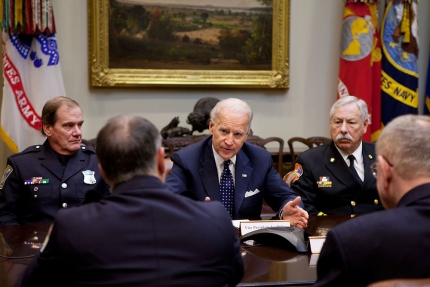
Vice President Joe Biden holds a conference call in the West Wing to thank first responders and to discuss the economic value of increasing spectrum, Feb. 21, 2012. (Official White House Photo by David Lienemann)

Today, Vice President Biden met with law enforcement officials, firefighters and public safety groups in the Roosevelt Room and spoke to a couple hundred more first responders by telephone to thank them for their service and to discuss the new nationwide public-safety broadband network included in the Payroll Tax Extension legislation. 

Members of the audience included police chiefs and sergeants from the New York City Police Department, the International Association of Fire Chiefs, and the National Association of Police Organization, among others. The Vice President discussed the need to ensure the safety of first responders and the public,and announced a new report from the Council of Economic Advisers (CEA) that discusses the positive benefits of wireless broadband for public safety as well as jobs, growth, and investment.

The report illustrates the economic impact of President Obama’s goal of doubling the amount of spectrum available for wireless broadcast over ten years, while adopting a nationwide inter operable wireless network. 

Vice President Biden said the expanded access “will enable new spectrum to be used for innovation, to speed wireless communication, and to fulfill a promise made to first responders after 9/11 that they would have the technology they need to stay safe and do their jobs.”

“I’ve been working on changing the way we allocate spectrum for a long time,” Vice President Biden said, “because a smarter system is good for our economy, good for innovation, and vital to keeping our communities as well as our cops, firefighters and EMTs safe.”

Kendra Barkoff is the Press Secretary to the Vice President

The White House

Office of the Vice President

Vice President Biden Thanks First Responders and Releases Report on the Economic Value of Increasing Spectrum

Today, Vice President Biden met with first responders to thank them for their service and to discuss the new nationwide public safety broadband network included in the Payroll Tax Extension legislation.  In addition, he announced the release of a new report from the Council of Economic Advisers (CEA), The Economic Benefits of New Spectrum for Wireless Broadband), describing the substantial economic value of aggressively pursuing President Obama’s goal of nearly doubling the amount of spectrum available for wireless broadband over ten years and deploying a nationwide interoperable wireless network for public safety. 

The report summarizes the compelling evidence that additional spectrum for wireless broadband is needed to accommodate the surging demand for wireless data traffic, projected to increase by a factor of twenty between 2010 and 2015.  The report also describes the potential for wireless broadband to play a transformative role in public safety and as a platform for innovation in many areas of the economy, and documents the substantial impact on jobs, growth, and investment that the growth of wireless broadband will have.

“I’ve been working on changing the way we allocate spectrum for a long time, because a smarter system is good for our economy, good for innovation, and vital to keeping our cops, firefighters and EMTs safe,” said Vice President Biden. “The measure that Congress just passed picks up on many aspects of the President’s Wireless Innovation Initiative and will enable new spectrum to be used for innovation, to speed wireless communication, and to fulfill a promise made to first responders after 9/11 that they would have the technology they need to stay safe and do their jobs.”
President Obama will soon sign into law a measure will implement important pieces of the Administration’s wireless initiative – including a nationwide interoperable public safety broadband network that will, for the first time, allow law enforcement, firefighters and EMTs to have a dedicated communications network so they can talk with one another. 

Our modern information economy depends on use of the radio airwaves for everything from smartphones and laptops connected to the Internet over wireless networks, to satellite and other wireless networks that bring Internet access to rural areas where running cables is too expensive. This report shows how important it is to continue supporting the growth of this vital sector of the economy.

In addition to describing the economic benefits of making additional spectrum available for wireless broadband, the new report addresses a number of key issues related to spectrum policy.  Specifically, the report reaches the following conclusions: 

  • The use of voluntary incentive auctions will ensure that spectrum is reassigned from the lowest value uses to the highest, and that the economic benefits are widely shared among stakeholders, including broadcasters, wireless carriers, consumers, and taxpayers. The recently passed spectrum bill gives the FCC authority to conduct these auctions.
  • Unlicensed spectrum is a valuable complement to licensed spectrum, and allocating new spectrum for a mix of licensed and unlicensed uses will offer the most fertile environment for future innovation.  The spectrum bill gives the FCC authority to allocate more spectrum for unlicensed uses, creating new opportunities for the development of innovative wireless technologies.
  • Federal funding for research and development in emerging wireless technologies will have substantial public benefits, particularly to support the development of innovative technologies for use in public safety. The bill sets aside $100-300 Million for public safety network R&D, funds that will be vital to helping the public safety community build a new robust, flexible and innovative network for first responders all around the country.

The White House

Office of the Vice President

Statement from Vice President Biden on Anthony Shadid

I've spent much of my career working on America's policy toward the Middle East, and particularly Iraq. Like millions of other readers around the world, I have enriched my understanding of that complex region through the reporting of Anthony Shadid. In the finest tradition of foreign correspondence, Shadid was never content merely to opine from afar. He went where the story took him--from the fall of Saddam Hussein, to the battlefields of Southern Lebanon, to the profound transformations of the Arab Spring--often at extraordinary personal risk. Few foreign correspondents of his generation, or any other, could match his mastery of the language and cultures in the region he covered. And he used those gifts to seek out those far from the corridors of power--giving voice to Iraqis, Lebanese, Egyptians and many others who might otherwise not have been heard.
 
Not one to dwell on his own achievements or hardships, Shadid once said, "the worst part of this job is what you put other people through." My thoughts and prayers are with his family and loved ones, and particularly his two young children.
 

The White House

Office of the Vice President

United States Achieves Breakthrough on Movies in Dispute with China

Washington, D.C. – Vice President Joe Biden announced today that China has agreed to significantly increase market access for U.S. movies in order to resolve outstanding issues related to films after the United States’ victory in a World Trade Organization (WTO) dispute last year. The agreement announced today will allow significantly more job-supporting U.S. film exports to China and provide fairer compensation to U.S. film producers for the movies being shown there.

“This agreement with China will make it easier than ever before for U.S. studios and independent filmmakers to reach the fast-growing Chinese audience, supporting thousands of American jobs in and around the film industry,” said Vice President Biden, who spent the day in the Los Angeles area with Vice President Xi Jinping of China. “At the same time, Chinese audiences will have access to more of the finest films made anywhere in the world.”

“U.S. studios and independent filmmakers cite China as one of their most important world markets, but barriers imposed by China and challenged by the United States in the WTO have artificially reduced the revenue U.S. film producers received from their movies in the Chinese market,” said United States Trade Representative Ron Kirk. “This agreement will help to change that, boosting one of America’s strongest export sectors in one of our largest export markets.”

The Chinese film market is large and growing quickly; last year, Chinese box office revenue was up to $2.1 billion.  Much of this revenue came from 3D titles, which are a rapidly growing sector of the film industry.

The agreement allows more American exports to China of 3D, IMAX, and similar enhanced format movies on favorable commercial terms, strengthens the opportunities to distribute films through private enterprises rather than the state film monopoly, and ensures fairer compensation levels for U.S. blockbuster films distributed by Chinese state-owned enterprises.  The agreement will be reviewed after 5 years to ensure that it is working as envisioned.  If necessary, the United States can return to the WTO to seek relief.

BACKGROUND

The United States initiated the underlying WTO dispute in April 2007. In the dispute, the United States sought to address significant market access concerns relating to China’s treatment of films for theatrical release, as well as other cultural products.

With regard to films, a WTO panel found in a report issued in August 2009 that key Chinese film import restrictions were inconsistent with China’s WTO obligations. In December 2009, after China appealed, the WTO Appellate Body rejected China's claims and upheld the panel's findings. China promised to come into compliance by March 2011, but informed the United States at the deadline that this would not be possible. The two sides have been making efforts to resolve their differences since that time.

On a global basis, films and other audiovisual services are a key export sector in which the United States enjoys a $12 billion trade surplus.  U.S. cross-border exports of audiovisual services, including films, have consistently exceeded U.S. cross-border imports over the last decade.

The White House

Office of the Vice President

Remarks by Vice President Biden at Lunch in Honor of Vice President Xi of the People's Republic of China

J.W. Marriott
Los Angeles, California

1:00 P.M. PST

VICE PRESIDENT BIDEN:  Thank you very much.  Mr. Mayor, let me begin by thanking you for your hospitality.  It’s good to be back in Los Angeles, and I want to thank Governor Jerry Brown for hosting us as well today.

It’s an honor to join you in welcoming Vice President Xi and all of those who have traveled from China to be here, from the provinces as well as the official delegation.

I was asked today what it’s like to spend so much time with Vice President Xi, both in China and here, and I indicated then and I’ll say it again -- it’s been a great pleasure getting to know him personally.

The Vice President and I have gotten to spend more time with one another than I think either of us anticipated when both our Presidents indicated and instructed us to get to know one another better.

We had the opportunity to spend some time together last year in Italy when we both were there representing our governments to celebrate the unification of Italy at its 150th anniversary.  And the Vice President was kind enough to host me for four days in China, both in Beijing and traveling to Chengdu with me. 

And I can say with real sincerity that I’ve been looking forward to the opportunity to return the hospitality that he has shown to me, and this is the capstone to that visit with he and I here in Los Angeles.

I suspect all of you in this audience have traveled a great deal, and I must tell you, the thing I have come to admire about my colleague is his incredible physical stamina.  (Laughter.)  Since he arrived in the United States on Monday, he started off with Dr. Kissinger and Zbig Brzezinski and a number of very serious American diplomats and strategists, and the next day he spent I think 13 or 14 hours with me, starting early in the morning and going straight through to a dinner at my home with members of our Cabinet and others ending late that night.

And Governor, the next morning he left early to go to Muscatine, Iowa, and Secretary Clinton and I said, better him than us.  (Laughter.)  I think he got more delegates than either of us in Muscatine.  (Laughter and applause.)  But I must -- I’m just telling you, it’s the measure of the man.  He wanted to go back and reacquaint himself with and thank the people who had been hospitable to him 27 years earlier.

And then just to prove his stamina he came to Los Angeles, and from here he leaves from Los Angeles to Ireland on his way to Turkey.  (Laughter.)  The only place I can really help him is in Ireland.  I can get elected there.  (Laughter.) 

Mr. Vice President, you and I have spent a substantial amount of time together, and that’s fairly rare in modern diplomacy.  And let me add that we’ve all been touched -- and I mean this sincerely -- by your interest in our country, your desire to meet our people, and by the personal relationships you’re forging here.  It’s made a deep impression.

As the former governors of California are in the room, as well as the present governor can tell you, there are no people in the world that know better than the people of California, that the United States of America is a Pacific nation.

For generations, Californians have looked to the Asian-Pacific region as a critical element of their prosperity.  And now, it is critical to our efforts, all of America's efforts, to put Americans back to work and expand opportunity.

I would venture to say, if we added up the hours in the last six months, the Vice President and I have probably spent 20 hours alone in conversation.  And we've pointed out that seven of our 15 largest export markets -- America's export markets -- are in Asia, with China now the foremost among them.  Last year alone, the United States exported to China more than $100 billion worth of goods and services, supporting hundreds of thousands of American jobs.  And those jobs that are tied to exports are quality, high-paying jobs, estimated to be worth more than 15 percent more than all other jobs in America.

And Mr. Vice President, as we've discussed, the faster the U.S. economy grows, the more Chinese citizens will benefit as well.  So there is a great potential for both of us in working together to increase and solidify this relationship.  The Vice President has been straightforward in the changes he'd like to see, and I have been equally as straightforward in the changes that I'd like to -- we'd like to see in our trade and economic relationship.

The Vice President indicated that China wants to invest more in the United States.  And we're working to make that easier, and there's a whole lot of governors here who are looking forward to that.  (Laughter.)  And thanks to the great work of our ambassador, Gary Locke -- and Gary, stand up so everybody can see you.  (Applause.)  Ambassador Locke was the Secretary of Commerce, as well as the -- when he was governor of the state of Washington.  His hallmark is getting things done, and getting them done quickly.

Under the ambassador's leadership, we are now issuing more than a million visas a year -- faster than ever before -- to Chinese students, to tourists, as well as to businesspeople.  (Applause.)  I assume that came from a student.  (Laughter.)  And I've explained the things that we need to see for American companies and workers.  Here too, we're making real progress. 

We very much want to see more of our businesses able to sell their goods and services in China.  And Vice President Xi has committed to help make that possible.  In this recent visit, China has opened its market to American auto insurers and has taken concrete steps to enforce intellectual property rights, and it has plans to reform its tax system, which will help increase demand for American goods and services by lowering taxes on so-called luxury goods.

As President Obama and I have told the Vice President and all of you -- and many of you have witnessed personally -- China has made the most remarkable progress in the shortest amount of time than maybe any country in history.  And we in our administration and in this country welcome those gains.  And I think American business leaders in this room will agree that we all welcome the competition.  I know American workers welcome the competition.  It not only pushes our companies to develop better products and services and our government to craft better policies, but it encourages our workers to be more cooperative [sic] and to work even harder, increasing productivity.

But the crux of our discussions is that competition only benefits everyone if the rules to the game are fair and followed.  So we will continue to work with the Vice President and the Chinese government to make sure that everyone is playing by the same rules on a level playing field.  I strongly believe, and I think Vice President Xi does as well, that the honest, sustained dialogue we've had this week can and will build a stronger relationship that benefits both our nations and our people. 

And ladies and gentlemen, it is now my great pleasure to introduce to you the Vice President of China, a man you are going to learn a great deal more about for a good number of years, ladies and gentlemen, my friend, Vice President Xi.  (Applause.)

END
1:15 P.M. PST