The White House

Office of the Vice President

Statement from Vice President Biden on the Spectrum Agreement to Safeguard First Responder Communications

After 9/11, we pledged that our cops, firefighters and EMTs would have the technology they need to stay safe and do their jobs. Part of that promise included deploying a nationwide, interoperable broadband network for our first responders. Today we made good on that overdue promise.  First responders put their lives on the line to protect us every day, and the least we can do is ensure that they have the dedicated bandwidth they need to communicate with each other.  It’s going to save lives and help keep our neighborhoods safe.

Vice President Biden’s Turn to Host Vice President Xi of China in the U.S.

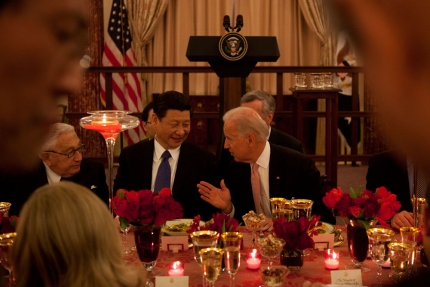
Vice President Joe Biden with Chinese Vice President Xi and former Secretary of State Henry Kissinger

Vice President Joe Biden talks with Chinese Vice President Xi and former Secretary of State Henry Kissinger during a luncheon at the State Department, in Washington, DC, February 14, 2012. (Official White House Photo by David Lienemann)

Yesterday, at the invitation of Vice President Biden, Vice President Xi Jinping of the People’s Republic of China spent the morning at the White House for a series of meetings with President Obama, Vice President Biden, and other Administration officials. Vice President Xi’s visit to the United States this week – which includes stops in Washington, D.C., Iowa and California – is the second of the planned reciprocal visits between the Vice Presidents announced by President Obama and Chinese President Hu Jintao during President Hu’s state visit to Washington last year. 

Welcoming Vice President Xi to the Roosevelt Room in the West Wing of the White House, Vice President Biden reflected on his four-day visit to China last August. “As we discussed in my visit to China, this bilateral relationship is one of the most important in the world… important not only to both our countries but to the world at large,” he said. 

From the White House, the Vice Presidents continued on to the State Department for a lunch in Vice President Xi’s honor, co-hosted by Secretary Clinton. Over 200 guests enjoyed Asian-inspired dishes prepared by acclaimed Chinese-American chef Ming Tsai. 

“Few other nations in history have come so far, so fast, and it’s a great credit to the talent and industriousness of the Chinese people,” Vice President Biden said in his remarks. 

Amy Dudley is Deputy Press Secretary for the Vice President.

State Department Lunch Honoring Vice President Xi Jinping of China

February 14, 2012 | 37:23 | Public Domain

Vice President Joe Biden and Secretary of State Hillary Clinton hold a lunch in honor of Vice President Xi Jinping of China.

Download mp4 (357MB) | mp3 (34MB)

Read the Transcript

Remarks by Vice President Biden and Chinese Vice President Xi at the State Department Luncheon

1:30 P.M. EST

        VICE PRESIDENT BIDEN:  Well, thank you all for being here.  And it’s an honor to welcome Vice President Xi, along with the entire Chinese delegation.

        I told Vice President Xi, his visit to Iowa tomorrow will assure him more delegates than I got the last time I was there.  (Laughter.)  And, Mr. Vice President, this is not part of the script, but Lindsey Graham is relieved you didn’t show up in January.  You may have won the Republican nomination.  (Laughter.)  Secretary Kissinger, you can see formality is still my forte.  (Laughter.)

        Madam Secretary, this lunch is a great start.  I hope we can match the extraordinary hospitality that the Vice President showed me in my four-day visit to China last August.

        The highlight of that trip for me, Mr. Vice President, was the time we spent in conversation together in Beijing, in Chengdu, and I look forward to continuing the conversations we started this morning over the next four days you’re here.

        The Vice President has already participated in three meetings prior to this lunch and they’ve covered a broad range of constructive discussions, and we have a very ambitious agenda in the coming days as well.

        As the Vice President and I have discussed at some length, the United States and China have much to do together, quite frankly, because our relationship is literally going to help shape the 21st century.  We’re not only the two -- the world’s two largest economies, we’re both Pacific powers.  And every day the affairs of our nations and the livelihoods of our citizens grow more connected.

        The President and I came to office determined to rebalance America’s strategic priorities toward those regions that are most critical to our nation’s future, and that meant refocusing on Asia, the most dynamic region of the global economy.  And to state the obvious, the U.S.-China relationship is a critical component of our broader Asian strategy.  Our people, both American and Chinese, are indeed people -- quite frankly, people all around the world will benefit from this mutual effort to build a more cooperative partnership between our countries.

        I first visited China in 1979, and the prosperity achieved since then, which I saw as recently as this past August is -- as all of you know who visit it -- stunning, absolutely stunning.  Few other nations in history have come so far, so fast, and it’s a great credit to the talent and industriousness of the Chinese people.

        But I respectfully suggest that this remarkable growth did not occur in a vacuum.  It was cultivated at every turn by an international system that enables rapid development grounded in rules that apply with equal measure to all nations.  Mr. Vice President, even as our cooperation grows, as we’ve discussed, the United States and China will continue to compete.  And, as Americans, we welcome competition.  It’s part of our DNA and it propels our citizens to rise to the challenge.

        But cooperation, as you and I have spoken about, can only be mutually beneficial if the game is fair.  That’s why in -- the meetings we’ve had this morning were essentially a continuation of the multiple meetings we had in your country in August, and we spent a great deal of time discussing the areas of our greatest concern, including the need to rebalance the global economy, to protect intellectual property rights and trade secrets, to address China’s undervalued exchange rate, to level the competitive playing field and to prevent the forced transfer of technology, and to continue a constructive dialogue on policies that would benefit our citizens and the world.

        While the United States and China -- as you have pointed out, Mr. Vice President -- will not always see eye to eye, it is a sign of the strength and maturity of our relationship that we can be candid about our differences as we have been.  We saw this in the recent U.N. Security Council debate about Syria, where we strongly disagreed with China and Russia’s veto of a resolution against the unconscionable violence being perpetrated by the Assad regime.

        And as was brought up by the President in his meeting with you and my meeting with you as well, we see our advocacy for human rights as a fundamental aspect of our foreign policy and we believe a key to the prosperity and stability of all societies.  We have been clear about our concern over the areas in which from our perspective conditions in China have deteriorated and about the plight of several very prominent individuals.  And we appreciate your response.

        Despite our differences, China and the United States are working more closely together on a broader range of issues than ever before.  These include pressing security challenges North Korea and Iran, maritime security, cyber security and the important work of developing cooperation between our militaries.

        As you and the President briefly discussed in the Oval Office, it also includes our efforts in Sudan and in South Asia, and on global issues such as climate change and nuclear security.  We appreciate your candid responses as we discuss these issues, Mr. Vice President, and I believe you appreciate ours as well.

        So, Mr. Vice President, once again welcome to the United States.  I’ve always believed that the best way -- sometimes, the only way -- to truly understand a country is to see it with your own eyes.  As you know, there’s an old Chinese saying, better to travel 10,000 miles than read 10,000 books.  Although I read Dr. Kissinger’s book on China, I felt that my trip to your country was at least as important last summer.  (Laughter.)

        Actually, Mr. Vice President, I can’t thank you enough for the hospitality you extended to me in my trip.  And I would like to, with your permission, propose a toast -- a toast to a successful visit for the Vice President and the increasing cooperation and understanding that will help both our nations continue to increase this relationship and may it benefit not only us, but the whole world.

        Mr. Vice President.  (Applause.)  

        (A toast was offered.)

        VICE PRESIDENT XI:  (As interpreted)  Mr. Vice President, Madam Secretary, ladies and gentlemen, dear friends, it gives me great pleasure to attend this luncheon hosted jointly by Vice President Biden and Secretary Clinton, for me and my colleagues.

        Last August, Vice President Biden paid a successful visit to China.  I’m now in the United States on a return visit at his kind invitation.  The purpose of my visit is to implement the agreement between our two presidents, enhance China-U.S. strategic trust, broaden practical cooperation, deepen people-to-people friendship, and further advance the cooperative partnership between our two countries.


        This year marks the 40th anniversary of President Nixon’s visit to China and the issuance of the Shanghai Communique.  Forty years ago, with the extraordinary courage and vision of statesmen, the leaders of our two countries opened the door of China-U.S. exchanges that had been sealed off for years.

        Despite some twists and turns over the past four decades, China-U.S. relations have kept moving forward, scoring achievements of historic proportions.  The growth of China-U.S. relations has brought huge benefits to the two countries and two peoples, and lent a strong impetus to peace, stability, and prosperity in the Asia-Pacific region and the world at large.  The China-U.S. relationship has become one of the most important, dynamic, and promising bilateral relationships in the world.  

        As the saying goes, when you drink water, don’t forget those who dug the well.  Today, when we enjoy the fruit of China-U.S. relations, we should be grateful to the generations of Chinese and American leaders for their outstanding contribution to the new chapter in the annals of China-U.S. relations.  We should also be grateful to the Chinese and American friends from various sectors, including many who are present today, for the painstaking and resourceful efforts they have made for the development of China-U.S. relations.

        In the past three years during the Obama administration, China-U.S. relations have, on the whole, maintained positive momentum of growth.  In January last year, President Hu Jintao paid a visit to the United States.  He and President Obama reached an important agreement on working together to build a China-U.S. cooperative partnership based on mutual respect and mutual benefit, charting the course for the long-term development of China-U.S. relations.  We are glad to see that the two countries have further deepened practical cooperation in a wide array of areas and carried out productive communication and coordination on a range of major international, regional, and global issues.  

        This morning, I had a meeting with President Obama and held talks with Vice President Biden at the White House.  We had an in-depth exchange of views on bilateral relations and major issues of shared interest and reached a lot of new and important consensus.  We all believe that the two sides should focus on our common interests and open a new path of cooperative partnership between major countries featuring harmonious coexistence, sound interactions and win-win cooperation.  To this end, our two sides should treat each other with sincerity and candor and enhanced dialogue and communication.  We should respect each other and strengthen strategic, mutual trust.  We should keep pace with the times and expand practical cooperation.  We should look ahead to the future and step up people-to-people exchanges.  And we should intensify coordination and work together to meet challenges.

        President Obama, Vice President Biden and I devoted the greater part of our discussion on economic and trade issues.  We share the view that as the international economic and financial situation remains grim and as ensuring growth, adjusting structure, and promoting employment are high on the domestic agenda of both countries, we must continue to make concerted efforts to tide over difficulties, accelerate the building of the comprehensive and the mutually beneficial economic partnership, and maintain steady economic recovery and growth in both countries and the world as a whole.

        We should tap our cooperation potential, create more bright spots in our cooperation, and strive for greater balance in trade and investment between the two countries.  We should address each other’s economic and trade concerns through dialogue and consultation, not protectionism, and uphold the mutually beneficial pattern of China-U.S. economic relations and trade.  

        We also had a candid exchange of views on human rights and other issues.  I stressed that China has made tremendous and well-recognized achievements in the field of human rights over the past 30 plus years since reform and opening up.  Of course, there is always room for improvement when it comes to human rights.  Given China’s huge population, considerable regional diversity, and uneven development, we’re still faced with many challenges in improving people’s livelihood and advancing human rights.  

        The Chinese Government will always put people’s interests first and take seriously people’s aspirations and demands.  We will, in the light of China’s national conditions, continue to take concrete and effective policies and measures to promote social fairness, justice and harmony, and push forward China’s course of human rights.

        At the same time, we’re ready to conduct candid and constructive dialogue and exchanges on human rights with the United States and other countries on the basis of equality and mutual respect, with a view to enhancing understanding, narrowing differences, learning from each other, and achieving common progress.

        China is the world’s largest developing country, while the United States is the largest developed country.  To build a new type of cooperative partnership between two countries like ours is a pioneering endeavor with great and far-reaching significance.  There is no precedent for us to follow and no ready experience for us to refer to.  We can only do what Mr. Deng Xiaoping said, “Cross the river by feeling the stones.”  Or what Secretary Clinton one quoted:  “When confronted by mountains, one finds a way through.  When blocked by a river, one finds a way to bridge to the other side.”  A Chinese pop song goes like this:  “May I ask where the path is?  It is where you take your first step.”

        I’m convinced that China and the United States have the wisdom, ability and means to maintain and develop their cooperative partnership based on mutual respect and mutual benefit.  And by doing so, we’ll set an unprecedented and inspiring example for countries with different political systems, histories, cultures, and levels of economic development to cultivate positive and cooperative relations.

        I now propose a toast to the health of Vice President Biden and Secretary Clinton, and that of all the friends present, to the remarkable development of China-U.S. relations in the past 40 years and to make even better tomorrow of China-U.S. relations.  Cheers.

        (A toast was offered.)  (Applause.)

END 2:03 P.M. EST

Close Transcript

The White House

Office of the Vice President

Remarks by Vice President Biden and Chinese Vice President Xi to US and China CEOs

U.S. Chamber of Commerce, Hall of Flags, Washington, D.C.

4:50 P.M. EST

        VICE PRESIDENT BIDEN:  Thank you for the hospitality here at the chamber, Tom.  I appreciate it very much, and thank all of you at the chamber and from the U.S.-China Business Council hosting this event; and a warm welcome to Vice President Xi and the Chinese delegation.

        I indicated as -- the entry hall that we’ve not -- I’ve not been a very good host thus far.  Vice President Xi arrived yesterday, and we’ve had him going since 8:30 this morning, meeting after meeting.  He just returned from the Pentagon.  And immediately Tom Donohue said, well, don't forget, Joe, he’s much younger than we are.  (Laughter.)  

        We’re joined by so many distinguished business leaders, and this indicates at least two things, Mr. Vice President, they're honored to have you here as our guest and, secondly, how important they feel and we feel -- U.S.-China economic and trade relationships are for both our nations.  And as you and I have discussed in the past, Mr. Vice President, we presume as well to think they're important for the world at large.

        In this area, as in many others, we’re working together to an unprecedented degree.  Let me be clear:  I believe, as the President said also to the Vice President in the Oval Office not long ago, we believe that a rising China is a positive development -- not only for China but also for the United States and the world.  It will fuel economic growth and prosperity, and a rising China will bring to the fore a new partner with whom we can have help meeting the global challenges we all face.

        Even as our nations cooperate, though, as the Vice President point out, we will continue to compete.  As Americans, we welcome this competition.  I’ve said to the Vice President before, it’s part of our DNA.  And it pushes our companies to develop better products and services and our government to craft better policies.

        But competition can only be mutually beneficial if the rules of the game are understood, agreed upon and followed.  I’m pleased that we have made progress in areas of concern.  China’s exchange rate is appreciating, though still substantially undervalued in our view.  China has committed to rebalance its economy and has just informed us that it will move forward this year with a tax reform policy that will increase imports and promote consumption.

        China has also just told us that it will open third-party liability auto insurance market to foreign companies, an important step in the reforming of the financial sector.  

        And China has responded to our concerns about procurement policies and established a high-level body to strengthen enforcement of intellectual property rights as well.  

        For our part, the U.S. is working to be responsive to Chinese concerns as well.  For example, the United States is expending our visa processing capacity in China to help reduce delays and encourage Chinese travel to the United States.

        But I’m sure, as the Vice President will be the first to tell you, we have work to do -- especially on issues like discriminatory subsidies and financing, protecting intellectual property and trade secrets and ending the practice of making the transfer of technology a requirement for doing business.

        The United States will also work to ensure that all countries play by the international rules.  We’ve brought cases that have challenged unfair trade practices, and we’ve defended U.S. producers and workers in many arenas.

        And in last months, State of the Union address, President Obama announced further steps to investigate and challenge unfair trading practices, protect our markets from counterfeit and unsafe goods and level the financial playing field for our companies.

        I look forward to hearing from those of you gathered here today about both the benefits -- and there are many -- and the challenges of doing business in China, as well as about your plans here and their plans here in the United States.  We welcome your suggestions as to how our governments can address the difficulties you face.

        And I want to thank you again, Tom, for your hospitality and thank all of your colleagues for joining us, and I look forward to our discussions.

        Mr. Vice President.

        VICE PRESIDENT XI:  (As interpreted.)  Vice President Biden, President Donahue, Chairman Muhtar Kent, Chairman Wan Jifei, business representatives to both China and the United States, ladies and gentlemen, dear friends it gives me great pleasure to attend this business roundtable in Washington D.C., together with Vice President Biden.

        I wish to thank the CCPIT, the U.S. Chamber of Commerce, the U.S.-China Business Council for their careful organization, and business leaders of both countries for their active participation.  The 20-plus business leaders from China and the United States present today include representatives both of the rural economy, financial sector, the traditional manufacturing industry and emerging industries.  They represent both state-owned enterprises and private companies.

        The broad and active participation of business people in both countries has made the comprehensive, mutually complimentary, and win-win China-U.S. economic relationship more colorful and more dynamic.  The purpose of my current visit to the United States at the invitation of Vice President Biden is to implement the important agreement of the two Presidents and advance the China-U.S. cooperative partnership.

        This morning, I met with President Obama and held talks with Vice President Biden.  During these meetings, we had in-depth and candid exchange of views on China-U.S. relations and major international and regional issues of shared concern.  We reached a new and important agreement that will help us enhance mutual trust, increase mutual understanding, and generate win-win outcomes.

        We had an in-depth exchange of views on economic and trade issues.  We agree that China-U.S. economic relationship is highly mutually complimentary and full of dynamism.  The two sides should quicken our steps to build a comprehensive and mutually beneficial economic partnership, advance the investment and trade package plan on cooperation, address economic frictions through dialogue and cooperation instead of by protectionist means so as to promote a steady recovery and growth of the two economies and the world economy as a whole.

        With regard to the U.S. concerns concerning trade imbalance, IPR protection, indigenous innovation and investment environment, the Chinese side has taken steps to address them and will continue to do so.  We hope that the U.S. side will adopt the same positive attitude and take credible steps as soon as possible to address Chinese concerns on lifting restrictions on high-tech exports to China and providing a level playing field for Chinese companies investing in America.

        Since the normalization of China-U.S. relations, business people of the two countries have worked together to make progress.  What they have done has made important contribution to China-U.S. economic cooperation and overall China-U.S. relationship.  In the process, they have shared development opportunities and reaped handsome profits.  This is a true example of one reaps what he has sown.

        Given the growing uncertainties and instability in world economic recovery, there has become an even more pressing need for China and the United States, and our businesses, to strengthen cooperation.  In August last year, in Beijing, Vice President Biden and I attended a business forum.  And today, once again, we are having this face-to-face interaction with business representatives of both countries.

        In doing so, we want to increase and expand China-U.S. economic and trade cooperation and bring it to a higher level, to the greater benefit of the two peoples.  To achieve this end, I would like to share with you some of my observations.  First, the British thinker Francis Bacon said, “The ripeness or un-ripeness of the occasion must ever be weighed.”

        At present, both China and the United States are at a critical juncture of shifting growth models.  China is implementing its 12th Five-Year Plan with focus on expanding consumption, upgrading service sector, and encouraging Chinese companies to go global, while the United States is implementing the National Export Initiative, investing in America and programs with focus on expanding exports, boosting the manufacturing sector, and inviting in foreign companies.

        The economic agendas of the two countries have a lot to offer to each other and there is space for our cooperation in energy, environmental protection, biomedicine, advanced manufacturing and infrastructure.  I hope business people of the two countries will follow their trend to seize the opportunities and translate potentials into real win-win outcomes.

        Second, range far your eye over long vistas.  We should adopt a long-term perspective and have broad vision.  The vision of an entrepreneur decides his strategy, his actions decide his attainments.  I hope business people will not let the drifting clouds block their views, will not allow their hands to be tied by some temporary disturbances.  Instead, I hope they will develop more and better products and services.  Here I wish to congratulate General Motors for becoming world champion in car sales last year.

        As far as I know, the SAIC-GM, a joint venture of SAIC and GM now produces and sells 1.2 million cars every year.  For two consecutive years, GM sales in China has exceeded its sales in the States.  Last year, the urbanization rate of China reached 51.2 percent with urban population totaling 690 million.  With the continued process of urbanization, it is estimated that by 2015 the total retail sales of consumer goods in China will reach 32 trillion RMB.

        During the 12th Five Year Plan period, China will import over $8 trillion U.S. worth of commodities.  Such a huge Chinese domestic market offers broad space for mutually beneficial cooperation between Chinese and American business communities.  We welcome more American companies to make investment in China.

        Third, to strengthen the role of China-U.S. economic relationship as the ballast and propeller in our bilateral relationship -- those two metaphors of ballast and propeller shows how much weight our economic relationship carries and as that it serves a strong, driving force.

        Last year, our bilateral trade hit a record high of $446.6 billion U.S., an increase of 16 percent on year-on-year basis.  At this rate, it is expected to top $500 billion U.S.  I hope business communities and chambers of commerce in both countries will continue to care about support and take part in China-U.S. economic cooperation, present a true picture of mutually beneficial China-U.S. economic relationship to the governments and the people, oppose protectionism, and more vocally effectively prevent politicizing economic issues and avoid various kinds of undue interference so as to uphold to the overall interests of China-U.S. relationship and bilateral relationship.

        Fourth, running business conscientiously, honestly fulfill corporate social responsibility.  Both Chinese and American business people should come to realize that only with credibility a company can win a good reputation.

        I’m happy to learn that Chinese Wanxiang Group in recent years has purchased some bankrupt American enterprises that has helped to keep more than 3,500 jobs for local people.  And the Tianjin Pipe Corporation of China invested $1 billion U.S. in the state of Texas, creating 800 jobs for local people.  I am also happy to learn that some of the American companies represented here have taken active parts in poverty alleviation and scholarship programs.  All these have demonstrated the strong sense of social responsibility and morals of Chinese and American business people.

        I hope while expanding your business, you will further reward the local community, creating jobs for local people, increasing revenues for local governments and taking part in the public welfare and community development projects, so that our two people benefit more from China-U.S. economic cooperation.

        Ladies and gentlemen, American writer Edward Bellamy said, “The Golden Age is before us, not behind us.”  Looking ahead to 2012 and even longer time to come, I’m fully confident that the Chinese economy will maintain steady and fast development; that the U.S. economy will achieve strong recovery and growth, and that China-U.S. economic cooperation has a bright future.

        I sincerely hope that business people of the two countries will seize the opportunity and strive for greater progress and write more success stories in China-U.S. economic cooperation.  I thank you.  (Applause.)

END 5:08 P.M. EST

The White House

Office of the Vice President

Remarks by Vice President Biden and Chinese Vice President Xi at the State Department Luncheon

Benjamin Franklin Room, State Department

1:30 P.M. EST

        VICE PRESIDENT BIDEN:  Well, thank you all for being here.  And it’s an honor to welcome Vice President Xi, along with the entire Chinese delegation.

        I told Vice President Xi, his visit to Iowa tomorrow will assure him more delegates than I got the last time I was there.  (Laughter.)  And, Mr. Vice President, this is not part of the script, but Lindsey Graham is relieved you didn’t show up in January.  You may have won the Republican nomination.  (Laughter.)  Secretary Kissinger, you can see formality is still my forte.  (Laughter.)

        Madam Secretary, this lunch is a great start.  I hope we can match the extraordinary hospitality that the Vice President showed me in my four-day visit to China last August.

        The highlight of that trip for me, Mr. Vice President, was the time we spent in conversation together in Beijing, in Chengdu, and I look forward to continuing the conversations we started this morning over the next four days you’re here.

        The Vice President has already participated in three meetings prior to this lunch and they’ve covered a broad range of constructive discussions, and we have a very ambitious agenda in the coming days as well.

        As the Vice President and I have discussed at some length, the United States and China have much to do together, quite frankly, because our relationship is literally going to help shape the 21st century.  We’re not only the two -- the world’s two largest economies, we’re both Pacific powers.  And every day the affairs of our nations and the livelihoods of our citizens grow more connected.

        The President and I came to office determined to rebalance America’s strategic priorities toward those regions that are most critical to our nation’s future, and that meant refocusing on Asia, the most dynamic region of the global economy.  And to state the obvious, the U.S.-China relationship is a critical component of our broader Asian strategy.  Our people, both American and Chinese, are indeed people -- quite frankly, people all around the world will benefit from this mutual effort to build a more cooperative partnership between our countries.

        I first visited China in 1979, and the prosperity achieved since then, which I saw as recently as this past August is -- as all of you know who visit it -- stunning, absolutely stunning.  Few other nations in history have come so far, so fast, and it’s a great credit to the talent and industriousness of the Chinese people.

        But I respectfully suggest that this remarkable growth did not occur in a vacuum.  It was cultivated at every turn by an international system that enables rapid development grounded in rules that apply with equal measure to all nations.  Mr. Vice President, even as our cooperation grows, as we’ve discussed, the United States and China will continue to compete.  And, as Americans, we welcome competition.  It’s part of our DNA and it propels our citizens to rise to the challenge.

        But cooperation, as you and I have spoken about, can only be mutually beneficial if the game is fair.  That’s why in -- the meetings we’ve had this morning were essentially a continuation of the multiple meetings we had in your country in August, and we spent a great deal of time discussing the areas of our greatest concern, including the need to rebalance the global economy, to protect intellectual property rights and trade secrets, to address China’s undervalued exchange rate, to level the competitive playing field and to prevent the forced transfer of technology, and to continue a constructive dialogue on policies that would benefit our citizens and the world.

        While the United States and China -- as you have pointed out, Mr. Vice President -- will not always see eye to eye, it is a sign of the strength and maturity of our relationship that we can be candid about our differences as we have been.  We saw this in the recent U.N. Security Council debate about Syria, where we strongly disagreed with China and Russia’s veto of a resolution against the unconscionable violence being perpetrated by the Assad regime.

        And as was brought up by the President in his meeting with you and my meeting with you as well, we see our advocacy for human rights as a fundamental aspect of our foreign policy and we believe a key to the prosperity and stability of all societies.  We have been clear about our concern over the areas in which from our perspective conditions in China have deteriorated and about the plight of several very prominent individuals.  And we appreciate your response.

        Despite our differences, China and the United States are working more closely together on a broader range of issues than ever before.  These include pressing security challenges North Korea and Iran, maritime security, cyber security and the important work of developing cooperation between our militaries.

        As you and the President briefly discussed in the Oval Office, it also includes our efforts in Sudan and in South Asia, and on global issues such as climate change and nuclear security.  We appreciate your candid responses as we discuss these issues, Mr. Vice President, and I believe you appreciate ours as well.

        So, Mr. Vice President, once again welcome to the United States.  I’ve always believed that the best way -- sometimes, the only way -- to truly understand a country is to see it with your own eyes.  As you know, there’s an old Chinese saying, better to travel 10,000 miles than read 10,000 books.  Although I read Dr. Kissinger’s book on China, I felt that my trip to your country was at least as important last summer.  (Laughter.)

        Actually, Mr. Vice President, I can’t thank you enough for the hospitality you extended to me in my trip.  And I would like to, with your permission, propose a toast -- a toast to a successful visit for the Vice President and the increasing cooperation and understanding that will help both our nations continue to increase this relationship and may it benefit not only us, but the whole world.

        Mr. Vice President.  (Applause.)  

        (A toast was offered.)

        VICE PRESIDENT XI:  (As interpreted)  Mr. Vice President, Madam Secretary, ladies and gentlemen, dear friends, it gives me great pleasure to attend this luncheon hosted jointly by Vice President Biden and Secretary Clinton, for me and my colleagues.

        Last August, Vice President Biden paid a successful visit to China.  I’m now in the United States on a return visit at his kind invitation.  The purpose of my visit is to implement the agreement between our two presidents, enhance China-U.S. strategic trust, broaden practical cooperation, deepen people-to-people friendship, and further advance the cooperative partnership between our two countries.

        This year marks the 40th anniversary of President Nixon’s visit to China and the issuance of the Shanghai Communique.  Forty years ago, with the extraordinary courage and vision of statesmen, the leaders of our two countries opened the door of China-U.S. exchanges that had been sealed off for years.

        Despite some twists and turns over the past four decades, China-U.S. relations have kept moving forward, scoring achievements of historic proportions.  The growth of China-U.S. relations has brought huge benefits to the two countries and two peoples, and lent a strong impetus to peace, stability, and prosperity in the Asia-Pacific region and the world at large.  The China-U.S. relationship has become one of the most important, dynamic, and promising bilateral relationships in the world.  

        As the saying goes, when you drink water, don’t forget those who dug the well.  Today, when we enjoy the fruit of China-U.S. relations, we should be grateful to the generations of Chinese and American leaders for their outstanding contribution to the new chapter in the annals of China-U.S. relations.  We should also be grateful to the Chinese and American friends from various sectors, including many who are present today, for the painstaking and resourceful efforts they have made for the development of China-U.S. relations.

        In the past three years during the Obama administration, China-U.S. relations have, on the whole, maintained positive momentum of growth.  In January last year, President Hu Jintao paid a visit to the United States.  He and President Obama reached an important agreement on working together to build a China-U.S. cooperative partnership based on mutual respect and mutual benefit, charting the course for the long-term development of China-U.S. relations.  We are glad to see that the two countries have further deepened practical cooperation in a wide array of areas and carried out productive communication and coordination on a range of major international, regional, and global issues.  

        This morning, I had a meeting with President Obama and held talks with Vice President Biden at the White House.  We had an in-depth exchange of views on bilateral relations and major issues of shared interest and reached a lot of new and important consensus.  We all believe that the two sides should focus on our common interests and open a new path of cooperative partnership between major countries featuring harmonious coexistence, sound interactions and win-win cooperation.  To this end, our two sides should treat each other with sincerity and candor and enhanced dialogue and communication.  We should respect each other and strengthen strategic, mutual trust.  We should keep pace with the times and expand practical cooperation.  We should look ahead to the future and step up people-to-people exchanges.  And we should intensify coordination and work together to meet challenges.

        President Obama, Vice President Biden and I devoted the greater part of our discussion on economic and trade issues.  We share the view that as the international economic and financial situation remains grim and as ensuring growth, adjusting structure, and promoting employment are high on the domestic agenda of both countries, we must continue to make concerted efforts to tide over difficulties, accelerate the building of the comprehensive and the mutually beneficial economic partnership, and maintain steady economic recovery and growth in both countries and the world as a whole.

        We should tap our cooperation potential, create more bright spots in our cooperation, and strive for greater balance in trade and investment between the two countries.  We should address each other’s economic and trade concerns through dialogue and consultation, not protectionism, and uphold the mutually beneficial pattern of China-U.S. economic relations and trade.  

        We also had a candid exchange of views on human rights and other issues.  I stressed that China has made tremendous and well-recognized achievements in the field of human rights over the past 30 plus years since reform and opening up.  Of course, there is always room for improvement when it comes to human rights.  Given China’s huge population, considerable regional diversity, and uneven development, we’re still faced with many challenges in improving people’s livelihood and advancing human rights.  

        The Chinese Government will always put people’s interests first and take seriously people’s aspirations and demands.  We will, in the light of China’s national conditions, continue to take concrete and effective policies and measures to promote social fairness, justice and harmony, and push forward China’s course of human rights.

        At the same time, we’re ready to conduct candid and constructive dialogue and exchanges on human rights with the United States and other countries on the basis of equality and mutual respect, with a view to enhancing understanding, narrowing differences, learning from each other, and achieving common progress.

        China is the world’s largest developing country, while the United States is the largest developed country.  To build a new type of cooperative partnership between two countries like ours is a pioneering endeavor with great and far-reaching significance.  There is no precedent for us to follow and no ready experience for us to refer to.  We can only do what Mr. Deng Xiaoping said, “Cross the river by feeling the stones.”  Or what Secretary Clinton one quoted:  “When confronted by mountains, one finds a way through.  When blocked by a river, one finds a way to bridge to the other side.”  A Chinese pop song goes like this:  “May I ask where the path is?  It is where you take your first step.”

        I’m convinced that China and the United States have the wisdom, ability and means to maintain and develop their cooperative partnership based on mutual respect and mutual benefit.  And by doing so, we’ll set an unprecedented and inspiring example for countries with different political systems, histories, cultures, and levels of economic development to cultivate positive and cooperative relations.

        I now propose a toast to the health of Vice President Biden and Secretary Clinton, and that of all the friends present, to the remarkable development of China-U.S. relations in the past 40 years and to make even better tomorrow of China-U.S. relations.  Cheers.

        (A toast was offered.)  (Applause.)

END 2:03 P.M. EST
Senate Judiciary Committee Passes Violence Against Women Act

On February 2, the Senate Judiciary Committee passed the reauthorization of the Violence Against Women Act (VAWA). Even though VAWA has a bipartisan group of co-sponsors, the eight Republicans on the committee voted against this critical piece of legislation. Now the Act goes to the full Senate for consideration. 

First authored by then Senator Biden in 1994, VAWA provides funding to states and local communities to improve the criminal justice response to domestic violence, dating violence, sexual assault and stalking.  VAWA supports specialized law enforcement units to investigate these crimes and helps prosecutors get dangerous offenders off the streets. VAWA also protects victims living in subsidized housing from being evicted after suffering domestic violence, supports training for health care providers, and brings help to victims in rural areas of the country.  The hallmark of VAWA is the coordinated community response, bringing different agencies together to create a seamless approach to combating violence. 

One day’s look at the headlines tells us why we still need VAWA. Domestic violence often spills into streets, workplaces, and communities, and is estimated to cost our nation 8 billion dollars a year in lost productivity and health care costs. This violence causes more than two million injuries each year, three deaths each day, and untold amounts of suffering to women. The hidden crime of stalking affects 1 in 6 women and 1 in 19 men, and sexual assault remains the most underreported violent crime in the country. 1 in 5 women and 1 in 71 men have been sexually assaulted at some time in their lives, most before the age of 18. 

It's fitting that the Senate Judiciary Committee took up VAWA during Teen Dating Violence Prevention and Awareness Month, because teens and young adults are at THE highest risk for this violence. The proposed legislation provides funding to schools, youth groups, and victim service agencies to develop new strategies to intervene in and prevent dating violence and sexual assault. If we can stop violence in this generation, some day we won’t need these services. But today, the need is still urgent. We need the full Senate to approve VAWA reauthorization and for Congress to send this legislation to President Obama to sign into law this year.

The First Day of The First Lady's Lets Move! Anniversary Tour

February 10, 2012 | 2:37 | Public Domain

Go inside First Lady Michelle Obama's first day of a three day tour to mark the second anniversary of the Lets Move! launch. Lets Move! is a nationwide initiative to end childhood obesity within a generation. http://letsmove.obamawhitehouse.archives.gov

Download mp4 (76.5MB)

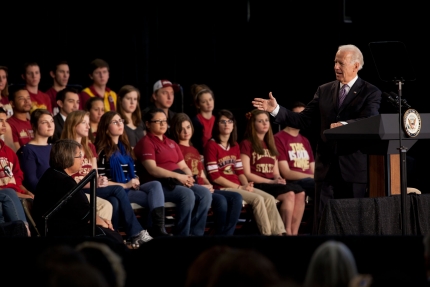
Vice President Highlights New College Affordability Proposals at Florida State

Vice President Joe Biden speaks to FSU students (February 8, 2012)

Vice President Joe Biden speaks to Florida State University students about college affordability, February 6, 2012. (Official White House Photo by David Lienemann)

The Vice President visited Florida State University on Monday to talk with students about our comprehensive plan to address rising college costs. The Vice President began by calling on Congress to permanently extend the $2,500 per year American Opportunity Tax Credit for tuition and other expenses, double the number of work-study jobs over the next five years, and help 7.4 million borrowers by stopping the interest rates on federal student loans from doubling later this year.

These proposals are important, but increasing federal aid is only part of the solution. States and universities also share some responsibility for reining in costs. The Vice President detailed our plan to steer federal campus-based aid to schools that keep tuition affordable – and away from schools that don’t.   While we plan to significantly increase the availability of campus-based aid by offering more Perkins loans to needy students and creating more work-study slots, the additional dollars will only flow to colleges that are providing good value to their students.

We are also proposing to create a new “Race to the Top” for college affordability and completion. This competitive grant program will encourage states to reform their higher education systems in ways that lower costs and increase completion rates. And because state funding cuts are one of the primary drivers of tuition increases at public universities, any state that wants a grant will have to promise not to slash funding for higher education.

You can learn more about our plan here.

The White House

Office of the Vice President

Readout of Vice President Biden's Call with Chinese Vice President Xi Jinping

Vice President Biden spoke by phone yesterday with Chinese Vice President Xi Jinping.  Following up on their discussions during Vice President Biden’s August trip to China, the two leaders previewed the agenda for Vice President Xi's visit to the U.S. next week – including a broad range of economic and trade issues and regional and global developments.  Vice President Biden emphasized the importance of building a U.S.-China relationship that addresses practical issues important to both countries, and expressed support for efforts during Vice President Xi’s visit to further develop bilateral cooperation.

The White House

Office of the Vice President

Readout of Vice President Biden’s Calls to Iraqi Leaders

Vice President Biden spoke on the phone today with Iraqi Council of Representatives Speaker Osama Nujaifi and yesterday with Dr. Ayad Allawi, a leader of the Iraqiyya political bloc. The two Iraqi leaders described deliberations underway among all Iraqi political factions and parties in the run-up to a proposed national conference led by President Jalal Talabani. The Vice President discussed with both leaders the importance of resolving outstanding issues through the political process. The Vice President and Iraqi leaders agreed to stay in close touch as events unfold.