The Vice President Talks College Affordability in Florida

20111209 VPOTUS FL Education

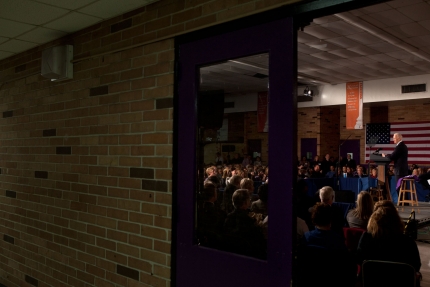
Vice President Joe Biden and Secretary of Education Arne Duncan hold town hall on college affordability at Fletcher High School in Neptune Beach, Florida, December 8, 2011. (Official White House Photo by David Lienemann)

This week, Vice President Biden and Secretary of Education Arne Duncan visited Fletcher High School in Neptune Beach, Florida to talk to students and their parents about college.  President Obama and Vice President Biden have focused on making college affordable for middle-class families since the day they took office. We increased the value of the maximum Pell Grant award by more than $800 and created the American Opportunity Tax Credit, which is worth up to $10,000 over four years for tuition and other expenses. Even after grants and tax credits, most students still need to borrow money for school. That’s why we are allowing borrowers to cap federal student loan payments at 10 percent of their discretionary income.

The Vice President reminded the audience of all these accomplishments, but he didn’t stop there. As proud as we are of this Administration’s record, increasing student aid is just one part of keeping college affordable. State higher education leaders and individual schools must also do their part. On Monday, the President gathered a group of college presidents at the White House to talk about rising college costs and strategies they can pursue to reduce these costs. In Florida, the Vice President argued that colleges "can cut cost and limit student debt without in any way compromising the quality of an education." He acknowledged that "it won’t be easy" but forcefully concluded that "there is no excuse for complacency."

Finally, the Vice President assured students who might be concerned about rising tuitions and debt loads that going to college is an excellent investment. College graduates earn more money and have a significantly lower unemployment rate than high school graduates with no post-secondary degree. And as the Vice President told the audience, "having a college degree is about a lot more than how much money you make. It’s about the independence it bestows upon you, the significantly broader range of choices it gives you…it’s about your sense of self-worth…it’s about being able to fulfill your potential."

Brian Levine is Deputy Domestic Policy Advisor to the Vice President

Vice President Biden Welcomes Home the USS Gettysburg

Vice President Joe Biden and Rear Admiral Nora Tyson welcome home the USS Gettysburg

Vice President Joe Biden and Rear Admiral Nora Tyson welcome home sailors from the USS Gettysburg following its return to Mayport Naval Base, Fla., Dec. 8, 2011. The Gettysburg, a guided missile cruiser, was part of the carrier strike group supporting the USS George H.W. Bush on its first deployment since being commissioned. (Official White House Photo by David Lienemann)

Yesterday morning, Vice President Biden made a surprise visit to Mayport Naval Station in Jacksonville, Florida to welcome over 300 sailors home from a seven month deployment to the Middle East. 

The sailors serve on the USS Gettysburg, which was returning to its homeport in Mayport. The Gettysburg deployed last May – along with helicopters and crew from Helicopter Maritime Strike Squadron 70 (the “Spartans”, based at nearby Naval Station Jacksonville) – as part of the George H.W. Bush Strike Group. 

As the Gettysburg slowly made its way into port, the Vice President said a few words to the hundreds of family and friends gathered to welcome home their loved ones. He was joined by Rear Admiral Nora Tyson, Commander of Carrier Strike Group 2 – the first woman in U.S. Navy history to assume command of a carrier strike group. The Vice President thanked the families for the sacrifices they have made while their loved ones served overseas. “They also serve who only stand and wait,” he said, quoting poet John Milton. 

He also recalled his own son Beau’s homecoming after serving a year in Iraq. 

“I learned early, early on,” the Vice President said, “if anyone got - no matter who it was, the president, the Lord almighty - got between his mother and him or his wife and him as he was getting off that bus, they would have been trampled.” 

“I promise I'm not going to get between you and that ship coming in here,” he told the crowd. 

Amy Dudley is the Deputy Press Secretary for the Vice President

From the Archives: Vice President Biden Pays Respects at Pearl Harbor Memorial

This video is no longer available.

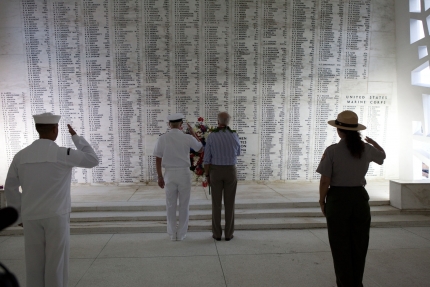
In August, Vice President Joe Biden traveled to Pearl Harbor after his trip to Asia to pay his respects at the USS Arizona Memorial -- a 184-foot structure that rests atop the midsection of the sunken World War Two battleship.

Today marks the 70th anniversary of the Japanese attack on Pearl Harbor. The USS Arizona, one of 21 battleships attacked on December 7th, 1941, is the final resting place for 1,177 American crewmen. It represents the greatest loss of life on any ship that day and about half of the total number of Americans killed in the attack.

The Vice President, his daughter-in-law Kathleen, and his granddaughter Naomi visited the memorial at sunset, and had the opportunity to reflect on the overwhelming loss of life in the memorial’s sanctuary, where 1,177 names of the fallen are etched in marble on the wall.

After laying a wreath at the foot of the wall, the Vice President and his family silently sprinkled flower petals into the sea -- a symbolic tribute to all those lost in the attack.

Vice President Joe Biden pays his respects at the USS Arizona Memorial

Vice President Joe Biden and U.S. Pacific Commander Admiral Willard, pay their respects at the USS Arizona Memorial in Pearl Harbor, Hawaii, Wednesday, August 24, 2011. (Official White House Photo by David Lienemann)

Related Topics: Veterans, Arizona, Hawaii

The White House

Office of the Vice President

Office of the Vice President Announces Staff Changes

Washington, DC – The Office of the Vice President announced today that Courtney O’Donnell, Director of Communications to Second Lady Jill Biden, will leave the White House to move to Berlin, Germany with her family where she plans to work on projects based in Europe. O’Donnell will be succeeded by Melanie Kaye, who most recently worked at a DC-area advertising and communications consulting firm.

Dr. Jill Biden said:  “Since Inauguration Day, Courtney has served as a trusted advisor to me and our entire team.  Her creativity and strategic thinking helped us build campaigns to showcase the strengths of community colleges, support our nation’s military families, fight breast cancer, and draw attention and resources to the issues in the Horn of Africa.   Her expertise, graceful demeanor and tireless work ethic have been invaluable not just to me but to the entire office of the Vice President.  Joe and I are extremely grateful for her tremendous contributions and we wish her all the best in her future endeavors.”

Melanie Kaye comes to the White House from GMMB, where she provided strategic communications counsel on a variety of issues, including public health topics such as cancer, tobacco and obesity, health care reform, workforce and workplace issues, and education, among others. Before that, she served as Press Secretary to former Wisconsin Governor Jim Doyle, both in his office and during his successful 2006 re-election campaign. Melanie also worked as a reporter for several years for publications including The Hill newspaper.  A native of Wisconsin, Kaye received her Bachelors of Arts from St. Norbert College and began work on her master’s degree at the University of Wisconsin’s Robert M. La Follette School of Public Affairs.

The White House

Office of the Vice President

Remarks by Vice President Biden and Greek Prime Minister Papademos at a Lunch Meeting

Prime Minister’s Office
Athens, Greece

 
12:06 P.M. (Local)
 
PRIME MINISTER PAPADEMOS:  (Opening remarks offered in Greek not translated.)
 
Now in today’s meeting, we will have the opportunity to have substantive and productive discussions on important issues of mutual interest, and also we’ll have an opportunity to explore on how we can further strengthen cooperation in the two countries.  We will discuss how we can foster the economic relations between the two countries and also the economic process we being implemented in Greece in order to address the economic challenges we are facing.
 
We will also have an exchange of views on major international and regional issues and on cooperative efforts in these -- and special attention will be paid on developments in Cyprus, the distant Mediterranean, Northern Africa, as well as the Balkans.  These are areas where cooperation between the U.S. and Greece can play an important role in preserving stability and security. 
 
Thank you, Mr. Vice President, for meeting with me.

VICE PRESIDENT BIDEN:  Well, thank you, Mr. Prime Minister.  On behalf of the President who -- I know you’ve already spoken to President Obama -- I am here to tell you that we stand with you in solidarity as you meet some very difficult requirements of the IMF and the European Union in this difficult time for Greece.  And we stand prepared to help you in any way we can. 
 
As you pointed out, Mr. Prime Minister, we have been friends for a long time.  We share the same value set.  We’re NATO allies, and it is overwhelmingly in the interest of the United States that Greece work its way through this financial crisis and that it remain a strong and vital part of the European Union.
 
You have a difficult job, but it appears as though all the political parties and the people of Greece have agreed to support you in this difficult time.  And we are pleased with that.
 
But we have many other things in common and many other mutual concerns, and we will discuss them ranging from the Aegean, to the Balkans, to the Middle East, to North Africa and Cyprus. 

And I think that out of difficult times opportunities present themselves.  And with a lot of hard work and a little bit of luck a year from now, we will have not only weathered this crisis but even be in a stronger position.  So let’s get to work.  (Laughter.)
 
END
12:12 P.M. (Local)

Vice President Biden Checks Out Istanbul's Samatya Square

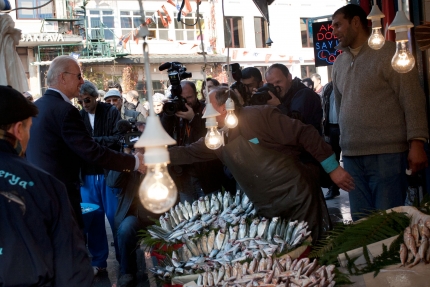
Vice President Joe Biden shakes hands with a fish monger in Istanbul

Vice President Joe Biden shakes hands with a fish monger in the Samatya Square neighborhood in Istanbul, Turkey, December 4, 2011. (Official White House Photo by David Lienemann)

Vice President Joe Biden had one last stop to make in Istanbul earlier today before departing for Athens - the last leg of his trip through the region.

Samatya Square -- a traditional neighborhood in the Fatih district of Istanbul -- is home to all sorts of vendors and food stands carrying local specialties.

The neighborhood is said to represent a "mosaic of life" in Istanbul, having been home to Turks and various minority groups for centuries.

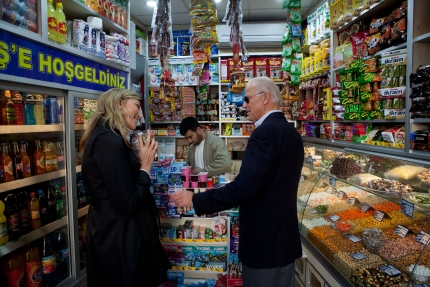
Vice President Biden walked through the cobblestone streets stopping in stores and picking up a few things. On the Vice President's shopping list: oranges, tangerines and other fruit as well as olives and cheeses.

Related:

See a slideshow of the Vice President's trip to Turkey
Vice President Biden Visits the Ecumenical Patriarchate
Vice President Biden Attends Summit in Turkey to Champion Entrepreneurial Spirit 


Vice President Joe Biden visits a shop in Istanbul

Vice President Joe Biden visits a shop in the Samatya Square neighborhood in Istanbul, Turkey, December 4, 2011. (by David Lienemann)

Amy Dudley is the Deputy Press Secretary for the Vice President
Related Topics: Foreign Policy

Vice President Biden Visits Ecumenical Patriarchate in Istanbul

Vice President Joe Biden lights a candle  at the Church of St. George at the Ecumenical Patriarchate in Istanbul

Vice President Joe Biden lights a candle with His All Holiness Ecumenical Patriarch Bartholomew at the Church of St. George at the Ecumenical Patriarchate in Istanbul, Turkey; December 3, 2011. (Official White House Photo by David Lienemann)

 
This afternoon in Istanbul, Vice President Biden met with His All Holiness Ecumenical Patriarch Bartholomew at the Greek Ecumenical Patriarchate.

Following their meeting, the Vice President and the Ecumenical Patriach were joined by members of the Holy Synod, Metropolitans, and Greek community leaders for continued discussions - not to mention an abundance of the local dessert of choice, Turkish Delight.

Vice President Biden then had the opportunity to tour the Church of St. George at the Patriarchate with His Eminence Archbishop Demitrios Trakatellis, Primate of the Greek Orthodox Church of America, with whom the Vice President recently met in New York City. A beautiful day in Istanbul, the tour included a stroll through the Church's mosaic adorned courtyard. It was a special honor to later light a candle at the Church with the Ecumenical Patriarch.

Amy Dudley is the Deputy Press Secretary for the Vice President
Related Topics: Foreign Policy

Vice President Biden Attends Summit to Champion Entrepreneurial Spirit Around the World

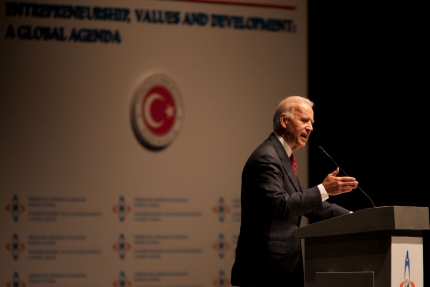
Vice President Joe Biden addresses the Global Entrepreneurship Summit in Istanbul

Vice President Joe Biden addresses the second Global Entrepreneurship Summit at the convention center in Istanbul, Turkey, December 3, 2011. (Official White House Photo by David Lienemann)


Earlier today in Istanbul, Vice President Biden addressed the second Global Entrepreneurship Summit, convened by Prime Minister Recep Tayyip Erdogan. The Vice President is leading the U.S. delegation to the summit, which follows the 2010 Presidential Summit on Entrepreneurship hosted by President Obama in Washington, D.C. 

This year’s summit comes at a critical moment in the Middle East and North Africa as millions have risked their lives for political freedom and economic opportunity. 

"Democratic revolutions like the ones in Tunisia, Egypt and Libya -- and the ones still unfolding in Syria and Yemen --are imbued, literally imbued with entrepreneurial spirit, a spirit that requires risk and initiative, steadfast determination, and a unifying idea," said Vice President Biden. "They aim to do more than merely change the government which is in power, but also to end practices like authoritarianism, corruption, the stifling of free expression -- practices that make political and economic freedom impossible."

The Vice President also highlighted how entrepreneurs are a driving force for job creation and economic growth in the United States.

"Once, the wealth of a nation was primarily measured by the abundance of its natural resources, the expanse of its landmass, the size of its population and the power of its armies," the Vice President said. "Today, the true wealth of a nation is found in the creative minds of its people and their freedom and ability to bring those ideas to life -- to develop not only new products, but the technologies that will create entirely new industries, entire new markets, entire new opportunities."

Amy Dudley is the Deputy Press Secretary for the Vice President
Related Topics: Economy, Foreign Policy

The White House

Office of the Vice President

Remarks by Vice President Joseph Biden at the Entrepreneurship Summit

Istanbul, Turkey

11:45 A.M. (local)

VICE PRESIDENT BIDEN:  Good morning.  To my fellow speakers at this conference, particularly with the economic minister of the UAE, thank you for recognizing President Obama’s purpose in suggesting such a conference.  I am not going to spend any time today talking to you about the U.S. economy, but I am going to suggest that we, all nations, are in this together.  The fact that our economy is three and a half times as large as the next largest economy and larger than the next four combined does not make us immune from what’s happening around the world.

And I’m here today to speak to you entrepreneurs.  I’m here today to speak to all of those of you who we look to and will be looking to in each of our countries to assure that we continue to grow and we continue to be open.  So I say hello to everyone here and thank you for being here.  (Applause.)

But before I get to my main topic and the focus of this conference, let me just say that I know we all wish the Prime Minister could join us today.  And I look forward to personally visiting with him after this meeting to wish him a speedy recovery on behalf of President Obama and our entire administration.  (Applause.)

I would also say to our host, particularly to the speaker, that I’ve had a great couple of days here in Turkey.  And I want to thank the Turkish people, and their leaders, for their hospitality.

I’ve had very productive meetings so far.  Yesterday, I met with my old friend, President Gul, as well as the Speaker, who is here today and will be speaking next.  And I want to thank him for arranging a breakfast that he arranged for me yesterday with members of the Parliament.  I hope he found it as useful as I did.

My discussions this week here in Turkey have covered many topics of mutual concern to both our countries.  Our close collaboration in NATO, Afghanistan and Iraq; our joint efforts against the PKK, which continues to launch appalling attacks that claim innocent lives; regional issues from the brutal repression in Syria where Turkey -- where we stand with Turkey and a growing chorus of nations in calling for President Asad to step aside.  And I welcomed the Human Rights Council’s condemnation yesterday of the regime’s violence.

And the constitutional reforms we discussed that are taking place here in Turkey, which we hope and I know all in Turkey hope, will strengthen Turkey’s already strong democracy and respect for human rights.  And President Gul and I discussed my hope that Turkey and Israel, two steadfast American allies, can find opportunities to strengthen their own relationship.

So, ladies and gentlemen, the United States and Turkey have been NATO allies since 1952 and I am pleased to say that today our economic relationship is flourishing as well as our long-term military relationship.  Trade between our nations grew by 45 percent this year alone.  And I think it’s both to the benefit -- I know it’s to the benefit of the American people and I feel certain it’s also to the benefit of the people of Turkey.  And that’s why President Obama was so pleased that Prime Minister Erdogan agreed to host this meeting here in this magnificent city.

And I also want to thank -- as I’ve already done personally -- the United Arab Emirates, which has agreed to host next year’s summit.  As I said to the Sultan, I hope -- I plan on being there assuming I am re-elected.  (Applause.)  And I hope we represent -- but I’m confident whomever is leading my country will be there with the minister of economic affairs.

In June of 2009 in a speech that’s already been referenced given by President Obama in Cairo, the President announced our intent to deepen ties between American entrepreneurs and their counterparts from countries around the world with significant Muslim populations.  And 10 months later, the first Global Entrepreneurship Summit brought to Washington innovators -- many of you are here today -- from 50 nations in five continents.

President Obama said then, and I quote, “We’ve come together today because of what we share, a belief that we are all bound together by certain common aspirations -- to live in dignity, to get an education, to live healthy lives and maybe start a business without having to pay tribute or a bribe to anyone, to speak freely and have a say in how we are governed, to live in peace and security and to give our children a better future.”

So the question might be asked, how does entrepreneurship have anything to do with those larger aspirations?  There was no way at the time the President made that speech that several months later many of these same principles, those aspirational notions about the desire for dignity and freedom of speech and good governance and the chance for a better life would begin to transform the Middle East and North Africa.

I suspect that many of you assembled here in this magnificent hall today, whether or not you’ve ever been politically active, felt some of the same affinity that many of us felt for those in the streets who were seeking to build something far larger than just something for themselves.  That’s because democratic revolutions like the ones in Tunisia, Egypt and Libya -- and the ones still unfolding in Syria and Yemen --are imbued, literally imbued with entrepreneurial spirit, a spirit that requires risk and initiative, steadfast determination, and a unifying idea.

They aim to do more than merely change the government which is in power, but also to end practices like authoritarianism, corruption, the stifling of free expression -- practices that make political and economic freedom impossible.  And they take advantage and have taken advantage of the technologies of their time, whether it was 30 years ago with radio waves that penetrated the Iron Curtain during the Cold War or Twitter feeds that spread the details of Libyan troop movements in an attempt to prevent attacks on civilians.

The revolution that gave birth to my own country was inspired by the same desire for freedom and ensured that from its earliest days America has been hard-wired for innovation.  Back then, it was pamphleteers like Thomas Paine.  Today, it’s modern new technologies that connect us in an instant.

A political system founded on the rule of law and the protection of basic liberties, including the freedom of speech and the freedom of religion provide the truest shield against sectarian strife that too often has afflicted this region and in previous centuries western Europe; an educational system that trains students not merely to learn and accept established orthodoxy, but to be skeptical, to challenge and improve on the ideas that are being presented to them; an economic system that not only encourages fair competition, but richly rewards those who excel.  The foundation -- this foundation has enabled generations of Americans and others to give life to world-changing ideas, in our country ideas from the cotton gin to the airplane to the microchip to the Internet -- world-leading companies like General Electric, Ford Motor Company, Microsoft, Apple, Google and I could go on and list many others.

And breakthroughs in medicine and medical technologies that may not have originally had a profit motive but that held the promise to benefit all of mankind, from the polio vaccine to the human genome project and many others which were started by the U.S. Department of Energy and the National Institutes of Health in my country or the mobile phone apps recently developed by a team of graduate students in Florida that can help diagnose malaria anywhere in the world.

America’s experience -- and that of many other nations, including many of yours -- teaches that fostering entrepreneurship is not just about crafting the right economic policy or developing the best educational curriculum.  It’s about creating a free political climate in which ideas and innovation can flourish.

Simply put, governments that protect liberties, embrace transparency allow for vibrant civil societies.  Give women equal opportunity.  They are the ones that pave the way for thriving cultures and entrepreneurs.  (Applause.)  It cannot happen without that.  

Meanwhile, countries that try to have it both ways, for example, making the Internet closed to free expression but open for business, those countries will find that approach is a dead end not because of anything the United States says or any other country, because they are totally inconsistent.  They may try to build walls between these different activities, but there isn’t a separate economic Internet, a political Internet and a social Internet.  There is simply an Internet and it must remain free and open.  (Applause.)  That is your conduit.  That is the conduit of all you brilliant, young minds who I’m looking at now.  That is the conduit through which entrepreneurship will flourish.  

We’re all here because we believe in the power of entrepreneurship to transform lives and lift up entire communities and nations.  It is no coincidence, ladies and gentlemen, that 19 of the top 20 most prosperous countries in the world are also the most entrepreneurial countries in the world, according to leading international indexes.

That’s why it’s so fitting that we meet here in Turkey today.  My old friend, the former foreign minister and now the economic minister spoke to Turkey’s great progress as did the economic minister.  A remarkable economic success story where the economy has tripled in size over the past decade, exports have quadrupled and per capita income has grown dramatically, allowing families to build better lives for themselves and for their children, and a better promise for their grandchildren. 

I understand that our ambassador, the U.S. ambassador to Turkey, said not too long ago that the next Steve Jobs may be a Turk.  Well, that’s a worthy goal.  (Applause.)  He also may be in the UAE.  He or she may be anywhere in the world.  Already, Turkey is cultivating its own brand of homegrown talents, some of whom are here today.  

In 2007, Mr. Ozturk founded a company called 41-29, named for Istanbul -- the coordinates of the city of Istanbul.  It quickly became Turkey’s leading digital marketing agency specializing in advergames, virtual videos, social media.  And it made Facebook’s exclusive list of 40 “preferred developers.”

Ms. Hulya opened Turkey’s -- the first Turkish chain of women’s workout facilities in 2006.  Already this entrepreneur has opened 45 gyms nationwide, all of them I might add run by female franchisees.

Turkey is now the 17th largest economy in the world.  And, as you heard today, it aspires to be more, one of the world’s top ten economies by 2023, the 100th anniversary I might add of the founding of the Turkish Republic.  With what I know about Turkey’s people and its leaders over the past 35 years and what I’ve seen in the last decade, and what I’ve seen this week, I’d say that’s a pretty good bet.  (Applause.)

To secure the sort of future we all seek, each of us here must do our part -- not just our nations, each of us individually must do our part.  Aspiring entrepreneurs must do what comes naturally to them -- dream, take chances, and in the memorable phrase coined by Steve Jobs -- “think different.”  (Applause.)  For those who think the same do not hold the promise of progress.

Established entrepreneurs and chambers of commerce must mentor the next generation -- as this conference is all about -- share the wisdom gained by their successes and their failures and perhaps just as importantly help them learn from your mistakes.  Universities and corporations must work together through research and internships to nurture and develop entrepreneurial skills of students before they graduate, because the single, most valuable resource on the planet is not what’s in the ground, but what’s in our minds.  That is the most valuable resource that we possess in the minds of individuals, which we all have to work to cultivate.

Investors must occasionally be willing to take a chance on an unknown talent and an unknown and unproven dream.   And governments must unlock the marketplace of ideas, because it’s hard to think different if you’re not free to think and openly express what you’re thinking.  And governments must unlock the commercial marketplace by facilitating access to capital, removing cumbersome regulations and ending corrupt practices like bribes, all of which stifle competition.  Countries that take this path will find ready partners in other nations with thriving entrepreneurial cultures, including my own.

Let me give you a few important examples of how the United States is delivering on the commitments President Obama made in Cairo and at the first entrepreneurial summit, because as was mentioned earlier by the minister, just as in his country, in my country a promise made is a promise kept.

In Egypt, our Overseas Private Investment Corporation is providing financing of up to $1 billion to support public-private partnerships in energy, health, waste-water treatment, as well as facilities for small and medium-sized entrepreneurs for lending and housing and consumer financing.  In Tunisia, we are providing job placement, business entrepreneurial and social entrepreneurship programs for up to 800 youth.

In Iraq, where I just left, 45 percent more college students studied in the United States than the last year.  We are working with the government of Iraq to ensure those numbers will increase.  In Baghdad, the government is wisely funding 10,000 scholarships for its students to study abroad.  And America’s goal is to attract 30 percent of those students -- 3,000 of them -- at America’s universities.

In eight different countries and territories, including Turkey, we have launched a program called Partnership for a New Beginning, which brings together government, private sector and civil society leaders to build and deepen engagement in areas of economic opportunity, science & technology, education and exchange.  Among its diverse programs are life skills training programs for Indonesia’s undergraduates, safe gathering space for Egyptian activists to discuss reform and tele-medicine training for Pakistani health workers.

We’re also promoting and protecting intellectual property rights not just because so much of our intellectual policy -- property is stolen worldwide.  Tens of billions of dollars is stolen every year.  But that’s not the major reason we’re promoting this.  Because without protection of international property in every country, the country that does not protect it, the society that tolerates the theft of innovation will never develop its own indigenous capacity to create, whether in music or film, software or pharmaceuticals.

For you young entrepreneurs, why would you take the risk of your intellectual property being stolen in your own country?  And what incentive is there for a country to develop their own entrepreneurship, their own new ideas if all they have to do is go and steal them.  It’s a self-defeating proposition for the country that does not protect intellectual property.  (Applause.)

Ladies and gentlemen, it will not surprise you, but we are particularly focused on encouraging women entrepreneurs because societies that deny women basic rights are squandering half of their intellectual capital.  The most valuable asset any country has, as I said, are the minds of their people, all of their people.  And in case you haven’t figured it out, women are just as bright as any man.  (Applause.)  

Study after study has shown that those nations that refuse to empower women to participate in economic affairs will be and have been left behind.  Their societies have not developed.  Already, in the developing world, almost half of the businesses, half of the new businesses are women-owned.

In Sub-Saharan Africa, we launched The African Women's Entrepreneurship Program,  which brings businesswomen to the United States for training related to trade and advocacy, and opportunities to meet U.S. political and business leaders, industrial associations and non-profit organizations.  Almost two-fifths of the participants who came have reported already that their businesses expanded upon their return, including a Tanzanian textile producer who signed a deal with a major American fashion designer Rachel Roy, assuring that she will make a great deal of money and employ a lot of her own people.

We’re also fulfilling a pledge President Obama made in Cairo to build networks of entrepreneurs and expand exchanges in education and to foster cooperation in science and technology.  We have led delegations of businesspeople and investors to Lebanon, Turkey, Egypt, Jordan, Tunisia, Indonesia, Morocco, and Algeria.

And lest you misunderstand me, we also understand in these exchanges we stand -- we, the United States stands -- to learn something.  We stand to benefit, because we are fully aware that the seed of innovation, change, technology and science does not rest in the United States alone.  And starting next year, the Global Entrepreneurship Summit will partner with the Kauffman Foundation and Global Entrepreneurship Week, the world’s largest celebration of business innovation will participate in 123 countries to expand the reach of this summit in the years to come, because we believe in you.  We believe in your capacity.  (Applause.) 

Ladies and gentlemen, as the great inventor Thomas Edison said, “To have a great idea, you need to have a lot of ideas."  And he was right.  This is the premise on which the Global Entrepreneurship Summit is based.  Once, the wealth of a nation was primarily measured by the abundance of its natural resources, the expanse of its landmass, the size of its population and the power of its armies.

Today, the true wealth of a nation is found in the creative minds of its people and their freedom and ability to bring those ideas to life -- to develop not only new products, but the technologies that will create entirely new industries, entire new markets, entire new opportunities.  We cannot prosper in the 21st century built on the industries of the 20th century.  But let me state it again, none of this can happen without governments that guarantee the right to “think different,” as Steve Jobs said.  Our presence at this Summit is a testament to our shared belief in this notion.

Despite these difficult economic times, when I look out at the talent assembled here in this great hall, I’m optimistic.  And I really mean this, I am optimistic about the future more than I have ever been in my entire 39-year career.  The spirit and the drive that brought all of you here today are the engines that will help build a better tomorrow for our families, for your families, for our neighbors, for your fellow citizens.

Therein lies the U.S. objective in sponsoring this.  We benefit when nations grow.  We benefit when you are secure.  We benefit when people can provide for themselves.  We benefit when democracies flourish.  And democracies flourish when entrepreneurs are part of the engine of that democratic instinct one idea at a time.  One idea at a time is what is going to build the 20th century -- the 21st century in a better and more coherent and less conflictual state than the 20th century.

Let me conclude by thanking all of you for being here. Thank you for your skill.  (Applause.)  Thank you for your passion, your passion and your self confidence to believe in yourselves and the hard work it takes to bring an idea to life.  I’m inspired to be here among you and I look forward to seeing how you reshape this world of ours.  The promise is amazing.  The promise is amazing.

Ladies and gentlemen, there is a quote I often use -- and if you excuse me for quoting an Irish poet.  I quoted this to the speaker when we had breakfast.  It was an Irish poet named William Butler Yeats who describing the transition taking place in his Ireland in 1916 wrote a poem that had the following line in it, a line that was intended to describe his Ireland at the moment.  But I would respectfully suggest it describes the Middle East and the world today even better than it described his country at the moment.  And here’s the line from that poem.  He said, “All has changed, changed utterly.  A terrible beauty has been born.”

All has changed not only in the Middle East in the last 20 years, but in the world at large.  We are at a inflection point in world history, a point at which my physics professor used to say, an inflection point is when you sit behind the wheel of an automobile that is going 60 miles an hour and abruptly you turn it five degrees in one direction.  It means you will never be back on the path you once were.  It is impossible to return to that path.

We are at one of those inflection points in world history.  But the good news is the reason for my optimism is you, you entrepreneurs.  You’re the ones that have your hand on the wheel.  And you have a chance like no other generation of entrepreneurs to direct the world, to steer it, to bend the curve in the direction of progress, openness, humanity.

So we’re relying on you more than just for your business acumen.  We’re relying on you for your passion and your understanding that only through a free exchange of ideas, the ability to think different, can the world be made better.  God bless you all.  (Applause.)

END           
12:16 P.M. (local)
The White House

Office of the Vice President

Background Briefing by a Senior Administration Official on Vice President Biden's Trip to Turkey

Aboard Air Force Two
En Route Istanbul, Turkey

 
3:21 P.M. (Local)
 
SENIOR ADMINISTRATION OFFICIAL:  So if this is helpful, I’ll give you a quick readout of the Vice President’s morning, some of which you saw, some of which you didn't at the meetings.
 
We started as you know at the breakfast with the Speaker.  And the conversation focused in some detail on the constitutional reform process in Turkey that the Speaker is helping to lead.  And the Vice President expressed his support for and our admiration for the very inclusive transparent process the Turks are engaged in to reform the constitution with many different stakeholders involved, including Kurdish parliamentarians, civil society, but mostly he listened to the Speaker explain the process and how they were going about it.
 
The Vice President noted that not only was this a historic opportunity for Turkey and for Turkey’s citizens, but it also offered the possibility of making Turkey an even stronger example for countries in transition in the region, many of whom look to Turkey.  And so there was an opportunity not only to change the lives of the Turkish people, but to influence the transition of many other -- many other peoples in the region.
 
And the Vice President noted some of the concerns that we’ve had with the judicial system and the desirability of reform there, as well as concerns about the detention of journalists and others, and the hope that the Turks would be addressing these issues through their reform efforts.
 
That was the bulk of the discussion.  Really quite fascinating to hear the Speaker talk in detail about how they were going about it. 
 
The only other issue that came up during the breakfast that the Vice President brought up was Armenia, and in particular, he expressed our hope that -- first of all, he applauded the fact that the protocols for normalization with Armenia were back on the agenda of the parliament.  And he expressed his hope that the parliament will be able to act those protocols in the months ahead.
 
So that was the breakfast.  I might add it featured an excellent selection of cheese, bread, pancakes -- really good.  (Laughter.)
 
Then we went, as you all saw and took part in, to the Ataturk Memorial Mausoleum, and the Vice President laid the wreath, wrote in the book.
 
SENIOR ADMINISTRATION OFFICIAL:  We gave them that.
 
SENIOR ADMINISTRATION OFFICIAL:  I see -- oh, you have the statement -- his written statement. 
 
And from there it was on to President Gul, and they covered a lot of ground.  The meeting went significantly over the planned time.  I think we allotted an hour for the meeting, and I believe it went close to two.  And that was a reflection of both the depth and breadth of the conversation that they had.
 
The Vice President has known President Gul for a number of years.  They’ve met several times before.  He has great appreciation for his wisdom and approach to problems.  So in that meeting as I said they covered a lot of ground.  They spent a lot of time on Iraq, mostly because, of course, we’d just come from there.  And Gul and his colleagues were certainly interested to hear the Vice President’s impressions.
 
The Vice President relayed some of the key points and take-aways from the trip, from his meetings.  He made it very clear to the Turks that we are not disengaging from Iraq.  The nature of our engagement is changing from military lead to civilian lead, but in many ways we were actually deepening our engagement. 
 
He talked about the session of the High Coordinating Committee of the Strategic Framework Agreement, and the fact that we were working in a very comprehensive way with the Iraqi government to help it build and strengthen its institutions.
 
They discussed the PKK, and the Vice President reiterated our commitment to help the Turks deal with this problem, which is a common problem.  He also conveyed that he had heard from Iraqis their commitment to do more to deal with the problem posed by PKK terrorism.
 
There was some discussion of Iran and Iranian influence in Iraq.  The Vice President conveyed his view that the Iraqis have very strong antibodies to interference by anyone, starting with Iran.  He noted the polling that shows that Iraqis of all persuasions do not abide by Iranian influence, and noted that Iranian efforts to dictate the outcome of the election and the government had failed.
 
They talked a little bit about prospects for the hydrocarbons law.  The Vice President noted that several of his Iraqi interlocutors had told him that they thought there was a chance that this long delayed law could move forward in the weeks ahead.
 
They also touched on Arab-Kurd relations in Iraq, and that was pretty much it for the Iraq discussion.  But it was lengthy. 
 
They turned to Syria.  The Vice President said he understood that the concern that some in the region had for the uncertainty about what might follow the Assad regime, but also underscored his conviction which the Turks share that Assad and his regime are the source of instability in Syria now and pose the greatest danger to fanning flames of sectarian conflict not only in Syria but beyond.  And the number one objective was to get the regime to stop killing its people and for Assad to leave power.
 
There was discussion of Iran more broadly.  The Vice President stated -- the Vice President said it was his assessment that Iranian influence in the region was declining and Iranian isolation was increasing as a result of its outrageous actions across the board from its refusal to come clean on its nuclear program and its violations of the nonproliferation treat, the attempt to assassinate the Saudi ambassador in Washington, the assault on the British embassy in Tehran, the threat to Turkey and the NATO radar system and so forth.
 
And then just very quickly three other things came up in the meeting.  Cyprus -- the Vice President expressed our hope that real progress can be made in the months ahead led by the United Nations and its efforts.  They discussed Israel and its relationship with Turkey.  The Vice President said that it is important to the United States that two of our closest friends and partners work to repair the damage to their relationship and the existing tensions, that that would be good for Turkey, good for Israel and good for us and expressed the hope that they would both work to seize any opportunities to do that.
 
And finally, he also raised with President Gul the same subject he’d raised with the Speaker, the Armenian protocols saying that again he was pleased to note that the protocols were back on the agenda of the parliament and hoped the parliament might be able to act on them. 
 
That's it.
 
Q    Did the Vice President get clarity from the President on that issue of the international buffer zone, whether that was --
 
SENIOR ADMINISTRATION OFFICIAL:  It did not come up.
 
Q    It did not come up.
 
SENIOR ADMINISTRATION OFFICIAL:  Did not come up.
 
Q    Did they talk about tougher sanctions on Iran?  He called in the Q&A that we saw in the newspaper for Iran to adopt tougher sanctions -- for Turkey to adopt tougher --
 
SENIOR ADMINISTRATION OFFICIAL:  Yes, it did not.  That specifically did not come up in the meeting.  It was a broader discussion of Iran:  where it was going and the need to keep the pressure on to encourage them to change their behavior.  But there was no specific reference to sanctions.
 
Q    Did you get any sense at all that the Turks might even want the U.S. to chill out a little bit on Iran?
 
SENIOR ADMINISTRATION OFFICIAL:  No, that certainly wasn’t expressed.
 
Q    And you said that the Vice President expressed understanding for fears of instability after Assad.  Did the President --
 
SENIOR ADMINISTRATION OFFICIAL:  Not --
 
Q    The possible instability --
 
SENIOR ADMINISTRATION OFFICIAL:  Yes, but not -- and I’m not attributing that to the Turks.
 
Q    That's what I was about to ask you.
 
SENIOR ADMINISTRATION OFFICIAL:  Yes.
 
Q    Is it possible to get a few words, a read-out on the Barzani meeting?
 
SENIOR ADMINISTRATION OFFICIAL:  Sure.  We can do that.  I think we’re going to land.  I don't know maybe we can do that --
 
SENIOR ADMINISTRATION OFFICIAL:  Do it at the hotel.  Let’s get to the hotel, figure things out.
 
Q    Thanks.
 
SENIOR ADMINISTRATION OFFICIAL:  Thanks, guys.
 
END
3:33 P.M. (Local)