Announcing the Winners of the Apps Against Abuse Technology Challenge

Last July, I wrote about a new and innovative effort to help address sexual assault and dating violence. While women of any age can be targets of this kind of abuse, young women aged 16-24, experience the highest rates of rape and sexual assault, and 1 in 5 will be a victim of sexual assault during college. Many of these assaults occur when the offender, often an acquaintance, has targeted and isolated a young woman in vulnerable circumstances. Moreover, sixty percent of college students who have been in an abusive relationship say no one helped them.

Working with the Office of the Vice President and the White House Office of Science and Technology, we launched the Apps Against Abuse technology challenge – calling on software innovators to harness the power of mobile technology to help prevent dating violence and abuse by keeping young adults connected to trusted friends and providing easy access to important resources for help including local police and abuse hotlines.

Today, we are pleased to announce the winners of the challenge: “Circle of 6” and “On Watch.” Prototypes of the two winning applications were selected from a pool of over 30 entries submitted to Challenge.gov.

Vice President Biden applauded the winning applications earlier today during a conference call with hundreds of college and university officials to discuss ongoing efforts to help better prevent and respond to sexual assault and violence on campuses across the country. He encouraged the college and university leaders to make students on their campuses aware of the applications when they become available for download in 2012.

The White House

Office of the Vice President

Readout of Presidential Delegation to the Kingdom of Saudi Arabia

Vice President Biden led a Presidential delegation to the Kingdom of Saudi Arabia today. The delegation met with Second Deputy Prime Minister and Minister of the Interior Prince Nayif bin Abd al-Aziz Al Saud, Governor of Riyadh Prince Salman bin Abd al-Aziz Al Saud, Foreign Minister Prince Saud al-Faisal, Assistant Minister of Defense for Military Affairs Prince Khalid bin Sultan and other members of the royal family to offer condolences on behalf of President Obama and the people of the United States on the passing of Crown Prince Sultan bin Abd al Aziz al Saud.

The Vice President recalled Crown Prince Sultan’s many years of service as Minister of Defense and Aviation and his lasting contributions to the enduring partnership between the United States and Saudi Arabia. In addition, the Vice President and the Princes discussed a broad range of bilateral and regional issues. The Princes thanked the Vice President on behalf of King Abdullah bin Abd al-Aziz Al Saud, noting that the delegation’s visit was a fitting tribute to Crown Prince Sultan and to the strength of the relationship between the two countries.

Members of the Presidential Delegation:
The Honorable James B. Smith, United States Ambassador to the Kingdom of Saudi Arabia
The Honorable John S. McCain, Ranking Member of the Senate Armed Services Committee
The Honorable William Cohen, Former Secretary of Defense
The Honorable Ray Mabus, Secretary of the Navy
The Honorable David H. Petraeus, Director of the Central Intelligence Agency
General James N. Mattis, Commander of the United States Central Command

The White House

Office of the Vice President

Remarks by Vice President Biden at the World Food Program USA Leadership Award Ceremony

U.S. Department of State
Washington, D.C.
October, 24, 2011

As Prepared For Delivery

Thank you, Rick, for that introduction and for the important work of the World Food Program USA to help meet humanity’s most basic need. Let me also congratulate our two honorees—Bill Gates and Howard Buffett—for your extraordinary contributions and personal commitment to eradicating hunger. Your groundbreaking work with the World Food Program on “Purchase for Progress”—using the purchasing power of the WFP to help small farmers—will set a standard for public-private partnerships for years to come.

I also want to acknowledge the team leading our Administration’s efforts on food security: Secretary of State Hillary Clinton, last year’s recipient of your leadership award, and USAID Administrator Rajiv Shah. Both Hillary and Raj have spoken eloquently and powerfully about these issues, especially amid the ongoing crisis in the Horn of Africa.

And I have heard, and continue to hear, powerful personal stories about the crisis in the Horn from my wife Jill and my son, Hunter, who have both traveled to the region, and talked with some of the 13 million people at risk there. Jill tells a haunting story of a Somali woman, who described the long walk from Somalia’s famine zones into Kenya with two young children. When she could no longer carry them both, she was forced to leave one of them behind.  That is a choice no parent should have to make.

A tragedy like this is a stain on the conscience of the world.  As the ad by the ONE Campaign put it, famine is obscene.  And I know that for those who have seen this suffering up close, it haunts you. It haunts all of us. And it stiffens our resolve to do something about it. In addressing these problems, our Administration is motivated by a simple proposition:  helping people in times of crisis is the right thing to do. 

The President also recognizes that it is not enough to make sure people have enough food to make it through today; we must help them take steps to prevent the crises of tomorrow. This approach benefits not only the people in these vulnerable countries, but the security of the international system, and of the United States.

In 2008, a global financial crisis brought us to the brink of a second Great Depression.  But another shock that year—a spike in global food prices— set off a crisis of food insecurity that touched every region of the world. The least fortunate were hurt the most—because when you live on a dollar or two a day, most of your income is spent on food.  And when that income is depleted, you go to bed hungry.

When we came to office, President Obama and I were determined to frame a global response to prevent such crises in the future. We knew that this was a problem we could do something about—and felt a moral obligation to the nearly one billion people in the world who suffer from chronic hunger.

So early in 2009, we launched a Food Security initiative and made it a priority for our administration.  We committed at least $3.5 billion over three years to launch this initiative, which we now call “Feed the Future.” The rest of the international community pledged another $18.5 billion, and we continually urge our partners to do more.

But we also asked our development experts to do things differently—to achieve the best results for the taxpayer by asking vulnerable countries to develop their own plans and spend more of their own budgets – to put skin in the game.  We are taking a comprehensive approach aimed at ensuring countries need not rely on food aid in the future by focusing on women as part of the solution and by meticulously and rigorously measuring our results.   

Feed the Future is about restoring the basic dignity that comes from being able to feed your family without having to turn to anyone for help. This series of programs is focusing on 20 vulnerable countries on three continents—with a goal of helping 18 million people out of poverty, including 7 million children who are chronically malnourished.

These plans are focused not just on today’s desperate needs, but on anticipating and preventing tomorrow’s challenges – with programs that emphasize nutrition, research and development and conservation and that unleash the productivity of women.

And we are actively engaging the private sector, which works in partnership with governments to help them create sustainable agricultural economies— which in the developing world remain the key to economic growth.

In several African countries, our Agency for International Development is working with General Mills to transform the food processing sector, offering technical support and training to increase the availability of high quality, nutritious, and safe foods.

In Central America, our development experts work with Wal-Mart to support small-scale farmers, facilitating relationships with Wal-Mart’s buyers, who can explain their quality standards and share their production calendars. 

And through a new initiative, our government will train Ethiopian chickpea farmers;  PepsiCo will source at least 10 percent of its growing demand for chickpeas from Ethiopia; and the World Food Program and others will process Ethiopian chickpeas into a highly nutritional supplement for malnourished children.

Through these and many other programs, we hope Feed the Future can be a blueprint for development policy in the coming decades. We launched Feed the Future because tackling global hunger reflects our nation’s cherished values and because we believe that starvation anywhere, even in far-off corners of the planet, is the responsibility of all people everywhere. 

But we also made food security a priority because it enhances our national security and the stability of the international system.

As Pope Paul VI once said, “development is the new word for peace.” And the reality is that, in many countries, food security and political stability are closely linked.

Investments made to ward off food insecurity and prevent its recurrence can prevent the vicious cycles of rising extremism, armed conflict and state failure than can require far larger commitments of resources down the road.

When food prices spiked three years ago, riots or demonstrations broke out in dozens of countries because people could no longer feed their children. Many of these protests turned violent.

In Sudan, the Darfur crisis, which seized the world’s attention for much of the past decade, was sparked, in part, by a competition for arable land—a competition later used to justify unspeakable atrocities by the Janjaweed militia.  The crisis in Darfur is man-made.  But it is also true that with dwindling supplies of water and arable land, often exacerbated by climate change, the conditions were ripe for conflict— because people were forced to compete for resources they once shared.

Food insecurity is also fueling political instability in the Horn of Africa, as millions flee Somalia into neighboring Kenya and Ethiopia.

That is why President Obama has not hesitated to authorize more aid to those affected by this famine, despite the risks posed by al-Shabaab, a terrorist group that has brutalized the Somali population and placed deadly restrictions on humanitarian access to southern Somalia.

“Let me worry about al-Shabaab,” he said, “Where we can, we have to take steps to help these starving women and children.” Al Shabaab terrorists did not create the food crisis, but they have made it far worse.  Drought conditions exist throughout East Africa, but so far, famine is concentrated only in Al Shabaab-controlled areas. 

And in the face of famine, Al Shabaab has disrupted agricultural practices and the free flow of goods, and willfully denied the hundreds of thousands of starving people access to food, water and medicine.

They have kidnapped innocent civilians and threatened aid workers in the very camp my wife visited. And in the most cynical action of all, they endanger their own people by commandeering assistance sent by the rest of the world.

These sorts of tactics are controversial even within Al Shabaab and among its leaders. Make no mistake—it is not that Al Shabaab cares about innocent people dying. Rather, they are concerned that these grim conditions threaten their grip on the region and undermine their propaganda purporting to defend the Somali people.

The challenges that remain are enormous. To broaden the scale of our most successful projects, we need to build on the alliances that brought us here today.  We need more leaders like Bill Gates and Howard Buffett.  More companies to join us as partners.  More nations willing to respond to our President’s commitment. More NGOs, and courageous NGO workers.

I want to thank all you here for doing your part. And those of you who work directly in the most vulnerable countries, we honor not only your humanity but also your physical courage, day in and day out, in delivering help where it is needed most.

We will continue to support your work, by urging our friends in Congress to resist the urge to slash foreign aid budgets, because long-term solutions now can reduce the cost of massive relief efforts and instability later.

We know one thing for sure—if we do nothing, food insecurity will loom as an even bigger threat in the future. We also know that if we act, we can make a difference. We have the science. We have the know-how. And we have the capabilities. We just have to have the will.

I am often accused of being an optimist.  I plead guilty, because I believe strongly in the human capacity—and desire—to build a better world.  But I am particularly confident in our ability to feed the future because we have done it before. 

Beginning in the 1950s, we provided agricultural support—research, training, and partnerships with American firms—to South Korea, which was one of the poorest countries on the planet. Today, it is the world’s 15th largest economy, and a major trading partner responsible for hundreds of thousands of American jobs. 

During the Green Revolution of the 1960s and 1970s, development initiatives raised living standards around the world—most notably in Asian countries that were newly able to feed themselves and never looked back.

And in the 1980s, Ethiopia was the center of a great famine, known around the world as the very epitome of human suffering. During the current drought, many Ethiopians still need our help. But because of investments Ethiopia made in agriculture, there are 8 million hit by the drought who do not need aid to survive.

Unfortunately, as the world’s attention shifted at the end of the last century, critical investments in agriculture fell.  The work was left unfinished.  Too many nations were left behind. This time, we must keep our focus.

Norman Borlaug, sometimes called the Green Revolution’s founder, once said: “If you desire peace, cultivate justice, but at the same time cultivate the fields to produce more bread; otherwise there will be no peace.” 

Many of you in this room have picked up that mantle and are carrying it forward with distinction. In doing so you are fostering a world that is more just and peaceful, and a nation that is more secure.

Thank you for listening; it is an honor to be here with you today.

The White House

Office of the Vice President

Statement by the Vice President on the Death of Crown Prince Sultan bin Abd al-Aziz of Saudi Arabia

Jill and I were saddened to learn of the passing of Crown Prince Sultan bin Abd al-Aziz of Saudi Arabia. He will be remembered around the world for his extraordinary half-century of service to the Saudi people as Minister of Defense and Aviation. Saudi citizens also benefitted greatly from his philanthropy at home, which funded housing and medical care for the Kingdom’s neediest citizens and scientific research on water and desertification, among other important causes. In the United States, he will also be remembered as a friend and champion of the close, decades-long partnership between our two countries. From my earliest days in the Senate, I have had the honor to work with Prince Sultan, King Abdullah, and other distinguished members of the Saudi royal family to enhance this important relationship. I join President Obama and all of our Administration in offering our condolences to the royal family and the people of Saudi Arabia.

Why There Is No Time to Waste In Putting Cops Back On The Beat

On Thursday night, Senate Republicans once again blocked a plan to put laid off cops and firefighters back to work protecting communities across the country. This partisan obstruction carries serious consequences – for the economy, and for the safety and wellbeing of all Americans.

State and local budget cuts have proven devastating to cities like Flint, Michigan, where Vice President Biden visited last week. More than half of the police force has been laid off in the past three years. In 2008, Flint employed 259 police officers. Now they have just 125.  At the same time, violent crime increased.  

Citing statistics from the City of Flint Police Department, Vice President Biden pointed to spikes in murder and rape to describe the heavy toll crime is taking in Flint.    

Some have questioned the validity of the Flint statistics, because they differ from FBI figures, but city crime data can vary from FBI crime data due to different definitions of crime. This is particularly true when it comes to rape. Just this week the FBI took steps to begin to update the definition it uses – a definition that hasn’t been updated since 1927. The City of Flint defines rape differently and, therefore, collects that information differently.

City of Flint Public Safety Director Chief Alvern Lock said of the information provided to the Vice President, “This information is the most accurate data and demonstrates the rise in crime associated with the economic crisis and the reduced staffing levels.”

According to Chief Lock,"The discrepancies with the FBI and other sources reveal the differences in how crimes can be counted and categorized, based on different criteria." Experts agree that a police department’s statistics about local crime can be more up to date than the FBI’s.

But make no mistake, the debate over crime statistics distracts from the real issue. What’s happening in Flint is troubling. And communities across the country are facing similar tough situations. 

The American Jobs Act contains $5 billion to help communities such as Flint rehire laid off cops and firefighters. It’s a shame that every single Republican in the Senate voted Thursday night to block putting those first responders back to work.

Let’s not lose sight of the real issue here. The fewer police officers on the street, the harder it is to fight crime, whether stolen cars or assaults.  

“Anyone who would question the value or impact of having a marked police unit actively patrolling an urban neighborhood with high crime rates, has obviously never lived or tried to raise a family in such an environment,” said Camden, New Jersey Chief of Police J. Scott Thomson. “Often the presence of a uniformed officer is the determining factor of whether or not a disturbance escalates into an act of violence or order is maintained.”

Thomson continued, “Police leaders do need to have the capacity which also affords the flexibility to effectively deploy officers to combat the thugs and criminals that are negatively defining the lives of the residents in a community.  This is why Camden (post layoff) has forsaken other functions and restructured its organization to have 92% of all available sworn personnel in a forward leaning position to address street crime and shape outcomes. “

As the Vice President said in Flint, “There are a few things everybody knows for a fact -- we can argue a lot about law enforcement.  But we know one thing:  The more law enforcement officers we have, the better opportunity to make our streets safe, our neighborhoods safe and our businesses and places of worship safe.”

Having enough officers means a department can deploy innovative strategies like community policing in high crime neighborhoods.  These tactics reduce crime. So when a city like Flint has to cut community policing and can’t send patrol cars to park on the corner in a crime hot spot, they lose an important crime fighting tool.   

“There is no question that the number of cops makes a difference when it comes to controlling crime rates,” says Philadelphia, Pennsylvania Police Commissioner Charles Ramsey.  “Whether it is a large department, midsize or small there is a staffing level that if you fall below, your ability to be effective on the street is impacted and as a result, crimes rates will rise.”

The American Jobs Act will provide help desperately needed by communities across the country, putting fire fighters and police officers back to work to keep neighborhoods safe.

Terrell McSweeny is the domestic policy advisor to the Vice President and a deputy assistant to the President

Vice President Biden Talks About the American Jobs Act with First Responders

Yesterday, the Vice President traveled to Philadelphia to participate in a roundtable about the American Jobs Act with Chiefs of Police from the region.  

Alongside Philadelphia Mayor Michael Nutter, Director of the Office of National Drug Control Policy Gil Kerlikowske, and more than 10 local police chiefs, the Vice President underscored how the piece of the American Jobs Act the Senate is considering this week would put thousands of cops back on the job. 

“I call on the members of Congress to step up this week.  Step up and make a choice.  Make a choice.  Make a choice for the people in your district.  Should they have more teachers back in school?  Should they have more police on the beat?  Should they have firefighters in the firehouse?  Or should you save a millionaire from a $500 tax? Ladies and gentlemen, it's that basic and that simple.”  

The Chiefs told the Vice President about the devastating impact budget cuts have had on their communities. Chief Scott Thomson of Camden, NJ, had to lay off 168 officers – nearly half of his force – in January of this year. In the wake of those layoffs, Camden has seen a 14 increase in violent crime, and homicide has risen 30 percent. 

The story echoed what the Vice President heard last week in Flint, Michigan – a city that has also seen an uptick in crime and a significant increase in police response times after cutting their police force in half since 2008.  Today, we released a video that shows what Flint’s first responders say the impact of the American Jobs Act would be:


First Responders Say the American Jobs Act Will "Allow Us to Respond Safely and More Effectively"

Vice President Biden was in Flint, Michigan to talk with fire fighters and police officers about the American Jobs Act.

Right now, local communities across the country are laying off first responders as policymakers struggle with budget cuts in the tough economy. It’s putting public safety at risk. 

In Michigan, the Vice President said, "The President and I believe that the single-most basic obligation a government has -- it exceeds -- the single-most basic obligation is to keep its citizens safe.  It’s literally -- everything flows from that.  All our civil rights flow from being able to be safe in our streets, in our homes, our schools, our businesses.  Everything flows from it.”

That's why the American Jobs Act calls for $5 billion for local governments to keep police and fire fighters on the job. 

Watch the Vice President and listen to these first responders tell their stories about why these funds are so necessary.

Related Topics: Economy, Michigan

The White House

Office of the Vice President

Vice President Biden to Travel to New Hampshire

Washington, D.C. – On Thursday, October 20th, Vice President Biden will travel to Plymouth, New Hampshire where he will deliver remarks at Plymouth State University on jobs and the economy. The Vice President will continue to call on Congress to pass the American Jobs Act piece-by-piece, beginning with a proposal awaiting Senate action to provide funding to prevent teacher layoffs and keep police officers and firefighters on the job.

Later, the Vice President will travel to Concord, New Hampshire to file campaign paperwork at the New Hampshire State House.

Public Safety, First Responders & The American Jobs Act

October 18, 2011 | 4:05 | Public Domain

Vice President Joe Biden is joined by Firefighters and Police Officers in Flint, Michigan in support of The American Jobs Act. The American Jobs Act calls for $5billion, fully paid for in offsets in deficit reduction, for local communities to hire additional first responders to improve public safety and create jobs. http://obamawhitehouse.archives.gov/jobsact

Download mp4 (126.3MB)

President Obama at the Martin Luther King, Jr. Memorial Dedication: "We Will Overcome"

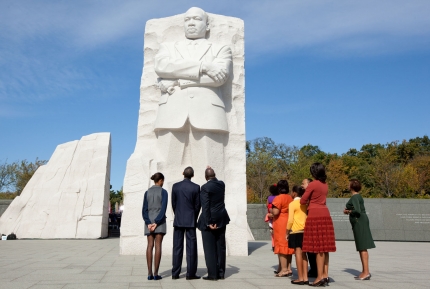
President Obama and the First Family tour the Martin Luther King Jr. National Memorial

President Barack Obama, First Lady Michelle Obama, daughters Sasha and Malia, and Marian Robinson tour the Martin Luther King Jr. National Memorial before the dedication ceremony in Washington, D.C., Sunday, Oct. 16, 2011. (Official White House Photo by Chuck Kennedy)

Today, nearly half a century after Martin Luther King, Jr. led the historic March on Washington for equality, tens of thousands came to the National Mall in Washington, D.C. for the Martin Luther King, Jr. Memorial Dedication. The memorial to Dr. King has been open since August, but the dedication was delayed due to Hurricane Irene. As President Obama said, though delayed, "this is a day that would not be denied."

President Obama, joined by the First Family, toured the memorial and then spoke at the dedication ceremony in honor of Dr. King's work to make his dream a reality for all. During his speech, President Obama reminded us that the progress towards Dr. King's vision has not come easily and there is still more to do to expand opportunity and make our nation more just:

Our work is not done.  And so on this day, in which we celebrate a man and a movement that did so much for this country, let us draw strength from those earlier struggles.  First and foremost, let us remember that change has never been quick.  Change has never been simple, or without controversy.  Change depends on persistence.  Change requires determination.  It took a full decade before the moral guidance of Brown v. Board of Education was translated into the enforcement measures of the Civil Rights Act and the Voting Rights Act, but those 10 long years did not lead Dr. King to give up.  He kept on pushing, he kept on speaking, he kept on marching until change finally came. 

And then when, even after the Civil Rights Act and the Voting Rights Act passed, African Americans still found themselves trapped in pockets of poverty across the country, Dr. King didn’t say those laws were a failure; he didn’t say this is too hard; he didn’t say, let’s settle for what we got and go home.  Instead he said, let’s take those victories and broaden our mission to achieve not just civil and political equality but also economic justice; let’s fight for a living wage and better schools and jobs for all who are willing to work.  In other words, when met with hardship, when confronting disappointment, Dr. King refused to accept what he called the “isness” of today.  He kept pushing towards the “oughtness” of tomorrow.

And so, as we think about all the work that we must do –- rebuilding an economy that can compete on a global stage, and fixing our schools so that every child -- not just some, but every child -- gets a world-class education, and making sure that our health care system is affordable and accessible to all, and that our economic system is one in which everybody gets a fair shake and everybody does their fair share, let us not be trapped by what is.  We can’t be discouraged by what is.  We’ve got to keep pushing for what ought to be, the America we ought to leave to our children, mindful that the hardships we face are nothing compared to those Dr. King and his fellow marchers faced 50 years ago, and that if we maintain our faith, in ourselves and in the possibilities of this nation, there is no challenge we cannot surmount.

Related Topics: Civil Rights, Economy, Service