The White House

Office of the Vice President

Readout of the Vice President's Call with Prime Minister Erdogan of Turkey

In the context of close U.S.-Turkish consultation on matters of mutual interest, Vice President Biden and Prime Minister Recep Tayyip Erdogan discussed regional issues, including political developments in Iraq, by telephone today.  Following up on their conversation during the Vice President’s trip to Turkey in December, the two leaders agreed on the need to advance security, support the rule of law and encourage democracy in the region. They agreed that our two governments would remain in regular contact on these issues.

The White House

Office of the Vice President

Readout of Vice President Biden's Calls to Iraqi Leaders

Vice President Biden spoke by phone today with Iraqi Prime Minister Nouri al-Maliki. The Vice President also spoke yesterday with Kurdistan Regional Government President Massoud Barzani. The Vice President offered condolences on the recent violence in Baghdad, exchanged views with both leaders on the current political climate in Iraq and reiterated our support for ongoing efforts to convene a dialogue among Iraqi political leaders.

The White House

Office of the Vice President

Vice President Biden Announces New Chairman for the Recovery Accountability and Transparency Board

WASHINGTON, D.C. --- Today, Vice President Biden announced that Kathleen S. Tighe will chair the Recovery Accountability and Transparency Board (RATB), replacing Earl Devaney, who will retire on December 31st, 2011. 

“Under Earl Devaney’s leadership, the Recovery Accountability and Transparency Board became a model for government oversight – ensuring that Recovery Act dollars were distributed efficiently and effectively across the country. He will be greatly missed,” said Vice President Biden. “I’m confident that Kathleen Tighe will continue to hold the board to the high standards set by Earl as the Recovery Act’s top watchdog.”

The Recovery Act, as implemented by the Recovery Board, was designed to provide transparency, accountability and a new vision of openness to allow the public to track how the program was being implemented.  In the RATB’s first years of operation, Chairman Devaney and the 12 Inspector Generals (IGs) who serve on the Board successfully delivered on that mission by creating two websites, FederalReporting.gov and Recovery.gov, that collect and post data showing how Recovery Act funds are being used, and by developing and deploying the Recovery Operations Center (ROC) and other oversight systems that have employed a team of dedicated data analysts and cutting-edge fraud detection tools to minimize waste, fraud, and abuse.

The RATB held its first meeting on March 27, 2009.  Since its inception, the Board has held 35 meetings.

Most of the Recovery dollars have now been disbursed and, under the Recovery Act, the Board will terminate operations on September 30, 2013.  Over the next 21 months, the priorities of the Board are to maintain ongoing prevention and detection of waste, fraud, and abuse by collaborating with agency IGs on audits and reviews of Recovery Act contracts, grants, and loans; oversee an orderly wind down of the RATB by September 30, 2013; and collaborate with the Government Accountability and  Transparency Board, which the President established by Executive Order on June 13, 2011, to ensure that the RATB’s data collection and transparency solutions and the investment in the ROC are captured and used more broadly across federal spending.   Kathleen Tighe is well positioned to lead the Board as it pursues these goals, and also continue her work providing oversight for the Department of Education as its Inspector General.

Official Biography of Kathleen S. Tighe - Inspector General, Department of Education

Kathleen Tighe currently serves on the Government Accountability and Transparency Board. On March 17, 2010, Ms. Tighe was sworn in as the Inspector General for the Department of Education. Prior to this, she was the Deputy Inspector General, United States Department of Agriculture. From 1995 to 2005, she served as Counsel to the Inspector General, General Services Administration and, before that, as an Assistant Counsel for the Office of Inspector General. From 1988 until 1991, she was a Trial Attorney with the Fraud Section of the Commercial Litigation Branch of the Department of Justice. Prior to her Government service, Ms. Tighe was in private practice.

Ms. Tighe has lectured frequently to both Government and industry groups. She has spoken at the Defense Procurement Fraud and Affirmative Civil Litigation conferences of the Department of Justice, at the Association of Directors of Investigation Conferences, before the Federal Law Enforcement Interagency Task Force, the Inspectors General Auditor Training Institute, the Federal Audit Executive Council, the Institute of Internal Auditors, American Bar Association groups, the Coalition for Government Procurement, and various other vendor organizations. Ms. Tighe is a member of the Public Contract Section of the American Bar Association and is a former Chair of the Council of Counsels to the Inspector General.

Ms. Tighe earned her law degree, with honors, from George Washington University (JD'83). She has a Master's degree in International Relations from American University (MA'79). She graduated, with distinction, from Purdue University (BA'76), where she was a member of Phi Beta Kappa.

The White House

Office of the Vice President

Readout of Vice President Biden's Calls to Iraqi Leaders

The Vice President today spoke on the phone with Iraqi Prime Minister Nouri al-Maliki and separately with Iraqi Council of Representatives Speaker Osama al-Nujaifi to discuss the current political climate in Baghdad. The Vice President told both leaders that the United States is monitoring events in Iraq closely.  He emphasized the United States’ commitment to a long-term strategic partnership with Iraq, our support for an inclusive partnership government and the importance of acting in a manner consistent with the rule of law and Iraq’s constitution. The Vice President also stressed the urgent need for the Prime Minister and the leaders of the other major blocs to meet and work through their differences together.
 

Homecoming for the Final U.S. Forces Iraq Troops

20111220 United States Forces-Iraq colors

President Barack Obama and Vice President Joe Biden greet Army Gen. Lloyd Austin III, Commanding General of U.S. Forces – Iraq, and deplaning troops during a ceremony marking the return of the U.S. Forces – Iraq Colors, and the end of the war in Iraq, at Joint Base Andrews, Md., Dec. 20, 2011. Greeters include from front left: Mrs. Deanie Dempsey, wife of Gen. Martin Dempsey; Gen. Martin Dempsey, Chairman of the Joint Chiefs of Staff; and Ashton B. Carter, Deputy Secretary of Defense. (Official White House Photo by Pete Souza)

Five days ago, Secretary of Defense Leon Panetta was on hand in Baghdad to bring the mission in Iraq to its official end. The United States Forces-Iraq colors were lowered and flown out of the country in the official casing ceremony.

Today, President Obama and Vice President Biden were there as the colors returned home.

They were joined by General Martin E. Dempsey, the Chairman of the Joint Chiefs of Staff and some of the families of the final returning service members from Iraq.

One of those the group welcomed home was General Lloyd Austin, III -- the final commander of the U.S. in Iraq.

General Austin spoke at the ceremony, thanking the soldiers, sailors, airmen, Marines, Coast Guardsmen, and civilians who served in the nearly nine year mission.

“I am truly humbled by your service and your many, many sacrifices,” he said.

The White House

Office of the Vice President

Readout of Vice President Biden's Calls to Iraqi Leaders

Vice President Biden spoke on the phone today with Kurdistan Regional Government President Masoud Barzani and Iraqi Council of Representatives Speaker Osama al-Nujaifi to mark the historic end of the U.S. war in Iraq and to discuss the recent visit of Iraqi Prime Minister Nouri al-Maliki to Washington. The leaders discussed the current political climate in Baghdad, and the Vice President reiterated the United States’ longstanding support for an inclusive partnership government in Iraq and for a long-term strategic partnership between our nations under the U.S.-Iraq Strategic Framework Agreement. The Vice President and President Barzani reaffirmed the longstanding friendship between the American and Kurdish people and discussed the Vice President’s recent visit to Turkey. The Vice President praised Speaker Nujaifi’s responsible stewardship of the Iraqi Council of Representatives.  

Vice President Biden Holds a Campaign to Cut Waste Cabinet Meeting

December 13, 2011 | 18:58 | Public Domain

Vice President Biden announces that $5.6 billion in fraud was recovered across the government in 2011, and discusses new initiatives to eliminate wasteful government spending, including suspending production of $1 coins and cracking down on prescription drug fraud and abuse.

Download mp4 (181MB) | mp3 (17MB)

Read the Transcript

Campaign to Cut Waste: Vice President Biden Announces U.S. will Halt Production of Excess Dollar Coins and Department of Justice Recovered a Record $5.6 billion in Fraud in 2011

Department of Health and Human Services Takes New Steps to Prevent Medicare Fraud

As part of the Obama Administration’s Campaign to Cut Waste, Vice President Biden today announced the U.S. Mint would suspend the production of Presidential dollar coins for circulation. Today, nearly 1.4 billion surplus dollar coins are sitting in Federal Reserve vaults due to lack of demand for the coins. By halting this unnecessary production, the Administration will save taxpayers at least $50 million per year in production and storage costs.  The Vice President made today’s announcement at a Cabinet meeting focused on the President’s commitment to cut waste and eliminate misspent dollars across the Federal government.

The Vice President also announced significant progress in cracking down on fraud, including that the Department of Justice recovered more than $5.6 billion in fraud government-wide in 2011, a 167 percent increase in recovery from 2008 and a new record, and that the Department of Health and Human Services will prevent Medicare fraud by telling prescription drug plans to withhold payment when they see signs of suspicious activity related to OxyContin, Percocet, and other narcotics and painkillers.

Vice President Biden said, “Today’s announcements, from putting an end to the wasteful production of Presidential dollar coins to recovering over $5 billion in fraud, demonstrate the Administration’s continued commitment to cutting waste and protecting taxpayers."

Halting Production of Excess Dollar Coins
The Vice President and Secretary Geithner announced the Administration’s plan to stop the wasteful production of $1 coins for circulation. In 2005, Congress enacted the Presidential $1 Coin Act, which mandated that the United States Mint issue new Presidential $1 Coins with the likeness of every deceased President.  But more than 40 percent of the $1 coins that the United States Mint has issued have been returned to the Federal Reserve, because nobody wants to use them.


As a result, nearly 1.4 billion excess dollar coins are already sitting unused in Federal Reserve Bank vaults – enough to meet demand for more than a decade.  But until today, the Mint was on pace to produce an additional 1.6 billion dollar coins through 2016.

To put a stop to this waste the Administration will halt the production of Presidential $1 Coins for circulation. The Administration will still be required, by law, to continue to produce a relatively small number of the coins to be sold to collectors, at no cost to taxpayers.  Instead of producing 70-80 million coins per President, the United States Mint will now only produce as many as collectors want. Regular circulating demand for $1 coins will be met through the Federal Reserve Banks' existing inventory, which will be drawn down over time. Overall, this step will save at least $50 million annually over the next several years.

“At the Treasury Department, we’re continuing to work hard in support of President Obama and Vice President Biden’s efforts to cut waste and streamline government,” said Treasury Secretary Tim Geithner. “Putting a stop to the minting of surplus $1 coins represents a significant opportunity to reduce costs and improve efficiency. In these tough times, Americans are making every dollar count, and they deserve the same from their government. We simply shouldn’t be wasting taxpayer money on money that taxpayers aren’t using.”

Cracking Down on Fraud
At the meeting, the Vice President and the Deputy Attorney General announced the Department of Justice (DOJ) recovered over $5.6 billion in total fraud in 2011, an increase of over 167% since 2008. This includes almost $3.4 billion in civil fraud, and over $2.2 billion in criminal fraud. For example, a company called American Grocers was buying expired (and, therefore, deeply discounted) food, altering the dates on the food, and selling the food at a steep markup to the government to serve to American troops serving in Iraq. The owner of the company was sentenced to 24 months in prison, and the Department of Justice reached a $15 million settlement with the company.

Of the $5.6 billion recovered by DOJ in 2011, over $2.9 billion was in health care fraud alone. This was driven in part by unprecedented cooperation between the Department of Justice and the Department of Health and Human Services to detect and halt fraud earlier.  Specifically, the Obama Administration has greatly expanded the use of Medicare Fraud Strike Forces, specialized teams of agents and prosecutors who focus on catching health care fraud. The teams monitor Medicare data in real time and work together to prosecute fraud much more quickly than before.  It now often takes months, not years, to bring a case to resolution. At the start of the Administration, there were two Strike Force teams. Now, there are Strike Force teams in nine different cities.  And they have been effective: in 2008, they brought cases involving $384 million in fraudulent claims. This year, they brought cases involving over $1 billion in fraudulent claims.  For every dollar spent on this effort, the Administration has recovered seven dollars.

The Department of Justice has also recovered $15 billion in total fraud since 2009. Some of this money has gone back to states, whistleblowers, or into strengthening important programs like Medicare and Medicaid.  Other funds have been returned to the Treasury for deficit reduction.  Of the $15 billion recovered since 2009, $8.4 billion was in health care fraud alone.

The Department of Justice also announced they doubled fraud recoveries between 2008 and 2011 in twenty-one states, the District of Columbia, and the Virgin Islands. This includes Alaska, Arkansas, Colorado, Florida, Georgia, Kansas, Massachusetts, Maryland, Michigan, Minnesota, Mississippi, Nevada, Ohio, Oklahoma, South Dakota, Tennessee, Virginia, Vermont, Washington, West Virginia, and Wisconsin, as well as the District of Columbia and the Virgin Islands.  In fact, 15 of these states quadrupled recoveries and 19 of these tripled recoveries. Click HERE to see the state by state numbers.

This increase in recovering fraud comes as the Administration is decreasing the amount of fraud that occurs in the first place.  Government-wide improper payment rates – which include fraudulent payments and other types of errors – were cut by 11 percent this year, keeping $18 billion in taxpayer funds from going to the wrong people or for the wrong purposes.

“All across the country, the Department of Justice continues to move aggressively to protect the American people from fraud.  In this past fiscal year, we recovered more money from fraudsters than ever before, over $5.6 billion,” said Deputy Attorney General James Cole. “These efforts not only send the message that those who commit fraud will be held to account, they also result in more dollars in the national treasury and demonstrate a high rate of return on the American taxpayers’ investment in the Justice Department.”

New Steps to Prevent Fraud with OxyContin, Percocet, and Other Prescription Drugs
As a next step in an aggressive campaign to crack down on Medicare fraud, the Department of Health and Human Services (HHS) will direct all Medicare prescription drug plans to use every tool at their disposal to prevent fraud. Patients sometimes “doctor shop,” visiting numerous doctors to get multiple prescriptions for OxyContin, Percocet, and other painkillers and narcotics.  In some cases, these medicines are abused by the patients. In others, patients sell the extra drugs.

OxyContin and Percocet abuse, prescription drug fraud, and so-called “doctor shopping” are major problems.  The Government Accountability Office recently reported that “170,000 Medicare beneficiaries received prescriptions from five or more” doctors for drugs that are frequently abused, like OxyContin and Percocet. 

While not all of these cases are fraudulent, some are. In 2008, for example, one Medicare beneficiary “received prescriptions for a total of 3,655 oxycodone pills [such as OxyContin]…from 58 different prescribers.” 

Today, HHS announced they have urged insurance companies to take every step possible to prevent such fraud. Specifically, HHS’ guidance tells prescription drug plans to withhold payment on suspicious claims, including when enrollees use multiple doctors to obtain painkillers and narcotics. Companies that offer prescription drug plans already process each of a patient’s prescriptions.  While HHS generally requires prompt payment, today’s guidance clarifies that if a plan sees signs of suspicious activity, it should withhold payment to pharmacies until it verifies the claim is valid. 

This guidance to prescription drug plans also explains how plans can use tools like prior authorization, retrospective medical review, and prescribing for less than 30 days (with the cooperation of prescribing practitioners) to root out fraud and ensure appropriate coverage in Medicare.

“Prescription drug misuse has a serious human and financial cost,” said Health and Human Services Secretary Kathleen Sebelius.  “The Obama Administration is making unprecedented strides in cracking down on fraud that contributes to this problem while costing taxpayers dollars.  With these actions, we are going to continue to stop fraud before it happens and make sure that those who do defraud taxpayers are held accountable.”

Close Transcript

The White House

Office of the Press Secretary

Campaign to Cut Waste: Vice President Biden Announces U.S. will Halt Production of Excess Dollar Coins and Department of Justice Recovered a Record $5.6 billion in Fraud in 2011

Department of Health and Human Services Takes New Steps to Prevent Medicare Fraud

As part of the Obama Administration’s Campaign to Cut Waste, Vice President Biden today announced the U.S. Mint would suspend the production of Presidential dollar coins for circulation. Today, nearly 1.4 billion surplus dollar coins are sitting in Federal Reserve vaults due to lack of demand for the coins. By halting this unnecessary production, the Administration will save taxpayers at least $50 million per year in production and storage costs.  The Vice President made today’s announcement at a Cabinet meeting focused on the President’s commitment to cut waste and eliminate misspent dollars across the Federal government.

The Vice President also announced significant progress in cracking down on fraud, including that the Department of Justice recovered more than $5.6 billion in fraud government-wide in 2011, a 167 percent increase in recovery from 2008 and a new record, and that the Department of Health and Human Services will prevent Medicare fraud by telling prescription drug plans to withhold payment when they see signs of suspicious activity related to OxyContin, Percocet, and other narcotics and painkillers.

Vice President Biden said, “Today’s announcements, from putting an end to the wasteful production of Presidential dollar coins to recovering over $5 billion in fraud, demonstrate the Administration’s continued commitment to cutting waste and protecting taxpayers."

Halting Production of Excess Dollar Coins
The Vice President and Secretary Geithner announced the Administration’s plan to stop the wasteful production of $1 coins for circulation. In 2005, Congress enacted the Presidential $1 Coin Act, which mandated that the United States Mint issue new Presidential $1 Coins with the likeness of every deceased President.  But more than 40 percent of the $1 coins that the United States Mint has issued have been returned to the Federal Reserve, because nobody wants to use them.


As a result, nearly 1.4 billion excess dollar coins are already sitting unused in Federal Reserve Bank vaults – enough to meet demand for more than a decade.  But until today, the Mint was on pace to produce an additional 1.6 billion dollar coins through 2016.

To put a stop to this waste the Administration will halt the production of Presidential $1 Coins for circulation. The Administration will still be required, by law, to continue to produce a relatively small number of the coins to be sold to collectors, at no cost to taxpayers.  Instead of producing 70-80 million coins per President, the United States Mint will now only produce as many as collectors want. Regular circulating demand for $1 coins will be met through the Federal Reserve Banks' existing inventory, which will be drawn down over time. Overall, this step will save at least $50 million annually over the next several years.

“At the Treasury Department, we’re continuing to work hard in support of President Obama and Vice President Biden’s efforts to cut waste and streamline government,” said Treasury Secretary Tim Geithner. “Putting a stop to the minting of surplus $1 coins represents a significant opportunity to reduce costs and improve efficiency. In these tough times, Americans are making every dollar count, and they deserve the same from their government. We simply shouldn’t be wasting taxpayer money on money that taxpayers aren’t using.”

Cracking Down on Fraud
At the meeting, the Vice President and the Deputy Attorney General announced the Department of Justice (DOJ) recovered over $5.6 billion in total fraud in 2011, an increase of over 167% since 2008. This includes almost $3.4 billion in civil fraud, and over $2.2 billion in criminal fraud. For example, a company called American Grocers was buying expired (and, therefore, deeply discounted) food, altering the dates on the food, and selling the food at a steep markup to the government to serve to American troops serving in Iraq. The owner of the company was sentenced to 24 months in prison, and the Department of Justice reached a $15 million settlement with the company.

Of the $5.6 billion recovered by DOJ in 2011, over $2.9 billion was in health care fraud alone. This was driven in part by unprecedented cooperation between the Department of Justice and the Department of Health and Human Services to detect and halt fraud earlier.  Specifically, the Obama Administration has greatly expanded the use of Medicare Fraud Strike Forces, specialized teams of agents and prosecutors who focus on catching health care fraud. The teams monitor Medicare data in real time and work together to prosecute fraud much more quickly than before.  It now often takes months, not years, to bring a case to resolution. At the start of the Administration, there were two Strike Force teams. Now, there are Strike Force teams in nine different cities.  And they have been effective: in 2008, they brought cases involving $384 million in fraudulent claims. This year, they brought cases involving over $1 billion in fraudulent claims.  For every dollar spent on this effort, the Administration has recovered seven dollars.

The Department of Justice has also recovered $15 billion in total fraud since 2009. Some of this money has gone back to states, whistleblowers, or into strengthening important programs like Medicare and Medicaid.  Other funds have been returned to the Treasury for deficit reduction.  Of the $15 billion recovered since 2009, $8.4 billion was in health care fraud alone.

The Department of Justice also announced they doubled fraud recoveries between 2008 and 2011 in twenty-one states, the District of Columbia, and the Virgin Islands. This includes Alaska, Arkansas, Colorado, Florida, Georgia, Kansas, Massachusetts, Maryland, Michigan, Minnesota, Mississippi, Nevada, Ohio, Oklahoma, South Dakota, Tennessee, Virginia, Vermont, Washington, West Virginia, and Wisconsin, as well as the District of Columbia and the Virgin Islands.  In fact, 15 of these states quadrupled recoveries and 19 of these tripled recoveries. Click HERE to see the state by state numbers.

This increase in recovering fraud comes as the Administration is decreasing the amount of fraud that occurs in the first place.  Government-wide improper payment rates – which include fraudulent payments and other types of errors – were cut by 11 percent this year, keeping $18 billion in taxpayer funds from going to the wrong people or for the wrong purposes.

“All across the country, the Department of Justice continues to move aggressively to protect the American people from fraud.  In this past fiscal year, we recovered more money from fraudsters than ever before, over $5.6 billion,” said Deputy Attorney General James Cole. “These efforts not only send the message that those who commit fraud will be held to account, they also result in more dollars in the national treasury and demonstrate a high rate of return on the American taxpayers’ investment in the Justice Department.”

New Steps to Prevent Fraud with OxyContin, Percocet, and Other Prescription Drugs
As a next step in an aggressive campaign to crack down on Medicare fraud, the Department of Health and Human Services (HHS) will direct all Medicare prescription drug plans to use every tool at their disposal to prevent fraud. Patients sometimes “doctor shop,” visiting numerous doctors to get multiple prescriptions for OxyContin, Percocet, and other painkillers and narcotics.  In some cases, these medicines are abused by the patients. In others, patients sell the extra drugs.

OxyContin and Percocet abuse, prescription drug fraud, and so-called “doctor shopping” are major problems.  The Government Accountability Office recently reported that “170,000 Medicare beneficiaries received prescriptions from five or more” doctors for drugs that are frequently abused, like OxyContin and Percocet. 

While not all of these cases are fraudulent, some are. In 2008, for example, one Medicare beneficiary “received prescriptions for a total of 3,655 oxycodone pills [such as OxyContin]…from 58 different prescribers.” 

Today, HHS announced they have urged insurance companies to take every step possible to prevent such fraud. Specifically, HHS’ guidance tells prescription drug plans to withhold payment on suspicious claims, including when enrollees use multiple doctors to obtain painkillers and narcotics. Companies that offer prescription drug plans already process each of a patient’s prescriptions.  While HHS generally requires prompt payment, today’s guidance clarifies that if a plan sees signs of suspicious activity, it should withhold payment to pharmacies until it verifies the claim is valid. 

This guidance to prescription drug plans also explains how plans can use tools like prior authorization, retrospective medical review, and prescribing for less than 30 days (with the cooperation of prescribing practitioners) to root out fraud and ensure appropriate coverage in Medicare.

“Prescription drug misuse has a serious human and financial cost,” said Health and Human Services Secretary Kathleen Sebelius.  “The Obama Administration is making unprecedented strides in cracking down on fraud that contributes to this problem while costing taxpayers dollars.  With these actions, we are going to continue to stop fraud before it happens and make sure that those who do defraud taxpayers are held accountable.”
Vice President Biden on College Affordability

December 09, 2011 | 27:09 | Public Domain

Vice President Joe Biden and Secretary of Education Arne Duncan visit Duncan Fletcher High School in Neptune Beach, Florida to discuss the steps the administration has taken to make college more affordable and the need for Colleges to keep costs lower so the next generation of Americans can outcompete the rest of the world.

Download mp4 (313.7MB)

A White House Hanukkah Celebration

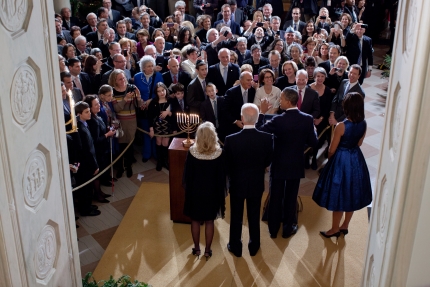
20111209 Hanukkah at the WH

President Barack Obama, with First Lady Michelle Obama, Vice President Joe Biden and Dr. Jill Biden, delivers remarks at a Hanukkah reception in the Grand Foyer of the White House, Dec. 8, 2011. (Official White House Photo by Pete Souza)

Officially, Hanukkah doesn't begin for another 11 days -- but last night, President Obama and First Lady Michelle Obama decided to kick things off a little early with a celebration of the holiday at the White House.

They were joined by Vice President Biden and Dr. Jill Biden. Supreme Court Justice Ruth Bader Ginsburg was in attendance, along with Israel's Ambassardor to the United States Michael Oren, the West Point Jewish Chapel Cadet Choir, and a large group of faith and community leaders.

Hanukkah, the President said, is "an opportunity to recognize the miracles in our own lives:"

Let’s honor the sacrifices our ancestors made so that we might be here today. Let’s think about those who are spending this holiday far away from home -– including members of our military who guard our freedom around the world. Let’s extend a hand to those who are in need, and allow the value of tikkun olam to guide our work this holiday season.

This is also a time to be grateful for our friendships, both with each other and between our nations. And that includes, of course, our unshakeable support and commitment to the security of the nation of Israel.

Watch.

Related Topics: Additional Issues