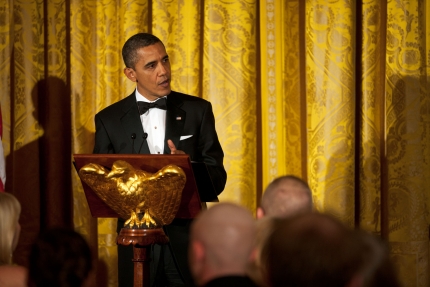
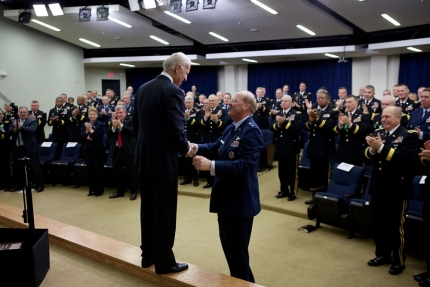
Vice President Biden interviews with Telemundo, Univisión, and CNN en Español

Vice President Biden interviewed with Telemundo, Univisión and CNN en Español this week after returning from a visit to Mexico and Honduras as part of the administration’s sustained, high-level engagement with the Americas. The Vice President’s visit comes in advance of the President’s participation in the Summit of the Americas this April in Colombia, which will focus on leveraging Hemispheric connections and partnerships to improve the lives of people throughout the region.

In addition to discussing his visit, the Vice President talked about the DREAM Act, immigration reform, and what it meant to him to visit the Basilica of Our Lady of Guadalupe – one of the most visited Roman Catholic sites in the world and the most holy Roman Catholic site in Mexico.  

Both Telemundo and Univision will air larger portions of the interview on their Sunday shows Enfoque and Al Punto so tune in, but here are clips of the interviews they have already run.

Take a look at the Vice President’s comments to Jose Diaz Balart from Telmundo: On the DREAM Act| On his visit to the Basilica

To see the Vice President’s interview with CNN en Español: Click Here

For an excerpt of the Vice President’s comments to Maria Elena Salinas from Univisión: Click Here

To read more about the Vice President’s trip to Mexico and Honduras Click Here, and for a blog post on his visit to the Basilica of Our Lady of Guadalupe Click Here. See a slideshow of the Vice President's triphere.

And don’t forget to tune in on Sunday!

Luis Miranda is White House Director of Hispanic Media

The White House

Office of the Vice President

Statement by the Vice President on the One Year Anniversary of 3/11 in Japan

On Sunday we will mark the first anniversary of the terrible disaster that shook an island, surged an ocean and cracked a reactor in the Tohoku region of Japan.  As we remember the nearly 16,000 lives that were lost and the 3,000 still missing, we also honor the Japanese people, who over the past year have reminded the world that the human spirit is as formidable as the forces of nature, particularly when we join together in trying times.

I had the privilege of visiting Japan five months after the March 11 earthquake and tsunami.  The survivors I met in Natori and Sendai made clear to me that the disaster met its match in the resilience and fortitude of the Japanese people.  While struck by the scale of the devastation, I also witnessed remarkable and inspiring progress in rebuilding homes, schools, and workplaces. 

The American people were proud and honored to assist Japan, just as Japan has done for countless others around the world, in their times of need.  Within hours of the disaster, we launched an unprecedented civilian and military relief effort – Operation Tomodachi.  In Sendai, I visited an airport that had been flooded and later became a home to more than 1,000 weary survivors with nowhere else to go.  A week after the tsunami, Japanese and American forces reopened a runway, allowing the arrival of hundreds of relief workers and more than two million tons of humanitarian supplies. 

We are proud to have continued our support over the past year. As Japan rebuilds, America will stand with them as long as it takes.  We join the Japanese people today in honoring the memories of those lost as they continue to work for a better future.

Talking American Manufacturing at Iowa State University

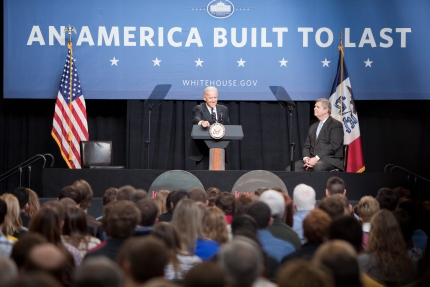
Vice President Joe Biden and Secretary of Agriculture Tom Vilsack at Iowa State University

Vice President Joe Biden and Secretary of Agriculture Tom Vilsack make remarks on American manufacturing and innovation at Iowa State University, Des Moines, Iowa, March 1, 2012. (Official White House Photo by David Lienemann)

Last Friday, Vice President traveled to Ames, Iowa to talk about the importance of strengthening the American manufacturing sector at Iowa State University’s College of Engineering.  Speaking to hundreds of students and faculty, the Vice President argued that manufacturing jobs are coming back to the United States and talked about the reasons that manufacturing matters—not just to people who might one day work in manufacturing like the engineering students at Iowa State, but to the entire U.S. economy and to the American middle class

The Vice President described how between America’s unique economic advantages and the rising costs of doing business in countries like China, more and more companies are choosing to bring jobs back to the America. 

He also emphasized that our skilled workers and engineers—like those trained at Iowa State and other leading American universities—are one of our greatest economic assets. The unique environment at America’s research universities equips students not only with strong technical skills, but with an unmatched capacity for innovation.  

“Here at Iowa State and every university in America,” the Vice President said, “you understand that change only comes through challenging orthodoxy, challenging the established norm, challenging the system that you’re working on ...  And that’s the environment where the next generation of great ideas is going to come from.” 

Vice President Biden Travels to Mexico and Honduras

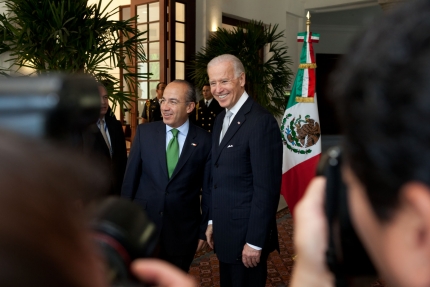
Vice President Joe Biden Greets Mexican President Felipe Calderon

Vice President Joe Biden greets Mexican President Felipe Calderon at Los Pinos in Mexico City, Mexico, March 5, 2012. (Official White House Photo by David Lienemann)

This week, Vice President Biden traveled to Mexico and Honduras as part of the administration’s sustained, high-level engagement with the Americas. The Vice President’s visit comes in advance of the President’s participation in the Summit of the Americas this April in Colombia, which will focus on leveraging Hemispheric connections and partnerships to improve the lives of people throughout the region.

On Monday, Vice President Biden met with President Calderon at Los Pinos, the Presidential Palace in Mexico City. On the agenda was the close U.S.-Mexico partnership including a wide range of economic and security issues related to a shared border that sees more than a million legal crossings and more than $1 billion in trade every day.

While in Mexico City, Vice President Biden also met with presidential candidates from the country’s three major political parties – Andrés Manuel López Obrador of the Party of the Democratic Revolution, Enrique Peña Nieto, of the Institutional Revolutionary Party and Josefina Vázquez Mota of the National Action Party. He learned about each candidate’s vision for Mexico, as well as the future of the U.S.-Mexico relationship, but also expressed that he and President Obama look forward to working with whomever the people of Mexico elect.

Amy Dudley is the Deputy Press Secretary for the Vice President

The White House

Office of the Vice President

Joint Statement to the Press by Vice President Joe Biden and Honduran President Porfirio Lobo Sosa

Presidential Palace
Tegucigalpa, Honduras

4:45 P.M. CST

PRESIDENT LOBO SOSA:  [As interpreted by Government of Honduras interpreter] Good afternoon, ladies and gentlemen of the national and international press and the media.  It’s a true honor for us that today we count with the attendance of Vice President Joe Biden.  Welcome to the Republic of Honduras, sir.  (Applause.) 

Likewise, it’s a true pleasure to receive the Presidents Otto Peréz Molina of Guatemala, Mauricio Funes of El Salvador, Daniel Ortega of Nicaragua, Laura Chinchilla of Costa Rica, Ricardo Martinelli of Panama, and Chancellor Carlos Morales Troncoso on behalf of the President Leonel Fernéndez of the Dominican Republic. 

We held a joint meeting, the presidents of the Central American Integration System, SICA, together with Vice President Biden.  It’s been a fairly -- a meeting concentrated in citizen security and how to continue our endeavors, efforts between the people and country of the United States of America and the peoples and governments of Central America on the struggle against organized crime and drug traffic. 

We are doing our best efforts and also using the best collaboration efforts from the people and government of the United States.  Vice President Biden, it’s a true honor for us, and to President Barack Obama, please mention that we count with your eternal friendship and the support of brotherly country.  And you’re accompanying us in this struggle that we need so much in order to generate spaces that are in our interest as we have lots of poverty that is the scourge of our country.  So, thank you for attending, being here with us.  Thank you.

VICE PRESIDENT BIDEN:  Mr. President, it’s an honor -- it’s a genuine honor to be here.  I appreciate President Lobo hosting me today and hosting our colleagues across the region.  And the leader of the Senate is here, Congress is here.  I thank you, Mr. President. 

And to the Vice Presidents, I thank you.  Madam Vice President, thank you for traveling an hour and a half to meet my aircraft.  The hospitality was much appreciated.         

The United States and Honduras have had a long and close partnership, and we reaffirmed that today.  The President and I discussed a wide range of topics, especially security and economic development.  We understand the grave threats of narcotrafficking and the gang violence, and the threat it poses to the people of Honduras, but quite frankly to the entire region as well as to my country.  And the United States is absolutely committed to continuing to work with Honduras to win this battle against the narcotraffickers.

One important area in which we can hopefully be of help -- and their legislature is already leading down here -- is in vetting the police, the prosecutors, and the judges.  My experience has been, and the experience of all of us is, that the people of a country have to be able to have confidence in the integrity of each of those institutions if progress is going to be made.  

I was pleased to meet with the presidents of the Central American countries to discuss the upcoming summit, the Summit of the Americas, and a wide range of regional issues.  I held a similar meeting in Costa Rica in 2009, March of 2009, immediately after President Obama and I were sworn into office.  And although many of the faces have changed around the table as new leaders have been elected, our common interests have not and the fundamental agenda has not changed.  

Security was an important part of our discussion in 2009, when President Obama and I came to office.  And we underscored, again, our commitment to work to build a safer future for the citizens of this region.  Last March, in El Salvador, President Obama announced the Central American Citizen Security Partnership, which recognizes that a secure and prosperous Central America is in the interest of all our people -- and I mean all of our people, including the United States.

To meet our shared responsibility -- and it is shared, because the United States has responsibility as well -- we help and are acting on multiple fronts.  Despite the significant recession we inherited and our difficult budget situation, we are sustaining support for the Central American Regional Security Initiative, through which we have dedicated $361 million since 2008.  And we're asking our Congress for another $107 million next year.  At home, in the United States, we're investing to reduce the demand for illegal drugs and to cut the illicit flow of money and weapons that contribute to crime and violence in the region.  It is our responsibility.

No one country can defeat transnational crime alone.  And we will continue to encourage increased collaboration among the Central American countries, as well as with the Group of Friends of Central America.  Not only are we committed to maintaining the financial support we've pledged, but we are working as hard as we can to get the Friends of Central America to increase and keep their commitments because it is a significant problem.  The indispensable ingredient comes, of course, from Central America itself in the form of action by governments, civil society, as well as the private sector.

And I applaud the leaders here today for the key steps that they have taken to tackle their security challenges.  To deepen our partnership, I proposed that our governments -- the same governments that met here today -- that our governments hold an annual high-level meeting to assess the progress we are making toward improving the security of our citizenry.  I asked my colleagues to take that under consideration, because we believe we should all be held accountable and all account for the progress we are making and what needs to be done beyond.

The ties that bind the United States and Central America are broad and they are deep.  That’s why we also focused on the importance of economic opportunity, social inclusion, respect for human rights and the rule of law.  The United States is committed, not merely because we gave our word, because it is in our own interest as well to help the region develop more prosperous and more inclusive societies.  Our trade and our economic cooperation through CAFTA-DR -- the CAFTA-DR agreement has helped advance trade in both directions and will help fuel sustainable and widely-shared economic growth.

We must give particular attention, in our view, to educating today’s young people so that they are equipped to compete in the challenging environment of the 21st century, the much larger market place.  To that end, as one example, the United States and the partners in the region -- including governments, universities, and the private sector -- are expanding international study opportunities under President Obama’s 100,000 Strong in the Americas Initiative.  Increased exchanges of our students will bring together the best and the brightest young thinkers in Central America and the United States to jointly confront the challenges which we face today as well as tomorrow.

And again, Mr. President, President Lobo, I thank you and my fellow leaders in Central America for this opportunity to discuss a broad range of issues relating to our partnerships and to work that I know the President is -- President Obama is interested in pursuing and looks forward to continuing at the Summit of the Americas next month.

It has been a pleasure being with you.  I truly appreciate your hospitality and I'm sure we're going to continue to make progress.

END             
4:54 P.M. CST

Vice President Biden Visits the Basilica of Our Lady of Guadalupe in Mexico City

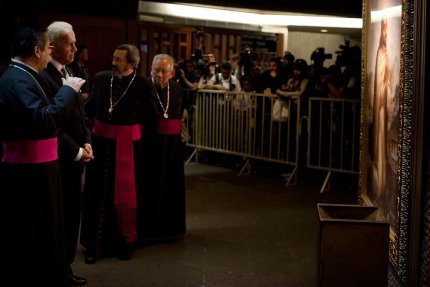
Vice President Biden with Clergy at the Basilica of Our Lady Guadalupe in Mexico City

Vice President Joe Biden with clergy during his visit to the Basilica of Our Lady of Guadalupe, in Mexico City, Mexico, March 5, 2012. (Official White House Photo by David Lienemann)

Capping his day of official activities in Mexico City yesterday, Vice President Biden visited the Basilica of Our Lady of Guadalupe – one of the most visited Roman Catholic sites in the world and the most holy Roman Catholic site in Mexico.  

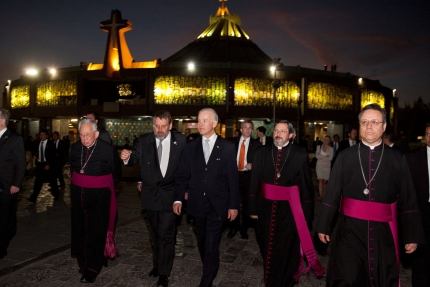
After touring and saying a prayer at the shrine of the Virgin of Guadalupe, the Vice President crossed the Basilica square to visit the Antigua Parrogquia de Los Indios (Old Church of the Indians). Calling the site a “great treasure,” Vice President Biden remarked that he would have come to Mexico City if only just to see the Basilica.

Vice President Biden Visits the Basilica of Our Lady Guadalupe in Mexico City

Vice President Joe Biden visits the Basilica of Our Lady of Guadalupe, in Mexico City, Mexico, March 5, 2012. (Official White House Photo by David Lienemann)

Amy Dudley is Deputy Press Secretary for the Vice President

The White House

Office of the Vice President

Vice President Biden, Administration Officials Welcome Clarification of Countervailing Duty Law

Administration Urged Congress to Act on Behalf of U.S. Businesses, Workers

Washington, D.C. Vice President Biden, along with U.S. Trade Representative Ron Kirk and U.S. Department of Commerce Secretary John Bryson, today welcomed congressional passage of legislation clarifying the Department of Commerce’s ability to apply countervailing duties (CVDs) on subsidized imports from non-market economies, including China.

“By passing this law, Congress has taken a clear stand against the unfair trade practices that have put countless American jobs in jeopardy,” said Vice President Biden. “We will continue to use every available tool to make sure America’s trading partners play by the rules, because when they do, U.S. businesses and workers can fairly compete – and out-compete anyone.”

“This law will make clear in no uncertain terms the rights that America’s businesses and workers have when their jobs are threatened by unfairly subsidized imports from countries like China,” said Ambassador Kirk.  “We’re pleased that access to appropriate trade remedies will be ensured.”

“The action taken by Congress today is a significant win for American businesses and workers,” said Secretary Bryson.  “The passage of this legislation will prevent more than 80 companies, both large and small, from across 38 states and employing tens of thousands of manufacturing workers, from being harmed by unfair trade subsidies.  I truly appreciate the leadership in both the House and the Senate for working with us to ensure that the Commerce Department maintains this critical tool to protect American businesses from subsidized imports, so that they can build things here and sell them everywhere.”

In December 2011, the Court of Appeals for the Federal Circuit (CAFC) found, in GPX v. United States, that U.S. law prohibits the Department of Commerce from applying CVDs to NMEs, including China.  This legislation overturns that decision.

The White House

Office of the Vice President

Conference Call Briefing on the Vice President's Upcoming Travel to Mexico and Honduras

Via Conference Call

4:22 P.M. EST

MS. BARKOFF:  Thank you and thanks for everyone for joining the call today.  Our hope is to provide you all with a more detailed sense of the Vice President’s schedule and goals during his upcoming trip to Mexico and Honduras.  Today we have Deputy Assistant to the President and National Security Advisor to the Vice President Tony Blinken, and Special Assistant to the President and Senior Director for Western Hemisphere Affairs Dan Restrepo. 

This call will be on the record and our speakers are happy to take questions after they give some opening remarks.  I also wanted to let folks know that since Dan is here, he will be able to answer questions in Spanish. 

We’d like to keep this call as focused on the Vice President’s trip as much as possible and I also wanted to remind folks of one question per reporter. 

So with that, I’m just going to go ahead and turn it over to Tony.

MR. BLINKEN:  Kendra, thanks very much.  Thanks, everyone, for being on the call. 

This trip is the latest chapter in the administration’s sustained, high-level engagement with our partners in the Americas.  The economic security, familial, historic and cultural ties we share with the Americas and particularly with Mexico and Central America, are among the most consequential we have as a country. 

I think as many of you know, this will be the Vice President’s second trip as Vice President to the region.  He made a similar trip in March, 2009, to Chile and Costa Rica, in anticipation of President Obama’s participation in the Summit of the Americas in April, 2009, in Trinidad and Tobago.  But let me just highlight briefly some of the main purposes of the trip and its two stops, first in Mexico and then in Honduras. 

We leave Washington on Sunday night to go to Mexico and we’ll be spending all day Monday there.  In Mexico, the Vice President will meet with Mexican President Felipe Calderón.  They will review the full range of economic, security, regional and global issues that we work on with Mexico each and every day.  And they’ll do that in the spirit of equal partnership, mutual respect and shared responsibility. 

The ongoing challenge posed by the drug cartels and transnational criminal organizations is one critical shared responsibility.  We strongly support Mexico’s efforts in dealing with this challenge, and the United States and Mexico are collaborating as never before. 

But it’s also important to keep focus on the central role our economic relationship plays in the prosperity of both countries:  One million legal border crossings and $1 billion in trade every single day.  So the two leaders will discuss our agenda to carry this economic relationship forward to the benefit of people in both countries. 

I’ve got to say the President and Vice President have tremendous respect for President Calderón and for his work as President of Mexico.  And as you know, beyond the strong relationship between the President and the Vice President, we maintain regular dialogue at all levels with the government of Mexico.

While we're in Mexico, the Vice President will also sit down with each of Mexico's three major party presidential candidates -- in alphabetical order, I might add -- to reaffirm the United States' commitment to respecting Mexico's democratic process in a totally impartial manner.  He looks very much forward to hearing from each of the candidates their views on the issues most important in Mexico and to Mexicans, and to the future of the bilateral relationship.

He'll underscore to each that the United States will continuing working with President Calderón and his administration until the final day that they're in office, and that we look very much forward to working with whomever the Mexican people elect as their next President.

That carries us through Monday.  On Tuesday, in the morning, we go to Honduras, where the Vice President will first meet with President Lobo.  The meeting there provides an opportunity to reaffirm the United States' strong support for the tremendous leadership President Lobo has displayed in advancing national reconciliation and democratic and constitutional order.

Following the meeting with President Lobo there will be a working lunch with leaders from across Central America, including the Presidents of Honduras, Guatemala, El Salvador, Costa Rica, and Panama.  And at that lunch, the Vice President will have an opportunity to discuss issues of principal concern to these leaders and to their people, reaffirm the U.S. commitment to working in partnership with the countries and people of Central America, and look ahead to President Obama’s participation in the upcoming Summit of the Americas. 

I know the Vice President is going to want to talk about the important contributions Central Americans make to the United States every single day, and I expect there will be a focus on citizen security.  As you all know, crime and violence poses a profound challenge in the region.  Its leaders are taking ownership of the problem, passing critical legislation, devoting more resources to security, and strengthening regional collaboration.  The United States is committed to supporting these efforts, and we will discuss ideas for strengthening our partnership with one clear goal -- improving people’s lives.

With that, let me end our comments and turn it over to all of you for questions for me and for Dan Restrepo, who is here with me.  Thanks very much.

Q    I just wanted to know if the topic of femicide will be discussed at all during his time in Mexico or Honduras.

MR. BLINKEN:  I’m sorry, could you repeat that?  We had trouble hearing you.  What was the --

Q    If the topic of femicide will be at all discussed during his time in Mexico or, more importantly, Honduras.

MR. RESTREPO:  This is Dan Restrepo.  I think the kind of full range of issues in terms of crime and violence in the region will be part of the agenda on both stops -- in all of the Vice President’s meetings with President Calderón, presumably with the candidates, and with President Lobo and the Presidents of Central America. 

So we envision discussing, again, the kind of full range of how we can work in partnership more effectively to make all folks safer in their daily lives, as they go about their daily business, and how the United States can be a responsible and effective partner in advancing those undertakings.

Q    Does that include that topic, though?

MS. BARKOFF:  I’m sorry, if folks could identify what news outlets they’re from as well, and we’ll move on to the next question.

Q    So just to confirm, the meeting in Honduras, can you confirm the date and time again of that meeting?  And the Central American Presidents -- Costa Rica, El Salvador, Panama, is it Guatemala there as well?  And at that meeting, I mean, the issues been raised of a change in drug policy by the Guatemalan President.  Is that something on the agenda at all -- questioning of the current strategy of prohibition and of attacking drug producers at all levels in Central America and Mexico, is that going to be on the agenda at all, questioning that policy?   

MR. BLINKEN:  Just quickly, on the logistics, that meeting is on Tuesday, this coming Tuesday.  And the President of Guatemala will be there.  Dan, do you want to add to that?

MR. RESTREPO:  And again, as Tony described at the top, we fully anticipate having a robust conversation about citizen security in all its aspects in Central America, and the partnership of the United States with the countries of Central America. 

The Obama administration has been quite clear in our opposition to decriminalization or legalization of illicit drugs.  At the same time, we've also been very open -- the President has said it on numerous occasions, in meetings with leaders and publicly -- of our willingness, our interest, in engaging in a robust dialogue with our partners to determine how we can be most effective in confronting the transnational criminal organizations, and, as in the case in Central America, the gangs that are adversely affecting people's daily lives and daily routines.

So this meeting, this trip is part of that ongoing dialogue.  And we fully anticipate that the leaders of Central America, as they have done on other occasions, will raise a full spectrum of issues with regard to citizen security and their views on how we can all move forward together more effectively.

Q    Thank you for doing the call.  Mr. Blinken, if you can elaborate a little bit more about why (inaudible) -- the presidential candidates.

MR. BLINKEN:  I'm not sure that I -- I apologize, I'm not sure that I heard your question clearly.  But if it regards the meetings with the presidential candidates in Mexico, which is what I understood, the purpose is really twofold.  It's to hear from them their vision for the relationship with the United States, but also and particularly, their vision for how they would lead the country and the concerns that they see the Mexican people having.  And it's also to reaffirm to them the commitment of the United States to work closely with whomever Mexico elects in the presidential contest.

Q    My question is about the meeting that we saw last year in June, in Guatemala City, where the focus was security.  At the time, lots of promises were made about improving the situation, and I was just wondering if you can tell us, since then, in the 9 months since then, what do you think has been the most important achievements, and have things gotten better or have they gotten worse in Central America.

MR. RESTREPO:  Dan Restrepo again.  The meeting in Guatemala that you referred to, the "Group of Friends" meeting with the Central American Integration System, or SICA, to unveil a citizen security strategy pulled together by the countries of Central America was a very important forward.  The seven countries of SICA came together to determine the path forward to deal with a set of challenges that transcend any national boundaries in the region was, again, an important step, and one that -- the United States played and continues to play an important role in rallying international support to the implementation of that security strategy.

The Central American countries in the past few weeks have identified eight priority projects from the SICA strategy that will be -- implementation would start here probably in the month of April.  We have continued to shape our assistance through the Central America Regional Security Initiative -- CARSI -- to support the goals and objectives of the strategy of the Central Americans themselves. 

We've also continued to work, for example, with our partners from Colombia, who have become a very significant exporter of security to Central America -- work to ensure, for example, in the last few weeks, the head of the National Police of Colombia traveled to Guatemala as part of the new Guatemalan government's effort to revamp the national security strategy in that country to ensure that it is facing what we all recognize to be a growing challenge in the region.  Levels of crime and violence, as you know, continue to rise in most countries.  Guatemala --the levels of violence actually in the last year seemed to have begun to decline. 

So it's a case-by-case, country-by-country situation in terms of improvements or added challenges.  But this is an ongoing process.  We also have, as you're aware, out of the Joint Interagency Task Force -- which is an interagency U.S. government law enforcement run out of Key West, an operation underway at the moment called Operation Martillo, to push traffickers away from the coastal waters of Central America.  That, too, is in support of the Citizen Security strategy that the Central Americans laid out back in June at the Guatemala conference.

So each and every day, we are working in ways to bring new partners to the table and to make sure we are bringing U.S. government resources -- both foreign assistance resources, but other aspects of the U.S. government to support the efforts of our Central American partners to make the daily lives of the people -- to make folks more secure in their daily lives in Central America.

Q    Good afternoon.  In the last years, we have seen an amazing level of cooperation -- military cooperation between the United States and Mexico.  We're seeing the U.S. providing a lot of security and intelligence information to the Mexican military forces.  And I would like if Vice President Biden is going to talk also about security -- if somebody from the Security Cabinet is traveling with him, and if he is going to meet with the Secretary of Defense of Mexico or some other military authorities.

MR. RESTREPO:  This is Dan Restrepo.  I think the right way to characterize our cooperation with Mexico over the last three years, certainly during the Obama administration, has been a whole-of-government to whole-of-government support for security efforts in Mexico; that all aspects of the U.S. government -- through the State Department, through the U.S. Agency for International Development, our law enforcement community and, very much in a supporting role, our colleagues in the Department of Defense, have been supporting the effort of Mexico, be it the federal police -- the SSP, be it in their law enforcement capacity, the forces from SEDENA or SEMAR in Mexico.

So this has been very much in a supporting role.  Again, it's very important to remember that enforcement activities in Mexico are undertaken by Mexico, not by the United States.  Our role is to support their efforts, to share information, to help train, through the Merida Initiative, to provide state-of-the-art equipment and mobility -- all things that allow the Mexicans and Mexican security forces to confront transnational criminal organizations that have created the violence and crime in Mexico that we have seen over the course of the last several years.

The Vice President, in terms of his meeting with the government of Mexico, will meet with President Calderón.  As to who will accompany President Calderón during that meeting, I would direct you to the government of Mexico for who will be with President Calderón in that meeting.

Q    Thank you.  A few weeks ago, Senator McCain suggested that at least one of Mexico's presidential candidates would negotiate with the drug cartels in Mexico.  In that regard, is Vice President Biden focusing on any particular candidates?

MR. RESTREPO:  I'm not going to comment upon Senator McCain's comments.  I would direct you to Senator McCain for further comment there.  As Tony has made clear, by sitting down with the three presidential -- the major party presidential candidates of Mexico to hear their views of the issues facing Mexico today and of the future of the U.S.-Mexico relationship, which, again, is one of our most important relationships in the world, the Vice President wants to send a very clear message that this administration is prepared to work with the next democratically elected leader of Mexico.  And as you know, that election will take place on July 1st, and a new Mexican government will take office on December 1st.

So that is very much the express purpose of sitting down and having this opportunity next Monday to meet with the three major party candidates in Mexico.

Q    (For Voice of America.)  Hello, good afternoon.  Thank you for taking my call.  Mr. Restrepo, can you tell us in Spanish the main purpose of the Vice President’s trip to Mexico and Honduras?

MR. RESTREPO:  (Answers in Spanish.)

For the rest of the folks, you all heard the question, and the answer was the same one you’ve been hearing from me and from Tony in English in terms of what the major goals and objectives are on each of the stops.

Q    Thank you very much.  What is the main worry for the U.S. regarding security in Mexico, regarding the strength of drug cartels?  What’s the main worry with regards President Calderón?  And finally, if you are going to discuss any mechanism to stop the flow of illicit money from the U.S. to Mexico.

MR. RESTREPO:  This is Dan again.  As has been the case from the onset of the Obama administration, the negative impact that transnational criminal organizations have on communities on both sides of our borders is our primary concern.  And how we can work more effectively in partnership with Mexico to confront and dismantle these organizations so that they pose less of a challenge in the daily lives of Americans and Mexicans has been and remains our primary objective in working these issues with the government of Mexico.

Part of that and part of fulfilling the shared responsibility of the United States in this is more effectively confronting the illicit finances that flow from the United States back to these transnational criminal organizations.  We have and we’ll continue to dedicate more resources to going after those illicit flows, to take away as best as possible the money that is fueling the crime and violence that is affecting, again, folks in Central America, in Mexico, and in communities in the United States.

MS. BARKOFF:  Thank you all. 

END
4:47 P.M. EST
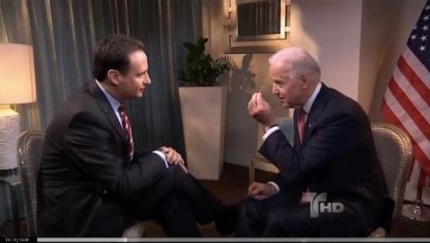
President Obama Honors Iraq Veterans at the White House

President Barack Obama delivers remarks at a dinner to honor Iraq War Veterans

President Barack Obama delivers remarks at a Department of Defense dinner in the East Room of the White House, Feb. 29, 2012. The President and Mrs. Obama hosted the dinner to honor Armed Forces who served in Operation Iraqi Freedom and Operation New Dawn, and to honor their families. (Official White House Photo by Lawrence Jackson)

President Obama, First Lady Michelle Obama, Vice President Joe Biden and Dr Jill Biden tonight welcomed a group of true American heroes to the White House. “A Nation’s Gratitude: Honoring those who served in Operation Iraqi Freedom and Operation New Dawn” was a formal dinner that paid tribute to our Iraq veterans and marked the end of the war.

More than 100 service members and their guests were in attendance, and the invitees included men and women in uniform from all ranks, each U.S. state and territory, and every branch of the Armed Forces. Together, they represented the million American troops who served in Iraq, and they also represented  what Vice President Joe Biden called the finest generation of warriors in all of history.

In his remarks, the President welcomed the veterans home, praised their bravery and dedication to their mission, and thanked them on behalf of more than 300 million Americans: 

Tonight, what we can do is convey what you’ve meant to the rest of us. Because through the dust and the din and the fog of war, the glory of your service always shone through. In your noble example, we see the virtues and the values that sustain America, that keep this country great.  

You taught us about duty. Blessed to live in the land of the free, you could have opted for an easier path. But you know that freedom is not free. And so you volunteered and you stepped forward, and you raised your hand and you took an oath -- to protect and defend; to serve a cause greater than yourself, knowing, in a time of war, you could be sent into harm’s way. 

You taught us about resolve. Invasion turned to insurgency and then sectarian strife. But you persevered, tour after tour, year after year.  Indeed, we’re mindful that even as we gather here, Iraq veterans continue to risk their lives in Afghanistan, and our prayers are with them all tonight.  

In one of our nation’s longest wars, you wrote one of the most extraordinary chapters in American military history. Now the Iraqi people have a chance to forge their own destiny, and every one of you who served there can take pride in knowing you gave the Iraqis this opportunity; that you succeeded in your mission.        

National Guard Adjutants General Visit the White House, Meet with Vice President Biden

VP Biden shakes hands with General McKinley during National Guard Adjutants General Visit to the White House

VP Biden shakes hands with General McKinley, Chief of the National Guard Bureau, after speaking to National Guard Adjutants General Meeting at the White House. February 29, 2012. (Official White House Photo by David Lienemann)

Today Vice President Biden spoke with the top ranking National Guard Officers from every state and territory to thank them for their service and discuss some of the most pressing challenges facing the Guard today.

At a White House meeting with National Guard Adjutants General from across the country, the Vice President talked about America’s place in the world three years into the Administration. From Iraq to Afghanistan, the Vice President discussed the progress made and the challenges still ahead. He said that nothing we’ve achieved in those countries would have been possible without the dedication and unparalleled service of our men and women in uniform.

“This 9/11 Generation is better than any generation of warriors we have ever produced in the history of the world,” he said. “I’m just in awe of the way all of you stepped up.”

And while thanking the Generals for their service, he also stressed that America’s commitment to its servicemembers can’t stop when they step off the battlefield. The Vice President promised that we won’t “yield one single solitary inch” on making sure that all of our veterans have “the care they need” and “the opportunities for jobs they deserve.”

Michael Flynn works in the Vice President’s Communications Office
Related Topics: Defense, Veterans