Honoring Dr. Maya Angelou

Dr. Maya Angelou, whose timeless works such as I Know Why the Caged Bird Sings encouraged and stirred the souls of millions of readers, passed away last week at the age of 86.

Dr. Angelou's family arranged a private memorial service in Wake Forest University’s Wait Chapel on Saturday, June 7, at 10 a.m. Eastern Time.

The First Lady, who has called Dr. Angelou one of her "she-roes" as well as a friend, spoke at the service.

You can watch Wake Forest University's video of the service below or read the First Lady's remarks here.

Related Topics: Faith Based, Working Families

The First Lady Announces the Mayors Challenge to End Veteran Homelessness

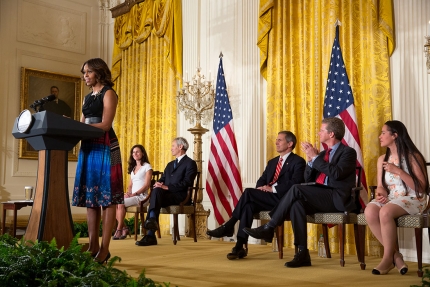
First Lady Michelle Obama speaks at event to announce the Mayors Challenge to End Veteran Homelessness

First Lady Michelle Obama speaks at event to announce, as part of the Joining Forces initiative, the Mayors Challenge to End Veteran Homelessness, in the East Room of the White House, June 4, 2014. (Official White House Photo by Amanda Lucidon)

Today, at the White House, First Lady Michelle Obama announced the Mayors Challenge to End Veteran Homelessness by 2015.

Joined by Secretary of Housing and Urban Development Shaun Donovan, Acting Secretary of Veterans Affairs Sloan Gibson, and Salt Lake City Mayor Ralph Becker, the First Lady announced the nationwide challenge, which already has the commitment of 77 mayors, 4 county commissioners, and 4 governors to help meet this goal.

Over the last three years, there has been a remarkable 24 percent decrease in homeless veterans, but with 58,000 homeless veterans across the nation, more still needs to be done. The Mayors Challenge will help us get there by involving federal, state, local and community organizations in this “eminently solvable problem.”

The First Lady Announces the Mayors Challenge to End Veteran Homelessness

June 04, 2014 | 35:27 | Public Domain

First Lady Michelle Obama announces a new program that aims to end veteran homelessness in the U.S. by 2015.

Download mp4 (1341MB) | mp3 (34MB)

Read the Transcript

Remarks by the First Lady Announcing Mayors Challenge to End Veterans Homelessness

East Room 1:49 P.M. EDT MRS. OBAMA: Thank you. (Applause.) Thank you so much, everyone. Thank you all. Well, welcome. Rest yourselves. Thank you so much. This is a good-news day, and I am honored to welcome everyone here to the White House. I want to start by thanking Chris. Let’s give Chris a round of applause for her courage. (Applause.) I look at Chris and I go she’s a baby. I mean, she served our country and she’s a baby. And Chris is also the face of veterans and the face of homelessness, which is why today is so important. And we are grateful that she could be here to share her story. We are proud of you, Chris, and proud of everything you’re going to do because we know you’re going to keep contributing. I also want to thank Secretary Donovan for his tremendous leadership at HUD, as well as Mayor Julian Castro, who we are confident will continue to build on the progress that we’ve been making. I also want to thank acting Secretary Sloan Gibson. Sloan and I have done some really good work together, and I am so happy he’s joining us and is going to keep doing great work. And we’re just grateful for his distinguished service to our country for so many years -- as well as Mayor Becker for doing such phenomenal work in Salt Lake City. I also want to recognize someone who doesn’t get a lot of attention, and that is Laura Zeilinger, who -- yes. (Applause.) Laura. Today is the first day I got to meet Laura, but her reputation precedes her. She is the Executive Director of the Interagency Council on Homelessness. So for many of the advancements we’ve made have, it’s been because of the Council’s work to streamline and coordinate our efforts across agencies. So I want to thank Laura and everyone from the Council for their outstanding leadership and service. And most of all, I want to thank all of you here today -– our guests, our mayors, our community leaders; the county and city, federal employees who work day in and day out to repay our debt to our veterans. Now, unfortunately, homelessness among our veterans is an issue that we’re all too familiar with. Sometimes we see these folks on our way to work or when we’re walking our kids home from school. We might pass them -- someone as we’re strolling through the park sitting on a bench and not even realize that he or she is a veteran. Maybe we say hello, offer to buy a sandwich, but often we just keep on going, rushing off to the next meeting, burying our heads into our smart phones. It’s not that we don’t care, it’s just that we think, well, there’s no way we’ll ever solve this problem, that’s just the way things go. But that kind of thinking starts to melt away when we better understand the stories of these veterans. The man who lost his arm in Vietnam, and when he and his wife’s medical bills kept piling up they lost their home. The Gulf War vet who injured her back and lost her job, and then her house, and spent months on the streets. The Army veteran from the Iraq War who survived cancer, but when she and her two kids were evicted from their home they had nowhere to go. These are just three stories. Altogether, roughly 58,000 veterans are experiencing homelessness in America today -– a number that, fortunately, has fallen sharply in the past few years. But whatever the number, these brave men and women have served this country with courage and grace. Some volunteered to serve; many others were drafted. They went off to faraway jungles and deserts and mountain regions; they saw their best friends fall in ambush, or because of a suicide bomb. Some of them were left wondering why they were the ones who survived. And after all that, too many of them have come home only to fight a new battle -– a battle to keep a roof over their head, a battle just to have somewhere to go when it rains. Now, I want to be very clear: The vast majority of our veterans return home in good health and good spirits. They go on to build good families, find good jobs. They keep serving this nation in their communities through their congregations and schools and neighborhoods. In fact, the percentage of veterans who are homeless today is actually just 0.3 percent of the total veteran population. But even one homeless veteran is a shame. (Applause.) And the fact that we have 58,000 is a moral outrage. We should all be horrified. (Applause.) Tens of thousands of veterans who risked their lives for our country are sleeping in their cars, or in a shelter, or next to a subway vent. We should be horrified because that’s not who we are as Americans. And so we can’t just throw up our hands and say that this problem is too big for us. Because the truth is, it’s not. When you break down the numbers, you see that those 58,000 homeless veterans are spread out across all of our cities and states. So even in some of our largest metropolitan areas, we’re often only talking about a few hundred people. For example, as of a year and a half ago, New Orleans had a total of 211 homeless veterans, and they’ve been driving that number down ever since. In Indianapolis, the most recent count of vets still out on the streets was 11. These numbers are still too high, because any number above zero is too much. And that’s why as President, my husband vowed to end this problem once and for all, and he’s -- absolutely. (Applause.) And he has directed record levels of funding toward helping homeless veterans, achieving historic success in getting our men and women in uniform into housing. Almost 90 percent of today’s homeless veterans served before 9/11, but this is the first time anyone has made this a government-wide priority. We’ve got HUD and the VA and the Interagency Council leading the way, and we’re also working with the Department of Health and Human Services, the Department of Labor and nonprofits and community leaders on the ground. We’ve cut through red tape and streamlined efforts across agencies, and together, we have made some extraordinary progress. For instance, Chris told you about those housing vouchers from HUD and the VA that helped her find a home. That program has existed since the early ‘90s, and up until 2008 it had housed a total of about 1,800 veterans. But this administration strengthened it to historic levels, and since 2008 the program has brought more than 73,000 veterans out of homelessness. (Applause.) And I’m not mathematician, but somebody did the numbers for me. (Laughter.) That means that in the last few years, more than 40 times as many veterans have been helped than during most of the program’s entire history. And the other program Chris mentioned, the Supportive Services for Veterans Families, the SSVF, is a new program started by this administration three years ago to prevent low-income veteran families from falling into homelessness. And last year alone, it served more than 60,000 veterans and their family members, and next year, we expect that number to grow to over 100,000. Yes. (Applause.) And as we all know, these programs are making a significant difference. Even during difficult economic times, veteran homelessness in America has dropped by 24 percent in just three years. So we’re beginning to make some real important progress on this issue. But we know that we are nowhere near finished. As I said before, any number above zero is way too high, and we still have tens of thousands of vets without a home. So we can’t rest, not even for a moment. And that’s why I am so thrilled and everyone in this building is so happy to announce a new effort called the Mayors Challenge to End Veteran Homelessness. We have got 77 mayors, four governors, four county officials on board already. These leaders -- yes, yes. (Applause.) These leaders are best equipped to tackle this challenge because they know their communities inside and out, and they’re in touch with service providers who know these veterans by name. So they aren’t just going to address veteran homelessness in their cities and states, they’re going to end it –- and they’re going to do it by the end of 2015. That is an audacious goal. (Applause.) It is an audacious goal, but it is achievable. It is absolutely achievable. We have seen incredible success at the local level already. As you heard, Mayor Becker, as well as his counterpart in Phoenix, Mayor Greg Stanton, they’ve already effectively ended chronic homelessness among veterans in their states. In New York, they’ve housed more than 2,000 veterans in the last year alone. Governor John Hickenlooper in Colorado has been making some incredible progress on this issue for almost a decade. And Governors Mark Dayton and Dan Malloy in Minnesota and Connecticut are also on board, as well. And we’ve got mayors like Chris Coleman from St. Paul, Minnesota, Mitch Landrieu from New Orleans, and Annise Parker from Houston. And all of these leaders are involved because this isn’t just the right thing to do for our veterans, it’s also the right thing to do for their budgets. Recent studies have shown that just one chronically homeless person can cost communities between $30,000 to $50,000 per year in emergency room visits, medical bills, and law enforcement. For some individuals, it can be even higher. But the cost to give someone a home of their own is only about $20,000. So this makes sense on so many different levels. And that’s why I want to applaud everyone who is already leading the way in this effort. And I also want to urge more leaders across the country to get involved, as well. We’ve got to get more people. I know how competitive our mayors can be. (Laughter.) I’ve seen it. That’s why I’m very excited, because you all -- guys like to beat each other and challenge each other. We saw it in Phoenix and Salt Lake City. So I want to know if more mayors can challenge each other on this issue. Can you challenge a neighboring mayor or governor to see who can get all their vets into housing first? That’s the kind of challenge -- can you challenge yourself to be the first to end veterans homelessness in the Midwest or in the South? Take a region, get it done. Can each of you get just one more mayor or one more governor to sign up? And this challenge isn’t just for mayors, governors, and county officials, but it’s for all of us –- for businesses and congregations and community organizations. And that’s where we hope Joining Forces can help. When Jill Biden and I started Joining Forces three years ago, one of the groups we were most concerned about was our homeless vets. But the truth is, we didn’t really know how to get started. But over the past few years, as we’ve seen federal and local efforts succeed, we’ve realized that this problem isn’t too big for us to tackle. So today, in addition to announcing this wonderful new effort, we are issuing a call to action to Americans all across the country to do their part to take this issue on. We’re asking all of you out there to volunteer your time to help these veterans navigate the system to find the resources they’ve earned. Maybe you can donate money from your business to pay a veteran’s security deposit. Maybe you can start a donation drive in your community to support efforts to get vets into housing. And if your mayor isn’t on board yet, light up their phone lines -- (laughter) -- write in to the newspaper. We all have power to make a real difference on this issue. We have the power to change lives here. You heard that from Chris. But we have another example. We have a wonderful man named Doran Hocker, who’s here with us today. Doran served in the Air Force for three years, including a deployment to Korea during the Vietnam War. Now, he never saw combat, but he saw more death and devastation than most of us ever will. So when he got back to the States, Doran says the first thing he did was kneel down on a patch of grass and kiss the ground. But in the months and years that followed, Doran just couldn’t shake the things he’d experienced. He started drinking more and isolated himself from his wife and his baby daughter. He ended up getting a divorce and falling in with the wrong people. And for almost three decades, Doran was homeless. As he says now, he says, “I tried to kill myself for 30 years, slowly.” He said, “It got so bad that people were throwing change at my feet in the streets.” And finally, Doran decided to turn his life around. He wrote down a list of 21 things he wanted to accomplish -– things like opening a bank account, cooking in his own kitchen. He moved from Detroit to St. Paul, Minnesota, and once he got there he walked across town to a local nonprofit that he knew could help him. With their help and the help of the Minnesota Assistance Council for Veterans, he got into housing and a substance abuse treatment program. And today, Doran has checked off all 21 items on that list. He’s cooking in his own kitchen -- Doran, please stand. (Applause.) A little cooking in the kitchen. (Laughter.) Paying his own rent. He even hugged his daughter who he’d been separated with for almost 25 years. And like so many of our veterans, Doran continues to give back. He is working full time as a caseworker to help other veterans find and sustain housing of their own. He’s dedicating his life to making sure that every veteran who comes home will never have to go through what he did. And here’s the thing -- that’s especially important now, because with our war in Iraq over and our war in Afghanistan drawing to a close, thousands of men and women who risked their lives for this country are transitioning back home. And we cannot make the same mistakes for this generation that we have had for the past generation. So that means we’ve got to move quickly. We’ve got to share best practices between cities. We’ve got to find every veteran like Chris and make sure that she doesn’t fall into homelessness in the first place. And we’ve got to reach out to every veteran from Doran’s generation and get them under a roof right this minute. We have made great progress over the past few years because of leaders like all of you who refuse to accept veteran homelessness as a fact of life. And now we have to finish the job once and for all, because when a veteran comes home kissing the ground, it is unacceptable that he should ever have to sleep on it. (Applause.) So just like it’s our country’s duty to bring back all of our men and women from the battlefield, we’ve also got a duty to make sure that every single veteran has a place to call home when they get here –- and for the rest of their lives. So thank you all. Thank you for this effort. Thank you for your courage. Thank you for all the work that so many of you have been doing on the ground long before we ever showed up. This means so much to these men and women and their families. It is truly a sign that they are coming home to a grateful nation, and I am proud to be a part of this effort. So let’s get to work. Thank you all. God bless. (Applause.) END 2:10 P.M. EDT

Close Transcript

The White House

Office of the First Lady

Remarks by the First Lady Announcing Mayors Challenge to End Veterans Homelessness

East Room

1:49 P.M. EDT

MRS. OBAMA: Thank you. (Applause.) Thank you so much, everyone. Thank you all. Well, welcome. Rest yourselves. Thank you so much. This is a good-news day, and I am honored to welcome everyone here to the White House.

I want to start by thanking Chris. Let’s give Chris a round of applause for her courage. (Applause.) I look at Chris and I go she’s a baby. I mean, she served our country and she’s a baby. And Chris is also the face of veterans and the face of homelessness, which is why today is so important. And we are grateful that she could be here to share her story. We are proud of you, Chris, and proud of everything you’re going to do because we know you’re going to keep contributing.

I also want to thank Secretary Donovan for his tremendous leadership at HUD, as well as Mayor Julian Castro, who we are confident will continue to build on the progress that we’ve been making. I also want to thank acting Secretary Sloan Gibson. Sloan and I have done some really good work together, and I am so happy he’s joining us and is going to keep doing great work. And we’re just grateful for his distinguished service to our country for so many years -- as well as Mayor Becker for doing such phenomenal work in Salt Lake City.

I also want to recognize someone who doesn’t get a lot of attention, and that is Laura Zeilinger, who -- yes. (Applause.) Laura. Today is the first day I got to meet Laura, but her reputation precedes her. She is the Executive Director of the Interagency Council on Homelessness. So for many of the advancements we’ve made have, it’s been because of the Council’s work to streamline and coordinate our efforts across agencies. So I want to thank Laura and everyone from the Council for their outstanding leadership and service.

And most of all, I want to thank all of you here today -– our guests, our mayors, our community leaders; the county and city, federal employees who work day in and day out to repay our debt to our veterans.

Now, unfortunately, homelessness among our veterans is an issue that we’re all too familiar with. Sometimes we see these folks on our way to work or when we’re walking our kids home from school. We might pass them -- someone as we’re strolling through the park sitting on a bench and not even realize that he or she is a veteran. Maybe we say hello, offer to buy a sandwich, but often we just keep on going, rushing off to the next meeting, burying our heads into our smart phones. It’s not that we don’t care, it’s just that we think, well, there’s no way we’ll ever solve this problem, that’s just the way things go.

But that kind of thinking starts to melt away when we better understand the stories of these veterans. The man who lost his arm in Vietnam, and when he and his wife’s medical bills kept piling up they lost their home. The Gulf War vet who injured her back and lost her job, and then her house, and spent months on the streets. The Army veteran from the Iraq War who survived cancer, but when she and her two kids were evicted from their home they had nowhere to go.

These are just three stories. Altogether, roughly 58,000 veterans are experiencing homelessness in America today -– a number that, fortunately, has fallen sharply in the past few years. But whatever the number, these brave men and women have served this country with courage and grace.

Some volunteered to serve; many others were drafted. They went off to faraway jungles and deserts and mountain regions; they saw their best friends fall in ambush, or because of a suicide bomb. Some of them were left wondering why they were the ones who survived. And after all that, too many of them have come home only to fight a new battle -– a battle to keep a roof over their head, a battle just to have somewhere to go when it rains.

Now, I want to be very clear: The vast majority of our veterans return home in good health and good spirits. They go on to build good families, find good jobs. They keep serving this nation in their communities through their congregations and schools and neighborhoods. In fact, the percentage of veterans who are homeless today is actually just 0.3 percent of the total veteran population.

But even one homeless veteran is a shame. (Applause.) And the fact that we have 58,000 is a moral outrage. We should all be horrified. (Applause.) Tens of thousands of veterans who risked their lives for our country are sleeping in their cars, or in a shelter, or next to a subway vent. We should be horrified because that’s not who we are as Americans.

And so we can’t just throw up our hands and say that this problem is too big for us. Because the truth is, it’s not. When you break down the numbers, you see that those 58,000 homeless veterans are spread out across all of our cities and states. So even in some of our largest metropolitan areas, we’re often only talking about a few hundred people.

For example, as of a year and a half ago, New Orleans had a total of 211 homeless veterans, and they’ve been driving that number down ever since. In Indianapolis, the most recent count of vets still out on the streets was 11. These numbers are still too high, because any number above zero is too much. And that’s why as President, my husband vowed to end this problem once and for all, and he’s -- absolutely. (Applause.) And he has directed record levels of funding toward helping homeless veterans, achieving historic success in getting our men and women in uniform into housing.

Almost 90 percent of today’s homeless veterans served before 9/11, but this is the first time anyone has made this a government-wide priority. We’ve got HUD and the VA and the Interagency Council leading the way, and we’re also working with the Department of Health and Human Services, the Department of Labor and nonprofits and community leaders on the ground. We’ve cut through red tape and streamlined efforts across agencies, and together, we have made some extraordinary progress.

For instance, Chris told you about those housing vouchers from HUD and the VA that helped her find a home. That program has existed since the early ‘90s, and up until 2008 it had housed a total of about 1,800 veterans. But this administration strengthened it to historic levels, and since 2008 the program has brought more than 73,000 veterans out of homelessness. (Applause.) And I’m not mathematician, but somebody did the numbers for me. (Laughter.) That means that in the last few years, more than 40 times as many veterans have been helped than during most of the program’s entire history.

And the other program Chris mentioned, the Supportive Services for Veterans Families, the SSVF, is a new program started by this administration three years ago to prevent low-income veteran families from falling into homelessness. And last year alone, it served more than 60,000 veterans and their family members, and next year, we expect that number to grow to over 100,000. Yes. (Applause.) And as we all know, these programs are making a significant difference. Even during difficult economic times, veteran homelessness in America has dropped by 24 percent in just three years.

So we’re beginning to make some real important progress on this issue. But we know that we are nowhere near finished. As I said before, any number above zero is way too high, and we still have tens of thousands of vets without a home. So we can’t rest, not even for a moment.

And that’s why I am so thrilled and everyone in this building is so happy to announce a new effort called the Mayors Challenge to End Veteran Homelessness. We have got 77 mayors, four governors, four county officials on board already. These leaders -- yes, yes. (Applause.) These leaders are best equipped to tackle this challenge because they know their communities inside and out, and they’re in touch with service providers who know these veterans by name. So they aren’t just going to address veteran homelessness in their cities and states, they’re going to end it –- and they’re going to do it by the end of 2015. That is an audacious goal. (Applause.) It is an audacious goal, but it is achievable. It is absolutely achievable. We have seen incredible success at the local level already.

As you heard, Mayor Becker, as well as his counterpart in Phoenix, Mayor Greg Stanton, they’ve already effectively ended chronic homelessness among veterans in their states. In New York, they’ve housed more than 2,000 veterans in the last year alone. Governor John Hickenlooper in Colorado has been making some incredible progress on this issue for almost a decade. And Governors Mark Dayton and Dan Malloy in Minnesota and Connecticut are also on board, as well. And we’ve got mayors like Chris Coleman from St. Paul, Minnesota, Mitch Landrieu from New Orleans, and Annise Parker from Houston. And all of these leaders are involved because this isn’t just the right thing to do for our veterans, it’s also the right thing to do for their budgets.

Recent studies have shown that just one chronically homeless person can cost communities between $30,000 to $50,000 per year in emergency room visits, medical bills, and law enforcement. For some individuals, it can be even higher. But the cost to give someone a home of their own is only about $20,000.

So this makes sense on so many different levels. And that’s why I want to applaud everyone who is already leading the way in this effort. And I also want to urge more leaders across the country to get involved, as well. We’ve got to get more people. I know how competitive our mayors can be. (Laughter.) I’ve seen it. That’s why I’m very excited, because you all -- guys like to beat each other and challenge each other. We saw it in Phoenix and Salt Lake City.

So I want to know if more mayors can challenge each other on this issue. Can you challenge a neighboring mayor or governor to see who can get all their vets into housing first? That’s the kind of challenge -- can you challenge yourself to be the first to end veterans homelessness in the Midwest or in the South? Take a region, get it done. Can each of you get just one more mayor or one more governor to sign up? And this challenge isn’t just for mayors, governors, and county officials, but it’s for all of us –- for businesses and congregations and community organizations.

And that’s where we hope Joining Forces can help. When Jill Biden and I started Joining Forces three years ago, one of the groups we were most concerned about was our homeless vets. But the truth is, we didn’t really know how to get started. But over the past few years, as we’ve seen federal and local efforts succeed, we’ve realized that this problem isn’t too big for us to tackle.

So today, in addition to announcing this wonderful new effort, we are issuing a call to action to Americans all across the country to do their part to take this issue on. We’re asking all of you out there to volunteer your time to help these veterans navigate the system to find the resources they’ve earned. Maybe you can donate money from your business to pay a veteran’s security deposit. Maybe you can start a donation drive in your community to support efforts to get vets into housing. And if your mayor isn’t on board yet, light up their phone lines -- (laughter) -- write in to the newspaper. We all have power to make a real difference on this issue. We have the power to change lives here. You heard that from Chris.

But we have another example. We have a wonderful man named Doran Hocker, who’s here with us today. Doran served in the Air Force for three years, including a deployment to Korea during the Vietnam War. Now, he never saw combat, but he saw more death and devastation than most of us ever will. So when he got back to the States, Doran says the first thing he did was kneel down on a patch of grass and kiss the ground.

But in the months and years that followed, Doran just couldn’t shake the things he’d experienced. He started drinking more and isolated himself from his wife and his baby daughter. He ended up getting a divorce and falling in with the wrong people. And for almost three decades, Doran was homeless. As he says now, he says, “I tried to kill myself for 30 years, slowly.” He said, “It got so bad that people were throwing change at my feet in the streets.”

And finally, Doran decided to turn his life around. He wrote down a list of 21 things he wanted to accomplish -– things like opening a bank account, cooking in his own kitchen. He moved from Detroit to St. Paul, Minnesota, and once he got there he walked across town to a local nonprofit that he knew could help him. With their help and the help of the Minnesota Assistance Council for Veterans, he got into housing and a substance abuse treatment program.

And today, Doran has checked off all 21 items on that list. He’s cooking in his own kitchen -- Doran, please stand. (Applause.) A little cooking in the kitchen. (Laughter.) Paying his own rent. He even hugged his daughter who he’d been separated with for almost 25 years.

And like so many of our veterans, Doran continues to give back. He is working full time as a caseworker to help other veterans find and sustain housing of their own. He’s dedicating his life to making sure that every veteran who comes home will never have to go through what he did. And here’s the thing -- that’s especially important now, because with our war in Iraq over and our war in Afghanistan drawing to a close, thousands of men and women who risked their lives for this country are transitioning back home.

And we cannot make the same mistakes for this generation that we have had for the past generation. So that means we’ve got to move quickly. We’ve got to share best practices between cities. We’ve got to find every veteran like Chris and make sure that she doesn’t fall into homelessness in the first place. And we’ve got to reach out to every veteran from Doran’s generation and get them under a roof right this minute.

We have made great progress over the past few years because of leaders like all of you who refuse to accept veteran homelessness as a fact of life. And now we have to finish the job once and for all, because when a veteran comes home kissing the ground, it is unacceptable that he should ever have to sleep on it. (Applause.)

So just like it’s our country’s duty to bring back all of our men and women from the battlefield, we’ve also got a duty to make sure that every single veteran has a place to call home when they get here –- and for the rest of their lives.

So thank you all. Thank you for this effort. Thank you for your courage. Thank you for all the work that so many of you have been doing on the ground long before we ever showed up. This means so much to these men and women and their families. It is truly a sign that they are coming home to a grateful nation, and I am proud to be a part of this effort.

So let’s get to work. Thank you all. God bless. (Applause.)

END
2:10 P.M. EDT

The White House

Office of the First Lady

Remarks by the First Lady at a DCCC Event

Intercontinental Hotel
Boston, Massachusetts

4:29 P.M. EDT

MRS. OBAMA:  Woo hoo!  (Applause.)  Are we fired up, ladies and a few gentlemen?  (Applause.)  Yes!  Yes!  Thank you all.  Thank you so much.  All right.  I want you to rest yourselves, because we have a lot of work to do.  I don’t want you to expend too much energy here because I want you out there winning.  (Laughter.) 

Let me start by just saying it is a pleasure and an honor to be here.  I want to start by thanking Representative Clark for that very wonderful introduction and for all the work that she has done to make this possible.  Mom, you should be proud.  (Laughter.)  I’m just adding to the good things that I’m saying about your daughter.  You can include the First Lady -- I think she’s terrific.  (Laughter.) 

And I also want to recognize our fabulous leader, Leader Nancy Pelosi, for her outstanding leadership every day in Congress.  (Applause.)  I’m going to embarrass you because, you know, I love Nancy Pelosi.  Barack Obama loves Nancy Pelosi.  (Laughter.)  It’s just amazing to watch her in action.  She is tireless.  She is fearless.  She is so deeply passionate about making a difference in the lives of families across this country. 

We are in awe when we watch her in action, and we couldn’t be more grateful for everything she has done not just for us -- she has become a friend, her family has become our family.  Paul is like my second husband.  (Laughter.)  So we are truly grateful for everything that you have accomplished, and we love you dearly.  So thank you so much.  (Applause.) 

I also want to thank Congressman Israel for his terrific leadership of the DCCC.  Where are you?  Where did you go?  Where is he?  (Laughter.)  He’s around here somewhere.  But he’s doing a great job.  I want to give a huge shout-out to -- yay.  (Applause.)  You know, the few men that are here, you’re lucky we let you stay.  (Laughter.) 

I want to give a huge, huge shout-out to all of the fantastic members of Congress who are here, many of whom are in the midst of their bus tour and have stopped here today to join us.  And I want to just congratulate them on the work that they’ve done, for always having my back, for working so hard.  So, you guys, get it done.  Keep getting it done.  (Applause.) 

And I got to meet for the first time your terrific new mayor -- Mayor Walsh was here, as well, so I’m so glad that he could be here.  And I’m just grateful for his willingness to step up and lead this great city.

And of course, most of all, I want to thank all of you.  As I look around the room, I see so many old friends who here today, folks who have been with us from the very beginning -- do you remember the beginning?  (Laughter.)  Back when we were pounding the pavement in Iowa and New Hampshire -- Carol, Ann, you guys remember my children in and out of the state -- talking about hope and change.  And then there were those of you -- joined us after the primaries, and you were there when Barack and I first took office -- or I took office alongside -- or he took office and I was there -- (laughter) -- and both of us were wondering what on Earth we had gotten ourselves into.  Remember that?  (Laughter.) 

But do you remember what was going on in the country at that time?  Remember where things were back then when our economy was on the brink of collapse -- do you remember that?  Wall Street banks were folding.  Our auto industry was imploding.  Our businesses were losing 800,000 jobs a month.  Newspapers were using words like “meltdown” and calamity,” and saying that we were headed for another Great Depression.  Do you remember that? 

AUDIENCE:  Yes.

MRS. OBAMA:  And that was just here at home.  Abroad, we were fighting not one but two wars.  And the man behind 9/11 was still on the loose -- do you remember that?  Well, this is what Barack walked into on day one as President -- day one. 

But today, just five years later, now that we’ve had 50 straight months of job growth -- (applause) -- now that this administration has created 9.2 million private sector jobs, and our auto industry has come roaring back -- now that we’re here, it’s easy to forget where we started.  But just think about all that we’ve achieved together in just five short years.

Think about all that we’ve achieved together.  We’ve cut our deficit by more than half.  We’re producing more clean energy than ever before.  We’ve raised high school graduation rates and college enrollment rates to new heights.  We brought Osama bin Laden to justice.  We’re bringing our brave men and women in uniform home.  And after a century of talk -- a century of talk -- and decades of trying to pass health reform, today, millions of American families have health insurance because of the Affordable Care Act.  That is saving lives. 

And think about all of the intangible changes going on, how different our country looks to children growing up today.  Think about how kids today take for granted that there are three brilliant women serving on our Supreme Court.  They take it for granted that a black person can be President of the United States –- and, yes, even a woman.  They don’t even notice it now.

They take for granted that their President will end hurtful policies like “don’t ask, don’t tell,” and will speak out for gay marriage because, as Barack said in his inauguration speech, “If we are truly created equal, then surely the love we commit to one another must be equal as well.”  (Applause.)

So today, when folks ask me whether I still believe everything we said about hope and change back in 2008, I tell them that I believe it more strongly now than ever before because I’ve seen it with my own eyes.  While we still have plenty of work to do, we have actually made so much of that change we were talking about. 

But here’s the thing I want you to remember:  Barack didn’t do all of this just by sitting alone in the Oval Office.  Remember the Recovery Act that helped rescue our economy?  Remember the legislation that helped save the auto industry, the Affordable Care Act that gave all those folks insurance?  Well, those bills were all passed by a Democratic Congress under the leadership of Speaker Nancy Pelosi back in 2008, 2009 and 2010.  (Applause.)  That’s how all that stuff got done.  And it is so easy to lose sight of that reality. 

Too often, we forget what we learned in civics class back in middle school, about how we have a separation of powers between three branches of government.  I cannot tell you how many people have asked me things like, well, just tell Barack to pass health care, just tell him to do it; why can’t he just get immigration reform done; why hasn’t he just fixed infrastructure yet; when is he going to just raise the minimum wage, he should just do it.  I get these questions.  (Laughter.)  And I have to tell them, well, infrastructure -- that’s a budget issue; immigration and wages are legislative issues -- and you all know who has the final say on all of that, don’t you?  Who?  Congress.  You guys remember civics.  It’s Congress.   

So the truth is, if we want to keep making that change we all believe in, then we need a President who will fight for that change, but we also need a Congress who will pass it. 

So make no mistake about it, Barack’s last campaign was not in 2012.  Barack’s last campaign is this year, 2014, because that election in 2012 -- (applause) -- that election wasn’t the change we sought, it was the only -- it was only the chance for us to make that change. 

And frankly, if we lose these midterm elections, it’s going to be a whole lot harder to finish what we’ve started together.  Because we will see more of the same out in Washington –- more obstruction, more re-investigations, more votes to repeal the Affordable Care Act.  And, look, I have to give them credit for their persistence on that one.  (Laughter.)  While they won’t let equal pay or the minimum wage come up for a vote, they voted to repeal Obamacare 50 times, and they even shut the entire federal government down.  Anybody remember that? 

In fact, it’s gotten so bad, as Katherine mentioned, they’re even trying to block the work that I do on childhood obesity -- and that’s really saying something.  I mean, for most folks in this country, making sure our kids get decent nutrition isn’t all that controversial.  And that’s why, back in 2010, we passed legislation to ensure that our school lunches meet modern nutrition standards -- standards set by experts, based on sound science.  Because I think we can all agree that when parents are working hard to serve balanced meals at home, they have a right to expect that their kids will get decent food in our schools.  And we all have a right to expect that our hard-earned taxpayer dollars won’t be spent on junk food for our kids.

But believe it or not, some folks in Congress are actually working to repeal these standards.  And that’s simply not acceptable.  It is not.  As parents, there is nothing we wouldn’t do for our kids -- nothing.  We always put our kids’ interests first -- always.  We wake up every morning, go to bed every night thinking and worrying about their health and their happiness and their futures. 

So we deserve a Congress that will do the same, I believe, don’t we?  We deserve a Congress that believes, like we do, that no matter how our kids start out in life, if they’re willing to work for it, they should have every opportunity to fulfill their boundless promise.  They should have every opportunity to get a good education, build a decent life for themselves and an even better life for their kids.  And that’s the American Dream we all believe in.  That’s what we’re working for.  And that’s what these midterm elections are all about. 

And here’s the thing:  We know that we can win these elections.  We can do this.  Right now, we are just 17 seats -- 17 -- that’s a doable number -- 17 seats away from taking back the House.  Seventeen.  (Applause.)  And, more importantly, we have all the votes we need right now to take back those seats and more if we get to the polls in November.

Just look at the numbers.  For example, in the first district in New Hampshire, if just 62 percent of the folks who voted for Barack back in 2012 show up in November and vote for Carol Shea-Porter, she will win.  Sixty-two percent of our voters have to show up -- Carol wins.  In the second district, if just 57 percent of those Obama voters get out and vote for Annie McLane Kuster, she will win, too.  In the sixth district, right here in Massachusetts, if just 60 percent of Obama voters make it to the polls, John Tierney will win.  Do you hear me?  It’s on us.  (Applause.)  All of us this is on us. 

And, yes, there’s too much money in politics.  Yes, special interests have too much influence.  But they had all that money and influence back in 2008 and 2012, and we still won those elections.  And you want to know why?  Because we showed up and we voted.

And at the end of the day, the folks running those special interest groups, they each have just one vote.  The folks who poured millions of dollars into the 2012 election –- they each have just one vote, too.  And so do each of us.  And ultimately, the only thing that counts are those votes.  That’s what decides elections in the United States of America. 

But the fact is that during the midterms, this is what happens -- a lot of our folks, we don’t show up.  Women, minorities, young people -- we don’t show up in the midterms.  And these are folks who agree with us.  They support our policies and ideas, so we don’t have to change any hearts and minds, we don’t have to spend hours persuading folks that we have the best plan.  We just need to get these folks out to vote.  And we need to call them and remind them that the midterms are coming, and then we need to give them a ride to the polls on Election Day to make sure they get there. 

This is about work on the ground.  It is doable.  We need to convince them to be as passionate and as hungry as they were back in 2008 and 2012.  In fact, we should tell them to be even more passionate and more hungry, because these midterm races will be even harder and even closer than those presidential elections.  We are talking about races that will be won or lost by just a few thousand or even a few hundred votes.

So we can’t just sit back and hope for the best, and then be surprised when things don’t work out.  We need to be engaged right from the very beginning.  And that’s where all of you come in.  That’s why I’m here.  (Laughter.)  Happy to be in Boston.  Great to see you.  But I’m here because we need you. 

And there’s something that all of you can do right now, today, to make a difference -- and I say this everywhere I go, because it matters -- you can write a big, fat check.  (Laughter.)  That’s what we need you to do right now.  We need you to write the biggest, fattest check you can possibly write.  I am so serious. 

And I know that some of you might occasionally feel a little bit annoyed that we’re always hitting you up for money -- especially the folks in this room, because I know a bunch of people are about to do a fundraiser for Barack two days from now or something like that.  But that’s okay.  You can be annoyed.  You can admit it -- we annoy you. 

But we do this because writing those checks is the single most impactful thing that you can do right now.  Because it is simply not enough for us to have the best candidates if they don’t have the resources they need to win elections.  It’s not enough to have the best values and ideas if we never get to make them into laws and policies.  We can’t just stake out the moral high ground and feel good about ourselves.  We need to act.

Because when you dig deep and we all dig deep, when you max out, that translates into staff hired and offices opened.  It translates into calls made, and doors knocked on, and ads running where they need to run.  And we can’t wait until September or October to get going, because these candidates need these resources today.

And then once you’ve given what you can, then we need you to get out there and volunteer.  Because we know that those person-to-person contacts, those calls made and doors knocked on, all of that can mean the difference between victory and defeat.  So we need your manpower.  We need you to roll up your sleeves.  Because the stakes this year simply could not be higher.

So many people are counting on us to give Barack the Congress he needs to finish what he started.  Folks who are working harder than ever before, they need a Congress that will raise the minimum wage, because no one in this country should work 40 or 50 hours a week and still be stuck in poverty -- not in America.  That’s now who we are.  (Applause.)  That is not who we are. 

Women across this country who are more than capable of making our own choices about our bodies, we need a Congress that will protect our rights and freedoms.  (Applause.)  We need a Congress that will help women like us get equal pay for equal work, because, as everyone says, “When women succeed --

AUDIENCE:  -- America succeeds.” 

MRS. OBAMA:  See, I was listening.  (Laughter.) 

And our children and grandchildren across this country, they need a Congress that will vote for quality preschool, better teacher training, affordable college -- because that’s what our kids deserve.  That’s what they need to fill every last bit of their God-given potential.

So our kids are counting on us to stand up for them this November.  They’re kids like a young man named Lawrence Lawson, who I met at a college affordability event in Virginia a few months ago.  Lawrence, this amazing kid -- his father died when he was just 8 years old.  And at the age of 9, Lawrence suffered a major seizure and it required him to have to learn to read and walk and speak again.  And then when he was 12, his mom died, so Lawrence was passed from his aunt in Atlanta to his sister in Baltimore. 

But no matter where he was, Lawrence did his best in school -- do you hear me?  This kid stayed focused.  He joined the marching band.  He interned at Johns Hopkins Hospital.  And he graduated as the valedictorian of his high school class.

And let me tell you, as I travel this country, I meet so many kids just like Lawrence.  Kids who wake up early and take the long route to school to avoid gangs.  Kids who juggle afterschool jobs to support their families, and stay up late to get their homework done -- I know those kids.  Kids whose parents don’t speak a word of English, but who are fighting every day to realize their dream of a better life.  

These kids have every reason to give up, but they are so hungry to succeed.  They are so desperate to lift themselves up.  And that’s why we’re here today -- because those kids never give up, and neither can we.

So between now and November, we need to be energized for them -- do you hear me?  We need to be inspired for those kids.  We need to pour everything we have into these elections so that they can have the opportunities they need to build the futures they deserve.

And if we all do that -- this is so within our power -- if we all keep stepping up and digging deep and bringing others with us along the way, then I know that we can keep on making that change we believe in.  I know that we can finish what we started.  And together, we can keep working on building a future worthy of all of our children.

Are you all ready? 

AUDIENCE:  Ready. 

MRS. OBAMA:  We can do this.  Didn’t you -- did you hear that?  It’s us, our voters.  We can get -- do you know where our voters are?  We’ve got to find them.  We’ve got to get them out.  We know.  The DCCC knows.  We’ll get this done, but we need you guys really working hard on this. 

Are you ready for this?  Can you guys get this done?  (Applause.)  Let’s just say we will make it happen.  We will make it happen.  We have great folks to send to Washington to keep in Washington, but it’s going to be on us to make it happen.  And I’m going to be there every step of the way.

So thank you, all.  God bless.  Let’s get it done.  (Applause.)

END
4:53 P.M. EDT

First Lady Michelle Obama Participates in Ceremony for New U.S. Navy Submarine -- Illinois

First Lady Michelle Obama Participates In Ceremony For New US Navy Submarine – ILLINOIS

As official sponsor of the future USS ILLINOIS, the First Lady inscribed her initials onto a steel plate to be welded as an enduring reminder of her special connection with the submarine and its crew.

Today, in Rhode Island, First Lady Michelle Obama participated in a keel-laying ceremony of a new U.S. Navy submarine called the Illinois. She is the official sponsor of the USS Illinois and has chosen her daughters, Malia and Sasha, to be her maids of honor. In this traditional role, the maids of honor lend symbolic support to the sponsor in her ceremonial duties.

The keel-laying ceremony is the first of three ceremonial events that mark the milestones during a submarine’s construction. It is the ceremonial start of construction for the submarine and gives the sponsor the first chance to see the submarine under construction and meet her crew. During the event, the First Lady's initials were welded onto a steel plate which will be mounted on to the submarine where it will remain permanently mounted.

As the sponsor, the First Lady is participating in one of the Navy’s oldest and most hallowed traditions. Sponsors are selected to instill their spirit into the heart of a Navy warship. Additionally, the sponsor is the ceremonial link between the submarine, her crew, and the submarine’s namesake.

In her remarks as the sponsor of the Illinois, the First Lady highlighted the service and sacrifice that all Navy submariners and their families have made for our great Nation.

Commander Cara LaPointe, U.S. Navy, is a White House Fellow in the Office of the First Lady.

The White House

Office of the First Lady

Remarks by the First Lady at the Keel Laying Ceremony for the PCU ILLINOIS

General Dynamics Electric Boat Shipyard
Quonset Point, Rhode Island

2:24 P.M. EDT

MRS. OBAMA:  (Applause.)  Thank you.  Thank you so much.  Good afternoon.  Wow.  All right, can I just break with protocol and say, this is really cool.  (Laughter.)  I mean, come on.  This is so nice.  (Applause.) 

I want to start by thanking Secretary Mabus for that very kind introduction, but more importantly, for his tremendous leadership for our country for so many years.  I also want to recognize Governor Chaffee, Governor Malloy, Senators Reed and Whitehouse, and all of the members of Congress and the elected officials that we have with us today, and all of the distinguished guests and military leaders who serve our country so bravely every single day.  

Now, I have been a sponsor for a Coast Guard cutter before, but I’ve heard that working with submariners is a whole different ballgame.  Is that true?  So I am beyond excited, and I am truly honored.  And I couldn’t be more proud that I have my daughters, Malia and Sasha, who join me to serve as maids of honor for this vessel.  They are not here today because they had tests to take.  That’s no indication of their commitment going forward, but today they had history and something else.  But they send their love, and they are truly excited by the honor.  But know that you have three really solid Chicago girls that are very excited to support this vessel. 

And we understand what a fine submarine the ILLINOIS will be.  And it has been fascinating for me to learn more about all that goes into building a submarine -– from laying the keel, to the christening, to the commissioning.  It is truly a privilege to be part of this very unique process.  It is something that I will take away as one of the extraordinary experiences that I’ve had in my entire life. 

So I want to thank everyone from General Dynamics Electric Boat for hosting us here today, for all the work that they’re doing, along with the folks from Newport News Shipbuilding to build this submarine.  And I especially want to, again, join in thanking all of the outstanding folks who work to make these submarines happen -- all of the welders, the machinists, the metalworkers, the electricians.  I know there are so many more.  I got to see some of you guys earlier -- some of you guys and gals, because we got some strong women on the team, as well.  But thank you for everything that you do, for being part of this effort.  I’ve heard that you all are some of the most skilled shipbuilders we have around, so I’m confident that this is going to be an outstanding vessel.

And it takes a lot to make it happen.  I know that in the coming months, you all will be working around the clock.  You’re going to be pouring your heart and soul into this vessel, you’ll be pulling all-night shifts -- I hear you probably have already done a few of those already -- and you’ll be creating one of the finest, most state-of-the-art submarines we have ever seen.  And as you all are building this sub, the sailors here will be working alongside you to build a top-notch crew to bring her to life.  So I want to just take a moment to give a round of applause to the crew of the ILLINOIS.  (Applause.) 

Now, I have learned that they don’t pick just anybody to be a part of a Pre-Comm crew.  That’s true, right?  You guys are pretty special.  These jobs aren’t easy.  They demand an intense sense of mission and discipline, as well as organizational skills, critical thinking, and the ability to perform under pressure.  So, again, I am honored and humbled to be putting my initials into this submarine with an exceptional crew like this one. 

And as we gather here for this keel laying ceremony, it’s important to remind ourselves why we’re building this new submarine now.  Yes, our war in Iraq is over.  Our war in Afghanistan will be over by the end of the year.  And as we saw this weekend, after nearly five years of captivity, we will welcome home Sergeant Bowe Bergdahl. 

But you all know that the work of keeping our country safe and secure will never be over.  And our Navy is a daily testament to that truth. 

No matter what’s going on in the world –- whether we’re at war or at peace, whether it’s day or night -- the Navy is always out there, watching out for our nation.  At any given time, tens of thousands of sailors like all of you are out to sea on behalf of our country, including nearly 4,000 in submarines.  You’re gathering crucial intelligence and taking on some of our most dangerous missions, often providing the quickest response to emerging threats around the globe.  And by keeping the seas safe and free for all nations, you’re fueling the engine of our global economy as well. 

In fact, 90 percent of our goods worldwide are carried by water.  And that cargo literally puts food on the table for millions of American families every single day.  So in a very real way, our nation depends on the Navy’s constant forward presence all around the world. 

But I know that folks aren’t always aware of the kind of sacrifices you all are making.  Because even when we’re at war, and we hear about boots on the ground, the image that comes to mind is usually men and women on combat patrols, or riding in Humvees, or parachuting into danger in the dead of night.  We often don’t hear about folks like you deployed at sea, hundreds of feet below the waves.  So we have no idea that for months at a time, you don’t see the sun or breathe fresh air.  We have no idea that you all go for weeks with no phone calls, no texts, no Skype sessions with your kids. 

And that brings me to your families.  For a long time, I was one of those Americans who didn’t really know much about the service and sacrifice of military families like yours –- the emotional toll of long and multiple deployments, the spouses putting their careers on hold, the kids starting up in a new school every couple of years, having to make new friends and readjust. 

But even though you don’t always get the recognition you deserve, our Navy and our Navy families always keep moving forward -- always -- doing the hard work of protecting our freedom.  As one Navy spouse told me a few weeks ago, she said “You just keep marching.  You just keep marching.” So it is no wonder that you all are known as the “silent service.” 

But I want you to know that every day, your service speaks volumes.  And one of my most important roles as First Lady is to make sure people know that.  You all are the reason why, three years ago, Jill Biden and I started Joining Forces -- because we wanted to make sure to honor and support servicemembers, veterans, and military families like yours.  Absolutely.  (Applause.)  It has truly been one of my greatest privileges, getting to know these families.  And I just want you to know that we’re going to keep serving and supporting you in the years ahead, long after the wars are over.  

So in many ways, this submarine represents not only a new vessel for our Navy, but a new chapter for our country.  In the years ahead, we may not have brigades deployed to outposts in the middle of a desert, but no matter what, we will have sailors like all of you looking out for us around the globe. 

You’re the sailors who step forward for our country when others step back.  You’re the sailors willing to go to the depths of the ocean to protect all of our freedoms.  That is the kind of service that inspires me, it inspires my husband, and I know it inspires millions of Americans in this country.

So I’m here today not just as a representative of my family, but as a representative of a grateful nation.  And I’m going to do my best to honor your service by being a really good sponsor, okay?  I’m going to do my job really, really well.  (Applause.)  I’m going to think about you always.  But more importantly, I’m going to use every fiber in my body to make sure that we live in a country that never forgets your service.

So I want to thank you again for your unparalleled service to this country.  Thank you to all the shipbuilders for the work that you all will do.  We are so proud of you.  You can see on this stage how many people are proud of you.  And I know for every one of you there are family members who will support and love you every step of the way, so we honor them, as well.  It is an honor to serve as your sponsor. 

God bless you all.  And God bless the United States of America.

END  
2:35 P.M. EDT

Remembering and Celebrating the Life of Dr. Maya Angelou

Maya Angelou delivers her poem at the inaugural ceremonies for President Bill Clinton

Maya Angelou reciting her poem "On the Pulse of Morning" at the 1993 Presidential Inauguration of William J. Clinton. U.S. Capitol, Washington, D.C. January 20, 1993. (William J. Clinton Presidential Library and Museum)

This afternoon, the President released a statement on the passing of Dr. Maya Angelou – one of the most prolific writers and activists of our time:

When her friend Nelson Mandela passed away last year, Maya Angelou wrote that “No sun outlasts its sunset, but will rise again, and bring the dawn.” 

Today, Michelle and I join millions around the world in remembering one of the brightest lights of our time – a brilliant writer, a fierce friend, and a truly phenomenal woman. Over the course of her remarkable life, Maya was many things – an author, poet, civil rights activist, playwright, actress, director, composer, singer and dancer. But above all, she was a storyteller – and her greatest stories were true. A childhood of suffering and abuse actually drove her to stop speaking – but the voice she found helped generations of Americans find their rainbow amidst the clouds, and inspired the rest of us to be our best selves. In fact, she inspired my own mother to name my sister Maya. 

Like so many others, Michelle and I will always cherish the time we were privileged to spend with Maya. With a kind word and a strong embrace, she had the ability to remind us that we are all God’s children; that we all have something to offer. And while Maya’s day may be done, we take comfort in knowing that her song will continue, “flung up to heaven” – and we celebrate the dawn that Maya Angelou helped bring.

Related Topics: Civil Rights

The First Lady Speaks at a School Nutrition Discussion

May 27, 2014 | 7:44 | Public Domain

First Lady Michelle Obama delivers remarks before a discussion with school leaders and experts on issues about school nutrition.

Download mp4 (282MB) | mp3 (8MB)

Read the Transcript

Remarks by the First Lady Before A Discussion with School Leaders and Experts on Issues Surrounding School Nutrition

1:50 P.M. EDT

MRS. OBAMA:  Hello, everyone.  Welcome.  Have you all been here for a little bit?  It’s good to have you.  Welcome to the White House.  And thank you all for your outstanding work every day on behalf of our children.

Because of you and your colleagues across the country, today, tens of millions of children are eating healthier school meals that finally meet modern nutrition standards -– standards, by the way, that were developed by experts at the Institute of Medicine, and based on sound science.

And I know that this type of major transformation of our nation’s school lunch program hasn’t been easy.  The truth is that when it came to the food being served in our schools, we had our work cut out for us.  Our school lunch program costs taxpayers more than $10 billion a year.  And before these new standards, a lot of that money was spent on meals that had more than the recommended amounts of salt, sugar and fat -- meals that weren't meeting basic nutrition guidelines.

But today, thanks to the hard work of school chefs, food service workers across the country, 90 percent of schools are now meeting modern nutrition standards.  That’s a good thing.  And the USDA is working to provide greater flexibility and more assistance to help the remaining schools catch up.

 So today, kids across America are eating more fruits and vegetables -- let’s hear it -- (applause) -- more low-fat dairy products and whole grains.  And as a result of these changes, in many school districts -- which is important to note -- the number of students participating in the school lunch program has actually increased.  And today, more importantly, parents across the country finally have some peace of mind about what their kids are eating during the school day.

But unfortunately, despite these successes, we're now seeing efforts in Congress to roll back these new standards and undo the hard work that all of you, all of us have done on behalf of our kids.  And this is unacceptable.  It’s unacceptable to me not just as First Lady, but as a mother.  I know that right now, because I have talked to so many parents, so many teachers, so many kids write me every day.  And more families are realizing that we are facing a health crisis in this country.  We’re now realizing that childhood obesity is a real issue.  And so many families are looking for help now in their efforts to find new ways to feed their families balanced meals.

So moms and dads don’t want their efforts undermined when they send their kids off to school.  Parents have a right to expect that their kids will get decent food in our schools.  And we all have a right to expect that our hard-earned taxpayer dollars won't be spent on junk food for our kids.

And the stakes just couldn’t be higher on this issue.  Because one in three children in this country are still overweight or obese, and one in three are on track to develop diabetes in their lifetimes.  Those are real statistics.  And we currently spend $190 billion a year treating obesity-related conditions -- and just imagine what those numbers are going to look like in 10 or 20 years if we don’t start working on this problem now, if we don’t solve it today.

So the last thing that we can afford to do right now is play politics with our kids’ health, especially when we’re finally starting to see some progress on this issue.  We’re starting to move the curve on this.  And folks like all of you have worked so hard to meet these new standards, and now is not the time to roll back everything that we have worked for.  Our kids deserve so much better than that.  They really do.

And as parents, there is nothing that we would not do for our kids -- there is nothing.  Not a thing.  We always put our kids' interests first.  We wake up every morning and we go to bed every night thinking and worrying about the health and well-being of our kids.  I know I do that with my kids, and I do it with every kid in this country. 

And when we make decisions about our kids’ health, we want those decisions to be guided by doctors and nutritionists.  We want decisions that rely on the best information based on sound science.  And that’s what we expect from our leaders in Washington, as well. 

So it is up to us to hold them accountable.  It’s up to us to let them know that we’re going to follow what’s going on here in Washington, and we expect them to act based on our children’s best interests.  And I know this work isn’t easy.  Transforming the health of an entire generation is no small task.  But we have to be willing to fight the hard fight now.  This is what I tell myself.  In 10 or 20 years, I don’t want to look back with regret and think that we gave up on our kids because we felt like this thing was too hard, or too expensive.  We owe our kids way more than that.

And so that’s why every day, so many parents and families and folks like all of you are fighting so hard to give our kids the healthy futures they deserve.  And I think that we all can agree that folks here in Washington should be on our side -- and, more importantly, on the side of our children’s futures. 

So I'm excited to join in this conversation.  It’s been wonderful working with all of you.  I think that we all can be proud of the progress that we’ve made.  I know there are a lot of folks out there who are so appreciative.  And you know, I can’t tell you the number of letters that I get not just from parents and teachers, but from kids -- kids who are struggling to create healthy lifestyles for themselves, who find themselves at odds when they go to school and they don’t have options.  Those kids are grateful for the changes that are being made.

 And with kids, it takes them a second to change their habits.  We know that.  Look, my kids growl at me every time we sit at the dinner table and there’s fish.  (Laughter.)  So we know that it’s tough to change the habits of kids, but that can’t be the reason why we start rolling these back.  There are many, many changes that we can make; many things that we can do to make the nutrition standards work for all schools.  But rolling things back is not the answer.

So I look forward to hearing from all of you, hearing about the progress.  I want to learn about what’s happening, what you see on the ground, what we can be doing better, what information we can share with the public and with parents to understand how these nutrition standards work.  I think the more information we give the better, so that people can make informed decisions.

So I really appreciate you all taking the time.  And with that, I’m going to turn it over to Sam.  And I’m going to be doing a lot of listening, so please, don’t be shy.  (Laughter.)  Thank you so much.

END
2:00 P.M. EDT

Close Transcript

The White House

Office of the First Lady

Remarks by the First Lady Before A Discussion with School Leaders and Experts on Issues Surrounding School Nutrition

Eisenhower Executive Office Building

1:50 P.M. EDT

MRS. OBAMA:  Hello, everyone.  Welcome.  Have you all been here for a little bit?  It’s good to have you.  Welcome to the White House.  And thank you all for your outstanding work every day on behalf of our children.

Because of you and your colleagues across the country, today, tens of millions of children are eating healthier school meals that finally meet modern nutrition standards -– standards, by the way, that were developed by experts at the Institute of Medicine, and based on sound science.

And I know that this type of major transformation of our nation’s school lunch program hasn’t been easy.  The truth is that when it came to the food being served in our schools, we had our work cut out for us.  Our school lunch program costs taxpayers more than $10 billion a year.  And before these new standards, a lot of that money was spent on meals that had more than the recommended amounts of salt, sugar and fat -- meals that weren't meeting basic nutrition guidelines.

But today, thanks to the hard work of school chefs, food service workers across the country, 90 percent of schools are now meeting modern nutrition standards.  That’s a good thing.  And the USDA is working to provide greater flexibility and more assistance to help the remaining schools catch up.

 So today, kids across America are eating more fruits and vegetables -- let’s hear it -- (applause) -- more low-fat dairy products and whole grains.  And as a result of these changes, in many school districts -- which is important to note -- the number of students participating in the school lunch program has actually increased.  And today, more importantly, parents across the country finally have some peace of mind about what their kids are eating during the school day.

But unfortunately, despite these successes, we're now seeing efforts in Congress to roll back these new standards and undo the hard work that all of you, all of us have done on behalf of our kids.  And this is unacceptable.  It’s unacceptable to me not just as First Lady, but as a mother.  I know that right now, because I have talked to so many parents, so many teachers, so many kids write me every day.  And more families are realizing that we are facing a health crisis in this country.  We’re now realizing that childhood obesity is a real issue.  And so many families are looking for help now in their efforts to find new ways to feed their families balanced meals.

So moms and dads don’t want their efforts undermined when they send their kids off to school.  Parents have a right to expect that their kids will get decent food in our schools.  And we all have a right to expect that our hard-earned taxpayer dollars won't be spent on junk food for our kids.

And the stakes just couldn’t be higher on this issue.  Because one in three children in this country are still overweight or obese, and one in three are on track to develop diabetes in their lifetimes.  Those are real statistics.  And we currently spend $190 billion a year treating obesity-related conditions -- and just imagine what those numbers are going to look like in 10 or 20 years if we don’t start working on this problem now, if we don’t solve it today.

So the last thing that we can afford to do right now is play politics with our kids’ health, especially when we’re finally starting to see some progress on this issue.  We’re starting to move the curve on this.  And folks like all of you have worked so hard to meet these new standards, and now is not the time to roll back everything that we have worked for.  Our kids deserve so much better than that.  They really do.

And as parents, there is nothing that we would not do for our kids -- there is nothing.  Not a thing.  We always put our kids' interests first.  We wake up every morning and we go to bed every night thinking and worrying about the health and well-being of our kids.  I know I do that with my kids, and I do it with every kid in this country. 

And when we make decisions about our kids’ health, we want those decisions to be guided by doctors and nutritionists.  We want decisions that rely on the best information based on sound science.  And that’s what we expect from our leaders in Washington, as well. 

So it is up to us to hold them accountable.  It’s up to us to let them know that we’re going to follow what’s going on here in Washington, and we expect them to act based on our children’s best interests.  And I know this work isn’t easy.  Transforming the health of an entire generation is no small task.  But we have to be willing to fight the hard fight now.  This is what I tell myself.  In 10 or 20 years, I don’t want to look back with regret and think that we gave up on our kids because we felt like this thing was too hard, or too expensive.  We owe our kids way more than that.

And so that’s why every day, so many parents and families and folks like all of you are fighting so hard to give our kids the healthy futures they deserve.  And I think that we all can agree that folks here in Washington should be on our side -- and, more importantly, on the side of our children’s futures. 

So I'm excited to join in this conversation.  It’s been wonderful working with all of you.  I think that we all can be proud of the progress that we’ve made.  I know there are a lot of folks out there who are so appreciative.  And you know, I can’t tell you the number of letters that I get not just from parents and teachers, but from kids -- kids who are struggling to create healthy lifestyles for themselves, who find themselves at odds when they go to school and they don’t have options.  Those kids are grateful for the changes that are being made.

 And with kids, it takes them a second to change their habits.  We know that.  Look, my kids growl at me every time we sit at the dinner table and there’s fish.  (Laughter.)  So we know that it’s tough to change the habits of kids, but that can’t be the reason why we start rolling these back.  There are many, many changes that we can make; many things that we can do to make the nutrition standards work for all schools.  But rolling things back is not the answer.

So I look forward to hearing from all of you, hearing about the progress.  I want to learn about what’s happening, what you see on the ground, what we can be doing better, what information we can share with the public and with parents to understand how these nutrition standards work.  I think the more information we give the better, so that people can make informed decisions.

So I really appreciate you all taking the time.  And with that, I’m going to turn it over to Sam.  And I’m going to be doing a lot of listening, so please, don’t be shy.  (Laughter.)  Thank you so much.

END
2:00 P.M. EDT