The White House

Office of the First Lady

Remarks by the First Lady During Conversation with Robin Roberts at The White House Working Families Summit

The Omni Hotel
Washington, D.C.

5:36 P.M. EDT

MS. ROBERTS:  Good to see you.

MRS. OBAMA:  How are you?

MS. ROBERTS:  Oh, doing well.

MRS. OBAMA:  Doesn’t Robin look good?  (Applause.) 

MS. ROBERTS:  Oh, thank you.

MRS. OBAMA:  You look good!

MS. ROBERTS:  You're just saying it because it's true.  (Laughter.)  But it has been, all day long here, and that lively group discussion which has preceded us, talking about the role of women in the workplace and the fact that nearly half of the workforce is made up of women.  Yet when you see the Fortune 500 companies, only 24 women are CEOs.  That's less than 5 percent.  And like everyone, if you're involved in any type of work, you want to be in an environment where you can excel and you can grow.

MRS. OBAMA:  Absolutely.

MS. ROBERTS:  So what do we need to do to change that environment?

MRS. OBAMA:  I think you’ve heard it all day today.  We have to use our voices, particularly the young generation, because we have to realize, now that the numbers are on our side, more and more people are realizing that this is an issue for everybody.  And we have to use our voices, our power and our leverage to make demands, to feel like we can make the request, to make the ask to our employers.

I mean, I had to find that voice within me, myself, and it occurred during my -- after the birth of Sasha.  And Barack, I think he mentioned this.  Everybody was like -- what was he talking about?  Well, this is what he was talking about.  (Applause.)  This is what he was talking about. 

I had sort of dealt with the tug of how am I balancing things.  Barack was in Springfield; then he was in Washington.  I was in Chicago, trying to manage these two beautiful girls, trying to still hold down a part-time job.  The first thing I tried to do, which was a mistake, was that I tried the part-time thing.  But what I realized was that I got gipped on that front, because when you are working a professional job, what happened was I got a part-time salary but continued to work full-time.  (Applause.) 

So after that experience I said never again will I short-change myself.  Because we were still paying for full-time babysitting because as a professional, when there was a meeting that needed to happen they expected you to be there.  So we had to have full-time babysitting.  So that was a net loss for us.

Then I had Sasha and we lost our babysitter, which was probably the worst time of my motherhood.  I was so devastated because that balance, that work-family balance is so fragile, and you realize how fragile it is that with a blink of an eye of a broken toilet, a sick child, a sick parent, that that balance is thrown off.  And after we lost that first babysitter, someone we developed trust with, you let them in their home, they were wonderful, they loved your kid, and then they left -- and she left for good reason; she left because she needed to make more money.  But it was devastating.  And I said then, I quit.  Just forget it.  I'm not doing it again. 

But I got a call from the University of Chicago Hospital; they wanted me to interview for a job.  And by then I was ready to be done, but that empowered me.  I said, you know, I don't even want this job, so I'm going to go to the interview and I'm just going to be whoever I'm going to be.  (Laughter.)  And they’re going to have to deal with it.  And who I was at the time was a breast-feeding mother of a four-month old -- (applause) -- and I didn’t have a babysitter, so I promptly took Sasha to the interview with me.  And I thought, look, this is who I am.  I've got a husband who’s away.  I've got two little babies.  They are my priority.  If you want me to do the job, you’ve got to pay me to do the job and you’ve got to give me flexibility.

And flexibility means that I will work my tail off for you, but you better pay me and value my family.  And the guy said, of course.  I thought, are you kidding?  (Laughter.)  And so I became a vice president at the University of Chicago Hospitals, and it was one of the best experiences that I had because they -- because he put my family first and I felt like I owed that hospital because they were supporting me.

And that's what we have to have.  We have to get employers to understand that this is about their bottom line as well.  (Applause.) 

MS. ROBERTS:  So your approach to your career changed as you became a mother, and how -- you said at first you learned not to ask for part-time, and so you were more direct in what you needed and your employer responded.  There are a lot of people, though, that are going to say, yeah, but I'm at risk if I do that, I might lose my job, I really need this job. 

MRS. OBAMA:  That's true.  That’s why it's so important for women and men who are in the position to make these demands to do it.  So this isn't just -- this fight isn't about me or Barack, because things are different now.  We live in the White House.  (Laughter.)  Grandma lives upstairs -- thank God.  (Laughter.)  And we have resources that we never could have imagined.  So this isn't -- the fight isn't about us.  It's about every mother and father out there who doesn’t have the leverage to make those demands.

We're fighting for them because we know how bad it is, we know how tough it is.  I knew back then when I was a vice president at a hospital.  I understood the advantage that I had. If I were a teacher or a bus driver or a nurse or a shift worker -- which my father was -- there’s no room for that kind of negotiation -- if you're an hourly worker.  But the needs are even greater because the balance is even -- it's even more delicate for many working families, folks on an hourly wage. 

Childcare is beyond expensive.  I mean, we had the luxury of looking at nannies, right?  We couldn't even afford to keep the one we had, but we weren’t looking at the cost of childcare, taking a baby, packing them up, putting them in a car-seat, dropping them off at a childcare center, coming back.  Just that emotional tug on its own is powerful.  And it is not lost on either me or Barack how tough it is, which is why we all have to be in this fight.  This is something that we're doing for each other.  (Applause.) 

MS. ROBERTS:  You bring up so many excellent points, and they’re so -- I know, I know, there are so many places -- but the fact that you're saying working families -- because the landscape is changing.  Women are going into the workforce; there are more stay-at-home dads.  Is that part of the movement and letting everybody know that it is an issue for everyone in the family?

MRS. OBAMA:  Absolutely.  That's why I love the fact that this is a Working Family Summit.  I mean, you guys heard from Barack -- I mean, at least I heard you heard from him.  What I heard that he talked about was just how important those first months that he had with the girls was.  And men understand that you need that time, too.  Because that bonding time, that time that he spent getting up, taking a late-night shift -- not only did it save me, gave me some sleep and some peace of mind, but he connected with our girls in a way that I still see.  That connection is real.  And we as mothers, we don't take that for granted.

But I think more and more men are understanding that you don't miss that time because you don't get that time back -- because, let me tell you, now that Malia and Sasha are teenagers, they don't want to be bothered with us.  (Laughter.)  So it's that time that you spent rocking in the chairs and reading them stories, and he was able to do that because not only did he value it, but he was in a work situation that allowed him to do that.  And that brought us closer.  So this is about strengthening the whole family.  (Applause.) 

And I think more and more men are realizing that they can't just -- they just can't pass off those responsibilities and they have to fight for these changes for themselves.  This isn't a women’s issue by any stretch of imagination.  (Applause.) 

MS. ROBERTS:  No, they realize that.  And your husband really -- he was -- the things that he was saying.  And one thing that really touched a lot of people is when he said, yes, you are a strong woman, a strong mother, a strong wife, but early in the marriage, to see you break down in tears because you were trying to juggle so much, and how that, after all this time, has still stayed with him.  Did you?  Were you in tears sometimes trying to do all --

MRS. OBAMA:  Oh, my goodness.  I mean, the minute those kids come into the world they just rip your heart out of your chest.  (Laughter.)  That's why I tell young women and young families that we grow up as professionals, many of us, and we think we have all our -- have it all figured out.  We've got the plan:  four years here at this university and then I'm going to go down this path, I'll earn this money and I'll get this promotion.  I'm like, just have a baby.  (Laughter.)  And that baby comes out and looks you in the face and all the plans go out the window.  You don't know how you're going to feel.  And every child is different.  They add a whole new set of joy, a whole new set of worries to your life.  There is nothing more important to me than my girls.

That's why when we first came in and people asked me what was my agenda -- when we first came into the White House -- and I said it's making sure that my kids are whole.  I thought I was being honest.  (Applause.)  I mean, some people judged me for that, but the truth of the matter was that whether I'm First Lady and he’s the President, our first job is to make sure that our kids are on point.  (Applause.)  That is the most important legacy we will ever leave.  (Applause.) 

So that’s why this issue is so important.  Because employers have to know is -- if a family’s life isn’t right, if there’s a worry, if you don’t think that you’re leaving your child in good care, if they’re not healthy and whole and happy, you’re going to bring that worry to work.  And it’s going to eat away at what you’re able to -- I don’t care what you do.  You wait -- as working families, don’t you wake up every morning just praying that nobody is sick?  Just don’t be sick, my God.  (Laughter.)  You know, we all push them out the door a little sniffly because it was like, okay, cough again.  (Laughter.)  No, you’re not really sick, you’re like -- it’s just -- it’s not 100!  It’s not 100!  (Laughter.)  We all sent them to school just a little -- you’re fine, try to get through lunch.  (Laughter.)  Call me, tell me how you feel.  But you send them off and all you’re doing is worrying that they’re falling apart in school. 

So these are real emotionally draining issues.  And there are -- because there are employers that have figured how to do this -- how to give us families the space to be good workers but also to first and foremost be good families, if some can do it, they call can do it.

MS. ROBERTS:  Some are doing it; not all are doing it.  And in part, why we’re here in Washington, people want to know the role of the federal government, and in some cases, the state government.  Is that something that should be done?  Because there are a lot of people who are not certain of that.

MRS. OBAMA:  Well, there are two ways to focus this -- you’re going to see in this administration, they’re going to do everything in their power administratively to make changes and to lead by example.  I think one of my young staffers said that she just got an email from the Chief of Staff who said because of this Summit this administration is going to start asking a set of different questions and so on.  So the first thing that the President can do is make sure that his administration is leading by example. 

Now, what we need to do on the policy front requires congressional action at some point in time.  And I know I just heard Nancy say it and I heard the President say it, that you’ve got to have elected officials who believe in these issues and the changes that need to be made as passionately as we all do, and that’s going to require us to help them understand just how important these issues are.  (Applause.)

MS. ROBERTS:  But you know there are some who feel -- when we talk about minimum wage and equal pay, but mainly minimum wage -- and I think the first time we sat down and had an interview you brought it up.  You were passionate about it then, and fighting, and saying how important -- and knowing the importance of that.  When there are people that are there who are saying it’s going to cause jobs to be lost, it’s such a political debate.  What can we do -- if we lose that debate, what can be done to push that through?

MRS. OBAMA:  Well, I think building momentum.  Because, again, most employers are private employers.  They can make decisions based on what’s most financially expedient for them.  And studies are showing that having a fair wage, having decent family leave policies and the like -- creating a flexible environment -- that that improves the bottom line for companies.  And we have to start getting that information out so that every company looks at the bottom line for themselves.

The question is, is everybody even looking at it?  Because if we’ve allowed this not to be an issue because we’re sucking it up, because -- and let me tell you, women, we suck it up.  We’re just going to figure it out -- maybe it’s me, the reason why I feel crazy.  It’s not because I should be -- we tell ourselves, I should be able to manage this, right?  I should be able to have a full-time job and pick my kids up from daycare and drop them off and cook a meal and fry it up in a pan and all that stuff --

MS. ROBERTS:  And never let him forget he’s a man. 

MRS. OBAMA:  That part, too.

MS. ROBERTS:  I’m a woman!  Enjoli.  (Laughter.)  Remember that?  Enjoli, yes.  (Laughter.)  I’m old school, baby, I’m old school.  (Laughter.) 

MRS. OBAMA:  Yes, yes, what Robin said.  (Laughter.)  But because we wind up taking these issues on, and we’re just going to do it all, right, we’re not focusing on the need to push for change. 

And the 21st-century workplace, as you have pointed out, it’s very different.  Women are working more, men are understanding their value as caregivers, women are primary breadwinners -- I mean, we could go on and on and on.  Things are different.  So we can’t keep operating like everything is the same, and that’s why many of us have done.  And I think it’s up to us to change the conversation. 

And this Summit hopefully is the beginning of a shift in dialogue so that, as Nancy said, as our good Speaker said, we have to change the public conversation.  And we can’t underestimate the power there.  You can’t just wait for politicians to do what they -- what you think they should know you want to do.  They have to feel the pressure.  And that’s the job of all of us, and it starts here.

But these conversations have to continue at the regional level.  I know many people have been working -- absolutely.  (Applause.)  This is just the beginning.  And it has to be a movement, and there has to be momentum, and it has to continue, and -- to the point where the pressure is to real, and that this is the conversation that we’re having at every socioeconomic level, within ever race and every community, that we are now demanding that we can have the resources to do it all -- to be good workers, to earn a decent living, and to raise our families so that they’re whole and happy and healthy.  That is the American way.  That is the American way.  (Applause.)

MS. ROBERTS:  And it was said here about how women -- there are more women that are in law school and medicine and other fields, but when it comes to the STEM fields, the one -- science, technology, engineering and mathematics -- that’s where the growth is, that’s where women can make even more money than any other field. 

But yet, women, even though there’s more of us on college campuses, we’re not in those fields.  And there seems to be a stigma still attached to that.  How do we eradicate that?

MRS. OBAMA:  Well, we have to start very early on.  And more and more resources are being put into encouraging more women and girls to enter STEM fields.  But as you all know, it starts very early on.  You’ve got to create that pool.

Because so much of that field requires the stair-steps of math and science, and you can’t sort of skip a step because everything builds upon everything else.  And so many girls shy away from math and science; they automatically say, oh, I’m not good at that.  I was a victim of that.  I didn’t go to medical school because I thought I wasn’t good at sciences.  My mother told me I talked a lot, so I went to law school.  (Laughter.) 

But we’ve got to get girls when they’re young before they move away -- or sort of buy into the mythology that women can’t do these things.  So we have to start very early.

MS. ROBERTS:  You had said in I think it was Parade Magazine that you and your husband would like your daughters to get a minimum-wage job to build character, to understand what it’s like.  What kind of job would you like -- when you say that? 

MRS. OBAMA:  I don’t care.  Just a job that pays them.  It really doesn’t matter what it is.  I think the whole point is that they learn how to roll up their sleeves and work hard and understand what the vast majority of folks in this country have to do to earn a living, and that’s it’s not glamorous, and that it’s not fun all the time, and there are people who get up every day for their entire lives and go to a job that’s not fun, and they do it to put food on the table.

My father was one of those folks, one of those men.  And just watching him get up every day and go to work and go to a job that didn’t -- that wasn’t exciting and glamorous, but -- to go to a job that paid the bills and sent us to college, it motivated me to never take my education or my opportunities for granted.  And I want my girls to understand that firsthand.  (Applause.) 

MS. ROBERTS:  And when you and your husband, when you leave Washington, let’s see, Malia will be in college.

MRS. OBAMA:  I know.  (Laughter.)

MS. ROBERTS:  Sasha will be in high school.  There are many people that are wondering what’s your next act?  Will it be political?

MRS. OBAMA:  Me?

MS. ROBERTS:  Yes, you.

MRS. OBAMA:  No, it will not be political.  (Laughter.) 

MS. ROBERTS:  No?

MRS. OBAMA:  Yes, no, it definitely will not be.  It will be mission-based, it will be service-focused.  (Applause.) 

MS. ROBERTS:  Not in that regard.  Here we are, we’re talking -- we have Nancy Pelosi that was up here, we have women at the Supreme Court, and there are many feeling that if we’re going to talk about leadership -- and that’s what we’re doing here -- that a woman president is part of that.  And what an example that would set for your girls and for young boys, and for all of us.  Do you foresee that happening, and should -- and when should that happen?

MRS. OBAMA:  That should happen as soon as possible.  (Applause.)  And, you know, I think this country is ready.  This country is ready for anyone who can do the job.  And what we have learned is that the person who can do the job is -- doesn’t have a particular race or gender or background or socioeconomic status.  (Applause.)  The person who should do the job is the person who’s the most qualified.  And I think we have some options, don’t we?  (Applause.) 

MS. ROBERTS:  You sure you’re not getting into politics?  Because that answer was really good.  (Laughter.) 

MRS. OBAMA:  I am positive.  (Laughter.) 

MS. ROBERTS:  In the time that we have remaining, as I said, you’re the closing act.  There has been a whole day of just great dialogue, and people --

MRS. OBAMA:  A great day.

MS. ROBERTS:  A great day.  And people want to feel -- and I was talking about this, because the last time I saw you was Dr. Angelou’s service.  And we had all said -- and it was up there in the chapel about how “people will forget what you said, people will forget what you did, but people will never forget how you made them feel.”  And there is a sense of how people are going to feel when they leave this day, this Summit.  What is it that you want them to know?

MRS. OBAMA:  People should feel energized and empowered.  (Applause.)  And I sense that in the room today.  I was backstage saying hi to some folks, and you guys were feeling it.  (Laughter.)  That’s a good thing.  That’s the word on the street, is that this was a very uplifting day. 

But this is just a day, right?  And movements don’t happen in the span of 24 hours, and they take a while, which is why we want to really empower the next generation.  Because the young folks coming into the workplace now are the ones who can really start pushing for a whole new type of paradigm. 

But it’s going to take time, and it’s going to take persistence and consistency.  And there will be bumps in the road, and there will be losses.  But we have to celebrate every small victory.  And we can’t be our own worst enemies and get down on ourselves because we lose a battle or we didn’t get a hundred percent of what we want.  Change can be -- come in increments of 20 percent victories, but we have to celebrate those victories and keep pushing forward. 

So this is just the beginning.  And it has to be, because this is going to be a long road.  We’re going to have to see changes in the way society perceives this issue -- that’s going to come from people in this room.  We’re going to have to change the way Congress sees these issues -- that’s going to come from the people in this room.  And we have to build on this movement, because it affects everyone.

This is one of those -- this should be one of those issues that galvanizes this nation.  Because, again, it knows no race, no socioeconomic background, no religion.  (Applause.)  It’s something that we all should be able to pull around, but we’ve all -- we all have to be out there pushing this forward.  And that is my hope for today, that this is just the beginning of an important conversation that’s going to continue for years and years to come until we’re finally up there with other leading nations who’ve had amazing work-family policies for a much longer time.

There’s no excuse for America to be following on this issue.  We should be leading on this issue.  (Applause.) 

MS. ROBERTS:  And picking up that, because your husband just today was talking about how this great country, that we are the only one of a developed nation that does not have a paid leave for maternity.  And I think when you see that and when the President expresses that, there is a feeling that this time has come.  And so what, again, when we’re going to leave here, what is it that you want us to do?

MRS. OBAMA:  Vote.  (Applause.)  Continue to use those voices.  For those of us who have the leverage to be sort of the trailblazers within our companies, we should be the ones doing it.  If we have seats at the table in companies across America, if we’re sitting on boards, if we’re leading organizations, then we should be taking the lead.  We should be pushing our companies.  We should be taking the risks of making somebody mad, making somebody feel a little bit uncomfortable.  We have to be leaders.

If we own a business, we should be trying to figure out the data and how to make it work for our bottom lines.  We should be looking at the research.  We should be asking those tough questions.  We should be looking at best practices.  We have to be leaders on this issue. 

And this group is not an accident.  I mean, we’ve picked the top advocates, the top business owners, the top policy makers -- you guys are the ones who are leading on this issue.  But remember, trailblazing can hurt sometimes.  And some of it may not feel so good, but you’re doing it for the men and women who don’t have that voice, and who can’t take the risks.  (Applause.)  So we have to be the ones to do it for them. 

MS. ROBERTS:  And you have consistently done that.  Mrs. Obama, thank you very much for this opportunity to sit down with me.

MRS. OBAMA:  Thank you, Robin.  (Applause.) 

END
6:09 P.M. EDT

The White House

Office of the First Lady

Remarks by the First Lady at Summer Learning Day Event

Department of Education
Washington, D.C.

11:43 A.M. EDT

MRS. OBAMA:  How exciting is it?  (Applause.)  That’s how excited I am.  But let me start by thanking Marielena for that very kind introduction.  We are so proud of you and what you’re going to be doing with your life.  That’s good stuff.  Yes!  (Applause.)  And I know all of you have a story like that.  I wish I could hear about every story, but we can’t.  But I’m proud of you guys.  I really am.

I also want to thank Sarah Pitcock from the National Summer Learning Association for her leadership and for helping to organize this event today.  I also particularly want to recognize everyone at the Department of Education, not only Undersecretary Ted Mitchell and your Assistant Secretary for Communications and Outreach, Massie Ritsch, but all the staffers here who have joined us today who are working so hard on behalf of kids across the country.  I’m so proud of you, and thankful for your work -- especially the guidance and support you’ve given to our development of Reach Higher, the initiative that Marielena spoke about, where we want to inspire young people to complete their education beyond high school. 

And I want to especially thank the Department of Education for letting me steal somebody important from you -- your Deputy Chief of Staff Eric Waldo, who’s doing an outstanding job as the Executive Director for Reach Higher.  This is his original home, but we stole him.  And he’s doing great work for us.

And most importantly, I want to give a big shoutout to all of the young people that we have here with us today -- yay to you guys.  (Applause.)  You guys are coming from all over the country -- places like Alabama and Kentucky; we’ve got folks from right here in D.C.  You guys are coming from everywhere.  (Applause.)  And I just spent some time talking to some really terrific young people about what you all are up to this summer, and it is really very cool.

You’re learning important things like cooking healthy foods and building Habitat houses.  And you’re learning about city planning by building Lego cities -- that was really pretty cool.

AUDIENCE MEMBER:  Woo hoo!

MRS. OBAMA:  Yes.  (Laughter.)  You’re getting some hands-on biology lessons by dissecting things like frogs, sheep eyes, flowers -- yes.  We didn’t have sheep eyes here, but I saw a picture.  It was pretty gross.  (Laughter.)  And you’re gaining new understandings of our history by studying our heroes like Jackie Robinson -- in fact, I saw a game that you guys created that helped you learn -- it was very cool.  Great job.  I got to play and I lost a patience point.  (Laughter.)  But I did that on purpose. 

So you guys are doing some great stuff.  But I imagine that maybe some of you are still wondering why the First Lady came to hear about what you’re doing this summer.  After all, it is summer, right?  I mean, summer is supposed that time you get to sleep in, go to the pool, finally beat that video game, right?  And you can still do that.

But the fact is, is summer is actually one of the most important times of the year for young people like you.  And I wish I had known this when I was your age.  Because if you’ve got big dreams -- and I know you all do -- if you want to go to college, if you want to get a good job, if you want to make the most of your potential, then summer can’t just be a vacation.  It’s really a time to try to get ahead. 

Think about all the people that you look up to in the world -- the athletes, the people you see on the basketball court or on the football field; the entertainers you see on TV or on stage; your teachers, who inspire you every day in the classroom.  Well, every one of these folks work all the time.  They’re working all summer long, they’re working after the season’s over, they’re spending hours in the gym pouring over game film.  When the music tour ends, those musicians that you love are back in the practice room perfecting their craft.  When school is over, your teachers are spending their summers going to conferences and workshops so that they can learn and develop new strategies to help you guys for the next year. 
 
So no matter what you want to do with your life, no matter what kind of dreams you have for yourselves, you’ve got to use every minute wisely to reach those dreams.  And that starts with being strategic about your summers.

So if you want to be an engineer or a doctor, for example, think about signing up for a science camp or asking your science teacher what you can do to get ahead in physics or biology over the summer.  If you want to perform on stage, maybe you can join a community theater or sign up for an acting class at your Boys and Girls Clubs in your community.  If you fell behind in your classes, well, now is the time to buckle down and work to catch up over the summer.

And no matter what you do, every single one of you should read, read, read.  That’s what the President tells our daughters.  (Applause.)  Libraries all across the country are hosting outstanding summer reading programs every single year.  So you all have got to go in and pick up some of those new books, maybe on some subjects you don’t know much about.  Because reading might be the most important thing you can do for your future.  And you can never do enough of it.  I know your parents tell you this, and we struggle in our own household to get our kids to turn off the screens and pick up books.  But truly, reading is going to do so much for you.  So pick up those books and really get into it.  

But here’s the thing:  Summer isn’t just about building new skills and gaining new experiences; it’s also about keeping your minds fresh.  Research shows that if you just sit around and you don’t work out your brain all summer, you not only miss out on new information and skills, you can actually lose up to three months’ worth of knowledge from the previous year.  That’s a lot.  So in some instances, you can actually go backwards.  

So if you’re not picking up a book, and all you’re doing all summer long is sitting on the couch and catching up on TV shows, then I guarantee that you’re going to lose some ground next year in school.  And that won’t just make a difference this fall, it can show up in the years ahead.  Because once you begin applying to colleges -- which all of you are going to do, right?

AUDIENCE:  Yes.

MRS. OBAMA:  You’re going to be competing against kids who are already making the most of their summers.  Let me just share this with you -- there are kids who are really serious about getting into college, and they work on this with the help of parents and tutors, and they’re prepping for their SATs already.  They’re completing phenomenal internships.  They’re doing everything they can to improve their chances of getting into college.  And so you don’t want to fall behind just because you took the summer off. 

That’s why programs that you’re participating in this summer are so important -– because they help make sure that you’re putting your best foot forward when you get ready to apply to college.  And they’re going to also help you start building your own academic and professional networks, which you can’t underestimate.  Networking is really important.  Whether you’re doing an internship or serving the community or participating in summer learning programs, you’re -- through this kind of stuff, you’re going to start meeting new mentors and coaches and supervisors who actually can help you out later in life.  Maybe they can write a letter of recommendation for you when it’s time to go to college.  You never know.  Years later, when you’re looking for a job, these will be the people that know you, and they’ll be inclined to say, come on, come do a paid job with me.  So you want to network.

And here’s another reason why summer is important:  It’s the perfect time for you to work on the skills you’ll actually need when you get to college.  I’m talking about things like time management -- do people talk to you about that?  Your parents?  Dealing with your finances, which I learned about.  There are some of you who are doing summer programs focusing on financial literacy, handling your own schedule.  I’m talking about that in my home now.  It’s like -- getting places on time, and figuring out where you have to be.

Because I know all of you are dying to be independent, right?  Yes, yes, you guys are way ready to be independent.  But as I always tell my daughters, before you can strike out on your own, you’ve got to learn how to take care of your own business. 

So this summer, start practicing some of that independence.  Think about it.  You don’t have to wait on your teacher or your school counselor to help you start getting prepared for your SATs.  Start making your own plan, your own study calendar.  Go on the website.  Figure out what you can do to start preparing yourself.  You don’t have to wait for Mom or Dad to pick you up from practice all the time and programs over the summer.  Maybe you can ride your bike.  Maybe you can organize with your friends a carpool. 

You don’t have to wait until you fill out your financial aid form to start thinking about how you’re going to pay for college.  Maybe you can start thinking about finding a summer job to help pay for tuition and start saving up for the additional expenses that you might not get from scholarships and loans.

And while you all are doing that, I want you to know that if you need it, you’ve got plenty of support and resources out there that can help you along the way.  You don’t have to do this on your own, because part of being independent is knowing when to ask for help.  And you’ve got your parents and teachers and coaches and school counselors -- all these people want you to succeed.  You’ve got folks here at the Department of Ed who have created the toolkits and resources that can help you.  You can go to studentaid.gov and look at those resources, and they’ll help you prepare to apply to college and get through college.

And you’ve got folks from organizations all across the country, many of whom are represented here today -- organizations like Trio and GEAR Up and Upward Bound -- yay.  (Applause.)  And all of these programs are giving young people like you such wonderful opportunities this summer.  It’s really just amazing to see all that you all are doing.  For instance, at the Sadie Nash Leadership Project in New York -- yay -- you guys are bringing in activists and artists and politicians and doctors to help give students advice about developing their leadership skills -- very cool. 

At the New Jersey Law Education Empowerment Program -- (applause) -- they’re right there.  (Laughter.)  I hear you guys are connecting students with internships and mentors from local law firms.  I was a lawyer -- you do know that.  And that was one thing I wish I had done, I never worked in a law firm before.  This is such great experience, because you’ll have some idea what you’re doing when you go to law school.  So good stuff.  And of course, the Upward Bound program at Prince George’s Community College -- (applause) -- there you guys go, they’re helping students learn to stick up for themselves and support their classmates by creating an anti-bullying campaign.  Excellent work. 

And while all of you here today are already making the most of your summer, one of the reasons why we have all these cameras here is that we know that a lot of kids aren’t.  They don’t have access to these opportunities.  Maybe they don’t, because there aren’t any programs in their neighborhoods.  And that’s what today is all about.  Today is National Summer Learning Day, and there are events and celebrations all across the country to help more young people sign up for summer programs like this one here today.

So we want everybody out there listening to go to SummerLearningDayMap.org to find activities right in their communities.  And if there aren’t any in your community, I want you to know that this is what we’re going to be working on over the next many, many years.  We’re going to work to make sure that every young person in America can have a great summer learning experience, no matter where they come from or how much money their parents have.  And that’s one of the goals of our Reach Higher initiative.  And that’s why we’ll be shining a spotlight on not just today, but in the months and years ahead. 

So that’s our job.  We’ve got to make sure you have the resources you need to reach your goals.  And as young people, your job is to make the most of your summer so that you can reach your potential and achieve every last one of your dreams.  You can do this.  You can.  If I can do it, you can do it.  But that starts right now, okay?  So I want you to stay focused over these next few months and in the summers ahead.  

Now, that doesn’t mean you can’t have any fun.  You all should be getting outside, hanging out with your friends, getting some exercise -- don’t forget about that.  (Laughter.)  But you also have to keep your eyes on the prize.  You’ve got to keep that college degree as your north star.  So you can’t let this summer go to waste, all right.  So I want you guys to have fun.  I wish you all the luck in the world.  I can’t wait to see everything you will accomplish.  And I’m going to come down there and shake some hands.  (Applause.) 

Keep up the great work.  We’re proud of you all.  (Applause.)

END
12:02 P.M. EDT

First Lady Michelle Obama to DC-CAP Graduates: "Despite It All, You Chose to Succeed"

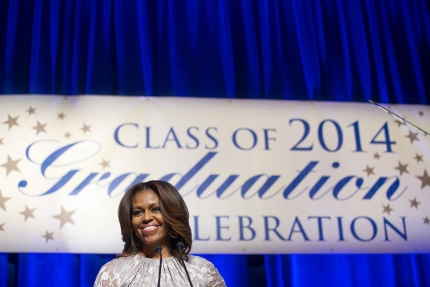
First Lady Michelle Obama delivers remarks during DC College Access Program graduation celebration

First Lady Michelle Obama delivers remarks during the DC College Access Program graduation celebration of former DC-CAP students who received college degrees this spring, in Washington D.C., June 19, 2014. DC-CAP is a private, nonprofit organization dedicated to helping D.C. high school students prepare for, enroll in, and graduate from college. (Official White House Photo by Lawrence Jackson)

Rhia Hardman, whose father and stepmother were both crack addicts, had to survive sometimes as a child without water or electricity. And Rashema Melson, whose family has been homeless for years, experienced times when she didn't have clean clothes to wear to school.

But today, Rhia is a graduate with honors from Virginia State University. And Rashema, who just graduated as the valedictorian of her class, is attending Georgetown University this fall on a full scholarship.

And as the First Lady said at last night's DC College Access Program graduation celebration, Rhia and Rashema aren't the only ones with similar stories of struggle and success.

"So many of you have stories just like these," Mrs. Obama told the graduates. "Stories of families who couldn’t support you, of communities where you weren’t safe, schools that maybe didn’t always live up to your promise. But ultimately, despite it all, you chose to succeed."

Related Topics: Reach Higher, Education, Virginia

Recognizing the Importance of Summer Learning Day

Ed. note: This is posted on the U.S. Department of Education's blog. See the original post here.

Today we join hundreds of communities and programs across the country in celebrating National Summer Learning Day, a recognized national advocacy day to spread awareness about the importance of summer learning to our nation’s youth—specifically, in helping close the achievement gap and supporting healthy development.

Summer learning is everywhere; it’s happening in cities and towns all across the country. Today in Fayetteville, NC, the local university is opening its doors to local youth to learn about its College Readiness Summer Institute and how they can participate. In Louisville, KY, Mayor Greg Fischer joined other prominent local figures to kick off Every 1 Learns, a citywide summer learning effort designed to provide access to academic support and meaningful work experience for Louisville youth.

Find more summer learning opportunities across the country on our interactive Summer Learning Day Map.

Last month, I blogged on HomeRoom about how families can keep their teens learning and preparing for college and careers this summer. A few weeks later, First Lady Michelle Obama joined students in San Antonio to highlight her college access initiative Reach Higher. She is supporting President Obama’s “North Star” goal of returning the U.S. to being the leader in college graduates by 2020. One of the core solutions in achieving that goal is summer learning. The National Summer Learning Association (NSLA) is excited to partner with the First Lady in helping teens “Reach Higher” all summer long and beyond.

Today it is a true honor to share the stage with the First Lady at the U.S. Department of Education to celebrate National Summer Learning Day. Bringing together high school students and education leaders from across the country, our event highlights the critical role summer learning plays in preparing young people for successful college entry and completion.

The First Lady and other guests will see and hear from young people about the incredible things they learned last summer, like how to write a personal statement, teach and mentor younger youth, dance, cook healthy meals, apply for financial aid, and even dissect a sheep brain.

The 100 youth joining us today have the opportunity of a lifetime to participate in exemplary programs, and we hope to extend that opportunity to all young people who need and want that experience. Across the country, we’re beginning to see school districts partner with institutions of higher education and other nonprofits to offer rigorous coursework, counseling, and meaningful work experience for young people in the summer, and it’s changing lives.

There’s great reason to believe that summer learning opportunities can increase college access and completion among first generation college students. We’re thrilled that Mrs. Obama has taken notice of the importance of summer learning, and we’re honored to work with her on such an important issue for our nation’s youth.

Sarah Pitcock is CEO of the National Summer Learning Association.

Related Topics: Reach Higher, Kentucky

The White House

Office of the First Lady

Remarks by the First Lady at DC-CAP Graduation Celebration

Wardman Park Mariott
Washington, D.C.

6:15 P.M. EDT

MRS. OBAMA:  Well, hello!  (Applause.)  How is everybody doing?  You all rest yourselves.

Well, I am beyond thrilled to be here tonight because we are celebrating these outstanding DC-CAP graduates from the class of 2014.  I told you all this when we took -- I am so proud of you all.  I am so proud.

And I want to start by thanking Jonathan -- yes -- (applause) -- for that wonderful introduction.  And thank you for your service to our country.  I’m proud of you.  (Applause.)  Yes, indeed. 

I also want to recognize the CEO of DC-CAP, Argelia Rodriguez.  (Applause.)  And I know her mom is here, so I’m going to recognize Mom, as well.  She told me she’s keeping an eye on her.  (Applause.)  Yes, indeed.  I told her I have one of these at home too -- (laughter) -- keeping an eye on me.  I also want to recognize the Board Chairman, Donald Graham.  (Applause.)  Yes, indeed.  And I want to thank them both, as well as the staff and the entire board for all of your outstanding leadership, the wonderful work that you have done to help these young people thrive and succeed.  You all are an amazing group of people.

And of course, I want to give a huge shoutout to all of the families here tonight.  (Applause.)  Yes, the folks who pushed you, who prayed for you, who believed in you every step of the way.  Tonight is your night too.  Right, graduates?  (Applause.)  Yes, indeed.

And finally, to our graduates.  

(Baby cries.)

MRS. OBAMA:  Oh, yes.  (Laughter.)  That's soon to be.  Soon to be.  (Laughter.)  But congratulations to you all.  I know you all have worked so hard.  You have journeyed so far and overcome so much to earn your degrees.

Remember how you first felt when you first left home and set foot on that college campus?  I know for many of you, being the first from your family or maybe even from your whole neighborhood to attend college must have been pretty unsettling at times.

Maybe there were times when you were overwhelmed in some of your classes, or felt uneasy around your new classmates.  Maybe there were months when you ran low on cash and worried about paying for those books or food even -- you can give me an Amen!  (Applause.)  Maybe you were homesick and desperately missed your family and friends.  And maybe there were nights when you lay awake wondering whether you really belonged, or if they had made some terrible mistake by letting you in.   (Laughter.)

But here’s the thing, graduates:  You didn’t give in to your panic.  You didn’t give in to your doubt or despair.  Instead, you swallowed your pride and you asked for help.  You opened your heart and you made new friends.  You patched together scholarships and jobs to make ends meet.  And you studied like your life depended on it, because you knew that it did. 

And after pushing yourself so hard for so long, you made it.  You achieved the dream that has driven you for so many years -- you all are now college graduates.  Yes, indeed.  (Applause.)  And today, you are the pride of your families and communities.  And let me tell you something, you are the pride of your President and your First Lady too.   (Applause.)

More importantly, you all are role models for young people across this country, especially the DC-CAP high school graduates who are here tonight who are going to follow in your footsteps.  So I hope that you all will truly savor this moment.  Take a second to sit back and relax.  Celebrate a little bit with your friends.  Sleep late -- (laughter) -- because you’ve earned it.

I want you to enjoy these moments of calm and satisfaction because, as you will learn, they are rare.  For just as you close one chapter, you realize that it’s time to start another.  And figuring out your next steps can stir up all those old feelings of anxiety and doubt.

Some of you may not know what’s next.  Maybe you don’t have a job yet; maybe you’re worried about finding one.  And if you do have a job, maybe you’re wondering whether you’ll succeed at that job.  Maybe you’re thinking about graduate school, but you don’t know how you’re ever going to pay for it. 

So just when you thought you had it all figured out, you are now faced with a whole new set of challenges.  And you’re once again wondering how you’re ever going to make it.  Sound familiar?

AUDIENCE:  Yes.

MRS. OBAMA:  Well, I’m here today, graduates, just to assure you that you are going to be just fine, because you have everything you need right here and right now to succeed beyond your wildest dreams. 

You see, during your time in college, you weren’t just learning business or biology or sociology, you were learning how to survive and thrive no matter what life throws your way.  And that’s what I want to talk with you about today.  I want to talk about how the lessons you’ve learned in college have prepared you to succeed out here in the real world.  And I want to start with a lesson that you all have been learning your entire lives, and that is to never, ever stop struggling -- because that’s how you got to college in the first place.  You struggled for it.  And when you got there, you struggled even more.

Maybe you failed your first test.  Maybe you got a bad grade on your first paper.  But you didn’t just throw up your hands and say, well, I must be stupid, I quit.  No, no, you buckled down.  You went to those professor’s office hours.  You stayed up late solving those problems, writing and rewriting those papers, right?  And soon, you mastered that material.  Soon, your grades started to improve. 

And believe it or not, that all happened because the sheer act of struggling made you smarter.  No, I’m serious.  This is really important, because there are there are scientific studies that prove this.  Science actually shows that when you’re struggling to solve a problem or to understand a concept, you’re forming new pathways and connections in your brain. 

So struggling isn’t a bad thing.  It is not a sign of weakness -- in fact, it’s a sign of growth.  It’s a sign that you’re expanding your capacity to handle the hard challenges that you will inevitably face throughout your entire life.  So don’t ever, ever shy away from a good struggle.  Instead, I want you to seek it out and dive in head first, because that’s what truly successful people do.

Take my husband, for example.  You know the guy.  (Laughter.)  Barack Obama wasn’t born as President of the United States.  He struggled for years to make it to the White House.  And then, once he got there, he struggled even harder -- (laughter and applause) -- to create jobs, to get people health care, to help young people like you go to college.  See, and here’s the thing -- in a few years, when it’s his time to leave office, he’s going to start all over again with a whole new set of challenges. 

See, graduates, that’s what life is.  It is an endless process of struggle and success, struggle and success.  And in the coming months, as you’re out there looking for a job, you might have to do five or 10 or 20 interviews before you finally get an offer.  You might get rejected from dozens of graduate schools before you finally get accepted to one.
 
But remember, just like in college, that struggle is making you stronger and smarter and more resilient.  So no matter how tough it gets, no matter how frustrated you are, I want you all to just keep moving forward.  And here’s the thing -- don’t ever let your doubts, or anyone else’s doubts about you, distract you from your path. 

And that brings me to the second lesson that I want to discuss today, which is to never, ever listen to the doubters, no matter how convincing they might sound.  (Applause.)  Indeed.  And I know that at some point in college, all of you faced a doubter or two.  Maybe it was that professor who took one look at you and made a snap judgment that you wouldn’t succeed.  Maybe it was the classmate who heard about where you came from and gave you that look of pity that made you feel like you didn’t belong.  Trust me, I know what that’s like.  You see, as Jonathan said, I grew up just like many of you.  My family didn’t have a lot of money.  My parents never went to college.  And there were plenty of folks who doubted whether a kid like me had what it took to reach my goals. 

I remember one of those doubters in particular.  He was a wonderful professor whose class I took at Princeton.  Now, let me say this, I aced his class.  I blew it out of the water.  (Applause.)  So at the end of the semester, I asked the professor if I could work with him on a research project and he said yes.  Now, I did this in part because I knew that I’d be applying to law school, and between the A that I’d gotten in the class and the research we’d be doing together, I was confident that this man would write me an excellent letter of recommendation.

So we’re working together over a course of months, and eventually I asked him if he would write me that letter.  And he said, “Sure, I’ll do it.  But really, you’re not the hottest thing I’ve seen coming out of the gate.”  Oh, yes.  (Laughter.)  I was stunned.  Now, in hindsight, I appreciated the honesty, but it really felt like he punched me right in my stomach. 

But in that moment, I made a decision.  I decided that I was going to do everything in my power to make that man regret those words.  (Applause.)  And at a point, I didn’t even care about the letter anymore.  I knew that it was my responsibility to show my professor how wrong he was about me. 

So for the rest of my time with him, I worked my butt off for this man.  I was in his office every day.  I was sitting side by side with him, analyzing data like no one had analyzed it before.  And I didn’t say a word about the letter.  And then, one day, the professor asked me, well, what are your plans for next year?  And I told him -- I said, I applied to law school.  And, he said, oh, did I write you a letter for that?  And I said, yes, as a matter of fact, you did.  He then got very quiet.  And, he said, well, how are things going?  And I told him that I’d gotten accepted everywhere I’d applied except for Harvard Law, where I’d been waitlisted.  He paused for a moment, and then he said, I’m going to write you another letter.

See, at that point, I knew I had won.  Whether or not I got into Harvard didn’t even matter.  I had shown not just my professor, but myself what I was capable of achieving. 

So graduates, when you encounter those doubters -- that boss who doesn’t think you deserve a promotion, that grad school advisor who thinks you’re nothing special -- don’t get angry.  Don’t get anxious or insecure.  Get better.  Work harder.  Let your light shine so bright that it blinds the doubters.  Because trust me, in the end, success is always your best revenge.  And not just because it feels so good -- (laughter) -- because even if you never change those doubters’ minds, at least you’ll have improved yourself while you’re working to prove them wrong.  And that’s an investment in yourself that no one can ever take away from you.

Which brings me to the final lesson I want to discuss today:  Investing in yourself, no matter what else is going on in your life.  So here is what I mean -- I know that for many of you, going away to college meant leaving behind important responsibilities at home.  In some of your families, you were the rock.  You were the shoulder to cry on, the one who took care of your brothers and sisters when your mom was working, or maybe you worked a job yourself to help pay the bills.

And when you went away to school, some of you may have felt guilty, constantly torn between the needs of your family and your dreams for yourself.  And graduates, the truth is, the tug of home won’t go away now that you have that degree.  In fact, as you start your career and start earning a paycheck, you might get even more of those late-night phone calls about how someone is sick or someone needs money, can you come home and help.

Now, there is nothing, nothing more important than family.  And there will be plenty of times when you need to answer those calls and take care of the people you love.  But I can tell you that, ultimately, the best way for you to help your family is to keep investing in yourself.  And that’s a hard thing for you to swallow.  I know that.  (Applause.)  I know that’s a tough one.  But I’ve dealt with this myself. 

You see, back when I was getting my education and starting my career, my parents were no strangers to struggle.  They were facing health challenges and any number of other problems.  But here is the thing -- no matter what was happening at home, whenever I called to see how my parents were doing, I always got the same answer:  Everything is fine, baby, just take care of yourself.

You see, my parents couldn’t offer me a lot in the way of tangible support.  They couldn’t give me advice about what classes to take or what jobs to apply for.  They didn’t have networks.  But what they could do was keep me from getting sucked into their problems.  They knew -- amen, and I want the families to hear this as well.  (Applause.)  They knew that I had enough stress in my life on my own, and they were determined not to add any more stress from their lives.  And because my parents gave me the space I needed to succeed, I was able to focus on getting good grades and a good job and earning some money.  And before long, I was able to start helping my parents out.  And today, my mother never has to worry about money again because my brother and I can afford to take care of her for the rest of our lives.  (Applause.)

So graduates, by continuing to focus on your own success, you will ensure that you can keep giving back -- not just to the people you love, but to the communities you come from.  And by the way, that last part isn’t a suggestion; it’s an obligation that folks like us share.  (Applause.)  The obligation to reach back and give others the same chances we’ve had to succeed.  And I know that some of you might be thinking to yourselves, well, I’ve dealt with so much on my own, how could I possibly have the time or energy to worry about anyone else?  Or maybe you don’t ever want to think about where you came from again.  Maybe you just want to walk away and never look back.

But, graduates, you all are here today because a lot of people chose not to walk away from you.  And there are so many kids just like you in communities across this country, kids like the DC-CAP high school grads here today, kids who need to meet you.  They need to see that your story can be their story. 

They need to hear the story of DC-CAP graduates like Rhia Hardman.  Rhia’s father and stepmother were both crack addicts, and she spent her teenage years breaking up fights in her own home.  She sometimes even had to survive without water or electricity.  But Rhia decided to build a different life for herself.  And as she wrote in a recent essay, she said, “Every time I wanted to quit, I pushed, knowing someone had the same dream but didn’t get the opportunity.”  And today, Rhia is a proud graduate –- with honors –- from Virginia State University.  (Applause.)

And then there’s Rashema Melson.  Rashema’s family has been homeless for years, and there were times when she didn’t even have clean clothes to wear to school.  But Rashema worked hard in her classes at Anacostia, and she ran track.  She worked hard, and after four years of struggle, Rashema graduated as valedictorian of her class.  And she will be attending Georgetown University on a full scholarship this fall.  (Applause.) 

I could go on and on, because so many of you have stories just like these –- stories of families who couldn’t support you, of communities where you weren’t safe, schools that maybe didn’t always live up to your promise.  But ultimately, despite it all, you chose to succeed.  And that is the thread that connects every single one of you.  It is your mindset, your fierce belief in your own potential, your unwavering conviction that you deserve something better from life.

And if you all can graduate from college despite such overwhelming odds, then there is no reason why every child in this country can’t follow in your footsteps.  (Applause.)  Your shining success -- your success -- it’s a powerful message to every young person in America that you don’t have to wait for your neighborhood to improve, or for your school to turn around, or for your family to solve all its problems.  Instead, no matter what’s going on in your life, you can find a way to make it to school every day, to go to class, to listen to those teachers, to get the education you deserve.

So, graduates, we need you out there as mentors and role models in our communities.  We need you as leaders in your companies, urging them to support programs like DC-CAP.  We need you working in our government, pushing our leaders to help every child get a college education no matter where they’re from or how they grew up.  (Applause.)  Because you know it is not enough just to help a small number of young people like you beat the odds.  We need to change the odds for all young people across this country.  Because this country, we need you.  We really do.  We need your passion, your determination, your brilliance, your drive.  That’s one of the reasons why I started Reach Higher -- to help all our young people complete their education beyond high school. 

So here’s the thing -- I want you all to know that I’m going to be fighting for you, and I am rooting for you and kids like you across this country.  I will be doing this work not just for the rest of my time as First Lady, but for the rest of my life.  (Applause.)  Because, graduates, I believe in you.  I really do.  I’m so proud of you.  I am inspired by you.  And I can’t wait to see what you all achieve in the years ahead.  So go out there and do some great things.

Thank you all.  God bless.  (Applause.)

END  
6:37 P.M. EDT

The First Lady Welcomes 50 New Americans at the National Archives

Watch on YouTube

This morning, First Lady Michelle Obama welcomed 50 new Americans in a naturalization ceremony at the National Archives in Washington, D.C.

"This is an exciting day," the First Lady said in her remarks, "and it's just wonderful that I can be among the first to congratulate you on becoming American citizens."

Only a few feet from where she spoke was the Declaration of Independence -- and as she noted, none of the 56 Founders who signed the Declaration were born American, "they became American."

Related Topics: Immigration

The First Lady Speaks at Naturalization Ceremony

June 18, 2014 | 6:45

First Lady Michelle Obama delivers remarks at a Naturalization Ceremony for 50 new Americans at the National Archives, June 18, 2014.

The White House

Office of the First Lady

Remarks by the First Lady at a Naturalization Ceremony

The National Archives
Washington, D.C.

11:11 A.M. EDT

MRS. OBAMA:  Well, let me join Jeh by saying good morning, my fellow Americans.  Sounds pretty good, huh?  (Laughter.)  You like that, right?  All right, I’m going to loosen you up if it takes all morning.  You’re now citizens!  It’s very cool.  (Laughter.)  And I am honored to be here.  This is an exciting day, and it’s just wonderful that I can be among the first to congratulate you on becoming American citizens.

And I also want to welcome your family and friends who are here -- let’s see the family members who are here.  Where are they?  You guys are here, that’s good, that’s good.  Yes.  (Applause.)  I know how important these people are because I know that they’ve supported you every step of the way.  And I see that they are beaming with pride, so welcome.

I want to thank Secretary Johnson, Director Scialabba, for taking the time to be here today and for their tremendous work.  I also want to especially thank David and the incredible staff at the National Archives for making today’s event possible.  This is a beautiful setting. 

It’s amazing that just a few feet from here where I’m standing are the signatures of the 56 Founders who put their names on a Declaration that changed the course of history.  And like the 50 of you, none of them were born American -- they became American.

Just like you’re about to pledge allegiance to our flag, they pledged their lives, their fortunes, and their sacred honor to this extraordinary idea that we now know as America -– the notion that we are all created equal, endowed with fundamental rights and freedoms that no one can ever take away from us.

People come from across the globe to see these documents, to read the names and signatures of the very first “Americans-by-choice,” because they know that this room holds the first chapter of our shared history.  And today, it holds the next chapter of our story, as well. 

As the newest “Americans-by-choice,” you, too, will play an important part in shaping our history.  Some of you were brought here as children.  Others came here to be with a loved one.  Some of you, like Parish Sapkota, have risked their lives for this country by serving overseas.  Others haven’t worn the uniform themselves, but have served America by supporting a spouse or a child who has. 

Take Blue Star Mom Zlatka Stefanova.  Her son Marian was wounded in an ambush in Iraq.  He spent 18 months at Walter Reed recovering from his injuries.  And today, with the love and support of his mother, Marian is a proud officer in the Fairfax Police Department. 

But no matter what your story, from this day forward, for the rest of your lives, you will always be able to say, “Yes, I am an American citizen.”  And I know this is an exciting, hopeful time for all of you, but it’s also an exciting, hopeful time for our country.  Because the fact is, America needs you. 

Immigration is at the heart of how we developed as a nation.  In every generation, immigrants have earned their place as part of “We the People.”  With the exception of just a few ethnicities, every person in this country can trace their history back to a parent, or a grandparent, or a great-grandparent, or an ancestor who made that choice to be part of this country. 

And today, much of our success is because we still very much are a nation of immigrants.  Immigrants start roughly one in four of our new businesses.  About 30,000 permanent residents serve in our military.  And according to one study, over the past 50 years, more than a quarter of our Nobel Laureates based in the U.S. have been foreign-born.

So in many ways, it is because of, not in spite of, our immigrant population that we grow stronger every single day.  Yet today, here in Washington, folks are still debating whether or not to fix our immigration system even though just about everyone agrees that it is broken.  But I want you all to know that my husband has made this his top legislative priority, and he refuses to give up the fight.  Because at the end of the day, this fight isn’t just about abstract principles, it’s about real people.  People like you.  People like us -- our fellow Americans.

That’s who you are.  You came here today as citizens of 44 different countries, and you’ll leave here as citizens of one great nation -– the United States of America.  And I hope that you never take that for granted, because I know how hard you worked for this.  You earned it.  And to be a citizen of this country is an incredible blessing. 

And what I hope you always remember is that, as citizens, we do not shut the doors of opportunity behind us.  We preserve the promise of America.  We renew it.  We extend it so that future generations of Americans -– Americans by birth and “Americans-by-choice” -– can do their part to form the more perfect union that our founders imagined so many years ago. 

So I want to once again congratulate you on this important honor, this extraordinary honor.  And I wish you the very best of luck on your journey ahead as citizens of this great country.

Thank you so much, and God bless.  (Applause.)

END
11:18 A.M. EDT

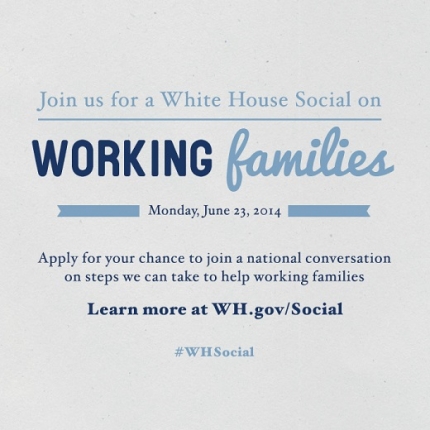
You're Invited: White House Summit on Working Families

We're excited to announce our next White House Social event -- an opportunity for our followers on Twitter and Instagram to attend the White House Summit on Working Families.

On Monday, June 23, 2014, this day-long event will feature remarks by the President, the First Lady, the Vice President, and Dr. Jill Biden, as they participate in a national conversation about how we can create 21st-century workplaces that work for all Americans.

Interested? Sign up for your chance to join other White House social media followers for the White House Summit on Working Families at WhiteHouse.gov/WH-Social-Working-Families. After you sign up, spread the word and tell your friends about the event by using the hashtag #WHSocial.

Working Families Summit Social Invite

West Wing Week 06/13/14 or, "I Am Hip to All These Things"

This week, the President commemorated the 70th anniversary of D-Day in Normandy, hosted his first-ever Tumblr Q&A, and spoke to graduates of Worcester Technical High School.

Watch on YouTube

Related Topics: Inside the White House