The White House

Office of the First Lady

Remarks by the First Lady at a Voter Registration Event -- Atlanta, Georgia

Martin Luther King Jr. Recreation Center
Atlanta, Georgia

5:29 P.M. EDT

MRS. OBAMA:  Oh, my goodness!  (Applause.)  I am so happy to be here in Atlanta!  (Applause.)  Look at you all!  You all sound like you’re already fired up, so I can just leave.  (Laughter.) 

Well, let me tell you, it is beyond a pleasure to be here with all of you today.  I want to start by giving a huge shoutout to the next senator from the state of Georgia, our friend, Michelle Nunn.  (Applause.)  Yes.  I really like this woman.  I like her. 

For two decades, Michelle has been a passionate champion for families and communities across this state.  Working with leading businesses, she grew a tiny non-for-profit into a world-renowned organization with millions of volunteers.  And under her leadership, we have seen communities rebuilt after disasters; we’ve seen veterans and servicemembers getting the jobs they deserve; we’ve seen kids getting the support they need to succeed in school. 

So folks here in Georgia know that Michelle Nunn will always be there for them, and that’s why I’m so proud to be here for her.  (Applause.)  Yes.  And I’m very excited that all of you are here for her.  I really am.  I love the feeling and the energy in this room.  You guys are doing it, and I’m very proud.

But I also want to thank Dr. Warnock for his wonderful remarks earlier.  (Applause.)  We are so thrilled and so honored that he could join us today.  And of course, I want to recognize your fantastic state senator and the next governor of Georgia, Jason Carter.  (Applause.)  Now, Jason has been such a strong, committed leader for folks here in Georgia, as well.  He’s been fighting for better schools and for more honest government.  He’s been fighting to support small businesses and protect voting rights.  And I know that he will be an extraordinary governor, so let’s give him another round of applause.  (Applause.) 

But most of all, I want to thank all of you.  Really.  I want to thank you.  I see so many friends here, many folks who have been I know with us from the very beginning -- back when we were out in Iowa and New Hampshire talking about hope and change, and getting folks all fired up and ready to go.  (Applause.)  Remember that?  (Applause.)  Feels good in here. 

And then you all were with us when Barack first took office.  (Applause.)  And then he took a look at the mess he’d been handed, and we both wondered what on Earth had he gotten himself into.  I don’t know if you remember that far back.  (Applause.)  Do you remember how bad things were back then? 

Let me take you back.  We were in full-blown crisis mode.  Our economy was literally on the brink of collapse.  Wall Street Banks were folding -- remember that?  Businesses were losing 800,000 jobs a month.  Folks on TV were panicking about whether we were headed for another Great Depression -- do you remember that?  (Applause.)  And that wasn’t just talk; that was a real possibility.  And this is what Barack walked into on day one as President of these United States.

Now, I want you to step back and think about how things look today, less than six years later.  (Applause.)  I’m not going to take forever, I’m just going to highlight a few things. 

Our businesses have created 10 million new jobs -- 10 million.  The long-term unemployment rate has dropped by more than half over the past four years -- half.  (Applause.)  We’ve now had the longest period of job growth since World War II.  (Applause.)  And folks across the country have gone back to work -- overall unemployment is the lowest it’s been in nearly six years.  We’ve cut our deficit by more than half.  We’re sending more kids to college.  And after decades of trying to pass health reform, today, millions of Americans, millions of families finally have health insurance because of the Affordable Care Act.  (Applause.)

And just think about how different our country looks to children growing up today.  Think about how our kids take for granted that a black person or a woman can be President of the United States -- they just take it for granted now.  (Applause.) They take for granted that their President will end hurtful policies like “don’t ask, don’t tell,” and speak out for equality for all of our citizens.  (Applause.) 

So today, when folks ask me whether I still believe everything we said about hope and change back in 2008, look, I tell them that I believe it more strongly than ever before because I’ve seen it with my own eyes.  I’ve seen it.  I’m out there.  (Applause.) 

I’ve seen veterans finding jobs as our nation proudly supports their transition to civilian life.  I’ve seen children getting better nutrition, growing up healthier -- our babies.  I’ve seen our young people from the most underserved areas reaching higher and going to college, and then reaching back to serve their own communities.  I’ve seen it.  (Applause.) 

So while we still have plenty of work to do -- we do -- much of that change we were talking about we’ve already made.  We’ve seen it.

But I want you to remember -- Barack didn’t do all that by himself, sitting alone in the Oval Office.  Thankfully he did it because of folks like you across the country who got organized and got people out to vote, and elected leaders in Congress who put you and your families first.  That’s how we passed legislation to rescue our economy and save our auto industry -- and so much more.

And if we want to keep helping families here in Georgia and across this country, we need to do that same thing again this year.  We’ve got to do the same thing.  Because, frankly, if we lose these midterm elections, it’s going to be a whole lot harder to finish what we started.  Because things will be even worse out in Washington.  Instead of leaders coming together on behalf of hardworking families and finding consensus on the issues that matter most, we’ll just see more conflict and more obstruction, more lawsuits and talk about impeachment, more votes to repeal the Affordable Care Act, or even shut the government down -- behavior that just wastes time and wastes taxpayer dollars. 

In fact, it’s gotten so bad, they’re even trying to block the work that I do on childhood obesity.  (Applause.)  And that’s really saying something.  I mean, for most folks in this country, making sure that our kids get decent nutrition isn’t all that controversial, because as parents, there is nothing we wouldn’t do for our kids -- nothing.  We always put our kids’ interests first.  We wake up every morning, we got to bed every night thinking and worrying about their health, their happiness, their futures.  And we deserve leaders across this country who will do the same. 

We deserve leaders who believe like we do that no matter how our kids start out in life, if they’re willing to work for it, they should have every opportunity to fulfill every last bit of their boundless promise.  They should have every opportunity to get a good education and build a decent life for themselves and an even better life for their own kids.  That’s what we believe. That’s the American Dream we all believe in.  And that is what these midterm elections are all about.  That’s what’s at stake.  (Applause.)

And I want to be very clear with you:  These races are going to be unbelievably tight.  They could be won or lost by just a few thousand, even a few hundred votes.  You know how tight that is?

AUDIENCE MEMBER:  That’s tight.

MRS. OBAMA:  That’s tight!  (Laughter.)  That’s right.  That’s too tight. 

But here’s the good news:  We have all the votes we need right now to win these races if -- if -- we get folks registered, and if we get them out to vote in November.  It’s on us.  It’s on us.  (Applause.)

Let’s delve a little deeper into the numbers, because I think this helps -- this helps me.  When they give me these numbers I’m like, are you kidding me? 

If we increase the voter rolls by just three percent by adding democratic voters, and we get those folks out to vote, then we will soon be swearing in senator Michelle Nunn and governor Jason Carter -- three percent.  (Applause.)  Let me put it another way -- another way -- if just 50 democratic voters per precinct who didn’t vote in 2010 get out and vote this November -- just 50 per precinct -- then Michelle Nunn and Jason Carter will win.  (Applause.)  Think about it. 

That’s why your gathering here is so important.  If everyone here today registers just one person -- and you know more than one person you can get to register -- but if you just get one, and then you get that person out to vote, then we could win a whole bunch of precincts.  And we have the power to do that right here in this room.  See, because you all are already fired up and ready and focused -- you are the champions, which is why you’re here. 

So this one is on us.  That’s the scary part, but that’s the beauty -- this is on us.  We can’t wait around for anybody else to do this for us. 

Now, it’s true that there is too much money in politics.  And it’s true that special interests have too much influence.  But let me tell you something -- they had plenty of money and influence back in 2008 and 2012, and we still won those elections.  (Applause.)  Just think about it.  You want to know why we won?  Because we showed up and we voted.  And at the end of the day, the folks running those special interest groups, the folks pouring millions of dollars into those elections -- they each just had one vote, just like you and me -- and so do we.

And ultimately, the only thing that counts in America are those votes.  That what decides elections in the United States of America.  And that’s why Barack Obama is President right now.  (Applause.)  He is President right now because a whole bunch of folks who never voted before showed up in 2008 and 2012. 

And a lot of people were shocked when Barack won, because they were counting on folks like you to stay home.  But you proved them wrong.  Barack won because record numbers of women and minorities and young people showed up to vote.  (Applause.) 

But then, when the midterms come along, too many people of our folks just tuned out.  See, that’s what happens in the midterms -- and that’s what folks on the other side are counting on this year too.  Because when you stay home, they win.  So they’re assuming that you won’t care.  They’re assuming that you won’t be organized and energized.  And only you can prove them wrong.  Only you can show up and vote for Michelle Nunn and Jason Carter, and other outstanding leaders who will fight every day for folks here in Georgia -- only you.  (Applause.)

And I’m counting on you.  I believe in you.  So if you care about what is happening in your communities, if you care about the safety of our young men and women on the streets, if you care about justice and equality, then you need to get registered, and then you need to vote.  And then you need to get everyone you know -- everyone you know -- to vote, too -- everyone you know. 

Bring folks from your family, neighborhood, the church.  Don’t leave anyone behind.  That’s how we did it before.  You have until October the 6th to get registered.  And if you know someone who just moved to Georgia, make sure they get registered too.  And that includes college students.  (Applause.) 

If you are attending college here in Georgia, you can register to vote here.  Couldn’t be easier.  Just go to MyGAVote.com -- that’s MyGAVote.com.  I know young people, you’re on the Internet on your little black things, whatever those things are -- (laughter) -- you’re on those!  And that site will take -- yes, I’m getting there.  I’m trying -- my kids are trying to hook me up.  (Laughter.)  But I know you can get on there from those things.  They do more than just take selfies.  (Laughter.)  You can get information.  You go on that site, it will take you right to the Secretary of State’s website, and that’s where you register to vote.

And once everyone you know is registered, then we need you to volunteer, right?  (Applause.)  Volunteer for Georgia Victory and start registering folks across the state.  Just find one of the people here -- we’ve got people here with clipboards -- see them?  They’re here!  Turn around, look at our clipboard people.  (Applause.)  Many of them are young people -- and some not so young, but they’re here!  (Laughter.)  And then bring some friends along with you.  This is how we do it.  You bring your friends along with you when you volunteer. 

And don’t wait another minute to get started, because we’ve got less than two months until Election Day, and we need all of you to be passionate and as hungry for these midterm elections as you were back in 2008 and 2012.  In fact, we need you to be even more passionate and more hungry, because these midterm races will be even harder and even closer than those presidential races, and they’re just as important. 

And the stakes this year couldn’t be higher.  Because if we don’t show up at the polls this November, if we don’t elect leaders in Congress and here in Georgia who will put people first instead of just fighting for special interests, then we know exactly what will happen.  We will see more folks interfering in women’s private decisions about our health care.  We’ll see more folks denying that climate change even exists.  We’ll see more votes against equal pay and immigration reform and raising the minimum wage for hardworking folks.  (Applause.)

So I want to be very clear:  If you think folks who work 40 or 50 hours a week shouldn’t have to live in poverty in the wealthiest nation on Earth; if you don’t want women’s bosses making decisions about their birth control; if you want your kids to have quality preschool and the college education they need to fulfill every last bit of their God-given potential -- then you need to step up and get everyone you know out to vote this November.  That’s what’s at stake in these elections -- the kind of country we want to leave for our kids and our grandkids.  (Applause.) 

And let’s just remember, our kids are counting on us to stand up for them this November.  That’s why I’m here.  Our kids are counting on us.  I see it in every child I meet. 

They’re kids like a young man named Lawrence Lawson, who I met earlier this year.  Let me tell you about this kid.  His father died when he was just eight years old.  At the age of nine, Lawrence suffered a major seizure and had to learn to read, walk and speak again.  When he was 12, his mother passed away, and Lawrence was passed from his aunt in Atlanta to his sister in Baltimore. 

But no matter where he was, Lawrence did his best in school -- joined the band, interned at Johns Hopkins Hospital.  He graduated as the valedictorian of his high school class, this young man.  (Applause.)  And as I travel across the country, I meet kids like Lawrence every day -- kids who wake up early and take the long route to school to avoid gangs; kids who juggle after-school jobs to support their families, and stay up late to get their homework done; kids whose parents don’t speak a word of English, but who are fighting every day to realize their dream of a better life.  (Applause.) 

These kids have every reason to give up.  But they are so hungry to succeed.  They are so desperate to lift themselves up.  And that’s why we’re here today -- because those kids never give up, and neither can we.  (Applause.)  Neither can we. 

Between now and November, we need to be energized for them.  We need to be inspired for them -- not for me, not for the President, but for them.  We need to pour everything we have into these elections so that they can have the opportunities they need to build the future they deserve. 

And if we all do that -- especially in this room -- if we all keep stepping up and bringing others along with us, then I know that we can keep making that change we believe in.  I know that we can send Michelle Nunn to the United States Senate.  I know we can elect Jason Carter as governor of Georgia.  (Applause.)  And together we can keep building a future worthy of all of our children.

Thank you all.  God bless.  Get to work.  (Applause.)

END
5:51 P.M. EDT

The White House

Office of the First Lady

Remarks by the First Lady at Reach Higher "Prep" Rally

Booker T. Washington High School

Atlanta, Georgia

2:07 P.M. EDT

MRS. OBAMA: Hey! (Applause.) What’s going on? Okay, they’re trying to make me dance some more. I’m not going to dance anymore. (Laughter.) I can only dance because my children aren’t here. When I dance with them, I’m embarrassing to them. (Laughter.) How are you guys doing? (Applause.) Oh, my goodness! I am so thrilled to be here in Atlanta with all of you. Let’s go, Bulldogs! (Applause.) You guys feeling good? (Applause.) I am, too.

Let me start -- I want to start by thanking a few people first. I want to start by thanking Alexandria for that very wonderful introduction. She did a good job, didn’t she? (Applause.) And your classmate Tauja, as well,for her remarks. She introduced Secretary Duncan -- she did a great job. (Applause.)

And we’ve got Sway Calloway here from MTV, he’s backstage. (Applause.) I don’t know if you’ve met our Secretary of Housing and Urban Development, Julian Castro, he’s here. (Applause.) And your First Lady of Georgia is here, Mrs. Sandra Deal, who has been doing some phenomenal work in education. (Applause.) I am so grateful to her for the work she’s doing on behalf of the children of this state. Thank you for taking the time.

We also have Mrs. Sarah-Elizabeth Reed, the First Lady of your city of Atlanta, who is here as well. (Applause.) And of course, Secretary Duncan, who is my partner in crime. I couldn’t be more excited to be here to help Secretary Duncan kick off his back-to-school bus tour. And when we were thinking about where to go for the kickoff, we thought we’d come to Booker T. Washington High School because -- (applause) -- yes -- we heard you all are doing some pretty good things -- yes, you’re excited, pretty excited. (Laughter.) But we heard you all are doing some great things here for all the students -- and I also heard you all could make a little noise, too. So that helps.

Now, I know you all have been back at school for a few weeks now, right? You’re settling into the routine, right?

STUDENTS: Yes.

MRS. OBAMA: Classes, activities, team practices, band practice, right? You guys are all into that. (Applause.) You’ve had a few games. Is your football team playing? (Applause.) You guys having a good season?

STUDENTS: No!

MRS. OBAMA: Oh, well, nevermind. (Laughter.) But you’ve got heart! You’ve got spirit! (Applause.) You’re probably getting a lot more homework; maybe you’re starting to have your first quizzes and your paper is already due, right?

Well, I’m here today because all of that that I just mentioned -– all those tests, all the papers, the extracurricular activities –- here -- and I want you all to listen to this -- all of that stuff isn’t just important to get you through the day or even this year. Everything you are doing in school right now is critical to the rest of your life.

That’s why I’m here -- because I want you all to succeed. And I want you to understand how people like me go from being kids like you to standing here as First Lady of the United States. (Applause.) That’s my message to all of you and to all the students across the country who may be watching this today -- that your time in school is extremely important. And what you do here each and every day will set you up to achieve so many of the dreams that I know you have for yourselves in the years ahead.

You have to understand that completing high school is not the end but the beginning of your life’s journey. It’s just the beginning. In today’s world, in order to compete in an ever-globalizing economy, you’ve got to continue your education after you graduate from high school. And fortunately, there are many paths that you can take –- whether that’s a professional training program, a four-year school like Georgia State or Emory or Clark Atlanta, or a community college like Atlanta Metro State College.

But no matter where you go, the important thing is that you go somewhere. Because no matter who you are or where you come from, higher education is absolutely the best way you can take charge of your future. And there’s a lot you need to be doing right now to prepare yourself for those next steps.

And that’s why this isn’t just any ordinary pep rally, this is why we’re calling this a prep rally -- you get it? It’s a prep rally. Because if you want to succeed in the years ahead, you’ve got to know how to prepare yourself today, and you’ve got to know how to rally when you get knocked down along the way -- because it’s going to happen. And that’s what we’re going to talk about.

So first, the prep part. And one of the reasons why we’re here at Washington High is because you all already have a great head start. You have got teachers and counselors who are doing everything they can to help you get to college. Your school offers classes that give you college credit. And you’ve got access to special programs that will prepare you for careers in health sciences, business, finance.

So the first thing that you can do to prepare yourself for the future is to take advantage of all the resources that are right here for you. And to do that, you have to show up to school every day. Yes, attendance matters. You are not going to learn or get the support that you need if you’re not here. And then once you’re here, you have to completely commit to learning all that you can –- in other words, when you’re here, you have to challenge yourself. You just can’t -- you can’t be hanging out. You can’t just coast through. You can’t just take the easy classes. You’ve got to stretch yourself.

Because here’s the thing -- studies show that when you’re working hard and stretching yourself, when you’re struggling to solve a problem or read a book or write an essay, you’re actually making new connections in your brain. The brain is just like a muscle -- it needs exercise. And remember -- I want you all to remember, nobody is born smart. You become smart by thinking hard and challenging yourself. And that’s how you’re going to prepare your brain not just for college, but for the rest of the challenges that you’re going to face in life.

And that doesn’t happen right away. It takes time, it takes effort, it takes planning -- and let me tell you, it takes a whole lot of courage. And I know this from my own experience.

I grew up on the South Side of Chicago. Neither of my parents went to college. But I set a goal for myself: I wanted to go to Princeton University. So I sketched out a plan to get there –- which classes I needed to take, when I needed to take my SATs, when I needed to apply for financial aid. And I worked incredibly hard to execute that plan.

My school was halfway across the city, so I had to get up at 4:00 or 5:00 in the morning just to get to school, to study in the morning. Had to stay up late at night doing my homework because it took me forever to get home. And when I didn’t understand something, I had to drum up the courage to ask for help, and believe me, there was a lot I didn’t understand going to high school.

In other words, I had to take control of my education, had to set my own course for my future. And here’s the thing that I do know, which is why I am here and I’m not anywhere else in this country -- I am here because I know that every single one of you can do that, too. I know that. If I can do it, you can do it. There is absolutely no excuse. You are no better or no different than me. I didn’t have money growing up. I didn’t grow up in a nice neighborhood. But I am here.

So if you are a freshman or a sophomore, start making your plan. Talk to your parents, your teachers, your counselors -- whoever -- about different colleges and careers that you might want to pursue. Get a plan in your head, and then figure out what it’s going to take for you to get where you want to go.

To the juniors and seniors, you all should be working hard to execute your plans. You should be studying for the SATs and ACTs. Let me tell you, my daughter, who is a junior, is studying for her tests right now. She studies every weekend, on the weekdays, in addition to her homework. I’m just telling you what one kid is doing, but I know that every kid in her school is doing the same thing. Got to fill out that FAFSA form, look for those scholarships and those grants that are out there just waiting for you. Got to start working on those college applications and essays starting now.

And all of you should be pushing yourselves and challenging yourselves right now every day to be the absolute best students and the best people that you can be. And you can just use the resources here -- I know you just had a college fair earlier today. So going to the college fair is important, but don’t stop there. If you can, go visit some of those schools. I was just talking to some of the kids who were with me at the college fair. It’s so important for you, if you get an opportunity, to spend some time on a college campus. I didn’t do that. I didn’t have the money. But you all live near so many colleges, there’s no reason for you not to spend a weekend or a week seeing what it’s like being on a college campus, getting that vision of what it means to be in college, getting excited about it.

And ask questions. Ask them about the cost and the kinds of financial aid that are available to you. You’ve got to figure this stuff out. And the Internet is an incredibly useful resource. You can find all sorts of information online at websites like StudentAid.gov -- we’ll make sure your counselors have that information. KhanAcademy.org -- if you haven’t heard of Khan Academy, it is a free, online educational resource, and they’ve created this new platform to help young people like many of you prepare for college. They’ve got all sorts of videos, checklists to help you plan your high school classes and activities; to search for schools that fit your needs; to fill out your college scholarships and applications. So thanks to websites like these, it’s easier than ever to before to take the steps to prepare yourself for the future.

But here’s the thing –- even if you’re working hard and doing everything right, there will still be times when things don’t go according to plan. That ever happen to you all?

STUDENTS: Yes.

MRS. OBAMA: Stuff just doesn’t work out. Maybe something goes wrong in your family or with one of your friends. Maybe you don’t do as well as you wanted on the SATs or the ACTs. Maybe you fall behind in classes. And when things like that happen, it’s easy to get down on yourself. It’s tempting to just give up. But trust me, that’s just not the answer.

And that’s what the second part of this prep rally is about –- it’s about rallying when things go wrong. She’s okay? It’s okay, that happens to a lot of people who have to stand up for a long time. We need one of our medics here. We’ve got a young girl who fainted. But it happens all the time. She’s going to be okay. Sometimes standing up -- if anybody is starting to feel tired standing up, bend your knees -- and eat your breakfast and lunch. (Laughter.) You okay? Make sure she’s okay, too, right here. Right here. Everybody else feeling okay?

STUDENTS: Yes!

MRS. OBAMA: Are you all still fired up and ready to -- are you listening to me?

STUDENTS: Yes!

MRS. OBAMA: Do you hear what I’m telling you?

STUDENTS: Yes!

MRS. OBAMA: Because I’m giving you some insights that a lot of rich kids all over the country -- they know this stuff, and I want you to know it, too. Because you have got to go and get your education. You’ve got to.

And there are going to be plenty of times, you guys -- have you dealt with situations where you just feel like you want to give up? Like it’s just too hard? Like everything is going wrong, you don’t have the support you need; that every time you try, you get something right, something else happens -- right? You think that’s never happened to me? You think somebody like me has never had any problems?

Well, let me tell you, I still remember how one of my high school counselors told me that I shouldn’t apply to Princeton. They told meI would never make it there, that I was setting my sights too high -- can you believe that? She told me, don’t bother.

But let me tell you something -- that stuck with me. It made me a little uncertain, it did. It threw me off a little bit. But let me tell you, it made me mad, too. But I didn’t let those emotions get the best of me. Instead, I focused on getting good grades. I focused on signing up for activities, lining up my recommendations from teachers and mentors. And in the end, I ended up showing that counselor just how wrong she was -- because look at where I am right now. (Applause.)

And then I had trouble at home. My dad, my father had Multiple Sclerosis. My dad grew up -- I grew up with him with MS, which meant it was a disease that made it hard for him to walk. And let me tell you, my father was my hero. He was our family’s rock. And seeing my father in pain, seeing him struggle to get himself out of bed every morning, to get dressed, to get to work just to support us -- let me tell you, watching that every day, it broke my heart.

But as hard as that was, I knew that the best thing I could do for my father was to take care of myself and to handle my business, and to make him proud. He taught me to keep myself out of trouble, so that’s what I did. He told me that he expected me to go to college, so I worked hard to live up to that expectation. And years later, when I got that degree he’d always dreamed for me, I knew I was doing right by my father.

Now, I know that many of you are dealing with even tougher challenges than I ever faced. You might live in a neighborhood where you have to watch your back even -- every time you leave the house. You might have friends who make fun of you because you’re trying to get good grades. Or maybe your parents aren’t around; maybe your folks are struggling just to pay the bills. Maybe you’ve lost somebody to guns or drugs. I don’t know -- all of that is tough stuff for anyone to deal with, especially when you are still trying to grow up.

So how do you rally from something like that? How do you pick yourself up when you feel like somebody keeps knocking you down over and over and over again? You can start by listening to the words of the man this school is named after.

Booker T. Washington once said, he said, “Success is to be measured not so much by the position that one has reached in life as by the obstacles which he has overcome while trying to succeed.” In other words, you have got to have something called grit -- have you all ever heard of grit? It’s a kind of fierce determination that means you won’t stop at anything, you won’t let anything get in your way until you reach your goal. That’s grit.

And let me tell you something, here is the secret to what you all have that a lot of other kids don’t -- a lot of you already have that kind of grit, because all the challenges you’re facing right now at home, in your neighborhood, those experiences are making you tougher. They’re making you stronger. Those are advantages. They’re not disadvantages. And now that -- you’ve got to just learn how to use that grit to help you get to and through college. It’s the same determination -- you already have it.

So if there is anybody telling you that you’re not college material -- anyone -- I want you to brush them off. Prove them wrong. If you’re having trouble with math or struggling to write a paper, don’t get discouraged -- work harder. And most importantly, don’t be afraid to ask for help. You know, our kids -- we don’t ask for help because we think it’s weak. We think it’s -- we’re scared to ask for help. But I want you all to ask for help. Ask your teachers, your counselors, your coaches, your friends –- I don’t care who it is.

But here’s the thing about asking for help -- you can’t do it just one time. You’ve got to keep asking again and again and again until you get what you need. You keep asking. Do you understand me? You don’t take no for an answer. You keep going back in. That’s how you rally back from adversity.

And if you ever begin to feel like you can’t make it, I want you to think about the story of a young man who walked these same halls 70 years ago. You all had better know who I’m talking about. Dr. Martin Luther King Jr. rode a bus across town every day to get to this very school. This is your legacy. This was back during the days of Jim Crow -- (applause) -- so even when there weren’t any white folks on the bus, he still had to stand in the aisle at the back looking out over empty seats in the front. As Dr. King later wrote, he said “every time I got on that bus,” he said, I left my mind on that front row. And he said, “I said to myself, ‘One of these days, I’m going to put my body up there where my mind is.’” And so Dr. King studied hard while he was here at this school. Then he reached higher and went on to college at Morehouse, and then went onto graduate school. And that education prepared him to lead a movement that tore down those Jim Crow laws and gave millions of folks across the country the rights they deserved.

Dr. King, Booker T. Washington, so many others worked and marched and risked their lives so that young people like you would have the chances that you have today –- the chance to go to a good school that cares about your future, the chance go on to college in America, the chance to build better lives for yourselves and for your families.

So now, my Washington Bulldogs, it is your responsibility to go on to achieve those dreams. It’s your responsibility to carry out that legacy. Those are big responsibilities, but I want you to know that you’re not doing this alone. That’s why we’re here. You’ve got so many people cheering for you, so many folks who have your back -– from your family, to the folks at this school, to your President and all the folks at the White House, including me. That’s what my Reach Higher initiative is all about -– it’s about the White House working with leaders across the country to help kids like you complete your education past high school.

So let me tell you, we are going to be there for you. But you have got to be there for yourself. You have got to prep, and then you have got to rally.

So let me ask this one final question, after all this is said and done: Are you ready to do that?

STUDENTS: Yes!

MRS. OBAMA: Are you ready to take on that challenge and own that responsibility, live up to that legacy? Can you all do that? Can you Bulldogs do what you need to do to get your education and own your future? Are your ready to reach higher?

STUDENTS: Yes!

MRS. OBAMA: All right. I want to hear it -- are you all ready to reach higher?

STUDENTS: Yes!

MRS. OBAMA: All right. Well, I’m looking forward to everything you all do in the years to come. I love you all. God bless. Keep working hard. I’m going to come down there and shake some hands. (Applause.)

END                   2:31 P.M. EDT

The First Lady Joins Upworthy as a Guest Curator

Today, we’re excited to announce that First Lady Michelle Obama is joining the site Upworthy as a guest curator. As part of her Reach Higher initiative, the First Lady will share videos and other content to inspire America's young people to take charge of their future. Mrs. Obama kicks off the series as she hits the road with Secretary Duncan on his annual Back to School Bus Tour, beginning at Booker T. Washington High School in Atlanta.

In her first Upworthy post, the First Lady highlights inspiring stories from first-generation students at Kansas State University who have overcome challenges. “Neither of my parents graduated from college, so when I got to campus as a freshman, I'll admit I was a little overwhelmed,” the First Lady writes. “It's up to all of us to make sure we're helping our young people reach higher and take charge of their futures.”

Check out the First Lady’s post on Upworthy, or below.


I Really Hope The Parents Of These People Get To See What They Said Here. They'd Probably Cry.

Neither of my parents graduated from college, so when I got to campus as a freshman, I'll admit I was a little overwhelmed. I didn’t know anyone on campus except my brother. I didn’t know how to pick the right classes or find the right buildings. I didn’t even bring the right size sheets for my dorm room bed.

The White House

Office of the First Lady

Remarks by the First Lady on Joining Forces Call with Military Family Support Personnel

Via Telephone

MRS. OBAMA:  Oh, thanks so much, Bradley.  Hello, everyone.  Thank you all for taking time to join us on this call today.

Let me start by once again thanking Bradley Cooper for not just that very kind introduction but for his outstanding work on this issue.  He has just been incredible.  He has a very busy schedule, but he’s taken the time -- I think he’s even out of the country -- to be on this call.  And he and his team have just shown the level of passion and focus, and we’re so grateful for his work and for joining us today.

I also want to thank Steve Parker for his leadership as the Executive Director of Joining Forces.  We’re very thrilled to have him on our team.  He is a great spokesperson.  As he said, he’s a devoted father.  He’s just dealing with a move and the first day of kindergarten, as he told me.  So you all know what he’s going through.  But we’re grateful for his leadership.

And finally, most of all, I want to thank all of you for everything you’re doing to support military families across this country.  You all are there for these families from the moment they set foot on your bases.  And you’re doing so much for them, everything from helping them enroll their kids in school and in childcare to finding doctors and dentists, churches, carpools. 

You plan countless events each year -– Mother’s Day teas, Thanksgiving meals, holiday parties -- to bring people together when their spouses are far from home.  And when folks are struggling, when their child is in trouble, or their spouse has been injured, or they’re just having a tough day, you all are there with a referral, with some good advice, or maybe just a shoulder to cry on.  And many of you aren’t even getting paid for the work that you do, but you are truly the safety net for our military families. 

You all know what’s going on -- really going on -- in people’s lives, and you reach folks exactly where they are.  And that’s why our military families trust you all so much, and they turn to you for guidance and support when they need it.  And that’s especially true for families with servicemembers who are making that transition back to civilian life.   

As you all know, those transitions aren’t always easy.  While our troops are incredibly happy to be back home, often their families can’t even begin to understand what they’ve been through.  They might be struggling with the loss of someone in their unit.  They might be rocked by memories of explosions and firefights.  They might be dealing with survivors’ guilt, wondering why they made it when others didn’t. 

And while the majority of our troops return home with few or no mental health issues at all, it’s understandable that some of them struggle with issues like PTSD and TBI and depression.  These are natural, normal responses to what they’ve been through.  They are not signs of weakness -- they’re signs of being human.  But too often, our troops don’t get the help they need because they’re embarrassed or because they don’t want to burden anyone.  But as you all know, that doesn’t just make it harder for them, it makes it harder for their families, sometimes straining marriages and affecting children who don’t know how to cope with a parent who is struggling.  And that’s really where all of you come in. 

You all are the ones who can reach out to families and let them know how to get help for their servicemembers and for themselves.  And that’s really why we wanted to bring you all together on this call today -- not just to say thank you, but also to make sure you have the information you need to do your jobs. 

So today, you’re going to be hearing about all the resources that are available to you not just on mental health, but on employment and all the things we’re doing through our Joining Forces initiative, and so much more.  And as you all are telling military families about these new resources -- and more of our troops, veterans and families are getting the support they need -- as Bradley said, it’s important to know you all are going to be creating a ripple effect throughout our society. 

Because when people see the bravest, most heroic people in our country speaking up about their mental health challenges and getting treatment, that sends a real message.  It shows people that getting help is a sign of strength, and it helps erase the stigma that sometimes surround these issues.  And that could be literally helpful to hundreds of thousands, maybe even millions of people in this country who will finally get the mental health care they need and deserve.

So I want to end today as I started, by saying thank you.  Thank you for everything you’re doing for our military families and for our entire country.  My husband and I, we are so grateful to all of you and we look forward to continuing our work together in the months and years ahead to serve our troops, veterans and military families as well as they have served this country.

And with that, it is now my pleasure to turn things over to two outstanding experts from the Department of Defense.  You’re going to hear from Barbara Thompson, who is the Director of Family Child Youth and Special Needs Policy, and Dave Julian, who is the Senior Advisor for Military, Community Family Policy.  They are two very concerned, focused and engaged individuals.  We’re grateful for all the work that they do, and I know that they have so much to share with all of you today.   

So once again, I will thank you all so much.  And God bless you. 

END
11:43 A.M. EDT

President Obama Engages with African Leaders on Final Day of the U.S.-Africa Leaders Summit

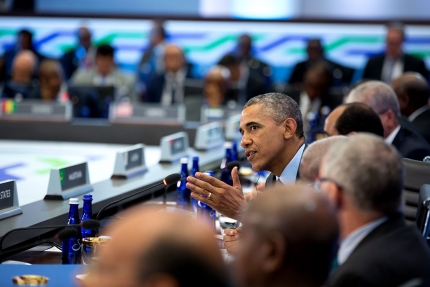
President Barack Obama delivers remarks at the “Investing in Africa’s Future” session during the U.S.-Africa Leaders Summit

President Barack Obama delivers remarks at the “Investing in Africa’s Future” session during the U.S.-Africa Leaders Summit at the U.S. Department of State in Washington, D.C., Aug. 6, 2014. (Official White House Photo by Pete Souza)

President Obama and African leaders took part in three action-oriented sessions today as part of the U.S.-Africa Leaders Summit in Washington, D.C. The summit is the largest event any U.S. president has held with African heads of state and government, and builds on President Obama's trip to Africa last summer.

In remarks at this morning's opening session, the President explained the purpose of the event and noted the progress across the African continent -- and what that means for America:

We come together this week because, even as the continent faces significant challenges, as I said last night, I believe a new Africa is emerging.  With some of the world’s fastest-growing economies, a growing middle class, and the youngest and fastest-growing population on Earth, Africa will help shape the world as never before.

Moreover, Africa’s progress is being led by Africans, including leaders represented here today.  More governments are embracing economic reforms, attracting record levels of investment.  Gains in development, increasing agricultural production, declining rates in infectious diseases are being driven by African plans.  African security forces and African peacekeepers are risking their lives to meet regional threats.  A new generation of young Africans is making its voice heard.  

Africa’s rise means opportunity for all of us -- including the opportunity to transform the relationship between the United States and Africa.  As I said in Cape Town last year, it’s time for a new model of partnership between America and Africa -- a partnership of equals that focuses on African capacity to solve problems, and on Africa’s capacity to grow.  And that’s why we’re here.

A Conversation with The First Lady and Mrs. Laura Bush

August 06, 2014 | 47:44 | Public Domain

During the U.S.-Africa Leaders Summit Symposium for African Spouses, the First Lady and Mrs. Laura Bush took part in a moderated conversation with NPR’s Cokie Roberts.

Download mp4 (1760MB) | mp3 (46MB)

Read the Transcript

A Conversation Between First Lady Michelle Obama and Mrs. Laura Bush Moderated by Cokie Roberts at "Investing in our Future," a Symposium for Spouses on Advancements for Women and Girls in Africa

The Kennedy Center for the Performing Arts
Washington, D.C.

10:17 A.M. EDT

MS. ROBERTS:  Well, I am so excited that we get to do this again.

MRS. BUSH:  We did this last summer in Dar es Salaam.
 
MS. ROBERTS:  In Tanzania.  And thank you so much for that.  It was a wonderful, wonderful experience for all of us to be there with you.  So thank you for hosting us last year.  And thank you for hosting us this year.  So here we are.

MRS. OBAMA:  It’s my pleasure.

MS. ROBERTS:  But it is -- I remember, as I recall, when were -- last year you were still getting blowback about your bangs.  (Laughter.)

MRS. OBAMA:  Yes, that’s over.

MRS. BUSH:  That’s an important issue.  (Laughter.)
 
MRS. OBAMA:  Let’s see what they say about this one.

MS. ROBERTS:  But the program -- you have bangs in the program, I just have to -- (laughter) -- and since then, your daughter has turned 16. 

MRS. OBAMA:  Yes, I know.  (Laughter.)
 
MS. ROBERTS:  I know, but I have to tell you, I am envious to anybody who’s had a daughter turn 16, as envious to have it happen in the White House where you kind of can keep an eye on her.

MRS. OBAMA:  We can share the experience with the world.  (Laughter.)  All the pain and pleasure that goes along with it.

MS. ROBERTS:  I remember Lucy Johnson, President Johnson’s daughter, saying when she turned 16 in the White House and got a driver’s license, she said, it was permission to drive a motor vehicle.  That’s all it was.  (Laughter.)  For most people, a driver’s license is freedom.

MRS. OBAMA:  That’s right.  That’s right.

MS. ROBERTS:  But you’re experiencing it well, right?

MRS. OBAMA:  The girls are growing up.  And as Laura and the President know, that it is a true testament to the parents to raise wonderful young people through this experience.  And we have had some terrific role models -- Jenna and Barbara are just amazing young women who are doing extraordinary things, not just in this country, but around the globe.  And once again, they’re setting a high bar.  But the girls are doing great.  I’m very proud of them.

MS. ROBERTS:  And you have a grand-baby, a girl.

MRS. BUSH:  That’s right.  We have our first grand-baby.  Yes, exactly.  (Applause.)  Our darling little Mila.  George and I are just gaga over our baby.
 
MRS. OBAMA:  How old is she now?

MRS. BUSH:  She’s 16 months.
 
MRS. OBAMA:  Oh, she’s doing real things.

MS. ROBERTS:  Also 16.

MRS. BUSH:  Yes, exactly -- 16 months.  She’s doing great.

MS. ROBERTS:  So we just saw that very important video.  And, Mrs. Obama, you spoke last week to the Young African leaders, and you were very strong in your statements about the need for educating girls and treating women and girls with dignity and equality.  Why did you choose to do that?

MRS. OBAMA:  Well, so often what we find in our positions is that you can -- you have to change attitudes before you can change behaviors.  And one of the things I said to the young people, that we can talk about the need for more resources as it comes -- when it concerns girls’ education, the need for school fees and the need to improve transportation.  But the bottom line is that until men, leaders, women, until we value women and girls, we won’t tackle those other problems.  Until we prioritize our girls and understand that they are as important and their education is as important as the education of our sons, then we will have lots of work to do. 

And I wanted to just implant that notion in the minds of these young leaders, because they have to approach their work with a whole new attitude.  And one of the things I asked the young men is that you have to be introspective and ask yourselves whether you truly believe that women can be your equal.  And in sharing my story, just understanding the power of having men in my life who valued me and put me first and treated me with respect and didn’t abuse me, and didn’t talk down to me -- I want young men around the world to understand that they have a role to play alongside women who are fighting for these rights, and I want our young men to understand this at an early age.  (Applause.) 

MS. ROBERTS:  Mrs. Bush, you have been working on this issue for a long time, particularly with women of Afghanistan.  And are you still doing that?  Tell us about where --

MRS. BUSH:  Yes, we’re still working on that.  After September 11th, when the spotlight turned to Afghanistan and we in the United States looked at the way women in Afghanistan were treated, many, many people, women and men in the U.S., were concerned.  And that’s when I first started working with women in Afghanistan. 

And Mrs. Obama is right -- in fact, one person said to me one time, why are you working with women, it’s men who have the problem.  (Laughter.)  And I think we do need to make sure worldwide that all humans are valued -- that women and men are valued, that girls and boys are valued, and that human life is valued.  I think that’s really the most important thing we can do, all of us can do, is try to increase that knowledge worldwide that every life is precious.

MS. ROBERTS:  And of course on this question, the question of girls’ education and women’s health and all that, we have so much data now that shows that if you educate a girl, you save a country.  So are you finding that you’re able to keep working on that, that that’s something you’re able -- because one of the questions I got last year after you all finished talking and I stayed for a couple of days from these wonderful women was, how do you keep it going?

MRS. BUSH:  Well, one of the things we’ve done, George and I have done -- obviously when you live in the White House you have a platform.  But former First Ladies and former Presidents continue to have a platform and a convening power, and we’ve tried to do that with the First Ladies Initiative that we started last summer with the first conference in Dar es Salaam, and that is to bring together First Ladies really from around the world. 

We started with African First Ladies but we’re interested in engaging women from every -- First Ladies from every country to talk about the very unique platform that the spouses of world leaders have to help the women in their countries, to make sure that everyone is paying attention to the education of boys and girls in their country, and that we’re making sure that women have the opportunity to be involved in the economic life of their country. 

Because only countries where all people are involved can be successful.  When we look around the world and we see countries where half of the population is marginalized or left out, then we usually see countries that are failing.  So it’s important to keep talking about that.

MRS. OBAMA:  And it’s important, as I said in my opening remarks, to make room for the next generation of leaders.  Because one of the things that the young people said to me, as I mentioned, is that they asked me to ask the first spouses to make room for them because they’re looking for a place at the table.  And they specifically said that when you meet with the spouses of our country, tell that we want to help, that we want a voice, and that we’re looking to them.  They’re looking to all of us to provide that seat. 

And that’s where that platform that Mrs. Bush speaks of, why it’s so important.  Because these young people, they believe that we -- they get their inspiration from us.  They’re looking to us.  They still don’t quite know that they have the expertise and the skills already, they think we know more.

MS. ROBERTS:  We actually do.  (Laughter.)

MRS. OBAMA:  We do, we do.  But when you listen to just the opening speakers, when you think about social media -- I mean, just listening to the hashtags and the Twitter accounts -- I mean, that was a little nutty.  (Laughter.)  But it’s how you continue the conversation.

MS. ROBERTS:  And globalize it.

MRS. OBAMA:  And globalize it.  And young people are just more adept at that.  And they can -- as I tease my kids, I tell them I want them to use Instagram to take a picture of something really important rather than their food.  (Laughter.)  But young people can be a support to us.  I mean, no one really cares what you had for lunch.  (Laughter.)

MS. ROBERTS:  Well, you both talked last year when we were having this conversation about shining a light on an issue, and that you -- in this unique position, that you have the opportunity to shine the light.  At some point, people stop looking at what you’re wearing and see what you’re aiming at. 

One of the questions I get all the time is, how do you choose?  How do you choose what issue to shine a light on?  Now, you knew when you came in that you wanted to do something about military families, but it was kind of inchoate, right?  You expected to do something about early childhood education and cognition, and of course, September 11th changed all of that.  How do you put it together to decide exactly what you’re going to do?

MRS. BUSH:  Well, I think you look at yourself and see what your expertise is.  When I came to the White House, I was a -- had been a librarian.  I loved to read.  I had been a teacher.  And so, education and literacy were very, very obvious interests of mine and expertise of mine, so what’s I started with.

But then, also you look at what appears, and are there ways you can take advantage of different things that happen to go in another way.  I got a phone call, for instance, from the head of the National Heart, Lung and Blood Institute here in Washington and she said, did you know that heart disease is the leading cause of death among American women?  And I didn’t know that.  I just had assumed cancer was the leading cause of death among American women.  So I knew if I didn’t know that heart disease was the leading cause of death, that many American women didn’t know that either.

And so I was presented with the opportunity to talk about The Heart Truth and to get the word out to American women that heart disease was the leading cause of death so that they could start doing things, because heart disease is often preventable.  But also, if you know that you might have a heart attack, it wouldn’t just be your husband that had a heart attack, then you can rush to the hospital yourself and get the kind of treatment that you would demand for your husband but you might not realize you would need it yourself. 

So I think there are both ways, both look to your own expertise and then just take advantage of other interests that come up and see if you can make a difference in your countries.

MRS. OBAMA:  Also, where your passions lie.  Because I’ve found that I’ve been most effective when I am uniquely authentic, there’s an authenticity to what I say.  So that means I have to really believe passionately in the causes that I take on.  And that lends itself to more power, more effectiveness.  It just makes you a better advocate, because this is something you care deeply about.  This was true when it came to the issue of educating our young people. 

I just started an initiative this year, Reach Higher, because one of the things I’m deeply passionate about is the role that education has to play in the lives of our young people.  And my story is the story that I try to share with young people to motivate them.  There is nothing in my life that would indicate that I would be sitting here on this stage with a former First Lady and one of the most renowned journalists and every first spouse in Africa.  (Laughter.)  Nothing in my life indicated that.

But my parents believed in the value of education, even though they were not educated themselves.  And they pushed my brother and I to do the best that we could do.  So what I want young people in America to understand is that we are blessed in this country to have public education, to have opportunities that many girls around the world are putting their lives at risk to achieve.  So it’s incumbent upon us here in America to take advantage of every opportunity.  And young people have to own their education.

I can do that because I believe it.  It is my story.  It is why I’m sitting here.  And my hope is that I can start a national conversation about reigniting that hunger for education in our young people and using that to talk about the issues that our girls around the world are facing with 60 million girls today not in school, 30 million of those in Sub-Saharan Africa.

I want our young people across the globe to be talking about how do we fix that.  So that's just an example.  I’m clearly passionate about that.  (Laughter.)

MS. ROBERTS:  But one of the things that we’re going to do today in the various panels is how-to, essentially.  And you all have done the how-to.  And part of that is private-public partnerships.  And on all of your initiatives it seems to me that you’ve both done that; that you’ve brought in universities, companies, foundations, whatever combination of things works.  Can you talk about it, for instance, with Helping America’s Youth?

MRS. BUSH:  Sure.  Helping America’s Youth was one of my initiatives.  And I traveled around the country and had summits, actually conferences in many parts of the United States with all of the youth-serving agencies, types of agencies -- from individual foundations that people had to individuals themselves; two men, for instance, who used sports to teach character building in Seattle and worked with sports groups because they knew they could attract boys, and then they attracted their mothers there because their mothers would bring the boys to their sports practices.  So they would talk about sportsmanship in a way that really talked about life, and the way that people can use all the characteristics of a good sport to also be a good person.

But what they discovered, then, was that their mothers were, in many cases, single mothers.  They didn't have a community really of their own.  And so they started -- after the sports games, they would have barbecues so the mothers could meet each other and be with each other.  And really, they were out to help the boys, but found out they helped the whole family with this one agency -- or one foundation that these two men started.  And that's just one example of many, many others that were part of Helping America’s Youth.

MS. ROBERTS:  And helping people get off of drugs or not get into drugs.

MRS. BUSH:  That's right. 

MS. ROBERTS:  And it seems to me in some ways you’ve built on that with Let's Move.  It is being preventatively healthy all along.  So talk to us a little bit about how you’ve put that together.

MRS. OBAMA:  For those of you who don't know, Let's Move is my initiative to end childhood obesity in a generation.  And we have really relied greatly on public-private partnerships because what we all have to understand is government has limits -- limited resources, a limited base of power.  People look to government and think that government can do everything, but many of the solutions that we’re trying to achieve require the involvement of the nonprofit sector and the private sector.

So we’ve really enlisted companies to market food differently to kids so that they are not marketing unhealthy products.  We’ve enlisted sports organizations to get kids up and moving, try to invest in more sports in communities that are underserved.  Whether it’s the U.S. Tennis Association or the NBA or what have you, many of these private players have been very eager to step up and partner with us to achieve this goal, because we all have an interest in making sure that the next generation is as healthy as possible.  We spend billions of dollars in covering obesity-related illnesses, and all of these illnesses are completely preventable with good diet and nutrition, exercise.

So what we have said to many of our partners is that we all have an interest in this, and there’s a way that we can all do well by doing good.  We can -- companies can still be profitable by creating foods and educating parents and families to help them make better choices about what they feed their kids. 

MS. ROBERTS:  I must say, with teenage daughters, though, it must be -- I would suspect that sometimes they say to you, let’s move, mom.  (Laughter.) 

MRS. OBAMA:  Yes, you’ve been sitting at our dining room table, Cokie?  (Laughter.)  Well, you know, every teenager has a little smart aleck in them, it’s true. 

But one of the things we’ve found in our household is that kids listen.  They take on these new messages even when we don’t think they’re paying attention.  And that’s one of the things that we try to tell parents, is that they don’t -- you don’t know that they’re listening, but I see how my children make different decisions about what they eat now as teenagers now that they have control because they have the information about how food affects their overall health and their ability to perform.  But it’s our job to empower parents and families to make the choices that are best for them. 

MS. ROBERTS:  You’ve gotten some blowback for it, which to some ways --

MRS. OBAMA:  Surprising.  (Laughter.)  Blowback, right?

MS. ROBERTS:  Don’t worry, that was --

MRS. OBAMA:  I don’t know. 

MRS. BUSH:  No good deed goes --

MRS. OBAMA:  Right.  (Laughter.) 

MS. ROBERTS:  That was just where I was headed.  I know that you both get into these things and you’re doing them for the good of the country, and suddenly you get criticized for it.  And it must just be such a shock in a way. 

MRS. BUSH:  Well, I was not that shocked.  (Laughter.)  Remember, we had somebody that lived in the White House that we watched very closely that we loved -- President Bush and Barbara Bush.  And so I was very aware when George ran for President that you’re always going to be characterized in a way that you aren’t, really.  And so I don’t think it was any big surprise to me.  That doesn’t make it any less hurtful. 

But on the other hand, I think anyone who’s in a leadership position of any sort knows that you’re going to be criticized and a target, really, for criticism. 

MRS. OBAMA:  That’s absolutely true.  And that’s really the role of leadership.  It’s not about amassing power; it’s taking some of those hits and continuing to do the work, even when it’s painful and sometimes unappreciated. 

But that’s why it’s important for all of us to have a vision as first spouses.  Because if you have your vision and you know what you’re passionate about, and you know what direction you’re going in, then all of the arrows and the spears and the criticisms, they just -- they bounce off of you because you keep doing the work every day.

MS. ROBERTS:  They might pinch a little.

MRS. OBAMA:  They might pinch a little bit.  You might get shot in the eye.  You just sort of go to the doctor, patch yourself up and get back in the game. 

MS. ROBERTS:  Well, I think that’s an important message for people to hear, because it’s hard to do what you all are doing.  And you talked about “it’s not about amassing power” -- it’s certainly not for the spouses.  It’s not being in that role, and still, you get the criticism.  So it’s important to say that you’ve lived through it.  (Laughter.)

MRS. OBAMA:  Well, and everyone comes to these positions with different temperaments.  And watching Mrs. Bush, she has been able to traverse all of this with a level of grace and kindness and compassion.  Just seeing how our transition worked -- and we talked about this in Tanzania -- that people are who they are.  I said this in my convention speech about the President -- being President doesn’t change who you are, it reveals who you are.  And that’s true for first spouses as well.

You come to this with a temperament.  Some people are shy and never want the limelight; other people are much more outgoing and maybe a bit more aggressive and able to withstand the heat of the spotlight that shines on us.  But I think that all of us, we have to bring what is uniquely us to the table and work within that.  And that’s sometimes what people around the world don’t understand.  First spouses, we don’t choose this position, we just happen to be in it, and we do the --

MRS. BUSH:  We’re elected by one man.  (Laughter.) 
 
MRS. OBAMA:  Right, right.   

MS. ROBERTS:  And you can’t be fired. 

MRS. OBAMA:  Can’t be fired. 

MRS. BUSH:  We certainly hope not.  (Laughter.) 

MRS. OBAMA:  I guess we’ll see.  (Laughter.) 

MS. ROBERTS:  Well, one of the things that is unique is your voice as women, and you both talked about that last year.  I went back and looked at -- you were both quite eloquent about how important it is for women to use to your voices and your power.  And I think, Mrs. Obama, you said, we’re not complicated, but we’re complex.  And I think that’s a good way of putting it.  But again, Mrs. Bush, why is it important for women’s voices in this particular position to be heard?

MRS. BUSH:  For the First Lady, well, I think it’s important because the First Lady has an opportunity really to talk about what is most interesting to her and what she thinks she can help -- the ways she thinks she can help her country and the people in her country the best.  I love to quote Lady Bird Johnson, who said, the First Lady has a podium and she intended to use it -- and she did.  She was another Texas First Lady, and I admired her from a distance.  I didn’t know her then, but got to know her later when George was governor and we lived in Austin.

But she really did, she used what she loved.  And she happened to love native flowers and the natural beauty of our country.  And she made a huge difference. 

MS. ROBERTS:  Well, and Head Start. 

MRS. BUSH:  The daffodils that you see blooming here along the George Washington Parkway were planted because of Lady Bird Johnson.  But, yes, she used education and civil rights.  And she was a southern First Lady, so it was very important for her to speak out about civil rights, and she did.  She campaigned all across the South for the civil rights laws that were passed and signed during President Johnson’s administration. 

MRS. OBAMA:  Once again, I always go back to young people.  We meet -- I know I do -- we meet thousands of just wonderful young people in our countries and around the world.  And to have a seven year old or a 12 year old walk up to you or send you a letter and tell them thank you for what you do, I look up to you, you inspire me.  That reminds us all that whether we like it or not, we are role models.  And as women, we have -- the young girls in our worlds, in our countries, they’re looking to us.  They’re looking to us for how we should be, how we should think, how to use our voices.

And as a result, we have a responsibility to show them the way in whatever way we can.  And that may be something as simple as embracing a child on the line and telling them that they’re beautiful and that you’re proud of them, and that you know that they’re important and they’re valued.  I think about that, because every time I meet a child I think, who knows what’s going on in her life, whether she was just bullied or whether she had a bad day at school or whether she lost a parent -- that interaction that we have with that individual, that child for that moment, could change their life. 

So we can’t waste this spotlight.  It is temporary and life is short, and change is needed.  And women are smarter than men.  (Laughter and applause.)

MS. ROBERTS:  That just goes without saying.  (Laughter.)

MRS. OBAMA:  And the men can’t complain, because you’re outnumbered today.  (Laughter.)

MS. ROBERTS:  But Mrs. Bush, you’ve talked about that before, too, that it’s a temporary spotlight.  But you are now working hard to carry it on.  And I think that sense of continuity is very important, so you have the George W. Bush First Ladies Initiative, you have the Global Women’s Initiative, the women for Afghanistan -- you’re keeping going. 

MRS. BUSH:  We are continuing to work, both George and I are, through the George Bush Institute, which is in Dallas now at the Bush Library and Museum.  And it gives both of us a chance to keep working on the issues that were the most important to us.  Pink Ribbon Red Ribbon is our global health initiative.  Many of you already know about that.  We’ve launched in three countries in Africa, and we’re going to hear about some more in a few minutes. 

Because PEPFAR was started while George was President, the President’s emergency plan for AIDS relief, we wanted to be able to continue a global health initiative that builds on PEPFAR.  And when we looked at the cancer numbers across Africa, and really across the world, and saw that cervical cancer -- which is preventable -- is the leading cause of cancer death among African women, we figured out there was a way we could use the PEPFAR platform that’s already established and add the testing and treatment for cervical and breast cancer to PEPFAR. 

And so, that’s our global health initiative.  It’s given us a way to keep building.  And we have a number of terrific partners who are in the room, so thank you all to all the partners, and thanks to the First Ladies in the countries where we’ve already launched and where we’re getting ready to launch.

MS. ROBERTS:  I just thought that was such a smart initiative, because it really does combine so many elements that are just sensible, which is another thing women are good at.  But the fact is, is that you had the PEPFAR clinics, so the women were already coming in, but you needed -- since breast cancer isn’t caused by the same diseases, you needed to get somebody else in so you got Susan G. Komen and the pharmaceutical companies in.  And it’s really now turned out to be a total women’s health platform.  

MRS. BUSH:  It is, really.  And it’s partnering, obviously, with the U.S. government as well, using the -- U.S. State Department is our partner, because we are using the PEPFAR platform to add.  And the great news is that cervical cancer really can be treated -- not when it’s advanced, which is why it’s so important that women come to be screened early on and then be treated.  And then, the vaccination programs with the HPV vaccination is important.  And I think many African First Ladies are trying now to manage these vaccination programs, so that we really won’t even have to worry about cervical cancer when these girls who are vaccinated grow up. 

Q    And do you think about that, Mrs. Obama?  I know you’re still right in the middle of it.

MRS. BUSH:  I hope you’re not thinking about that, yet. 

MRS. OBAMA:  Oh, no, not at all.  Not at all.  (Laughter.)

MS. ROBERTS:  But about how you can carry on some of these -- and talk about some of your other initiatives too while you’re doing it, because you have done these private-public partnerships, particularly around the military families.

MRS. OBAMA:  Well, Dr. Biden and I, we started Joining Forces, which is a nationwide effort to provide the support, respect to our men and women in uniform and their families.  We have worked with private companies to create jobs as these men and women transition to civilian life, working on making sure they get the education benefits, all the support that they should expect having put their lives on the line and their families’ lives on hold.

MS. ROBERTS:  And the medical schools -- you’re working with medical schools too?

MRS. OBAMA:  Well, nurses are becoming trained to be able to identify and support men and women who may have post-traumatic stress disorder; just educating the entire country on what PTSD means, trying to de-stigmatize it so that these men and women feel like they can seek help when they need it.  All of that has been -- it is a passion for both Jill and I.

Jill is a Blue Star Mom, and she proudly says that.  She has grandchildren who she has seen grow up while her son Beau was deployed, so it’s truly a passion for her.  And for me, this is something that I’m going to do long after we leave the White House, because these needs will always be there.  And as I’ve been able to see through former first spouses and former Presidents, that the platform is -- it continues.  And that's something that I would encourage all of you to think about as well, is how do you sort of lay the foundation for the legacy that you want to create for yourselves.

And I think as women, we shouldn’t be afraid to talk about our legacies, what we want to leave behind in the work that we do.  Yes, there are so many important, symbolic responsibilities that we have in our roles, but there is nothing wrong with thinking about legacy and what we want to leave for the world. 

But that takes planning.  It takes coordination.  It takes partnerships.  And I don’t think that we should be afraid as women to have those conversations.  It’s too soon for me to do it now -- (laughter) -- but the time will come and I will embrace that, because what I’ve seen from the Bush family is that there is a level of freedom that also comes after you’re out of the spotlight; it’s a new spotlight, it’s a different spotlight.  But I think that there is more that you’re able to do outside of office oftentimes than you can do when you’re in office.

MS. ROBERTS:  Except you don’t have the same -- I remember you saying at one point, Mrs. Bush, you could pick up the phone and call a member of Congress and get something done.  (Laughter.)

MRS. BUSH:  Yes, exactly.  (Laughter.)

MS. ROBERTS:  But I also just want to come back because we are at an African summit and both of you have exhibited such a strong interest in Africa, and I think you have very much helped to shine a spotlight on the continent and caused us all to learn a great deal more about the good news that’s going on in Africa.  But I’m kind of wondering how you got there.  I mean, Mrs. Bush, I know you were in 75 countries when you were First Lady, which is a lot, but why Africa?

MRS. BUSH:  Well, obviously, it started with PEPFAR.  When George launched PEPFAR in 2003, remember what it was like -- people were dying every single day all across Africa.  It was a huge pandemic that was going to leave a continent of orphans if no one did anything about it.  And so George saw that it was really important for the United States to be actively involved in helping in Africa.  It was so important for us, as the wealthiest country in the world, both because we could, but also because we should morally try to save as many lives as possible.

So I went on that trip with George in 2003 when PEPFAR was launched.  And our daughter Barbara was with us as well, and she has really made her life choices because of that trip.  She is now the head of Global Health Corps, she engages young people from every part of the world.

MS. ROBERTS:  She created it, right?

MRS. BUSH:  She created Global Health Corps, founded it to engage young people to work in the health field.  And she has Global Health Corps fellows in Africa and also here in the United States. 

But I think because of that first trip and because of PEPFAR, we just got a huge interest in Africa and traveled there many times, and of course have traveled there many times since we’ve been home.  We just had a wonderful trip this last March -- a private trip, not a business trip -- to Ethiopia to visit the Christian sites in Ethiopia.  So Africa has become a very important continent to us, partly because of that, because of PEPFAR, but just also because of our experiences there.

MRS. OBAMA:  And Africa is an important continent to the rest of the world.  Its success is integral to the success of this nation, the United States and the world.  And it is an under-valued, under-appreciated continent.  So it is incumbent upon the world to have a better understanding of what Africa has to offer.

The importance of Africa is very personal to me because, as the President said last night in his toast, Africa is home for us.  His family is there.  We have relatives there.  We have visited the continent on several occasions.  We have taken our daughters back to his grandfather’s village and they have seen a part of themselves. 

So the partnership with this continent means a great deal to us.  And we've seen the power, the potential -- I mean, to meet these young leaders and to see how hungry they are to take their countries to a new level, that kind of passion is infectious, and it's something that young people here should know and understand.

We want people from America to travel to Africa, to understand its languages and its different cultures, and not to see it as a monolith, and to truly see the investment opportunities -- which is one of the reasons why this summit has been so important, because it hasn’t just been a conversation with world leaders, but some of the nation’s most powerful businesses are here; some of the most prestigious non-profits are here.  That's why today’s session is so important, because our success as a nation is directly tied to the success of Africa.  And now it is time for the United States as a whole to embrace that reality. 

So this is the beginning of a lot of work that needs to be done, but it is -- we are encouraged and we are optimistic.

MS. ROBERTS:  Well, I think this week has been very instructive for the whole country.  I really do.  It was wonderful to be in Africa, but to have African leaders here in the United States is educating the country about what is going on there. 

But I am going to end where we began, which is that as good as the news is coming out of much of Africa, it won't be as good as it can be until we do more about the girls. 

MRS. BUSH:  That's right.

MS. ROBERTS:  And if you all want to just say a finishing word on that subject, and then we will conclude.

MRS. BUSH:  Well, let me just thank you.  Thank you very much.  Thank you, Michelle, and thank you to President Obama for hosting the African Leaders Summit here.  And thank you for inviting the Bush Institute to be a part of the First Lady’s initiative.  Thank you for coming to our First Lady’s Conference last summer as well. 

And thanks to all the First Ladies who have joined us.  Thank you for the great work you're already doing in your countries, which we'll hear about in a few minutes.  And thank you for all the good work you will do. 

Thanks, Cokie.  (Applause.) 

MRS. OBAMA:  Well, thank you.  Back at you.  (Laughter.)  But, Laura, no, absolutely.  We are here today because of the example that was set in Tanzania through the summit that the Bush Institute organized.  And as my Chief of Staff stated, that when this summit was being organized, we jumped at the chance to do something similar and to continue this conversation and to come together as first spouses, and to continue to be inspired by each other.

What I would say just in closing is that we have to fight for our girls.  There should never be a girl in this world who has to fear getting educated.  That should be something that is intolerable to all of us. 

I can only think of my own girls, and I think we all have to see our daughters in these young girls.  We want the best for our daughters.  We want them to be smart and empowered and loved.  We want them to be healthy.  We want them to be mentally sound.  And if it's good enough for our girls, it's good enough for every single girl in the world.

But it's going to take leadership like us, women like us speaking up in our countries and making sure that young girls are not subject to abuse, and that they are loved and valued.  And until we do that, we will not solve these problems.  Investing in our women -- the people who raise our children, the people who take care of families -- they have to be healthy and whole.  And that is the most important work that we do.  Whether we talk about clean energy or economic empowerment, until we start to value women and girls, we will continue to struggle on this planet.

But I have high hopes when I look around this room that we won’t tolerate that, not anywhere on the planet.  And if we continue to work together and continue to lift up our young people who we’re fighting for a better future, then I think we will see some progress on these issues. 

So I look forward to working with all of you in the years ahead.  So thank you all, and I hope you enjoy the rest of the conference. 

Cokie, thank you.  Thank you, as well. 

MRS. BUSH:  Thank you.  (Applause.)

MS. ROBERTS:  Thank you both so much for the work you’re doing, first of all, for coming together.  I keep saying you’ve set such a good example for the men.  (Laughter.)  But also for allowing me to participate in this conversation.  Thank you very, very much.  (Applause.)

END
10:55 A.M. EDT

Close Transcript

The White House

Office of the First Lady

Investments Announced at Symposium for African Spouses Hosted by First Lady Michelle Obama and Former First Lady Laura Bush

More than $200 million committed to programs that will empower more than 1 million people in Africa

Today, the Office of First Lady Michelle Obama, the George W. Bush Institute, and the U.S. Department of State hosted a day-long symposium for spouses entitled Investing in Our Future at the U.S.-Africa Leaders Summit.

The symposium brought together First Lady Michelle Obama, Mrs. Laura Bush, African first spouses from nearly 30 countries, leaders from non-governmental and non-profit organizations, private sector partners, and other leading experts.

President George W. Bush delivered remarks at the event, announcing the expansion of the Pink Ribbon Red Ribbon® initiative and the important role of national leadership, including that of a First Spouse, in galvanizing a country to make the fight against women’s cancers a priority.

The symposium highlighted the important role first spouses play and focused on the impact of investments in education, health, and economic development through public-private partnerships.

The investments announced at the symposium total more than $200 million to support programs fostering improved education, health, and economic opportunity for more than 1 million Africans across the continent. Some of the announcements include:

  • The U.S. President’s Emergency Plan for AIDS Relief (PEPFAR), in partnership with the Children’s Investment Fund Foundation (CIFF), launched Accelerating Children’s HIV/AIDS Treatment (ACT).  ACT is an ambitious $200 million initiative ($150 million from PEPFAR and up to $50 million from CIFF) to double the total number of children receiving life-saving antiretroviral therapy (ART) across ten priority African countries over the next two years.  This will enable 300,000 more children to receive ART.
  • Caterpillar Foundation announced a partnership with the U.S. Department of State’s African Women’s Entrepreneurship Program (AWEP) to create the first ever AWEP-Women’s Entrepreneurial Centers of Resources, Education, Access, and Training for Economic Empowerment (WECREATE) in sub-Saharan Africa.  Caterpillar Foundation and the U.S. State Department are providing $1 million each to create these self-sustaining women’s business centers where women can gain the tools, resources, support and education they need to become successful entrepreneurs and exporters. By being in control of their own financial destiny, women helped by the Centers will help to end the cycle of poverty faced by many girls and women in developing countries and catalyze economic development, prosperity and job creation in their respective countries.
  • Intel announced a new collaboration with the U.S. Agency for International Development (USAID) called the Women and the Web Alliance. The Alliance will catalyze a group of partners to address the gender and Internet gap by bringing more than 600,000 young women online in Nigeria and Kenya in the next 3 years. The Alliance consists of USAID, Intel, NetHope, World Pulse, World Vision, UN Women, and Women in Technology in Nigeria, combining efforts to transform girls’ and women’s lives and livelihoods in Africa through digital literacy training, relevant content, policy work, and online social networks.
  • The MasterCard Foundation announced that nearly 6,000 of the 15,000 students it has pledged to support with The MasterCard Foundation Scholars Program, predominantly from Africa, will be enrolled in high school and university by December 2014. By the end of the 10-year initiative, 75% of the Scholars will be girls and young women.
  • Walmart, through its Global Women’s Economic Empowerment Initiative, has committed to train one million farmers, half of which will be women, by the end of 2016. Today, through $3 million in grants and in partnership with leading NGOs and USAID – which is working with the Feed the Future initiative – Walmart is accelerating the pace of training and aiming to deliver training to more than 135,000 farmers - 80,000 of which will be women - in Kenya, Rwanda, and Zambia. Kenyan farmers taking part in the program should see farm incomes double in just one growing season.
  • Additionally, six organizations made formal commitments to support Pink Ribbon Red Ribbon’s expansion into Ethiopia and Namibia. Their contributions toward Pink Ribbon Red Ribbon’s expansion comes in the form of financial commitments totaling nearly $3 million, and in-kind donations or assistance.

African First Ladies speaking in the program included: Mrs. Roman Tesfaye, First Lady of The Federal Democratic Republic of Ethiopia; Mrs. Lordina Mahama, First Lady of The Republic of Ghana; and Mrs. Penehupifo Pohamba, First Lady of The Republic of Namibia.

Other program participants included: Deputy Secretary Heather Higginbottom, U.S. Department of State, Ambassador Deborah Birx, U.S. Department of State, Ambassador Cathy Russell, U.S. Department of State; Jamie Cooper, Children’s Investment Fund Foundation, Cherie Blair, Cherie Blair Foundation for Women; Shelly Esque, Intel Foundation; Ann Cotton, Camfed International; Dr. Sara Ruto, Uwezo; Reeta Roy, The MasterCard Foundation; Madame Aicha Bah Diallo, Foundation for African Women Educationalists; Isha Sesay, CNN International; Noa Gimelli, ExxonMobil; Neha Misra, Solar Sister; Kay Kuenker, Dow AgroSciences; Damaris Achieng Odeny, International Crops Research Institute for the Semi-Arid Tropics; Deb Elam, GE Foundation; Bernard Olayo, M.D., Center for Public Health and Development; and Maggie Sans, Walmart Foundation

About the Bush Institute:

The mission of the Bush Institute at the George W. Bush Presidential Center is advancing freedom by expanding opportunities for individuals at home and across the globe. The Bush Institute is a non-partisan public policy institute committed to serious, independent research aimed at generating practical solutions to important public policy issues in the areas of education reform, human freedom, economic growth, and global health. Built on principles that guided President and Mrs. Bush in public life, the Bush Institute seeks to improve America’s public schools; foster the spread of democracy; save lives through global health programs; and promote free markets and economic growth. The Women’s Initiative works to improve access to education, health care, and economic opportunity for women and children around the world, and the Military Service Initiative honors our servicemen and servicewomen and helps them transition to civilian life.

About the First Ladies Initiative:

The First Ladies Initiative is a program of the Bush Institute’s Women’s Initiative, which helps prepare First Ladies’ senior advisors and staff with training sessions on effective governance, strategic planning, and communication, and also fosters public-private partnerships by connecting First Ladies with funding partners, corporations, and NGOs. These efforts help First Ladies effectively use their unique platforms to promote issues and programs that improve the lives of women and children in their countries, with an initial focus on Africa.

About Pink Ribbon Red Ribbon:

Pink Ribbon Red Ribbon® is the leading public-private partnership aimed at catalyzing the global community to reduce deaths from cervical and breast cancer in sub-Saharan Africa and Latin America by raising awareness of these diseases and increasing access to quality services to detect and treat them. Its activities integrate prevention—including increased access to vaccination against the human papillomavirus (HPV)—screenings, and treatment into existing healthcare programs. Organizing members of the partnership include the George W. Bush Institute, the U.S. President’s Emergency Plan for AIDS Relief (PEPFAR), Susan G. Komen®, and the Joint United Nations Programme on HIV/AIDS (UNAIDS). Corporate and foundation members include Becton, Dickinson and Company; the Bill & Melinda Gates Foundation; the Bristol-Myers Squibb Foundation; the Caris Foundation; GlaxoSmithKline; IBM; Merck; and QIAGEN.

About the Young African Leaders Initiative:

The Mandela Washington Fellowship is the flagship exchange program of the President’s Young African Leaders Initiative (YALI) and embodies President Obama’s commitment to invest in the future of Africa. The first class of Mandela Washington Fellows arrived in June 2014 for six weeks of intensive executive leadership training, networking, and skills building, followed by a Presidential Summit in Washington, DC.  Regional Leadership Centers in Africa, seed funding, mentoring, and a vast array of virtual resources will provide sustained support to the Fellows upon their return to the continent.  The YALI Network provides online and on the ground platforms, programs, and resources for tens of thousands of young African entrepreneurs, activists, and public officials.  Through YALI, young African leaders gain the skills, connections, and investments they need to accelerate their initiatives and contribute more robustly to strengthening democratic institutions, spurring economic growth, and enhancing peace and security in Africa.

The White House

Office of the First Lady

A Conversation Between First Lady Michelle Obama and Mrs. Laura Bush Moderated by Cokie Roberts at "Investing in our Future," a Symposium for Spouses on Advancements for Women and Girls in Africa

The Kennedy Center for the Performing Arts
Washington, D.C.

10:17 A.M. EDT

MS. ROBERTS:  Well, I am so excited that we get to do this again.

MRS. BUSH:  We did this last summer in Dar es Salaam.
 
MS. ROBERTS:  In Tanzania.  And thank you so much for that.  It was a wonderful, wonderful experience for all of us to be there with you.  So thank you for hosting us last year.  And thank you for hosting us this year.  So here we are.

MRS. OBAMA:  It’s my pleasure.

MS. ROBERTS:  But it is -- I remember, as I recall, when were -- last year you were still getting blowback about your bangs.  (Laughter.)

MRS. OBAMA:  Yes, that’s over.

MRS. BUSH:  That’s an important issue.  (Laughter.)
 
MRS. OBAMA:  Let’s see what they say about this one.

MS. ROBERTS:  But the program -- you have bangs in the program, I just have to -- (laughter) -- and since then, your daughter has turned 16. 

MRS. OBAMA:  Yes, I know.  (Laughter.)
 
MS. ROBERTS:  I know, but I have to tell you, I am envious to anybody who’s had a daughter turn 16, as envious to have it happen in the White House where you kind of can keep an eye on her.

MRS. OBAMA:  We can share the experience with the world.  (Laughter.)  All the pain and pleasure that goes along with it.

MS. ROBERTS:  I remember Lucy Johnson, President Johnson’s daughter, saying when she turned 16 in the White House and got a driver’s license, she said, it was permission to drive a motor vehicle.  That’s all it was.  (Laughter.)  For most people, a driver’s license is freedom.

MRS. OBAMA:  That’s right.  That’s right.

MS. ROBERTS:  But you’re experiencing it well, right?

MRS. OBAMA:  The girls are growing up.  And as Laura and the President know, that it is a true testament to the parents to raise wonderful young people through this experience.  And we have had some terrific role models -- Jenna and Barbara are just amazing young women who are doing extraordinary things, not just in this country, but around the globe.  And once again, they’re setting a high bar.  But the girls are doing great.  I’m very proud of them.

MS. ROBERTS:  And you have a grand-baby, a girl.

MRS. BUSH:  That’s right.  We have our first grand-baby.  Yes, exactly.  (Applause.)  Our darling little Mila.  George and I are just gaga over our baby.
 
MRS. OBAMA:  How old is she now?

MRS. BUSH:  She’s 16 months.
 
MRS. OBAMA:  Oh, she’s doing real things.

MS. ROBERTS:  Also 16.

MRS. BUSH:  Yes, exactly -- 16 months.  She’s doing great.

MS. ROBERTS:  So we just saw that very important video.  And, Mrs. Obama, you spoke last week to the Young African leaders, and you were very strong in your statements about the need for educating girls and treating women and girls with dignity and equality.  Why did you choose to do that?

MRS. OBAMA:  Well, so often what we find in our positions is that you can -- you have to change attitudes before you can change behaviors.  And one of the things I said to the young people, that we can talk about the need for more resources as it comes -- when it concerns girls’ education, the need for school fees and the need to improve transportation.  But the bottom line is that until men, leaders, women, until we value women and girls, we won’t tackle those other problems.  Until we prioritize our girls and understand that they are as important and their education is as important as the education of our sons, then we will have lots of work to do. 

And I wanted to just implant that notion in the minds of these young leaders, because they have to approach their work with a whole new attitude.  And one of the things I asked the young men is that you have to be introspective and ask yourselves whether you truly believe that women can be your equal.  And in sharing my story, just understanding the power of having men in my life who valued me and put me first and treated me with respect and didn’t abuse me, and didn’t talk down to me -- I want young men around the world to understand that they have a role to play alongside women who are fighting for these rights, and I want our young men to understand this at an early age.  (Applause.) 

MS. ROBERTS:  Mrs. Bush, you have been working on this issue for a long time, particularly with women of Afghanistan.  And are you still doing that?  Tell us about where --

MRS. BUSH:  Yes, we’re still working on that.  After September 11th, when the spotlight turned to Afghanistan and we in the United States looked at the way women in Afghanistan were treated, many, many people, women and men in the U.S., were concerned.  And that’s when I first started working with women in Afghanistan. 

And Mrs. Obama is right -- in fact, one person said to me one time, why are you working with women, it’s men who have the problem.  (Laughter.)  And I think we do need to make sure worldwide that all humans are valued -- that women and men are valued, that girls and boys are valued, and that human life is valued.  I think that’s really the most important thing we can do, all of us can do, is try to increase that knowledge worldwide that every life is precious.

MS. ROBERTS:  And of course on this question, the question of girls’ education and women’s health and all that, we have so much data now that shows that if you educate a girl, you save a country.  So are you finding that you’re able to keep working on that, that that’s something you’re able -- because one of the questions I got last year after you all finished talking and I stayed for a couple of days from these wonderful women was, how do you keep it going?

MRS. BUSH:  Well, one of the things we’ve done, George and I have done -- obviously when you live in the White House you have a platform.  But former First Ladies and former Presidents continue to have a platform and a convening power, and we’ve tried to do that with the First Ladies Initiative that we started last summer with the first conference in Dar es Salaam, and that is to bring together First Ladies really from around the world. 

We started with African First Ladies but we’re interested in engaging women from every -- First Ladies from every country to talk about the very unique platform that the spouses of world leaders have to help the women in their countries, to make sure that everyone is paying attention to the education of boys and girls in their country, and that we’re making sure that women have the opportunity to be involved in the economic life of their country. 

Because only countries where all people are involved can be successful.  When we look around the world and we see countries where half of the population is marginalized or left out, then we usually see countries that are failing.  So it’s important to keep talking about that.

MRS. OBAMA:  And it’s important, as I said in my opening remarks, to make room for the next generation of leaders.  Because one of the things that the young people said to me, as I mentioned, is that they asked me to ask the first spouses to make room for them because they’re looking for a place at the table.  And they specifically said that when you meet with the spouses of our country, tell that we want to help, that we want a voice, and that we’re looking to them.  They’re looking to all of us to provide that seat. 

And that’s where that platform that Mrs. Bush speaks of, why it’s so important.  Because these young people, they believe that we -- they get their inspiration from us.  They’re looking to us.  They still don’t quite know that they have the expertise and the skills already, they think we know more.

MS. ROBERTS:  We actually do.  (Laughter.)

MRS. OBAMA:  We do, we do.  But when you listen to just the opening speakers, when you think about social media -- I mean, just listening to the hashtags and the Twitter accounts -- I mean, that was a little nutty.  (Laughter.)  But it’s how you continue the conversation.

MS. ROBERTS:  And globalize it.

MRS. OBAMA:  And globalize it.  And young people are just more adept at that.  And they can -- as I tease my kids, I tell them I want them to use Instagram to take a picture of something really important rather than their food.  (Laughter.)  But young people can be a support to us.  I mean, no one really cares what you had for lunch.  (Laughter.)

MS. ROBERTS:  Well, you both talked last year when we were having this conversation about shining a light on an issue, and that you -- in this unique position, that you have the opportunity to shine the light.  At some point, people stop looking at what you’re wearing and see what you’re aiming at. 

One of the questions I get all the time is, how do you choose?  How do you choose what issue to shine a light on?  Now, you knew when you came in that you wanted to do something about military families, but it was kind of inchoate, right?  You expected to do something about early childhood education and cognition, and of course, September 11th changed all of that.  How do you put it together to decide exactly what you’re going to do?

MRS. BUSH:  Well, I think you look at yourself and see what your expertise is.  When I came to the White House, I was a -- had been a librarian.  I loved to read.  I had been a teacher.  And so, education and literacy were very, very obvious interests of mine and expertise of mine, so what’s I started with.

But then, also you look at what appears, and are there ways you can take advantage of different things that happen to go in another way.  I got a phone call, for instance, from the head of the National Heart, Lung and Blood Institute here in Washington and she said, did you know that heart disease is the leading cause of death among American women?  And I didn’t know that.  I just had assumed cancer was the leading cause of death among American women.  So I knew if I didn’t know that heart disease was the leading cause of death, that many American women didn’t know that either.

And so I was presented with the opportunity to talk about The Heart Truth and to get the word out to American women that heart disease was the leading cause of death so that they could start doing things, because heart disease is often preventable.  But also, if you know that you might have a heart attack, it wouldn’t just be your husband that had a heart attack, then you can rush to the hospital yourself and get the kind of treatment that you would demand for your husband but you might not realize you would need it yourself. 

So I think there are both ways, both look to your own expertise and then just take advantage of other interests that come up and see if you can make a difference in your countries.

MRS. OBAMA:  Also, where your passions lie.  Because I’ve found that I’ve been most effective when I am uniquely authentic, there’s an authenticity to what I say.  So that means I have to really believe passionately in the causes that I take on.  And that lends itself to more power, more effectiveness.  It just makes you a better advocate, because this is something you care deeply about.  This was true when it came to the issue of educating our young people. 

I just started an initiative this year, Reach Higher, because one of the things I’m deeply passionate about is the role that education has to play in the lives of our young people.  And my story is the story that I try to share with young people to motivate them.  There is nothing in my life that would indicate that I would be sitting here on this stage with a former First Lady and one of the most renowned journalists and every first spouse in Africa.  (Laughter.)  Nothing in my life indicated that.

But my parents believed in the value of education, even though they were not educated themselves.  And they pushed my brother and I to do the best that we could do.  So what I want young people in America to understand is that we are blessed in this country to have public education, to have opportunities that many girls around the world are putting their lives at risk to achieve.  So it’s incumbent upon us here in America to take advantage of every opportunity.  And young people have to own their education.

I can do that because I believe it.  It is my story.  It is why I’m sitting here.  And my hope is that I can start a national conversation about reigniting that hunger for education in our young people and using that to talk about the issues that our girls around the world are facing with 60 million girls today not in school, 30 million of those in Sub-Saharan Africa.

I want our young people across the globe to be talking about how do we fix that.  So that's just an example.  I’m clearly passionate about that.  (Laughter.)

MS. ROBERTS:  But one of the things that we’re going to do today in the various panels is how-to, essentially.  And you all have done the how-to.  And part of that is private-public partnerships.  And on all of your initiatives it seems to me that you’ve both done that; that you’ve brought in universities, companies, foundations, whatever combination of things works.  Can you talk about it, for instance, with Helping America’s Youth?

MRS. BUSH:  Sure.  Helping America’s Youth was one of my initiatives.  And I traveled around the country and had summits, actually conferences in many parts of the United States with all of the youth-serving agencies, types of agencies -- from individual foundations that people had to individuals themselves; two men, for instance, who used sports to teach character building in Seattle and worked with sports groups because they knew they could attract boys, and then they attracted their mothers there because their mothers would bring the boys to their sports practices.  So they would talk about sportsmanship in a way that really talked about life, and the way that people can use all the characteristics of a good sport to also be a good person.

But what they discovered, then, was that their mothers were, in many cases, single mothers.  They didn't have a community really of their own.  And so they started -- after the sports games, they would have barbecues so the mothers could meet each other and be with each other.  And really, they were out to help the boys, but found out they helped the whole family with this one agency -- or one foundation that these two men started.  And that's just one example of many, many others that were part of Helping America’s Youth.

MS. ROBERTS:  And helping people get off of drugs or not get into drugs.

MRS. BUSH:  That's right. 

MS. ROBERTS:  And it seems to me in some ways you’ve built on that with Let's Move.  It is being preventatively healthy all along.  So talk to us a little bit about how you’ve put that together.

MRS. OBAMA:  For those of you who don't know, Let's Move is my initiative to end childhood obesity in a generation.  And we have really relied greatly on public-private partnerships because what we all have to understand is government has limits -- limited resources, a limited base of power.  People look to government and think that government can do everything, but many of the solutions that we’re trying to achieve require the involvement of the nonprofit sector and the private sector.

So we’ve really enlisted companies to market food differently to kids so that they are not marketing unhealthy products.  We’ve enlisted sports organizations to get kids up and moving, try to invest in more sports in communities that are underserved.  Whether it’s the U.S. Tennis Association or the NBA or what have you, many of these private players have been very eager to step up and partner with us to achieve this goal, because we all have an interest in making sure that the next generation is as healthy as possible.  We spend billions of dollars in covering obesity-related illnesses, and all of these illnesses are completely preventable with good diet and nutrition, exercise.

So what we have said to many of our partners is that we all have an interest in this, and there’s a way that we can all do well by doing good.  We can -- companies can still be profitable by creating foods and educating parents and families to help them make better choices about what they feed their kids. 

MS. ROBERTS:  I must say, with teenage daughters, though, it must be -- I would suspect that sometimes they say to you, let’s move, mom.  (Laughter.) 

MRS. OBAMA:  Yes, you’ve been sitting at our dining room table, Cokie?  (Laughter.)  Well, you know, every teenager has a little smart aleck in them, it’s true. 

But one of the things we’ve found in our household is that kids listen.  They take on these new messages even when we don’t think they’re paying attention.  And that’s one of the things that we try to tell parents, is that they don’t -- you don’t know that they’re listening, but I see how my children make different decisions about what they eat now as teenagers now that they have control because they have the information about how food affects their overall health and their ability to perform.  But it’s our job to empower parents and families to make the choices that are best for them. 

MS. ROBERTS:  You’ve gotten some blowback for it, which to some ways --

MRS. OBAMA:  Surprising.  (Laughter.)  Blowback, right?

MS. ROBERTS:  Don’t worry, that was --

MRS. OBAMA:  I don’t know. 

MRS. BUSH:  No good deed goes --

MRS. OBAMA:  Right.  (Laughter.) 

MS. ROBERTS:  That was just where I was headed.  I know that you both get into these things and you’re doing them for the good of the country, and suddenly you get criticized for it.  And it must just be such a shock in a way. 

MRS. BUSH:  Well, I was not that shocked.  (Laughter.)  Remember, we had somebody that lived in the White House that we watched very closely that we loved -- President Bush and Barbara Bush.  And so I was very aware when George ran for President that you’re always going to be characterized in a way that you aren’t, really.  And so I don’t think it was any big surprise to me.  That doesn’t make it any less hurtful. 

But on the other hand, I think anyone who’s in a leadership position of any sort knows that you’re going to be criticized and a target, really, for criticism. 

MRS. OBAMA:  That’s absolutely true.  And that’s really the role of leadership.  It’s not about amassing power; it’s taking some of those hits and continuing to do the work, even when it’s painful and sometimes unappreciated. 

But that’s why it’s important for all of us to have a vision as first spouses.  Because if you have your vision and you know what you’re passionate about, and you know what direction you’re going in, then all of the arrows and the spears and the criticisms, they just -- they bounce off of you because you keep doing the work every day.

MS. ROBERTS:  They might pinch a little.

MRS. OBAMA:  They might pinch a little bit.  You might get shot in the eye.  You just sort of go to the doctor, patch yourself up and get back in the game. 

MS. ROBERTS:  Well, I think that’s an important message for people to hear, because it’s hard to do what you all are doing.  And you talked about “it’s not about amassing power” -- it’s certainly not for the spouses.  It’s not being in that role, and still, you get the criticism.  So it’s important to say that you’ve lived through it.  (Laughter.)

MRS. OBAMA:  Well, and everyone comes to these positions with different temperaments.  And watching Mrs. Bush, she has been able to traverse all of this with a level of grace and kindness and compassion.  Just seeing how our transition worked -- and we talked about this in Tanzania -- that people are who they are.  I said this in my convention speech about the President -- being President doesn’t change who you are, it reveals who you are.  And that’s true for first spouses as well.

You come to this with a temperament.  Some people are shy and never want the limelight; other people are much more outgoing and maybe a bit more aggressive and able to withstand the heat of the spotlight that shines on us.  But I think that all of us, we have to bring what is uniquely us to the table and work within that.  And that’s sometimes what people around the world don’t understand.  First spouses, we don’t choose this position, we just happen to be in it, and we do the --

MRS. BUSH:  We’re elected by one man.  (Laughter.) 
 
MRS. OBAMA:  Right, right.   

MS. ROBERTS:  And you can’t be fired. 

MRS. OBAMA:  Can’t be fired. 

MRS. BUSH:  We certainly hope not.  (Laughter.) 

MRS. OBAMA:  I guess we’ll see.  (Laughter.) 

MS. ROBERTS:  Well, one of the things that is unique is your voice as women, and you both talked about that last year.  I went back and looked at -- you were both quite eloquent about how important it is for women to use to your voices and your power.  And I think, Mrs. Obama, you said, we’re not complicated, but we’re complex.  And I think that’s a good way of putting it.  But again, Mrs. Bush, why is it important for women’s voices in this particular position to be heard?

MRS. BUSH:  For the First Lady, well, I think it’s important because the First Lady has an opportunity really to talk about what is most interesting to her and what she thinks she can help -- the ways she thinks she can help her country and the people in her country the best.  I love to quote Lady Bird Johnson, who said, the First Lady has a podium and she intended to use it -- and she did.  She was another Texas First Lady, and I admired her from a distance.  I didn’t know her then, but got to know her later when George was governor and we lived in Austin.

But she really did, she used what she loved.  And she happened to love native flowers and the natural beauty of our country.  And she made a huge difference. 

MS. ROBERTS:  Well, and Head Start. 

MRS. BUSH:  The daffodils that you see blooming here along the George Washington Parkway were planted because of Lady Bird Johnson.  But, yes, she used education and civil rights.  And she was a southern First Lady, so it was very important for her to speak out about civil rights, and she did.  She campaigned all across the South for the civil rights laws that were passed and signed during President Johnson’s administration. 

MRS. OBAMA:  Once again, I always go back to young people.  We meet -- I know I do -- we meet thousands of just wonderful young people in our countries and around the world.  And to have a seven year old or a 12 year old walk up to you or send you a letter and tell them thank you for what you do, I look up to you, you inspire me.  That reminds us all that whether we like it or not, we are role models.  And as women, we have -- the young girls in our worlds, in our countries, they’re looking to us.  They’re looking to us for how we should be, how we should think, how to use our voices.

And as a result, we have a responsibility to show them the way in whatever way we can.  And that may be something as simple as embracing a child on the line and telling them that they’re beautiful and that you’re proud of them, and that you know that they’re important and they’re valued.  I think about that, because every time I meet a child I think, who knows what’s going on in her life, whether she was just bullied or whether she had a bad day at school or whether she lost a parent -- that interaction that we have with that individual, that child for that moment, could change their life. 

So we can’t waste this spotlight.  It is temporary and life is short, and change is needed.  And women are smarter than men.  (Laughter and applause.)

MS. ROBERTS:  That just goes without saying.  (Laughter.)

MRS. OBAMA:  And the men can’t complain, because you’re outnumbered today.  (Laughter.)

MS. ROBERTS:  But Mrs. Bush, you’ve talked about that before, too, that it’s a temporary spotlight.  But you are now working hard to carry it on.  And I think that sense of continuity is very important, so you have the George W. Bush First Ladies Initiative, you have the Global Women’s Initiative, the women for Afghanistan -- you’re keeping going. 

MRS. BUSH:  We are continuing to work, both George and I are, through the George Bush Institute, which is in Dallas now at the Bush Library and Museum.  And it gives both of us a chance to keep working on the issues that were the most important to us.  Pink Ribbon Red Ribbon is our global health initiative.  Many of you already know about that.  We’ve launched in three countries in Africa, and we’re going to hear about some more in a few minutes. 

Because PEPFAR was started while George was President, the President’s emergency plan for AIDS relief, we wanted to be able to continue a global health initiative that builds on PEPFAR.  And when we looked at the cancer numbers across Africa, and really across the world, and saw that cervical cancer -- which is preventable -- is the leading cause of cancer death among African women, we figured out there was a way we could use the PEPFAR platform that’s already established and add the testing and treatment for cervical and breast cancer to PEPFAR. 

And so, that’s our global health initiative.  It’s given us a way to keep building.  And we have a number of terrific partners who are in the room, so thank you all to all the partners, and thanks to the First Ladies in the countries where we’ve already launched and where we’re getting ready to launch.

MS. ROBERTS:  I just thought that was such a smart initiative, because it really does combine so many elements that are just sensible, which is another thing women are good at.  But the fact is, is that you had the PEPFAR clinics, so the women were already coming in, but you needed -- since breast cancer isn’t caused by the same diseases, you needed to get somebody else in so you got Susan G. Komen and the pharmaceutical companies in.  And it’s really now turned out to be a total women’s health platform.  

MRS. BUSH:  It is, really.  And it’s partnering, obviously, with the U.S. government as well, using the -- U.S. State Department is our partner, because we are using the PEPFAR platform to add.  And the great news is that cervical cancer really can be treated -- not when it’s advanced, which is why it’s so important that women come to be screened early on and then be treated.  And then, the vaccination programs with the HPV vaccination is important.  And I think many African First Ladies are trying now to manage these vaccination programs, so that we really won’t even have to worry about cervical cancer when these girls who are vaccinated grow up. 

Q    And do you think about that, Mrs. Obama?  I know you’re still right in the middle of it.

MRS. BUSH:  I hope you’re not thinking about that, yet. 

MRS. OBAMA:  Oh, no, not at all.  Not at all.  (Laughter.)

MS. ROBERTS:  But about how you can carry on some of these -- and talk about some of your other initiatives too while you’re doing it, because you have done these private-public partnerships, particularly around the military families.

MRS. OBAMA:  Well, Dr. Biden and I, we started Joining Forces, which is a nationwide effort to provide the support, respect to our men and women in uniform and their families.  We have worked with private companies to create jobs as these men and women transition to civilian life, working on making sure they get the education benefits, all the support that they should expect having put their lives on the line and their families’ lives on hold.

MS. ROBERTS:  And the medical schools -- you’re working with medical schools too?

MRS. OBAMA:  Well, nurses are becoming trained to be able to identify and support men and women who may have post-traumatic stress disorder; just educating the entire country on what PTSD means, trying to de-stigmatize it so that these men and women feel like they can seek help when they need it.  All of that has been -- it is a passion for both Jill and I.

Jill is a Blue Star Mom, and she proudly says that.  She has grandchildren who she has seen grow up while her son Beau was deployed, so it’s truly a passion for her.  And for me, this is something that I’m going to do long after we leave the White House, because these needs will always be there.  And as I’ve been able to see through former first spouses and former Presidents, that the platform is -- it continues.  And that's something that I would encourage all of you to think about as well, is how do you sort of lay the foundation for the legacy that you want to create for yourselves.

And I think as women, we shouldn’t be afraid to talk about our legacies, what we want to leave behind in the work that we do.  Yes, there are so many important, symbolic responsibilities that we have in our roles, but there is nothing wrong with thinking about legacy and what we want to leave for the world. 

But that takes planning.  It takes coordination.  It takes partnerships.  And I don’t think that we should be afraid as women to have those conversations.  It’s too soon for me to do it now -- (laughter) -- but the time will come and I will embrace that, because what I’ve seen from the Bush family is that there is a level of freedom that also comes after you’re out of the spotlight; it’s a new spotlight, it’s a different spotlight.  But I think that there is more that you’re able to do outside of office oftentimes than you can do when you’re in office.

MS. ROBERTS:  Except you don’t have the same -- I remember you saying at one point, Mrs. Bush, you could pick up the phone and call a member of Congress and get something done.  (Laughter.)

MRS. BUSH:  Yes, exactly.  (Laughter.)

MS. ROBERTS:  But I also just want to come back because we are at an African summit and both of you have exhibited such a strong interest in Africa, and I think you have very much helped to shine a spotlight on the continent and caused us all to learn a great deal more about the good news that’s going on in Africa.  But I’m kind of wondering how you got there.  I mean, Mrs. Bush, I know you were in 75 countries when you were First Lady, which is a lot, but why Africa?

MRS. BUSH:  Well, obviously, it started with PEPFAR.  When George launched PEPFAR in 2003, remember what it was like -- people were dying every single day all across Africa.  It was a huge pandemic that was going to leave a continent of orphans if no one did anything about it.  And so George saw that it was really important for the United States to be actively involved in helping in Africa.  It was so important for us, as the wealthiest country in the world, both because we could, but also because we should morally try to save as many lives as possible.

So I went on that trip with George in 2003 when PEPFAR was launched.  And our daughter Barbara was with us as well, and she has really made her life choices because of that trip.  She is now the head of Global Health Corps, she engages young people from every part of the world.

MS. ROBERTS:  She created it, right?

MRS. BUSH:  She created Global Health Corps, founded it to engage young people to work in the health field.  And she has Global Health Corps fellows in Africa and also here in the United States. 

But I think because of that first trip and because of PEPFAR, we just got a huge interest in Africa and traveled there many times, and of course have traveled there many times since we’ve been home.  We just had a wonderful trip this last March -- a private trip, not a business trip -- to Ethiopia to visit the Christian sites in Ethiopia.  So Africa has become a very important continent to us, partly because of that, because of PEPFAR, but just also because of our experiences there.

MRS. OBAMA:  And Africa is an important continent to the rest of the world.  Its success is integral to the success of this nation, the United States and the world.  And it is an under-valued, under-appreciated continent.  So it is incumbent upon the world to have a better understanding of what Africa has to offer.

The importance of Africa is very personal to me because, as the President said last night in his toast, Africa is home for us.  His family is there.  We have relatives there.  We have visited the continent on several occasions.  We have taken our daughters back to his grandfather’s village and they have seen a part of themselves. 

So the partnership with this continent means a great deal to us.  And we've seen the power, the potential -- I mean, to meet these young leaders and to see how hungry they are to take their countries to a new level, that kind of passion is infectious, and it's something that young people here should know and understand.

We want people from America to travel to Africa, to understand its languages and its different cultures, and not to see it as a monolith, and to truly see the investment opportunities -- which is one of the reasons why this summit has been so important, because it hasn’t just been a conversation with world leaders, but some of the nation’s most powerful businesses are here; some of the most prestigious non-profits are here.  That's why today’s session is so important, because our success as a nation is directly tied to the success of Africa.  And now it is time for the United States as a whole to embrace that reality. 

So this is the beginning of a lot of work that needs to be done, but it is -- we are encouraged and we are optimistic.

MS. ROBERTS:  Well, I think this week has been very instructive for the whole country.  I really do.  It was wonderful to be in Africa, but to have African leaders here in the United States is educating the country about what is going on there. 

But I am going to end where we began, which is that as good as the news is coming out of much of Africa, it won't be as good as it can be until we do more about the girls. 

MRS. BUSH:  That's right.

MS. ROBERTS:  And if you all want to just say a finishing word on that subject, and then we will conclude.

MRS. BUSH:  Well, let me just thank you.  Thank you very much.  Thank you, Michelle, and thank you to President Obama for hosting the African Leaders Summit here.  And thank you for inviting the Bush Institute to be a part of the First Lady’s initiative.  Thank you for coming to our First Lady’s Conference last summer as well. 

And thanks to all the First Ladies who have joined us.  Thank you for the great work you're already doing in your countries, which we'll hear about in a few minutes.  And thank you for all the good work you will do. 

Thanks, Cokie.  (Applause.) 

MRS. OBAMA:  Well, thank you.  Back at you.  (Laughter.)  But, Laura, no, absolutely.  We are here today because of the example that was set in Tanzania through the summit that the Bush Institute organized.  And as my Chief of Staff stated, that when this summit was being organized, we jumped at the chance to do something similar and to continue this conversation and to come together as first spouses, and to continue to be inspired by each other.

What I would say just in closing is that we have to fight for our girls.  There should never be a girl in this world who has to fear getting educated.  That should be something that is intolerable to all of us. 

I can only think of my own girls, and I think we all have to see our daughters in these young girls.  We want the best for our daughters.  We want them to be smart and empowered and loved.  We want them to be healthy.  We want them to be mentally sound.  And if it's good enough for our girls, it's good enough for every single girl in the world.

But it's going to take leadership like us, women like us speaking up in our countries and making sure that young girls are not subject to abuse, and that they are loved and valued.  And until we do that, we will not solve these problems.  Investing in our women -- the people who raise our children, the people who take care of families -- they have to be healthy and whole.  And that is the most important work that we do.  Whether we talk about clean energy or economic empowerment, until we start to value women and girls, we will continue to struggle on this planet.

But I have high hopes when I look around this room that we won’t tolerate that, not anywhere on the planet.  And if we continue to work together and continue to lift up our young people who we’re fighting for a better future, then I think we will see some progress on these issues. 

So I look forward to working with all of you in the years ahead.  So thank you all, and I hope you enjoy the rest of the conference. 

Cokie, thank you.  Thank you, as well. 

MRS. BUSH:  Thank you.  (Applause.)

MS. ROBERTS:  Thank you both so much for the work you’re doing, first of all, for coming together.  I keep saying you’ve set such a good example for the men.  (Laughter.)  But also for allowing me to participate in this conversation.  Thank you very, very much.  (Applause.)

END
10:55 A.M. EDT

The White House

Office of the First Lady

Remarks by First Lady Michelle Obama at “Investing in Our Future,” a Symposium for Spouses on Advancement for Women and Girls in Africa

The Kennedy Center for the Performing Arts
Washington, D.C.

10:09 A.M. EDT

MRS. OBAMA:  Good morning.  (Applause.)  Thank you so much.  Thank you so much, everyone.  Well, my name is Michelle Obama, and I am an African American woman.  (Applause.)  On behalf of myself and my husband, it is truly a pleasure and an honor to welcome you all here to Washington.

We have so many distinguished leaders here with us today.  Of course, we have President Bush and Mrs. Bush who are here today, and I want to thank them both and the Bush Institute for their passionate leadership on the issues that we’re going to be discussing today.

I also want to recognize my dear friend, Dr. Jill Biden, who is here as well.  She has been a tremendous partner over the past five and a half years, and I’m thrilled that she is here with us today.  

And of course, most of all, I want to thank all of you for joining us at this event.  We have a fabulous program lined up for you today, as you’ve heard.  We’ll be discussing important issues, we’ll be hearing from renowned experts, and we’re going to be making some really exciting announcements about new initiatives across Africa.  So this is going to be a really big day.  This has been a day that’s been a part of a big week that’s been a part of a big couple of months, actually. 

As you may know, the summit that your husbands are attending this week is the largest gathering of African leaders ever hosted by an American president.  And about six weeks ago, 500 young leaders from across Africa arrived here in the United States to take part in the Mandela Washington Fellowship for Young African Leaders. 

And I have to tell you that these young men and women are truly extraordinary.  Many of them are barely half my age –- I don’t want to say that, but they’re young -- (laughter) -- and they’ve already founded NGOs, they’ve started their own businesses, they’ve risen to senior levels of their governments.  And as part of the Mandela Fellowship, they have undertaken intensive academic coursework and leadership training at universities across America.  And the passion, the intelligence, the dedication of these young leaders has inspired all of us here in the U.S. who have had the pleasure of spending any time with them. 

I had the privilege of speaking with these fellows last week, and I met with a group of them who share my interest in girls’ education.  And two of the fellows from that meeting will be doing a presentation today about their stories and their ideas.  And I’m not going to steal any of their thunder, because they are remarkable individuals.  But I can tell you this -- that while we talked about a range of issues, there was one theme we kept returning to.  Again and again, these young people emphasized how important it is for them to have support from leaders in their governments.  And this is the very same message that I hear so often from the young American leaders that I meet with. 

These young people are working so hard in their communities.  They’re facing so many challenges and obstacles.  And they’re looking to all of us for inspiration.  They’re looking to us to champion the issues they care about.  And most of all, they’re looking to us to empower them to be part of the solution.

And that means that we all are going to need to do everything in our power to bring these young people to the table.  We need to spend a lot of time with them, more time listening -– and I mean really listening –- to their voices, to their views so that we can understand the challenges that they’re facing through their eyes.  And we need to learn from their experiences and from their expertise.  

You see, these young people are developing all kinds of new technologies and social media strategies to address problems that our generation hasn’t yet solved.  Whether it’s an app to fight cervical cancer or a new approach to clean energy, they’re coming up with solutions that we never could have dreamed of. 

So the question is, can we and our governments learn from them and follow their lead?  Can we embrace their ideas and incorporate them into policies and strategies?  And in our work as First Ladies, First Spouses, can we find new ways to be more inclusive of these young people and show them that we truly value their voices?

And so many of you are already embracing the young leaders in your countries through your work –- whether it’s improving girls’ education, or fighting cervical cancer or HIV, or supporting microfinance.  You all have the potential to inspire millions across the globe. 

So it is my hope that today, we will rededicate ourselves to these efforts and commit to new efforts to lift up our young people.  And I hope that you all will have a chance today to really connect with each other, and learn from each other, and hopefully be inspired by each other. 

And with that, it is now my pleasure to begin a conversation with a First Lady who has long been an inspiration to me.  Laura Bush set a high bar for me during her time in the White House, and she has continued to do outstanding work around the world since she and her husband left Washington.  And I consider her not just a role model, but also a friend.  And I’m thrilled that our conversation today will be moderated by another woman who I greatly respect and admire, one of America’s leading journalists, our friend, Cokie Roberts.

And with that, I will have them come out to the stage so that we can begin our conversation.  Thank you so much for joining us.  Enjoy the rest of the day.  (Applause.)

END
10:16 A.M. EDT

The White House

Office of the First Lady

First Lady Michelle Obama's Open Letter on Seventeen.com

The following open letter by First Lady Michelle Obama appeared this morning on Seventeen.com. http://www.seventeen.com/college/advice/michelle-obama-africa-leaders-summit-open-letter-education-disparities

Additionally, the symposium for spouses hosted by First Lady Michelle Obama and Mrs. Laura Bush is being livestreamed today at http://obamawhitehouse.archives.gov/us-africa-leaders-summit.

Did you know that right now, 62 million girls around the world are not in school, and in some countries, fewer than ten percent of girls complete high school (as compared to 85 percent in the U.S.)?

Did you know that when girls are educated, they go on to earn higher wages, get married later, and have healthier children who are more likely to attend school themselves?

So you might be wondering: why on earth are so many girls worldwide not in school? 

There are many answers to this question.  Sometimes, families simply can’t afford to send their daughters to school (some countries don’t have free public education, and families have to pay school fees); or girls live in rural areas, far from schools, and have no means of transportation; or girls can’t afford to buy sanitary pads, so they’re unable to attend school during their periods, and they wind up falling behind and dropping out.

But often, the problem isn’t just about resources, it’s also about attitudes and beliefs.

In some places, girls are viewed as less worthy of an education than boys, so when a family has limited funds, they’ll educate their sons instead of their daughters.  In some parts of the world, girls are forced to get married young – sometimes before they even reach puberty – to men who might be three or four times their age, and instead of attending school, they wind up having children at a young age.

And often, even when girls do have the chance to attend school, they do so at great risk.  For example, in some countries, there are terrorist organizations who view educated girls as a serious threat and do everything in their power to keep girls from going to school.

We saw this in Pakistan when Taliban terrorists boarded a school bus and shot a 15 year-old girl named Malala Yousafzai because she had spoken out for girls’ education.  We saw it in Nigeria when men from a terrorist organization called Boko Haram kidnapped more than 200 girls from their school dormitory in the middle of the night. 

These girls were well aware of the risks they were taking – they had been receiving threats for months – but they insisted on showing up for school because they were determined to pursue their dreams and make their families and communities proud. 

Knowing the heartbreaking challenges so many girls in the world are facing, think about all the girls you know who don’t take their education seriously – girls who skip class, or don’t do their homework, or even drop out because they don’t see the point of school.

To any girl – or any young person – who might be thinking this way, I have a simple message: you can do better – for yourself, your family and your country.

I know that your school might not be as good as it should be, or you might be facing challenges in your family that make it hard for you to focus in class.  But if girls across the globe can walk hours each day from their villages to attend school, or work two or three jobs to pay their school fees, or even risk their lives to attend school, then I know you can overcome any obstacles you face.

Maybe that means talking to a teacher or a counselor to get some help, or committing yourself to concrete goals each week, like showing up on time for class and getting your homework done each night.

Whatever you do, I urge you to take your education seriously, because no matter what you want to do with your life, I guarantee that you will need a high school diploma and some higher education, like a two-year or four-year college degree or a professional certificate.

And as you get yourself on track for higher education, I hope you’ll work to give girls around the world opportunities to attend school too.  Get involved with an organization that focuses on girls’ education; form a club at your school to raise money and awareness; use social media to educate everyone you know about this issue.

So many girls around the world would give anything to get the kind of education that so many girls take for granted in the U.S.  And I hope you will show just a fraction of their courage and determination in getting your own education and helping them get theirs.