The First Lady Attends the Unite for Veterans Summit

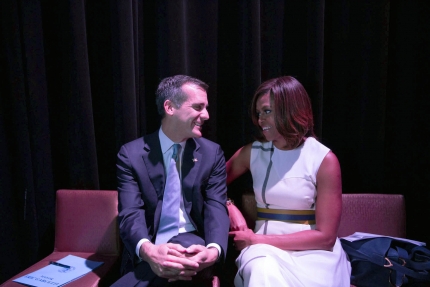
First Lady Michelle Obama talks with L.A. Mayor Eric Garcetti

First Lady Michelle Obama talks with L.A. Mayor Eric Garcetti backstage before the Veterans Homelessness event in Los Angeles, Calif., July 16, 2013. (Official White House Photo by Lawrence Jackson)

Today, First Lady Michelle Obama delivered the keynote speech during the Unite for Veterans Summit in Los Angeles. The summit, which gathered local officials, service providers, researchers, and funders, identified best practices in housing and employment for veterans and their families, and was a shining example of community collaboration.

The event — co-hosted by the United Way of Greater Los Angeles, the University of Southern California, and the Federal Reserve Bank of San Francisco — gave Los Angeles community leaders an opportunity to learn about the issues impacting veterans and their families, and to accept the challenge of addressing and ending them. As one formerly homeless veteran noted, "We are here to do whatever it takes for as long as it takes.”

Tune In: The First Lady Speaks at the Unite for Veterans Summit

Ed. note: This live event has concluded.

Today at 2:15 p.m. ET, First Lady Michelle Obama will deliver the keynote address at the Unite for Veterans Summit in Los Angeles, an event hosted by United Way of Greater Los Angeles, the Federal Reserve Bank, and the University of Southern California. 

As part of the Joining Forces Initiative, the First Lady is teaming up with Los Angeles Mayor Eric Garcetti to highlight the importance of aiding veterans as they transition into the next phase of their lives. Mayor Garcetti has joined the Mayors Challenge to End Veteran Homelessness by the end of 2015.

Watch the First Lady's remarks right here starting at 2:15 p.m. ET:

Watch on YouTube

The White House

Office of the First Lady

Remarks by the First Lady at LULAC Unity Luncheon

New York Hilton
New York, New York

1:36 P.M. EDT

MRS. OBAMA:  Oh, my goodness.  (Applause.)  Thank you, everyone.  Let’s give our love to Jennifer Lopez.  Thank you so much for that kind introduction.  (Applause.)

Good afternoon, everyone.  How are you all doing?  (Applause.)  It is my honor and pleasure to be here today.  I want to again thank Jennifer for that very kind introduction and for all of her amazing work to lift up our young people every single day.  She is truly an amazing woman, and I am so very proud of all of her work.

I also want to recognize LULAC President Margaret Moran, as well as your Executive Director, Brent Wilkes.  Yes!  Give them a round of applause.  (Applause.)  

Most of all, I want to thank all of you -- the activists, the community leader, the business, labor, and government officials.  We have our high school and college students here -- (applause) -- who are the heart and soul of this organization.  Yes, indeed!  (Applause.)  Where are my young people?  Where are you all?  (Applause.)  Yes.  So proud of you.  So proud.

AUDIENCE MEMBER:  We are, too.

MRS. OBAMA:  Yes, we all are proud of you.  You all are making such a huge difference for your communities.  You’re working to improve health outcomes, you’re registering folks to vote and signing them up for health insurance, you’re organizing around issues like housing, financial empowerment, and civil rights.  And the vast majority of you are not paid.  So you’re doing all of this after a long day of work or school.  You’re running off to a meeting after you cook dinner.  You’re giving up your weekends and holidays to host events. 

And you’re doing it all because you know that if you give just a little bit of your time and energy, and convince more folks to do the same, you can truly do your part to create a better future for our next generation.  And perhaps more than anything else, that is LULAC’s history.

Just think about the story of one of this organization’s former leaders, a man named Felix Tijerina.  (Applause.)  Felix was born to Mexican migrant farmworkers in 1905, and never got a formal education himself because he spent his childhood picking cotton in South Texas and washing dishes in a restaurant in Houston.  Like so many in your community, Felix was smart and he taught himself enough English words and phrases to work his way out of the dish room.  And by the time he was 50, he owned a total of four restaurants across the Houston area.  (Applause.) 

But just being a successful businessman wasn’t enough for Felix.  He’d heard that many Latino children were dropping out of school before the end of the first grade because they struggled with English and couldn’t catch up.  Now, Felix knew this trouble from his own life.  And when he became LULAC’s national president, he launched a pilot project to help these kids. 

He hired a young woman to teach a class of Latino preschoolers five or ten English words a day, so that by the end of the summer they knew about 400 words.  A year later, the project expanded to nine more communities.  There was no money for salaries, so Felix paid the teachers himself.  And when the schools ran into debt, he paid off that debt, too. 

Eventually, Felix and LULAC convinced the State of Texas to fund these schools that would be known as the “Little Schools of the 400.”  And in 1965, these Little Schools went on to inspire President Johnson to launch the Head Start program –- a program that you know now serves more than a million children every year.  (Applause.) 

Felix’s story is the story of that tenacious pursuit of the American Dream, that unyielding focus on lifting up the next generation through education.  That has always been the story of this organization. 

In the 1930s and ‘40s when many Latino schoolchildren were sent to places referred to as “Mexican schools” -- tiny one-room shacks with little or no ventilation or running water –- it was LULAC who took those school boards to court, helping to set the stage for Brown v. Board of Education a decade later.  (Applause.)  

In the 1970s, this organization created a network of National Education Service Centers to provide young people with educational counseling, mentorship, and leadership development.  And today, you’re providing more than a million dollars in college scholarships to promising students every year.  (Applause.)  This is an extraordinary legacy. 

And while I know you all are incredibly proud of everything you’ve achieved, I also know that you are not satisfied -- not by a longshot.  And that is why you are here today. 

You’re here because, in the face of so many challenges and obstacles, you’re still asking yourselves the hard questions:  How are we going to lift up our children and grandchildren and improve their educational outcomes?  You’re asking, how will we instill in them that hunger for education that drove so many people before us -- folks who came to this country in search of a better life and worked hard to seize that American Dream for themselves and their families?

Because the truth is that right now there are still too many young people in this country who aren’t getting the education they need -- an education that goes beyond high school.  The reality in today’s economy is that education is essential to getting a good job.  So our young people must understand that a college degree or some kind of professional training is an absolute necessity.

But as you know, too many young people in the Latino community simply aren’t fulfilling their potential.  Just listen to some of the statistics.  A while we’re thrilled that Latino high school graduation rates have reached a record high, they’re still lower than almost every other group.  And when it comes to college, regardless of their test scores and GPAs entering school, Latinos are far more likely to drop out than their white counterparts.  And fewer than 15 percent of Latinos over age 25 have a bachelor’s degree -- a rate that trails blacks, whites, and Asians. 

So those are some pretty sobering numbers.  And maybe there are those who believe that this isn’t the most pressing issue, or who hear those statistics and think, “Well, I’m not part of that problem.  I’ve got my degree, or at least I’m on track to get it, so I’ve done my part.” 

But that’s not how somebody like Felix would think.  See, he’d be thinking about the millions of kids who aren’t on track to get any kind of degree.  He’d be worrying about what’s going on in their lives, what’s going to happen to them and their families.  And right now, we all have got to think like that, too -- every single one of us. 

Now, I know that education is one of so many pressing issues on your plates right now.  And with a broken immigration system hurting so many of our families and neighbors -- (applause) -- some of you may be wondering why I decided to focus on education today.  But what I know from my own life experiences, is that if we truly want to lift up our next generation, we must tackle all of these challenges at the same time.  And that is actually one of the greatest lessons of LULAC’s history. 

LULAC initially formed back in 1929 in response to horrific violations of Latino civil rights.  Back then, Latinos were being brutalized and killed by police and lynched by the KKK.  “No Mexicans Allowed” signs hung outside of restaurants and storefronts.  Latinos often couldn’t own property or serve on a jury.  And if you walked into a public building, you’d often see not two water fountains, but three -- one white, one black, and one brown.

But LULAC didn’t just focus on these pressing crises; all along, they were investing in education too.  Yes, those early leaders traveled from town to town to organize local councils to right those injustices, once being run out of town at gunpoint.  And they rallied the Latino vote, even in the face of poll taxes and voter intimidation.  But they also sued to desegregate their schools.  They also organized parents into neighborhood committees, launched boycotts to protest terrible learning conditions for their children.  They sold tamales and held dances to raise scholarship money. 

So make no mistake about it, we have to keep on fighting as hard as we can on immigration.  (Applause.)  And as my husband has said, he’s going to do whatever administrative action it takes to fix this broken system.  (Applause.)  

But we cannot afford to wait on Congress to lift up our next generation.  We can’t afford to wait on anybody when it comes to our kids’ future.  Your grandparents and parents didn’t wait for opportunities to come to them.  No, they packed up their families and moved to this country for a better life.  Felix didn’t wait for Texas to set up a program to teach kids English.  No, he hired those teachers himself. 

So today, we have got to live up to those examples and reignite that hunger for opportunity -- that hunger for education –- across all of our communities.  And we all have a role to play in this endeavor.  Parents have to be reading to their kids from an early age and making sure they go to school every day and do their homework every night.  Our young people, you have a role to play as well.  You have to make education your number-one priority and be role models for those around you.  (Applause.)

So if you have a friend, a sibling, a classmate who is not taking school seriously, if you know someone who’s not planning to go on past high school, I want you to reach out to them and convince them that their future depends on getting a good education.  And all of us, we must look around our communities and start asking some important questions, like does the local high school offer enough AP classes for our kids?  Does the library offer a summer reading program?  Do the community groups and churches give enough scholarships to our kids?  Do the overworked school counselors have enough time to help kids apply to college? 

And if the answer to any of these questions is no, then we’ve got work to do -- because we have got to encourage every one of our kids to dream big.  And then we have got to shower them with love and support and resources as they strive for those dreams.

And that’s what my Reach Higher initiative is all about.  We’re trying to inspire every young person in this country to complete their education beyond high school -- whether that’s a community college, a four-year university, or a professional training program.  And we’re urging businesses and nonprofits, schools and universities, state and local governments to find new ways to support our young people on this journey.

And believe me, this effort is personal to me.  See, my parents never finished college, but they always told my brother and me that education was our ticket to success.  And they worked, and sacrificed, and saved every penny so they could send us to college.  (Applause.)  And no matter what they were dealing with in their lives, whether it was health issues or any number of other problems, they kept those issues to themselves because they didn’t want to distract us from getting our degrees. 

And I know how hard that can be for parents to let their kids go, especially for families who are up against even more challenges than mine ever was -- folks who are just barely making ends meet.  So they need their kids working part-time jobs to help pay the bills; they need them around to help take care of their siblings. 

And those are crucial issues, and nothing is more important than taking care of family.  But we need every parent to understand that the most important thing any child can do for themselves and their loved ones is to get an education.  That’s how they can ensure that they’ll truly be able to take care of their families.  That was certainly true for my family.  And today, my mom doesn’t have to worry about a thing, because my brother and I, we got our degrees.  (Applause.)  We achieved financial stability, and now we can take care of her. 

And that story can be true for families all across the country.  And the young people in this room are perfect examples.  Take the story of a DREAMer, Emma Chalott.  Emma is here.  Yay for Emma.  (Applause.)  Emma and her family moved to Dallas from Mexico in 2003 when she was just seven years old.  And for years, she struggled to adjust to the new language and customs.  But when she entered high school, Emma joined her school’s LULAC council.  She obtained her deferred action status, and then volunteered in the community to help other young people request theirs as well. 

This spring, Emma graduated from high school with honors, and in the fall she’ll be enrolled at Austin College, where she’s earned enough scholarships and grants to graduate debt-free.  (Applause.)  Yes!  Looking back on her journey, Emma realized that she didn’t do this all on her own.  She had the backing of LULAC and her teachers and counselors.  But most of all, she had the support of loving parents who helped her believe she could succeed. 

So for Emma, living out the American Dream by getting an outstanding education isn’t just an aspiration; it’s an expectation.  And she says that the real pressure is real in that -- the pressure to live up to the hopes and dreams of those around her.  But listen to what Emma says about the pressure. She says, “It’s not a burden at all.”  She says, “It’s a blessing.”  Yes -- a blessing.  This 18-year-old understands the opportunities we have here in this country.  And we are all so blessed. 

We’re blessed by the sacrifice and hard work of all those who paved the way for us -- the parents and grandparents who risked everything to come to this country; the folks who washed dishes and worked in the fields; the folks who were run out of town trying to organize their communities.  They’ve blessed us with the opportunities we have today -- opportunities for our kids to go to schools worthy of their promise; opportunities for our young people to finish college; and opportunities for all of us to build a better future for ourselves and our family, regardless of the color of our skin or the language of our parents or grandparents.  (Applause.) We are blessed. 

And to all the young people here, I want you to know that simply having those opportunities is no guarantee of success.  You’ve probably begun to understand that for yourselves already.  Maybe you’re the first in your family to go to college.  Maybe you’re working part-time jobs on the side to even afford college.  Maybe along the way, somebody doubted that you were college material at all.  Maybe they picked on you because of your accent -- because you were striving for something better. 

But in spite of all that, you all are here today as scholarship winners and leaders for your peers and your communities.  And you should be so proud of that success.  And I want you all to take some time and savor it, celebrate a little bit.  But only a little bit.  (Laughter.)  And then I want you to get back to work -- because the truth is, the work of pursuing your dreams is never finished, and it’s never going to be easy.

That’s something that the President and I have seen throughout our lives.  There will always be another challenge around the corner.  There will always be doubters and cynics who tell you to set your sights lower.  And yes, there will always be those fears and anxieties in your own mind -- fears that you’re not good enough or that you just don’t belong on a college campus and shouldn’t even try to get there in the first place.

But my message to all of you today is this:  Instead of letting those fears hold you back, use them -- use them to spur you forward.  When you start to doubt yourself, just buckle down and work harder, and do everything you can in your power to get that education.  Now, that might mean stepping outside of your comfort zone, or even moving far away from your family to get that education.  But that’s how you’ll get the skills you need for the life you dream of -- skills like leadership, and critical thinking, and learning how to thrive in new situations. 

And here’s the thing:  Once you get those skills, no matter what challenges you face, whether in your family or your community or your personal life, you will be able to rise above them.  You will be able to reach back and help others do the same.  That is the power of a good education.  That’s how you can give back. 

That’s how you can help carry forward the dream of folks like Felix and everyone else who built this organization.  That’s how you can continue their legacy of building an even better future for those who come after you.  

And like Emma says, remember that’s a blessing.  And I want you all to move forward with the wind at your backs, and the knowledge that so many people believe in you.  I believe in you.  Your President believes in you.  (Applause.)  And we couldn’t be more inspired by your promise. 

So we cannot wait to see all that you accomplish in the years ahead. 

Thank you, LULAC.  Thank you all for everything you do for this country.  (Applause.)  Keep up the great work.  We have lots to do.  God bless.  And we are there for you.  Thank you.  (Applause.)

END
1:57 P.M. EDT

The First Lady's Message to the United States-China Consultation on People-to-People Exchange

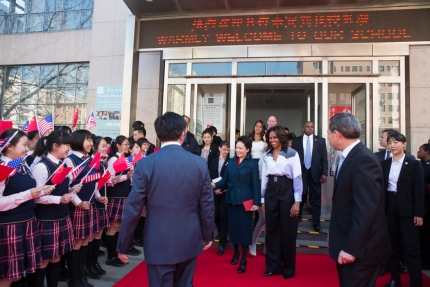
First Lady Michelle Obama and Madam Peng are greeted by a group of students as they leave the Beijing Normal School in Beijing, China

First Lady Michelle Obama and Madam Peng are greeted by a group of students as they leave the Beijing Normal School in Beijing, China, March 21, 2014. (Official White House Photo by Amanda Lucidon)

This March, First Lady Michelle Obama traveled to China with her mother and her daughters, Malia and Sasha Obama. Mrs. Obama’s trip to China underscored the mutual emphasis placed on education by the U.S. and China and the importance of cultural exchanges between each nation’s youth. While there, the First Lady met with students from both countries and explained that the defining challenges of our time - from climate change to economic opportunity – are shared challenges that the next generation will need to solve by working together across borders.

This week, the U.S. and China held meetings for the sixth round of the Strategic and Economic Dialogue (S&ED), and the fifth annual Consultation on People-to-People Exchange (CPE) in Beijing. The S&ED, which was co-led by Secretary of State John Kerry and Treasury Secretary Jacob J. Lew, focused on addressing shared strategic and economic challenges and opportunities. The CPE, which was led by Secretary Kerry, focused on strengthening ties between the two peoples through cultural, scientific, educational, and technological exchange. The First Lady delivered a message to the CPE, which was read by her Chief of Staff Tina Tchen, who is serving as the Women’s Pillar Lead for the U.S.-China People-to-People Exchange.

You can read the full message from First Lady Michelle Obama here and below:

Good Morning.  I am pleased to send my warmest greetings to all those gathered at the opening of the fifth round of the United States-China Consultation on People-to-People Exchange (CPE) in Beijing, China.  I would like to send my thanks to President Xi Jinping, Vice Premier Liu Yandong, and the entire Chinese delegation for hosting the United States’ delegation this year.

Lauren Vrazilek is the Deputy Associate Director of Correspondence in the Office of the First Lady
Related Topics: 2014 Asia Trip

The White House

Office of the First Lady

Message from First Lady Michelle Obama to the United States-China Consultation on People-to-People Exchange

I am pleased to send my warmest greetings to all those gathered at the opening of the fifth round of the United States-China Consultation on People-to-People Exchange (CPE) in Beijing, China.  I would like to send my thanks to President Xi Jinping, Vice Premier Liu Yandong, and the entire Chinese delegation for hosting the United States’ delegation this year.

I would also like to take this opportunity to personally thank President Xi, Madame Peng, and the Chinese people for their gracious hospitality during my recent visit to China.  In conversations with Madame Peng – as well as with students, teachers and others from across China – I gained a deep appreciation for the shared aspirations of people in both of our countries.  I saw firsthand the importance of continuing to strengthen the bonds between our peoples – the foundation upon which the U.S.-China relationship is built. 

Over the past five years, we have collaborated on a number of important initiatives.  Through the CPE, our two countries have encouraged Chinese and American women to enter science, technology, engineering, and mathematics careers through the Young Scientist Forum.  The Fulbright program and other educational opportunities have helped foster the highest numbers of exchange students and scholars in the history of both our countries.  The NBA Yao School opened in February in Beijing to promote youth development on and off basketball courts, and the NBA will also lead a youth-exchange at the 2014 World Youth Olympic Games in August.  The U.S. Olympic Committee, U.S. Paralympic Committee and the Special Olympics have continued to forge relationships with their Chinese counterparts to promote access to every level of sport for all people. 

By strengthening the bonds between our two nations, you all are playing a critical role in building our relationship for future generations.  I wish you every success in these efforts, and I hope you have a productive and enjoyable event. 

Fourth of July 2014 at the White House

First Lady Michelle Obama, Malia Obama, and President Obama watch the Fourth of July fireworks

First Lady Michelle Obama, left, Malia Obama and President Barack Obama watch the Fourth of July fireworks from the roof of the White House, July 4, 2014. (Official White House Photo by Pete Souza)

Yesterday, true to tradition, the President and First Lady celebrated the Fourth of July by hosting military heroes and their families for an Independence Day celebration with a barbecue, concert, and a view of fireworks on the South Lawn.

Related Topics:

West Wing Week 07/04/14 or, “Cynicism is a Choice… Hope is a Better Choice”

This week, the President wrapped up a trip to Minneapolis, nominated a new VA Secretary, and caught some World Cup fever. 

Experience the White House Kitchen Garden!

Ed. note: This is cross-posted on the Let's Move blog. See the original post here.

In keeping with the President and First Lady's commitment to open the People's House to as many people as possible, tours of the White House Kitchen Garden are back and now available to community organizations as well as school groups with an interest in gardening and healthy eating. Come smell the beautiful, brightly colored fruits and vegetables in the Kitchen Garden, including herbs grown from Thomas Jefferson's garden at Monticello; see the vibrant flowers in the Pollinator Garden; and hear the bees buzzing around the White House Beehive.

Nestled on the White House South Lawn, the Kitchen Garden is home to different fruits, vegetables, and herbs each growing season. The First Lady planted the White House Kitchen Garden in 2009 to initiate a national conversation around the health and wellbeing of our nation and to serve as an inspiration for schools and community groups across the country to plant gardens of their own. Now nearly five years later, the Kitchen Garden is as healthy as ever and is an example of just how easy it is to plant a garden in your backyard, school, or community space.

So if you haven’t already started your own garden, click here to check out the Let’s Move! Gardening Guide, which has all the information you need to get planting!

Related Topics: Healthy Kids

The White House

Office of the First Lady

Remarks by the First Lady to the American School Counselor Association Annual Conference -- Orlando, Florida

The Dolphin Hotel
Orlando, Florida

11:42 A.M. EDT

MRS. OBAMA:  Yes!  (Applause.)  How is everybody feeling today?  (Applause.)  It is really, really my pleasure.  You guys, rest yourselves.  You work hard enough.  (Laughter.)  No need to stand for my remarks.  It is truly a pleasure and an honor to be with you today, so thank you for having me.  Thank you so much. 

Let me start by thanking Shari for that very kind introduction, but more importantly, for her service as your Board Chair and as a school counselor out in St. Louis.

AUDIENCE MEMBER:  Yes!

MRS. OBAMA:  Yes!  St. Louis in the house?  (Applause.)  All right.  What about Chicago?  We could try that.  (Applause.)  Okay, I’ll stop.  (Laughter.) 

I also want to thank your Executive Director, Dr. Richard Wong, for his leadership at ASCA.  And of course, I’ve got to give a big shout-out to my dear friend, Stedman Graham.  Yes, indeed.  (Applause.)  Now, see, Stedman is a tough act to follow, but I’m going to do my best.  I know he imparted words of wisdom, but I’m going to try and do the same. 

But most of all, I want to recognize all of you for everything you do for our young people every single day.  And I have to tell you, when I found out that you all were making me an honorary school counselor, my first thought was, there is absolutely no way I’m worthy of this honor.  Because I know that you all have one of the hardest, most stressful, most important and most underappreciated jobs of anyone in this country -- and I live with the President of the United States.  (Applause.)  So frankly, when I think about what you all do on an average day, well, quite frankly, I’m amazed.

An average day for all of you might start with a child sobbing in your office because she’s being bullied or having trouble at home.  Or maybe it’s the kid who’s been kicked out of every class, and he’s sitting in front of you, angry and defiant, and it’s up to you to figure out how to help him get back on track. 

And then, later on in the day, perhaps you meet with an overwhelmed parent who’s not sure that they can really trust you, so you’ve got to convince them that you’re there to help and that you’re on their side.  And then maybe you see that kid with so much promise but who doesn’t think she’s college material and refuses to apply to any schools because she doesn’t know how she’s going to pay for school, so you’ve got to somehow show her that she has what it takes to succeed in life.

And those are just a few ways that you support our young people every day.  Too often, you are the only adults in their lives who aren’t there to grade them or judge them or punish them, and that’s why they seek you out when they have nowhere else to turn. 

So before I say anything else today, I want to say something that I’m sure you all don’t hear nearly enough, and that is, thank you.  Thank you.  (Applause.)  Thank you for your passion and your dedication.  Thank you for refusing to give up on a single child because you believe that every child has promise and every child has something to contribute.

And as First Lady, I share that conviction, which is why I want to talk with you about my new initiative that Shari mentioned; I launched it recently to help all of our children fulfill their boundless potential.  It’s called Reach Higher, and the goal is to inspire every young person in this country to complete their education beyond high school. 

And I’m here today because, while we talk a great deal about the role of teachers and principals and parents in preparing kids for higher education, often, engaged school counselors like all of you are the deciding factor in whether young people attend college or not.

Just take the example of a young woman named Sbeidy Dominguez from Escondido, California.  Now, no one in Sbeidy’s family had ever attended college -- I know you see many kids like that -- but her school counselor, Rita Guerra, insisted that she was college material.  So Rita pushed Sbeidy to take the SATs and the ACTs and enroll in AP classes.  Then, senior year, Sbeidy became pregnant, and her dreams of college started to seem impossible. 

But once again, Rita stepped in.  She helped Sbeidy find medical care, to complete her FAFSA forms, and to make up her AP exams after she gave birth.  And as a result, Sbeidy graduated in the top one percent of her high school class, and this fall, she will be starting [her senior year] at the University of California in Riverside.  (Applause.)  That’s the difference that you all make in a student’s life. 

You’re the ones planting the seeds about college as early as elementary school and middle school, making it clear that higher education is the expectation, not the exception.  You’re the ones grabbing kids in the hallway to tell them to sign up for that right college prep program, to check out that website for professional training opportunities, to convince them that they belong in that AP class and then to call the teacher to make sure it happens.  And when push comes to shove, you’re the ones helping our students meet those deadlines, and write those essays, and untangle those financial aid forms.

I recently saw this firsthand at a financial aid event run by school counselors at a school in Virginia.  Students and parents had gathered to learn how to fill out their FAFSA forms.  Many of these parents hadn’t gone to college, and they seemed anxious and overwhelmed.  But I watched how those counselors interacted -- they were joking with those kids and patiently answering their parents’ questions, and I could see the connection that they had to those families, and I could see the bonds of trust that had been formed.  

And those parents and kids walked away feeling hopeful.  They walked away feeling like they weren’t alone, like maybe they could do this college thing after all.  And that’s the impact that you all have.  And by putting our kids on the path to higher education, you all are literally affecting the entire course of their lives. 

See, 40 or 50 years ago, most kids could expect to graduate from high school and then go out and get a decent-paying job at a local factory or business.  But, as you all know, today, most of the fastest-growing jobs in this country require higher education, and college graduates, as you know, earn twice as much as folks with only a high school diploma. 

So higher education is no longer just for kids in the top quarter or the top half of the class -- college is for everyone. Every student in this country needs some higher education, whether that’s two-year degree, a four-year degree, or professional training of some sort.  But while in recent decades the need for college counseling has skyrocketed, the staffing and resources have not kept pace with this increased need. 

And all of you know the numbers.  While school counselors at private schools have an average caseload of 106 students, and ASCA recommends no more than 250 students per counselor, the national average is one school counselor for every 471 students.  And that is outrageous.  Outrageous.  (Applause.)  And one in five American high schools doesn’t have any school counselors at all –- none.  And that’s appalling.  And a lot of people in this country have no idea about these numbers.  They have no idea about all the other challenges you face just to do your jobs. 

For example, those of you at the high school level are expected to help students choose between thousands of colleges and certificate programs and countless financial aid packages, but hardly any of your master’s degree programs included training on college and career readiness.  (Applause.)   On top of that, today, students at all levels are arriving at school with greater needs and pressures and distractions, but instead of giving you time to deal with these issues, too often your schools burden you with all kinds of unrelated responsibilities.  (Applause.)
  
So while you might be the most highly educated professional in the building, instead of being allowed to do the job you were trained for, you’re assigned to proctor exams, or monitor the lunchroom, or serve as substitute teachers.  (Applause.)  And then I understand that on professional development days, you have to sit through yet another workshop on reading strategies or the new math curriculum because there aren’t any professional development units relevant to your job.  (Applause.)   

So today, we make all kinds of demands on our school counselors, but we often don’t give you the support you need to meet those demands.  And this is unacceptable.  School counseling should not be an extra or a luxury just for school systems that can afford it.  School counseling is a necessity to ensure that all our young people get the education they need to succeed in today’s economy.

And that’s why when we launched Reach Higher we decided to make school counselors a key focus of our work.  See, the purpose of Reach Higher is very simple –- yes.  (Applause.)  You are at -- the key.  One of the things we’re trying to do through Reach Higher is to help us reach my husband’s North Star goal -- that by 2020, America will once again have the highest proportion of college graduates in the world.  And we simply cannot achieve this goal unless you all have what you need to do your jobs.  (Applause.) 

And that’s why, today, I’m pleased to announce three new efforts to support and recognize school counselors across this country. 

First, as many of you might know, just yesterday, our Secretary of Education Arne Duncan released new guidance for students -- for superintendents and school principals, and he stated that they can and should use their budgets to create professional development units for school counselors -- that was just yesterday.  (Applause.)  Because our Secretary of Education knows that every school counselor in this country should have quality, relevant professional development opportunities, end of story.  

Second, I’m thrilled that the White House will be partnering with the Harvard Graduate School of Education, with ASCA, and with other organizations to host a special event on college counseling at the end of July.  And together, we’ll be coming up with ambitious new agenda items to improve training, professional development and support for school counselors. 

And third -- and I hope this is something you’ll like -- my husband and I think that it’s time that we started giving our school counselors the recognition that you all deserve for the work that you do.  So, as you may know, every year we honor the national Teacher of the Year at the White House.  Well, starting next year, for the first time ever, we will also hold a White House ceremony honoring the School Counselor of the Year.  (Applause.)  Yes.  This is a start.  It is really a start.   

The idea behind these efforts is very simple:  We want to celebrate our school counselors, and we want to highlight what’s working in college counseling across the country.  Because we know that so many of you are already leading the way.

For example, Jeremy Goldman, who is the 2014 Maryland High School Counselor of the Year -- you guys know Jeremy?  (Laughter.)  Is he kind of cool?  Where -- is Jeremy here?  Jeremy, where are you?  Hey, Jeremy!  (Applause.)  You!  Well, Jeremy noticed that hardly any African American students in his school were enrolling in AP classes, so his counseling team worked with teachers and the principal and created an action plan to close this gap.  And today, both enrollment and test scores are up for African American students in his school.  (Applause.)  

And Kendra Moulton -- is Kendra -- is she in the house?  Well, let me tell you about Kendra, because she couldn’t make it.  (Laughter.)  She’s a school counselor at the Edmund G. Ross Elementary School in Albuquerque, and --

AUDIENCE MEMBER:  Woo hoo!

MRS. OBAMA:  Yeah -- (laughter) -- and works to create a college mindset starting as early as kindergarten.  She does this by plastering her school with college pennants, and sponsoring college T-shirt days.  She conducts career days with fifth graders, pushing them to think about the higher education that they’re going to need for the jobs of their dreams.

And in districts across the country, school counselors are leading the charge to get more students to fill out their FAFSA forms.  In Miami, FAFSA completion rates jumped by 13 percent in just one year, and in San Antonio, they jumped by 31 percent.  Yes.  (Applause.)  And these school districts are no different than any others, and they face every challenge you can possibly imagine. 

So if they can find creative ways to get students on track to college, then I know that every district in America can do the same.  And when they do it, that won’t just transform the future of the students, it will transform the future of this country.  Because that’s how we build the workforce we need to compete in today’s global economy.

And I know that seems like a big ask, especially with everything else you all have on your plates.  But this isn’t the first time we’ve called on school counselors like all of you to help us meet a big national goal. 

In fact, back in the 1950s, after the Russians launched Sputnik and we feared that America might lose the space race, Congress passed the National Defense Education Act, which actually called for the training of more school counselors.  We did this because we knew that school counselors would play a vital role in identifying and preparing students to pursue careers in science and engineering.

And the same thing is true with our 2020 goal –- once again, we need your help, and we’re counting on you.  And I know you all can do this, because the fact is that with every life you transform, with every life you save, you all have an impact that is truly beyond measure.

And just take the example of a young man I learned about named Mikela Jones.  Mikela grew up on an Indian Reservation, and only --

AUDIENCE MEMBER:  Woo hoo!

MRS. OBAMA:  Yes.  (Laughter.)  And only one member of his tribe had gone to a four-year college, so Mikela was convinced that college just wasn’t for him.  But Mikela’s school counselor, Antonio Lopez, had other ideas.  Antonio pushed and prodded Mikela and insisted that he meet with college admissions officers, and as a result, Mikela didn’t just go to college, he became the first person from his entire Tribe to earn a master’s degree.  And today, Mikela is a school counselor himself.  (Applause.)   

He chose this career -- and these are his words -- he said: “I wanted to be like Mr. Lopez, to remind students that they are special, important, and have something to offer the world.”  He said, “That is how I repay him, by helping others.”

So here’s the thing, ASCA members -- whenever you get tired -- and I know that you do -- whenever you get frustrated or overwhelmed -- and I know that you do -- I want you to think about the extraordinary ripple effect of your work, because it’s real.  I want you to think about the impact you have not just on every child whose life you transform, but on the family that child will raise, on the business where that child will work, on the community that child will one day serve.  I want you to think about how long after those kids graduate your work lives on in their hearts and minds, and in the hearts and minds of everyone they touch.  

So today, I want to end as I started –- by once again saying thank you.  Really, thank you.  Thank you for your compassion and determination.  Thank you for the boundless love you show our children. 

And I for one, as your First Lady, I am grateful for all that you do.  And I look forward to working closely with you in the years ahead to give all our young people the bright futures they so richly deserve. 

Thank you all.  God bless.  (Applause.)  

END
12:01 P.M. EDT

The First Lady Speaks at the Working Families Summit

June 23, 2014 | 26:27 | Public Domain

First Lady Michelle Obama delivers closing remarks at the White House Summit on Working Families in Washington, D.C.

Download mp4 (975MB) | mp3 (25MB)

Read the Transcript

Remarks by the First Lady During Conversation with Robin Roberts at The White House Working Families Summit

The Omni Hotel
Washington, D.C.

5:36 P.M. EDT

MS. ROBERTS:  Good to see you.

MRS. OBAMA:  How are you?

MS. ROBERTS:  Oh, doing well.

MRS. OBAMA:  Doesn’t Robin look good?  (Applause.) 

MS. ROBERTS:  Oh, thank you.

MRS. OBAMA:  You look good!

MS. ROBERTS:  You're just saying it because it's true.  (Laughter.)  But it has been, all day long here, and that lively group discussion which has preceded us, talking about the role of women in the workplace and the fact that nearly half of the workforce is made up of women.  Yet when you see the Fortune 500 companies, only 24 women are CEOs.  That's less than 5 percent.  And like everyone, if you're involved in any type of work, you want to be in an environment where you can excel and you can grow.

MRS. OBAMA:  Absolutely.

MS. ROBERTS:  So what do we need to do to change that environment?

MRS. OBAMA:  I think you’ve heard it all day today.  We have to use our voices, particularly the young generation, because we have to realize, now that the numbers are on our side, more and more people are realizing that this is an issue for everybody.  And we have to use our voices, our power and our leverage to make demands, to feel like we can make the request, to make the ask to our employers.

I mean, I had to find that voice within me, myself, and it occurred during my -- after the birth of Sasha.  And Barack, I think he mentioned this.  Everybody was like -- what was he talking about?  Well, this is what he was talking about.  (Applause.)  This is what he was talking about. 

I had sort of dealt with the tug of how am I balancing things.  Barack was in Springfield; then he was in Washington.  I was in Chicago, trying to manage these two beautiful girls, trying to still hold down a part-time job.  The first thing I tried to do, which was a mistake, was that I tried the part-time thing.  But what I realized was that I got gipped on that front, because when you are working a professional job, what happened was I got a part-time salary but continued to work full-time.  (Applause.) 

So after that experience I said never again will I short-change myself.  Because we were still paying for full-time babysitting because as a professional, when there was a meeting that needed to happen they expected you to be there.  So we had to have full-time babysitting.  So that was a net loss for us.

Then I had Sasha and we lost our babysitter, which was probably the worst time of my motherhood.  I was so devastated because that balance, that work-family balance is so fragile, and you realize how fragile it is that with a blink of an eye of a broken toilet, a sick child, a sick parent, that that balance is thrown off.  And after we lost that first babysitter, someone we developed trust with, you let them in their home, they were wonderful, they loved your kid, and then they left -- and she left for good reason; she left because she needed to make more money.  But it was devastating.  And I said then, I quit.  Just forget it.  I'm not doing it again. 

But I got a call from the University of Chicago Hospital; they wanted me to interview for a job.  And by then I was ready to be done, but that empowered me.  I said, you know, I don't even want this job, so I'm going to go to the interview and I'm just going to be whoever I'm going to be.  (Laughter.)  And they’re going to have to deal with it.  And who I was at the time was a breast-feeding mother of a four-month old -- (applause) -- and I didn’t have a babysitter, so I promptly took Sasha to the interview with me.  And I thought, look, this is who I am.  I've got a husband who’s away.  I've got two little babies.  They are my priority.  If you want me to do the job, you’ve got to pay me to do the job and you’ve got to give me flexibility.

And flexibility means that I will work my tail off for you, but you better pay me and value my family.  And the guy said, of course.  I thought, are you kidding?  (Laughter.)  And so I became a vice president at the University of Chicago Hospitals, and it was one of the best experiences that I had because they -- because he put my family first and I felt like I owed that hospital because they were supporting me.

And that's what we have to have.  We have to get employers to understand that this is about their bottom line as well.  (Applause.) 

MS. ROBERTS:  So your approach to your career changed as you became a mother, and how -- you said at first you learned not to ask for part-time, and so you were more direct in what you needed and your employer responded.  There are a lot of people, though, that are going to say, yeah, but I'm at risk if I do that, I might lose my job, I really need this job. 

MRS. OBAMA:  That's true.  That’s why it's so important for women and men who are in the position to make these demands to do it.  So this isn't just -- this fight isn't about me or Barack, because things are different now.  We live in the White House.  (Laughter.)  Grandma lives upstairs -- thank God.  (Laughter.)  And we have resources that we never could have imagined.  So this isn't -- the fight isn't about us.  It's about every mother and father out there who doesn’t have the leverage to make those demands.

We're fighting for them because we know how bad it is, we know how tough it is.  I knew back then when I was a vice president at a hospital.  I understood the advantage that I had. If I were a teacher or a bus driver or a nurse or a shift worker -- which my father was -- there’s no room for that kind of negotiation -- if you're an hourly worker.  But the needs are even greater because the balance is even -- it's even more delicate for many working families, folks on an hourly wage. 

Childcare is beyond expensive.  I mean, we had the luxury of looking at nannies, right?  We couldn't even afford to keep the one we had, but we weren’t looking at the cost of childcare, taking a baby, packing them up, putting them in a car-seat, dropping them off at a childcare center, coming back.  Just that emotional tug on its own is powerful.  And it is not lost on either me or Barack how tough it is, which is why we all have to be in this fight.  This is something that we're doing for each other.  (Applause.) 

MS. ROBERTS:  You bring up so many excellent points, and they’re so -- I know, I know, there are so many places -- but the fact that you're saying working families -- because the landscape is changing.  Women are going into the workforce; there are more stay-at-home dads.  Is that part of the movement and letting everybody know that it is an issue for everyone in the family?

MRS. OBAMA:  Absolutely.  That's why I love the fact that this is a Working Family Summit.  I mean, you guys heard from Barack -- I mean, at least I heard you heard from him.  What I heard that he talked about was just how important those first months that he had with the girls was.  And men understand that you need that time, too.  Because that bonding time, that time that he spent getting up, taking a late-night shift -- not only did it save me, gave me some sleep and some peace of mind, but he connected with our girls in a way that I still see.  That connection is real.  And we as mothers, we don't take that for granted.

But I think more and more men are understanding that you don't miss that time because you don't get that time back -- because, let me tell you, now that Malia and Sasha are teenagers, they don't want to be bothered with us.  (Laughter.)  So it's that time that you spent rocking in the chairs and reading them stories, and he was able to do that because not only did he value it, but he was in a work situation that allowed him to do that.  And that brought us closer.  So this is about strengthening the whole family.  (Applause.) 

And I think more and more men are realizing that they can't just -- they just can't pass off those responsibilities and they have to fight for these changes for themselves.  This isn't a women’s issue by any stretch of imagination.  (Applause.) 

MS. ROBERTS:  No, they realize that.  And your husband really -- he was -- the things that he was saying.  And one thing that really touched a lot of people is when he said, yes, you are a strong woman, a strong mother, a strong wife, but early in the marriage, to see you break down in tears because you were trying to juggle so much, and how that, after all this time, has still stayed with him.  Did you?  Were you in tears sometimes trying to do all --

MRS. OBAMA:  Oh, my goodness.  I mean, the minute those kids come into the world they just rip your heart out of your chest.  (Laughter.)  That's why I tell young women and young families that we grow up as professionals, many of us, and we think we have all our -- have it all figured out.  We've got the plan:  four years here at this university and then I'm going to go down this path, I'll earn this money and I'll get this promotion.  I'm like, just have a baby.  (Laughter.)  And that baby comes out and looks you in the face and all the plans go out the window.  You don't know how you're going to feel.  And every child is different.  They add a whole new set of joy, a whole new set of worries to your life.  There is nothing more important to me than my girls.

That's why when we first came in and people asked me what was my agenda -- when we first came into the White House -- and I said it's making sure that my kids are whole.  I thought I was being honest.  (Applause.)  I mean, some people judged me for that, but the truth of the matter was that whether I'm First Lady and he’s the President, our first job is to make sure that our kids are on point.  (Applause.)  That is the most important legacy we will ever leave.  (Applause.) 

So that’s why this issue is so important.  Because employers have to know is -- if a family’s life isn’t right, if there’s a worry, if you don’t think that you’re leaving your child in good care, if they’re not healthy and whole and happy, you’re going to bring that worry to work.  And it’s going to eat away at what you’re able to -- I don’t care what you do.  You wait -- as working families, don’t you wake up every morning just praying that nobody is sick?  Just don’t be sick, my God.  (Laughter.)  You know, we all push them out the door a little sniffly because it was like, okay, cough again.  (Laughter.)  No, you’re not really sick, you’re like -- it’s just -- it’s not 100!  It’s not 100!  (Laughter.)  We all sent them to school just a little -- you’re fine, try to get through lunch.  (Laughter.)  Call me, tell me how you feel.  But you send them off and all you’re doing is worrying that they’re falling apart in school. 

So these are real emotionally draining issues.  And there are -- because there are employers that have figured how to do this -- how to give us families the space to be good workers but also to first and foremost be good families, if some can do it, they call can do it.

MS. ROBERTS:  Some are doing it; not all are doing it.  And in part, why we’re here in Washington, people want to know the role of the federal government, and in some cases, the state government.  Is that something that should be done?  Because there are a lot of people who are not certain of that.

MRS. OBAMA:  Well, there are two ways to focus this -- you’re going to see in this administration, they’re going to do everything in their power administratively to make changes and to lead by example.  I think one of my young staffers said that she just got an email from the Chief of Staff who said because of this Summit this administration is going to start asking a set of different questions and so on.  So the first thing that the President can do is make sure that his administration is leading by example. 

Now, what we need to do on the policy front requires congressional action at some point in time.  And I know I just heard Nancy say it and I heard the President say it, that you’ve got to have elected officials who believe in these issues and the changes that need to be made as passionately as we all do, and that’s going to require us to help them understand just how important these issues are.  (Applause.)

MS. ROBERTS:  But you know there are some who feel -- when we talk about minimum wage and equal pay, but mainly minimum wage -- and I think the first time we sat down and had an interview you brought it up.  You were passionate about it then, and fighting, and saying how important -- and knowing the importance of that.  When there are people that are there who are saying it’s going to cause jobs to be lost, it’s such a political debate.  What can we do -- if we lose that debate, what can be done to push that through?

MRS. OBAMA:  Well, I think building momentum.  Because, again, most employers are private employers.  They can make decisions based on what’s most financially expedient for them.  And studies are showing that having a fair wage, having decent family leave policies and the like -- creating a flexible environment -- that that improves the bottom line for companies.  And we have to start getting that information out so that every company looks at the bottom line for themselves.

The question is, is everybody even looking at it?  Because if we’ve allowed this not to be an issue because we’re sucking it up, because -- and let me tell you, women, we suck it up.  We’re just going to figure it out -- maybe it’s me, the reason why I feel crazy.  It’s not because I should be -- we tell ourselves, I should be able to manage this, right?  I should be able to have a full-time job and pick my kids up from daycare and drop them off and cook a meal and fry it up in a pan and all that stuff --

MS. ROBERTS:  And never let him forget he’s a man. 

MRS. OBAMA:  That part, too.

MS. ROBERTS:  I’m a woman!  Enjoli.  (Laughter.)  Remember that?  Enjoli, yes.  (Laughter.)  I’m old school, baby, I’m old school.  (Laughter.) 

MRS. OBAMA:  Yes, yes, what Robin said.  (Laughter.)  But because we wind up taking these issues on, and we’re just going to do it all, right, we’re not focusing on the need to push for change. 

And the 21st-century workplace, as you have pointed out, it’s very different.  Women are working more, men are understanding their value as caregivers, women are primary breadwinners -- I mean, we could go on and on and on.  Things are different.  So we can’t keep operating like everything is the same, and that’s why many of us have done.  And I think it’s up to us to change the conversation. 

And this Summit hopefully is the beginning of a shift in dialogue so that, as Nancy said, as our good Speaker said, we have to change the public conversation.  And we can’t underestimate the power there.  You can’t just wait for politicians to do what they -- what you think they should know you want to do.  They have to feel the pressure.  And that’s the job of all of us, and it starts here.

But these conversations have to continue at the regional level.  I know many people have been working -- absolutely.  (Applause.)  This is just the beginning.  And it has to be a movement, and there has to be momentum, and it has to continue, and -- to the point where the pressure is to real, and that this is the conversation that we’re having at every socioeconomic level, within ever race and every community, that we are now demanding that we can have the resources to do it all -- to be good workers, to earn a decent living, and to raise our families so that they’re whole and happy and healthy.  That is the American way.  That is the American way.  (Applause.)

MS. ROBERTS:  And it was said here about how women -- there are more women that are in law school and medicine and other fields, but when it comes to the STEM fields, the one -- science, technology, engineering and mathematics -- that’s where the growth is, that’s where women can make even more money than any other field. 

But yet, women, even though there’s more of us on college campuses, we’re not in those fields.  And there seems to be a stigma still attached to that.  How do we eradicate that?

MRS. OBAMA:  Well, we have to start very early on.  And more and more resources are being put into encouraging more women and girls to enter STEM fields.  But as you all know, it starts very early on.  You’ve got to create that pool.

Because so much of that field requires the stair-steps of math and science, and you can’t sort of skip a step because everything builds upon everything else.  And so many girls shy away from math and science; they automatically say, oh, I’m not good at that.  I was a victim of that.  I didn’t go to medical school because I thought I wasn’t good at sciences.  My mother told me I talked a lot, so I went to law school.  (Laughter.) 

But we’ve got to get girls when they’re young before they move away -- or sort of buy into the mythology that women can’t do these things.  So we have to start very early.

MS. ROBERTS:  You had said in I think it was Parade Magazine that you and your husband would like your daughters to get a minimum-wage job to build character, to understand what it’s like.  What kind of job would you like -- when you say that? 

MRS. OBAMA:  I don’t care.  Just a job that pays them.  It really doesn’t matter what it is.  I think the whole point is that they learn how to roll up their sleeves and work hard and understand what the vast majority of folks in this country have to do to earn a living, and that’s it’s not glamorous, and that it’s not fun all the time, and there are people who get up every day for their entire lives and go to a job that’s not fun, and they do it to put food on the table.

My father was one of those folks, one of those men.  And just watching him get up every day and go to work and go to a job that didn’t -- that wasn’t exciting and glamorous, but -- to go to a job that paid the bills and sent us to college, it motivated me to never take my education or my opportunities for granted.  And I want my girls to understand that firsthand.  (Applause.) 

MS. ROBERTS:  And when you and your husband, when you leave Washington, let’s see, Malia will be in college.

MRS. OBAMA:  I know.  (Laughter.)

MS. ROBERTS:  Sasha will be in high school.  There are many people that are wondering what’s your next act?  Will it be political?

MRS. OBAMA:  Me?

MS. ROBERTS:  Yes, you.

MRS. OBAMA:  No, it will not be political.  (Laughter.) 

MS. ROBERTS:  No?

MRS. OBAMA:  Yes, no, it definitely will not be.  It will be mission-based, it will be service-focused.  (Applause.) 

MS. ROBERTS:  Not in that regard.  Here we are, we’re talking -- we have Nancy Pelosi that was up here, we have women at the Supreme Court, and there are many feeling that if we’re going to talk about leadership -- and that’s what we’re doing here -- that a woman president is part of that.  And what an example that would set for your girls and for young boys, and for all of us.  Do you foresee that happening, and should -- and when should that happen?

MRS. OBAMA:  That should happen as soon as possible.  (Applause.)  And, you know, I think this country is ready.  This country is ready for anyone who can do the job.  And what we have learned is that the person who can do the job is -- doesn’t have a particular race or gender or background or socioeconomic status.  (Applause.)  The person who should do the job is the person who’s the most qualified.  And I think we have some options, don’t we?  (Applause.) 

MS. ROBERTS:  You sure you’re not getting into politics?  Because that answer was really good.  (Laughter.) 

MRS. OBAMA:  I am positive.  (Laughter.) 

MS. ROBERTS:  In the time that we have remaining, as I said, you’re the closing act.  There has been a whole day of just great dialogue, and people --

MRS. OBAMA:  A great day.

MS. ROBERTS:  A great day.  And people want to feel -- and I was talking about this, because the last time I saw you was Dr. Angelou’s service.  And we had all said -- and it was up there in the chapel about how “people will forget what you said, people will forget what you did, but people will never forget how you made them feel.”  And there is a sense of how people are going to feel when they leave this day, this Summit.  What is it that you want them to know?

MRS. OBAMA:  People should feel energized and empowered.  (Applause.)  And I sense that in the room today.  I was backstage saying hi to some folks, and you guys were feeling it.  (Laughter.)  That’s a good thing.  That’s the word on the street, is that this was a very uplifting day. 

But this is just a day, right?  And movements don’t happen in the span of 24 hours, and they take a while, which is why we want to really empower the next generation.  Because the young folks coming into the workplace now are the ones who can really start pushing for a whole new type of paradigm. 

But it’s going to take time, and it’s going to take persistence and consistency.  And there will be bumps in the road, and there will be losses.  But we have to celebrate every small victory.  And we can’t be our own worst enemies and get down on ourselves because we lose a battle or we didn’t get a hundred percent of what we want.  Change can be -- come in increments of 20 percent victories, but we have to celebrate those victories and keep pushing forward. 

So this is just the beginning.  And it has to be, because this is going to be a long road.  We’re going to have to see changes in the way society perceives this issue -- that’s going to come from people in this room.  We’re going to have to change the way Congress sees these issues -- that’s going to come from the people in this room.  And we have to build on this movement, because it affects everyone.

This is one of those -- this should be one of those issues that galvanizes this nation.  Because, again, it knows no race, no socioeconomic background, no religion.  (Applause.)  It’s something that we all should be able to pull around, but we’ve all -- we all have to be out there pushing this forward.  And that is my hope for today, that this is just the beginning of an important conversation that’s going to continue for years and years to come until we’re finally up there with other leading nations who’ve had amazing work-family policies for a much longer time.

There’s no excuse for America to be following on this issue.  We should be leading on this issue.  (Applause.) 

MS. ROBERTS:  And picking up that, because your husband just today was talking about how this great country, that we are the only one of a developed nation that does not have a paid leave for maternity.  And I think when you see that and when the President expresses that, there is a feeling that this time has come.  And so what, again, when we’re going to leave here, what is it that you want us to do?

MRS. OBAMA:  Vote.  (Applause.)  Continue to use those voices.  For those of us who have the leverage to be sort of the trailblazers within our companies, we should be the ones doing it.  If we have seats at the table in companies across America, if we’re sitting on boards, if we’re leading organizations, then we should be taking the lead.  We should be pushing our companies.  We should be taking the risks of making somebody mad, making somebody feel a little bit uncomfortable.  We have to be leaders.

If we own a business, we should be trying to figure out the data and how to make it work for our bottom lines.  We should be looking at the research.  We should be asking those tough questions.  We should be looking at best practices.  We have to be leaders on this issue. 

And this group is not an accident.  I mean, we’ve picked the top advocates, the top business owners, the top policy makers -- you guys are the ones who are leading on this issue.  But remember, trailblazing can hurt sometimes.  And some of it may not feel so good, but you’re doing it for the men and women who don’t have that voice, and who can’t take the risks.  (Applause.)  So we have to be the ones to do it for them. 

MS. ROBERTS:  And you have consistently done that.  Mrs. Obama, thank you very much for this opportunity to sit down with me.

MRS. OBAMA:  Thank you, Robin.  (Applause.) 

END
6:09 P.M. EDT

Close Transcript