The White House

Office of the First Lady

Remarks by the First Lady at a Visit to thank USDA Employees

U.S. Department of Agriculture
Washington, D.C.

11:48 A.M. EDT

MRS. OBAMA:  Hi, good morning.  (Applause.)  Oh, my goodness, you all look so good this Friday morning.  It is a pleasure to be back, because I got to come here a couple of years ago to say hello.  Well, it's time to re-up the hello.  (Laughter.)  So I wanted to come and see you all.
 
I want to start by thanking Secretary Vilsack, not just for his kind introduction and the wonderful offer to have my picture here -- which we won't do that -- (laughter) -- but for his outstanding service of the Department of Agriculture.  And Tom has been here from the very beginning of this administration.  And let me just say from day one, he has led with passion and vision and an unyielding commitment to the mission of this Department. 
 
And Barack and I got to know Tom during our Iowa days.  And I just want to say, just as a personal note, that Tom -- more than anything else -- is a good man.  And he has been such a loyal, dependable and honest person.  He and his family are terrific.  He represents not just this agency, but this administration and this country.  And we are just proud to have him on our team.  So let's give Tom a round of applause.  (Applause.)  

Back when my husband appointed Tom as Secretary, he noted that when President Lincoln created the USDA back in the 1800s, he called it the “people’s department" -- the "people's department."  And I actually think that’s a pretty good description of what Secretary Vilsack and all of you at USDA have achieved over these past four years.  I think that you all have truly made this department the people’s department.  And that’s really why I’m here today.  I'm here to just thank you, truly thank you for the terrific work that you do every single day on behalf of the American people. 
 
Thank you for supporting our farmers and our ranchers and working tirelessly to market their products across the globe -- which, by the way, helps to create jobs right here at home.  Thank you for protecting our environment, promoting renewable energy sources that will power our country for generations to come.  So that's an impact on not just us, but our children and our grandchildren and their children.  Thank you for that work.  Thank you for lifting up rural communities.  And thank you for keeping our food safe.  And I think this is something most of the country doesn’t realize -- the work that you do here to protect the environment, you keep our food safe, working to end hunger, improve nutrition for families across this country.
 
And the nutrition issue, as Tom mentioned, as you all know, is something near and dear to my heart not just as First Lady, but as a mother.  In fact, one of the first things that I did, as you know, as First Lady, was to plant the garden at the White House.  And it's really pretty.  (Laughter.)  I hope you guys get a chance -- it's beautiful now.  It rained a couple of days.  Thank you.  (Laughter.)  And the idea with planting the garden wasn't just to encourage kids to eat more vegetables.  I also wanted to teach them about where their food comes from.
 
I think you've known this -- we see this as we traveled around the country -- some kids have never seen what a real tomato looks like off the vine.  They don't know where a cucumber comes from.  And that really affects the way they view food.  So a garden helps them really get their hands dirty, literally, and understand the whole process of where their food comes from.  And I wanted them to see just how challenging and rewarding it is to grow your own food, so that they would better understand what our farmers are doing every single day across this country and have an appreciation for that work, that tradition -- that American tradition of growing our own food and feeding ourselves.
 
And the garden helped spark a conversation in this country about healthy eating that led us to create Let’s Move.  As you know, it's a nationwide initiative to end childhood obesity in this country in a generation, so that all of our kids can grow up healthy.  And all of you all at USDA, let me just tell you, have been such a critical part of this effort right from the very start.  This would not happen -- all the conversation, all the movement around health, that's all because of so many of you right here in this room and throughout this building, and in agencies and facilities all over this country.  You helped to launch our new MyPlate icon, which is changing the way families serve their meals and gives them a really easy way to understand what a healthy plate looks like. 
 
You worked, as Tom said, to help pass historic childhood nutrition legislation and so much more.  But that legislation that Tom mentioned that you all worked so hard on, The Healthy Hunger-Free Kids Act, I believe that that legislation is truly one of the greatest legacies that we can leave our children.  Because of this Act, as Tom mentioned, 32 million American children are getting more of the nutrition they need to learn and grow and be successful.  And I do hope that it's delicious.  We're working on that, yes indeed.  (Laughter.)  And you all are playing a big role in that.  And, more importantly, kids are playing a big role in making sure that their food is nutritious.  And I think that's part of the chain of progress -- they grow the food, they're involved in preparation, they're involved in how it tastes.  That means they're going to eat it. 

And none of this would have been possible without you all here at the USDA who worked tirelessly to pass this legislation and are working tirelessly to implement it all across the country.  So the bottom line is that with the work that you do at USDA -- work that affects the vitality of our communities, the food we feed our children, the air, the land, the water we’re passing on to our children -- you all touch just about every single American in this country with the work that you do. 

So what you all do here couldn't be more important.  But I do know, and another one of the reasons why I'm coming around not just to say thank you, but to just let you know that we know that the work you do isn't easy.  Most Americans don't understand what federal workers do and just how much they sacrifice and how much we depend upon the work that you do, how much we rely on you in so many ways -- both seen and unseen.  I know that the budgets are tight.  And that mean that you all are handling more responsibilities with even fewer resources than before. 
 
And I know that Mother Nature hasn’t exactly made matters easy in this country.  In 2011, you all had to contend with severe flooding all throughout the many regions.  In 2012, you dealt with the worst drought in half a century.  And this year, we’re facing both drought and flooding at the same time.
So I know that all of you have had a lot on your plates these past few years.  But let me just say time and again, you all have risen to the challenge.  You have risen to face whatever it is you've been asked to face.  And I’m here today because I want to tell you how much Barack and I really, truly appreciate what you do.  We know that you are sacrificing as much as us.  And oftentimes, we get the attention.  We get the limelight.  But the truth is we couldn’t do what we do without you sacrificing, you and your families.

So I want to say a big thank you to them -- all the kids whose plays have been missed, the birthdays that have been sacrificed, the spouses/partners that are upset.  You tell them thank you from the First Lady.  (Laughter and applause.)  Please, tell them thank you.  But I also want to encourage you, because you all are lifetime employees, so many of you, just to retain that passion.  Retain that passion and that energy and that vigor for what you do.  It absolutely matters to so many people.  So don't get tired.  Stay engaged.  Stay blessed.  And just know that you have a President and First Lady who truly values every single thing you do every day.

So thank you.  And I'm going to come down and shake a few hands.  (Applause.)

END
11:58 A.M. EDT

West Wing Week: 05/03/13 or “Nobody Does It Better”

May 02, 2013 | 6:22 | Public Domain

This week, the President spoke at the Planned Parenthood conference and the White House Correspondents’ Association Dinner, met with the King of Jordan, made five personnel announcements, celebrated the sciences and the Joining Forces Initiative, and embarked on a trip to Mexico and Costa Rica.

Download mp4 (268.5MB)

West Wing Week: 05/03/13 or “Nobody Does It Better”

This week, President Obama spoke at the Planned Parenthood conference and the White House Correspondents’ Association Dinner, met with the King of Jordan, made five personnel announcements, celebrated the sciences and the Joining Forces Initiative, and embarked on a trip to Mexico and Costa Rica.

Related Topics: Inside the White House

The White House

Office of the Press Secretary

Remarks by the President, The Vice President, The First Lady, Dr. Jill Biden, and Petty Officer David Padilla at Joining Forces Employment Event

East Room
 
 
11:46 A.M. EDT
 
THE VICE PRESIDENT:  Thank you all very much.  My name is Joe Biden, I’m Jill Biden’s husband.  (Laughter.)  And it’s a delight to be here with all of you.
 
Secretary Shinseki, Becky Blank, who is the acting Commerce Secretary, all -- we have Seth Harris here, who is the acting Labor Secretary.  And, Admiral, good to see you, man.  Look at all the brass here.  There’s no reason why we all shouldn’t be here.
 
Look, folks, the truth of the matter is that we’re delighted to welcome you to the White House, but all the business leaders, military leaders, it’s great to have you here -- and veterans.
 
But the truth is we all should be here.  We all should be in this spot at this time because there’s so much work to do.  My colleagues are tired of hearing me say over the last 20 years, we only have one truly sacred obligation in this country.  We have a lot of obligations -- to our children, to the elderly, to the poor.  But there’s only truly sacred obligation in my view, and that's to equip those we send to war and care for those who come home from war and their families.  That's a sacred obligation.
 
This post-9/11 generation -- and I see some folks out there -- well, no one is quite my age.  (Laughter.)  But I see folks out there from the Vietnam generation on, and before.  All made incredible contributions, but this 9/11 generation has been astounding.  Over 3.4 million young women and men have joined our military since 9/11, with almost the certain knowledge that they're likely to be deployed overseas.  1.7 million of those brave women and men have walked across those scorching sands of Iraq or those barren mountains in Afghanistan.  And many of them, as all of you know -- and some of you are among them, including some of the brass here -- didn't just serve once or twice.  Some have served three and four and five deployments.  Pretty incredible.
 
Every day I get a card, and on my schedule card I have them listed on the back -- and, thanks to the Pentagon, we call every day.  I want to know exactly how many lives have been lost and exactly how many people -- how many of our brave soldiers, Marines, Guardsmen, et cetera, how many have been wounded.  As of today, 6,564 have died in those conflicts; 50,651 have been wounded.  And like all of you, I count the one.
 
I know how we would have felt if, God forbid, something happened to our son when he was there a year and someone said, by the way, there are around 6,000 who have died, or there are about 65,000 who have been wounded.  Every single one of these women and men have families, have a story and a future, and many of them still have a future.
 
So this obligation is real, and it’s going to be lasting, and it’s consequential.  The truth of it is these veterans coming home into civilian life are among the most qualified men and women that have ever served our military because of these men up here -- how they -- and women, how they’ve trained them.  They're among the most qualified technically, intellectually.  They're among the most qualified Americans that have ever been available for the job market.  They have the capacity to do virtually any job in the private sector. 
 
You're going to hear from a young man soon who, I will not steal his thunder, but works in an industry where they move a lot of equipment and freight around.  I remember talking to someone at one of these big companies and saying, well, I don't know about so and so; he was talking about a young man.  And I said, man, this kid handled more responsibility and billions dollars' worth of equipment than you own, than you’ll ever own.  (Laughter.)  So don't tell me this kid can't handle the dispatching yard of your trucks.  One of the vehicles he had cost more than all your trucks.  (Laughter.)  
 
And, seriously, think of these kids.  Go to an aircraft carrier.  Watch who is making the judgment as to when that jet aircraft lands down.  It’s a 19-, 20-year-old kid standing there with a flag.  It’s a 19-, 20-year-old kid -- they even let me do it once -- (laughter) -- that sits underneath that as they catapult off.  They can handle anything.  They're technologically proficient.  They're totally responsible.  And they’re undeniably capable.  
 
So what we’re selling here today -- and all of us are selling it -- is an incredible product.  And I want to thank so many of you business leaders here today behind me and out in the audience for recognizing that fact.
 
As the President said, no one who fights for this country overseas should have to come home and fight for a job when they come back home.  They just shouldn’t have to do that.  And that's what you’re all about.  That's what we’re about. 
 
But it’s not just about the returning veterans.  We know there are families, and particularly you men and women in uniform know the sacrifices your families make to allow you to serve.  The English poet John Milton once said, “They also serve who only stand and wait.”  And literally, hundreds of thousands, millions of wives, husbands, sons, daughters, mothers, fathers -- they’ve stood and waited.  And we owe them as well, because they have served as well.  
 
And quite frankly, I’ve never seen my wife, Jill, so absolutely, totally committed to any cause, and that's the cause of serving military families, the cause of serving all of you who served.  I’ve heard her say it once, I’ve heard her say it over the last seven years I don't know how many times:  Everyone, everyone can do something.  Only 1 percent of the population is serving, but 90 percent of the population -- 99 percent owes them just a simple act of kindness.
 
I remember how moved we were when we got a call from our daughter-in-law after a snowstorm the winter our son was deployed.  The next-door neighbor just walked over and shoveled the driveway -- just shoveled the driveway.  Never said a word, packed up, left.  Shoveled the driveway.  We’ve got a lot of driveways to shovel.  We owe an awful lot.  
 
And that's why Michelle and Jill started Joining Forces, and why, with the absolute rock-solid commitment of President Barack Obama behind them, they’ve done, with your help, a remarkable job.  I’m sure you’ll hear the numbers and you will all know the remarkable job that you’ve done and they’ve done responding to the needs of these brave women and men.
 
And now I’d like to introduce you to a woman whose father served, whose sons serve, and who serves us every day -- Jill Biden, Dr. Jill Biden, who happens to be my wife.  (Applause.) 
 
DR. BIDEN:  Thank you, Joe.  Hi, everyone.  I’m Jill Biden, a proud Blue Star mother.  
 
Over the past few years, the First Lady and I have had the incredible honor of meeting military spouses all over this country, and I’m always amazed by their strength, their commitment, and, most importantly, by their resilience.
 
These are spouses like Erin Voirol.  Erin met her husband, Dale, a Sergeant First Class in the Army, when they were both in high school.  Not long after becoming an Army wife, Erin found herself overseas with two young children.  Soon thereafter, her husband deployed for a year.  That was just the beginning.  
 
Over the past 18 years, they have moved their family 10 times.  They are raising three children with Erin providing primary care of the kids during three deployments, each for more than a year.  And today, Dale is stationed at Fort Bragg in North Carolina while Erin and their children stayed in the Hampton Roads area in Virginia so that their kids can finish high school there.  
 
Through all this, Erin pursued her own education, made strong connections with other military spouses, and embraced a wide range of careers, all leading to her current profession of serving other military families.  Erin is the operations manager for two non-profits that provide employment readiness and job-placement assistance for veterans, military spouses, and more.
 
Erin is here with us today.  Erin, would you stand.  Thank you, Erin, for all you do.  Thank you.  (Applause.)
 
Yet stories like Erin’s are not unique among military spouses.  They are people who, when their spouse deploys, are carrying our military families, doing the work of two parents, raising children, running a household.  And military spouses are the first to step up for their communities, whether it’s volunteering to help out a neighbor or serving in the PTA.  All the while they’re building their own careers.  
 
And because our nation’s military spouses move 10 times more than their civilian counterparts, that’s not always easy.  Just as they’re settled into a new job, it might be time to pack up again, move across the country or out of the country, and start the entire process all over again.
 
But of all the things Michelle and I have learned about military spouses, here’s what stands out the most:  They never complain.  Whatever the situation, they keep on serving, doing whatever needs to be done.  Military spouses like Erin have so much to offer -- their skills, their incredible work ethic, and perhaps most of all, their endless energy.  
 
That’s why nearly two years ago, we were proud to launch the Military Spouse Employment Partnership.  This effort has helped spouses build strong resumes, has sponsored hiring fairs and has created mentoring programs.  Since its launch, more than 160 Fortune 500 employers have signed on to the partnership, and more than 43,000 military spouses have been hired.  And more and more companies are finding ways to keep these spouses in their employment, even after they move.  And I’m sure every partnership company will say, if you’re looking for dynamic, resourceful, and highly skilled employees, our military spouses are exactly who you are looking for.  
 
As Joe mentioned just a moment ago, our military spouses serve right along our servicemen and women.  Through Joining Forces, we honor all military service and we ask all Americans to join us in finding ways to show our gratitude.  From the beginning, the private sector has played an important part in supporting the Joining Forces initiative.  
 
Our next speaker is a veteran who has benefited from this private sector involvement.  It is my great pleasure to introduce David Padilla, who served in the United States Navy for five years as a second-class petty officer operations specialist.  And he has a new four-month-old daughter -- month, right?  Four-month-old.  David, thank you for your service to our country.  (Applause.)
 
PETTY OFFICE PADILLA:  Good morning.  My name is David Padilla.  I served honorably for the United States Navy as an operations specialist second-class petty officer.  I served in two deployments -- first, as a database manager in Operation Iraqi Freedom, and second, as an air controller and watch supervisor on an AFRICOM partnership for countries such as Kenya and the Congo.  
 
My time in the Navy taught me invaluable skills:  How to manage a team, work with data, and operate high-tech equipment -- not to mention all the discipline and hard work that comes with wearing that uniform.  But when I came home and started my job search, it felt like companies didn’t see any of that in me.  
 
After returning from the Navy, I applied to countless jobs and was averaging two interviews a week, but nothing ever materialized.  So with the help of the GI Bill, I enrolled at Mercy College in New York where I earned a bachelor’s degree in finance.  Just after I graduated, my fiancée discovered she was pregnant with our beautiful daughter, Emiliana (ph), who is now four months old.  I knew that with a growing family, I needed to double down on my job search, even with a bachelor’s degree.  So I signed up for veterans’ workshops, updated my resume, and attended dozens of job fairs.  But still, I struggled to find work.  
 
In all, I was unemployed for two and a half years before and after college.  But then, thanks to Paralyzed Veterans of America and their PAVE program, which provides support to all veterans who are looking for work, UPS hired me as a dispatch supervisor where I could use my management training I received from the Navy.  And after only four months on the job, UPS recognized my leadership skills and promoted me, where I’m responsible now for dispatching 75 drivers and optimizing our delivery schedule.  
 
UPS has given me the opportunity to build my career and provide financial support for my family.  I want to thank UPS and CEO Scott Davis, who is here today, for giving me this opportunity and making veteran-hiring a priority.  And I also want to salute all the companies here today who are making hiring veterans and their spouses a priority.  I only hope that more companies stand up for families like mine.
 
No one understands this better than our Commander-in-Chief and First Lady.  They have both made it their mission to support our troops, veterans and military families.  And now, I have the great pleasure to introduce them now.  
 
Ladies and gentlemen, please welcome our President, Barack Obama, and First Lady Michelle Obama.  (Applause.)
 
THE PRESIDENT:  Thank you.  Thank you very much.  Thank you.  (Applause.)  Please, everybody have a seat.  David, thank you so much for your introduction and sharing your story, but most importantly, thanks for your extraordinary service to our nation.  We are very, very proud of you.  
 
Thank you to our partners in crime -- (laughter) -- the outstanding Joe Biden, and the even more outstanding Jill Biden.  (Laughter and applause.)  We're grateful for their leadership, their commitment on a whole range of issues.  But I'm particularly grateful for the passion that Jill, you've shown when it comes to our military families, because you know what it’s like when a loved one is deployed.  And that passion comes through with everything you do.  So we're very, very proud of you. 
 
I also want to recognize the members of my Cabinet and Joint Chiefs and some of our top brass who are here.  We appreciate all the great work that they're doing.  And your presence reflects our commitment to this cause across the entire government.  
 
And now, I've got a simple task this morning, and that is to introduce the graceful, brilliant, inspiring love of my life -- (laughter) -- First Lady Michelle Obama.  Joe and I are just warm-up acts today, which in our families means it’s just another Tuesday.  (Laughter.)  That's how it generally goes.    
 
But of all the honors and privileges of serving as President, the opportunity to meet incredible people like David is among the things that I cherish the most.  David, being here today is representative of a 9/11 generation -- men and women who volunteered to put the uniform on even though they understood it was wartime, knowing full well they could be sent into harm’s way.  
 
And for more than a decade, they have answered every call, executing some of the most dangerous missions on the planet; operating some of the most cutting-edge, complex technologies known to man; leading their peers in moments where their decisions can determine life or death.  And, as we saw during the attacks in Boston, as Guardsmen and as veterans were racing towards danger, they put that courage and experience and skills that they’ve earned serving in our military to use every single day.  George Washington once said, “When we assumed the soldier, we did not lay aside the citizen.”
 
Our troops and our military families who serve right alongside them keep us strong and they keep us safe.  And as Commander-in-Chief, I’ve pledged that just as they’ve left their homes and families to take care of us, we've got to make sure we're taking care of them when they come home.  That’s our sacred obligation:  To make sure that they get the care and the benefits and opportunities that they deserve.  And that includes economic opportunity -- good jobs worthy of their incredible talents.  
 
And as David indicated, unfortunately, when they hit the job market, employers don’t always recognize the high-quality, high-tech skills our newest veterans have gained in the military.  They don't understand the leadership that they've shown under extraordinary circumstances.  So, too often, just when these men and women are looking to move forward in the next chapter of their lives, they’re stuck in neutral, scraping together odd jobs just to pay the bills.  
 
Now, our economy is growing.  It's creating jobs on a consistent basis.  Although I just had a press conference -- we could be doing even better if we'd get a little more cooperation down the street.  But for post-9/11 veterans, employment continues to lag behind the national average -- and that's especially true for our youngest veterans.  And this does not make any sense.  
 
If you can save a life on the battlefield, then you sure as heck can save one in an ambulance in a state-of-the-art hospital.  If you can oversee a convoy of equipment and track millions of dollars of assets, then you can run a company’s supply chain or you can balance its books.  If you can lead a platoon in a war zone, then I think you can lead a team in a conference center.   
 
There are lots of extremely talented young people who are more than qualified for the jobs that businesses are looking to fill.  We've got the end of the Iraq war.  The war in Afghanistan is drawing to a close.  More than 1 million servicemembers are going to be transitioning back to civilian life in the coming years.  So we've got to do everything we can to make sure they have every opportunity to succeed.  
 
That’s why, a year and a half ago, I signed new tax credits for companies that hire unemployed veterans and Wounded Warriors.  And since then, the number of veterans hired through tax credits like these has more than doubled.  And my budgets proposed extending these tax credits permanently.  Congress needs to get that done.  
 
We’re working to help our troops earn the credentials they need for jobs in manufacturing and medicine and transportation.  We strengthened the Post-9/11 GI Bill, helping nearly 1 million veterans and military family members get a college education.  And for the first time in 20 years, we've overhauled the military’s Transition Assistance Program to help our newest veterans compete for those private sector jobs.  Our online Veterans Jobs Bank now has more than 2.5 million searchable job postings.  With our Veterans Gold Card, our veterans receive six months of personalized career counseling.  At my direction, the federal government has hired nearly 250,000 veterans. 
 
So we've made progress, but we know that government alone can't put every veteran and military spouse to work.  So about a year and a half ago, I went down to the Navy Yard and issued a challenge to America’s businesses:  Hire or train 100,000 veterans and military spouses by the end of 2013.  And I am proud to say that these companies stepped up.  And some of those companies are represented here today.  
 
In just a year, businesses had already hired 125,000 veterans or military spouses.  They committed to hiring 250,000 more.  Today, we’re announcing a major milestone in this effort, thanks in large part to the leadership of so many companies that are represented here today.  And we could not be more grateful for the commitments of these companies.  
 
Now, they're doing it partly because it's good business sense, because they're getting great employees.  But they're also doing it because they're patriots.  They're also doing it because they really care about this country and they understand that they don't succeed unless they've got an incredible military that's doing this. 
 
Hiring our veterans and military spouses is not just the patriotic thing to do, it's the smart thing to do.  They're looking for highly skilled workers.  Highly skilled veterans and military spouses are looking for jobs, let’s connect them up.  It’s good for families, it’s good for businesses, it’s good for our country.  
 
And that’s why Joining Forces is so important.  It’s a way for us to both honor and serve the men and women who have served us so well, but also to move the country forward.  That’s why we've all got to step up and do our parts -- government, business, schools, hospitals, community groups, houses of worship, neighbors, and obviously our military and our VA.  We've had to up our game, and we're not there yet, but we continually try to strive to improve to make sure we're doing the right thing.  And just as service and sacrifice defines our military families, serving our military families has to define who we are as Americans.  
 
Now, none of this could have happened had it not been for the extraordinary work that Michelle and Jill have engaged in over the last two years.  And that’s a call that we're renewing here today.  I've got to tell you, I'm proud of my wife all the time.  I could not be prouder of the work that she and Jill have done in this effort.  They have put their heart and their soul into it, they care about it deeply.  They identify so deeply with these military families because they understand the sacrifices that they're making.  
 
So with that, let me introduce a woman who I've seen live out that message every day as a wife and a mother, a tireless champion of military families, love her dearly -- my wife, First Lady Michelle Obama.  (Applause.) 
 
MRS. OBAMA:  Thanks so much.  (Applause.)  Thank you all.  Well, let me start by thanking the President of the United States for that nice introduction.  (Laughter.)  It's always nice to get a good introduction from the President, and from your husband.  But I want to thank you and Joe, because truly, we could not issue these challenges without leadership from the top.  And that’s something that Jill and I always say, is that we're out there on the front lines pushing this initiative, but the only way we get this done is because we've got strong leadership in our President and our Vice President.  
And, of course, to Jill, who is not just an extraordinary partner but a wonderful friend in this endeavor, not just working with our military families but in this interesting life that our husbands have gotten us into.  (Laughter.)  Jill is a true champion, and she's taught me a lot about what it means to serve, what it means to be part of the military community.  And I couldn’t be more grateful.
 
I also want to recognize all of the leaders from the administration, from the military and throughout the country, especially the veterans and military spouses who are here with us today.  Thank you all for your commitment and your service to this nation.  
 
And finally, I want to take a moment to say a special thank you to someone who didn’t know I was going to thank him, but who has been a cornerstone of this effort throughout this year in a difficult time -- when we've been in transition -- these two were running for something -- (laughter) -- but we couldn’t have kept this effort going without Captain Todd Veazie.  (Applause.)  And, believe it or not, today is Todd's last day as our Joining Forces executive director.  That’s another miracle -- the fact that we get so much done with sporadic support like Todd's.
 
And I want to make that point, because it's not just Jill and I, but Todd and a small team of others really keeps this going.  And this year has been a success because of you, so we decided as a reward, we would have you, as your last hurrah, to plan an event with every single one of your bosses -- (laughter) -- because we knew you could pull it off, because that’s what Navy SEALs do, right?  
 
But in Todd, we saw his skill, determination on display every single day.  And I'm just so proud.  We'll miss you here with Joining Forces.  So Todd and I just wanted to say thank you -- or, Barack and I wanted to say thank you.  (Laughter.)  You.  You, too.  (Laughter.)  At least I caught that one.  (Laughter.)  But we are grateful and impressed by your talent, integrity, and the incredible work ethic that you've shown to make this possible.  Todd!  (Applause.)  Very bashful.  We kept that out of the remarks so that you wouldn’t know that it was there.  
 
But really, the same thing can be said -- all those wonderful traits in Todd -- can be said of all the servicemembers and military spouses we have had the honor of meeting over these past four years.  These men and women are some of the most talented, accomplished, dedicated people you will ever meet. 
 
And that’s why, two years ago, when the four of us came together to launch Joining Forces right here in this very room, our goal was to create an initiative that was worthy of their character and their service.  We challenged every segment of our society to stand up and take action and make a real commitment to support and serve our military families.  And since then, this nation has truly joined forces in so many amazing ways. 
 
We have seen doctors and nurses take bold new steps to care for the families affected by PTSD and traumatic brain injuries.  We’ve seen colleges sign up to train teachers to be more responsive to the needs of our military children in their classrooms.  We’ve seen community groups and houses of worship and citizens from every walk of life show their appreciation for our military families, not just with words but with deeds. 
 
And today, we are here to recognize the tremendous efforts of businesses all across the country.  Together, we have been partnering to do everything in our power to help our veterans and military families find the jobs they need and deserve.  
 
These efforts are about so much more than a paycheck.  This is about giving these men and women a source of identity and purpose.  It’s about providing thousands of families with financial security, and giving our veterans and military spouses the confidence that they can provide a better future for their children.  
 
So as we reflect on our accomplishments to date and challenge ourselves to do more, it’s important to remember what’s at stake with all this.  It’s important to remind ourselves every single day what this employment effort is really all about.  
 
And that’s exactly what we did two years ago when the President issued this challenge.  Because every time we looked at those veterans’ unemployment numbers, every time we heard another story about someone who had taken incoming fire on a combat patrol but couldn’t get an HR rep to take their calls, every time we talked to a military spouse who had been transferred far too many times to build a decent career, we became even more determined to make this right. 
 
So with that challenge, we all snapped into action.  And since then, it seems like every week -- quite frankly, every day -- someone new gets involved in this effort.  There hasn’t been a "no" from anyone.  And today, I am thrilled to announce that in less than two years, America’s businesses have hired or trained 290,000 veterans and military spouses -- (applause) -- which is almost triple the original goal with eight months to spare. 
 
And we are also proud to announce that American companies have committed to hire or train another 435,000 of these men and women over the next five years.  (Applause.)  And we are so grateful to all of the business leaders here today who are a part of this effort.  
 
These commitments come from companies of every shape and size.  BNSF Railroad is hiring 5,000 veterans in the next 5 years.  UPS, hiring 25,000.  Home Depot, 55,000.  McDonald’s is hiring 100,000 in the next three years.  Deloitte is doubling its veterans hiring over the next three years.
 
USAA is pledging that 30 percent of its new hires will be veterans or military spouses.  Walmart is telling any veteran who has served honorably that if they want a job in the year after they separate from service, Walmart is going to hire them.  And their goal is to do it within 30 days of the veteran’s application.
 
The Blackstone Group has challenged each of its 50,000 hiring managers at affiliated businesses to hire at least one more veteran.  AT&T is creating an online, military exchange for a group of businesses so that if one company can't hire a veteran at that moment, they can connect them to someone who can.
 
The International Franchise Association has helped more than 4,300 veterans own their own businesses since 2011.  And right now as we speak, the U.S. Chamber of Commerce is holding its 400th career fair since last March, fulfilling a commitment that it made to us a year ago.
 
So we are thrilled with all the new, innovative ideas and we’re in awe of the meaningful employment commitments.  But ultimately, these companies aren’t just committing to a number –- they’re committing people, people like David.  Right here in this room, there are so many stories like his.  So I’d like to take just a moment to tell a few of these stories.  And as I call your name, I want you to stand and remain standing. 
 
Staff Sergeant Shaun Murphy, please stand.  Shaun is an eight-year Army veteran who transitioned to become a sixth-grade special-ed teacher in Delaware for three years.  (Applause.)  A little shout-out to Delaware.  He’s working for Teach For America, and today, he has been promoted to lead Teach For America’s nationwide effort to hire more veterans as teachers -- yes, indeed.  He’s doing it all because, as he said, “When you hang up those fatigues and put those boots away, you don’t want to feel like you’ve given up your sense of service.”  
 
And then there’s Staff Sergeant Courtney Beard.  (Applause.)  Courtney has served in the New Jersey Air National Guard for six years, including a deployment in Iraq.  But when she’s not serving on active duty, she’s putting her skills as an intelligence analyst to use at Cisco as a network consulting engineer -- small, but tough.  (Laughter.)  And really smart.  Thank you.  (Applause.)  
 
And then there’s Chryssy Johnson, who is on stage with us.  Chryssy is a mother and an Army wife from San Antonio.  Her family has been transferred three different times over nine years, leaving Chryssy scrambling for jobs at restaurants or call centers or beauty counters.  But USAA gave her a shot to build a career, and today, she is a financial -- a senior financial foundations specialist on her way to earning her MBA.  Yes.  (Applause.)   
 
And then there’s Sergeant Erick Varela.  Erick served in combat infantry for the 82nd Airborne Division, and was deployed two times to the Middle East.  But when he came home to California in the middle of the housing crisis, Erick couldn’t find a job.  And soon, he and his wife found themselves homeless.  
But fortunately, Erick was accepted in an electrical apprenticeship program in San Francisco.  And even though he and his wife were living out of his pickup truck at that time, Erick was able to pinch enough pennies to buy enough gas to drive to and from that class and finish that program.  And today, he’s employed full-time at PG&E, even taking on leadership roles within his crew.  And now, Erick is hoping to buy a home for their growing family.  And we are so proud.  (Applause.)
 
These veterans and military families are talented, resilient, disciplined, and they are ready to do the job no matter what it takes.  And these characteristics connect every single veteran and military spouse in this room.  So I’d like to ask all of our veterans and military spouses here today to please stand if they are able so we can give you all a round of applause.  (Applause.)  Thank you all so much.  
 
Stories like these are not just in this room, but they’re all around us.  Across America and around the world, our men and women in uniform and their families are standing up for us.  They’re standing up for our values, our security, our communities.  And in so many ways, all they’re looking for is another way to serve.  All they need is that next mission.  All they need is a job.  
 
So, to every business leader in this room and throughout the country, I just want you to remember these stories every single day.  Think about all of the skills these men and women possess, all the people they've led, all the risks they've taken and sacrifices they've endured for us.  And then I want you to ask yourselves, what more can you do for these men and women -- what more can you do?  
 
If you own a small business, can you commit to hiring a few veterans, maybe even just one?  If you own a larger company, can you hire a few hundred, maybe a few thousand?  Can you retain the veterans already in your workforce so that they are able to grow within your company?  Can you team up with other businesses to hire more veterans all across this country?
 
And again, I just want to reiterate that my husband and I, we're in this with you.  Jill and Joe, we're in this with you.  We're going to keep working to do what we can to develop new programs and partnerships at the federal level that can help you all put these men and women to work even faster.  Because while we're proud of how far we've come, we know that today is not the finish line.  Today is simply just a mile marker, and we're not going to stop until every single veteran or military spouse that is searching for a job has found one.
 
These men and women have stood up for us again and again and again.  So now the question is, will we do the same for them?  And everything that we have seen in these past two years gives me confidence that the answer is absolutely yes.  You live in a grateful nation, and people will stand up.  
 
So to all the business leaders, I just want to say thank you all.  Thank you for getting us this far.  And to the veterans and military families here in this room and around the country, thank you, again.  We can't thank you enough for your courage and your service.  We will stand with you now and for decades to come.
 
Thank you all.  God bless.
 
 
END
12:30 P.M. EDT

First Lady Michelle Obama Announces New Hiring Commitments for Veterans and Military Spouses

First Lady Michelle Obama Makes a Veterans' Employment Announcement in the East Room, April 30, 2013

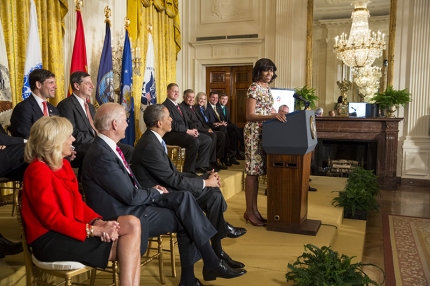
First Lady Michelle Obama delivers remarks during a Joining Forces initiative employment announcement for veterans and military spouses, in the East Room of the White House, April 30, 2013. Stage participants included, from left, Dr. Jill Biden, Vice President Joe Biden and President Barack Obama. (Official White House Photo by Chuck Kennedy)

Two years ago, President Obama announced a challenge to the private sector to hire or train 100,000 unemployed veterans or their spouses by the end of 2013.

Today, President Obama, First Lady Michelle Obama, Vice President Biden, and Dr. Jill Biden all participated in a Joining Forces Employment event at the White House.

The First Lady announced that America’s businesses nearly tripled the goal set by President Obama and did so eight months early. The private sector has already hired or trained 290,000 veterans and military spouses.

The First Lady also announced that American companies have committed to hire or train another 435,000 veterans and military spouses over the next five years. 

Valerie B. Jarrett is a Senior Advisor to President Barack Obama. She oversees the Offices of Public Engagement and Intergovernmental Affairs and chairs the White House Council on Women and Girls.
Related Topics: Jobs, Defense, Economy, Veterans, Delaware

Joining Forces to Provide Jobs for Military Families

April 30, 2013 | 6:10 | Public Domain

Joining Forces is dedicated to connecting our servicemen and women, veterans and military spouses with the resources they need to find jobs at home. Learn more at http://www.joiningforces.gov

Download mp4 (496.9MB)

The White House

Office of the First Lady

President Obama, Vice President Biden, First Lady Michelle Obama, and Dr. Jill Biden Announce that Since President Obama’s Challenge in August 2011, American Businesses Have Hired or Trained 290,000 Veterans and Military Spouses

New announcements today total an additional 435,000 veterans and military spouses hired or trained by 2018

By the numbers:

  • August 2011: President Obama challenged American business to hire or train 100,000 veterans or military spouses by 2013.
  • August 2012: The First Lady announced that companies had hired or trained 125,000 veterans and military spouses, and committed to hiring or training 250,000 more by the end of 2014.
  • April 30, 2013: The President, Vice President, First Lady, and Dr. Biden announce that 290,000 veterans or military spouses have been hired or trained, with an additional commitment of 435,000 veterans or military spouses hired or trained by the end of 2018.

For a video about Joining Forces’ hiring efforts, please click here.

Washington, D.C. – Today, the President, Vice President, First Lady, and Dr. Biden announced that 290,000 veterans or military spouses have been hired or trained, with an additional commitment of 435,000 veterans or military spouses hired by 2018.

At the Business Roundtable Quarterly Meeting in March 2013, the First Lady urged CEOs to: “Think outside the box.  Take real risks.  And work together to make big, bold commitments to hire our veterans and military spouses and help them reach their full potential within your companies.” And we’re seeing businesses get more and more creative.  Wal-Mart is telling any veteran who has served honorably that if they need a job in the year after they separate from the service, they can have one at Wal-Mart.  The Blackstone Group is setting up a program where each of its 50,000 managers is pledging to hire one veteran. 

But we still have more work to do.  With the one million servicemembers transitioning out of the military in the coming years, we need every business that has not yet joined this effort to make a commitment to hire or train our veterans and military spouses in the years to come.  That’s how we’ll continue to serve our military families as well as they have served us.

The President, Vice President, First Lady, and Dr. Biden have noted that with the Iraq war over and the war in Afghanistan drawing to a close, more than one million service members are projected to leave the military in the next several years. Hiring our veterans and military spouses will not only help them manage the transition, but shows them that our nation truly honors their service, not simply with words, but with real, concrete action that will profoundly impact their lives long after they leave the military.

Companies are making new commitments to veteran employment every week. The following companies are among the many that recognize that hiring veterans is good for their bottom line:

 Blackstone has pledged to hire 50,000 employees across its 80 portfolio companies over the next 5 years. Some of Blackstone’s better known companies include Hilton, Sea World, The Weather Channel, La Quinta, Extended Stay, Michaels Stores, Nielsen and Allied Barton.  Blackstone safeguards pensions and makes money for its investors by buying companies, restoring them, and positioning them for long-term growth.

• Deloitte LLP is doubling its veteran hiring commitment over three years.  Deloitte will also continue to sponsor events and programs such as the Warrior Games and the 100,000 Jobs Mission, by increasing the number of transition assistance workshops and Deloitte Day Open Houses, and through a new education series at Deloitte University, The Leadership Center, focused on assessment, mentoring, networking, personal branding, and career coaching.  Deloitte is also expanding its social networking outreach to veterans by establishing talent communities and networks.

• The International Franchise Association (IFA) and its more than 1,200 affiliate companies are committing to hiring 80,000 veterans and military spouses through 2014. This commitment also includes the desire to employ 5,000 Wounded Warriors.  This commitment is an expansion IFA’s VetFran strategic initiative, launched in 1991 to help veterans of the first Gulf War, adding a hiring component in addition to its original franchise owner development mission, to address the immediate needs of returning veterans.  Over 64,000 veterans, military spouses and wounded warriors have started careers in franchising, including 4,314 who have become veteran franchise business owners, since 2011.

• UPS has made a commitment to hire more than 25,000 veterans over the next five years, as well as committing to serve more than 25,000 employee volunteer hours helping veterans and Veterans Service Organizations (VSO). Veteran’s commitment to service reflects strong ethics, integrity and work discipline that transfers well and is aligned to values for which UPS employees are so well-known.  We rely on the talents and skills of our veterans to deliver unmatched logistics capabilities to our customers.  UPS has always supported Veterans, who through their service, honored their nation.  Employees that are veterans, or that serve in the National Guard and Reserves make up 7.5 percent of UPS’s domestic workforce.
 
• USAA, an organization created by the military exclusively for the military, is committed to providing career opportunities at all levels to members of the military community as they transition to civilian life. At USAA, one out of every four new employees we hire is a veteran or military spouse.  Going forward, USAA has set an even higher internal hiring goal of 30 percent of new hires will be a veteran or a spouse. Since 2005, USAA has hired more than 6,000 military veterans and spouses.  That track record has earned USAA the title of the No. 1 Military Friendly Employer by G.I. Jobs magazine and – for five consecutive years – the top military spouse-friendly employer by Military Spouse Magazine.

• Wal-Mart will offer a job to any honorably discharged veteran within his or her first 12 months off active duty beginning this Memorial Day. Wal-Mart has set a goal of a 30 day hiring process for veterans seeking direct job placement. Every veteran may not want a job in retail, but if they do, they have a place at Wal-Mart. The company is already the largest private employer of veterans, and projects they will train and hire more than 100,000 veterans over the next five years.

A complete list of every company and their commitment to veteran and military spouse employment through Joining Forces can be found at www.joiningforces.gov/commitments.

Businesses Must Hire More Vets

Ed note: This op-ed by First Lady Michelle Obama and Dr. Jill Biden was first published on Fortune.com. You can see the original article here.

Two years ago, we launched Joining Forces, a nationwide campaign to rally all Americans to support our veterans and military families. We did this for two simple reasons: because we were both awed by the courage and sacrifice of our men and women in uniform who risk their lives every day to protect our values and keep us safe. We were also awed by their families, the spouses and children who serve right along with them, enduring deployment after deployment with grace and resolve.

As we traveled the country visiting bases and military communities, everywhere we went, we heard from veterans who had years of training and experience in the military -- leading dozens, even hundreds of their peers; operating some of the most advanced technology; and solving complex problems under the most extreme conditions imaginable. But when they returned home, they struggled to find decent jobs. We met military spouses who'd spent decades moving from base to base every couple of years and struggled to maintain their careers. As the months passed, we saw that the unemployment rate for our most recent veterans remained far too high above the national average.

These men and women are some of the highest-skilled, best-trained, hardest-working people in this country. They are medics and engineers, drivers and welders, computer technicians and machinists. They are eager to work and determined to keep on serving this country. All they need is a chance.

The White House

Office of the First Lady

Op-ed by First Lady Michelle Obama and Dr. Jill Biden on Fortune.com: Businesses must hire more vets

The following op-ed by First Lady Michelle Obama and Dr. Jill Biden appeared this morning on Fortune.com
http://management.fortune.cnn.com/2013/04/30/michelle-obama-jill-biden-vets/

Michelle Obama, Jill Biden: Businesses must hire more vets

Two years ago, we launched Joining Forces, a nationwide campaign to rally all Americans to support our veterans and military families. We did this for two simple reasons: because we were both awed by the courage and sacrifice of our men and women in uniform who risk their lives every day to protect our values and keep us safe. We were also awed by their families, the spouses and children who serve right along with them, enduring deployment after deployment with grace and resolve.

As we traveled the country visiting bases and military communities, everywhere we went, we heard from veterans who had years of training and experience in the military -- leading dozens, even hundreds of their peers; operating some of the most advanced technology; and solving complex problems under the most extreme conditions imaginable. But when they returned home, they struggled to find decent jobs. We met military spouses who'd spent decades moving from base to base every couple of years and struggled to maintain their careers. As the months passed, we saw that the unemployment rate for our most recent veterans remained far too high above the national average.
These men and women are some of the highest-skilled, best-trained, hardest-working people in this country. They are medics and engineers, drivers and welders, computer technicians and machinists. They are eager to work and determined to keep on serving this country. All they need is a chance.

But the challenge of giving them that chance is only becoming more urgent. In the coming years, more than a million servicemembers will be hanging up their uniforms and transitioning to civilian life. That's on top of the hundreds of thousands of veterans and military spouses already out there looking for work.

That's why, back in August of 2011, President Obama challenged the private sector to hire or train 100,000 veterans and military spouses by the end of 2013. And over the past two years, businesses across America have answered that call. By last August, they had already filled 125,000 jobs, with commitments to hire 250,000 more. And today, we are proud to announce that America's businesses have hired or trained 290,000 veterans and military spouses, almost triple the original goal. In addition, companies like Wal-Mart, UPS, Home Depot, the Blackstone Group, Target, and McDonald's have committed to hire or train another 435,000 veterans and military spouses over the next five years.

So we're making real progress. We're encouraged that the unemployment rate for post-9/11 veterans dropped by 2.2% in 2012. But it is still too high; because as long as any veteran or military spouse who needs a job is unable to find one, then we still have work to do.

That's why, in his budget, President Obama proposed a permanent extension of the tax credits he signed into law for businesses that hire unemployed veterans and wounded warriors. We've also been working with governors and state legislators to revamp state laws to give our troops credit for the skills they've learned in the military when they apply for professional licenses and credentials here at home. In addition, we've created new partnerships between the armed forces and the manufacturing and information technology industries to ensure that our servicemembers are trained for good jobs.

But ultimately, it's up to our companies to actually hire veterans for these jobs. So today, we need business leaders across this country to ask themselves, "What can my company do for these men and women who have served our country so bravely?" If you own a small business, can you commit to hiring a few veterans -- or even just one? If you own a larger company, can you hire a few hundred -- or a few thousand? Can you retrain the veterans already in your workforce so they can grow within your company? Can you team up with other businesses to hire the veterans in your communities?

This is an all-hands-on-deck issue, and we cannot rest until every single veteran and military spouse who is searching for a job has found one. These men and women have sacrificed so much for all of us. Now is the time for all of us to come together to serve them as well as they have served this country.

Michelle Obama is First Lady of the U.S., and Dr. Jill Biden is Second Lady of the U.S.

First Lady Speaks at the White House Forum on Military Credentialing and Licensing

April 29, 2013 | 9:45 | Public Domain

First Lady Michelle Obama delivers remarks at the White House Forum on Military Credentialing and Licensing.

Download mp4 (357MB) | mp3 (24MB)

Read the Transcript

Remarks by the First Lady at White House Forum on Military Credentialing and Licensing

South Court Auditorium

11:11 A.M. EDT
 
MRS. OBAMA:  Good morning.  (Applause.)  Good morning, everyone.  Thanks so much.  (Applause.)  Thank you.  Please, sit, rest.  Because we want you to do a lot of work today, so we don’t want you to wear yourselves out.
 
It is a true pleasure to be here today.  I want to start by thanking Sergeant Hall for that very kind introduction, but, more importantly, for his outstanding service to this country.  I also want to recognize Gene Sperling for his excellent work on this issue here at the White House.
 
And of course, I want to thank John Chambers and everyone at Cisco for their extraordinary leadership to create this new IT Training and Certification Program.  So let’s just take a moment to give them a round of applause for their excellent work.  Very proud, very proud.  (Applause.)  This is the kind of leadership that is going to make the world of difference to hundreds of thousands of veterans and military families across this country.
 
And finally, I want to thank all of you for taking the time.  This is a big commitment on the part of everyone in this room, to work on this issue.  Because, as you all know, we’re here today to address one of the most pressing issues we face -- not just for our veterans and our military families, but for our economy and for the future of our country.
 
You all know the numbers.  As John said, in the coming years, more than one million servicemembers will be hanging up their uniforms and transitioning to civilian life.  And that’s on top of the hundreds of thousands of veterans and military spouses already out there looking for work.
 
These folks, as you have heard, you have seen, you will continue to see -- they are some of the most highly skilled, best-trained, hardest-working, diligent, dedicated, proud, noble, smart people that we have in this country.  And believe me, I have met with hundreds of them in the course of my service as First Lady, and it has been one of the greatest privileges -- not just to work with the men and women in uniform, but with their family members who are just as outstanding.
 
They do everything.  They are medics and engineers, they're drivers, welders.  They’re folks like Sergeant Hall, with years of experience at the highest levels of our military.  And they are eminently qualified to do the very jobs that employers across this country are desperate to fill.
 
But too often, because of red tape, or outdated rules, or simple lack of coordination, our men and women in uniform come home only to find that the training and experience they’ve gotten during their time in uniform simply doesn’t count.  Or they discover that the credits that they’ve earned in military courses don’t actually transfer when they enroll in college, so they’re turned away from jobs that they’re more than qualified to do.  Or they wind up paying to do the same coursework over again, and all that training, all that education, all that expertise that they have devoted their lives to attain, it all goes to waste.
 
And this is unfair to the men and women who have served this country so bravely.  They deserve a fair shot at a good job when they come home.  But it’s also unfair to their families who have sacrificed probably more in some instances so that these men and women can do their job.  And they deserve some financial security once they return to civilian life.
 
It is also unfair to this country, because when we don’t take advantage of the skills and talents of our veterans and military spouses, jobs go unfilled and, far worse, human potential goes untapped.  And that’s bad for our economy, as we all know.
 
Now fortunately, in recent months we’ve seen leaders across this country starting to solve this problem.  We have seen dozens of governors and state legislators passing laws that clear away all the red tape so that veterans and military spouses can get the licenses they need for the jobs they’re qualified for.  And that’s really a big deal.  It’s not a small task.
 
But the truth is that changing our laws is truly just the beginning.  Because even the best laws in the world won’t make a difference until companies are actually making those job offers, schools are accepting those credits, and our veterans and military spouses are actually collecting those paychecks that they need to take care of their families.
 
So at the end of the day, whether or not we solve this problem in so many ways is up to the men and women in this room.  That’s why we’ve invited you to the White House today to participate in these roundtables.
 
So today, I hope that you will start working together to figure out where the gaps are and how we can work together to close those gaps.  If you have a program or a curriculum that’s working at your school or your hospital or your company, we really want you to share the information here.  Tell people about it.  Be proud of it.  Share your materials so that others can replicate what you’re doing in communities across this country.  Because we have to be prepared to accept our military members, our veterans and servicemembers wherever they land in this country after their service.
 
If you think there are courses or certifications that our military should be offering to better prepare members to transition, or you think they need to revise what they’re currently offering to make it more relevant, don’t be shy.  Speak up.  Let them know.  They're used to getting good, strong feedback.  (Laughter.)  They're tough.
 
We have representatives from the Department of Defense and across the federal government who have come here today for exactly that reason –- because they want to hear your thoughts and they want to learn, and grow, and develop and make sure that we’re all working together.
 
In short, today is your chance to make the connections, form the partnerships that our veterans and military families need and deserve.  And remember, it was roundtables like these that led to the creation of the IT Training and Certification Partnership that we are announcing today.  It was this kind of work that led to this initiative.  And I hope you all will use this partnership as a model, because it is an outstanding example of what can happen when industries come together with our armed forces on behalf of our veterans.
 
As you’ve heard, this new partnership will provide up to 161,000 servicemembers with the chance to gain the certifications they need for 12 different high-demand, high-paying technology careers -– everything from IT security analysts to computer programmers to quality assurance engineers.
 
And that’s exactly the kind of impact that we’re aiming for through these conversations today.  And I also just want to say that this isn’t going to be a one-and-done kind of event.  This is the beginning.  We have directed federal agencies to host a series of follow-up meetings with the goal of creating partnerships in all four of the areas that we’re focusing on today.
 
Again, this is just the beginning.  Because once we’ve made it easier for veterans and military spouses to get the jobs they deserve, we need to make sure that companies are actually creating those jobs.  And that’s why tomorrow, here at the White House, we will be announcing groundbreaking commitments by companies across this country to hire even more of our veterans and military spouses.
 
And a thing I will say, because this is a commitment that comes from the top and it comes from our hearts:  We are not going to stop until all of our veterans and all of our military families have good jobs -- the good jobs they deserve, the good jobs that they've earned, jobs that will help them build their careers and create a better future for their children.
 
We're not going to stop.  Because in the end, that’s really what this is all about.  In the end, if we keep on working together and building these public-private partnerships, then I know that we’ll be able to serve our veterans and military families as well as they have served this country.  And that's what it's all about.
 
We are so proud of them, but we're also proud of the work that our companies have done, the way people have been stepping up without question.  It's going to take a little more work because we've got millions of people to employ, but I am confident that these kind of roundtables will move the ball forward.
 
So I thank you all again, and I wish you good luck and hard work today as we continue the work of utilizing the resources of our military and their families.  Thank you all.  God bless.  Good luck.  (Applause.)
 
END
11:21 A.M. EDT

Close Transcript