West Wing Week: "X.Y.Z."

Thanks for checking out the West Wing Week, your guide to everything that's happening at 1600 Pennsylvania Ave. This week, walk step-by-step with the President as he monitors and then visits areas affected by the BP Oil Rig incident, delivers a commencement address at University of Michigan, attends the White House Correspondents Dinner, presents the Commander-in-Chief trophy to the Navy Midshipman, ushers in Cinco de Mayo and much more.

Friday, April 30th

Saturday, May 1st

Sunday, May 2nd

Monday, May 3rd

Tuesday, May 4th

Wednesday, May 5th

Thursday, May 6th

Previous Installments

Arun Chaudhary is the official White House videographer

President Obama on Times Square Developments and Wall Street Reform

May 04, 2010 | 26:16 | Public Domain

The President vows that Americans will not be intimidated by the threat of terrorist attacks and makes the case for Wall Street Reform during remarks at the annual meeting of the Business Council in Washington, DC.

Download mp4 (525MB) | mp3 (24MB)

Read the Transcript

The President on Times Square: "But as Americans, and as a Nation, We Will Not Be Terrorized"

[[nid:11831]]

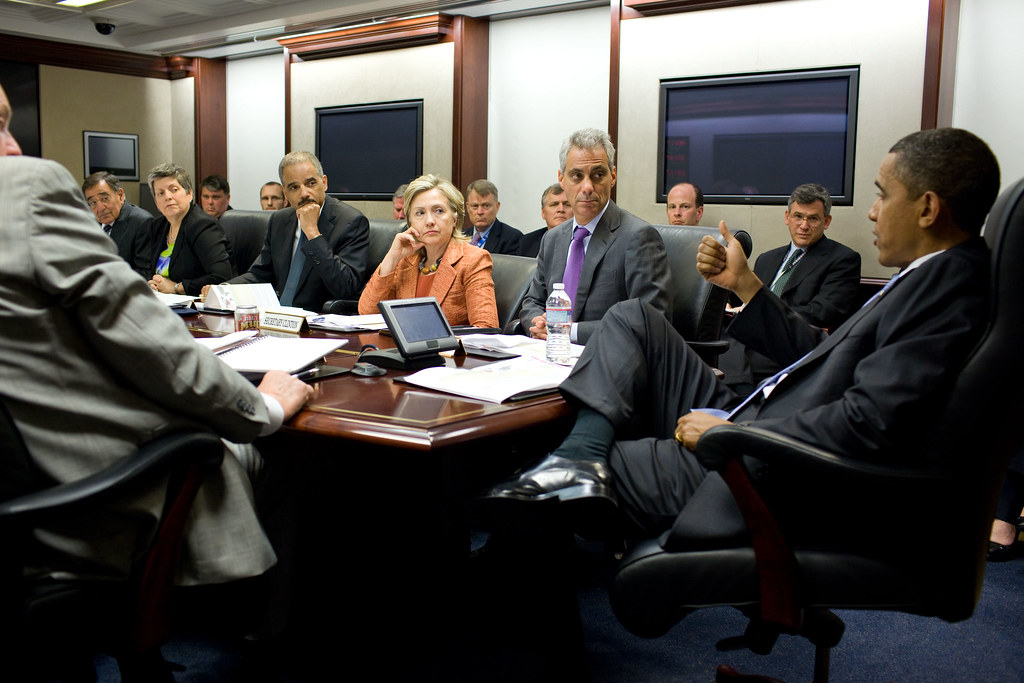
Addressing the Business Council this morning, the President spoke first on the new developments regarding the recent incident in Times Square.  Between yesterday and this morning, the President has talked with Duane Jackson and Lance Orton, who were the vendors who first reported the suspicious vehicle, as well as Officers Wayne Rhatigan and Pam Duffy who were on the scene to thank them for their vigilance:

Before I begin, I hope you don’t mind -- I indicated to Jim Owen that I want to give the American people a brief update on the investigation into the attempted terrorist attack in Times Square.  A suspect is now in custody and is being questioned.  The American people can be assured that the FBI and their partners in this process have all the tools and experience they need to learn everything we can.  That includes what, if any, connection this individual has to terrorist groups.  And it includes collecting critical intelligence as we work to disrupt any future attacks.  Justice will be done, and we will continue to do everything in our power to protect the American people.

Attorney General Eric Holder and other members of my national security team are going to be providing more details, but let me say this.  This incident is another sobering reminder of the times in which we live.  Around the world and here at home, there are those who would attack our citizens and who would slaughter innocent men, women and children in pursuit of their murderous agenda.  They will stop at nothing to kill and disrupt our way of life.  But once again, an attempted attack has been failed.

It has failed because ordinary citizens were vigilant and reported suspicious activity to the authorities.  It failed because these authorities -- local, state and federal -- acted quickly and did what they’re trained to do.  I’ve had the opportunity to personally thank some of the citizens and law enforcement officers whose quick thinking may have saved hundreds of lives.  And this suspect has been apprehended because of close and effective coordination at every level, including our Joint Terrorism Task Force and U.S. Customs and Border Protection.
Finally, New Yorkers have reminded us once again of how to live with their heads held high.  We know that the aim of those who try to carry out these attacks is to force us to live in fear, and thereby amplifying the effects of their attacks -- even those that fail.  But as Americans, and as a nation, we will not be terrorized.  We will not cower in fear.  We will not be intimidated.  We will be vigilant.  We will work together.  And we will protect and defend the country we love to ensure a safe and prosperous future for our people.  That’s what I intend to do as President and that’s what we will do as a nation.

Also read Attorney General Holder's statement.

President Barack Obama meets with administration officials on the Times Square attempted car bombing during a terrorism threat briefing in the Situation Room of the White House, May 4, 2010. Left to right, National Security Advisor Gen. James Jones, CIA Director Leon Panetta, Homeland Security Secretary Janet Napolitano, Attorney General Eric Holder, Secretary of State Hillary Clinton and Chief of Staff Rahm Emanuel. (Official White House Photo by Pete Souza)

[View Full Size]

Close Transcript

Weekly Address: Giving Government Back to the American People

April 30, 2010 | 4:58 | Public Domain

As the President beats back lobbyists seeking to weaken Wall Street Reform, he talks about an even broader threat that would vastly expand the influence of massive industries and their lobbyists in Washington. A recent Supreme Court decision opened the floodgates for corporations, including foreign corporations, to spend endless money on political ads that would give them even more power at the expense of American families – the President pledges to fight for reforms to stem that influence.

Download mp4 (141MB) | mp3 (5MB)

Read the Transcript

Weekly Address: President Obama Calls on Congress to Enact Reforms to Stop a "Potential Corporate Takeover of Our Elections"

WASHINGTON – In the wake of a recent Supreme Court ruling, which gives special interests, corporations – and potentially foreign nationals – the power to spend unlimited money to influence the outcome of elections, President Barack Obama called on Congress to enact reforms to limit this power and protect the integrity of our democracy.  With these reforms, campaign committees will have to reveal who is funding them, and their leaders or financers will have to claim responsibility for their ads.  Also, the reforms will restrict foreign corporations and foreign nationals from spending money in American elections.  These reforms will help ensure the government works for the American people, not the special interests.

The full audio of the address is HERE. The video can be viewed online at www.whitehouse.gov.

Remarks of President Barack Obama
Saturday, May 1, 2010
Weekly Address
Washington, DC

Over the past few weeks, as we’ve debated reforms to hold Wall Street accountable and protect consumers and small businesses in our financial system, we’ve come face-to-face with the great power of special interests in the workings of our democracy.  Of course, this isn’t a surprise.  Every time a major issue arises, we’ve come to expect that an army of lobbyists will descend on Capitol Hill in the hopes of tilting the laws in their favor. 

That’s one of the reasons I ran for President: because I believe so strongly that the voices of ordinary Americans were being drowned out by the clamor of a privileged few in Washington.  And that’s why, since the day I took office, my administration has been taking steps to reform the system.  Recently, however, the Supreme Court issued a decision that overturned decades of law and precedent – dealing a huge blow to our efforts to rein in this undue influence.  In short, this decision gives corporations and other special interests the power to spend unlimited amounts of money – literally millions of dollars – to affect elections throughout our country.  This, in turn, will multiply their influence over decision-making in our government.

In the starkest terms, members will know – when pressured by lobbyists – that if they dare to oppose that lobbyist’s client, they could face an onslaught of negative advertisements in the run up to their next election.  And corporations will be allowed to run these ads without ever having to tell voters exactly who is paying for them.  At a time when the American people are already being overpowered in Washington by these forces, this will be a new and even more powerful weapon that the special interests will wield. 

In fact, it’s exactly this kind of vast power that led a great Republican President – Teddy Roosevelt – to tackle this issue a century ago.  He warned of the dangers of limitless corporate spending in our political system.  He actually called it “one of the principal sources of corruption in our political affairs.”  And he proposed strict limits on corporate influence in elections.  “Every special interest is entitled to justice,” he said.  “but not one is entitled to a vote in Congress, to a voice on the bench, or to representation in any public office.”

In the wake of the recent Supreme Court ruling, we face a similar challenge.  That’s why it’s so important that Congress consider new reforms to prevent corporations and other special interests from gaining even more clout in Washington.  And almost all of these reforms are designed to bring new transparency to campaign spending.  They are based on the principle espoused by former Supreme Court Justice Louis Brandeis – that sunlight is the best disinfectant. 

Shadowy campaign committees would have to reveal who’s funding their activities to the American people.  And when corporations and other special interests take to the airwaves, whoever is running and funding the ad would have to appear in the advertisement and claim responsibility for it – like a company’s CEO or an organization’s biggest contributor.  This will mean citizens can evaluate the claims in these ads with information about an organization’s real motives. 

We know how important this is. We’ve all seen groups with benign-seeming names sponsoring television commercials that make accusations and assertions designed to influence the public debate and sway voters’ minds.  Now, of course every organization has every right in this country to make their voices heard.  But the American people also have the right to know when some group like “Citizens for a Better Future” is actually funded entirely by “Corporations for Weaker Oversight.”

In addition, these reforms would address another troubling aspect of the Supreme Court’s ruling.  Under the bill Congress will consider, we’ll make sure that foreign corporations and foreign nationals are restricted from spending money to influence American elections, just as they were in the past – even through U.S. subsidiaries.  And we’d keep large contractors that receive taxpayer funds from interfering in our elections as well, to avoid the appearance of corruption and the possible misuse of tax dollars. 

Now, we can expect that these proposed changes will be met with heavy resistance from the special interests and their supporters in Congress.  But I’m calling on leaders in both parties to resist these pressures.  For what we are facing is no less than a potential corporate takeover of our elections.  And what is at stake is no less than the integrity of our democracy.  This shouldn’t be a Democratic issue or a Republican issue. This is an issue that goes to whether or not we will have a government that works for ordinary Americans – a government of, by, and for the people.  That’s why these reforms are so important. And that’s why I’m going to fight to see them passed into law.

Thanks so much.

Close Transcript

West Wing Week: "Doing the Math"

April 29, 2010 | 6:08 | Public Domain

Thanks for checking out the West Wing Week, your guide to everything that's happening at 1600 Pennsylvania Ave. This week, walk step-by-step with the President as he attends a naturalization ceremony for some members of the Armed Forces, delivers a eulogy for West Virginia miners, welcomes the World Series Champion New York Yankees, travels to the Midwest as part of his White House to Main Street tour, and much more.

Download mp4 (173.3MB)

The White House

Office of the Press Secretary

Declaraciones del Presidente sobre la aprobación en la Cámara de Representantes de la Ley para Eliminar y Recuperar Pagos Inapropiados

“Hoy la Cámara de Representantes dio otro paso crucial hacia una mayor responsabilidad fiscal al aprobar la Ley para Eliminar y Recuperar Pagos Inapropiados (Improper Payments Elimination and Recovery Act).  Esta ley cuenta con el respaldo de ambos partidos y ayudará a ahorrar dinero de los contribuyentes al controlar pagos excesivos y despilfarradores hechos por el gobierno federal a personas, organizaciones y contratistas, el tipo de inaceptables errores contables que les costaron a los contribuyentes $98,000 millones en el 2009. Esta ley también pone en vigor requisitos más rigurosos respecto al escrutinio de programas con pagos errados y amplía la autoridad de las agencias federales para que utilicen auditores del sector privado a fin de encontrar y recuperar pagos excesivos hechos por el gobierno. Y aumenta significativamente la transparencia y rendimiento de cuentas en el gasto gubernamental. En pocas palabras, cambia la manera en que Washington ha venido operando.
 
Considero que tenemos la especial responsabilidad de ser sabios administradores del dinero que con tanto trabajo ganan los estadounidenses y pagan como impuestos. Por eso, en noviembre pasado firmé un decreto ejecutivo para disminuir los pagos inapropiados al aumentar la transparencia, requerir rendimiento de cuentas de las agencias y crear sólidos incentivos para el cumplimiento. Y por eso en marzo pasado firmé un decreto haciendo un llamado a todas las agencias federales para que realizaran rigurosas auditorías a fin de recuperar parte del dinero perdido a raíz de pagos inapropiados el año anterior. Aplaudo a la Cámara de Representantes por aprobar hoy la legislación que apoya estos objetivos y espero que el Senado tome pronta acción y que me envíen la ley para su promulgación lo antes posible”.
 

Reforming Wall Street: The View from Main Street

April 28, 2010 | 30:39 | Public Domain

President Obama makes the case for bringing financial reform and responsibility to Wall Street at a "White House to Main Street" tour stop in Quincy, IL.

Download mp4 (610MB) | mp3 (28MB)

“White House to Main Street” Town Hall: Ottumwa, IA

April 27, 2010 | 1:08:39 | Public Domain

President Obama holds a town hall meeting in Ottumwa, IA and tells the crowd that his Administration is committed to issues that affect the middle class like health reform, employment, and fiscal responsibility.

Download mp4 (851MB) | mp3 (63MB)

National Commission on Fiscal Responsibility and Reform

April 27, 2010 | 2:45:29 | Public Domain

Former White House Chief of Staff Erskine Bowles and former Senator Alan Simpson preside over the first meeting of the bipartisan National Commission on Fiscal Responsibility and Reform.

Download mp3 (151MB)

Getting to the Root Causes of Our Fiscal Challenges

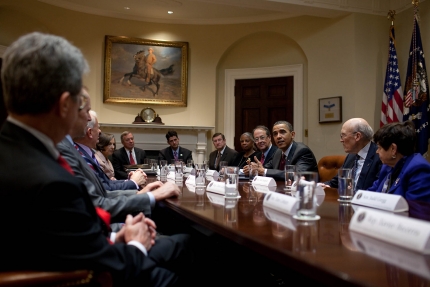
This morning the President’s Bipartisan Fiscal Commission holds its first meeting, taking on one of the most difficult challenges facing any government. The Commission was established by Executive Order in February, when the President appointed co-chairs former White House Chief of Staff Erskine Bowles and former Republican Senate Whip Alan Simpson, along with four other members a week later. The other dozen members of the Commission were appointed by Democratic and Republican leadership in Congress.

President Obama Meets with National Commission on Fiscal Responsibility and Reform

President Barack Obama meets with the National Commission on Fiscal Responsibility and Reform in the Roosevelt Room of the White House, April 27, 2010. (Official White House Photo by Pete Souza)

The President talked briefly with the Commission before they began their meeting, and said a few words about the importance of their mission. He spoke about the work he has done already towards trying to restore a stable fiscal path, from asking Congress to restore the “pay as you go” rule, to going line by line through the budget for more than $20 billion in savings, to challenging long-entrenched but outdated defense projects, to proposing a freeze in most of the discretionary budget for the next three years. As he made clear though, these steps are not enough:

Now, I’ve said that it’s important that we not restrict the review or the recommendations that this commission comes up with in any way. Everything has to be on the table. And I just met briefly with the commission and said the same thing to them. Of course, this means that all of you, our friends in the media, will ask me and others once a week or once a day about what we’re willing to rule out or rule in when it comes to the recommendations of the commission. That’s an old Washington game and it’s one that has made it all but impossible in the past for people to sit down and have an honest discussion about putting our country on a more secure fiscal footing.

So I want to deliver this message today: We’re not playing that game. I’m not going to say what’s in. I’m not going to say what’s out. I want this commission to be free to do its work.

In theory, there are few issues on which there is more vigorous bipartisan agreement than fiscal responsibility. But in practice, this responsibility for the future is often overwhelmed by the politics of the moment. It falls prey to special interest pressures, to the pull of local concerns, and to the reality familiar to every single American -- it’s a lot easier to spend a dollar than to save one. That’s what, at root, led to these exploding deficits. And that is what will lead to a day of reckoning.  

But I believe, with the help of these gentlemen and this commission, we can begin to meet this challenge in a serious and thoughtful way. And I believe we must, for the future of our country. 

Related Topics: Fiscal Responsibility

The White House

Office of the Press Secretary

Declaraciones del Presidente en la Primera Reunión de la Comisión Fiscal

Jardín de Rosas
 
9:50 A.M. EDT
 
 
     EL PRESIDENTE: Buenos días a todos.
 
Como nación, continuamos sintiendo las consecuencias de tres desafíos distintos pero interrelacionados. Uno es la crisis financiera, producto de especulación imprudente que amenazó con paralizar los préstamos a familias y empresas. Y esta crisis, a su vez, llevó a la mayor recesión en varias generaciones, y el precio lo han pagado millones de estadounidenses que han perdido su empleo y su vivienda, miles de empresas que han cerrado, y las economías locales en todo el país que han sido devastadas. En los últimos dos años, esta desaceleración ha agravado una severa crisis fiscal ya existente, motivada por décadas de malos hábitos en Washington.
 
Como resultado de esto, el día que crucé esta puerta, que entré a la Oficina Oval, el déficit era de $1,300 billones y se proyectaba un déficit de $8 billones en los próximos 10 años. En parte, esto fue causado por la recesión, lo que significaba que el gobierno recaudaba menos y al mismo tiempo era mayor la necesidad de ayuda para quienes habían perdido el empleo. Otro factor que ha contribuido a nuestro déficit es el creciente costo del cuidado de salud. Cada año, se destina más dinero de los contribuyentes a Medicare y Medicaid.
 
Pero lo que también hizo posible este enorme déficit fue que la gente de Washington postergó decisiones políticas difíciles y evitó decir la dura verdad sobre la naturaleza del problema. El hecho es que, siempre es más fácil, cuando eres servidor público, contar las buenas noticias, decirle a la gente lo que quiere oír en lugar de lo que necesita saber. Y los caballeros detrás de mí, Alan Simpson y Erskine Bowles, son testigos de que durante mucho tiempo ésa fue la norma en Washington respecto a nuestras finanzas.
 
En el último año, hemos tenido que tomar medidas de emergencia para evitar que la recesión se convirtiera en otra depresión. Ahora, en momentos en que millones de personas no tienen trabajo, seguiremos haciendo todo lo que sea necesario para impulsar la generación de empleo a la vez que sentamos nuevas bases para un crecimiento económico duradero. Pero las medidas de emergencia han añadido aproximadamente $1 billón al déficit en los próximos 10 años. Como resultado, incluso a medida que damos estos pasos necesarios para el corto plazo, tenemos una obligación con las generaciones futuras, de solucionar el déficit estructural y de largo plazo que amenaza con debilitar nuestra economía y dejarles a nuestros hijos y nietos una montaña de deudas.
 
Por eso le pedí al Congreso que volviera a instaurar la regla de “pagar gastos cuando se incurren en ellos” (pay as you go). Esta regla dice que el Congreso no puede gastar un solo dólar en otorgar un nuevo recorte tributario o crear un programa de beneficios a menos que ahorre un dólar en otro rubro. Es lo que ayudó a lograr el equilibrio presupuestal en los noventa. En realidad, el hecho de abandonar “pay as you go” fue lo que llevó a que el superávit récord se convirtiera en déficit récord en sólo una década.
 
Luego, hemos estado examinando el presupuesto, partida por partida, y hemos identificado más de $20,000 millones en ahorros sólo este año. Hemos recortado o eliminado cientos de programas desactualizados o ineficaces, y hemos empezado a reformar nuestro inflado sistema de contratación. También hemos desafiado con éxito la costumbre del Congreso de favorecer a ciertos contratistas con la aprobación de sistemas de armamento que el Pentágono mismo dice que no desea ni necesita. Porque en estos tiempos difíciles tenemos que ahorrar todo lo posible para poder pagar las cosas que necesitamos, al igual que lo hacen las familias.
 
    Finalmente, hemos propuesto congelar el gasto gubernamental durante tres años. Esto no afectará los beneficios de Medicare, Medicaid ni el Seguro Social. Tampoco afectará la seguridad nacional ni los beneficios para veteranos. Pero sí afectara todo el otro gasto discrecional. Mi presupuesto acaba con las lagunas legales y los regalos tributarios a las compañías petroleras y de gas, y al 2 por ciento de los estadounidenses más ricos, simplemente porque no podemos costearlos. Y cumplí mi promesa de aprobar una ley de reforma de salud sin añadir un centavo al déficit. De hecho, se espera que al eliminar el despilfarro, atacar el fraude y promover un mejor cuidado de salud, la reforma reduzca nuestro déficit en más de $1 billón en las próximas dos décadas.
 
Pero todas estas medidas, a pesar de ser significativas, no son suficientes. Porque si bien estamos controlando el despilfarro y le pedimos cuentas al Congreso por cada dólar que gasta, esto por sí solo no compensará los años en que Washington se rehusó a tomar las decisiones difíciles y gastar dentro de sus posibilidades. Y no compensará por la permanente abstención de informar sinceramente al pueblo estadounidense sobre el costo de los servicios que tanto valoran.
 
Esto va a requerir que gente de ambos partidos se una y analice a profundidad la creciente brecha entre lo que el gobierno gasta y lo que el gobierno recauda en impuestos. Y requerirá que pongamos la politiquería de lado y que pensemos más en la próxima generación que en la próxima elección. Simplemente no hay otra manera.
 
Por eso establecí una Comisión Nacional de Reforma y Responsabilidad Fiscal (National Commission on Fiscal Responsibility and Reform) en base a una propuesta inicial presentada por un grupo de senadores de ambos partidos. Y ahora, la comisión tendrá su primera reunión oficial. Y les agradezco a todos sus miembros, demócratas y republicanos, gente del gobierno y gente del sector privado, por participar.
 
Quiero agradecer especialmente a Erskine Bowles y Alan Simpson por presidir la comisión. Estos caballeros tienen diferente afiliación política, pero comparten la misma fortaleza de carácter, la habilidad de trabajar con gente de otros partidos y la voluntad de decir la dura verdad, incluso si es difícil. Estas cualidades serán esenciales, así como la valentía que ya han demostrado al asumir esta labor.
 
Bien, he dicho que es importante que no restrinjamos de ninguna manera el análisis ni las recomendaciones que produzca esta comisión. Todo debe ponerse sobre la mesa. Y acabo de reunirme brevemente con la comisión y les dije lo mismo. Por supuesto, esto significa que todos ustedes, nuestros amigos de los medios, me preguntarán a mí y a otros una vez a la semana o a diario lo que estamos dispuestos a descartar de las recomendaciones de la comisión. Ése es un viejo juego en Washington que en el pasado ha hecho casi imposible que la gente se siente y tenga una conversación franca sobre cómo poner a nuestro país en una mejor situación fiscal.
 
Entonces deseo enviarles un mensaje hoy: No vamos a participar de ese juego. No voy a decir lo que va. No voy a decir lo que no va. Quiero que esta comisión se sienta libre de hacer su labor.
 
En teoría, hay pocos asuntos en los cuales hay un acuerdo más sólido entre los dos partidos que respecto a la responsabilidad fiscal. Pero en la práctica, esta responsabilidad por el futuro a menudo es relegada por la política coyuntural. Cae víctima de la presión de los intereses especiales, la influencia de las inquietudes locales y la realidad con la que cada estadounidense está familiarizado: que es mucho más fácil gastar un dólar que ahorrarlo. Eso es lo que llevó a este exorbitante déficit, es la raíz de todo. Y eso nos llevará al día de ajuste de cuentas.
 
Pero creo que con la ayuda de estos caballeros y de la comisión, podemos empezar a hacerle frente a este desafío de una manera seria y razonada. Y creo que debemos hacerlo, por el futuro de nuestro país.
 
Entonces, Alan, Erskine, gracias por participar. Quiero agradecerles a todos los miembros de la comisión fiscal. Contamos con un grupo serio de demócratas y republicanos, del sector privado y público, gente sincera respecto a este esfuerzo. Y les dije que nosotros también hablamos en serio.
 
Creo que he demostrado en el transcurso del último año que estoy dispuesto a hacer cosas incluso si no son populares. Muchas de las decisiones para controlar el déficit presupuestal probablemente no sean populares, pero creo que Alan y Erskine acordaron asumir esta labor porque están convencidos de que hablo en serio. Y voy a estar de su lado cuando presenten sus recomendaciones.
 
Entonces, muchas gracias a todos.
 
                                       END                9:59 A.M. EDT