The White House

Office of the Press Secretary

President Obama Names Members of Bipartisan National Commission on Fiscal Responsibility and Reform

WASHINGTON – Today, President Barack Obama named the following individuals to serve on the bipartisan National Commission on Fiscal Responsibility and Reform being co-chaired by former White House Chief of Staff Erskine Bowles and former Republican Senate Whip Alan Simpson:

  • David Cote, Member, National Commission on Fiscal Responsibility and Reform
  • Ann Fudge, Member, National Commission on Fiscal Responsibility and Reform
  • Alice Rivlin, Member, National Commission on Fiscal Responsibility and Reform
  • Andy Stern, Member, National Commission on Fiscal Responsibility and Reform

President Obama said, “For far too long, Washington has avoided the tough choices necessary to solve our fiscal problems.  I am proud that these distinguished individuals have agreed to work to build a bipartisan consensus to put America on the path toward fiscal reform and responsibility.  I know they’ll take up their work with the sense of integrity and strength of commitment that the American people deserve and America’s future demands.”

The bipartisan National Commission on Fiscal Responsibility and Reform will make recommendations to Congress by December 1, 2010 to put the budget in primary balance so that all operations and programs for the federal government are paid for (achieving deficits of about 3 percent of GDP) by 2015 and to meaningfully improve the long-term fiscal outlook.  With today’s appointments the President has named 6 bipartisan appointees to the commission.  The remaining 12 members of the commission will be appointed by Senate and House leaders (3 each by the Republican and Democratic leaders of both chambers).

President Obama named the following individuals as members of the National Commission on Fiscal Responsibility and Reform:

Dave Cote has served since 2002 as chairman, chief executive officer, and president of Honeywell, a diversified technology and manufacturing leader. Under Cote’s leadership, Honeywell has delivered strong performance in sales, earnings per share, segment profit, and cash flow.  He has served on the U.S.-India CEO Forum since 2005 and was named co-chair by President Obama in 2009.  Previously, he was chairman, chief executive officer, and president of TRW.  He joined TRW from General Electric, where he served 25 years in various manufacturing, finance, and management positions.  He received the Corporate Social Responsibility Award from the Foreign Policy Association in 2007.  He is a graduate of the University of New Hampshire.

Ann Fudge served as chairman and chief executive officer of Young & Rubicam Brands from 2003 to 2006.  Prior to joining Young & Rubicam Brands, she worked at General Mills and Kraft, where she served in a number of senior executive positions.  Fudge is not only a proven business leader, but also an engaged civic voice having served on the boards of the Gates Foundation, the Rockefeller Foundation, and the Boys and Girls Clubs of America.  She is a graduate of Simmons College and Harvard Business School.

Alice Rivlin is a senior fellow in the Economic Studies Program at the Brookings Institution and visiting professor at Georgetown University.  Before returning to Brookings, she served in a variety of senior public policy roles including vice chair of the Federal Reserve Board, director of the White House Office of Management and Budget, chair of the District of Columbia Financial Management Assistance Authority, and founding director of the Congressional Budget Office.  She is a graduate of Bryn Mawr College and received her Ph.D. in economics from Harvard University.

Andy Stern, president of the Service Employees International Union, represents 2.2 million healthcare workers, janitors, security officers, public employees, and other hardworking women and men in the United States, Canada, and Puerto Rico.  As both a labor leader and an activist, he is a leading voice and aggressive advocate for practical solutions to achieve economic opportunity and justice for workers.  Stern began working as a social service worker and member of SEIU Local 668 in 1973 and rose through the ranks before his election as SEIU president in 1996.  He is a graduate of the University of Pennsylvania. 

Of Government, Business, and Jobs

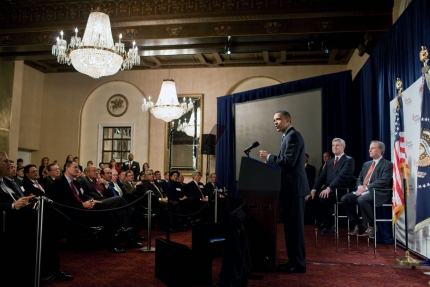
Today, President Obama gave a major address to the Business Roundtable to encourage cooperation from business leaders to promote economic recovery. "I want to spend most of my time talking about the specific steps we need to take to build this more competitive America," he told them, "But before I do, I want to talk a little bit about the relationship between business and government in promoting economic growth."

He began spelling out his vision on that score:

I am an ardent believer in the free market.  I believe businesses like yours are the engines of economic growth in this country.  You create jobs.  You develop new products and cutting-edge technologies.  And you create the supply chains that make it possible for small businesses to open their doors.  So I want everyone in this room to succeed.  I want your shareholders to do well, I want your workers to do well, I want you to do well -- because I firmly believe that America’s success in large part depends on your success internationally.

Now, I also believe this:  Government has a vital, if limited, role to play in fostering sustained economic growth and creating the foundations for you to succeed.

President Obama at Business Roundtable 02.24

President Barack Obama addresses the Business Roundtable's 2010 First Quarter Meeting in Washington. With the President are John Castellani, President of the Business Roundtable, center, and Ivan Seidenberg, CEO of Verizon Communications, February 24, 2010. (Official White House Photo by Pete Souza)

Saying that the government he leads doesn’t step in “to supplant private enterprise, but to catalyze it,” he reminded the business leaders that it is the government’s responsibility to establish the basic rules of the marketplace to ensure honest competition, make investments that serve general welfare, and to guarantee a level of security for all Americans.

The President discussed a series of initiatives that the administration is taking to assist economic recovery, including the one that the Senate passed today, which provides tax cuts for small businesses that hire new workers. He noted the importance of making it easier for small businesses to get loans, and providing tax incentives for large businesses to invest in new plants and equipment.

He called for support for new financial regulations that can get rid of the system’s current vulnerabilities in order to prevent a future economic crisis by not allowing recklessness to continue. He explained that financial reform means closing loopholes that allow firms to evade rules in order to ensure consumer and investor protections. "This is about putting in place rules that encourage drive and innovation instead of shortcuts and abuse.  And those are rules that will benefit everybody."
 
President Obama highlighted the importance of the administration’s new initiatives to jumpstart clean energy technology, push for stronger education, strengthen trade relations for competition, and establish a stronger health care system. He emphasized the drag on the economy that is caused by the current state of health care, pointing out that health care reform would significantly reduce the deficit while providing more certainty for businesses.

On all these issues -– from education to health care to taxes -– my first question can’t be, “Is this good for business?” or “Is this good for labor?”  It can’t be, “Is this good politics?”  “Are folks going to tag me as a liberal or a conservative?”  The only question I have to ask myself is, “Is this good for America?  Does it help us compete?  Does it grow our economy?  Does it create jobs for middle-class and those trying to join the middle class?  Is it fostering innovation and creating new business opportunities?”  That’s my job as President.
 

Business Leaders at watch President Obama Address the Business Roundtable

Members of the Business Roundtable listen as President Barack Obama addresses their 2010 First Quarter Meeting in Washington, February 24, 2010. (Official White House Photo by Pete Souza)

The White House

Office of the Press Secretary

Presidente Obama constituye Comisión Nacional para la Responsabilidad Fiscal y Reforma con miembros de ambos partidos

Presidirán la comisión el antiguo jefe de gabinete de la Casa Blanca Erskine Bowles y el ex encargado de disciplina republicana en el Senado Alan Simpson

WASHINGTON – Hoy, el Presidente Obama firmará un decreto ejecutivo constituyendo la Comisión Nacional para la Responsabilidad Fiscal y la Reforma (National Commission on Fiscal Responsibility and Reform) con miembros de ambos partidos y designó como presidentes de la comisión al ex jefe de gabinete de la Casa Blanca Erskine Bowles y al ex encargado de disciplina de los republicanos en el Senado Alan Simpson.

El Presidente Obama declaró, “Durante demasiado tiempo, Washington ha esquivado las decisiones difíciles que son necesarias para resolver nuestros problemas fiscales, y éstos no se resolverán de la noche a la mañana. Pero con el liderazgo de Erskine y Alan, estoy seguro de que la comisión que estoy constituyendo hoy generará consenso entre ambos partidos para volver a llevar a Estados Unidos por el camino de la reforma fiscal y responsabilidad. Sé que emprenderán la labor con la integridad y el compromiso que el pueblo estadounidense merece y el futuro de Estados Unidos exige”.

El ex jefe de gabinete de la Casa Blanca Erskine Bowles afirmó, “Éste es uno de los desafíos más importantes que enfrenta el país en la actualidad, y es necesario que ambos partidos lo aborden conjuntamente. No se trata de un problema republicano o demócrata; se trata de un desafío para Estados Unidos”.

El ex encargado de disciplina de los republicanos en el Senado Alan Simpson dijo, “Nos encontramos en una difícil situación económica que es insostenible. Independientemente de los resultados de nuestro trabajo, el pueblo estadounidense sabrá mucho más sobre a dónde nos dirigimos con una evaluación franca de nuestra situación y la valentía de hacer algo al respecto. Me complace aceptar este difícil papel y estoy deseoso de trabajar con Erskine y los miembros de la comisión”.

La Comisión Nacional para la Responsabilidad Fiscal y Reforma generará consenso entre ambos partidos para presentar soluciones a nuestros desafíos fiscales, que se han ignorado desde hace tiempo.
• La comisión hará recomendaciones para que exista un saldo presupuestal primario, de manera que paguemos todas las operaciones y programas del gobierno federal (reduciendo el déficit a aproximadamente 3 por ciento del PIB) para el 2015 y mejoremos significativamente las perspectivas fiscales a largo plazo.
• La comisión estará compuesta por un total de 18 miembros. Los líderes del Senado/Cámara de Representantes nombrarán a 12 miembros (3 por cada uno de los líderes republicanos y demócratas de ambas cámaras). Todos deben ser miembros del Congreso en funciones. El Presidente nombrará a los 6 miembros adicionales, y no más de 4 serán del mismo partido político.
• Además, se requerirán 14 de los 18 votos para reportar recomendaciones, y éstas se deben presentar ante el Congreso para el 1º de diciembre, 2010, a más tardar.

El decreto ejecutivo se firmó en un evento esta mañana.

Desde que asumió el mando, el Presidente Obama se ha esforzado por iniciar una nueva era de responsabilidad en Washington. Presentó un presupuesto para el 2011 que incluye medidas para reducir el déficit en más de $1 billón, salvo lo que se ahorre en guerras, y promulgó la ley sobre el pago estatutario de gastos cuando se incurren en ellos (PAYGO), de manera que el Congreso pague sus propuestas. Dio instrucciones a miembros de su gobierno para que examinen el presupuesto partida por partida, en busca de programas no eficaces, obsoletos o redundantes. Y el Presidente está acometiendo el mayor desafío de nuestro futuro fiscal –acabar con el desmesurado aumento en los costos del cuidado de salud– luchando por la aprobación de una ley para la reforma significativa de la atención de salud y exigiendo que no aumente nuestro déficit ni en un centavo.

El Presidente Obama nombró como presidentes de la Comisión Nacional para la Responsabilidad Fiscal y Reforma a las siguientes personas:

Erskine Bowles actualmente es rector de la Universidad de Carolina del Norte. Ocupó el cargo de jefe de gabinete de la Casa Blanca bajo el Presidente Clinton de 1996 a 1998. En esa calidad, Bowles negoció con los líderes republicanos del Congreso el último y más significativo acuerdo que contó con la aprobación de ambos partidos: la Ley de Equilibrio Presupuestal (Balanced Budget Act) de 1997, que ayudó a lograr el equilibrio presupuestal por primera vez en casi 30 años. Anteriormente se desempeñó como subjefe de gabinete de la Casa Blanca de 1994 a 1995 y estuvo al mando de la Dirección de Pequeñas Empresas (Small Business Administration) de 1993 a 1994. Bowles también ha trabajando extensamente en el sector empresarial, donde ayudó a fundar la firma de inversiones Carousel Capital en Charlotte, Carolina del Norte, y fue el candidato demócrata al Senado de Estados Unidos por Carolina del Norte tanto en el 2002 como el 2004.

Alan Simpson fue senador federal de Wyoming de 1979 a 1997. De 1985 a 1995, fue el encargado de disciplina de los republicanos en el Senado, y también presidió el subcomité de Seguro Social del comité de finanzas del Senado. Durante su carrera en el Senado, Simpson se pronunció con frecuencia a favor del equilibrio presupuestal, y por ejemplo, votó a favor del acuerdo para la reducción del déficit suscrito por ambos partidos en 1990. De 1997 al 2000, Simpson fue profesor en el Centro Joan Shorenstein sobre prensa, política y administración pública en la Facultad Kennedy de Gobierno de la Universidad Harvard. Simpson dejó Harvard en el 2000 para regresar a Cody, Wyoming, donde ahora ejerce derecho con sus dos hijos. Simpson es miembro de la Comisión para la Continuidad en el Gobierno, (Commission for Continuity in Government), y también es uno de los presidentes de Americans for Campaign Reform, con varios ex colegas del Senado. Fue miembro del Grupo de Análisis sobre Irak.

###


Encouraging Long-Term Fiscal Responsibility and Reform

February 18, 2010 | 9:48 | Public Domain

President Obama establishes The National Commission On Fiscal Responsibility and Reform, headed by Alan Simpson and Erskine Bowles, to help the Nation’s long-term fiscal picture and guide responsible Federal spending.

Download mp4 (197MB) | mp3 (9MB)

Read the Transcript

Remarks by The President Establishing The National Commission On Fiscal Responsibility and Reform

10:20 A.M. EST

THE PRESIDENT:  Good morning, everybody.  When I took office, America faced three closely linked challenges.  One was a financial crisis, brought on by reckless speculation that threatened to choke off all lending.  And this helped to spark the deepest recession since the Great Depression, from which we're still recovering.  That recession, in turn, helped to aggravate an already severe fiscal crisis, brought on by years of bad habits in Washington.

Now, the economic crisis required the government to make immediate emergency investments that added to our accumulated debt -- critical investments that have helped to break the back of the recession and lay the groundwork for growth and job creation.  But now, with so many Americans still out of work, the task of recovery is far from complete.  So in the short term, we're going to be taking steps to encourage business to create jobs that will continue to be my top priority. 

Still there's no doubt that we're going to have to also address the long-term quandary of a government that routinely and extravagantly spends more than it takes in. 

When I walked into the door of the White House, our government was spending about 25 percent of GDP but taking in only about 16 percent of GDP.  Without action, the accumulated weight of that structural deficit, of ever-increasing debt, will hobble our economy, it will cloud our future, and it will saddle every child in America with an intolerable burden.

This isn't news.  Since the budget surpluses at the end of the 1990s, federal debt has exploded.  The trajectory is clear and it is disturbing.  But the politics of dealing with chronic deficits is fraught with hard choices and therefore it's treacherous to officeholders here in Washington.  As a consequence, nobody has been too eager to deal with it.

That's where these two gentlemen come in.  Alan Simpson and Erskine Bowles are taking on the impossible:  They're going to try to restore reason to the fiscal debate and come up with answers as co-chairs of the new National Commission on Fiscal Responsibility and Reform.  I'm asking them to produce clear recommendations on how to cover the costs of all federal programs by 2015, and to meaningfully improve our long-term fiscal picture.  I've every confidence that they'll do that because nobody is better qualified than these two.

Alan Simpson is a flinty Wyoming truth-teller -- (laughter) -- if you look in the dictionary it says "flinty," and then it's got Simpson's picture.  (Laughter.)   Through nearly two decades in the United States Senate, he earned a reputation for putting common sense and the people's welfare ahead of petty politics.  As the number two Republican in the Senate, he made the tough choices necessary to close deficits and he played an important role in bipartisan deficit reduction agreements.

Erskine Bowles understands the importance of managing money responsibly in the public sector, where he ran the Small Business Administration and served as President Clinton's chief of staff.  In that capacity, he brokered the 1997 budget agreement with Republicans that helped produce the first balanced budget in nearly 30 years.  One is a good Republican, the other a good Democrat.  But above all, both are patriotic Americans who are answering their country's call to free our future from the stranglehold of debt.

The commission they'll lead was structured in such a way as to rise above partisanship.  There's going to be 18 members.  In addition to the two co-chairs, four others will be appointed by me.  Six will be appointed by Republican leaders, six by Democratic leaders.  Their recommendations will require the approval of 14 of the commission's 18 members, and that ensures that any recommendation coming out of this effort and sent forward to Congress has to be bipartisan in nature.

This commission is patterned on a bill that I supported for a binding commission that was proposed by Democratic Senator Kent Conrad and Republican Senator Judd Gregg.  Their proposal failed recently in the Senate.  But I hope congressional leaders in both parties can step away from the partisan bickering and join this effort to serve the national interest.

As important as this commission is, our fiscal challenge is too great to be solved with any one step alone, and we can't we wait to act.  That's why last week, I signed into law the PAYGO bill -- says very simply that the United States of America should pay as we go and live within our means again -- just like responsible families and businesses do.  This law is what helped get deficits under control in the 1990s and produced surpluses by the end of the decade. 

It was suspended in the last decade, and during that period we saw deficits explode again.  By reinstituting it, we're taking an important step towards addressing the deficit problem in this decade, and in decades to come.

That's also why, after taking steps to cut taxes and increase access to credit for small businesses to jumpstart job creation this year, I've called for a three-year freeze on discretionary spending, starting next year.  This freeze won't affect Medicare, Medicaid, or Social Security spending.  And it won't affect national security spending, including veterans' benefits.  But all other discretionary spending will be subject to this freeze. 

These are tough times and we can't keep spending like they're not.  That's why we're seeking to reform our health insurance system -- because if we don't, soaring health care costs will eventually become the single largest driver of our federal deficits.  Reform legislation in the House and the Senate would bring down deficits, and I'm looking forward to meeting with members of both parties and both chambers next week to try to get this done.

And that's also why this year, we're proposing a responsible budget that cuts what we don't need to pay for what we do.  We've proposed budget reductions and terminations that would yield about $20 billion in savings.  We're ending loopholes and tax giveaways for oil and gas companies and for the wealthiest 2 percent of Americans.  So, taken together, these and other steps would provide more than $1 trillion in deficit reduction over the coming decade.  That's more savings than any administration's budget in the past 10 years.

I know the issue of deficits has stirred debate.  And there's some on the left who believe that this issue can be deferred.  There are some on the right who won't enter into serious discussions about deficits without preconditions.  But those who preach fiscal discipline have to be willing to take the hard steps necessary to achieve it.  And those who believe government has a responsibility to meet these urgent challenges have a great stake in bringing our deficits under control -- because if we don't, we won't be able to meet our most basic obligations to one another.

So America's fiscal problems won't be solved overnight.  They've been growing for years; they're going to take time to wind down.  But with the commission that I'm establishing today, and the other steps we're pursuing, I believe we are finally putting America on the path towards fiscal reform and fiscal responsibility. 

And I want to again thank Alan and Erskine for taking on what is a difficult and perhaps thankless task.  I'm grateful to them for their willingness to sacrifice their time and their energy in this cause.  I know that they're going to take up their work with a sense of integrity and a sense of commitment that America's people deserve and America's future demands. 

And I think part of the reason they're going to be effective is, although one is a strong Democrat and one is a strong Republican, these are examples of people who put country first.  And they know how to disagree without being disagreeable, and there's a sense of civility and a sense that there are moments where you set politics aside to do what's right. 

That's the kind of spirit that we need.  And I am confident that the product that they put forward is going to be honest; it's going to be clear; it's going to give a path to both parties in terms of how we have to address these challenges.

All right.  Thank you very much.

(The executive order is signed.)

Q    Sir, is everything on the table for this?

THE PRESIDENT:  Everything is on the table.  That's how this thing is going to work.

Q    What's "Erskine" in the dictionary?  (Laughter.) 

END
10:29 A.M. EST

Close Transcript

The White House

Office of the Press Secretary

Remarks by The President Establishing The National Commission On Fiscal Responsibility and Reform

Diplomatic Reception Room

10:20 A.M. EST

THE PRESIDENT:  Good morning, everybody.  When I took office, America faced three closely linked challenges.  One was a financial crisis, brought on by reckless speculation that threatened to choke off all lending.  And this helped to spark the deepest recession since the Great Depression, from which we're still recovering.  That recession, in turn, helped to aggravate an already severe fiscal crisis, brought on by years of bad habits in Washington.

Now, the economic crisis required the government to make immediate emergency investments that added to our accumulated debt -- critical investments that have helped to break the back of the recession and lay the groundwork for growth and job creation.  But now, with so many Americans still out of work, the task of recovery is far from complete.  So in the short term, we're going to be taking steps to encourage business to create jobs that will continue to be my top priority. 

Still there's no doubt that we're going to have to also address the long-term quandary of a government that routinely and extravagantly spends more than it takes in. 

When I walked into the door of the White House, our government was spending about 25 percent of GDP but taking in only about 16 percent of GDP.  Without action, the accumulated weight of that structural deficit, of ever-increasing debt, will hobble our economy, it will cloud our future, and it will saddle every child in America with an intolerable burden.

This isn't news.  Since the budget surpluses at the end of the 1990s, federal debt has exploded.  The trajectory is clear and it is disturbing.  But the politics of dealing with chronic deficits is fraught with hard choices and therefore it's treacherous to officeholders here in Washington.  As a consequence, nobody has been too eager to deal with it.

That's where these two gentlemen come in.  Alan Simpson and Erskine Bowles are taking on the impossible:  They're going to try to restore reason to the fiscal debate and come up with answers as co-chairs of the new National Commission on Fiscal Responsibility and Reform.  I'm asking them to produce clear recommendations on how to cover the costs of all federal programs by 2015, and to meaningfully improve our long-term fiscal picture.  I've every confidence that they'll do that because nobody is better qualified than these two.

Alan Simpson is a flinty Wyoming truth-teller -- (laughter) -- if you look in the dictionary it says "flinty," and then it's got Simpson's picture.  (Laughter.)   Through nearly two decades in the United States Senate, he earned a reputation for putting common sense and the people's welfare ahead of petty politics.  As the number two Republican in the Senate, he made the tough choices necessary to close deficits and he played an important role in bipartisan deficit reduction agreements.

Erskine Bowles understands the importance of managing money responsibly in the public sector, where he ran the Small Business Administration and served as President Clinton's chief of staff.  In that capacity, he brokered the 1997 budget agreement with Republicans that helped produce the first balanced budget in nearly 30 years.  One is a good Republican, the other a good Democrat.  But above all, both are patriotic Americans who are answering their country's call to free our future from the stranglehold of debt.

The commission they'll lead was structured in such a way as to rise above partisanship.  There's going to be 18 members.  In addition to the two co-chairs, four others will be appointed by me.  Six will be appointed by Republican leaders, six by Democratic leaders.  Their recommendations will require the approval of 14 of the commission's 18 members, and that ensures that any recommendation coming out of this effort and sent forward to Congress has to be bipartisan in nature.

This commission is patterned on a bill that I supported for a binding commission that was proposed by Democratic Senator Kent Conrad and Republican Senator Judd Gregg.  Their proposal failed recently in the Senate.  But I hope congressional leaders in both parties can step away from the partisan bickering and join this effort to serve the national interest.

As important as this commission is, our fiscal challenge is too great to be solved with any one step alone, and we can't we wait to act.  That's why last week, I signed into law the PAYGO bill -- says very simply that the United States of America should pay as we go and live within our means again -- just like responsible families and businesses do.  This law is what helped get deficits under control in the 1990s and produced surpluses by the end of the decade. 

It was suspended in the last decade, and during that period we saw deficits explode again.  By reinstituting it, we're taking an important step towards addressing the deficit problem in this decade, and in decades to come.

That's also why, after taking steps to cut taxes and increase access to credit for small businesses to jumpstart job creation this year, I've called for a three-year freeze on discretionary spending, starting next year.  This freeze won't affect Medicare, Medicaid, or Social Security spending.  And it won't affect national security spending, including veterans' benefits.  But all other discretionary spending will be subject to this freeze. 

These are tough times and we can't keep spending like they're not.  That's why we're seeking to reform our health insurance system -- because if we don't, soaring health care costs will eventually become the single largest driver of our federal deficits.  Reform legislation in the House and the Senate would bring down deficits, and I'm looking forward to meeting with members of both parties and both chambers next week to try to get this done.

And that's also why this year, we're proposing a responsible budget that cuts what we don't need to pay for what we do.  We've proposed budget reductions and terminations that would yield about $20 billion in savings.  We're ending loopholes and tax giveaways for oil and gas companies and for the wealthiest 2 percent of Americans.  So, taken together, these and other steps would provide more than $1 trillion in deficit reduction over the coming decade.  That's more savings than any administration's budget in the past 10 years.

I know the issue of deficits has stirred debate.  And there's some on the left who believe that this issue can be deferred.  There are some on the right who won't enter into serious discussions about deficits without preconditions.  But those who preach fiscal discipline have to be willing to take the hard steps necessary to achieve it.  And those who believe government has a responsibility to meet these urgent challenges have a great stake in bringing our deficits under control -- because if we don't, we won't be able to meet our most basic obligations to one another.

So America's fiscal problems won't be solved overnight.  They've been growing for years; they're going to take time to wind down.  But with the commission that I'm establishing today, and the other steps we're pursuing, I believe we are finally putting America on the path towards fiscal reform and fiscal responsibility. 

And I want to again thank Alan and Erskine for taking on what is a difficult and perhaps thankless task.  I'm grateful to them for their willingness to sacrifice their time and their energy in this cause.  I know that they're going to take up their work with a sense of integrity and a sense of commitment that America's people deserve and America's future demands. 

And I think part of the reason they're going to be effective is, although one is a strong Democrat and one is a strong Republican, these are examples of people who put country first.  And they know how to disagree without being disagreeable, and there's a sense of civility and a sense that there are moments where you set politics aside to do what's right. 

That's the kind of spirit that we need.  And I am confident that the product that they put forward is going to be honest; it's going to be clear; it's going to give a path to both parties in terms of how we have to address these challenges.

All right.  Thank you very much.

(The executive order is signed.)

Q    Sir, is everything on the table for this?

THE PRESIDENT:  Everything is on the table.  That's how this thing is going to work.

Q    What's "Erskine" in the dictionary?  (Laughter.) 

END
10:29 A.M. EST

Welcoming the National Commission on Fiscal Responsibility and Reform

Cross-posted from the OMB blog.

This morning, the President signed an executive order establishing a new, bipartisan National Commission on Fiscal Responsibility and Reform.  The Commission’s co-chairs – former Clinton White House Chief of Staff Erskine Bowles and former Republican Senate Whip Alan Simpson – will bring Republicans and Democrats together to help tackle one of our looming fiscal challenges.

With members appointed by the leaders from both political parties in both houses of Congress as well as the President, the Commission’s objective is to put forward proposals to balance the budget excluding interest payments on the debt (the so-called primary budget) by 2015 and to meaningfully improve the long-term fiscal outlook.  Meeting the medium-term target means that by the middle of this decade, we would be paying for the operations and programs of the federal government and not increasing our debt relative to the size of the economy; under current projections, the result would be stable overall deficits (including interest payments) hovering around 3 percent of GDP.  The Commission will also examine changes to address the growth of entitlement spending and the gap between the projected revenues and expenditures of the Federal government over the long term.

To report out a recommendation, the Commission would need 14 out of 18 votes, ensuring that any report will have bipartisan support. The Commission will issue its recommendations by December 1, 2010, and the leaders of both the Senate and the House have assured us that they will bring these recommendations to a vote before the end of the current Congress.

In the past, our nation’s leaders used extraordinary processes – much like this fiscal commission – to construct solutions that, for example, helped address Social Security’s looming imbalance in the early 1980s. We believe that the National Commission on Fiscal Responsibility and Reform can be just as successful.

Erskine Bowles was a key architect of the 1997 bipartisan budget agreement which helped put it into surplus, and Alan Simpson – throughout his almost two decades in the Senate – was a consistent voice for fiscal discipline and commonsense solutions. I am glad that they have decided to serve their country once more, and look forward to the leadership of both parties on Capitol Hill making their appointments so that this Commission can begin its important work for the American people.

Peter Orszag is the Director of the Office of Management and Budget

Related Topics: Fiscal Responsibility

The White House

Office of the Press Secretary

Executive Order 13531 -- National Commission on Fiscal Responsibility and Reform

By the authority vested in me as President by the Constitution and the laws of the United States of America, it is hereby ordered as follows:

Section 1. Establishment. There is established within the Executive Office of the President the National Commission on Fiscal Responsibility and Reform (Commission).

Sec. 2. Membership. The Commission shall be composed of 18 members who shall be selected as follows:

(a) six members appointed by the President, not more than four of whom shall be from the same political party;
(b) three members selected by the Majority Leader of the Senate, all of whom shall be current Members of the Senate;
(c) three members selected by the Speaker of the House of Representatives, all of whom shall be current Members of the House of Representatives;
(d) three members selected by the Minority Leader of the Senate, all of whom shall be current Members of the Senate; and
(e) three members selected by the Minority Leader of the House of Representatives, all of whom shall be current Members of the House of Representatives.

Sec. 3. Co-Chairs. From among his appointees, the President shall designate two members, who shall not be of the same political party, to serve as Co-Chairs of the Commission.

Sec. 4. Mission. The Commission is charged with identifying policies to improve the fiscal situation in the medium term and to achieve fiscal sustainability over the long run. Specifically, the Commission shall propose recommendations designed to balance the budget, excluding interest payments on the debt, by 2015. This result is projected to stabilize the debt-to-GDP ratio at an acceptable level once the economy recovers. The magnitude and timing of the policy measures necessary to achieve this goal are subject to considerable uncertainty and will depend on the evolution of the economy. In addition, the Commission shall propose recommendations that meaningfully improve the long-run fiscal outlook, including changes to address the growth of entitlement spending and the gap between the projected revenues and expenditures of the Federal Government.

Sec. 5. Reports.

(a) No later than December 1, 2010, the Commission shall vote on the approval of a final report containing a set of recommendations to achieve the mission set forth in section 4 of this order.
(b) The issuance of a final report of the Commission shall require the approval of not less than 14 of the 18 members of the Commission.

Sec. 6. Administration.

(a) Members of the Commission shall serve without any additional compensation, but shall be allowed travel expenses, including per diem in lieu of subsistence, as authorized by law for persons serving intermittently in Government service (5 U.S.C. 5701-5707), consistent with the availability of funds.
(b) The Commission shall have a staff headed by an Executive Director.

Sec. 7. General.

(a) The Commission shall terminate 30 days after submitting its final report.
(b) Nothing in this order shall be construed to impair or otherwise affect:
 

(i) authority granted by law to an executive department, agency, or the head thereof; or
(ii) functions of the Director of the Office of Management and Budget relating to budgetary, administrative, or legislative proposals.

(c) This order is not intended to, and does not, create any right or benefit, substantive or procedural, enforceable at law or in equity by any party against the United States, its departments, agencies, or entities, its officers, employees, or agents, or any other person.


BARACK OBAMA

THE WHITE HOUSE,
February 18, 2010.

The White House

Office of the Press Secretary

President Obama Establishes Bipartisan National Commission on Fiscal Responsibility and Reform

Names former White House Chief of Staff Erskine Bowles and former Republican Senate Whip Alan Simpson as Commission Co-Chairs

WASHINGTON – Today, President Obama will sign an executive order establishing the bipartisan National Commission on Fiscal Responsibility and Reform and announce that former White House Chief of Staff Erskine Bowles and former Republican Senate Whip Alan Simpson will serve as the Commission’s co-chairs.

President Obama said, “For far too long, Washington has avoided the tough choices necessary to solve our fiscal problems – and they won’t be solved overnight.  But under the leadership of Erksine and Alan, I’m confident that the Commission I’m establishing today will build a bipartisan consensus to put America on the path toward fiscal reform and responsibility.  I know they’ll take up their work with the sense of integrity and strength of commitment that America’s people deserve and America’s future demands.”

Former White House Chief of Staff Erskine Bowles said, “This is one of the most critically important challenges facing the country today and it has be addressed in a bipartisan manner.  This is not a Republican or Democratic problem– this is a challenge for America.” 

Former Republican Senate Whip Alan Simpson said, “We find ourselves in a difficult fiscal situation that is unsustainable.  Whatever the results of our work, the American people are going to know about a lot more where we are headed with an honest appraisal of our situation and the courage to do something about it.  I am pleased to accept this difficult role and eager to work with Erskine and the members of the Commission.  ”

The bipartisan National Commission on Fiscal Responsibility and Reform will build bipartisan consensus to put forth solutions to tackle our long-ignored fiscal challenges.

  • The Commission will make recommendations that put the budget in primary balance so that we are paying for all operations and programs for the federal government (achieving deficits of about 3 percent of GDP) by 2015 and meaningfully improve the long-term fiscal outlook.
  • The Commission will be comprised of 18 total members.  12 members will be appointed by Senate/House leaders (3 each by the Republican and Democratic leaders of both chambers).  All must be sitting members of Congress.  The additional 6 members will be appointed by the President, with no more than 4 from the same political party.
  • Furthermore, 14 out of 18 votes needed to report recommendations, and recommendations must be reported to Congress by December 1, 2010. 

The executive order will be signed at the event this morning.

Since taking office, President Obama has worked to usher in a new era of responsibility in Washington.  He put forward a 2011 Budget that includes more than a $1 trillion of deficit reduction, excluding war savings, and signed into law statutory PAYGO legislation so that Congress would have to pay for what it proposes.  He ordered his administration to go line by line through the budget looking for programs that do not work or are outdated or duplicative. And the President is taking on the biggest challenge to our fiscal future -- rising health care costs -- by fighting to pass meaningful health reform legislation, and demanding that it doesn’t add a dime to our deficit.

President Obama named the following individuals as Co-Chairs of the National Commission on Fiscal Responsibility and Reform:

Erskine Bowles is currently President of the University of North Carolina.  He served as White House Chief of Staff under President Clinton from 1996 to 1998.  In that capacity, Bowles brokered the last significant bipartisan budget agreement, the Balanced Budget Act of 1997, with the Republican leadership in Congress—helping to generate the first balanced budget in nearly 30 years.  He had previously served as Deputy White House Chief of Staff from 1994 to 1995 and as head of the Small Business Administration from 1993 to 1994.  Bowles has also had a long career in business, helping to found the investment firm Carousel Capital in Charlotte, North Carolina, and he was the Democratic nominee for the U.S. Senate in North Carolina in both 2002 and 2004.

Alan Simpson served as a U.S. Senator from Wyoming from 1979 to 1997.  From 1985 to 1995, he was the Republican whip in the Senate, and he also chaired the Senate Finance Committee’s Subcommittee on Social Security.  During his career in the Senate, Simpson was a consistent voice for fiscal balance—for example, voting in favor the bipartisan 1990 deficit-reduction agreement. From 1997 to 2000, Simpson taught at the Joan Shorenstein Center on the Press, Politics, and Public Policy at Harvard’s Kennedy School of Government.  Simpson left Harvard in 2000 to return home to Cody, Wyoming, where he now practices law with his two sons.  Simpson serves on the Commission for Continuity in Government, as well as Co-Chair of Americans for Campaign Reform with several former Senate colleagues.  He served as a member of the Iraq Study group.

Weekly Address: Pay As You Go

The President, having just signed the "Pay As You Go" law, discusses the importance of this fundamental rule to getting budget deficits in check.  Ensuring that new spending and tax cuts are offset was a important factor in creating the budget surplus of the late 1990’s.

Read the Transcript  |  Download Video: mp4 (133MB) | mp3 (4MB)
Related Topics: Fiscal Responsibility

The White House

Office of the Press Secretary

Statement by the Press Secretary on H.J. Res. 45

On Friday, February 12, 2010, the President signed into law:

H.J. Res. 45, the Statutory Pay-As-You-Go Act of 2010, which increases the public debt limit from $12.394 trillion to $14.294 trillion; and establishes a statutory Pay-As-You-Go procedure requiring that new non-emergency legislation affecting tax revenue or mandatory spending not increase the Federal deficit.