The Affordable Care Act and the Deficit

Cross-posted from the OMB blog.

CBO Director Doug Elmendorf recently gave a presentation on health costs and the fiscal outlook.  Doug concludes that the federal budget remains on an unsustainable course even after enactment of the Affordable Care Act, and I wholly agree with him. 
 
There should be no ambiguity about whether we face unsustainably large deficits over the medium- and long-term.  We do.  That is why the Administration’s Budget proposes significant additional deficit reduction and that is also why the President has formed a bi-partisan Fiscal Commission charged with recommending measures to achieve medium term fiscal sustainability and to meaningfully improve the long-run fiscal outlook.

The fact that more action must be taken on the deficit even after enactment of the Affordable Care Act, however, is a distinct question from whether the health legislation helps to improve our fiscal course — which it does. 

In particular, CBO estimates that the Act will reduce the deficit by more than $100 billion over the next ten years and more than $1 trillion in the ten years after that.  That’s more deficit reduction than has been enacted in over a decade.
 
Perhaps more importantly, the Act has the potential to fundamentally transform our health system into one that delivers better care at lower cost.  This potential isn’t fully captured in CBO’s numbers, and that’s appropriate.  CBO produces its estimates based on what has happened in the past, and we have never enacted such a fundamental transformation. 
 
The new law incorporates the most promising ideas from economists and leaders from  across the political spectrum to control health care costs.  As I have written before, this includes the vast majority of the options CBO itself suggested for reducing long-term health care cost growth.  And we now have a variety of new institutions that will be devoted to guiding policy toward higher-quality and lower-cost outcomes.
 
The bottom line is that we are on a long journey toward fiscal sustainability — but that should not diminish the importance and potential of the Affordable Care Act.

Peter R. Orszag is the Director of the Office of Management and Budget

Reducing Unnecessary Spending

Cross-posted from the OMB Blog.

Today, the President sent to Congress the Reduce Unnecessary Spending Act of 2010 to establish a new, expedited tool to reduce unnecessary or wasteful spending. Under this new expedited procedure, the President would submit a package of rescissions shortly after a spending bill is passed. Congress is then required to consider these recommendations as a package, without amendment, and with a guaranteed up-or-down vote within a specified timeframe.
 
The Reduce Unnecessary Spending Act will empower the President and the Congress to eliminate unnecessary spending while discouraging waste in the first place. This is critically important both because we should never tolerate taxpayer dollars going to programs that are duplicative or ineffective and because, especially in the current fiscal environment, we cannot afford this waste.
 
Indeed, the expedited rescission authority in the Reduce Unnecessary Spending Act would be particularly effective in reining in programs that are heavily earmarked or not merit-based as well as those that are plainly wasteful and duplicative. For instance:

  • The State Assistance Grants for Water Infrastructure at the Environmental Protection Agency currently consists of $157 million in non-merit-based, earmarked funding instead of being allocated through the regular formula allocation process.
  • The Department of Transportation was given $293 million for earmarked surface transportation projects that also circumvent formula grant funding.
  • The Department of Commerce was allocated $20 million and the USDA was given $5 million to fund public broadcasting even though this activity is ably supported through the Corporation for Public Broadcasting.
  • The Department of Housing and Urban Development was allocated $17 million for the Brownfields Economic Development Initiative, a worthy goal that duplicates the function of the CDBG program.

The Reduce Unnecessary Spending Act of 2010 alone is not enough to cut waste, streamline government operations, and create a government that is more responsive to the American people. Rather, it is part of a larger effort the President has undertaken to rein in wasteful spending. This effort includes: the $20 billion in terminations, reductions, and savings the President included in both his budgets; our work with Congress to curb earmarks; the signing into law of statutory PAYGO; the Administration-wide effort to curb the $100 billion in improper government payments; and the three-year freeze on non-security discretionary funding that the President put forward in the FY 2011 Budget.
 
We look forward to working with Congress in passing the Reduce Unnecessary Spending Act and creating a government that is effective and efficient.

Peter R. Orszag is Director of the Office of Management and Budget

Related Topics: Fiscal Responsibility

16 Months of Change

In today's New York Times, David Leonhardt writes about the dramatic impact of President Obama's domestic policy agenda since coming into office. It touches on the efforts of the Administration to  help the economy recover while building a new foundation designed to bring greater security and economic growth to America's middle-class families.

From overhauling our health care system to make it more affordable and accessible, to bringing much needed reforms to our education system, to ensuring greater accountability for Wall Street and stronger protections for consumers, the tough choices the President has made since taking office are already making a long term impact.

Jen Psaki is the White House Deputy Communications Director

The White House

Office of the Press Secretary

Declaraciones del Presidente sobre el Cierre del Debate sobre la Reforma Financiera

Jardín de Rosas
 
4:33 P.M. EDT
 
EL PRESIDENTE: Buenas tardes a todos. Quiero decir unas cuantas palabras sobre la votación de hoy con respecto a la reforma financiera en el Senado.
 
He dicho muchas veces que la recesión de la que estamos saliendo fue causada principalmente por la falta de responsabilidad y de rendimiento de cuentas desde Wall Street hasta Washington. Es una de las razones por la cual nuestra economía casi colapsó. Es lo que ocasionó innumerables ejecuciones hipotecarias, la quiebra de bancos comunitarios y pequeñas empresas, y un torrente de empleos perdidos que dejaron a millones de estadounidenses sin trabajo. Y es por eso que hice de la aprobación de la reforma de Wall Street una de mis principales prioridades como Presidente, para que no vuelva a suceder una crisis como ésta.
 
En el último año, el sector financiero ha tratado repetidamente de descarrilar esta reforma con hordas de cabilderos y millones de dólares en anuncios. Y cuando no pudieron eliminarla, trataron de debilitarla con brechas legales y beneficios especiales para intereses especiales, dirigidos a socavar el verdadero cambio.
 
Hoy, pienso que cabe decir que estos esfuerzos han fracasado. Hoy, los demócratas y unos cuantos republicanos en el Senado votaron para acabar con maniobras obstruccionistas y permitir un debate final y votación sobre la reforma financiera, una reforma que protegerá a los consumidores, protegerá nuestra economía y hará que Wall Street rinda cuentas por sus actos.
 
Quiero darles las gracias al senador Chris Dodd y al líder mayoritario Reid por su liderazgo con respecto a esta medida, como también todos los senadores que pusieron de lado las poses partidistas al permitir una votación sobre esta importante reforma. Y quiero darle las gracias a todo estadounidense que continuó ejerciendo presión en Washington para que se cambiara un sistema que funcionaba mejor para los bancos de Wall Street que para las familias promedio.
 
Ahora, aún nos queda trabajo por hacer. Pronto vamos a tener una votación final en el Senado, y luego la Cámara de Representantes y el Senado tendrán que salvar las diferencias entre las dos propuestas. Y no hay duda de que durante ese tiempo, el sector financiero y sus cabilderos continuarán dando lucha. Pero me aseguraré que logremos un producto final que sea a la vez eficaz y responsable, que haga que Wall Street cumpla con altos estándares de responsabilidad y logre la estabilidad financiera, y a la vez mantenga la solidez y las funciones cruciales del sector financiero, lo que es esencial para nuestra prosperidad y nuestra capacidad de innovar y competir en una economía mundial.
 
Nuestro objetivo no es castigar a los bancos, sino proteger a la economía en general y al pueblo estadounidense de cualquier tipo de conmoción que hayamos visto en los últimos años. Y la medida de hoy fue un importante paso hacia lograr dicho objetivo.
 
Debido a la reforma de Wall Street, pronto tendremos en vigor las más estrictas medidas de protección al consumidor de la historia. Si alguna vez han solicitado una tarjeta de crédito, un préstamo de estudios o un préstamo hipotecario, conocen la sensación de firmar páginas de letra menuda que apenas se pueden entender. Es un gran paso para la mayoría de las familias, pero uno que a menudo está lleno de confusión y recelo innecesarios. Como resultado, muchos estadounidenses simplemente son embaucados con préstamos que simplemente no pueden pagar y con tarifas escondidas intencionalmente por compañías inescrupulosas.
 
Esos días llegarán a su fin pronto. De ahora en adelante, todos los consumidores estarán en mejor posición, pues contarán con la información clara y precisa que necesitan para tomar las mejores decisiones financieras para ellos. Este proyecto de ley acabará con las prácticas que se aprovechan de la gente y las instituciones inescrupulosas de préstamos hipotecarios. Velará por el cumplimiento de la nueva ley de tarjetas de crédito que aprobamos y que prohíbe los aumentos injustos de tasas y asegura que a la gente no la sorprendan las tarifas por sobregiro cuando abren una cuenta corriente. Les dará información a los estudiantes que sacan préstamos para estudios universitarios y se asegurará de que los prestamistas no se burlen del sistema. Y se cerciorará de que todo estadounidense reciba gratis su puntaje crediticio si se le ha denegado un préstamo o seguro debido a ese puntaje.
 
Debido a la reforma financiera, nunca se le volverá a pedir al pueblo estadounidense que pague la cuenta por los errores de Wall Street. Ya no habrá planes de rescate financiados por los contribuyentes, punto. Si una gran institución financiera quiebra algún día, contaremos con las herramientas para que cese de operar sin poner en peligro la economía en general. Y habrá nuevas normas para evitar que, para comenzar, las instituciones financieras se vuelvan “demasiado grandes para fracasar”, de manera que no tengamos otro AIG.
 
Debido a la reforma, los tipos de tratos complejos y a puerta cerrada que ayudaron a desencadenar la crisis financiera se sacarán por fin a la luz del día. Y de ahora en adelante, los accionistas tendrán más voz y voto sobre la paga del CEO y otros ejecutivos, para que puedan recompensar el éxito en vez del fracaso y ayudar a cambiar los malsanos incentivos que fomentaron tanto riesgo imprudente en primer lugar.

En resumen, la reforma de Wall Street les dará mayor seguridad a los estadounidenses promedio, a las familias que están por comprar su primer auto o su primera casa, a los contribuyentes que no deben tener que pagar por la irresponsabilidad de otros, a las pequeñas empresas y bancos comunitarios que obedecen las reglas, y a los accionistas e inversionistas que desean ver que sus compañías crecen y prosperan.

Y permítanme recalcar que no se trata de que cuando Wall Street pierde, los estadounidenses promedio ganan. Aprendimos la lección y, en la economía actual, todos estamos conectados. Cuando la economía prospera, todos ganamos. Cuando el sector financiero funciona con normas más seguras que garantizan equidad y estabilidad, todos ganamos. Todos los estadounidenses tenemos interés en el bienestar del sector financiero. Pero por esa razón, también es imperativo que quienes toman las decisiones en Wall Street y venden valores bursátiles rindan cuentas por sus actos. Porque detrás de cada dólar en una transacción o préstamo de Wall Street, hay una familia que desea comprar una casa, pagar estudios universitarios, abrir un negocio o ahorrar para la jubilación.

Y la reforma que promulgue no va a quitarle libertad al mercado, simplemente producirá normas sensatas, responsables y previsibles para el mercado bursátil. Nadie tiene nada que temer de esta ley, a no ser que su negocio se base en estafar a sus clientes y evadir la ley.
 
Ahora que estamos dejando atrás la recesión, esta reforma es un paso importante que le dará solidez a nuestra economía. Y a pesar de los altibajos asociados con una recuperación, esta economía está mejorando cada día. El crecimiento económico se ha reanudado. El mes pasado, hubo crecimiento laboral, y fue el cuarto mes consecutivo de crecimiento laboral y el mayor incremento en cuatro años. Y estamos colaborando estrechamente con nuestros socios del G20 en todo el mundo para asegurarnos de que el crecimiento sea equilibrado y sostenible.
 
Cuando asumí la presidencia también dije que no simplemente reconstruiríamos esta economía sobre el mismo terreno arenoso de tarjetas de crédito al máximo, burbujas de vivienda o imprudentes riesgos en Wall Street. La vamos a reconstruir sobre cimientos más firmes y sólidos que fomenten el crecimiento económico. Por eso hemos invertido en energía renovable que actualmente tiene el potencial de generar nuevos empleos en todo Estados Unidos. Por eso estamos reformando nuestro sistema educativo para que nuestros trabajadores puedan competir a nivel mundial. Por eso aprobamos una reforma del seguro médico para que los costos de las familias y empresas se redujeran. Y por eso estamos a punto de aprobar la reforma de la normatividad financiera, para proteger a los consumidores y asegurarnos de que no tengamos otra crisis provocada por la irresponsabilidad de unos pocos.
 
Junto con las medidas que estamos tomando para fomentar la innovación y alentar la contratación y controlar nuestro déficit, es así que construiremos finalmente una economía más próspera y sólida de lo que era antes.

Muchas gracias a todos.

END                  4:41 P.M. EDT
 

President Obama Hails Progress on Wall Street Reform

May 20, 2010 | 7:31 | Public Domain

The President commends the Senate for moving closer to bringing Wall Street Reform legislation to a final vote during remarks in the Rose Garden.

Download mp4 (86MB) | mp3 (7MB)

Read the Transcript

Remarks by the President on Wall Street Reform

4:33 P.M. EDT

THE PRESIDENT:  Good afternoon, everybody.  I want to say a few words about the vote on financial reform in the Senate today.

I’ve said many times that the recession we’re emerging from was primarily caused by a lack of responsibility and accountability from Wall Street to Washington.  It’s part of the reason our economy nearly collapsed.  It’s what led to countless home foreclosures, the failure of community banks and small businesses, and a cascade of job losses that have left millions of Americans out of work.  And that's why I made passage of Wall Street reform one of my top priorities as President -– so that a crisis like this does not happen again. 

Over the last year, the financial industry has repeatedly tried to end this reform with hordes of lobbyists and millions of dollars in ads.  And when they couldn’t kill it, they tried to water it down with special interest loopholes and carve-outs aimed at undermining real change. 

Today, I think it’s fair to say that these efforts have failed.  Today, Democrats and a handful of Republicans in the Senate have voted to break the filibuster and allow a final debate and vote on financial reform -- reform that will protect consumers, protect our economy, and hold Wall Street accountable. 
I want to thank Senator Chris Dodd and Majority Leader Reid for their leadership on this legislation, as well as all the senators who put partisan posturing aside in allowing a vote on this important reform.  And I want to thank every American who kept the pressure on Washington to change a system that worked better for banks on Wall Street than it did for families on Main Street. 

Now, we’ve still got some work to do.  Soon we’re going to have a final vote in the Senate, and then the House and the Senate will have to iron out the differences between the two bills.  And there’s no doubt that during that time, the financial industry and their lobbyists will keep on fighting.  But I will ensure that we arrive at a final product that is both effective and responsible -– one that holds Wall Street to high standards of accountability and secures financial stability, while preserving the strength and crucial functions of a financial industry that is central to our prosperity and our ability to innovate and compete in a global economy.

Our goal is not to punish the banks, but to protect the larger economy and the American people from the kind of upheavals that we’ve seen in the past few years.  And today’s action was a major step forward in achieving that goal.

Because of Wall Street reform, we’ll soon have in place the strongest consumer protections in history.  If you’ve ever applied for a credit card, a student loan, or a mortgage, you know the feeling of signing your name to pages of barely understandable fine print.  It’s a big step for most families, but one that’s often filled with unnecessary confusion and apprehension.  As a result, many Americans are simply duped into hidden fees and loans they just can’t afford by companies that know exactly what they’re doing. 

Those days will soon end.  From now on, every consumer will be empowered with the clear and concise information that you need to make financial decisions that are best for you.  This bill will crack down on predatory practices and unscrupulous mortgage lenders.  It will enforce the new credit card law we passed banning unfair rate hikes, and ensure that folks aren’t unwittingly caught by overdraft fees when they sign up for a checking account.  It will give students who take out college loans information and make sure lenders don’t cheat the system.  And it will ensure that every American receives a free credit score if they are denied a loan or insurance because of that score.

Because of financial reform, the American people will never again be asked to foot the bill for Wall Street’s mistakes.  There will be no more taxpayer-funded bailouts -- period.  If a large financial institution should ever fail, we will have the tools to wind it down without endangering the broader economy.  And there will be new rules to prevent financial institutions from becoming “too big to fail” in the first place, so that we don’t have another AIG. 

Because of reform, the kinds of complex, backroom deals that helped trigger the financial crisis will finally be brought to the light of day.  And from now on, shareholders will have greater say on the pay of CEOs and other executives, so that they can reward success instead of failure, and help change the perverse incentives that encouraged so much reckless risk-taking in the first place. 

So, in short, Wall Street reform will bring greater security to folks on Main Street -- to families who are looking to buy their first car or their first home; to taxpayers who shouldn’t have to pay for somebody else’s irresponsibility; to small businesses and community banks who play by the rules; and to shareholders and investors who want to see their companies grow and thrive.

But let me stress that this is not a zero-sum game where Wall Street loses and Main Street wins.  As we’ve learned, in today’s economy, we’re all connected.  When the economy prospers, we all win.  When the financial sector operates under sound rules of the road to ensure fairness and stability, we all win.  Every American has an interest in a healthy financial sector.  But for that reason, it’s also imperative that those in Wall Street boardrooms and on trading floors be held accountable for the decisions that they make.  For behind every dollar traded or leveraged on Wall Street, there is a family looking to buy a house, pay for an education, open a business, or save for retirement.

And the reform I sign will not stifle the power of the free market -- it will simply bring predictable, responsible, sensible rules into the marketplace.  Unless your business model is based on bilking your customers and skirting the law, you should have nothing to fear from this legislation. 

As we continue to emerge from this recession, this reform is one important step that will strengthen our economy.  And despite the ups and downs associated with a recovery, that economy is getting stronger by the day.  It’s an economy that’s growing again.  Last month, we added jobs -- the fourth straight month of job growth and the largest increase in four years.  And we’re working closely with our G20 partners around the world to ensure that growth is balanced and sustained. 

I also said when I took office that we can’t simply rebuild this economy on the same pile of sand -- on maxed-out credit cards or housing bubbles or reckless risk-taking on Wall Street. We’re going to have to build it on a firmer, stronger foundation for economic growth.  That’s why we invested in renewable energies that currently have the potential of creating new jobs all across America.  That’s why we’re reforming our education system so that our workers can compete on the global stage.  That’s why we passed health care reform that will lower costs for families and businesses.  And that’s why we’re about to pass financial regulatory reform -- to protect consumers and ensure that we don’t have another crisis caused by the irresponsibility of a few. 

Along with the steps we’re taking to spur innovation and encourage hiring and rein in our deficits, that is how we will ultimately build an economy that is stronger and more prosperous than it was before. 

Thanks very much, everybody.

END
4:41 P.M. EDT

Close Transcript

Wall Street Reform and Sending Remittances

Ed. Note: En Español aquí.

As President Obama welcomed President Calderon of Mexico to the White House for a state visit yesterday, we were reminded of the many little known benefits the Wall Street reform bill will have for middle class families. Every year, millions of working Americans send financial assistance back to their families in Mexico. In 2006, Mexico received over $23 billion in remittances, the vast majority of which came from the United States. While each transaction averages less than $300, there are frequently hidden fees and costs associated with each transaction.

Remittance transfer providers currently are not required to disclose, prior to initiating a transaction for a consumer, the amount that will be received at the other end, making it essentially impossible for consumers to effectively comparison shop. No federal agency is specifically charged with protecting the rights of consumers using remittance services and federal regulations that apply to many other consumer payments transactions generally do not apply to remittance transfers. Although most states regulate remittance transfer providers to some degree, few require disclosures designed with consumers in mind. Meanwhile, researchers have found that the millions of families sending financial assistance Mexico frequently have difficulty understanding the total cost of sending a remittances, specifically the exchange rate and fees charged by the provider, before they engage in a transaction.

That’s where Wall Street reform comes in. The bureau for consumer financial protection – which would be established under the bill pending before the Senate – will be able to provide, for the first time, federal consumer oversight over companies that provide remittance transfer services to consumers. The bureau will have the authority to lay down and enforce common-sense rules of the road to ensure that consumers are protected from unfair practices and that remittance transfers are subject to fair rules and accountability. The bureau will also enforce new consumer protections, including requirements to provide consumers easy-to-understand pricing disclosures and receipts, and be the place for consumers to turn to with complaints and questions about remittance transfers.

This piece of the Wall Street reform bill – along with many others – benefits hardworking individuals here in the United States as well as their families abroad. As we look ahead to the Senate cloture vote this afternoon we are hopeful that the millions of working people who have not had a voice, have not had an advocate standing up for what is good for consumers, will find themselves one step closer to long overdue changes to the financial system.

Diana Farrell is Deputy Director of the White House National Economic Council

Related Topics: Fiscal Responsibility

Weekly Address: Wall Street Reform & Main Street

May 15, 2010 | 4:19 | Public Domain

The President explains how Wall Street Reform will not only end bailouts and bring accountability for big banks, but empower consumers, shareholders and community banks.

Download mp4 (122MB) | mp3 (4MB)

Read the Transcript

Weekly Address: President Obama "Wall Street Reform Will Bring Greater Security to Folks on Main Street"

WASHINGTON – In his weekly address, President Barack Obama discussed how reforming Wall Street will strengthen Main Street.  The reform bill moving through Congress will empower and protect American families with the strongest consumer financial protections in history, level the playing field for community banks by making sure all lenders are subject to tough oversight, and strengthen small businesses by curbing excessive risk taking on Wall Street, which will help protect credit for our small businesses.  As the economy recovers in the short term, we need to build a new foundation for growth and prosperity for the long term.  This bill helps to do just that.

The full audio of the address is HERE. The video can be viewed online at www.whitehouse.gov.

Remarks of President Barack Obama
Saturday, May 15, 2010
Weekly Address
Washington, DC

On Thursday, I paid a visit to a small business in Buffalo, New York, a town that’s been hard hit in recent decades. I heard from folks about the struggles they’ve been facing for longer than they care to remember. And I talked with them about what my administration is doing to help our families, our small businesses, and our economy rebound from this recession.

Jumpstarting job creation in the private sector and fostering a climate that encourages businesses to hire again is vitally important – and I’ll continue working hard to make sure that happens. But my responsibility as President isn’t just to help our economy rebound from this recession – it’s to make sure an economic crisis like the one that helped trigger this recession never happens again.

That’s what Wall Street reform will help us do. In recent weeks, there’s been a lot of back and forth about the reform bill currently making its way through Congress. There’s been a lot of discussion about technical aspects of the bill, and a lot of heated – and frankly, sometimes misleading – rhetoric coming from opponents of reform.

All of this has helped obscure what reform would actually mean for you, the American people. So, I just wanted to take a few minutes to talk about why every American has a stake in Wall Street reform.

First and foremost, you have a stake in it if you’ve ever been treated unfairly by a credit card company, misled by pages and pages of fine print, or ended up paying fees and penalties you’d never heard of before. And you have a stake in it if you’ve ever tried to take out a home loan, a car loan, or a student loan, and been targeted by the predatory practices of unscrupulous lenders.

The Wall Street reform bill in Congress represents the strongest consumer financial protections in history. You’ll be empowered with the clear and concise information you need to make the choices that are best for you. We’ll help stop predatory practices, and curb unscrupulous lenders, helping secure your family’s financial future.

That’s why families have a stake in it. And our community banks also have a stake in reform. These are banks we count on to provide the capital that lets our small businesses hire and grow.

The way the system is currently set up, these banks are at a disadvantage because while they are often playing by the rules, many of their less scrupulous competitors are not. So, what reform will do is help level the playing field by making sure all our lenders – not just community banks – are subject to tough oversight. That’s good news for our community banks, which is why we’ve received letters from some of these banks in support of reform.

What’s true for our community banks is also true for small businessmen and women like the ones I met in Buffalo. These small businesses were some of the worst victims of the excessive risk-taking on Wall Street that led to this crisis. Their credit dried up. They had to let people go. Some even shut their doors altogether. And unless we put in place real safeguards, we could see it happen all over again.

That’s why Wall Street reform is so important. With reform, we’ll make our financial system more transparent by bringing the kinds of complex, backroom deals that helped trigger this crisis into the light of day. We’ll prevent banks from taking on so much risk that they could collapse and threaten our whole economy. And we’ll give shareholders more of a say on pay to help change the perverse incentives that encouraged reckless risk-taking in the first place. Put simply, Wall Street reform will bring greater security to folks on Main Street.

The stories I heard in Buffalo this week were a reminder that, despite the progress we’ve made, we need to keep working hard, so we can build on that progress and rebound from this recession in the short-term. But even as we do, we also need to lay a new foundation for growth and shared prosperity over the long-term.

Next week, we have a chance to help lay a cornerstone in that foundation. The reform bill being debated in the Senate will not solve every problem in our financial system – no bill could. But what this strong bill will do is important, and I urge the Senate to pass it as soon as possible, so we can secure America’s economic future in the 21st century.

Close Transcript

Small Businesses: "The Backbone of America's Economy"

Read the Transcript  |  Download Video: mp4 (542MB) | mp3 (40MB)

President Obama travelled to Buffalo, New York this afternoon, where he visited Industrial Support Inc. and discussed the important role that small businesses have as the “backbone of America’s economy.” He explained that the government has been removing barriers to help businesses get loans as part of the President's broader economic agenda, and that this agenda is starting to bear fruit:

All those tough steps we took, they’re working.  Despite all the naysayers who were predicting failure a year ago, our economy is growing again.  Last month we had the strongest job growth that we’d seen in years.  And by the way, almost all of it was in the private sector, and a bunch of it was manufacturing.  So this month was better than last month.  Next month is going to be stronger than this month.  And next year is going to be better than this year.  Last month we gained 290,000 jobs -- that was the largest increase in four years. 

Check out the chart below to see the job losses and gains by month over the last year and half:
 

You need to upgrade your Flash Player

[Download the data as a csv file.]

The President talked about business owner Dave Sullivan who received a loan from the Small Business Administration as part of the Recovery Act, which allowed him to pay bills, purchase new equipment, and increase his workforce. The President explained that the Administration has continued to take steps to help companies grow, including enacting seven tax cuts for small business last year, and supporting over 63,000 loans through the Recovery Act. The President also signed a law a few weeks ago that makes businesses eligible for tax cuts for hiring unemployed workers.

President Obama in Buffalo, NY

President Barack Obama delivers remarks on the economy at Industrial Support Inc., in Buffalo, N.Y., May 13, 2010. (Official White House Photo by Samantha Appleton)

He referred back to his State of the Union address, when he called for a $30 billion small business lending fund to help ensure that business owners would get the capital they need. The President said that the legislation has been sent to Congress and now includes a new state small business credit initiative that will help expand lending for small businesses and manufacturers.

He pointed out that Republicans have been criticizing the initiatives as “big government,” and explained that government helping businesses grow and create jobs isn’t just “another debate about big versus small government.”


That’s our jobs agenda -- empowering small businesses so they can hire.  I hear a lot of noise from some of our friends out there that say, this is nothing more than “big government.”  I want everybody here to understand, I don't -- I personally don't think that giving tax cuts to businesses is big government.  I don’t understand how helping businesses get loans so they can grow and hire more workers is big government.  

I’m not interested in another debate about big government versus small government.  I care about whether government is meeting its responsibilities to the people it represents.  And I want to unleash the great power of our economy, so Americans who are looking for work can find it.  And I'm hopeful that our small business agenda doesn’t fall victim to the same partisanship that we’ve seen over the last year.  Helping businesses to create jobs should be something that both parties can agree to.   


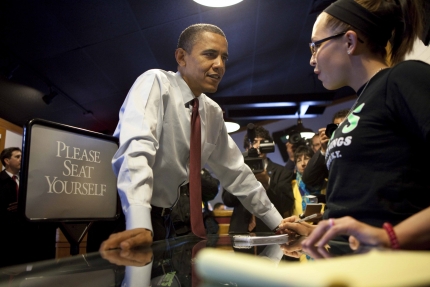
President Barack Obama places his order for wings

President Barack Obama places his order for wings during a stop for lunch at Duff's Famous Wings in Cheektowaga, New York, May 13, 2010. (Official White House Photo by Samantha Appleton)


The White House

Office of the Press Secretary

Declaraciones del Presidente Obama sobre la reforma financiera

Durante todo el debate sobre la reforma de Wall Street, he instado a los miembros del Senado a que combatan los esfuerzos de los intereses especiales y sus cabilderos por debilitar las medidas de protección al consumidor. Una enmienda que el Senado pronto someterá a consideración haría precisamente eso al socavar las estrictas medidas de protección al consumidor con una laguna legal de particular beneficio para los concesionarios de autos que también hacen de prestamistas. Esta enmienda creará una exención especial para estos prestamistas que permitiría que aumenten demasiado las tasas y añadan gastos excesivos que tomarían a los compradores por sorpresa. Esta modificación debilita las cláusulas que les dan poder a los consumidores con información clara, que les permite tomar las decisiones financieras que más les convienen. Además, simplemente fomenta engañosas tácticas de ventas que perjudican a los consumidores estadounidenses. Desafortunadamente, innumerables familias –particularmente familias militares– han sido blanco de estas prácticas engañosas.

Simplemente son incorrectas las afirmaciones de quienes se oponen a la reforma de que esta medida está dirigida injustamente a los concesionarios de autos. El hecho es que los concesionarios de autos-prestamistas otorgan casi 80 por ciento de los préstamos para automóviles en el país, y estos prestamistas deben cumplir con los mismos estándares que cualquier banco local o comunitario que otorga préstamos. Los concesionarios de autos-prestamistas que les ofrezcan productos financieros honrados y transparentes a sus clientes deben acoger con beneplácito dichas reformas, que harán que sus competidores que no cumplen con las normas compitan bajo condiciones equitativas.

Simplemente no podemos permitir que las lagunas y concesiones especiales inspiradas por los cabilderos debiliten la verdadera reforma, que les otorgará poder a las familias estadounidenses. Insto al Senado a que continúe derrotando los esfuerzos de los intereses especiales por debilitar las medidas de protección que favorecen a todos los consumidores estadounidenses.
 

West Wing Week: " X , Y , Z "

May 06, 2010 | 6:05 | Public Domain

Thanks for checking out the West Wing Week, your guide to everything that's happening at 1600 Pennsylvania Ave. This week, walk step-by-step with the President as he monitors and then visits areas affected by the BP Oil Rig incident, delivers a commencement address at University of Michigan, attends the White House Correspondents Dinner, presents the Commander-in-Chief trophy to the Navy Midshipman, ushers in Cinco de Mayo and much more.

Download mp4 (173MB)