Investing in Women

Happy New Year everyone! We kick off 2012 with a brand new “Women Working to Do Good” blog from HelloGiggles. This week’s profile features Alexa von Tobel, the founder of a start-up focused on offering personal finance advice to women. In the profile the author writes, “It’s a role she was born to play. Alexa says she has known she wanted to be an entrepreneur since she was a little girl, filling notebooks with all her plans for future projects.”

Alexa Von Tobel

Alexa Von Tobel. (Photo from HelloGiggles)

With the announcement of President Obama’s appointment of Richard Cordray to head the new Consumer Financial Protection Bureau, information and resources to prevent people from financial tricks and traps are becoming more abundant. For Alexa, her focus has been on educating women and arming them with “money skills” to improve their lives and help achieve their goals. “Alexa says she recognized a huge gap in the market. “Women control approximately eighty percent of household spending. It seemed like a no-brainer.”

With so many people making New Year’s resolutions to get their fiscal house in order, Alexa’s vision and passion to help women save money simply makes a lot of sense.

Read more about Women Working to Do Good:

Ronnie Cho is an Associate Director in the White House Office of Public Engagement.

The White House

Office of the Press Secretary

Letter from the President to the Speaker of the House of Representatives and the President of the Senate regarding the Consolidated Appropriations Act, 2012

TEXT OF A LETTER FROM THE PRESIDENT TO THE SPEAKER OF THE HOUSE OF REPRESENTATIVES AND THE PRESIDENT OF THE SENATE

December 23, 2011 

Dear Mr. Speaker:  (Dear Mr. President:)

In accordance with section 5 of the Consolidated Appropriations Act, 2012, I hereby designate for Overseas Contingency Operations/Global War on Terrorism all funding (including the rescission of funds) so designated by the Congress in the Act pursuant to section 251(b)(2)(A) of the Balanced Budget and Emergency Deficit Control Act of 1985, as amended, as outlined in the enclosed list of accounts.

The details of this action are set forth in the enclosed letter from the Director of the Office of Management and Budget. 

Sincerely,

BARACK OBAMA

West Wing Week 12/23/11 or "#40Dollars"

December 22, 2011 | 4:23 | Public Domain

With the holidays in full swing and the countdown clock ticking away, President Obama continued to press for the extension of the payroll tax cut for 160 million working Americans and unemployment insurance benefits for those looking for work. The President urged House Republicans to put aside their political games and pass a bill that garnered overwhelming, bipartisan support in the US Senate.

Download mp4 (134.8MB)

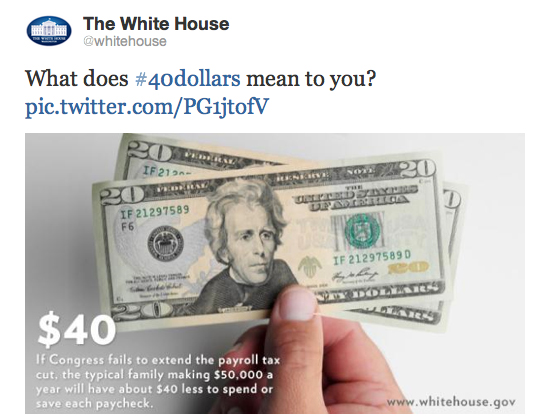
What #40dollars Means to Americans

Ed. Note: Today at 3:30 pm EDT, Brian Deese, Deputy Director of the National Economic Council will be holding a session of Office Hours on Twitter.  He’ll be on the @WHLive account answering questions about the payroll tax cut extension.  Ask your question now and during the live event on Twitter using the hashtag #WHChat.

Yesterday, the White House called on Americans to add their voice to the conversation happening in Washington, DC about why we need to extend the payroll tax cut. If Congress fails to extend this tax cut, the typical family making $50,000 a year will have about $40 less to spend or save with each paycheck. Over the year, that adds up to about $1,000 -- and has a real impact on American families.

Opponents of the payroll tax cut dismissed the impact by insisting $40 isn’t a lot of money. Well, we know that's not the case for many families who are already working hard to make ends meet, so we asked you tell us what $40 means for you and your family. We asked in an email from David Plouffe, and on Facebook and Twitter. 

The response was overwhelming.

We received over 18,000 submissions through a form on Whitehouse.gov, averaging over 1,000 an hour and coming in from every state in the nation. On Twitter, we asked “What does #40dollars mean to you?” In a short period of time, the hashtag #40dollars was trending on Twitter, not just nationwide, but worldwide. The hashtag #40dollars has been used in over 1,000 tweets and counting, and that based on the latest report from Hashtracking.com generated nearly 16 million impressions and reached an audience of over 3 million people. 

So, what does $40 mean to you? Share your story and have a look at what people around the country are saying below or on Storify:

The White House

Office of the Press Secretary

Executive Order -- Adjustments of Certain Rates of Pay

ADJUSTMENTS OF CERTAIN RATES OF PAY

By the authority vested in me as President by the Constitution and the laws of the United States of America, including the Continuing Appropriations and Surface Transportation Extensions Act, 2011 (Public Law 111 322), which freezes certain pay schedules for civilian Federal employees at 2010 levels through 2012 and provides for the phase-in of the full applicable locality pay rates in non-foreign areas pursuant to the Non-Foreign Area Retirement Equity Assurance Act of 2009 (5 U.S.C. 5304 note), it is hereby ordered as follows:

Section 1Statutory Pay Systems.  Pursuant to the Continuing Appropriations and Surface Transportation Extensions Act, 2011 (Public Law 111 322; December 22, 2010), the rates of basic pay or salaries of the statutory pay systems (as defined in 5 U.S.C. 5302(1)) are set forth on the schedules attached hereto and made a part hereof:

(a)  The General Schedule (5 U.S.C. 5332(a)) at Schedule 1;

(b)  The Foreign Service Schedule (22 U.S.C. 3963) at Schedule 2; and

(c) The schedules for the Veterans Health Administration of the Department of Veterans Affairs (38 U.S.C. 7306, 7404; section 301(a) of Public Law 102 40) at Schedule 3.

Sec. 2Senior Executive Service.  The ranges of rates of basic pay for senior executives in the Senior Executive Service, as established pursuant to 5 U.S.C. 5382, are set forth on Schedule 4 attached hereto and made a part hereof.

Sec. 3Certain Executive, Legislative, and Judicial Salaries.  The rates of basic pay or salaries for the following offices and positions are set forth on the schedules attached hereto and made a part hereof:

(a)  The Executive Schedule (5 U.S.C. 5312 5318) at Schedule 5;

(b)  The Vice President (3 U.S.C. 104) and the Congress (2 U.S.C. 31) at Schedule 6; and

(c)  Justices and judges (28 U.S.C. 5, 44(d), 135, 252, and 461(a), and section 140 of Public Law 97 92) at Schedule 7.

Sec. 4Uniformed Services.  The rates of monthly basic pay (37 U.S.C. 203(a)) for members of the uniformed services, as adjusted under 37 U.S.C. 1009, and the rate of monthly cadet or midshipman pay (37 U.S.C. 203(c)) are set forth on Schedule 8 attached hereto and made a part hereof.

Sec. 5Locality Based Comparability Payments.  (a)  Pursuant to section 5304 of title 5, United States Code, the Non Foreign Area Retirement Equity Assurance Act of 2009 (5 U.S.C. 5304 note), and the Continuing Appropriations and Surface Transportation Extensions Act, 2011 (Public Law 111 322; December 22, 2010), locality based comparability payments shall be paid in accordance with Schedule 9 attached hereto and made a part hereof.

(b)  The Director of the Office of Personnel Management shall take such actions as may be necessary to implement these payments and to publish appropriate notice of such payments in the Federal Register.

Sec. 6Administrative Law Judges.  Pursuant to section 5372 of title 5, United States Code, the rates of basic pay for administrative law judges are set forth on Schedule 10 attached hereto and made a part hereof.

Sec. 7Effective Dates.  Schedule 8 is effective January 1, 2012.  The other schedules contained herein are effective on the first day of the first applicable pay period beginning on or after January 1, 2012.

Sec. 8Prior Order Superseded.  Executive Order 13561 of December 22, 2010, is superseded.

BARACK OBAMA

THE WHITE HOUSE,
         December 19, 2011.

From the Archives: President Teddy Roosevelt's New Nationalism Speech

On August 31, 1910, President Theodore Roosevelt visited Osawatomie, Kansas and laid out his vision for what he called a "new nationalism."

In the speech, he called for the end of special protections for businesses in government. He declared that anyone who worked hard should be able to provide for themselves and their family, and that no one person was more entitled to special privileges than another. He stood by fair play under the rules of the game ensuring the rules made opportunity available to everyone.

Today President Obama traveled to Osawatomie to talk about some of the very same things. In his speech, the President talked about how this is a make-or-break moment for the middle class, and all those who are fighting to get into the middle class.  At stake is the very survival of a country where working people can earn enough to raise a family, build a modest savings, own a home, and secure their retirement.

Read President Obama's speech here and read President Roosevelt's new nationalism speech below.

The White House

Office of the Press Secretary

Statement by the President

Tonight, Senate Republicans chose to raise taxes on nearly 160 million hardworking Americans because they refused to ask a few hundred thousand millionaires and billionaires to pay their fair share.  They voted against a bill that would have not only extended the $1,000 tax cut for a typical family, but expanded that tax cut to put an extra $1,500 in their pockets next year, and given nearly six million small business owners new incentives to expand and hire.  That is unacceptable.  It makes absolutely no sense to raise taxes on the middle class at a time when so many are still trying to get back on their feet.

Now is not the time to put the economy and the security of the middle class at risk. Now is the time to rebuild an economy where hard work and responsibility pay off, and everybody has a chance to succeed.  Now is the time to put country before party and work together on behalf of the American people.  And I will continue to urge Congress to stop playing politics with the security of millions of American families and small business owners and get this done.

By the Numbers: 141,000

141,000

Illegal sales of counterfeit DVDs cost the U.S. economy 141,000 jobs and $20.5 billion each year. Money from the sales of pirated music and movies often helps fuel drug trafficking and gang crime. Together, these facts make theft of intellectual property far from a victimless crime.

Today, the Department of Justice and the National Crime Prevention Council launched a public awareness campaign to make sure people know the facts. Eighty percent of Americans believe it’s illegal to knowingly purchase counterfeit or pirated goods, but do it any way. And nearly 60 percent believe they won’t get caught. The truth is that buying a pirated album or movie doesn’t just hurt stores or movie studios or musicians or actors. It affects everyone involved in the production of that CD or DVD, from the ideas to the production to the processing, including artists, writers, technicians, janitors, caterers, and others.

The campaign launched today targets all types of intellectual property theft, including goods like purses and sunglasses, medications, movies, and music, and aims to raise awareness that buying these items is a serious crime.

Bargain Hunters Be Wary

As Americans kick off the holiday shopping season, it's a good time to remember the importance of making responsible purchases and rejecting counterfeits that pose a threat to American jobs, safety and health. Today I joined Attorney General Eric Holder and other Administration officials at the White House to announce progress we’ve made cracking down on intellectual property theft crimes, and to launch a public awareness campaign to combat the purchase and sale of counterfeit and pirated products.

As President Obama has said, in order to win the future in the global economy America must out innovate our competitors. Intellectual property theft undermines our nation's innovators and entrepreneurs. The new campaign will educate the public about the full range of intellectual property crimes we confront, from counterfeit consumer goods and fake pharmaceuticals laced with potentially dangerous substances to illegal downloads, while highlighting the potential threat these crimes pose to economic prosperity and public safety. The campaign will include a television PSA, materials delivered through social media, and radio, web, and print ads. 

The Administration has been proactive on multiple fronts in order to increase intellectual property enforcement. We have increased law enforcement efficiency, advocated for legislative reform, informed the public about the negative impacts of intellectual property theft, and engaged the private sector to foster cooperation and create voluntary solutions through productive conversations. Today’s announcement marks an important milestone in the Administration’s ongoing efforts to curb intellectual property theft that harms the economy, undermines job creation, undermines innovation, and jeopardizes the health and safety of American consumers.  

At the event, Attorney General Holder and I were joined by Acting Deputy Secretary of Commerce Rebecca Blank, who discussed the ways in which counterfeit goods impact the everyday lives of American families. Director of Immigration and Customs Enforcement John Morton was also in attendance to discuss ongoing Administration law enforcement efforts concerning counterfeit goods and intellectual property crimes. And Ann Harkins, National Crime Prevention Council President and CEO, was on hand to unveil the products of the campaign that will help build awareness about the harm caused by counterfeit goods and engage the public in stopping intellectual property theft. 

For more information about the campaign, visit: http://www.ncpc.org/getreal.

We Can't Wait: Bringing Records Management into the Twenty-First Century

Federal records are crucial to documenting the history of our national experience –the problems, the triumphs, and the challenges. They provide a prism through which future generations will view, understand, and learn from the actions of the current generation. A sensible system of records management is the backbone of open government.

For many decades, the framework for records management has been based on an approach developed in the middle of the twentieth century, involving paper and filing cabinets. Things are of course very different today. In the digital age, when many records are made and maintained in electronic form, we have extraordinary opportunities to improve records management. New steps can save money, improve efficiency, promote openness, and increase both accuracy and transparency. They can provide great benefits to posterity.

Today President Obama is taking a historic step -- and the most important step in many decades -- to improve the management of federal records. Delivering on a commitment in the recent Open Government Partnership: National Action Plan for the United States, he is calling for a large-scale transformation in how agencies maintain their records. In the process, he is inaugurating a government-wide effort to reform records management policies and practices. 

Today’s Presidential Memorandum requires a number of concrete actions. The new effort calls for reports, by each agency head, describing their current plans for improving records management programs; outlining current obstacles to sound, cost-effective records management policies;and cataloging potential reforms and improvements. The agency reports will inform, and be followed, by a Records Management Directive, to be issued by the Director of OMB and the National Archivist. The Directive will focus on maintaining accountability to the American public through documenting agency actions; increasing efficiency (and thus reducing costs); and switching, where feasible, from paper-based records to electronic records. In addition, all statutes, regulations, and policies must be reviewed to improve government-wide practices in records management. In a key provision, the President has required the Director of OMB and the National Archivist to consult with those inside and outside the government – including public stakeholders interested in improving records management and open government. 

Today’s action begins a large-scale transformation in how we maintain the backbone of open government. It promises, at once, to save money, to increase accuracy, and to contribute knowledge and perspective to future generations.